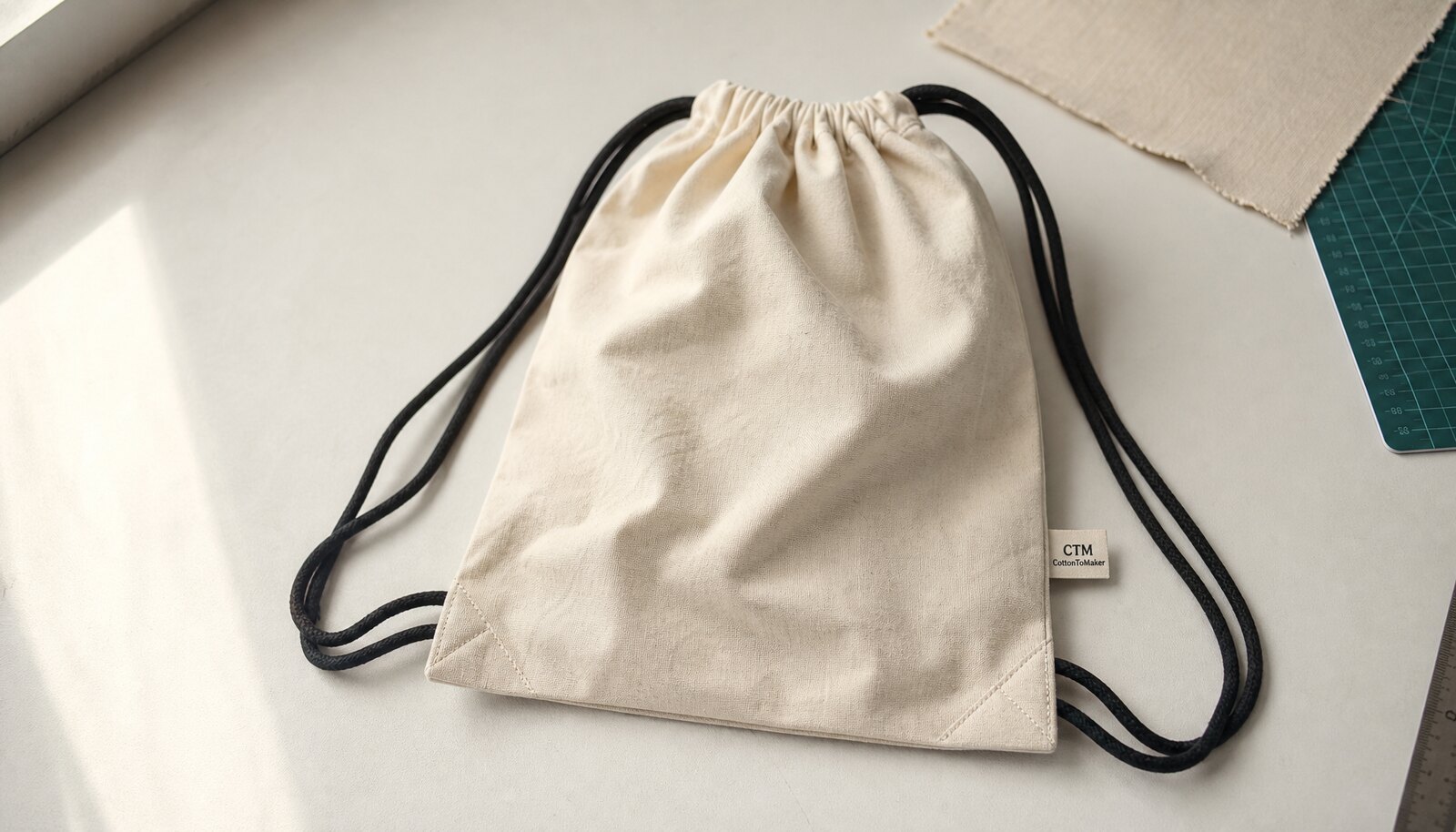
Start With The Use Case, Not The Bag
Corporate gifting orders go wrong when the buyer starts with the item and only later defines the use case. A cotton drawstring backpack for an employee welcome kit has different requirements from one used for an event giveaway, a conference insert, or a premium mailer. If the bag needs to hold a folded hoodie, a notebook, and a water bottle, the fabric weight, stitch reinforcement, and cord channel design all need to change. If it only needs to carry a small brochure set, the buyer can keep the spec lighter and cheaper.
Write the brief around what the bag must carry, how it will be handed out, and what it should look like beside the rest of the gift set. Then ask every supplier to quote against the same dimensions, logo placement, and packing format. That is the only way to compare a factory quote with another factory quote, or a factory quote with a trading company quote, without paying for hidden differences. The clearer the use case, the fewer surprise changes appear after artwork approval.
- State the target contents and the maximum filled weight.
- Define whether the program is promotional, mid-tier, or premium.
- Fix the logo position and the number of print colors.
- Tell suppliers whether the bag will ship alone or inside a larger kit.
Choose Fabric Weight And Build For The Gift Tier
For cotton drawstring backpacks, GSM is not a decoration detail. It is one of the main signals of how the bag will feel in the hand, how it will hold shape, and how it will survive packing. 120-140 gsm is usually acceptable for light giveaways, but it can look soft and collapse easily when packed with rigid items. 160-180 gsm is the practical middle ground for most corporate gifting programs because it gives a firmer body, better print opacity, and a more reassuring finish without pushing cost too far.
If the order is aimed at a premium audience or the backpack is expected to be reused often, move toward 180-220 gsm and ask for reinforced seams, a double-folded mouth, and stronger cord channels. Also pay attention to weave density and finishing. A tighter, more even cotton weave usually prints cleaner than a loose fabric at the same GSM. Ask for the fabric to be pre-shrunk if size stability matters after washing or storage.
- 120-140 gsm works for light brochure sets and low-cost promotions.
- 160-180 gsm is the safest baseline for most corporate gifting orders.
- 180-220 gsm fits premium kits, heavier contents, and repeat-use expectations.
- Double stitching and reinforced stress points reduce seam failures in transit.
Compare Supplier Routes Before You Compare Unit Price
A direct factory is usually the best route when the buyer needs control over fabric weight, print quality, packing, and sample approval. A trading company can still work if it has real factory access and can manage the communication load, but the buyer should verify who is actually cutting, printing, and packing the order. A local decorator or stockist can be useful when the event date is fixed and the order is small, but that route often trades away fabric control and carton-level consistency.
The right route depends on the risk of the program, not only the quoted price. Corporate gifting buyers are judged on what the bag feels like when it lands in the recipient's hands, whether the logo is clean, and whether all cartons match the order. A cheaper quote can become expensive if the supplier changes the print method, subcontracts packing, or ships a bag that needs rework before distribution. Compare the route first, then the price.
- Direct factory: best for repeat programs and tighter spec control.
- Trading company: useful when they manage multiple parts of a kit.
- Local decorator: useful for speed, small runs, and simple decoration.
- Unknown broker: avoid unless the actual factory and process are disclosed.
Build The Quote So Hidden Costs Show Up
A useful quote separates the cost drivers instead of folding everything into one number. The buyer should see fabric, cutting, stitching, print setup, print unit charge, labels, sample fee, packing, carton marks, and any insert cards or hangtags. If those items are hidden inside a lump sum, there is no way to tell whether the quote is efficient or just incomplete. This matters even more for wholesale corporate gifting because the cheapest quote often omits the work that appears later as a change order.
MOQ logic also needs to be visible. One-color screen print may share one setup across a large run, but extra print colors, extra placements, woven labels, or special packaging can trigger new setup costs or higher minimums. Ask where the MOQ changes and what drives it. Some suppliers limit MOQ by fabric purchase, some by print line efficiency, and some by packaging labor. If you do not ask, the supplier will decide the rules later.
- Ask every supplier to quote on the same fabric color, size, and print area.
- Separate the bag price from print, packing, sample, and freight charges.
- Request ex-works, FOB, and DDP if you need a landed-cost comparison.
- Clarify whether screens, labels, couriers, and carton marks are included.
Use Samples To Test Real Carrying Performance
A digital mockup proves only the artwork layout. It does not prove that the bag closes neatly, sits flat when filled, or survives handling after packing. For a corporate gifting order, request a pre-production sample or a production-intent strike-off on the actual fabric. Then test it with the real contents or a weight-equivalent dummy. This shows whether the bag distorts, whether the seam line shifts, and whether the logo still looks centered after the contents are inside.
Samples also reveal the practical issues that buyers usually discover too late. Cotton that smells strongly of finishing chemicals, cords that slip through the channel, or corners that pucker under load all create complaints once the bags are handed out. If the item is part of a timed launch, approve the sample only after you have packed it in the same way it will leave the warehouse. The sample is not a formality; it is the only reliable proof that the order can be repeated.
- Test the sample with the heaviest intended contents.
- Check logo placement after filling, not only when flat.
- Confirm cord length, knot security, and smooth draw action.
- Approve only the exact sample that will be used as the production reference.
Match The Decoration Method To The Brand Message
Screen printing is usually the most efficient choice for simple logos, bold shapes, and larger quantities. It works well on cotton when the mesh count, ink load, and curing process are controlled. Embroidery sends a more premium signal, but it adds stiffness, can distort light fabric, and may not suit fine text. Woven labels and sewn patches sit between those two options: they are durable, tidy, and often better for subtle brand presentation when the buyer does not want a heavy ink block on the front panel.
The mistake is choosing the decoration before the logo has been evaluated for the bag. Thin type, gradients, and small legal text are often poor fits for direct screen print on a drawstring backpack. If the artwork is detailed, ask the supplier which method will preserve legibility without making the bag feel over-decorated. A good supplier will protect the logo and the bag at the same time, instead of forcing the artwork into a process that cannot support it.
- Screen print is best for simple, high-volume logos.
- Embroidery is best for premium presentation, but test fabric support.
- Woven labels or side labels work well for subtle repeatable branding.
- Heat transfer can work for short runs, but test rub and wash resistance.
Specify Packing As Part Of The Product
Packing becomes a real sourcing issue when the backpacks need to move through a warehouse, an event kit line, or a direct distribution program. State whether the bags will ship loose, flat-folded, individually polybagged, or packed into a custom master carton. If the order includes other products, ask for the folded size so the kitting team can build the set without crushing the logo or overstressing the cords. The packing format should be part of the product spec, not an afterthought.
Packing also shapes the unboxing experience. A clean fold, a size sticker, and a moisture-safe polybag may be all that is needed for a direct event distribution program. If the order needs a premium presentation, specify the insert card, hangtag, barcode label, or tissue wrap before production starts. Do not assume the factory will choose the format that best fits your channel. The wrong packing style can create wrinkles, count errors, and time-consuming rework in your own warehouse.
- Decide whether the buyer or the factory supplies inserts and hangtags.
- Confirm carton count, carton size, and gross weight limits.
- Specify whether each bag needs a barcode, SKU sticker, or size mark.
- State if cartons will be reused for direct event distribution.
Write QC Thresholds Into The Purchase Order
Inspection should not be a loose promise to look closely. Define what fails the order and what is acceptable variation. For cotton drawstring backpacks, the common pain points are size drift, print misregistration, loose threads, uneven top hems, weak cord channels, and lot-to-lot color change. If the backpacks are going into a branded kit, add count accuracy and carton labeling to the critical list because those errors waste labor after the cartons are already received.
Ask the supplier to inspect against a defect plan. Major defects should include broken stitches, open seams, severe stains, missing labels, and print that cannot be read from a normal viewing distance. Minor defects can include small slubs or slight folding marks if they do not affect function or presentation. If you want an AQL standard, specify it before bulk production starts. If you do not want to use AQL, write the exact rejection rule into the PO so there is no argument later about what is acceptable.
- Set size tolerance and print position tolerance in advance.
- Define seam strength and stitch density expectations.
- Reject open seams, broken cords, or visible oil stains.
- Make carton counts and outer marks part of the quality check.
Plan Lead Time Around Sample, Bulk, And Freight
Lead time is usually lost in small gaps, not only in sewing time. Material sourcing, print approval, sample correction, thread matching, and carton prep can each add days. If the order is tied to an event or a launch window, build in time for a pre-production sample and at least one correction cycle. A rushed schedule often compresses print curing or packing verification, and that is where quality problems start. Buyers who only look at bulk sewing days usually underestimate the real timeline by a wide margin.
Compare suppliers using the same delivery term. Ex-works is useful for factory comparison, but it hides freight and export handling. FOB makes port-side comparison easier. DDP can simplify budgeting, but only if the supplier is clear about duties, final-mile delivery, and the customs risk. The true landed cost is not the cheapest unit price. It is the full cost of the bag, packing, inland handling, freight, duty, and any corrective work you had to absorb because the order was not built correctly the first time.
- Confirm sample lead time, bulk lead time, and shipping lead time separately.
- Ask which steps are on the critical path and which can overlap.
- Compare quotes on the same Incoterm before judging price.
- Build a buffer for print approval and carton rework.
Use A Clean RFQ Packet To Force Better Quotes
The easiest way to improve quote quality is to remove ambiguity. A good RFQ packet should include bag size, target fabric weight, cord style, logo artwork, print position, packing format, destination, target delivery date, and whether the supplier should quote sample cost and freight separately. If the buyer leaves out those details, the supplier fills the gaps with assumptions, and the cheapest quote often turns out to be the one that left out the most work. That is a poor basis for award decisions.
For corporate gifting, the order is never just a backpack. It is a small part of a larger brand presentation. That is why repeatability matters. If you want a long-term supplier instead of a one-off quote, ask for their recommended spec, their defect control method, and the files they archive for reorders. A factory that can repeat the same bag with the same print, packing, and carton count is more valuable than a supplier that can only win on the first order.
- Send vector artwork plus a simple placement sketch.
- Include a filled or weighted reference item if fit matters.
- Request the supplier's recommended GSM, stitching, and packing.
- Ask what they keep on file for reorder consistency.
Specification comparison for buyers
| Spec decision | Recommended option | When it fits | Buyer risk to check |
|---|---|---|---|
| Price-sensitive bulk order with a simple logo | Direct factory with one-color screen print and standard packing | When the order is large, the artwork is simple, and the buyer can wait for a normal production cycle | Confirm the fabric GSM, print setup charge, and whether the quote includes folding and carton packing |
| Premium employee welcome kit | Direct factory with 180-220 gsm cotton, reinforced seams, and custom label options | When the backpack is part of a higher-value gift set and first impression matters | Check whether the heavier fabric changes MOQ, lead time, or print curing time |
| Small pilot order or event with a fixed date | Local decorator or regional stockist with in-house decoration and stock fabric | When speed matters more than exact fabric control and the quantity is modest | Watch for higher unit cost, limited size options, and less control over carton packing |
| Multi-item kit with insert cards and barcode labels | Factory or kitting supplier that can pack in-house | When the backpack ships as part of a larger corporate gifting assembly | Confirm who supplies the inserts, how the kit is counted, and whether the pack line is audited |
| Detailed artwork or a logo with fine text | Supplier that can propose embroidery, woven labels, or a controlled print test | When screen print would lose detail or make the logo look heavy on cotton | Ask for a strike-off and verify legibility after the bag is filled |
| Strict brand color consistency across reorders | Direct factory that archives strike-offs, swatches, and print references | When the program will be reordered across seasons or regions | Make sure the supplier keeps the same fabric lot reference and print recipe |
| Lowest landed cost at scale | Direct factory quoted on FOB with clear packaging and carton terms | When the buyer can manage freight and customs separately and wants a clean comparison | Do not compare FOB against delivered quotes without normalizing freight, duty, and handling |
| Compliance or audit trail required | Supplier with traceable batch records and a documented testing path | When the order feeds a regulated retailer program or a controlled brand process | Request the actual document set up front, not after the order is placed |
Buyer checklist before sampling
- Fix the bag size, target contents, and maximum filled weight before you ask for prices.
- Lock the fabric weight target in GSM and decide whether the finish should feel promotional or premium.
- Choose one print method for the RFQ and state logo size, placement, and color count.
- Ask suppliers to quote the same packing format: loose bulk, folded polybag, or kit-packed.
- Request a pre-production sample on the actual fabric, not only a digital mockup.
- Compare quotes on the same Incoterm and the same carton count.
- Confirm MOQ breakpoints for fabric color, print color, and custom labels.
- Define seam strength, size tolerance, and print position tolerance before bulk production.
- State whether the factory or the buyer supplies hangtags, inserts, and barcodes.
- Ask for reorder consistency so the supplier can repeat the same spec on the next run.
Factory quote questions to send
- What is the finished fabric GSM after finishing, and what tolerance do you hold?
- Is printing, embroidery, label making, and packing done in-house or outsourced?
- What is the MOQ for one color, two colors, and custom woven labels?
- Can you quote the bag separately from printing, packing, sample cost, and freight?
- What sample options do you offer before bulk production, and how long do they take?
- What packing formats do you recommend for direct gift distribution or kit assembly?
- What inspection standard do you use, and can you share defect examples for major and minor issues?
- What documents or reference files do you keep for repeat orders and reorders?
Quality-control points to confirm
- Finished size stays within the agreed tolerance after stitching and packing.
- Fabric weight matches the approved GSM target and does not feel thinner than the sample.
- Print position, color density, and edge sharpness match the signed sample.
- Seams are straight, closed, and reinforced at stress points with no loose threads or skipped stitches.
- Cord length, cord movement, and knot security are consistent across the batch.
- No oil stains, sharp odor, visible dirt, or color transfer appear on packed bags.
- Carton counts, outer marks, and SKU labels match the purchase order exactly.
- The packed bag opens, closes, and carries the intended contents without distortion.