1. Why roaster buyers should define durability before comparing prices
A cotton drawstring backpack may look simple in a supplier photo: natural canvas, black cords, one-color logo, flat carton packing. For procurement, that description is too thin. Two visually similar bags can differ in finished GSM, weave density, cord diameter, reinforcement, stitch quality, ink curing, and packing discipline. One may be suitable for a one-day event insert. Another may be strong enough for a reusable coffee kit or paid merchandise item.
Coffee products create concentrated load. One 340 g or 12 oz coffee bag is light, but several valve bags, a tumbler, a catalog, and brewing accessories push against the lower seams and corners. In a drawstring backpack, the cord is both closure and shoulder strap, so load transfers directly into the lower cord exits. If those exits run through one fabric layer without reinforcement, tearing can start while the main panel still looks strong.
Durability also affects receiving cost. Weak corners, tangled cords, smeared prints, mildew odor, mixed shades, or wrong carton counts create sorting work and delay launches. A clear RFQ and a repeatable durability testing checklist make supplier quotes easier to compare and reduce the chance of silent downgrades between sample approval and bulk production.
- Define the use case and expected load before requesting final pricing.
- Treat lower cord exits, top channels, side seams, and print fold lines as high-risk areas.
- Do not compare quotes until fabric, reinforcement, cord, print, packing, and tolerances are aligned.
- Approve a sealed pre-production sample, not only a digital mockup or substitute material sample.
2. Convert the coffee bundle into a measurable RFQ
Start with the commercial role of the backpack. A resale item needs a stronger handfeel and cleaner finishing than a trade show giveaway. A subscription welcome kit must hold the intended products and still arrive presentable. A wholesale partner gift may need room for sample bags, literature, and small tools. These are different specifications even if the flat bag size is similar.
Write the intended contents into the RFQ. Instead of asking for a bag that is “large enough for coffee,” list the planned set: two 340 g bags plus one tumbler, four 250 g sample packs plus a catalog, or one 2 lb coffee bag with accessories. Coffee packaging has depth, valves, sealed tops, and stiff corners. A bag that looks adequate by flat measurement may strain once the contents are loaded.
Set a working load and a sample test load. Many coffee merchandise programs fall somewhere around 2-5 kg depending on the bundle, but the correct number is the buyer’s actual product set. The test load should include the expected contents plus a defined safety margin. Put the load, duration, cycle count, and pass/fail criteria in the RFQ so each supplier quotes the same performance expectation.
- State the use: resale, event, subscription kit, wholesale gift, cafe opening pack, or accessory packaging.
- List coffee pack size and quantity, plus any rigid or bulky accessories.
- Define finished width, height, channel depth, and usable opening width.
- Tell the factory if the item will be sold at retail, because cosmetic standards should be higher.
- Include odor, cleanliness, shade consistency, and print appearance requirements for direct-to-customer programs.
3. Specify cotton canvas without relying on vague fabric names
For coffee roaster merchandise, 10 oz to 12 oz cotton canvas, often about 280-340 GSM finished weight, is a practical starting range. It generally gives better handfeel and shape retention than light cotton sheeting. A lighter 220-250 GSM fabric may be acceptable for low-load promotions, but it should be tested before being used for kits, resale, or repeated customer use.
Clarify what the quoted weight means. Greige fabric is unfinished; finished GSM is the weight after dyeing, washing, or finishing. Processing can change weight, shrinkage, shade, and surface texture. A quote that says only “10 oz canvas” leaves room for mismatch unless the supplier states the measurement basis and tolerance. If your program uses ±5% finished GSM as an inspection range, state that it is buyer-defined, not an assumed universal rule.
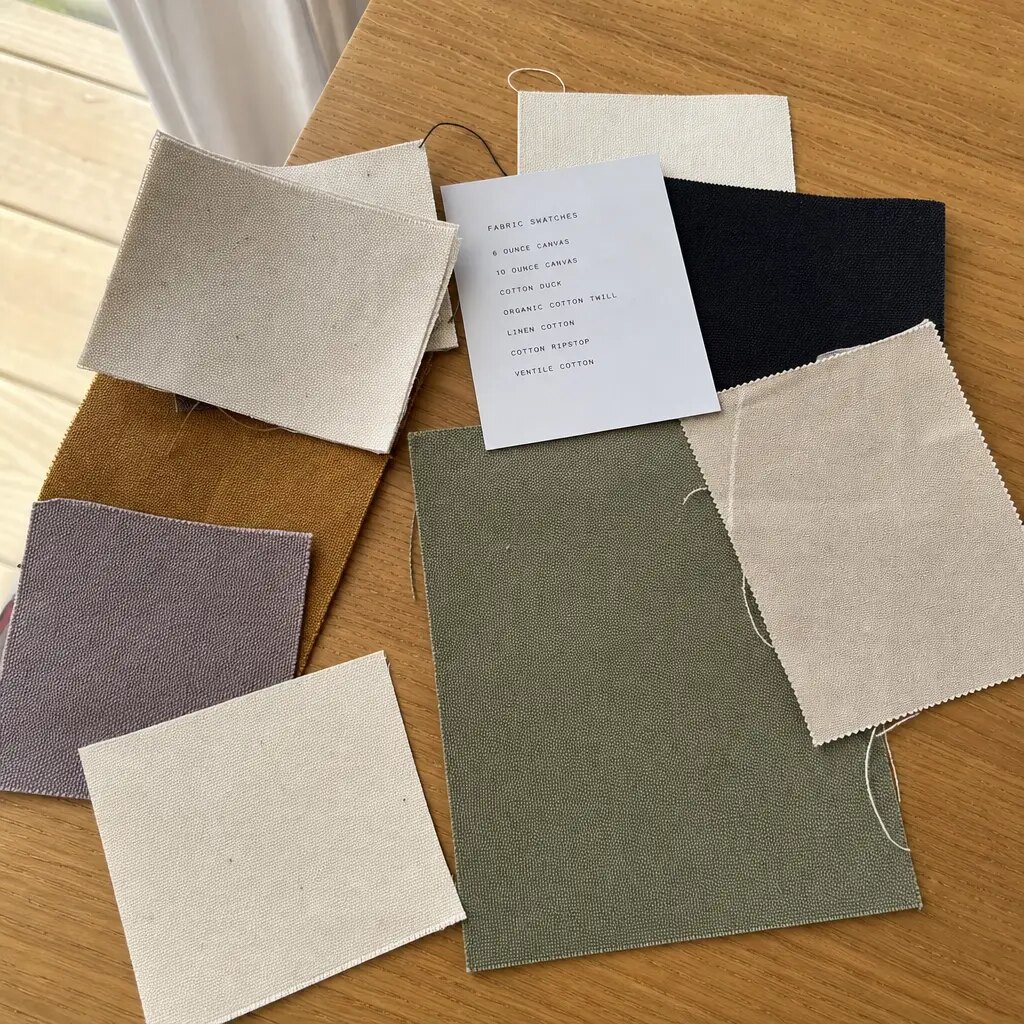
Weight alone is not enough. Tight plain-weave canvas usually cuts more predictably, prints more cleanly, and resists seam distortion better than a loose open weave at the same nominal GSM. Natural cotton may show seed flecks, neps, and mild shade variation. That can support a craft roaster aesthetic, but it should be approved intentionally. For black or dyed fabric, review shade control, crocking risk, and print opacity before bulk production.
- Specify fiber content, weave, surface character, finish, color, and finished GSM.
- Ask whether the quoted weight is greige or finished fabric weight.
- Define acceptable natural flecks, neps, slub, and shade variation with a physical swatch.
- Request documentation early for organic, recycled, or other claim-bearing cotton.
- Use actual fabric swatches and a sealed sample to control reorders.
4. Engineer the real stress points: corners, channel, seams, and cords
Most failures do not begin in the middle of the fabric panel. They begin where stress concentrates: lower cord exits, top channels, side seams, and bottom seams. A supplier can reduce cost by using thinner cord, skipping reinforcement, or lowering stitch quality, and the backpack may still look acceptable in a front-facing product photo.
For reusable roaster bags, lower corner reinforcement should be specified. Acceptable constructions can include an inside self-fabric patch, an outside triangular or rectangular patch, or an integrated reinforced cord-exit panel. The goal is to spread cord force across more than one fabric layer and lock the area with bartack, box-X, or equivalent reinforcement. Record patch dimensions, placement, and stitch method in the production sheet.
Cord selection needs measurable language. An 8-10 mm braided cotton or cotton-poly blend cord usually feels more durable and comfortable than a thin 4-6 mm cord. Cotton cord fits a natural canvas look; cotton-poly blends may reduce fraying and improve abrasion resistance. Specify material, diameter, braid, color, cord length, loop drop, and end finish. If the cord is dyed, confirm colorfastness risk against light fabric and clothing.
- Require reinforcement at both lower cord exits.
- Define stitch type and stitch density as buyer specifications rather than assumptions.
- Specify bartacks, box-X stitching, or an equivalent reinforcement method at load points.
- Avoid raw or twisted top channels that increase friction and fraying.
- Consider a gusseted tote or drawstring bag if the intended contents are rigid, heavy, or boxy.
5. Choose a print method that survives folding and carton handling
Coffee roasters usually need a clean logo, stable brand color, and a print that survives packing, warehouse handling, and customer reuse. For one-color or two-color artwork at wholesale volume, screen printing is often the practical default. Water-based ink can give a softer handfeel on cotton, while plastisol may improve opacity on darker fabric. The right choice depends on fabric color, logo size, ink coverage, handfeel, and curing control.
Heat transfer can suit short runs, detailed artwork, gradients, or many colors, but it needs realistic testing. Transfers may crack, crease, or lift when bags are folded sharply or compressed in cartons. Digital print can support detail, but coarse canvas may soften edges. Embroidery can work for small marks, yet it can pucker lighter fabric or distort the flat drawstring panel.
Do not approve print quality only from a fresh flat sample. Require a strike-off on the actual production fabric. Fold the printed panel along the planned packing fold, rub the printed surface with a dry white cotton cloth, and inspect for cracking, pinholes, poor opacity, smearing, or color transfer. For dark fabric, confirm whether an underbase is included and whether it changes handfeel or curing time.
- Confirm ink type, number of colors, print side, print size, underbase, curing, and handfeel.
- Set logo placement tolerance, such as ±5 mm if appropriate for the design.
- Test large solid ink areas because they are more vulnerable on fold lines.
- Keep artwork file, Pantone reference, strike-off, and placement template together for reorders.
- Do not pack printed bags before ink is fully cured under the printer’s process.
6. Use MOQ strategy instead of over-customizing the first PO
MOQ depends on the customization route. For a first roaster merchandise program, the lower-risk path is often stock natural canvas, stock cord, and a one-color screen print. This limits material approvals, shortens development time, and lets the buyer validate size, print, durability, and sell-through before committing to custom dye lots or special trims.
Fully custom programs add constraints. Custom-dyed fabric may require lab dips, shade approval, fabric booking, and tighter lot control. Custom cord color, woven labels, hangtags, barcode stickers, individual packing, and special carton allocation can each add MOQ, setup cost, and lead time. These features may be worthwhile for a mature program, but they should match annual volume and reorder plans.
A useful quoting structure is good, better, and best using the same size and artwork. Good might be 280 GSM stock natural canvas with standard cord and screen print. Better may add 320 GSM fabric and reinforced corners. Best may include custom-dyed fabric, branded labels, and retail packing. This reveals the real cost of durability improvements and avoids comparing a promotional quote against a retail-grade build.
- Launch with stock natural canvas plus custom print when speed and risk control matter.
- Move to custom dyed fabric only when volume or brand requirements justify the extra approvals.
- Ask which components have separate MOQs: fabric, cord, labels, hangtags, barcode packing, and cartons.
- Consolidate fabric across backpacks, totes, pouches, or coffee gift bags where possible.
- Watch for low-MOQ offers that reduce GSM, cord thickness, reinforcement, or QC scope.
7. Durability testing checklist with practical pass/fail examples
Durability testing does not need to be complex, but it must be repeatable. Use the same load, same cycle count, same inspection points, and same pass/fail language for every supplier sample. Run the tests before bulk cutting and repeat selected checks during inline or final inspection.
The pre-production sample should be a functional approval item. It should include the actual fabric, final drawcord, final reinforcement, final print method, final labels if any, and intended packing. If a factory sends a substitute sample to save time, mark it as reference only. The sealed approved sample should be supported by a measurement sheet, material specification, print strike-off, reinforcement photos, and packing reference.
Set the test load from your actual bundle. If the kit weighs 2.5 kg, testing an empty bag is not meaningful. Many buyers test at the expected working load and add a short higher-load check as a safety margin. The key is not a universal load number; it is written agreement on load, time, cycles, and failure conditions.
- Static load: fill to the agreed test weight and suspend by the cords for 30-60 minutes. Pass if there is no open seam, corner tear, cord slippage, channel failure, or severe distortion. Fail if reinforcement shifts, stitches break, or fabric cuts at the cord exit.
- Dynamic handling: lift, wear, set down, and lift again for 25-50 sample-screening cycles using realistic contents. Pass if cords remain even, seams stay closed, and corners do not elongate. Fail if seam grin becomes open, cords abrade, or stitch failure starts.
- Lower corner pull: pull each cord exit firmly by hand or with an agreed force check. Pass if patches and bartacks remain secure. Fail if tearing, skipped stitches, patch movement, or fabric cutting appears.
- Drawcord cycling: open and close the bag 50-100 times. Pass if the channel runs smoothly and cord ends remain secure. Fail if the channel twists, cord frays heavily, or closure becomes difficult.
- Print fold and rub: fold along the intended packing line, press, reopen, then rub with clean white cotton cloth for a fixed number of strokes. Pass if cracking, ink lift, and transfer are within the approved standard. Fail if visible peeling, smearing, or unacceptable color transfer appears.
- Fit and carton simulation: load real coffee products, then pack samples using the proposed fold and cord arrangement. Pass if contents fit without forcing and printed panels do not abrade. Fail if bags deform, cords tangle badly, print blocks, or carton counts become unreliable.
8. Set QC tolerances inspectors can enforce
Quality control should be specific enough to inspect and simple enough for production teams to follow. For cotton drawstring backpacks, the most useful measurable controls are finished size, fabric weight, print placement, cord length, cord diameter, stitch density, shade range, reinforcement, and carton count. A PO that says “good quality” leaves too much room for interpretation.
Separate defects before production starts. Critical defects may include mildew, unsafe contamination, wrong logo, wrong material, or incorrect compliance labeling. Major defects may include open seams, missing reinforcement, severe print defects, wrong dimensions, wrong cord, heavy stains, or mixed shade lots. Minor defects may include small loose threads, mild wrinkles, or natural cotton variation within the approved standard.
Coffee roaster programs need both function and presentation. A bag may pass a load test but still create receiving problems if it arrives with oil marks, odor, tangled cords, or incorrect carton marks. Require inspection photos showing measurements, print placement, lower corner reinforcement, pull or load checks, packed cartons, and shipping marks.
- Finished GSM: use the agreed buyer tolerance, such as ±5% if suitable for the program.
- Finished size: define width, height, opening, and channel tolerance, such as ±1 cm where appropriate.
- Print placement: define measurement points and tolerance, such as ±5 mm if suitable for the artwork.
- Cord: inspect material, diameter, length, loop drop, color, end finish, and symmetry.
- Reject missing reinforcement, open seams, skipped stitches at stress points, severe shade mix, mildew, oil stains, incorrect logo, and wrong packing.
- Require inline checks after cutting and printing, not only final inspection after cartons are sealed.
9. Control packing and lead time before the order is released
Packing belongs in the product specification because it affects freight, receiving, and print condition. Cotton drawstring backpacks usually ship efficiently when folded flat in bulk cartons. Individual polybags, barcode bags, paper belly bands, or hangtags may be necessary for retail handling or fulfillment, but they add material, labor, carton cube, and receiving steps.
Loose packing instructions create avoidable issues. Cords can tangle, printed panels can rub, heavy cartons can crush lower layers, and carton counts can vary. If the print is dark or has a large ink area, confirm curing time and decide whether tissue, paper separation, or print-face orientation is needed. If goods are allocated to multiple cafes, distributors, or fulfillment centers, carton marks and SKU separation are part of the product requirement.
Plan lead time around approvals, not just sewing capacity. Delays often come from artwork corrections, fabric selection, lab dips, print strike-offs, cord availability, pre-production sample comments, or packing changes. Ask suppliers to break the schedule into artwork review, material booking, sample making, strike-off, pre-production approval, cutting, printing, sewing, inspection, packing, and export handoff. Build in time for rework if inspection finds missing reinforcement, print defects, shade mixing, or wrong carton marks.
- Specify fold method, print-face direction, cord tucking or tying, and whether paper bands or tissue are required.
- Request carton dimensions, units per carton, net weight, gross weight, carton material, and shipping marks before PO approval.
- Avoid cartons that are too heavy, over-compressed, poorly sealed, or inconsistent in count.
- Add moisture protection instructions for long ocean transit or humid storage routes.
- Separate development lead time from bulk production lead time in quote comparisons.
- For event orders, work backward from the latest acceptable delivery date and include inspection and rework buffer.
Specification comparison for buyers
| Spec decision | Recommended option | When it fits | Buyer risk to check |
|---|---|---|---|
| Base fabric weight | 10 oz to 12 oz cotton canvas, often about 280-340 GSM finished weight | Retail merch, subscription welcome kits, wholesale partner gifts, event bags expected to be reused | Quotes below about 250 GSM may feel promotional, wrinkle heavily, distort after printing, or fail earlier at seams and cord exits |
| Fabric construction | Tight plain-weave cotton canvas with even yarns and approved surface character | Clean logo printing, predictable cutting, consistent appearance across natural, bleached, black, or dyed fabric | Open weave and heavy slub variation can cause print pinholes, weak seams, shrinkage variation, and inconsistent retail appearance |
| Fiber and claim route | Conventional cotton for standard programs; certified organic or recycled cotton only when documentation is required | Useful for sustainability claims, retailer compliance, or brand positioning | Avoid vague terms such as eco cotton; confirm certificate scope and whether claims apply to fabric, factory, or finished goods |
| Lower corner reinforcement | Inside self-fabric patch, outside patch, or reinforced cord-exit panel with bartack, box-X, or equivalent stitching | Bags carrying coffee packs plus tumblers, catalogs, brewing tools, or gift contents | Low-cost versions often route cord through one fabric layer only, creating an early tear point under shoulder load |
| Drawcord material | 8-10 mm braided cotton cord or cotton-poly blend cord with secure finished ends | Reusable retail or kit bags where shoulder comfort and repeated closure matter | Thin 4-6 mm cords can dig into shoulders, fray, knot in cartons, cut into corners, or feel low-grade |
| Seam construction | Lockstitch assembly, secure top channel, reinforced lower corners, buyer-defined stitch density such as 7-10 SPI where appropriate | Backpacks positioned as reusable merchandise rather than disposable event packaging | Skipped stitches, loose backtacking, seam grin, or single-layer stress points may pass photo review but fail handling tests |
| Print method | Screen print for solid one-color or two-color logos; transfer or digital only when artwork needs it | Most roaster logos at wholesale volume, especially on natural canvas | Transfers may crack after folding; digital print on coarse canvas may lose edge sharpness; dark fabric may need an underbase |
| Finished size tolerance | Define finished width, height, channel depth, opening width, and print placement tolerance | Important when fitting 250 g, 340 g, 12 oz, 1 lb, or 2 lb coffee bags and accessories | Without agreed tolerance, cotton cutting and sewing variation can become a receiving dispute |
| MOQ route | Stock natural canvas plus custom print for launch orders; custom dyed fabric, trim, labels, and retail packing for repeat volume | Testing merch, cafe openings, events, holiday bundles, then scaling into a program | Fully custom color and trim on a small first PO can add lab dips, material MOQ, shade risk, and approval delays |
Buyer checklist before sampling
- Define the commercial use: resale merchandise, event giveaway, subscription welcome kit, wholesale partner gift, cafe opening pack, or accessory packaging.
- List the intended contents in the RFQ, including coffee bag sizes such as 250 g, 340 g, 12 oz, 1 lb, or 2 lb packs, plus any tumblers, catalogs, or brewing accessories.
- Set a target working load in kg and a separate sample test load based on the real bundle plus a buyer-defined safety margin.
- Specify finished width, height, channel depth, opening width, and tolerance; verify with physical coffee products, not only flat dimensions.
- Specify fabric by fiber content, weave, color, finish, GSM and/or oz designation, and whether the quoted weight is greige or finished fabric weight.
- Set an inspection tolerance for fabric weight, such as ±5% finished GSM if that fits the program, or a tighter buyer-defined range when necessary.
- Define whether conventional, recycled, organic, or certified cotton is required, and request documentation before approving any claim-bearing sample.
- Set the shade standard using an approved supplier swatch, Pantone reference where suitable, or sealed physical sample; define acceptable natural flecks and neps.
- Require reinforcement at both lower cord exits, including patch dimensions, placement, stitch type, and inside or outside construction.
- Define drawcord material, diameter, braid, color, length, loop drop, end finish, and colorfastness expectation.
Factory quote questions to send
- What exact fabric are you quoting: fiber content, weave, yarn appearance, greige weight, finished GSM, oz designation, finish, and tolerance?
- Is the body fabric stock greige, stock dyed, custom dyed, or custom woven for this order, and what material MOQ applies to each route?
- Can you provide a swatch from the proposed stock material or actual fabric lot that will control bulk production?
- For natural cotton, what level of seed flecks, neps, shade variation, and slub is acceptable? For dyed fabric, what lab dip and shade tolerance process is included?
- What shrinkage or internal wash check do you use, and what shrinkage range should we expect after finishing?
- What reinforcement is included at the lower cord exits: patch material, patch size, stitch pattern, bartack length, and inside or outside placement?
- What seam construction is included in the unit price: lockstitch, stitch density, backtacking, bartacks, overlock finishing if any, and top-channel construction?
- What drawcord material, braid type, diameter, color, length, loop drop, end finish, and colorfastness expectation are included?
- Which print method are you quoting, how many colors and sides are included, and is an underbase included for dark fabric or low-opacity ink?
- Do you include a print strike-off on actual bag fabric before bulk production, and how many working days does strike-off approval add?
Quality-control points to confirm
- Fabric finished weight should match the approved buyer specification, such as ±5% if agreed, with no obvious thin panels, mixed fabric lots, severe slubs, holes, stains, or inconsistent finishing.
- Finished body dimensions should match the approved size within the agreed tolerance; opening width must allow the intended coffee products to load without force.
- Fabric shade should match the approved swatch or lab dip range, with no visible mixed shade lots in the same carton or shipment allocation.
- Natural cotton character such as seed flecks and neps must remain within the approved standard; reject heavy contamination, mildew, oil marks, or foreign fibers that affect retail appearance.
- Cord diameter, material, color, braid, length, and loop drop should match the approved sample; paired cords must close evenly and hang symmetrically.
- Cord ends should be secured according to the approved method, with no loose unraveling, sharp melted synthetic ends, dirty tips, or inconsistent knots if knots are used.
- Lower corner exits must include the approved reinforcement and show no skipped stitches, broken stitches, fabric cutting, patch movement, cord abrasion, or tearing after pull checks.
- Top channel seams should be straight, secure, and free from twisting, bunching, raw edges, or excessive friction that prevents smooth drawcord movement.
- Side and bottom seams should show consistent stitch density, secure backtacking, no seam grin under light load, no open seams, and no loose threads beyond the agreed trim allowance.
- Print color, opacity, size, and placement should match the approved strike-off and template, with placement tolerance defined in the PO.