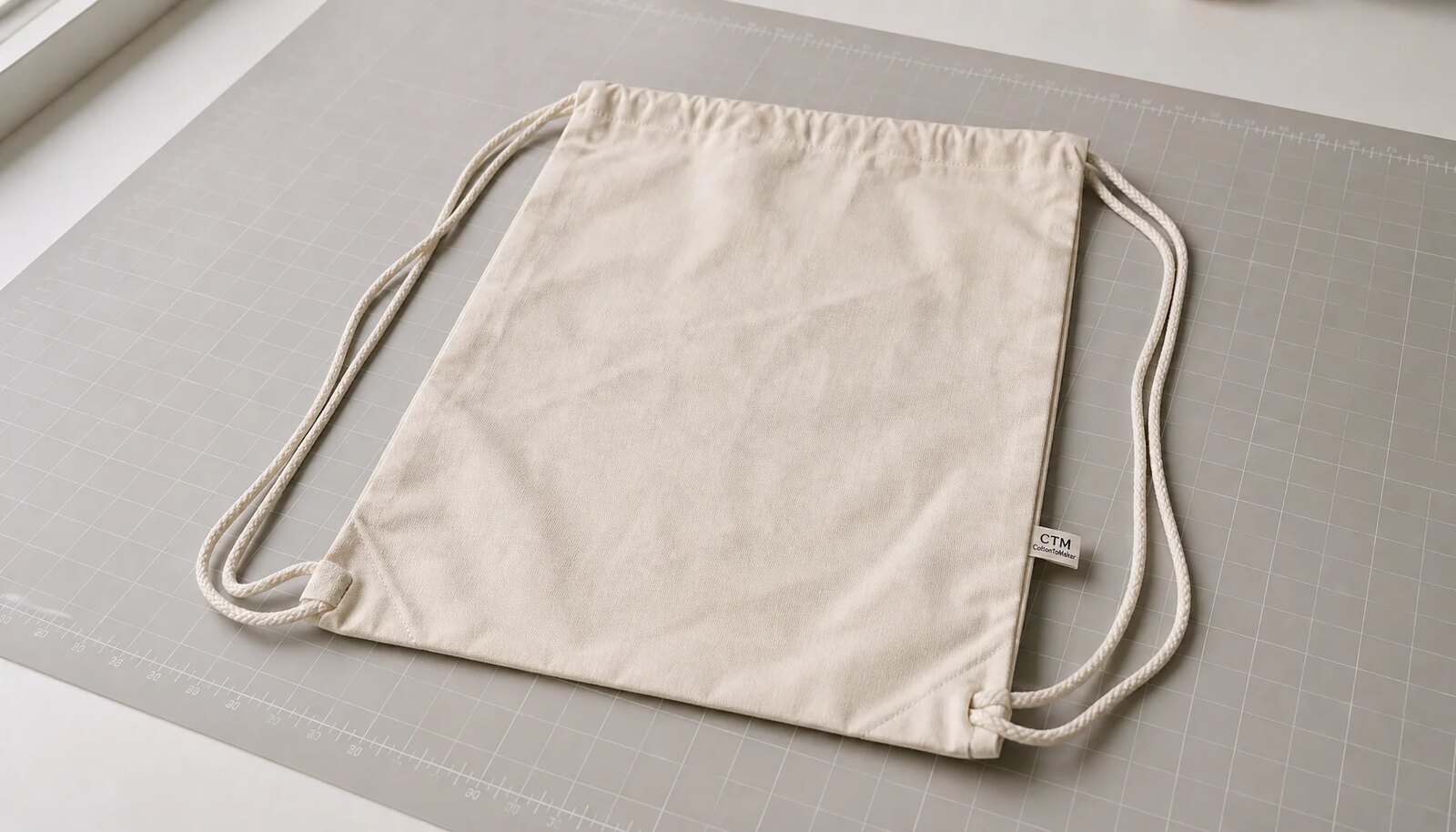
Price Only Matters After the Spec Is the Same
Cotton drawstring backpacks can look deceptively simple on a sourcing sheet. One line says cotton bag, another says drawstring backpack, and the price spread looks easy to compare. It is not. One supplier may be pricing 140 GSM plain weave cotton with basic overlocked seams. Another may assume 180 GSM canvas, a thicker cord, and a cleaner fold. A third may quote from available stock fabric in a shade that is close enough for sampling but not controlled for repeat orders.
For eco apparel brands, this small sewn item often touches the customer experience directly. It may hold a folded garment, ship inside an ecommerce order, sit in an event kit, or become a low-price retail add-on. If the bag feels flimsy, shows thread ends, carries a dull print, or arrives packed in uneven bundles, the brand pays for that weakness even when the main apparel product is well made.
The buying goal is not to make a basic product complicated. The goal is to make every quote describe the same bag. Procurement can then compare unit price, lead time, payment terms, factory control, and landed cost with a cleaner view. A strong RFQ for wholesale cotton drawstring backpacks for eco apparel brands should name the fabric, weight, size, construction, cord, logo method, packing, carton data, sample process, and QC tolerances before price is treated as meaningful.
- Do not compare quotes until fabric GSM, finished size, construction, cord, decoration, and packing are stated.
- Ask each supplier to restate the quoted specification line by line so hidden assumptions become visible.
- Treat missing details as sourcing risk, because blank specs often turn into substitutions, rework, or receiving delays.
Start With Use Case, Not Fabric Weight
The first procurement question is simple: what job does the bag need to do? A one-day event giveaway does not need the same material, lower-corner reinforcement, cord comfort, or packing presentation as a resale accessory. A bag used as apparel packaging may need clean folding, low lint, and accurate SKU separation more than heavy load capacity. A membership kit or staff merch item may need a stronger hand feel and a closure that customers will use repeatedly.
This decision should be made before the RFQ goes out. Marketing may focus on logo size, ink color, and how natural the cotton looks next to the apparel range. Product teams may care about hand feel and whether the material story supports the brand's eco positioning. Operations will care about how many units fit per carton, how the bags are folded, whether barcodes are applied, and how quickly a 3PL can receive the shipment. Finance should look beyond ex-works price and ask what the packed product costs to move, store, and handle.
Briefing the supplier with real use language is more useful than asking for the cheapest cotton bag. State the expected contents, the likely use duration, and the presentation standard. A bag meant to hold one folded T-shirt can be lighter than a bag expected to carry shoes, samples, or daily light items. If repeated customer use matters, ask for stronger stress points, a comfortable cord, and a fabric weight that supports that expectation. If the bag is mostly packaging, specify fold quality, cleanliness, and consistent size so it works smoothly in kitting.
- For event giveaways, prioritize readable branding, cost control, simple construction, and fast flat packing.
- For apparel packaging inserts, prioritize clean fabric, compact folding, SKU accuracy, and carton efficiency.
- For retail, kit, staff, or reusable programs, prioritize stronger lower corners, better cord comfort, print durability, and a more finished presentation.
Specify Cotton in Measurable Terms
A fabric description that only says 100% cotton is too thin for B2B buying. Cotton drawstring backpacks can be made from plain weave cotton, cotton canvas, drill, twill-like cotton, or other woven qualities. Each option cuts, sews, folds, prints, and wears differently. GSM matters, but it does not tell the whole story. Weave tightness, yarn size, finish, opacity, shrinkage behavior, and shade control all influence the final product.
For light promotional use, 140-160 GSM cotton can be practical when the contents are small and the budget is tight. For eco apparel brands using the bag as packaging, resale merch, membership kits, or a reusable light-carry item, 180-220 GSM is often a better planning range because it gives more structure and usually supports cleaner print results. Heavier fabric may feel more premium, but it also increases carton weight, reduces units per carton, and can make folding bulkier. The right choice is the fabric that matches the use case, customer expectation, and landed-cost target.
The RFQ should also state whether the fabric is natural, bleached, dyed, garment dyed, piece dyed, printed, organic-certified, recycled-content, or conventional. Natural cotton can vary from lot to lot, which may be acceptable for some eco-positioned collections but risky for strict brand palettes. Bleached cotton can give a cleaner print ground. Dyed cotton needs shade approval and may require lab dips or production swatches. If the brand plans to make a sustainability claim in product copy, on hangtags, or on a retail page, ask what documentation is available before committing to that language.
- Write the fabric line as composition, weave, target GSM, GSM tolerance, color, finish, and stock or dyed-to-order status.
- Use physical swatches or approved samples for shade decisions when color matters to the brand presentation.
- Ask for documentation before using claims such as organic cotton, recycled content, certified material, or other sustainability language.
Control Size, Cord, Tunnel, and Stress Points
Most failures on a drawstring backpack happen around functional details, not in the middle of the cotton panel. The tunnel may be too narrow for the cord. The top opening may snag when the user pulls it closed. The bottom corner may tear where the cord carries the load. The side seam may open after repeated pulling. Cord ends may fray before the customer has used the bag many times. These problems are easier to prevent in the spec than to argue about after shipment.
Finished size should be written as a measured sewn dimension, not just a rough product name. Common planning sizes sit around 33 x 40 cm, 35 x 45 cm, or 38 x 45 cm, but the buyer should confirm the size against the intended contents and packing plan. State whether width is measured flat from outside seam to outside seam, and whether height is measured from the top edge to the bottom seam. Agree the tolerance before production. For many simple sewn bags, +/-0.5 cm to +/-1.0 cm may be practical, depending on size, fabric, and construction.
The cord also needs its own line in the RFQ. Define material, color, diameter, length, end finish, and attachment method. A 4-6 mm cotton or cotton-blend cord is a common practical range for many light bags, but the best diameter depends on fabric weight, tunnel depth, and shoulder comfort. Lower-corner attachment can use metal eyelets, fabric loops, reinforced sewn corners, or another approved method. Each choice affects appearance, cost, durability, and inspection. Do not let the cord be whatever the factory usually uses unless that standard has been seen and approved.
- Define finished width, finished height, measurement points, and tolerance in the PO.
- Specify tunnel depth, seam allowance, cord diameter, cord length, cord material, cord path, and cord-end finish.
- Reinforce lower cord points when the bag is expected to carry more than very light contents or be reused by customers.
Choose Decoration From the Artwork, Then Test It
Logo application should follow the artwork, the fabric surface, and the use case. Screen printing is often efficient for wholesale cotton drawstring backpacks when the logo is bold, spot-color, and not too fine. It works best when the fabric surface is stable and the supplier controls screen preparation, ink mixing, placement, and curing. Buyers should define print size, placement from fixed edges, color reference, and hand-feel expectations instead of approving a mockup and hoping the production result matches.
Embroidery can look premium for small marks, but it is not automatically the higher-quality option. Dense embroidery on lighter cotton can pucker the panel, add stiffness, and make the bag harder to fold cleanly. Woven side labels, patches, and small sewn labels often suit eco apparel brands because they feel closer to apparel trims than promotional decoration. Heat transfer can solve some artwork challenges, but it should be reviewed for adhesion, edge lift, hand feel, and durability on the selected cotton fabric.
A digital mockup is a layout tool, not a production approval. Send vector artwork, Pantone or brand color references, print dimensions, number of colors, placement measured from fixed seams or edges, and any restrictions on ink feel or opacity. For screen print, ask for a strike-off or pre-production sample before bulk printing. For woven labels or patches, confirm size, fold type, stitch line, label MOQ, and whether label production affects the schedule. Small decoration details can quietly become the difference between a product that feels retail-ready and one that looks improvised.
- Use screen print for bold logos, typography, and spot-color artwork where opacity and placement matter.
- Use woven labels, patches, or small embroidery for quieter apparel-style branding and premium trim language.
- Approve a strike-off or pre-production sample when logo color, placement, registration, adhesion, or hand feel is important.
Write the RFQ So Alternatives Do Not Blur the Base Quote
A useful RFQ gives the factory enough detail to price accurately and gives procurement enough detail to compare accurately. Include fabric, finished dimensions, construction, cord, decoration, labels, packing, quantity, destination, trade term, sample requirement, lead time target, and QC expectations. If the supplier has to assume something, ask them to state that assumption in the quote rather than leaving it behind the unit price.
Supplier alternatives can be valuable, but they should sit outside the base quote. A factory may have a regular 200 GSM cotton canvas that prices better than the requested 220 GSM fabric. They may have a stock cord color that avoids dyeing time. They may suggest a standard size that improves cutting yield. Those ideas are worth reviewing, especially for margin-sensitive programs, but the exact-match quote and the alternate quote should be separate lines. Otherwise, procurement may end up comparing three different products under one product name.
The RFQ should also support landed-cost planning. Ask for carton quantity, carton dimensions, gross weight, net weight, packing method, and SKU separation before supplier selection. For a low-value bulky item, freight and warehouse handling can change the economics more than expected. A low factory price is less attractive if the bags are loosely packed, cartons are oversized, or the receiving team must relabel mixed cartons. The wholesale buying checklist should therefore connect technical spec, commercial terms, and logistics data in one request.
- Request one exact-match quote and separate alternate quotes for any suggested changes in fabric, size, cord, or packing.
- Ask for setup costs, sample costs, label costs, packing costs, testing costs, and documentation costs as visible lines.
- Collect carton data early enough to compare landed cost instead of judging only ex-works unit price.
Read MOQ, Price Breaks, and Setup Charges Closely
MOQ is not just a supplier preference. It is tied to fabric purchasing, cutting yield, print setup, sewing line changeover, label production, carton packing, and administrative work. A supplier may offer a low MOQ by using stock fabric, standard sizing, simplified branding, or shared production planning. That can be a good fit for a launch, test order, or limited event. The risk is assuming the same low minimum will apply to dyed fabric, custom labels, special cords, or multiple artwork versions.
For many custom cotton drawstring backpack programs, 500-1,000 pieces per color and design is a practical planning range, with larger price breaks at 3,000 and 5,000 pieces depending on fabric and decoration. The actual MOQ may move higher when the buyer needs dyed-to-order fabric, unusual cord colors, multi-color prints, retailer-specific packing, or trim production. Always ask whether the MOQ applies per color, per design, per size, or across the total order. A quote that says 1,000 pieces minimum may still mean 1,000 pieces per colorway.
Price breaks can show where the real cost drivers sit. A sharp drop after a certain quantity may indicate setup costs, fabric minimums, or cutting efficiency. A small drop at higher tiers may mean material cost dominates. Separate one-time costs from recurring unit price so reorders are easier to evaluate. Screens, strike-offs, sample development, label setup, hangtag setup, barcode setup, testing, export documents, and inspection support should not be hidden inside vague pricing language.
- Ask for 500, 1,000, 3,000, and 5,000 piece pricing when those tiers match real buying plans.
- Confirm whether MOQ applies per color, per artwork, per size, or per total purchase order.
- Separate recurring unit price from screens, strike-offs, labels, samples, packing labor, cartons, testing, and documents.
Use Samples as Production Control, Not Decoration Approval
Samples are not only for deciding whether the bag looks nice. They are the buyer's first real check that the quote, fabric, construction, cord, artwork, and packing idea work together. A sample should be measured, pulled closed, folded, photographed, and compared against the RFQ. Look at fabric feel, opacity, seam security, lower-corner strength, cord action, print edge quality, label placement, and whether the finished bag fits the intended product or kit.
Sampling often reveals interactions that a spec sheet cannot fully predict. A large print may stiffen a light cotton panel. A thick cord may bunch inside a shallow tunnel. A woven side label may sit poorly if the seam allowance is too small. Natural cotton may warm the appearance of a brand color. A fold that looks fine in one sample may not work when hundreds of units are stacked for kitting. These are useful discoveries before bulk production. They are expensive discoveries after the goods are finished.
Once approved, the pre-production sample should become the control reference. Keep one sample with the buyer and one with the factory when possible. Record the approval date, sample version, fabric type, GSM, size, cord, decoration, label, fold method, and any accepted deviations. If anything changes after approval, revise the spec and approve the change in writing before bulk production continues. This protects both buyer and supplier because inspection can compare finished goods against a known reference, not memory.
- Measure the sample against the RFQ instead of approving from photos only.
- Check closure action, cord pull, lower-corner strength, print finish, label placement, seam quality, and fold method.
- Release bulk production only when the PO, spec sheet, artwork proof, and approved sample match.
Define QC Tolerances Before Cutting Starts
Quality control works best when acceptance rules are clear before the factory cuts fabric. For cotton drawstring backpacks, important checks include fabric GSM, fabric shade, finished dimensions, print placement, print quality, seam security, stitch consistency, cord length, cord finish, reinforcement, labels, stains, loose threads, carton count, and barcode accuracy. Without written standards, the factory may use its usual judgment, which may not match the standard an eco apparel brand needs for customer-facing merchandise.
Tolerances should be practical and measurable. Finished size might allow +/-0.5 cm to +/-1.0 cm depending on bag size and construction. Print placement may need tighter control, such as +/-3 mm to +/-5 mm, especially for a centered logo. GSM tolerance should be agreed with the supplier, often as +/-5% or +/-10% depending on the fabric and supplier capability. Cord length should be consistent enough that paired cords hang evenly and close properly. Natural cotton shade may have approved variation, but stains, oil marks, mildew odor, and wrong color lots should not be treated as normal variation.
Defects should also be categorized. Minor defects may include loose trim threads that can be cleaned without changing appearance. Major defects may include visible stains, skewed panels, open seams, poor print registration, wrong placement, weak opacity, broken cord ends, or labels sewn in the wrong position. Critical defects may include sharp hardware, unsafe contamination, severe mold odor, wrong product, or mixed SKU cartons that prevent sale or fulfillment. For higher-risk orders, ask for inline checks at fabric receipt, first print, sewing start, and final packing.
- Set written tolerances for finished size, GSM, shade, print placement, print color, cord length, stitch quality, label placement, and carton count.
- Define minor, major, and critical defects before production so rework, replacement, discount, or rejection rules are clear.
- Use the approved pre-production sample as the inspection reference for fabric, size, sewing, cord, decoration, labels, folding, and packing.
Make Packing and Carton Data Part of the Purchase
Packing is not an afterthought. It affects freight cost, warehouse receiving, kitting speed, customer presentation, and inventory accuracy. Cotton drawstring backpacks usually ship efficiently when flat packed, but the fold method should still be specified. A bag folded for a retail insert may need a cleaner presentation than a bag packed in bulk for an event. If the factory chooses the fold without guidance, the buyer may receive deep creasing, uneven stacks, or a format that slows fulfillment.
Retail-ready packing adds more decisions. Individual polybags, paper bands, hangtags, barcode stickers, inserts, and master carton labels can all be useful, but every addition affects cost, labor, material, and carton volume. Eco apparel brands may prefer reduced plastic or recyclable materials, but those requirements need to be included before final quotation. A late change from bulk pack to individual packaging can change lead time, unit cost, and carton dimensions.
Carton information should be requested before the purchase order is finalized. Ask for units per carton, inner pack quantity, carton dimensions, net weight, gross weight, carton marks, SKU separation, and whether mixed cartons are allowed. If goods ship to a 3PL, retailer, distributor, or marketplace preparation center, carton labels may need PO number, SKU, color, quantity, country of origin, barcode, and carton sequence. Accurate packing data reduces receiving disputes and gives procurement a more reliable landed-cost comparison.
- Specify fold method, inner pack, export carton quantity, and whether SKUs may be mixed in one carton.
- Request carton dimensions, net weight, and gross weight before final supplier selection.
- Make carton marks detailed enough for warehouse receiving, not only international transport.
Specification comparison for buyers
| Spec decision | Recommended option | When it fits | Buyer risk to check |
|---|---|---|---|
| Fabric construction | Plain weave cotton, cotton canvas, cotton drill, or cotton twill with stated composition, weave, GSM, and finish | Needed when buyers want comparable quotes and predictable hand feel, opacity, and print results | A quote that only says cotton may hide loose weave, low opacity, shade variation, shrinkage risk, or a fabric substituted from stock |
| Fabric weight | 140-160 GSM for light promotional use; 180-220 GSM for retail, apparel packaging, kits, or repeated light use; tighter tolerance such as +/-5% to +/-10% by agreement | Helps balance cost, structure, fold bulk, print hold, and shipping volume | Too light can strain at cord points and look disposable; too heavy can raise carton weight, freight cost, and folding labor |
| Finished size | Common planning range around 33 x 40 cm to 38 x 45 cm, with buyer-defined flat measurement points and tolerance | Useful for apparel inserts, event merch, footwear bags, membership kits, and reusable light-carry bags | If size is not measured seam-to-seam after sewing, bulk lots can vary enough to affect kitting, barcode placement, or customer fit expectations |
| Construction level | Unlined with overlocked seams for value programs; bound seams, lining, bar tacks, fabric loops, or eyelets for higher presentation or load points | Matches build quality to the intended use rather than overbuilding every order | Lowest-cost construction can produce open seams, fraying interiors, weak lower corners, or a tunnel that snags when pulled closed |
| Cord specification | Cotton or cotton-blend cord with defined diameter, length, color, end finish, and lower-corner attachment method | Best for natural styling, comfortable shoulder feel, and consistent closure action | Thin cord can cut into shoulders or fail early; thick cord can bunch in the tunnel or distort lighter bags |
| Decoration method | Screen print for bold spot-color artwork; woven label, patch, or small embroidery for apparel-style branding; heat transfer only after adhesion and hand-feel review | Works when the method is chosen from artwork detail, fabric texture, order volume, and brand positioning | Fine lines, gradients, low-curing ink, dense embroidery, or oversized transfers can crack, bleed, pucker, peel, or feel inconsistent |
| Supplier route | Cut-and-sew factory with controlled decoration or a documented print partner, approval process, and rework responsibility | Important for custom size, custom color, labels, multi-SKU orders, and repeat production | If printing, dyeing, or labels are subcontracted without control, responsibility gaps can appear when color, curing, or timing problems occur |
| MOQ and price breaks | Request MOQ per color/design/size and tiered pricing at 500, 1,000, 3,000, and 5,000 pcs where relevant | Gives procurement a cleaner view of setup cost, fabric minimums, and scalable reorder pricing | A low MOQ may depend on available fabric, simplified colors, shared production, higher setup charges, or reduced customization |
| Packing method | Flat packed by SKU with defined fold, inner pack, units per carton, carton dimensions, gross weight, carton marks, and barcode rules | Suitable for export, 3PL receiving, retailer routing, kit assembly, and inventory control | Loose or mixed packing increases carton volume, count errors, creasing, barcode relabeling, and receiving delays |
Buyer checklist before sampling
- Define the commercial use case before asking for price: retail accessory, apparel packaging insert, event giveaway, membership kit, staff merch, footwear bag, or resale product.
- Write the fabric spec in measurable terms: composition, weave, target GSM, GSM tolerance, color, finish, stock or dyed-to-order status, and whether shade variation is acceptable.
- Confirm finished dimensions using flat measurement points, such as outside width seam-to-seam and height from top edge to bottom seam, with agreed tolerance before the PO is issued.
- Specify tunnel depth, seam allowance, stitch type, stitch density target, lower-corner reinforcement, cord path, cord diameter, cord length, and cord-end finish.
- Match decoration to artwork: provide vector files, Pantone or brand color references, print dimensions, placement from fixed edges, number of colors, and any hand-feel restrictions.
- Ask whether fabric sourcing, cutting, sewing, printing, labeling, and packing are controlled in-house or by approved subcontractors, and who is responsible for rework at each step.
- Request tiered prices at realistic quantities, such as 500, 1,000, 3,000, and 5,000 pieces, with MOQ stated per color, per design, per size, and per total order.
- Separate one-time charges from recurring unit costs, including screens, strike-offs, sample development, label setup, hangtag setup, packing labor, cartons, testing, and documentation.
- Approve a pre-production sample before bulk production, then measure it, photograph it, retain it, and use it as the inspection reference for fabric, size, print, sewing, cord, and packing.
- Set written tolerances for finished size, fabric weight, shade, print placement, print color, stitch quality, cord length, carton count, and barcode or carton mark accuracy.
Factory quote questions to send
- What exact fabric are you quoting: composition, weave, target GSM, GSM tolerance, fabric width, finish, color standard, and stock or dyed-to-order status?
- Is the quoted cotton natural, bleached, garment dyed, piece dyed, printed, organic-certified, recycled-content, or conventional? Which documentation is available if a claim will appear in our product copy?
- What finished bag size, measurement method, seam allowance, tunnel depth, cord diameter, cord length, and cord-end finish are included in the unit price?
- Which construction details are included: overlock, lockstitch, double stitch, bound seams, lining, bar tacks, metal eyelets, fabric loops, reinforced corners, inside label, or side label?
- What stitch density or seam standard do you normally use on this product, and can it be specified for bulk inspection?
- Is the logo applied by screen print, heat transfer, embroidery, woven label, printed label, patch, or another method, and what artwork limitations should we review before sampling?
- Is printing done in-house or by a subcontractor? If subcontracted, who controls strike-off approval, ink mixing, curing, inspection, and rework?
- What internal checks do you use for print adhesion, rub resistance, curing, wash response, color transfer, or cracking on cotton fabric?
- What is the MOQ per color, per design, and per size? What price breaks are available at 500, 1,000, 3,000, and 5,000 pieces?
- Which costs are one-time setup charges and which are included in the unit price: screens, plates, labels, sample development, packing labor, cartons, testing, export documents, or inspection support?
Quality-control points to confirm
- Fabric weight should be checked against the approved target GSM and agreed tolerance, such as +/-5% or +/-10% depending on fabric and supplier capability.
- Fabric shade should be compared with the approved swatch or sample under consistent lighting, with natural cotton variation separated from stains, oil marks, yellowing, or wrong dye shade.
- Finished width and height should be measured flat at defined points, with practical tolerances agreed before production, often around +/-0.5 cm to +/-1.0 cm for simple sewn bags depending on size and construction.
- Panel alignment and cutting grain should be checked so the bag is not visibly skewed, twisted, or uneven after sewing and closing.
- Drawcord tunnel depth, opening width, cord diameter, cord length, cord color, and cord-end finishing should match the approved sample so the bag closes smoothly and wears evenly.
- Print position should be measured from fixed seams or edges, not judged by eye only, with a defined tolerance such as +/-3 mm to +/-5 mm when brand presentation requires tight placement.
- Print quality should be checked for ghosting, pinholes, bleeding, cracking, poor curing, weak opacity, registration drift, rough ink edges, and unwanted ink marks on the reverse panel.
- Print durability should be reviewed with agreed checks such as dry rub, light wet rub, tape pull, gentle flexing, or wash response if the buyer intends to claim washability.
- Stitching should be even and secure, with no skipped stitches, loose threads, open seams, broken threads, needle cuts, puckering, or uneven tension on visible panels.
- Stress points should be inspected at top tunnel ends, bottom cord entry points, side seams, eyelets, loops, bar-tack areas, and label attachment points.