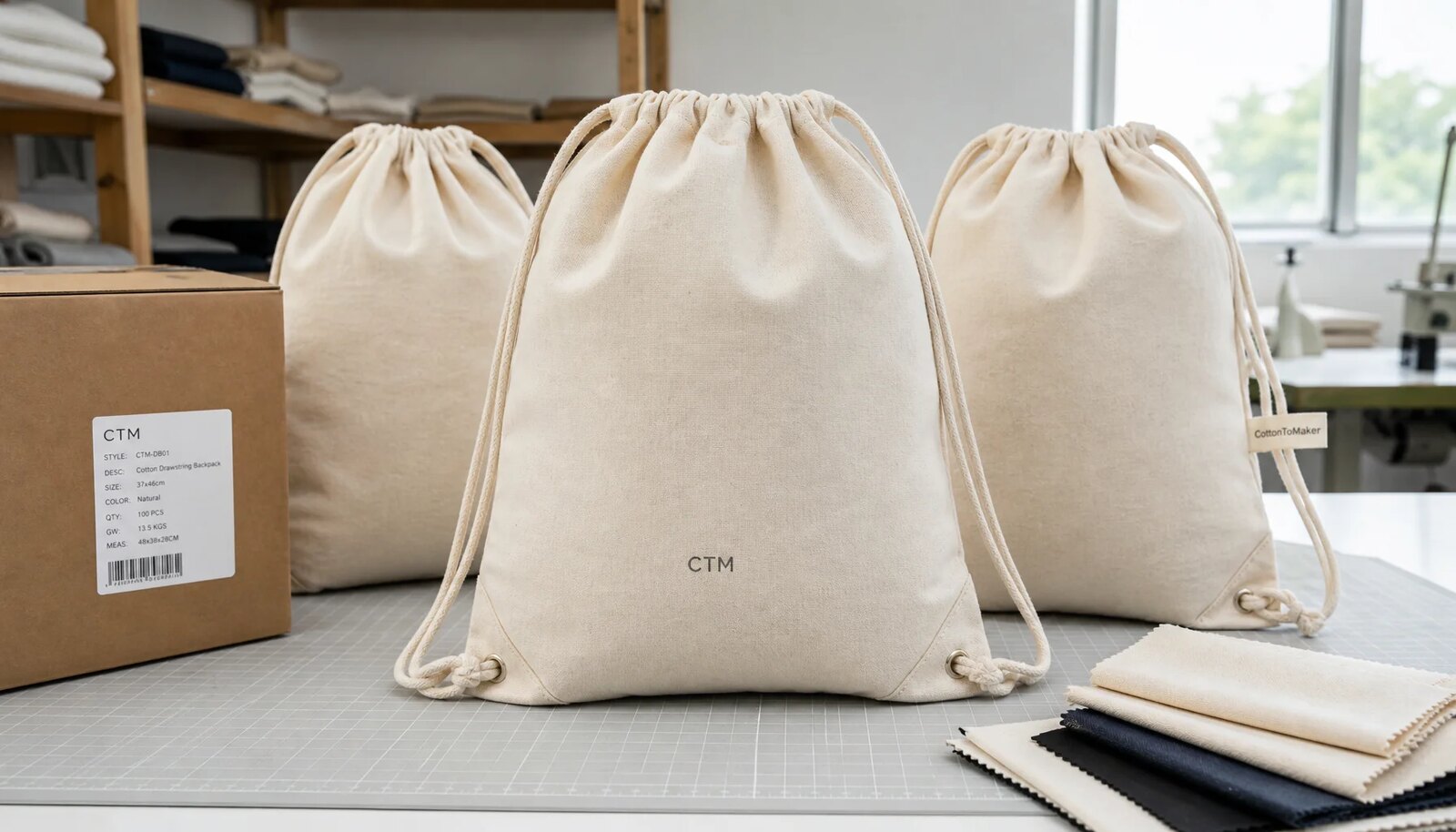
Define the Job Before You Price the Bag
Wholesale cotton drawstring backpacks for farmers market vendors should begin with the way the bag will be used, not with a catalog photo. The same style can serve as a vendor welcome kit, sponsor giveaway, CSA pickup bag, customer loyalty reward, farm stand retail item, or market association merchandise. Those programs may all want a natural cotton look, but they do not need the same fabric weight, reinforcement, packing, or inspection plan.
Start with the contents. A seed packet, coupon sheet, and market map may weigh only a few hundred grams. A bag carrying soap bars, a small jar, printed inserts, and a branded towel can reach 1-2 kg. Produce adds another layer because shapes are irregular and customers may reuse the bag throughout the season. If the expected load is vague, suppliers will usually quote their default construction, and those defaults may not match the real program.
Also decide what failure would cost. A loose thread on a free handout is annoying. A torn cord exit on a resale item is a customer-service problem. Mixed cartons for twenty vendor logos can slow down local distribution even when the bags themselves are acceptable. B2B procurement buyers get better quotes when they describe contents, handling, brand role, and downstream allocation in the first request.
- List the expected contents, rough filled weight, and any sharp or bulky item shapes.
- Classify the order as giveaway, resale, vendor kit, CSA package, or loyalty program.
- Tell suppliers whether bags need to survive one event, a season of reuse, or retail handling.
- Connect the use case to fabric, cord, reinforcement, decoration, packing, and inspection requirements.
Choose Fabric by Finished Performance
GSM matters, but it is only one part of the fabric decision. Cotton canvas, cotton sheeting, cotton twill, muslin, and cotton blends can carry similar weight numbers while feeling different in the hand. Canvas tends to feel more structured and durable. Sheeting is often more economical for larger promotional runs. Twill can feel smoother, though availability and price may vary. Ask suppliers to quote the fabric construction, measured finished GSM, and finished bag weight for the exact approved size.
For many farmers market programs, 180 gsm finished cotton is a practical starting point. It gives a reusable feel without pushing the order into a premium material and freight bracket. A 140-160 gsm cotton sheeting bag can work for brochures, seed packets, coupons, or low-load events, but it may wrinkle more and show stress around the drawstring channel. A 220 gsm canvas build is better suited for retail merchandise, CSA welcome kits, heavier product bundles, and repeated customer use.
Do not rely on a size name alone. Common cotton drawstring backpack dimensions often fall around 34 x 42 cm, 36 x 44 cm, or 38 x 45 cm, but a few centimeters can decide whether a jar set, folded shirt, catalog, or boxed item fits comfortably. Write the finished flat width, finished flat height, usable opening width, and tolerance into the purchase order. If size is critical, test a physical sample with the actual contents before approving production.
- Ask whether GSM is measured before or after dyeing, washing, or finishing.
- Request finished bag weight in grams for the approved sample size.
- Use 180 gsm as the reference point for most reusable farmers market vendor programs.
- Specify finished dimensions and tolerances instead of relying on catalog dimensions.
Make Construction Easy to Quote
Two bags can share the same GSM and still perform very differently. Construction controls durability, comfort, and cost. The RFQ should name the cord type, cord diameter, channel method, lower cord exits, reinforcement, stitch quality, seam allowance, and finishing. These are not small production notes; they are quote variables. If one factory includes reinforced lower corners and another does not, their unit prices are not directly comparable.
Cord is a good example. A 3 mm cord can lower cost, but it may feel thin or sharp when the bag carries weight. A 4-6 mm cord is a stronger default for reusable programs, especially if customers will open and close the bag often. Cotton cord gives a natural feel. Polyester-cotton cord may offer more consistency and can reduce some fraying issues. Ask for cord material, diameter, length, color, and end finishing. Cord ends might be knotted, tipped, sealed, or left raw, and the choice affects both appearance and handling.
Pay close attention to the lower corners. That is where drawstring tension meets the bag body. Reinforcement may be a stitched fabric patch, bartack, folded seam construction, metal eyelet, or another factory method. Eyelets can look tidy, but they are not automatically stronger if set through light fabric or installed with rough edges. Stitched reinforcement can be enough for many market programs and may keep the price cleaner. The quote should say exactly what is included.
- Name cord material, diameter, length, color, and end finish in the RFQ.
- Specify whether cord exits use fabric patches, bartacks, eyelets, folded seams, or another method.
- Ask for stitch density range and reinforcement at side seams, bottom corners, and the drawstring channel.
- Confirm reinforcement is included in the unit price before comparing supplier quotes.
Build a Bulk Pricing Plan Around Versions
MOQ is not just a number at the top of a quote. It reflects setup time, material purchasing, decoration, sorting, and version control. One natural cotton bag with one black screen print, one cord color, and bulk carton packing is far easier to produce than the same total quantity split across multiple logos, dyed fabric colors, cord colors, woven labels, or retail packing formats.
Ask for price breaks at 500, 1,000, 2,500, 5,000, and 10,000 pieces using the same physical specification. This shows where setup cost begins to spread across the order. The comparison only works if the construction, artwork count, packing method, and delivery terms stay consistent across all tiers. If the supplier changes GSM or packing at a lower tier, you are looking at a different product, not simply a different quantity.
For farmers market vendor programs, version math is often where budgets get messy. A 5,000-piece order divided among ten vendor logos may behave like ten smaller production runs. Each logo can require separate artwork approval, screen setup, print checks, carton labels, and sorting. Ask for MOQ by fabric color, cord color, print artwork, print location, woven label, and packing format. Then decide whether the first run should stay simple, with vendor-specific versions reserved for later replenishment.
- Request clean price breaks at 500, 1,000, 2,500, 5,000, and 10,000 pieces.
- Ask for MOQ by fabric color, cord color, artwork version, print location, label version, and packing format.
- Keep the first bulk order to fewer versions when setup cost and speed matter.
- Separate sample fees, setup charges, screens, labels, packing, inspection, and freight from the unit price.
Normalize Supplier Quotes Before Choosing
A low unit price can be useful. It can also hide missing costs. For wholesale cotton drawstring backpacks, the main cost drivers are fabric, cutting, sewing, reinforcement, decoration, packing, carton labeling, inspection, inland freight, export handling, and international freight when applicable. A quote that excludes screen charges, sample revisions, barcode labels, or custom carton marks may look cheaper than one that is more complete.
Give every supplier the same quote format. Include unit price by tier, sample fee, sample revision cost, setup or screen charge, extra cost per print color, extra cost per artwork version, packing cost, carton details, inland delivery cost, inspection cost if included, Incoterm, payment terms, lead time, and exclusions. If one quote is EXW and another is FOB, CIF, or DDP, procurement should convert them into a comparable landed-cost view before making a decision.
Think in cost per usable unit. If print versions arrive mixed, carton marks are unclear, barcode stickers are missing, or a high defect rate forces local sorting, the cheaper quote may lose its advantage. Farmers market programs often move through a market association, sponsor team, warehouse, or individual vendor pickup process. Packing accuracy and carton identification are operational costs, not administrative extras.
- Compare material, sewing, reinforcement, decoration, packing, inspection, and freight separately.
- Require written inclusions and exclusions from each supplier.
- Use the same Incoterm and delivery destination when comparing landed cost.
- Include local sorting, relabeling, repacking, and defect handling in the cost model.
Select Decoration That Suits Cotton
Screen printing is usually the strongest default for bulk cotton drawstring backpacks with simple artwork. One- or two-color logos, market names, farm brands, and sponsor marks are generally well suited to screen print. It scales efficiently and gives a familiar promotional or retail result. Still, buyers should control print size, ink color, placement, opacity, and curing quality. Cotton texture can soften edges, and natural cotton can make some light inks appear less solid.
Review the artwork before locking the quote. Fine type, thin lines, gradients, small negative-space details, and tight multicolor registration are harder to control on textured cotton than on a smooth synthetic surface. Ask the factory to confirm the minimum readable text size for the actual fabric and print method. A digital mockup can show placement, but it cannot prove how ink will sit on the material.
Other methods may fit specific needs. Heat transfer or digital transfer can help with many-color artwork, pilot runs, or multiple vendor versions, but they may change hand feel and unit cost. Embroidery can look premium, yet it may be impractical for lightweight cotton or large solid areas. A proper approval process includes an artwork placement proof and a physical printed sample made with production fabric, production cord, and the intended print method.
- Use screen print for simple spot-color logos and stable bulk quantities.
- Consider transfer methods when artwork complexity or many small versions justify the tradeoff.
- Set a print placement tolerance, such as +/- 5 mm to +/- 10 mm, where alignment matters.
- Approve decoration on physical production fabric, not only on a digital proof.
Write QC Rules People Can Actually Check
Quality control should be written before bulk production begins. A practical standard for cotton drawstring backpacks covers finished dimensions, fabric shade, GSM, finished bag weight, seam quality, cord movement, lower reinforcement, print quality, odor, stains, loose threads, packing count, and carton marks. The standard does not need to be elaborate, but it should be measurable enough for a factory, inspector, and buyer to use the same language.
Many buyers use an AQL-based inspection or an internal random sampling plan for soft sewn goods. The sampling level depends on order value and risk, but the method should pull units from multiple cartons, not only from the top layer or supplier-selected pieces. Critical defects may include sharp metal edges, mildew, severe contamination, unsafe broken hardware, or completely wrong artwork. Major defects may include open seams, wrong fabric, incorrect logo, severe print smudging, missing reinforcement, wrong carton count, or function failure. Minor defects may include small loose threads or slight cosmetic variation within the agreed tolerance.
Tolerances prevent arguments after the shipment is finished. Size might be controlled within +/- 1 cm, cord length within +/- 2 cm, print placement within an agreed millimeter range, and GSM within an agreed percentage such as +/- 5%, if both sides accept those limits. Keep a golden sample as the reference for fabric hand, stitch appearance, cord function, print color, and overall workmanship. Anything stricter should be agreed before fabric is purchased or panels are cut.
- Define critical, major, and minor defects before confirming the purchase order.
- Inspect random units from multiple cartons across the finished shipment.
- Use a golden sample as the reference for fabric, cord, reinforcement, print, and workmanship.
- Put size, GSM, cord length, print, shade, and packing tolerances in writing.
Plan Packing for the Real Distribution Path
Packing should match the downstream workflow. Bulk packing in master cartons is usually the lowest-cost route when a market association, sponsor, or warehouse will allocate bags locally. Inner bundles of 25 or 50 pieces make counting faster and reduce handling mistakes. Individual polybags can be useful for resale, e-commerce, retailer compliance, cleanliness, or barcode scanning, but they add material, labor, and sometimes regulatory or retailer label requirements.
The RFQ should state pieces per inner bundle, pieces per master carton, whether cartons are single-version or mixed, carton mark content, SKU label format, barcode requirements, and pallet needs. If bags are printed for multiple vendors, each version should ideally be separated by carton unless the receiving team has a reliable sorting process. Mixed cartons can reduce empty space, but they often increase labor and error risk after arrival.
Carton size affects freight, storage, and product condition. Overpacked cartons can wrinkle print areas, crush bags, deform eyelets, or make counts difficult. Underpacked cartons raise cubic volume and freight cost per unit. Before approval, request estimated carton dimensions, gross weight, net weight, carton count, and CBM for the quoted quantity. For retail-ready orders, confirm country-of-origin marking, barcode placement, and any required warning text or retailer-specific carton labels.
- Use bulk cartons for wholesale allocation and local repacking.
- Use 25- or 50-piece inner bundles when cartons will be split across vendors or event teams.
- Use individual polybags only when resale, scanning, cleanliness, or compliance requires them.
- Request carton dimensions, gross weight, net weight, carton marks, carton count, and CBM.
Protect the Seasonal Calendar
Farmers market purchasing often runs against opening weekends, harvest promotions, sponsor launches, and local event dates. The production clock should start after final sample approval, not after the first quote. Before bulk production, teams may still need artwork cleanup, Pantone confirmation, fabric approval, sample production, sample transit, internal review, and one correction round. These steps can take longer when a board, sponsor group, or multiple vendors must approve the same item.
Lead time also depends on material and process choices. Natural cotton in a standard construction may move faster than custom dyed fabric, special cord colors, woven side labels, unusual eyelets, or many print versions. Printing may be handled in-house or by a subcontractor. Packing may be completed by the sewing factory or a finishing partner. Ask which steps the supplier controls directly and which steps depend on outside schedules.
A realistic timeline includes sample development, sample shipping, sample approval, bulk fabric preparation, cutting, sewing, printing, drying or curing, trimming, final inspection, packing, export handling, freight, customs clearance, and final delivery. Rush freight can save a late order, but it can damage the economics of a bulk pricing plan. For repeat seasonal programs, keep the approved spec, artwork files, carton marks, and QC checklist on file so the next order starts from known decisions.
- Treat signed golden sample approval as day zero for bulk production.
- Add buffer for artwork revisions, sample transit, inspection, freight, customs, and local delivery.
- Ask whether fabric, printing, labels, or packing are subcontracted.
- For repeat orders, reuse the approved spec sheet, artwork, carton marks, and QC standard.
Send an RFQ That Removes Guesswork
A strong RFQ gives suppliers enough information to quote the same product. It should include finished size, fabric type, finished GSM, color, cord material, cord diameter, reinforcement method, stitch expectations, decoration method, artwork files, print size, print placement, packing format, target quantities, delivery destination, Incoterm preference, inspection requirement, and delivery window. If the request only says cotton drawstring backpack with logo, each supplier will fill in the blanks differently.
Ask suppliers to return a structured quote table, not a loose unit price. The response should show price tiers, sample cost, setup charges, cost for extra print colors or versions, packing charges, carton data, lead time, payment terms, Incoterm, and exclusions. Also ask them to list assumptions. A careful supplier should tell you whether the quote assumes natural cotton, one print color, bulk carton packing, no barcode labels, no individual polybags, and one artwork version.
The final decision should balance price with repeatability. Farmers market vendor programs often reorder when the first batch works, and repeat orders stay efficient only when fabric, artwork, packing, and QC records are controlled. The lowest first quote is not always the best value if it depends on vague fabric, unknown subcontracting, or weak carton control. A stronger supplier gives clear specs, realistic tolerances, accountable samples, and a quote structure procurement can defend internally.
- Send the same complete spec sheet and vector artwork to every supplier.
- Require a quote table with price tiers, setup costs, packing costs, carton data, lead time, and exclusions.
- Ask suppliers to identify assumptions before you compare pricing.
- Choose repeatable production control, not only the lowest first unit price.
Specification comparison for buyers
| Spec decision | Recommended option | When it fits | Buyer risk to check |
|---|---|---|---|
| Base fabric | 180 gsm finished cotton canvas or heavy cotton sheeting | Most farmers market vendor programs that need a reusable feel without premium resale cost | Confirm whether GSM is measured before or after washing, dyeing, or finishing; request finished bag weight for the approved size |
| Lightweight build | 140-160 gsm cotton sheeting with simple stitched cord exits | Brochure packs, coupon handouts, seed packet promotions, and low-load event distribution | Light fabric can stretch near the channel and show print-through; test with actual contents before approving bulk |
| Premium build | 220 gsm cotton canvas with reinforced lower corners and 5-6 mm cord | Retail merchandise, CSA welcome kits, heavier produce bundles, and repeat-use customer bags | Heavier GSM increases carton weight and freight cost; verify print opacity, needle size, and seam strength on the sample |
| Finished size | Common range: 34 x 42 cm to 38 x 45 cm, with +/- 1 cm tolerance unless otherwise agreed | Market maps, small purchases, vendor kits, branded merch, and customer loyalty packs | Unclear dimensions create fit failures; specify finished width, height, usable opening, and whether measurements are taken flat |
| Cord and channel | Cotton cord or polyester-cotton cord, 4-6 mm diameter, smooth draw through folded top channel | Programs where customers will open and close the bag repeatedly | Thin cord reduces cost but can feel sharp under load; require cord length, pull test, and cord-end finishing in the quote |
| Reinforcement | Stitched fabric reinforcement or metal eyelets at lower cord exits | Any order carrying jars, soap, books, produce, or multi-item vendor kits | Eyelets are only useful if cleanly set; check tearing, sharp edges, rust risk, and whether reinforcement is included in the base price |
| Decoration | 1-2 color screen print with Pantone or approved shade target | Logo-first bulk orders, market association branding, farm stand merchandise, and repeat replenishment | Cotton texture softens fine details; approve print size, placement tolerance, opacity, and a physical pre-production sample |
| Version strategy | One fabric color, one cord color, one print location, one packing method for the first bulk run | Lowest setup cost, faster approval, and cleaner bulk pricing for farmers market vendors | Total quantity may not determine price if split across many vendor logos; ask MOQ and price break by version |
| Packing route | Bulk pack in export cartons, optionally with 25- or 50-piece inner bundles | Wholesale distribution, local allocation, market associations, and B2B resale programs | Individual polybags, barcode labels, and custom carton marks add labor; confirm they are included or priced separately |
Buyer checklist before sampling
- Define the load: list expected contents, estimated filled weight, item shapes, and whether the bag must carry produce, jars, soap, printed materials, apparel, or only lightweight inserts.
- Specify finished dimensions in centimeters or inches, including flat width, flat height, usable opening width, and acceptable tolerance such as +/- 1 cm for size and +/- 2 cm for cord length.
- Confirm fabric type and weight: cotton canvas, cotton sheeting, cotton twill, or blended fabric; request measured finished GSM and finished bag weight for the exact sample size.
- State whether the fabric is natural, bleached, dyed, or custom dyed, and require shade approval for dyed or repeat-order programs.
- Define cord material, cord diameter, cord length, cord color, cord-end finishing, drawstring channel construction, and lower cord-exit reinforcement.
- Tell the factory whether reinforced corners, bartacks, double stitching at stress points, metal eyelets, woven labels, or extra trimming are included in the target spec.
- Send production-ready vector artwork, Pantone references or approved color targets, maximum print dimensions, print placement, print method, and any rules for small text or logo spacing.
- Request price breaks at 500, 1,000, 2,500, 5,000, and 10,000 pieces using the same construction, same artwork count, and same packing method.
- Ask for MOQ by fabric color, cord color, print version, label version, and packing format, not only by total order quantity.
- Separate unit price, sample cost, sample revision cost, screen or setup charge, packing charge, carton mark charge, inland freight, inspection cost, and international freight estimate.
Factory quote questions to send
- What exact fabric construction are you quoting: cotton canvas, cotton sheeting, cotton twill, muslin, or cotton blend, and what is the measured GSM after finishing?
- What is the finished bag weight in grams for the quoted size, and what tolerance applies to GSM and finished weight?
- What finished dimensions are included, and are measurements taken flat before packing, after steam finishing, or after bulk carton compression?
- What tolerance do you allow for width, height, opening width, cord length, print placement, and print color?
- What cord material, diameter, length, and finishing method are included in the price?
- Is the lower cord exit reinforced by stitched fabric patch, bartack, metal eyelet, or another method, and is that reinforcement included in the quoted unit price?
- What stitch type, stitch density range, seam allowance, and stress-point reinforcement are used for the side seams, bottom corners, and drawstring channel?
- How many print colors, print locations, screens, artwork versions, and placement proofs are included?
- What is the cost for each additional print color, print location, screen, logo version, woven label, or custom carton mark?
- Can you produce a physical pre-production sample using production fabric, production cord, production print method, and the proposed packing format?
Quality-control points to confirm
- Finished size should meet the approved tolerance for width, height, usable opening, lower corner shape, and cord length across randomly selected cartons.
- Fabric GSM should match the approved range, commonly controlled within an agreed tolerance such as +/- 5% unless the purchase order states otherwise.
- Finished bag weight should be checked against the golden sample so a supplier cannot substitute lighter fabric while keeping the same nominal GSM.
- Fabric shade should be checked across multiple cartons and against an approved swatch, especially for dyed fabric or repeat orders.
- Stitching should be even, locked, and free of skipped stitches at side seams, bottom seam, bottom corners, drawstring channel, and reinforcement points.
- Stress areas should pass a practical pull check: cord exits, side seams, channel ends, eyelets, and bartacks should not tear or deform under normal manual force.
- Cord should move smoothly through the channel without binding, heavy twisting, rough edges, or friction that damages the fabric.
- Cord ends should be knotted, tipped, sealed, or otherwise finished to reduce fraying during packing, warehouse handling, and customer use.
- Metal eyelets, if used, should sit flat with no sharp edges, cracking, rust marks, loose setting, or fabric tearing around the hole.
- Printed artwork should match the approved size, orientation, placement window, color target, opacity, and registration.