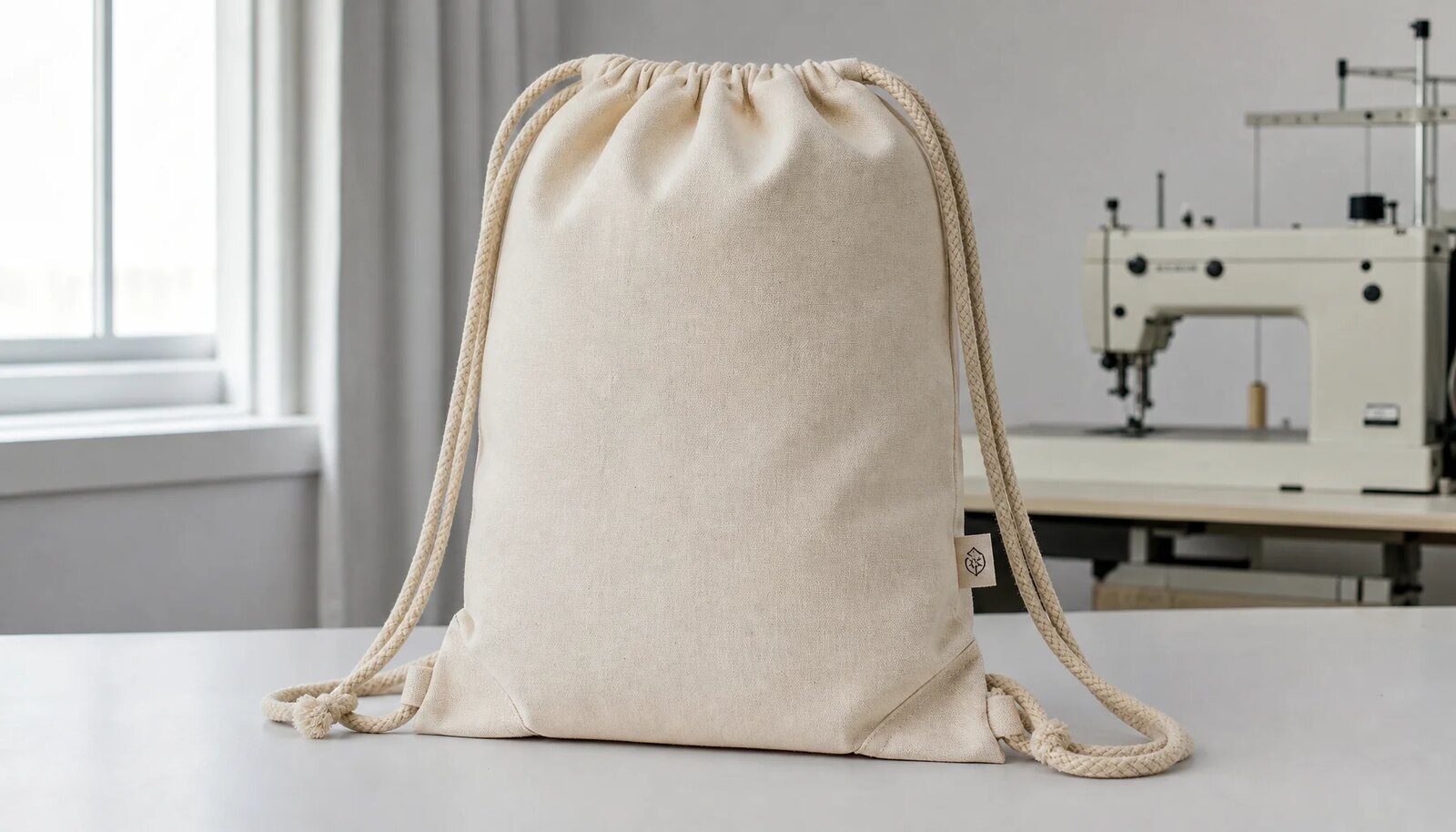
Start With the Buying Job
Cotton drawstring backpacks look simple, which is why weak RFQs create uneven quotes. One supplier may price a thin promotional pouch with backpack cords. Another may quote a reusable canvas accessory with reinforced corners. Both may call the product a cotton drawstring backpack, but the cost, durability, and customer experience are not the same.
Begin by naming the job. A garment pack-in for one T-shirt has a different target than a resale accessory sold beside apparel. A gift-with-purchase needs a cleaner hand feel and stronger presentation than a back-of-house subscription insert. Event giveaways may prioritize budget and speed, while employee kits and capsule merchandise may need tighter shade, decoration, and packing control.
For eco apparel brands, separate material preference from claim. Natural cotton, organic cotton, recycled cotton, unbleached fabric, recycled polybag, paper packing, and water-based ink are separate choices. Each can affect MOQ, documentation, lead time, unit cost, and inspection. Asking for an eco bag is too loose. Asking for a natural 160 GSM cotton twill drawstring backpack with cotton cord, one-color water-based screen print, bulk flat packing, and documentation for any organic claim gives suppliers a product they can quote.
- Define whether the bag is a pack-in, giveaway, gift-with-purchase, kit component, subscription insert, or resale accessory.
- State expected contents and approximate loaded weight before discussing fabric or decoration.
- Separate mandatory sustainability requirements from nice-to-have preferences.
- Tell suppliers whether the bag must arrive retail-ready or simply protect apparel through handling.
- Use the same use-case brief for every supplier so the first quotes are comparable.
Convert the Spec Into Numbers
A product photo can explain the look, but it cannot control the order. Finished size, fabric weight, cord length, seam construction, decoration method, packing, carton count, and tolerance all move price. If these details are missing, the lowest offer may simply be the loosest interpretation.
Use finished dimensions rather than only a flat visual target. State finished width, finished height, cord channel height, seam allowance expectation, and dimensional tolerance. For many soft cotton bags, finished size tolerance is often written around plus or minus 0.5 cm to 1 cm, depending on bag size and construction. Logo placement usually needs tighter control, such as plus or minus 3 mm to 5 mm, because a shifted mark is visible immediately.
Fabric needs the same discipline. Cotton canvas is not a complete spec. Write composition, weave, GSM or ounce weight, weight tolerance, color, dye status, and shade standard. A 120 to 140 GSM cotton bag can work for light-duty programs after sample approval. A 150 to 180 GSM cotton canvas or twill is a more practical baseline for reusable apparel packaging. An 8 oz canvas or heavier bag can feel premium, but it affects sewing, cords, carton weight, and freight.
The cord is not minor trim. It is the closure and, for backpack use, the shoulder strap. Specify material, braided or twisted structure, diameter, finished length, color, knot or end finish, and length tolerance. If the bag will be worn, ask for a pull check on the complete cord system, including channel openings and lower-corner attachment.
- Write finished width, finished height, cord channel height, and tolerance into the main spec.
- Define fabric composition, weave, GSM or ounce weight, weight tolerance, color, and shade standard.
- Specify cord material, structure, diameter, finished length, color, and end finish.
- Include stitch density, seam type, reinforcement points, and back-tack requirements.
- Require written approval before any fabric, cord, thread, ink, label, or packing substitution.
Use an RFQ Table
A structured RFQ table is a control tool, not paperwork for its own sake. When suppliers receive only a narrative brief, they fill gaps with their factory standard. That may be acceptable during early sampling, but it is risky for wholesale cotton drawstring backpacks bought in volume.
The table should cover bag body, cord, construction, decoration, packing, carton data, inspection, incoterm, destination, and delivery schedule. Add a supplier-response column beside each buyer requirement. Blank fabric weight, missing cord diameter, or vague carton data then become visible before the purchase order is issued.
Keep alternates separate. A supplier may recommend 180 GSM instead of 160 GSM, polyester cord instead of cotton cord, or individual packing instead of bulk cartons. Those options can be useful, but they should be priced as separate lines. Mixing an alternate into the main quote destroys comparability and usually causes confusion when samples arrive.
- Bag body: finished size, tolerance, fabric composition, weave, weight, color, and shade standard.
- Cord: material, structure, diameter, finished length, color, knot or end finish, and pull check.
- Construction: stitch density, seam type, cord channel height, reinforcement points, and lower-corner detail.
- Decoration: method, logo size, color count, color reference, placement, placement tolerance, and approval sample.
- Packing: fold method, inner pack, individual pack if needed, pieces per carton, carton dimensions, weights, and carton marks.
Build Usable Bulk Price Bands
A bulk pricing plan should show the cost curve for the same bag at meaningful quantities. For many B2B apparel programs, price bands at 1,000, 3,000, 5,000, 10,000, and 20,000 pieces give a useful view of setup absorption, fabric buying, cutting efficiency, decoration labor, and packing time. Your bands should match forecast demand, but only quantity should change.
This matters more than it sounds. If the 1,000-piece quote is based on stock blanks and the 10,000-piece quote is based on custom production, you do not have a clean price ladder. If one tier includes individual packing and another assumes bulk cartons, the comparison is broken. Ask suppliers to hold the specification constant and show alternates separately.
Separate first-order cost from reorder cost. Screens, embroidery digitizing, woven label tooling, sample making, artwork cleanup, courier freight, carton mark setup, and testing may be one-time or launch charges. Keep them outside the recurring unit price so finance can compare initial landed cost and reorder landed cost without guessing what was buried in the unit number.
A strong quote should also state currency, price validity, payment terms, incoterm, delivery destination, lead-time trigger, and overrun or underrun allowance. For sewn cotton goods, suppliers may request quantity tolerance because cutting, printing, and finishing yields are not always exact. If your company can accept it, write the allowed percentage into the PO. If not, state that before production starts.
- Request price bands on the identical spec at practical order quantities.
- Show unit price, one-time charges, sample costs, decoration setup, testing, packing, inspection, and documentation separately.
- Ask what drives each price break: fabric MOQ, cutting efficiency, print setup, trim MOQ, or packing labor.
- Confirm currency, price validity, payment terms, incoterm, destination, and quantity tolerance.
- Compare first-order landed cost and reorder landed cost as separate views.
Document Material Claims
Fabric and cord choices carry the material story of the backpack. They also carry cost and compliance risk. A cotton body with polyester cord can be practical and durable, but it should not be described as all-cotton. Organic cotton should not be claimed unless the documentation supports the buyer's labeling, catalog copy, and compliance requirements. Recycled cotton, conventional cotton, natural cotton, and blended cotton are not interchangeable sourcing categories.
Ask for the exact documents behind each claim. For organic cotton, buyers commonly request a valid transaction certificate or equivalent chain-of-custody documentation tied to the order, plus supplier scope documents where relevant. For recycled cotton, ask for documentation that identifies recycled content, material source, percentage, and certification or test basis if a standard is being claimed. For conventional cotton with no certified claim, keep the marketing language modest and avoid implying certification.
Natural unbleached cotton may show seed flecks, small slubs, or slight shade variation depending on grade. Those can be acceptable if they match the approved swatch. They are different from oil stains, mildew, dirt, strong odor, uncontrolled discoloration, or contamination. Your approval notes should make that distinction clear so inspectors do not reject normal fabric character or pass genuine defects.
Dyed fabric needs shade control. Ask whether the supplier is quoting stock fabric or custom dyeing. Stock colors may reduce lead time and MOQ, but shade can vary by lot. Custom dyeing may improve brand alignment when the bag sits beside apparel, but it can add lab dips, fabric MOQ, and lead time.
- Match product claims to actual composition, documentation, and approved labeling language.
- Request order-specific documentation for organic or recycled cotton claims where those claims will be used commercially.
- Keep natural cotton flecks and slubs separate from stains, mildew, odor, and dirt in the defect standard.
- Confirm whether the quote uses stock fabric or custom dyeing.
- Require written approval before changing cotton type, recycled content, cord fiber, dye process, or packaging claim.
Lock Decoration Before Comparing Quotes
Decoration can change the quote as much as fabric. A one-color water-based screen print on natural cotton is usually efficient for bulk orders. Cost rises with large print areas, added colors, tight registration, special inks, heat transfers, embroidery, woven labels, patches, and extra placement checks. Do not compare suppliers until the decoration method is named.
For screen printing, give production artwork, logo size, color count, color references, placement from top and side edges, and placement tolerance. Ask what ink type is included and whether curing, rub resistance, and print transfer are checked. A soft print can be desirable on cotton, but opacity and durability still need approval on the actual fabric. A digital mockup cannot prove those points.
Embroidery works best when the logo is small enough and the fabric is stable enough. Dense embroidery on thin cotton can pucker, stiffen the panel, or look uneven after packing. If embroidery is selected, approve stitch count, thread colors, backing, reverse-side finish, loose-thread standard, and puckering tolerance. Show digitizing as a separate charge if it is not part of the recurring unit price.
Woven labels and patches can make the backpack feel closer to apparel trim. They also add more parts to control. Confirm trim MOQ, lead time, edge finish, thread colors, sewing alignment, placement tolerance, and whether unused label inventory can be held for reorder programs.
- State decoration method, logo size, color count, color reference, and placement from top and side edges.
- Define placement tolerance, such as plus or minus 3 mm to 5 mm when appropriate for the logo and bag size.
- Ask for ink type, cure method, rub resistance, and print transfer checks when the bag ships with apparel.
- For embroidery, approve stitch density, backing, thread color, reverse-side finish, and puckering range.
- For labels or patches, confirm trim MOQ, sewing alignment, edge finish, placement tolerance, and reorder inventory control.
Read the Quote Closely
A procurement-ready quote should make sense to someone who has never seen the sample. It should list the product specification, quantity bands, unit price, one-time charges, sample fees, packing method, carton data, lead time, incoterm, payment terms, price validity, exclusions, and change-control rules. A photo plus a unit price is not ready for a bulk purchase order.
Ask what is included and what is excluded. Screen setup, embroidery digitizing, woven label tooling, patch tooling, sample freight, insert cards, barcode labels, carton marks, inspection, export documents, testing, special packing, and courier charges can all change the real cost. Cleaner quotes show these as separate lines. Messier quotes hide them, which makes internal approval and reorder pricing harder.
Lead time needs a trigger. A supplier may say 25 days, but 25 days from what: deposit receipt, artwork approval, sample approval, fabric arrival, lab dip approval, or trim confirmation? Break the schedule into sample making, courier transit, buyer approval, fabric procurement, dyeing if needed, trim preparation, cutting, decoration, sewing, finishing, inspection, packing, and shipment release.
Ask which processes are in-house and which are subcontracted. Outsourcing is not automatically a problem, especially for dyeing, printing, embroidery, washing, or special packing. The risk is unmanaged outsourcing. The supplier should remain responsible for final quality and should disclose outside processes that affect schedule, claims, or inspection.
- Reject quotes that omit fabric weight, finished dimensions, cord details, decoration method, or packing data.
- Require separate lines for unit price, one-time charges, optional charges, excluded charges, and sample costs.
- Ask for lead time by stage, including the exact trigger for bulk production days.
- Confirm in-house processes, subcontracted processes, and final QC responsibility.
- Add no substitution without written buyer approval to the purchase order.
Approve Samples as Evidence
Sample approval is not only a style checkpoint. It is production evidence. A cotton drawstring backpack sample should confirm fabric hand feel, opacity, shade, cord movement, seam strength, odor, print cure, decoration placement, packed condition, and loaded appearance. Photos help with layout, but they should not replace a physical sample for resale, retail-facing, color-critical, or brand-sensitive programs.
Check the bag empty and filled. Use the intended apparel bundle when possible, or a realistic substitute weight. Watch the lower corners, side seams, cord channel, and logo area. Does the print distort when the bag is cinched? Does the cord feel rough on the shoulder? Does the filled shape still show the logo properly? These observations prevent expensive surprises.
Measure the sample against the RFQ. Record finished width, finished height, cord channel height, cord length, logo placement, seam details, stitch density, and reinforcement. If the sample falls outside tolerance but the team accepts it, update the written spec. An undocumented exception can become the bulk standard.
Keep a golden sample. The buyer should retain one, the supplier should retain one, and the final signed spec should match both. For reorders, compare back to the same reference unless the buyer intentionally approves a new material, decoration, or construction standard.
- Approve fabric, construction, cord action, decoration, odor, packing, and loaded appearance, not only artwork layout.
- Measure the sample and record approved deviations before bulk production starts.
- Test with intended contents or a realistic substitute weight.
- Keep a signed golden sample, fabric swatch, trim reference, and print or embroidery approval standard.
- Close all sample comments in writing before authorizing bulk cutting or decoration.
Set QC Before Cutting
Quality control works best when defects are defined before production begins. For cotton drawstring backpacks, critical defects may include wrong material, wrong logo, missing cords, broken seams, mildew, unsafe contamination, severe odor, or unusable product. Major defects may include off-center printing, weak stitching, uneven cord lengths, large stains, obvious shade mismatch, incorrect label placement, and print transfer. Minor defects may include small loose threads or slight cosmetic marks within the agreed limit.
Use measurements wherever possible. Finished dimensions, logo placement, cord length, stitch density, carton count, and pieces per inner pack can all be checked numerically. Visual standards still matter, especially on natural cotton, but inspectors need an approved swatch and clear defect descriptions. If seed flecks are acceptable, say so. If dark contamination is not acceptable, say that too.
Stage the checks. Inspect fabric before cutting for weight, shade, stains, odor, weave, and surface cleanliness. Check decoration before sewing or final assembly where possible, so print color, cure, registration, embroidery puckering, or label placement problems do not move too far downstream. Use in-line sewing checks for seam tension, skipped stitches, open seams, cord-channel issues, lower-corner weakness, and thread trimming.
Functional checks should match use. A garment pack-in may need a modest loaded handling check. A resale backpack needs more confidence in cord pull, corner reinforcement, seam security, and repeated cinching. A rub test can flag ink transfer risk, especially if bags ship with light-colored apparel. Any wash, colorfastness, or lab test should be specified before quoting because it can affect cost and schedule.
- Define critical, major, and minor defects in the purchase order or QC addendum.
- Inspect fabric, decoration, sewing, finishing, and packed cartons, not only final appearance.
- Use measurement tolerances for finished size, logo placement, cord length, stitch density, and carton count.
- Run load, cord pull, seam, cinching, and print rub checks that reflect the intended use.
- Reject mildew, strong odor, oil stains, severe shade mismatch, print transfer, broken seams, and missing cords before shipment.
Plan Packing and Freight
Packing is part of product cost. It affects cleanliness, carton volume, receiving speed, retail presentation, and freight. Bulk flat packing is often the most efficient choice for wholesale cotton drawstring backpacks, but it may not be enough for e-commerce, retail display, event kits, or resale accessories that need individual presentation.
Eco apparel brands often want reduced packaging, and that can be a good goal. The goods still need to arrive clean, dry, and sellable. Plastic-free packing may work in controlled domestic moves or short storage windows. Recycled polybags, paper wraps, or bulk inner bags may be more practical where moisture, dust, or long transit adds risk. Quote the packing method with the bag because folding and packing labor can change the unit price.
Carton data belongs in the quote file. Ask for pieces per carton, carton dimensions, gross weight, net weight, estimated CBM, carton strength, carton marks, and pallet assumptions if relevant. Air freight can be punished by dimensional weight. Ocean freight depends on CBM, carton strength, and loading efficiency. A supplier with a lower unit price can lose the landed-cost comparison if its cartons are oversized or weak.
Review the fold method before bulk packing. A fold through a large screen print can create creases, shine marks, or ink stress. Over-compressed cartons can distort cotton bags and leave deep lines. If the bags must arrive customer-ready, request a packed sample or packing photos before final carton sealing.
- Choose bulk flat packing unless the sales channel requires individual presentation.
- Quote polybags, paper wraps, hangtags, insert cards, barcode labels, and carton marks as separate line items.
- Confirm pieces per carton, carton dimensions, gross weight, net weight, CBM, carton strength, and pallet assumptions.
- Avoid folds through large printed logos when possible.
- Match packing to cleanliness, freight efficiency, retail requirements, warehouse receiving, and sustainability goals.
Specification comparison for buyers
| Buying decision | Practical specification position | Best fit | Risk to verify before PO |
|---|---|---|---|
| Garment pack-in | Light to midweight cotton bag sized to the folded garment, with controlled logo placement and efficient bulk packing | T-shirts, socks, underwear, base layers, accessories, subscription apparel, and retail bundles | Check fill weight, seam distortion, print transfer, odor, dust, and whether the bag protects the garment through handling |
| Gift-with-purchase | Midweight cotton canvas or twill with a cleaner hand feel, stable decoration, and consistent folding | Eco apparel promotions, loyalty gifts, capsule launches, pop-ups, and retail events | Confirm the bag looks customer-facing after carton compression and does not feel like a disposable promo pouch |
| Resale accessory | Heavier fabric, reinforced stress points, defined cord pull checks, tighter appearance standard, and retail-ready packing | Merchandise add-ons, seasonal drops, footwear accessories, outdoor apparel, and premium kits | Avoid promo-grade sewing; inspect cord comfort, lower-corner strength, loose threads, shade consistency, and packed presentation |
| 120-140 GSM cotton | Use only when low cost and light-duty use matter more than structure | Simple garment protection, short campaigns, giveaways, and low-load inserts | Thin fabric can be translucent, twist at seams, and weaken logo opacity; approve a physical sample with actual artwork |
| 150-180 GSM cotton canvas or twill | Use as the normal starting point for reusable brand packaging | Apparel pack-ins, gift programs, and moderate reuse expectations | Confirm fabric weight tolerance, weave, shrinkage expectation, shade standard, and whether weight is measured before or after finishing |
| 8 oz canvas or heavier | Use when the backpack must feel substantial or support resale value | Higher perceived-value merchandise, footwear packs, outdoor apparel, and heavier contents | Model added material cost, carton weight, freight impact, needle size, seam allowance, and stronger cord requirements |
| Cotton cord | Specify braided or twisted structure, diameter, finished length, color, knot or end finish, and tolerance | Programs where natural fiber content and soft touch are important | Cotton cord can fray, shrink, or vary in shade; check pull strength, abrasion, and colorfastness if dyed |
| Polyester or blended cord | Use when smoother draw action, durability, bright color matching, or lower friction is more important than all-cotton composition | High-use backpacks, vivid brand colors, and bags worn regularly as shoulder bags | Material content may affect sustainability or labeling claims; disclose the blend clearly |
| Water-based screen print | Use for most bulk logos, larger marks, simple artwork, and lower decoration cost at volume | One to four spot colors, clean typography, and apparel brand marks | Confirm ink type, cure, rub resistance, opacity, placement tolerance, and transfer risk against light garments |
Buyer checklist before sampling
- Define the commercial role: garment pack-in, giveaway, gift-with-purchase, employee kit, subscription insert, event bag, or resale accessory.
- State intended contents and approximate loaded weight, such as one T-shirt, one hoodie, footwear accessories, or a folded apparel bundle.
- Set finished width, finished height, cord channel height, seam allowance expectation, and dimensional tolerance before requesting bulk pricing.
- Specify fabric composition, weave, GSM or ounce weight, acceptable weight tolerance, color, dye status, and whether cotton is conventional, organic, recycled, or blended.
- Write cord material, cord structure, diameter, color, finished length, knot or end finish, and cord-length tolerance into the RFQ.
- Define construction details: seam type, stitch density range, back-tack points, reinforced lower corners, and bar-tack requirements if the bag will be worn.
- Provide production artwork with decoration method, logo size, color count, Pantone or brand color reference, placement from top and side edges, and placement tolerance.
- Request price bands on the same exact specification, such as 1,000, 3,000, 5,000, 10,000, and 20,000 pieces.
- Separate one-time charges from repeat pricing, including screens, digitizing, label tooling, sample fees, artwork cleanup, courier fees, carton marks, and testing.
- Confirm MOQ by fabric color, material claim, logo version, decoration method, trim color, packing method, and shipping destination.
Factory quote questions to send
- What fabric composition, weave, GSM or ounce weight, and weight tolerance are included in this quote?
- Is the fabric natural, bleached, dyed, organic cotton, recycled cotton, conventional cotton, or blended, and what documentation supports any material claim?
- Is the fabric weight measured before dyeing, after finishing, or from the finished bag, and what internal or third-party test method is used?
- What are the finished bag width and height, cord channel height, seam allowance, stitch density range, and measurement tolerance?
- What cord material, structure, diameter, finished length, color, knot style, and end finish are included?
- Are the lower corners reinforced, bar-tacked, or standard sewn, and what load or pull check is used for backpack-style cords?
- Is the logo quoted as screen print, heat transfer, embroidery, woven label, patch, or another method, and what logo size, color count, ink type, and placement are included?
- What one-time charges apply for screen setup, embroidery digitizing, woven labels, patches, sample making, artwork adjustment, carton marks, special packing, testing, or courier shipment?
- What MOQ applies per bag color, material type, logo version, print color count, trim color, packing method, and destination?
- What are the price breaks for 1,000, 3,000, 5,000, 10,000, and 20,000 pieces on the same exact specification?
Quality-control points to confirm
- Fabric matches the approved swatch for composition, weave, weight, texture, shade, opacity, surface cleanliness, and odor.
- Finished dimensions stay within the agreed tolerance for width, height, cord channel, seam position, and logo placement.
- Fabric weight is checked against the agreed GSM or ounce range, with the method and sample location recorded.
- Panels are cut on grain where required, with no obvious skewing, twisting, or mismatched front and back panel dimensions.
- Stress seams are straight, evenly stitched, securely back-tacked, and reinforced at cord channel openings and lower corners when specified.
- Stitch density is consistent, with no skipped stitches, open seams, needle cuts, broken thread, loose tension, or excessive thread ends.
- Cord material, diameter, color, length, construction, and end finish match the approved sample.
- Drawstrings move smoothly through the channel without snagging, slipping into the channel, or tearing the opening during repeated cinching.
- Cord pull and loaded bag checks meet the agreed internal standard for the intended fill weight and use case.
- Logo placement is centered or intentionally positioned within tolerance, with no distortion from seams, folds, fabric stretch, or carton compression.