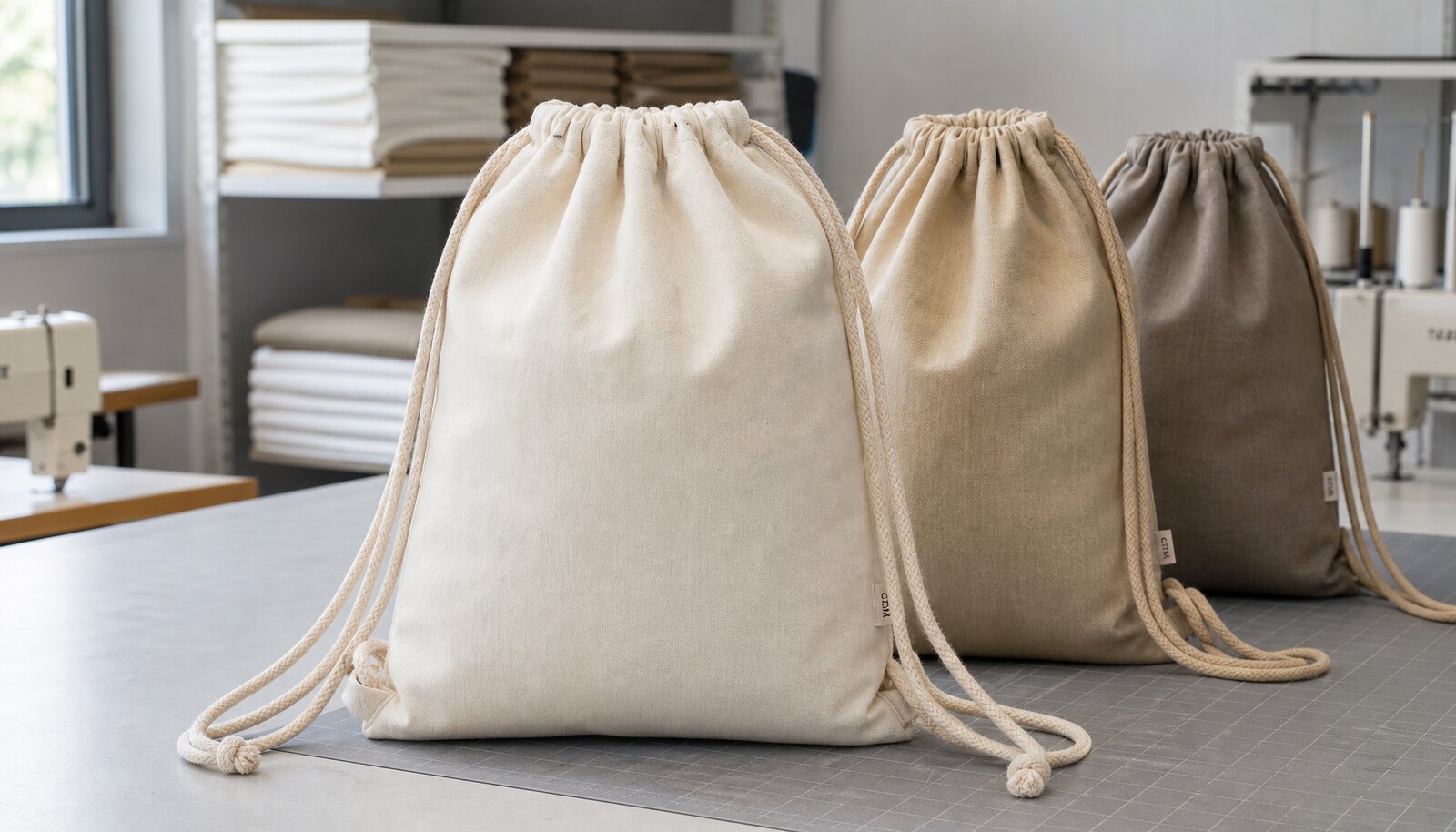
Why fabric weight decides the whole buying decision
For boutique wineries, a cotton drawstring backpack is rarely just a giveaway. It might be a tasting room retail item, a wine club welcome pack, a seasonal gift bag, or a container for brochures and small accessories. That is why fabric weight is the first spec to settle. A lightweight bag can look neat on a counter but feel flimsy once it carries a bottle, a catalog, or a few merch items. A heavier bag costs more, but it improves structure, print clarity, and perceived value, which matters when the bag sits beside premium wine packaging.
The mistake most buyers make is asking for cotton drawstring backpacks before deciding the use case. That produces quote drift because one supplier prices a promotional 140 GSM bag while another quotes a retail-grade 240 GSM version with better cord, stronger seams, and cleaner finishing. For a winery program, the right answer is usually a middle weight that feels substantial without becoming overbuilt. If the bag is mainly for club gifts or retail merchandising, the fabric has to support repeated handling, not just one event handout.
- Use case first, then GSM: giveaway, retail, club pack, or event kit.
- Heavier fabric raises unit cost but also raises shelf value and durability.
- The same artwork can look very different on 160 GSM versus 240 GSM cotton.
Picking the right GSM band for winery use
A practical starting point is 140 to 180 GSM for lightweight promotion, 200 to 240 GSM for most boutique winery programs, and 260 to 320 GSM only when the bag is expected to feel premium or carry heavier contents. In the winery space, 200 to 240 GSM is often the best balance. It gives enough body for screen printing and avoids the limp look that cheapens a retail presentation. If the bag will carry glass bottles or be reused as a travel or picnic bag, move upward in weight and reinforce the seams.
Do not treat GSM as the only fabric decision. Weave density, yarn quality, bleaching, and pre-shrinking change how the bag feels in hand and how it behaves after production. A 220 GSM bag made from loosely woven cotton can still look soft and saggy, while a tighter weave at the same GSM can look cleaner and print better. For buyer comparison, ask for the fabric description in full, not just the weight number. Good quotes should state whether the cloth is natural, bleached, dyed, pre-shrunk, or brushed, because each version affects cost and finish.
- 140 to 180 GSM: best for budget promotions and low-content inserts.
- 200 to 240 GSM: strongest fit for winery merch, club gifts, and repeat use.
- 260 to 320 GSM: use when the bag must feel premium or support heavier loads.
- Request fabric construction details, not GSM alone.
Construction details that change cost and performance
A buyer can usually control the price more by changing construction details than by chasing a small fabric discount. Bag dimensions, gusset depth, cord thickness, and reinforcement all alter sewing time and material usage. A flat 34 by 42 cm bag is simpler and cheaper than a gusseted bag with a reinforced base. If the winery wants to fit a catalog, tasting notes, a corkscrew pouch, or a small bottle, a gusset is worth the upgrade because it gives the bag usable volume instead of just a flat profile. In many cases, a narrow gusset is enough to improve utility without creating a large price jump.
Cord choice is another quiet cost driver. Thicker cotton cord improves comfort on the shoulder and looks more premium, but it can require a wider channel and more sewing time. Eyelets, metal tips, double stitching, and inner lining all add labor and can move the quote more than expected. Buyers should compare supplier quotes only after freezing the basic structure. Otherwise, one supplier may look expensive simply because they included reinforcement that another supplier left out. Ask for the construction drawing or measured spec sheet so you can compare apples to apples.
- Fix bag size and gusset before comparing unit prices.
- Thicker cord improves handfeel but increases sewing and material cost.
- Reinforcement at stress points matters more than decorative extras for reuse.
Print and branding choices that affect quote quality
For most boutique winery programs, one-color or two-color screen print is the cleanest value. It gives strong logo opacity on natural cotton and keeps the quote manageable. If the artwork is detailed, includes gradients, or needs photographic quality, heat transfer can work, but it adds process sensitivity and can feel less integrated into the fabric. Embroidery looks premium on a retail shelf, yet it is usually better on a thicker bag and can distort lightweight cotton if the stitch area is too large. Woven labels and side labels are often the best way to add brand identity without pushing the print area too hard.
The buyer should decide whether the logo is supposed to be a sales tool, a retail product mark, or a subtle brand sign-off. That choice affects placement and print size. A large front logo is easy to see in the tasting room, but a woven side label can feel more upscale for retail. If the art has thin lines or small text, the factory needs a real production file with minimum stroke guidance. Ask the supplier to confirm the exact print method on the quote, then approve a pre-production sample with the same ink, the same fabric color, and the same curing process.
- Screen print is usually the lowest-risk option for simple winery logos.
- Heat transfer fits more detailed art but needs tighter process control.
- Embroidery and woven labels support premium positioning, not lowest cost.
- Fine text and thin lines need print limits stated in the RFQ.
How to compare supplier routes without comparing bad quotes
The quote problem is usually a sourcing problem. Direct factories can give better cost control and better construction visibility, but only if they are set up for cut-and-sew plus print under one roof or tightly managed partners. Trading companies can simplify communication and consolidate multiple products, yet they may hide the real factory and widen the margin. Local print shops are useful for rush tests and small runs, but they often lack control over base bag quality and repeat supply. For a winery program that may reorder across seasons, the safest route is the one that can reproduce the same bag consistently, not just the lowest initial sample cost.
The right decision depends on volume, art complexity, and how much variation the buyer can tolerate. A single-logo wine club bag can often move through a direct factory with minimal risk. A mixed pack with inserts, barcodes, and retail labeling may justify a more service-oriented sourcing route if it reduces internal labor. What matters is that the supplier states the exact production path. If the bag body comes from one mill, the cord from another, and the print from a third party, you need to know who owns quality if the final cartons fail inspection.
- Direct factory is best when you need cost control and repeatability.
- Trading companies help with coordination but can obscure cost structure.
- Local decoration is good for fast samples, not always for bulk consistency.
- Mixed production paths need clear accountability in the quote.
What a useful quote should include line by line
A quote for cotton drawstring backpacks should separate the base bag, fabric weight, print method, packing method, and any add-ons. Buyers should not accept a flat unit price with no breakdown. The line items matter because the cheapest-looking quote often excludes the parts that create trouble later, such as extra color changes, barcodes, carton markings, or folded-inserts. If the bag is for retail or distributor delivery, the quote should also state the carton count, carton dimensions, and gross weight so the logistics team can plan shipping and warehousing correctly.
The most useful quote also notes tolerances and assumptions. If the supplier assumes one print location, one artwork file, and one polybag style, that should be visible. If the buyer wants a hangtag or a sewn side label, that should appear as a separate line. Keep the spec sheet close to the price request so every supplier prices the same job. This is the simplest way to expose hidden variation before it reaches production.
- Base bag price should be separated from print, label, and packing charges.
- Carton size and gross weight should be quoted for logistics planning.
- Any color change, extra label, or insert should be priced as a separate line.
- Assumptions and tolerances must be written into the quote.
Sample approval and QC thresholds that stop expensive mistakes
A sample is only useful if it represents the real bulk build. A hand-made approval piece that uses a different fabric or a different print route can hide the very issues the buyer needs to catch. For winery programs, the pre-production sample should use the same GSM, same cord, same print method, and same label attachment as the planned bulk run. Look at seam finishing, bag symmetry, logo placement, and how the fabric sits after folding. If the sample feels too light or too stiff, do not assume bulk production will correct it by itself. That difference usually gets worse, not better.
The QC threshold should be written in measurable terms. For example, the bag should hold the planned load without seam failure, the print should remain legible after moderate rub testing, and the finished size should stay within the agreed tolerance. If the bag will be reused by customers, shrinkage and color fastness matter more than they do for one-time promo items. A factory that can provide in-process photos, a top-of-production sample, and a final carton photo gives the buyer a much better chance of catching problems before shipment.
- Approve the same fabric, cord, print, and label that will be used in bulk.
- Define load, size, and print acceptance in measurable terms.
- Use top-of-production and final carton photos for visibility before ship-out.
- Do not approve a sample that hides a cheaper bulk construction.
Packing choices for retail shelves and distributor cartons
Packing is not a minor detail when the bags are entering retail channels or fulfillment centers. A loose bulk pack may be fine for internal storage, but a winery retail program usually needs clean folding, consistent polybagging, and clear carton labels. If the bags are sold as merch, the fold and presentation matter because customers see the package before they handle the product. If the bags are going into e-commerce or distributor inventory, barcodes, carton counts, and moisture protection need to be specified in advance. Every packing change has a labor cost, so it is better to price it before the order is placed than to negotiate it after production starts.
The buyer should also think about how the bag will sit next to bottles, gift sets, and tasting-room displays. A cotton drawstring backpack with a neat fold and a clean side label can look retail-ready without a large packaging budget. If the bag needs an insert card, care label, or hangtag, make sure the factory knows the exact position and insertion method. Small errors in packout create warehouse rework, which is usually more expensive than the packaging itself.
- Specify fold style, polybag type, and carton label format early.
- Retail or e-commerce programs need barcode and count accuracy.
- Insert cards and hangtags should be quoted as labor, not assumed freebies.
- Moisture protection matters for cotton stored long before resale.
Lead time planning and where schedules usually slip
Lead time on cotton drawstring backpacks is rarely just a sewing timeline. It includes fabric sourcing, dyeing or bleaching if needed, print setup, sample approval, packing, and carton booking. A buyer can lose a week simply by changing the artwork after the sample has already been approved. Another delay appears when the factory has to source a non-standard cord color or a special label. For a winery program tied to a seasonal release, the safest schedule is the one that fixes fabric and artwork early, then protects the approval window from late changes.
A realistic planning approach is to separate the schedule into sample, pre-production, bulk, and shipment steps. The sample stage should reveal structural problems, not cosmetic ones only. The pre-production stage should lock the exact fabric and print. Bulk should not start until the buyer has written approval on the approved sample or reference photo. If the order must land by a retailer receiving date, build buffer time for inspection and freight movement. Fast schedules usually fail because the buyer compresses every decision into one step instead of controlling them in sequence.
- Artwork changes after sample approval are a common schedule slip.
- Non-standard cords, labels, or fabrics extend the lead time.
- Separate sample, pre-production, bulk, and shipment in the plan.
- Build buffer for inspection and freight, not just sewing time.
Landed cost is where the real decision gets made
The unit price on the quote is only one part of the decision. A higher-cost factory can still win if it reduces rework, gives cleaner packing, and shortens the internal time your team spends fixing specs. For boutique winery buyers, the landed cost should include the bag, print, labels, packing, inspection, inland handling, freight terms, and any import duty or brokerage exposure depending on the route. If one supplier prices a low-cost blank bag but your team must arrange local decoration and repacking, the apparent savings can disappear quickly.
For comparison, use the same commercial terms across suppliers. EXW, FOB, and DDP are not interchangeable, and they can make a quote look cheaper or more expensive than it really is. The best practice is to compare total delivered cost to the destination you actually use, whether that is a warehouse, distributor, or fulfillment center. If the winery program is likely to reorder, also look at the supplier's ability to repeat the same spec at the same GSM and print setup. The first order sets the template; the second order reveals whether the supplier can really run the program.
- Compare delivered cost, not just factory unit price.
- Use the same Incoterms across all quotes.
- Include import, freight, inspection, and rework exposure in the comparison.
- Repeat order reliability is part of landed cost.
Specification comparison for buyers
| Spec decision | Recommended option | When it fits | Buyer risk to check |
|---|---|---|---|
| Best sourcing route for a simple one-color winery logo | Direct factory with in-house screen printing | Runs of 1,000 pcs or more with one or two art placements | Ink coverage, registration tolerance, and whether the factory controls print curing in-house |
| Best sourcing route for a premium retail feel | OEM factory with combed cotton and woven side label | Gift shop merch, wine club welcome packs, or higher-margin retail packs | Whether the label is sewn cleanly and the fabric handfeel matches the quoted GSM |
| Best sourcing route for the lowest MOQ | Trading company or multi-supplier sourcing desk | Test orders, first-season launches, or assortments split across colors | Hidden markups, weaker spec control, and whether the true mill or factory is disclosed |
| Best sourcing route for the fastest sample | Blank stock bag plus local print partner | When the buyer needs pre-production samples within days rather than weeks | Color shift, print placement drift, and whether bulk production can match the sample route |
| Best sourcing route for strict shade control | Factory with pantone-managed dyed fabric and lab dip approval | Programs that need a consistent brand color across reorder waves | Batch-to-batch shade variation and whether the factory keeps shade bands on file |
| Best sourcing route for mixed SKU club packs | Factory with cut-make-trim flexibility and carton-level SKU sorting | Wine club kits that combine backpack, insert card, and pouch or bottle accessory | Packing errors, mixed counts per carton, and missing inserts |
| Best sourcing route for complex packaging | OEM factory with in-line polybagging, barcode labeling, and carton marking | Retail-ready shipments to a distributor or fulfillment center | Whether the packout is quoted as a real line item instead of a vague free service |
| Best sourcing route for a reorder with tight lead time | Local decoration on imported blanks or a factory with reserved capacity | Replenishment for a proven style with fixed size and print layout | Blank availability, repeatability of the base bag, and rush surcharge exposure |
Buyer checklist before sampling
- Define the end use first: tasting room giveaway, wine club welcome pack, retail merch, or event gift bag. The use case determines the right GSM, size, and print method.
- Lock the bag size, gusset, cord length, and whether the program needs a single bottle or multi-item carry target.
- Choose a GSM band before asking for quotes so suppliers do not quote different fabrics that cannot be compared.
- Specify print method, print area, and number of colors. If the artwork is detailed, state whether halftones or fine lines are allowed.
- Request a pre-production sample, bulk photo proof, and packing method before approving the order.
- Ask for exact carton count, carton size, and gross weight if the goods will ship to a fulfillment center or distributor.
- Confirm shrinkage allowance, stitch reinforcement, and load target so the bag does not fail after first use.
- Collect the same quote data from every supplier, including Incoterms, lead time, and any surcharge for labels, inserts, or barcode stickers.
Factory quote questions to send
- What cotton GSM do you recommend for this use case, and is it single-layer or double-layer fabric?
- Is the price based on direct screen print, heat transfer, embroidery, or woven label, and what does each option change in the unit cost?
- What are the exact bag dimensions, cord diameter, gusset depth, and reinforcement method at the stress points?
- What is your MOQ by color and by print version, and what happens to pricing if I split the order across two shades?
- Can you send a pre-production sample with the final fabric, cord, print, and label, not a hand-made mockup?
- What QC checks do you run on fabric weight, color tolerance, seam strength, and print adhesion before shipment?
- How are bags packed per polybag and per carton, and can you add barcode stickers or retail inserts?
- What is the production lead time after sample approval, and what parts of the schedule are at risk if artwork or fabric is changed?
Quality-control points to confirm
- Fabric GSM should match the approved band within a reasonable factory tolerance, not a vague description like medium weight.
- Stitching at the drawstring channel, side seams, and bottom corners should be even, secure, and free from skipped stitches.
- Printed logos should stay within the agreed placement window and retain legibility after rubbing and folding.
- Cord ends should be neatly finished so they do not fray or pull back into the channel during use.
- Final bag dimensions should stay within the approved tolerance so retail packs and carton counts remain accurate.
- A pull or load test should reflect the actual use case, especially if the bag will carry bottles, merch, or heavier tasting-room kits.
- Shrinkage after wash or steam exposure should be understood before bulk approval if the buyer expects a reusable retail bag.
- Carton packout should match the purchase order exactly, including color splits, inserts, labels, and master carton marking.