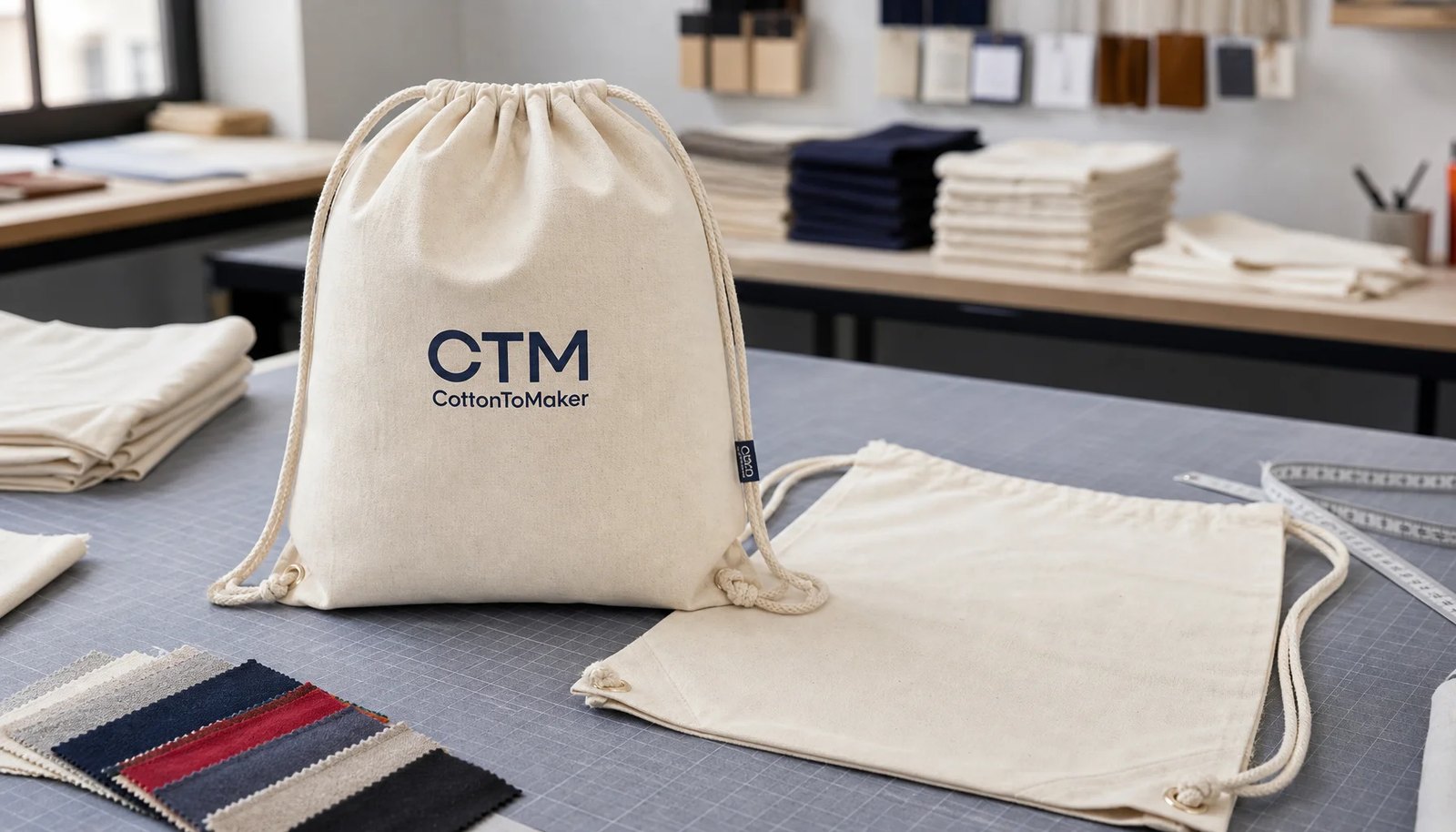
Start With the Bookstore Use Case
Wholesale cotton drawstring backpacks for university bookstores sit between promotional bags and retail accessories. They may be sold on a shelf, bundled with hoodies, used for orientation, or packed into admissions kits. The same basic shape can be built very differently depending on whether the buyer wants the lowest event cost or a product that feels worth buying at campus retail price.
The first sourcing mistake is quoting a bag without defining the use case. A 4 oz natural cotton backpack may be acceptable for a one-day orientation handout, but it will feel thin beside apparel and drinkware in a bookstore. A 10 oz canvas version may feel premium, but it adds fabric cost, carton weight, and freight cost. Procurement should lock the intended carrying load, retail positioning, and packaging before comparing supplier quotes.
- For bookstore retail: consider 6 oz to 8 oz cotton canvas with clean stitching and stronger drawcords.
- For orientation or welcome kits: 5 oz to 6 oz cotton can work if the logo is simple and the load is light.
- For alumni or gift programs: heavier canvas, woven label, hangtag, and better carton separation improve perceived value.
- For department orders: standardize fabric and size, then vary logo artwork to control MOQ and inspection complexity.
Specify Fabric Weight Before Price
Cotton drawstring backpack quotes can look close on paper while the actual bags feel very different. Fabric is usually described by ounces per square yard or GSM. A practical range for university bookstore programs is about 5 oz to 8 oz, roughly 170-270 GSM depending on weave and finishing. Natural cotton often appears heavier by hand than a loosely woven dyed fabric, so the quote should state both the weight and the fabric type.
Fabric weight affects print result, sewing stability, shrinkage behavior, carton weight, and landed cost. Lighter cotton can let ink show through and may wrinkle more inside retail cartons. Heavier canvas supports a cleaner print edge and better durability, but it can make a simple drawstring backpack too bulky if the size is small. The buyer should decide the acceptable hand feel before suppliers compete on price.
- Common budget range: 5 oz cotton for simple giveaway use with light contents.
- Balanced bookstore range: 6 oz to 8 oz cotton canvas for better shelf feel and print stability.
- Premium range: 10 oz canvas only when the retail price can absorb higher material and freight cost.
- RFQ wording: state fabric weight, weave, color, and whether recycled cotton content is required.
Choose the Print Method by Artwork Risk
Most bookstore cotton drawstring backpacks use screen printing because university marks are often spot colors and need consistent logo edges. Screen print is usually the safest method for one to four solid colors on cotton. It also gives a better unit cost for bulk orders after screens are made. However, each print color needs setup, alignment, curing control, and approval on the actual fabric shade.
Digital print and heat transfer can support gradients, small runs, and complex graphics, but they change the hand feel and durability profile. Embroidery gives a premium look but is not always suitable on thin drawstring backpack panels because dense stitching can distort fabric. For official university branding, the print proof should show color, placement, scale, and how the ink sits on the cotton surface, not just the logo file.
- Use screen print for flat campus logos, slogans, mascot graphics, and bookstore marks.
- Use heat transfer only when artwork complexity justifies a slightly different surface feel.
- Avoid dense embroidery on light cotton unless a sample proves the panel stays flat.
- Approve ink opacity on natural, black, navy, or custom dyed cotton separately.
Build a Proofing Standard That Production Can Follow
A print proofing checklist must be more than a visual approval email. The factory needs measurable information: print width, print height, distance from top edge, distance from side seams, Pantone references, fabric color, print side, and whether the drawcord should be inside or outside the photographed sample. Without these points, production teams may make a reasonable decision that still fails campus brand review.
For university bookstores, brand compliance often involves licensed marks and strict color rules. A PDF proof is useful for layout, but a physical strike-off is the safer approval tool when ink color, opacity, and fabric texture matter. The approved sample should be signed off with date, version number, and notes about any acceptable deviation. This protects both buyer and factory when bulk production begins.
- Record print placement from the finished bag edges, not only from the artwork file.
- Set a print placement tolerance, such as plus or minus 5 mm for standard front prints.
- Compare Pantone target against the printed fabric under stable lighting.
- Keep one approved sample at the factory and one with the buyer or inspection team.
Understand MOQ Logic Before Comparing Quotes
MOQ for cotton drawstring backpacks is not only about sewing quantity. It depends on fabric availability, dyeing requirements, print setup, cord material, label type, and packing. A supplier may accept a low MOQ for natural cotton in a standard size because fabric is available, but require a much higher MOQ for custom dyed fabric or special cord color. Comparing only the final unit price can hide these assumptions.
For multi-campus or multi-department programs, buyers can reduce MOQ pressure by keeping the same fabric, size, and construction across designs. Different logos can be handled as separate print screens while the sewing line remains consistent. This approach also makes inspection easier because the main physical product stays the same and only artwork and packing labels change.
- Lowest MOQ path: standard natural cotton, standard size, one-side screen print, bulk packing.
- Higher MOQ triggers: custom dyed fabric, custom cord, private label, special size, individual retail packing.
- Cost driver: every print color and print position can add setup cost even if unit quantity is small.
- Better RFQ method: ask for price breaks at 500, 1,000, 3,000, and 5,000 pieces using the same specification.
Sample Approval Should Test More Than the Logo
A good pre-production sample should be treated as a small production rehearsal. The buyer should review fabric weight, bag size, drawcord thickness, seam strength, corner reinforcement, print placement, print hand feel, and packing method. If the sample is only a blank bag plus a separate printed fabric swatch, it may not reveal distortion, seam alignment, or how the print looks on the finished front panel.
Sample comments should be written as production instructions, not general opinions. Instead of saying the logo is too low, state the required distance from the top edge. Instead of saying the cord feels cheap, state cotton cord, polyester cord, diameter, or approved reference sample. Factories can control measurable standards more reliably than subjective descriptions.
- Measure finished size flat after the drawcord channel is sewn.
- Pull the drawcord several times to check channel friction and corner stress.
- Rub the printed area with a dry white cloth after curing to check obvious ink transfer.
- Photograph the approved sample with ruler, carton label sample, and artwork version.
Set QC Thresholds for Retail Acceptance
University bookstore buyers should define which defects are acceptable, which require sorting, and which require rejection. Cotton fabric naturally has small slubs, shade variation, and wrinkles, especially in natural or recycled blends. These should be distinguished from stains, holes, broken stitching, crooked prints, ink smears, and mixed logos. A clear defect standard reduces disputes during final inspection.
For retail shelves, visual defects matter more than they would for a low-cost giveaway. A slightly crooked print may become obvious when bags hang together in a display. Uneven drawcord lengths can make the product look poorly made even if the bag still functions. Inspection should sample across cartons and SKUs, not only the top carton provided at the factory.
- Critical defects: wrong logo, wrong university color, unsafe needle or metal contamination, mildew odor.
- Major defects: broken seam, severe stain, print cracking, print position outside tolerance, missing label.
- Minor defects: small cotton slub, slight wrinkle, minor thread end that can be trimmed.
- Retail threshold: front panel appearance should be clean enough for direct shelf display.
Packing Decisions Affect Receiving and Shelf Work
Packing is often treated as an afterthought, but it directly affects bookstore labor. Bulk packing may be fine for orientation kits where staff will unpack and distribute quickly. Retail programs may need individual polybags, belly bands, hangtags, barcode stickers, or carton-level SKU separation. These details should be in the RFQ because they change labor, material cost, carton size, and inspection steps.
For imported orders, cartons should protect cotton from moisture and crushing while staying practical for warehouse handling. Over-packed cartons can deform drawstring channels and create heavy boxes that are difficult to receive. Under-packed cartons waste freight space. The quote should list pieces per carton, carton dimensions, gross weight, net weight, and CBM so the buyer can compare landed cost.
- Bulk packing: lower cost and less plastic, suitable for event distribution.
- Individual polybag: better dust protection, useful for online bookstore fulfillment.
- Hangtag or barcode sticker: needed when the item enters retail POS inventory.
- Carton marks: include PO number, SKU, design name, quantity, destination, and carton count.
Lead Time Risk Comes From Approvals
The longest delay in cotton drawstring backpack orders is often not sewing. It is artwork approval, sample revision, fabric color approval, or late packing data. A realistic schedule separates artwork review, sample making, sample transit, buyer approval, material preparation, printing, sewing, finishing, inspection, and shipping handover. If all of these are shown as one production lead time, the buyer has no way to see where the risk sits.
Bookstore programs tied to orientation, homecoming, graduation, or semester start dates need buffer. Campus trademark approval can take longer than expected, especially when multiple departments are involved. Procurement should freeze artwork and packing data before the factory starts bulk printing. Reprinting after bulk production is one of the most expensive mistakes in this category.
- Artwork preparation: allow time for vector cleanup, Pantone confirmation, and placement proof.
- Sample stage: plan for one physical sample plus one revision if the logo is sensitive.
- Bulk stage: printing and curing should not be rushed, especially on darker cotton.
- Shipping stage: confirm whether the required arrival date needs air, sea, truck, or split shipment.
Compare Quotes by Landed Cost, Not FOB Only
Two suppliers may quote the same FOB unit price while delivering different total cost. Fabric weight changes carton weight. Packing style changes carton volume. Individual polybags and hangtags add labor and materials. A heavier canvas bag may increase freight enough to affect the landed unit cost, especially for air shipments or small consolidated orders.
A useful quote should allow the buyer to build a landed-cost comparison. At minimum, request unit price, setup charges, sample charges, carton quantity, carton dimensions, gross weight, estimated CBM, Incoterm, payment terms, and lead time after approval. If a supplier cannot provide packing data before production, the buyer should treat the freight estimate as unstable.
- Separate one-time costs such as screens, sample fees, artwork handling, and label setup.
- Compare price breaks using identical fabric weight, size, print colors, and packing.
- Include inland freight, duty, customs brokerage, and final delivery when evaluating imports.
- For tight event dates, compare the cost of air freight against the cost of missing the selling window.
Specification comparison for buyers
| Spec decision | Recommended option | When it fits | Buyer risk to check |
|---|---|---|---|
| Direct factory sourcing for 3,000+ pieces | Use a cut-and-sew cotton bag factory with in-house or controlled screen printing | Best for bookstore programs with repeat orders, multiple campus logos, or strict packing needs | Confirm the factory controls fabric cutting, sewing, print curing, and final inspection instead of outsourcing all key steps |
| Local decorator plus imported blank bags | Buy blank cotton drawstring backpacks and print domestically | Useful for very urgent bookstore events or late logo approvals | Blank bag size, fabric shade, and drawcord quality may vary by lot, making reorders harder to match |
| Trading company management | Use only when they provide factory details, pre-production sample control, and inspection reports | Fits buyers who need consolidated products across bags, apparel, and stationery | Margin layers can hide fabric substitution, print outsourcing, and weak responsibility for defects |
| Fabric weight selection | 6 oz to 8 oz cotton canvas, roughly 200-270 GSM, for most university retail use | Balances hand feel, print coverage, shelf price, and carrying strength for books or campus merchandise | Very light 4 oz cotton can feel promotional rather than bookstore-grade and may show more print strike-through |
| Print method choice | Spot-color screen print for logos, slogans, and one to four solid brand colors | Best for official marks, bookstore graphics, orientation bags, and alumni merchandise | Pantone matching depends on fabric shade and ink opacity; approve a physical strike-off, not only a PDF |
| Low MOQ order route | Use existing fabric and standard size to keep MOQ practical | Fits pilot runs, limited campus events, or department-specific designs | Small quantities may carry higher print setup cost per unit and less flexibility on dyed fabric or custom cord |
| Premium retail route | Use heavier canvas, reinforced bottom corners, thicker drawcord, and retail-ready carton packing | Works for bookstore shelves, gift bundles, and higher perceived value programs | Higher fabric weight increases unit cost, carton weight, and freight; compare landed cost, not only FOB price |
| Multi-logo campus program | Group designs by fabric, size, and print method while separating artwork screens and packing labels | Useful for bookstores serving athletics, alumni, admissions, and department stores in one PO | Poor SKU mapping causes mixed cartons, wrong hangtags, and delays during receiving |
Buyer checklist before sampling
- Define the final backpack size, fabric weight, fabric color, drawcord type, and whether the bag needs reinforced corners before requesting prices.
- Provide editable vector artwork, Pantone references, logo placement dimensions, and maximum print area instead of only a low-resolution campus logo file.
- State expected use: bookstore retail, orientation giveaway, event merchandise, admissions kit, or alumni gift, because fabric and packing choices change.
- Request a physical pre-production sample or print strike-off on the actual cotton fabric before bulk printing.
- Set tolerance limits for bag size, print position, print color, fabric weight, and drawcord length in the PO or approved sample record.
- Confirm MOQ logic by fabric color, print color count, size, and packing style; do not compare quotes unless the same assumptions are used.
- Require carton marks, inner packing method, SKU separation, and barcode or hangtag needs before mass packing begins.
- Ask for a production timeline that separates material preparation, sample approval, printing, sewing, inspection, packing, and vessel or courier handover.
Factory quote questions to send
- What cotton fabric weight in oz and GSM is included in the quote, and is it plain cotton, canvas, recycled cotton blend, or dyed cotton?
- Is the quoted price based on standard stock fabric or custom dyed fabric, and what MOQ applies to each color?
- What print method is included: screen print, heat transfer, digital print, embroidery, or woven label?
- How many print colors, print positions, and artwork screens are included before extra charges apply?
- Can you produce a print strike-off on the actual bag fabric, and what is the sample fee and sample lead time?
- What are the size tolerance, fabric weight tolerance, and print placement tolerance used during inspection?
- Are drawcords cotton, polyester, PP, or blended cord, and what diameter or finished thickness is included?
- What packing is included: bulk polybag, individual polybag, belly band, hangtag, carton labels, or barcode sticker?
- What is the production lead time after sample approval, and what dates are at risk during local holidays or peak season?
- Can the quote separate EXW, FOB, carton dimensions, gross weight, and estimated CBM so landed cost can be compared?
Quality-control points to confirm
- Fabric weight should be checked from a cut swatch or finished panel and compared with the approved GSM tolerance, not judged only by hand feel.
- Finished bag dimensions should be measured flat after sewing, with tolerance agreed before production, commonly around plus or minus 1 cm for standard cotton drawstring backpacks.
- Print color should be reviewed under consistent light against approved Pantone target and physical sample, with allowance for the natural fabric base shade.
- Print adhesion should pass a basic rub test after curing; ink should not crack, powder, or transfer under normal handling.
- Drawcord channels, corner reinforcements, and bartack or stitch density should be checked because these points carry the load when students use the bag.
- Cartons should be inspected for SKU separation, quantity per carton, readable carton marks, and moisture protection suitable for ocean or truck movement.