Why Bakery Backpacks Need Real Procurement Specs
Wholesale cotton drawstring backpacks for artisan bakeries sit in an awkward place between packaging, merchandise, and brand experience. They may be sold on a retail shelf, packed with coffee and bread-making kits, used as staff welcome bags, handed out at farmers markets, or shipped to multiple bakery locations before a seasonal launch. In every case, the bag has to do more than carry a logo. It has to survive handling, look clean when opened, and feel consistent with the bakery’s price point.
That is why a bakery buyer should not source these bags as generic promo items. Two quotes can both say “cotton drawstring backpack, 34 x 42 cm, one-color logo” while describing very different products. One may assume 160 GSM cotton, narrow cords, single stitching, and bulk cartons. Another may include 300 GSM canvas, reinforced seams, 8 mm cotton cord, tested screen print, and a defined inspection plan. The product name is the same. The performance is not.
A strong RFQ turns vague language into measurable requirements. Instead of asking for a “durable natural cotton backpack,” state the target GSM, fabric type, finished piece weight, target load, seam construction, cord diameter, print method, packing method, and tests required before shipment. This keeps price comparisons fair and reduces the risk of approving a beautiful sample that cannot handle bakery boxes, dense coffee bags, or repeated cord pulling.
The most useful durability testing checklist is practical. It does not need to sound like a laboratory manual, but it should be repeatable. A loaded hang test should have a stated weight and time. A cord pull test should define what counts as failure. A print rub test should identify unacceptable transfer, cracking, tackiness, or blocking. These details protect the buyer, the supplier, and the bakery brand.
- Start with use case, expected contents, target load, and retail expectations before asking for price.
- Align fabric, finished weight, seam type, cord, print, packing, and inspection before comparing suppliers.
- Avoid relying on words such as premium, heavy duty, natural, or reinforced unless they are tied to measurable specs.
- Treat the approved sample as a production standard, not as a loose design reference.
Fabric Choices: GSM, Weave, Finish, and Weight Control
Fabric is the first durability decision, but GSM alone is not enough. For very short-term giveaways, 140-180 GSM cotton may be acceptable when the bag only carries light inserts or small samples. For light promotional bakery programs, 220-260 GSM is often a better starting point because it gives more body and opacity. For reusable retail merchandise, staff kits, and bakery bundles, 280-320 GSM cotton canvas or twill is usually a stronger specification. Going heavier can add a premium feel, but it can also increase freight cost, carton weight, stiffness, and closing resistance.
Weave changes the result. Plain cotton calico can support a rustic bakery look, but a loose weave may distort around stitching and reduce print sharpness. Canvas generally offers better body and abrasion resistance. Twill can feel smoother while staying stable enough for a reusable bag. Ask suppliers to name the construction rather than writing only “cotton.” A useful quote should state fiber content, weave, GSM, finish, color, and whether the fabric is natural, bleached, dyed, washed, softened, or otherwise treated.
Tolerance belongs in the purchase order. A common commercial tolerance for cut-and-sew cotton goods is ±5% GSM when both sides agree, but buyers should add a second control: finished piece weight. Finished weight helps reveal real construction changes. If the approved sample weighs 145 g and bulk pieces average far lower, the difference may come from lighter cloth, smaller panels, thinner cord, narrower seam allowance, or missing reinforcement.
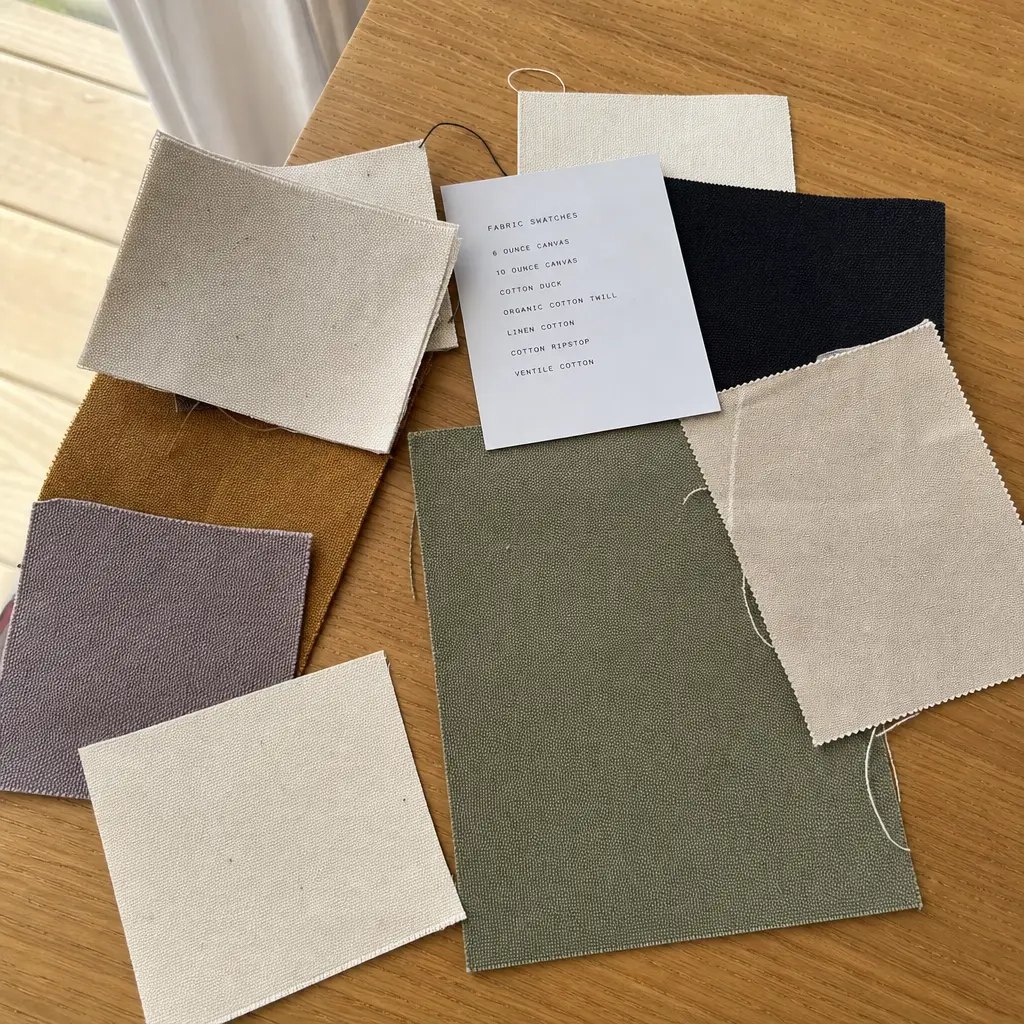
Natural cotton works well for artisan bakeries because it matches handmade, organic, and farm-to-table positioning. It may also show seed specks, slubs, and shade variation. These can be acceptable, but only when the buyer approves a physical standard. Photos are not enough. Dyed cotton brings other issues: lab dip approval, bulk shade variation, crocking, shrinkage, and possible print adhesion concerns from finishing chemicals. For dyed programs, approve a lab dip before the printed pre-production sample.
- Specify fiber content, weave, target GSM, GSM tolerance, finish, shade standard, and accepted natural cotton characteristics.
- Use 220-260 GSM for lighter promotional programs and 280-320 GSM for stronger reusable bakery merchandise.
- Record finished piece weight from the approved sample and set a realistic inspection tolerance.
- Judge natural shade, seed specks, slubs, and weave variation against a physical swatch, not a screen image.
- Request lab dips and colorfastness expectations before bulk cutting dyed cotton.
Size and Load Mapping for Bakery Contents
A common drawstring backpack size, such as 34 x 42 cm, can be a sensible starting point. It should not be the final decision until the buyer tests actual contents. Bakery items are often bulky, stiff, or dense. A pastry box stresses bottom corners differently from a T-shirt. Coffee and flour pull downward in a concentrated way. A ceramic mug can create pressure points. The bag may pass a simple weight check and still be frustrating to pack if the opening is too tight.
Build the specification around the contents. Measure the largest box length, width, and depth. Add the height of the full bundle if the backpack will carry several items. Then check the usable opening width, not just the finished flat width. The drawcord channel reduces the practical mouth of the bag, and a thick cord can make the opening feel narrower. During a holiday launch, retail staff may need to pack dozens or hundreds of bags quickly. A tight opening becomes a labor issue, not just a design detail.
Set the load target in kilograms and connect it to the use case. A 3 kg target is suitable for many light promotional programs. A 5 kg target is a stronger benchmark for reusable retail backpacks expected to carry coffee, flour, mugs, apparel, or multiple baked-goods boxes. The target is not a promise that every customer will carry exactly that weight. It gives the factory a design basis for fabric, seam allowance, stitch density, cord diameter, and reinforcement.
Stress points deserve special attention. Box corners press into bottom seams. Dense retail items pull at corners. Customers may lift a loaded bag by one cord. The RFQ should identify the areas that must be checked: bottom corners, side seams near the top channel, cord exits, channel seams, label seams, and any pockets. Reinforcement does not need to look industrial. Folded seams, double-needle stitching, secure backtacking, bar tacks, and adequate seam allowance can be enough when tested properly.
- Measure the largest bakery box or full merchandise bundle before confirming the finished bag size.
- Check usable opening width with the intended contents, not only the empty flat bag.
- Use 3 kg for light promotional programs and 5 kg for stronger reusable retail or staff-kit programs when appropriate.
- Map stress points at bottom corners, upper side seams, cord exits, channel seams, labels, and pockets.
- Avoid adding metal grommets unless the supplier can prove clean setting, no rust risk, and no fabric cutting under load.
Seam Construction That Survives Pulling and Corners
Many weak cotton drawstring backpacks fail at the seams, not in the middle of the fabric. A sample can look neat on a table and still open once it is loaded, pulled, or packed with boxes. For bakery use, side seams should generally be double-needle stitched or otherwise reinforced. Raw edges should be overlocked, folded, bound, or securely finished. Bottom corners need extra care because boxes, coffee bags, and dense bundles press directly into them.
The RFQ should describe each construction area: side seams, bottom seam, upper channel, cord exits, labels, pockets, and reinforcement points. Ask the factory for planned seam allowance and stitch density, using stitches per inch or stitches per 3 cm depending on their normal system. There is no universal stitch count that fits every fabric, but inconsistency is a red flag. Skipped stitches, broken thread, loose ends, poor backtacking, and uneven seam allowance should not pass inspection.
Bar tacks can be useful at cord exits, upper side seams, and other high-stress areas. Placement matters. A bar tack too close to an edge can weaken the fabric. Too much dense stitching through multiple layers can create puckering or stiffness. Buyers should judge reinforcement by performance after testing, not by the fact that a bar tack appears on a sample.
Repeat orders need documentation. A signed golden sample is helpful, but written specifications and close-up photos make the standard easier to repeat. Keep records of seam construction, finished piece weight, cord details, print method, and packing fold. If the bakery runs a holiday program every year, these details prevent quiet downgrades in later production.
- Require construction details for side seams, bottom corners, upper channel, cord exits, labels, and pockets.
- Use double-needle or otherwise reinforced seams for reusable retail and staff-kit programs.
- Inspect seam allowance, raw-edge finishing, stitch density, backtacking, skipped stitches, broken thread, and seam slippage.
- Use bar tacks at real stress points and confirm their value through load and cord-pull tests.
- Photograph approved seam details and keep them with the golden sample for repeat orders.
Cord System: Comfort, Strength, and Channel Fit
The drawcord system takes constant handling. Customers pull the cords to close the bag, wear them over the shoulder, hang the bag from hooks, and sometimes lift the full load by one cord. A thin promotional cord can save cost, but it may feel sharp, fray early, cut into the channel, or make the backpack feel cheaper than the bakery’s brand position.
For many artisan bakery merchandise programs, 8-10 mm cotton cord is a strong starting point. It looks natural and pairs well with ecru canvas. Cotton-poly or polyester cord may offer better abrasion resistance and tensile strength while still fitting the brand if the texture and color are chosen carefully. If the buyer plans to make material claims, clarify whether “cotton” applies to the bag body only or also to the cord.
Cord diameter and channel height need to work together. A thick cord in a narrow channel creates drag and stresses the top seam. A thin cord in a wide channel can twist, tangle, or close unevenly. The pre-production sample should confirm channel height, cord diameter, cord length, routing pattern, and comfort on the shoulder. The bag should close smoothly without excessive force.
End treatment is a small detail until it fails. Unfinished cotton cord can fray during packing or early use. Knots are common, but they must be tight and stable. Sewn tips, wrapped ends, aglets, or heat-sealed synthetic ends may be better depending on material and brand style. During inspection, check for loose fibers, slipping knots, missing tips, inconsistent length, staining, and uncomfortable edges.
- Specify cord material, diameter, color, length, routing, hand feel, and end treatment.
- Use 8-10 mm cord for many reusable bakery programs unless sample testing supports another size.
- Match channel height to cord diameter so opening and closing remain smooth after repeated use.
- Test cord pull with the bag loaded and inspect top corners, channel seams, knots, and cord exits.
- Reject cords that look acceptable in photos but feel sharp, fray early, or distort the channel.
Logo Durability and Print Approval
Branding is often the reason the bakery orders the backpack, so the print should not be treated as decoration alone. Screen printing is usually the best starting point for one-color to three-color bakery logos on natural cotton canvas or twill. It is familiar, scalable for wholesale quantities, and visually consistent with artisan branding. Still, print durability depends on fabric texture, ink selection, ink thickness, curing time, curing temperature, and packing conditions.
Artwork should arrive as vector files with Pantone or other color references, final print size, placement from top and side edges, and registration tolerance. Fine text can fill in on textured cotton. Large ink blocks can feel stiff or crack if the deposit is too heavy. If the bakery logo includes a distressed effect, the artwork file should make clear which marks are intentional. Agree on minimum readable text height before sampling; a small tagline that looks sharp in a PDF may blur on canvas.
Heat transfer can work for detailed graphics, gradients, or smaller orders, but it needs testing. Check edge lifting, peel resistance, folding, rubbing, shine, and pressure marks. Embroidery can feel premium and last well, but lighter cotton may pucker unless the fabric and backing are appropriate. Woven labels or side tabs can also suit minimalist bakery branding when a large front print is not needed.
Request a printed strike-off on the final fabric before approving the full pre-production sample, especially for new artwork or dyed fabric. Rub the print with a clean dry white cloth. Bend and fold the printed area. Stack folded printed samples under pressure to check blocking, where print surfaces stick together. If bags are packed soon after printing, confirm that curing and cooling time are complete before carton packing.
- Use screen printing for solid bakery logos, spot colors, and repeat wholesale orders.
- Require vector artwork, color references, print size, placement, registration tolerance, and minimum readable text size.
- Approve heat transfer only after edge-lift, peel, fold, rub, shine, and pressure checks.
- Use embroidery only when fabric weight and backing prevent unacceptable puckering.
- Test print on final bulk fabric, not a substitute swatch with a different finish or weave.
MOQ, Price Drivers, and Fair Quote Comparison
MOQ is rarely just a quantity. It is tied to fabric availability, dyeing minimums, cutting yield, cord color, cord diameter, print method, print color count, packaging, carton plan, and inspection scope. Standard natural cotton with a simple one-color screen print can often be easier to quote than custom dyed fabric, nonstandard sizing, special cord color, multi-color artwork, or retail-ready individual packing.
Normalize every quote before making a cost decision. If three suppliers quote a 34 x 42 cm cotton drawstring backpack, compare target GSM, finished piece weight, seam construction, cord diameter, print system, packing method, carton quantity, and QC responsibilities. A 220 GSM single-stitched bag is not the same product as a 300 GSM canvas bag with double-needle seams and 8 mm cord, even if both carry the same logo.
Ask suppliers to expose cost drivers. Heavier fabric increases material cost and freight. Custom dyeing adds lab dip approval, dyeing time, shade risk, and possible mill minimums. Larger panels affect cutting yield. More print colors add screen setup and registration work. Individual packing adds material, labor, and waste-management considerations. Smaller carton quantities may protect the product better but can increase freight volume.
The best comparison is landed cost per approved sellable bag. A cheaper unit price may become expensive if the lot fails inspection, arrives with print transfer, smells musty, or requires warehouse sorting. At the same time, the heaviest possible bag may be unnecessary for a one-day giveaway. The procurement goal is balance: enough durability for the intended use, without overbuilding the product.
- Ask suppliers to separate assumptions for fabric, sewing, cord, branding, packing, inspection, and freight.
- Confirm whether MOQ is driven by stock fabric, dyeing minimums, cord sourcing, print setup, or sewing-line setup.
- Compare finished piece weight and construction details across quotes, not only unit price and logo size.
- Treat unusually low prices as a prompt to verify GSM, seam allowance, cord diameter, and packing method.
- Evaluate landed cost per approved sellable bag, including inspection, rework, repacking, and delay risk.
Pre-Production Sample and Golden Sample Control
The pre-production sample should represent mass production. For wholesale cotton drawstring backpacks for artisan bakeries, that means final bulk fabric, final cord, final thread, final seam construction, final print or label method, and intended packing fold. A quick substitute sample can help discuss size or artwork placement, but it should not release bulk cutting or durability approval.
Document the sample like a control record. Measure finished width, finished height, usable opening width, channel height, cord diameter, cord length, print size, print position, fabric GSM, finished piece weight, seam construction, and packing method. Photograph bottom corners, side seams, upper channel, cord exits, print surface, labels, and folded packing condition. If the sample passes with comments, list each correction and how it will be verified.
Testing should use realistic bakery contents. A flat metal weight can confirm load, but it does not create the same corner pressure as a pastry box or the same dense pull as coffee and flour. Fill the sample with actual contents or close substitutes, then run the loaded hang, short carry, cord pull, open-close, and print fold checks. If the printed logo sits on a fold line, inspect it after packing pressure.
Keep one signed golden sample for inspection and repeat orders. The factory should also retain a matched sample when possible. The purchase order should state that bulk production must match the golden sample within documented tolerances. Any change to fabric source, GSM, cord, thread, print method, packing, or seam construction should require buyer approval before production continues.
- Approve a physical sample made from final fabric, cord, thread, print, seam construction, and packing fold.
- Record dimensions, usable opening, fabric GSM, finished piece weight, cord details, print placement, and tolerances.
- Test with actual or equivalent bakery contents, including bulky boxes and dense retail items.
- Keep a signed golden sample for inspectors, warehouses, and repeat-order comparison.
- Do not release bulk cutting while material substitutions or unresolved sample corrections remain open.
Durability Testing Checklist for Bulk Readiness
Durability testing should be written into the PO, sample approval form, or inspection checklist. The tests do not need to be complex for every order, but they must be repeatable. For bakery programs, the most useful checks are loaded hang, short carry, cord pull, open-close cycling, seam inspection, print rub, fold pressure, basic abrasion review, odor check, and packing pressure review.
For the loaded hang test, fill the bag to the agreed target, commonly 3 kg for light promotional use or 5 kg for reusable retail use. Hang the loaded bag by the cords for the agreed time. Then inspect bottom corners, side seams, top channel, cord exits, and fabric around stress points. Failure should be clearly defined: stitch popping, seam opening, fabric tearing, channel ripping, cord breakage, severe permanent distortion, or inability to close afterward.
Cord pull and open-close tests check how the cord, channel, and top seams work together. Pull both cords firmly several times while the bag is loaded, then open and close the bag through an agreed number of cycles. For smaller orders, 20-30 manual cycles on sample pieces can reveal obvious abrasion or binding. For higher-value programs, the buyer may request a higher cycle count or third-party testing. Inspect for fraying, flattened cord, slipping knots, loose tips, channel wear, and uneven closure.
Print checks should match the branding method. For screen print, rub with a clean dry white cloth, bend and fold the printed area, and check for smearing, crocking, tackiness, cracking, or blocking. For heat transfer, add edge-lift and peel observations. For embroidery, check puckering, loose thread, backing comfort, and fabric distortion. A packing pressure check is important because folded printed bags may sit in cartons for weeks before the bakery opens them.
Basic abrasion review is useful at the bottom corners. Place a loaded sample on a clean rough surface and move it lightly several times, then inspect scuffing, seam exposure, and corner wear. This is not a formal Martindale or Wyzenbeek test, but it helps buyers identify fragile construction early. Odor and moisture checks also matter, especially for natural cotton shipped by sea or stored before seasonal bakery launches.
- Loaded hang: 3 kg or 5 kg target with no stitch popping, seam opening, channel tear, cord failure, or corner damage.
- Cord pull: firm pulls without cord breakage, knot slipping, channel distortion, fabric tearing, or top-corner failure.
- Open-close cycling: smooth movement without binding, fraying, channel abrasion, or uneven closure.
- Seam inspection: consistent stitch density, secure backtacking, no skipped stitches, no loose ends, and no seam slippage.
- Print rub and fold: no unacceptable color transfer, cracking, tackiness, peeling, edge lifting, or blocking.
- Packing pressure: folded bags do not stick together, transfer ink, crush cords, or crease logos beyond the approved standard.
Final Inspection, Packing, and Shipment Release
Final QC should combine AQL sampling with product-specific functional checks. A generic visual inspection may catch stains, wrong quantities, and obvious logo problems, but it can miss weak channels, thin cord, poor print cure, and seam slippage. The purchase order should state inspection level, AQL limits, sample size, defect classification, measurement tolerances, functional tests, carton checks, and who pays for reinspection if the lot fails.
Defect classification should be agreed before production. Critical defects may include mildew, unsafe contamination, sharp metal parts if hardware is used, severe odor, or clearly wrong artwork. Major defects may include open seams, broken stitches at stress points, fabric GSM or finished weight outside tolerance, wrong size beyond tolerance, unreadable logo, print peeling, severe stains, missing cords, wrong cord diameter, or cartons too wet or crushed to ship. Minor defects may include small loose threads, slight shade variation within the approved range, or natural cotton specks already accepted in the standard.
Measurement checks should include finished width, finished height, usable opening, channel height, cord length, print placement, print size, carton quantity, and carton gross weight. Weight checks should include finished piece weight and, where possible, fabric GSM verification. Inspectors should compare bulk goods to the signed golden sample for shade, hand feel, print clarity, cord quality, seam construction, and packing fold.
Packing deserves its own review. Individual polybags may be needed for distributor handling, retail storage, e-commerce kitting, or multi-location shipment. Bulk packing, recycled polybags, paper bands, or belly bands may be better when waste reduction is a priority. Whatever the method, cartons must protect cotton from moisture, dirt, odor, crushing, and print transfer. Inspection photos should show stress points, print rub cloths, failed samples, carton labels, carton condition, and reworked goods if any.
- Use AQL plus backpack-specific functional tests, not visual inspection alone.
- Define critical, major, and minor defects before bulk production starts.
- Check finished size, usable opening, piece weight, cord length, print placement, seam quality, carton count, and carton gross weight.
- Compare against the signed golden sample for fabric shade, hand feel, print, cord, construction, and packing fold.
- Require inspection photos of stress points, print rub results, failed samples, carton labels, moisture condition, and reworked goods.
Specification comparison for buyers
| Spec decision | Recommended option | When it fits | Buyer risk to check |
|---|---|---|---|
| Fabric weight | 220-260 GSM for light promotional use; 280-320 GSM cotton canvas or twill for reusable bakery merchandise | Giveaways, staff kits, loyalty rewards, retail shelves, holiday bundles, and moderate daily carry | Below 220 GSM may look acceptable in photos but fail on seam slippage, print show-through, bottom abrasion, or perceived value |
| Fabric tolerance | Agree GSM tolerance before ordering, often ±5% only when both buyer and factory approve it; record finished piece weight tolerance separately | Buyers comparing suppliers or repeating the same bakery backpack program | A supplier can keep the same nominal GSM while reducing panel size, cord thickness, seam allowance, or reinforcement |
| Fabric finish | Natural/ecru cotton matched to an approved swatch, or dyed cotton controlled by lab dip and bulk shade standard | Rustic bakery branding, organic positioning, farm-to-table programs, or custom brand-color merchandise | Natural cotton may show seed specks and slubs; dyed lots may vary, and some finishes can affect ink adhesion or colorfastness |
| Bag size | Common starting point: 34 x 42 cm, adjusted after testing the largest bakery box or merchandise bundle | Pastry boxes, coffee bags, aprons, recipe cards, flour packets, mugs, branded apparel, and retail add-ons | Flat measurements do not confirm usable opening; bulky boxes may catch under the drawcord channel |
| Load target | 3 kg for light promotional programs; 5 kg for stronger reusable retail or staff-kit programs | Procurement teams that want objective pass/fail durability checks | If the target load is unstated, factories may quote lighter fabric, narrower cord, smaller seam allowance, or fewer reinforcement stitches |
| Seam construction | Double-needle side seams, secure folded or overlocked raw edges, reinforced bottom corners, strong cord channel, and bar tacks at stress points | Orders expected to carry dense bakery products, coffee, flour, ceramic mugs, or repeated customer reuse | Single stitching can look clean on a sample table but open when cords are pulled sharply or box corners press into bottom seams |
| Drawcord material | 8-10 mm cotton cord for a natural look, or cotton-poly/polyester cord when higher abrasion resistance is required | Premium bakery merchandise, staff bags, market kits, and reusable customer bags | Thin cord can cut into the channel, feel uncomfortable on shoulders, fray early, or create customer complaints |
| Branding method | Screen print for solid spot-color logos; heat transfer only after peel, rub, and fold tests; embroidery only on fabric heavy enough to resist puckering | One to three spot colors, natural cotton panels, minimalist bakery logos, and wholesale quantities | Thick ink can crack on loose weave; transfers can peel; embroidery can distort light panels |
| MOQ structure | Quote MOQ against the exact fabric, color, size, cord, print colors, packing method, and inspection scope | Buyers comparing stock natural cotton, dyed cotton, custom sizing, and retail packing options | A low MOQ may rely on stock fabric substitutions, shared dye lots, thinner cord, simplified packing, or reduced QC |
Buyer checklist before sampling
- Define the commercial use: paid retail merchandise, customer loyalty gift, staff welcome kit, holiday bundle, farmers market giveaway, franchise opening pack, or distributor program.
- List the contents the bag must carry, including dimensions and approximate weight of pastry boxes, coffee bags, flour packets, aprons, mugs, recipe cards, or apparel.
- Set the target load in kilograms, such as 3 kg for light promotional use or 5 kg for stronger reusable bakery programs.
- Specify fiber content, weave, target GSM, accepted GSM tolerance, fabric finish, shade standard, and whether seed specks, slubs, or weave variation are acceptable.
- Request finished piece weight per bag and agree a tolerance so bulk production cannot silently shift to smaller panels, lighter fabric, thinner cord, or missing reinforcement.
- Confirm finished width, finished height, usable opening width, seam allowance, cord channel height, cord diameter, cord material, cord length, and cord-end treatment.
- Send vector artwork with Pantone or color references, print size, print position from top and side edges, registration tolerance, and minimum readable text height.
- Require written construction details for side seams, bottom corners, upper channel, cord exits, labels, pockets, bar tacks, reinforcement stitches, and raw-edge finishing.
- Approve one physical pre-production sample made with final bulk fabric, final cord, final ink or transfer, final thread, final sewing method, and intended packing fold.
- Run loaded hang, cord pull, open-close cycling, seam review, print rub, fold pressure, odor, moisture, and carton compression checks before mass production release.
Factory quote questions to send
- What exact fiber content, weave, fabric finish, target GSM, GSM tolerance, and finished piece weight are included in the quoted unit price?
- Is the cotton natural, bleached, dyed, washed, softened, or chemically finished, and can that finish affect screen-print adhesion, hand feel, odor, or colorfastness?
- Can you provide fabric swatches, lab dips for dyed colors, and a printed strike-off on the final fabric before making the pre-production sample?
- What MOQ applies to this exact size, fabric color, cord color, cord diameter, print method, print color count, packing style, and inspection requirement?
- Which seams are single-needle, double-needle, overlocked, folded, bound, or reinforced, and where are bar tacks or extra stitch lines applied?
- What seam allowance and stitch density are planned for the side seams, bottom corners, upper channel, cord exits, and label attachment points?
- What drawcord material, diameter, length, color, and end treatment are quoted, and can the sample be tested for cord pull, fraying, and channel abrasion?
- Which branding method is quoted, how many colors are included, what ink or transfer system is used, and what curing time or temperature controls are applied?
- What print placement tolerance, registration tolerance, and minimum readable text size can you hold on textured cotton canvas or twill?
- What load test, open-close cycle test, print rub test, fold pressure check, odor check, and carton pressure check can your factory perform before shipment?
Quality-control points to confirm
- Fabric GSM should stay within the agreed tolerance, commonly ±5% only when buyer and factory approve that range in writing.
- Finished piece weight should be recorded from approved sample and bulk inspection because it helps detect fabric substitution, undersized panels, thinner cord, or missing reinforcement.
- Finished bag dimensions should match the approved tolerance, commonly ±1 cm for cut-and-sew cotton bags unless tighter tolerances are realistic and agreed.
- Usable opening width should be checked with the intended bakery box or bundle, not only measured flat on an empty bag.
- A 3 kg or 5 kg loaded hang test should show no seam opening, cord channel tearing, stitch popping, corner distortion, fabric tearing, or cord failure after the agreed time.
- Cord pull and repeated open-close tests should not cause channel distortion, cord fraying, slipping knots, loose tips, abrasion holes, or excessive resistance when closing the bag.
- Side seams, bottom seams, cord-channel seams, and label seams should show consistent stitch density, secure backtacking, no skipped stitches, no broken thread, no loose seam ends, and no seam slippage.
- Print rub testing should not create unacceptable color transfer on a dry white cloth, visible smearing, tackiness, cracking, edge lifting, or blocking after folding and pressure.
- Print placement should remain within agreed tolerance from the top edge, side edges, and centerline, especially for front-panel bakery logos intended for retail display.
- Natural cotton shade, seed specks, slubs, and minor weave variation should be judged against an approved physical standard before bulk inspection starts.