Treat MOQ as a specification result, not a single number
For eco apparel brands, the MOQ on wholesale cotton drawstring backpacks is rarely created by sewing capacity alone. It usually comes from a stack of material and process minimums: fabric roll availability, dye lot requirements, cord sourcing, screen setup, label vendor minimums, packing materials, and the supplier's risk of holding leftover components. A factory may be comfortable sewing 300 bags, but the fabric mill may require a larger purchase for a custom color. A label supplier may require 1,000 woven labels even when the bag factory can produce fewer finished units.
That is why MOQ negotiation should begin with the product specification, not with pressure on the final number. Asking only for a lower MOQ gives the supplier one lever: reject, accept, or raise the unit price. Asking which component is driving the MOQ gives both sides more room. If the constraint is custom cord color, the buyer can accept a stock natural cord. If the constraint is woven labels, the buyer can start with a printed logo and add the label on a reorder. If the issue is retail packing labor, bulk packing may make a smaller opening order workable.
The safest first order is often intentionally simple: one fabric, one color, one decoration method, one logo placement, one packing method, and one carton specification. This does not mean the bag should feel cheap. It means procurement protects quality while removing nonessential complexity. A 160 GSM or 180 GSM natural cotton canvas bag with a clean one-color screen print can be a stronger pilot order than a low-quantity custom-dyed, multi-trim program that creates avoidable delays and hidden minimums.
- Ask the supplier to identify the MOQ driver before negotiating the number.
- Reduce optional complexity before reducing fabric weight or construction quality.
- Use the first order to validate fit, feel, print, packing, and supplier discipline before adding custom dye or extra trims.
Write an RFQ that factories can price without guessing
A B2B RFQ should let multiple suppliers quote the same product. The phrase "cotton drawstring backpack with logo" is too open. One supplier may price a 100 GSM cotton sheeting bag, another may price 160 GSM canvas, and another may assume a reinforced bottom seam and 6 mm cord. Those quotations may look comparable in a spreadsheet, but they are different products. Procurement teams need enough detail to prevent suppliers from filling gaps with the cheapest assumption.
Start with the intended use. A bag used to hold one folded T-shirt for an e-commerce insert does not need the same strength as a retail accessory carrying a hoodie, shoes, and a bottle. State the approximate contents and target loaded weight. This affects fabric GSM, cord diameter, seam reinforcement, and the kind of load check that should be used during inspection. A supplier can recommend a better construction when it understands the physical job of the bag.
The RFQ should also show where flexibility exists. If unbleached natural cotton is mandatory, mark it fixed. If stock black is acceptable instead of a Pantone-matched custom dye, mark that flexible. If the first order can use bulk packing but future retail orders may need barcode polybags, say so. This prevents the factory from overpricing the pilot order for requirements that are not yet needed.
- Include finished width, height, gusset if any, tunnel height, cord diameter, target load, fabric GSM, decoration method, and packing method.
- State the commercial use: packaging, merchandise, retail accessory, event bag, kit bag, or gift-with-purchase.
- Mark each major spec as fixed, preferred, or flexible so MOQ alternatives are easier to quote.
Choose cotton fabric with measurable standards
Fabric is one of the largest cost, feel, and MOQ variables in cotton drawstring backpacks. For many apparel brand programs, 140-180 GSM cotton canvas is a practical working range. It usually feels more credible than very light promotional cotton, supports cleaner screen printing, and still folds efficiently for carton packing. A 140 GSM bag may work for lighter packaging or giveaways. A 160-180 GSM bag often gives better opacity, seam hold, and hand feel. A 220 GSM or heavier canvas can suit premium kits or sold accessories, but it may increase cost, carton cube, needle wear, and material sourcing pressure.
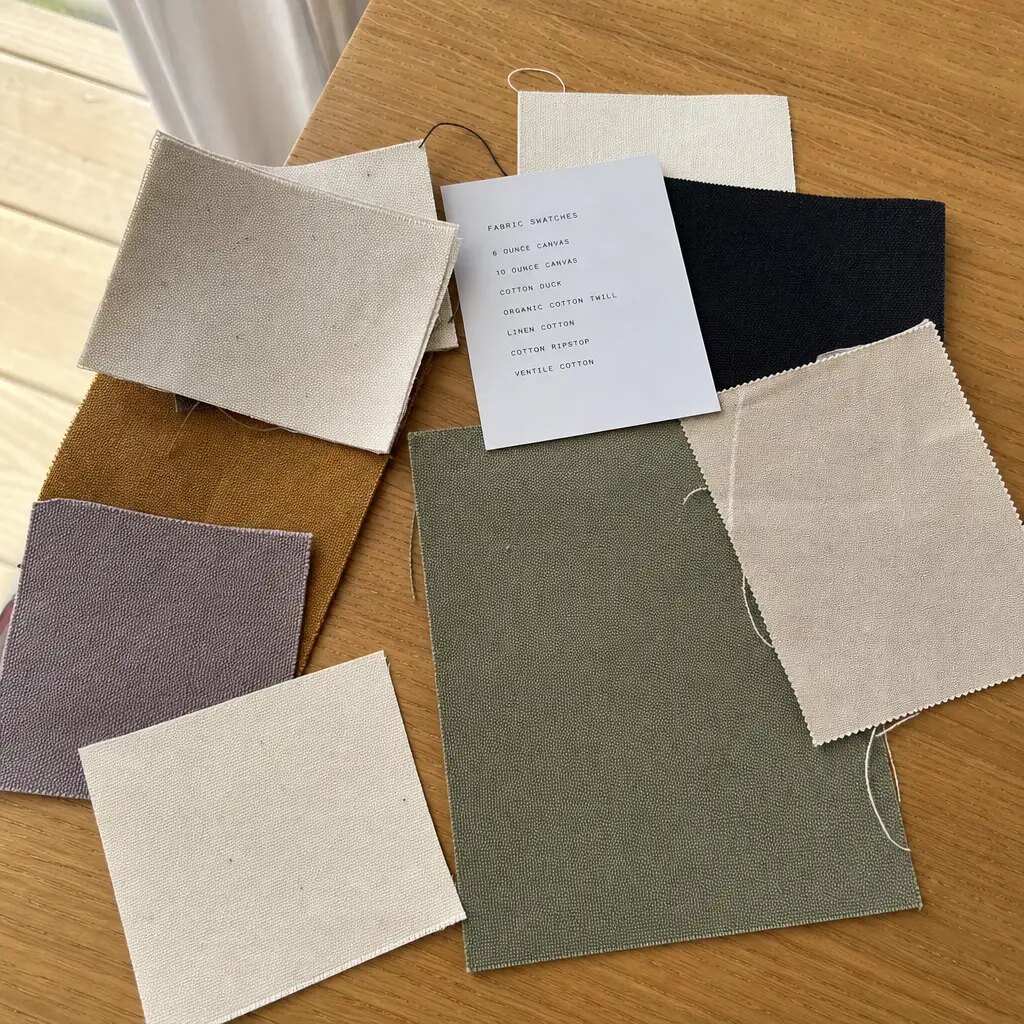
GSM is useful, but it is not the full quality standard. Weave density, yarn quality, finishing, shrinkage, surface smoothness, and color consistency all matter. Two fabrics both described as 160 GSM can feel different in the hand and behave differently under print. Natural cotton can also vary in flecking and shade. Procurement should approve physical swatches or a pre-production sample, then write the approved standard into the purchase order.
Use tolerances rather than vague language. A practical PO line might read: "160 GSM cotton canvas, natural color, acceptable bulk GSM tolerance +/- 5%, shade and hand feel to approved pre-production sample, visible stains and strong odor not acceptable." If shrinkage matters because the bag will be washed or steamed, ask the supplier for a shrinkage estimate and test method. For eco claims, separate the material claim from the appearance. "Cotton" does not automatically mean organic, recycled, undyed, or certified.
- Quote at least two GSM options so cost and feel can be compared honestly.
- Approve fabric by physical sample, not only by the supplier's GSM description.
- Write GSM tolerance, shade standard, odor requirement, and stain limits into the production record.
Use construction details to prevent the common failures
Drawstring backpacks usually fail in predictable places: the cord tunnel, the side seam near the cord exit, the bottom corners, and any point where a label or reinforcement interrupts the stitch path. Buyers sometimes respond by choosing heavier fabric everywhere, but targeted construction details can be more efficient. A reinforced top hem, secure bottom seam, adequate seam allowance, and clean cord exit can improve durability without forcing a full double-layer bag.
Cord specification deserves its own line in the RFQ. The cord functions as both closure and shoulder strap. A thin cord can reduce unit cost but may cut into the shoulder, fray quickly, or look mismatched against heavier canvas. A thicker cotton cord can improve hand feel and brand consistency, but the buyer should confirm whether it pulls smoothly through the tunnel and whether the knots hold. Cotton-poly cord may offer smoother pull or greater strength, but the composition should be disclosed if the brand plans to make cotton-focused product claims.
Finished dimensions should be reviewed with real contents. A flat bag may look correct on a table but fail to close cleanly after loading. If the tunnel is too narrow, the draw action becomes stiff. If the print sits too close to the top, the logo can distort when the bag is gathered. If the body is too short, contents may press against the closure. Sample review should include filling, closing, carrying, and opening the bag repeatedly.
- Specify seam allowance, stitch density target, reinforced areas, tunnel height, and cord exit finish.
- Match cord material and diameter to the fabric weight and expected load.
- Approve the bag filled and closed, not only flat and empty.
Control decoration before it controls your MOQ
Decoration is often the second major MOQ driver after fabric. For wholesale cotton drawstring backpacks, one-color screen printing is usually the cleanest option when the artwork is simple and the buyer wants repeatable cost. It has clear setup, predictable inspection points, and works well on many cotton canvas surfaces when ink and curing are handled correctly. Two-color screen printing can still be practical, but it adds registration control and setup time.
Heat transfer, digital print, and embroidery have different risk profiles. Heat transfer can support detailed artwork, but buyers should inspect edge lift, hand feel, surface marks, and adhesion on cotton. Digital print can help with complex graphics or smaller art runs, but results depend on pretreatment and fabric surface. Embroidery can look premium for compact logos, yet it adds stitch time, backing, thread approval, and puckering risk on lighter fabrics. Large embroidery on thin cotton is a common mismatch.
Decoration instructions should be measurable. "Logo front center" is not enough for production or QC. Use language such as: "One-color black screen print, logo 180 mm wide, centered horizontally on front panel, top of logo 80 mm below finished top edge, placement tolerance +/- 5 mm, color reference Pantone Black C." The more precise the artwork package, the less likely a low MOQ order will be delayed by rework.
- Keep first orders to one print location and one or two colors when MOQ control matters.
- Approve print strike-off or pre-production sample on the actual fabric surface.
- Define print size, color, placement, registration tolerance, and curing expectation before bulk production.
Negotiate MOQ by component, then by order plan
A useful MOQ conversation breaks the bag into components. Ask the supplier to state the minimum for body fabric, dyeing, cord, label, print setup, packing materials, and finished production. This often reveals a solvable constraint. If the body fabric is stock but the woven label minimum is high, the buyer can decide whether the label is worth it on the first run. If the print setup is the same for 500 and 1,000 pieces, procurement can compare the unit price impact of spreading setup cost over fewer bags.
Trade-offs should be explicit. A supplier might agree to 500 pieces if the buyer uses stock natural cotton, one-color print, standard cord, no custom label, and bulk packing. The same supplier may need 1,000 or more pieces for custom-dyed fabric, custom cord, woven label, and individual barcode polybags. Neither number is automatically unreasonable; they reflect different purchasing and labor requirements.
A forecast can help, but it should not be treated as a purchase order. Procurement can share expected reorder tiers and ask for future price breaks at 1,000, 3,000, or 5,000 pieces. This helps the factory understand the commercial path without relying on unverifiable promises. For the confirmed order, the PO should only include actual committed quantity, approved specs, and agreed pricing.
- Ask: "Which component is setting this MOQ?" before requesting a lower number.
- Request price and MOQ scenarios for simple stock specs versus custom-color or retail-packed specs.
- Discuss reorder tiers separately from the confirmed purchase commitment.
Compare quotations as production documents
A strong quotation should read like a short production specification. It should include fabric type, target GSM, finished dimensions, construction, cord material and diameter, decoration method, print size, label type, packing method, carton quantity, carton dimensions, sample charge, lead time, payment terms, Incoterms, and quote validity. A quote that says only "cotton drawstring bag with logo" creates too much room for later disagreement.
Unit price alone is not enough for supplier comparison. One quote may include screen setup and pre-production sample while another excludes them. One may be EXW and another FOB. One may pack 100 pieces per carton and another 200 pieces, affecting freight cube and warehouse labor. A lower unit price can become more expensive once setup charges, cartons, inspection delays, and freight dimensions are considered.
Ask suppliers to state exclusions clearly. Barcode labeling, hangtag attachment, moisture bags, palletization, third-party inspection support, and special carton marks should not appear as surprises after approval. Also confirm when lead time begins. "30 days" can mean 30 days after deposit, after artwork approval, after lab dip approval, or after pre-production sample approval. Those are very different calendars.
- Normalize quotations for Incoterms, included setup charges, sample cost, and packing data.
- Compare landed-cost inputs, not only unit price.
- Require clear exclusions and a defined lead time start point.
Use sampling to lock the production standard
Sampling should reduce risk, not create a false sense of certainty. A showroom sample can help buyers understand general workmanship, but it may not match the final fabric, cord, print method, or packing. The production reference should be a pre-production sample using actual bulk materials whenever possible. If the exact bulk fabric is not available during sampling, the supplier should identify what differs and provide a clear replacement approval before cutting.
The buyer should measure and record the sample. Check finished width, finished height, tunnel height, cord diameter, cord length, print size, print position, label placement, seam quality, closure behavior, odor, and packing presentation. Keep the comments factual. "Approved except logo must move 10 mm lower" is useful. "Looks good" is not enough for production control.
For higher-risk orders, keep one approved sample with the buyer and one sealed reference with the supplier. The sealed reference helps resolve disputes about shade, fabric hand feel, print scale, and label position. If a third-party inspection is planned, share the approved sample details and measurement points before the inspection date so the inspector is not guessing at the standard.
- Do not approve mass production from a sample that uses unknown or substitute materials without documenting the difference.
- Record sample measurements and tolerances in writing.
- Use the approved sample as the reference for both factory production and final inspection.
Set practical tolerances and defect definitions
Cotton drawstring backpacks are soft goods, so zero variation is not realistic. What matters is defining the variation that procurement can accept. Finished dimensions commonly need a tolerance, such as +/- 10 mm for width and height, unless the bag must fit strict retail packaging or a specific product bundle. Print placement may allow +/- 5 mm or another agreed limit depending on logo size and position. GSM may be controlled by a percentage range if the supplier can verify it.
Defect classification should be clear before inspection. Critical defects may include unsafe contamination, wrong product, severe odor, mold, or incorrect branding that cannot be sold. Major defects may include open seams, broken cord, wrong dimensions outside tolerance, severe stains, poor print adhesion, incorrect label placement, or wrong carton quantity. Minor defects may include loose threads, small acceptable natural cotton flecks, slight creasing, or minor shade variation within the approved standard.
For natural cotton, define the difference between normal material character and unacceptable dirt. Seed specks and small natural flecks may be acceptable if the brand chooses unbleached cotton. Oil marks, colored stains, mildew odor, and heavy shade bands should not be treated as normal. A short defect guide with photos from sampling or early production can save time during final inspection.
- Agree tolerances for size, GSM, cord length, print placement, and label placement before production.
- Classify critical, major, and minor defects so inspection decisions are not subjective.
- Define acceptable natural cotton flecking separately from stains or contamination.
Inspect fabric, sewing, print, and packing separately
A final inspection should not be only a quick look at finished bags. Fabric checks should confirm GSM range, shade consistency, odor, stains, slubs, holes, oil marks, and lot mixing. Sewing checks should focus on stitch density, skipped stitches, open seams, loose threads, seam allowance, bottom corners, tunnel construction, and cord exit strength. These areas determine whether the bag survives real use.
Decoration checks must match the method. For screen print, inspect opacity, color, edge sharpness, registration, curing, cracking, rubbing resistance, and placement. For heat transfer, check edge lift, adhesion, heat marks, and flexibility. For embroidery, check thread color, stitch density, backing, puckering, and loose threads. A light rub test or scratch check is useful for screen print, but the exact method should suit the ink and fabric.
Packing is part of product quality. Cotton bags can pick up moisture, odor, and deep creases during storage and transit. Inspect pieces per carton, bundle count, carton marks, SKU labels, barcode accuracy, inner packing, moisture protection, carton strength, and compression. Ask for inspection photos of the product front, back, seams, cord exits, print close-up, label close-up, packed bundle, carton mark, and any defects found.
- Use separate inspection lines for fabric, sewing, decoration, and packing.
- Perform a practical load and cord-pull check based on intended contents.
- Hold shipment release until quantity, carton marks, and packing match the purchase order.
Specification comparison for buyers
| Sourcing decision | Practical B2B specification | MOQ impact | QC or quote detail to confirm |
|---|---|---|---|
| Fabric weight / GSM | 140-180 GSM cotton canvas for everyday apparel packaging, merchandise, and gift-with-purchase programs; 220+ GSM for premium kits or heavier loads | Stock 140-180 GSM fabrics are often easier to source at lower opening quantities than custom heavy canvas | Write target GSM plus tolerance, commonly +/- 5% if supplier can support it, and approve hand feel against a physical sample |
| Fabric color | Natural, black, navy, or supplier-held stock dyed color for first orders; custom Pantone dye only when volume and schedule support it | Custom dye lots may create higher fabric MOQ, lab dip time, and shade approval risk | Ask for stock shade cards, lab dip lead time, dye lot minimum, and acceptable shade tolerance against the approved sample |
| Bag dimensions | Common retail-friendly flat sizes often fall around 350-420 mm width x 420-480 mm height, adjusted to actual contents | Non-standard sizes can reduce fabric nesting efficiency and increase waste, especially at low quantities | Confirm finished-size tolerance such as +/- 10 mm unless the buyer needs tighter control |
| Construction | Single-layer body with reinforced top hem and secure bottom seam for normal apparel use; reinforced bottom or heavier seam for kits | Reinforcement at stress points is usually more MOQ-friendly than changing every panel to heavier material | Specify seam allowance, stitch density target, tunnel height, cord exit finish, and whether bar-tacks are required |
| Cord | Cotton cord or cotton-poly cord, typically 5-8 mm depending on bag size and load | Custom cord color or unusual diameter can trigger separate component MOQ | Confirm material composition, diameter tolerance, length, knot finish, fray control, and pull-through resistance |
| Decoration | One-color screen print for clean MOQ control; two-color screen print when necessary; heat transfer or digital print for complex art; embroidery for compact premium marks | More colors, larger artwork, second-side decoration, or embroidery increase setup, sampling, and inspection complexity | Quote print setup separately and define size, placement, ink color, curing method, and placement tolerance |
| Labels and trims | Printed logo only for simplest programs; woven side label, care label, hangtag, or barcode only when needed | Woven labels, hangtags, and barcode operations may carry vendor MOQ and extra packing labor | Confirm label size, fold type, material, placement distance, orientation, and who supplies barcode data |
| Packing | Bulk pack by counted bundles for B2B or e-commerce inserts; individual polybag only when retail, fulfillment, or cleanliness requirements justify it | Individual packing increases labor, carton cube, plastic use, and sometimes MOQ pressure | Quote pieces per carton, inner bundle count, carton dimensions, carton marks, moisture protection, and pallet rules |
| Supplier route | Direct factory for repeatable single-category orders; trading company when consolidation, small mixed orders, or extra coordination is needed | Direct factory can expose real MOQ drivers; trading company may aggregate but can hide component constraints | Ask who owns sampling, production QC, defect sorting, and claim resolution before order placement |
Buyer checklist before sampling
- Define the use case first: garment packaging, gift-with-purchase, event merchandise, retail accessory, subscription kit, or e-commerce insert. State the intended contents and estimated loaded weight.
- Specify finished bag dimensions in millimeters, including width, height, gusset if any, cord tunnel height, seam allowance expectation, and whether the bag must close fully when filled.
- Choose the fabric standard: cotton canvas or cotton sheeting, target GSM, acceptable GSM tolerance, weave or hand-feel reference, natural or dyed color, shrinkage expectation, and whether recycled or organic certification is required.
- Separate fixed specs from flexible specs. Mark fabric color, cord color, label type, print position, and packing method as either must-have, preferred, or negotiable.
- Ask the supplier to quote MOQ by component: body fabric, dye lot, cord, label, print setup, packing material, carton marking, and style version.
- Send production-ready artwork in vector format and define logo width or height, color reference, print side, print position from top edge and side seam, and placement tolerance.
- Request quote options for at least two GSM levels, such as 160 GSM and 180 GSM, so procurement can compare price, feel, durability, carton cube, and MOQ pressure.
- Confirm whether the quoted price includes sample cost, screen setup, print strike-off, woven label, hangtag application, barcode sticker, inner packing, carton marks, and export carton.
- Require one pre-production sample made with actual or clearly documented bulk-equivalent fabric, cord, print method, label, and packing method before bulk cutting or mass decoration.
- Approve sample measurements in writing: bag width, bag height, tunnel height, cord diameter, cord length, print size, print placement, label placement, and acceptable tolerances.
Factory quote questions to send
- What is the MOQ separately for stock natural fabric, stock dyed fabric, custom dyed fabric, custom cord color, woven label, screen print, embroidery, individual polybag, and carton marking?
- Which exact fabric are you quoting: cotton canvas, cotton sheeting, recycled cotton blend, organic cotton, or another construction? What is the target GSM and bulk tolerance?
- Can you quote 140 GSM, 160 GSM, 180 GSM, and 220 GSM as separate lines with unit price, MOQ, estimated carton quantity, and lead time?
- Is the fabric already in stock, reserved after deposit, or purchased after order confirmation? If custom dye is required, what is the lab dip lead time and dye lot minimum?
- What finished-size tolerance do you use for bag width, height, tunnel height, cord length, and print placement? Can those tolerances be written into the purchase order?
- What cord material, diameter, length, color, and knot finish are included? Is the cord composition consistent with our eco-positioning claims?
- Does the quoted unit price include screen setup, print plate, ink mixing, print strike-off, curing, woven label, hangtag, barcode sticker, polybag, carton marks, and export carton?
- Will the pre-production sample use the same fabric lot, cord, ink, curing process, label, and packing method planned for bulk production? If not, what will differ?
- What inspection standard do you use for critical, major, and minor defects, and what AQL or internal sampling method is available for this product?
- What are your standard defect limits for stains, oil marks, shade variation, odor, skipped stitches, broken threads, open seams, print misregistration, poor print adhesion, and incorrect carton quantity?
Quality-control points to confirm
- Fabric GSM should be checked against the approved range, not only against the sales description. Record the measurement method or supplier certificate used for the lot.
- Bulk fabric should be inspected before cutting for stains, oil marks, slubs, holes, shade bands, odor, excessive creasing, and obvious lot-to-lot variation.
- Natural cotton should have an agreed standard for seed specks and flecking so normal material character is not confused with unacceptable contamination.
- Finished bag dimensions should be measured after sewing and pressing. Width, height, tunnel height, gusset, and bottom reinforcement should match the approved tolerance.
- Stitching should be checked for stitch density consistency, skipped stitches, broken threads, loose thread ends, open seams, uneven seam allowance, and poor backstitching.
- Stress areas should receive extra attention: cord tunnel ends, side seams near cord exits, bottom corners, label insertion points, bar-tacks, and reinforced hems.
- Drawcords should be checked for correct material, diameter, length, color, exit symmetry, knot security, fray control, smooth pull, and resistance to pulling out of the tunnel.
- A practical load check should reflect intended contents, such as folded apparel, shoes, or kit items, and should assess seam strain, cord comfort, and closure performance.
- Screen print should be checked for correct color, opacity, edge sharpness, registration, curing, cracking, rubbing resistance, and placement tolerance.
- Heat transfer should be checked for edge lift, gloss consistency, heat marks, hand feel, adhesion, and cracking after bending or light abrasion.