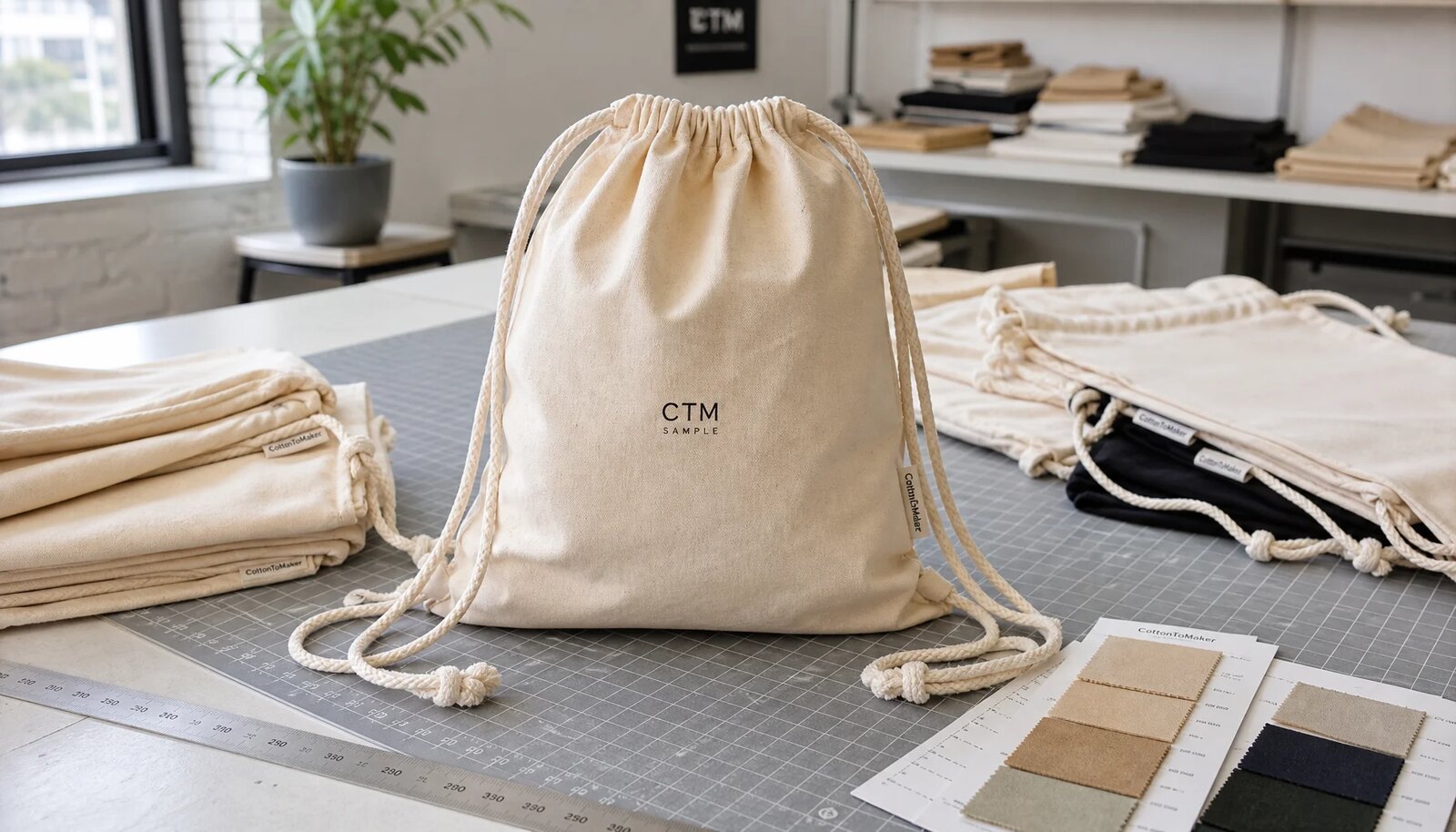
Start With the Buying Risk, Not the Bag Name
Wholesale cotton drawstring backpacks for craft fairs sound like a simple product until procurement begins comparing supplier quotes. One supplier may be pricing a 140 GSM natural cotton giveaway bag with a thin cord and bulk carton packing. Another may be quoting a 280 GSM cotton canvas backpack with a thicker braided drawcord, reinforced lower corners, controlled screen-print curing, individual packing, and retail carton marks. Both descriptions may say cotton drawstring backpack. Commercially, they are different products.
That is why the sourcing process should begin with a controlled specification, not with a target price alone. Before negotiation, procurement should lock the finished size, material composition, GSM, cord type, reinforcement method, print process, tolerances, compliance scope, packing standard, carton data, inspection plan, and incoterm. When these points are missing, the lowest offer often reflects an incomplete quote rather than a better supplier.
Craft fair programs also sit in a gray zone between promotional goods and retail merchandise. A free bag for maps and flyers can be lighter and simpler. A paid booth item, maker kit backpack, museum shop product, sponsor gift, or school craft pack needs tougher construction, better branding control, and clearer compliance evidence. The first sourcing decision is therefore the required performance level.
- Use one RFQ sheet so every supplier quotes the same construction, artwork, packing, and compliance scope.
- Separate unit price from setup fees, sample fees, testing, packing, inland freight, export charges, and courier costs.
- State the maximum intended contents, such as paper only, apparel, boxed kits, books, ceramics, or mixed craft merchandise.
- Require written confirmation of every material, trim, print, label, and packing assumption before sampling starts.
- Treat any quote without GSM, finished size, cord detail, print method, carton data, and incoterm as incomplete.
Map End Use and Compliance Early
The same cotton bag can require very different paperwork depending on how it enters the market. A private adult giveaway usually needs fewer records than a retail product. A children’s craft kit or school activity pack deserves a closer review of chemical restrictions, cords, warnings, age grading, and destination-market requirements. A museum shop or retailer may add its own vendor manual covering labels, barcode format, carton marks, restricted substances, and social compliance records.
Classify the program before asking for samples. Is the backpack a giveaway, a resale accessory, product packaging, or a component in a kit? Will it be used by adults, families, or children? Is it shipping to the United States, European Union, United Kingdom, Canada, or another market? These answers shape the test plan and the documentation cost. They also prevent a common problem: approving a beautiful sample and discovering later that labels, claims, or reports do not support the sales channel.
Be careful with sustainability and safety claims. Terms such as organic, recycled, azo-free, plastic-free, biodegradable, sustainable, child-safe, and eco-friendly should not appear in artwork, product copy, hangtags, or listings unless the evidence matches the actual fabric, dyeing, printing, and packing used for the order. Unsupported claims are easier to remove at RFQ stage than after the bags are printed.
- Classify the order as giveaway, resale item, kit component, school program product, retail accessory, or event staff pack.
- Identify user age and likely use because children’s-use programs can trigger extra review beyond ordinary promotional bags.
- List destination markets and retailer manuals before quoting so required tests, labels, and documents are priced correctly.
- Define approved claim language for cotton content, organic cotton, recycled cotton, azo-free dye, and plastic-reduced packing.
- Ask the supplier to disclose all subcontracted dyeing, printing, sewing, labeling, packing, testing, and inspection steps.
Make Fabric Quotes Comparable
Fabric weight is one of the biggest cost drivers in cotton drawstring backpacks. Suppliers may quote in GSM, ounces, or loose terms such as light cotton, heavy cotton, or canvas. Ask for both GSM and ounce equivalent when possible, but use GSM as the working control point because it can be checked from cut fabric samples. The RFQ should also define composition, weave, finish, color, and whether the fabric is natural, bleached, dyed, organic, recycled, or blended.
For craft fairs, 140 to 170 GSM cotton generally suits short-term giveaways and light paper contents. A 180 to 220 GSM range is often a practical middle specification for sponsor bags, vendor merchandise, and general reusable event backpacks. A 240 to 300 GSM cotton canvas backpack gives a heavier hand feel for paid merchandise, books, art supplies, and boxed craft kits. It also increases unit cost, carton weight, CBM, and freight exposure. Heavier fabric helps, but it does not save a bag with weak cord capture or poor stitching.
Natural unbleached cotton is popular for maker markets because it looks tactile, simple, and print-friendly. It can vary, though, because yarn lot, scouring, finishing, and storage conditions all affect shade. Approve a shade band rather than one perfect color. If strict body color is required, dyed cotton is more controllable, but it normally needs lab dips, bulk shade approval, colorfastness review, and a higher fabric MOQ.
- 140-170 GSM: low-cost giveaway bags for maps, brochures, postcards, and light paper inserts.
- 180-220 GSM: balanced option for craft fair merchandise, sponsor bags, and general reusable event backpacks.
- 240-300 GSM: heavier cotton canvas for paid retail bags, maker kits, books, apparel, and higher perceived value.
- Natural cotton: approve a shade range and check stains, seed flecks, odor, and fabric slubs against the sample standard.
- Dyed cotton: approve lab dips and define colorfastness, shade tolerance, and dye-lot management before production.
- Organic or recycled cotton: require order-specific material evidence before allowing the claim on labels or product copy.
Specify Construction Where Bags Actually Fail
Most failures do not begin in the center of the fabric panel. They begin at the cord exits, top channel, side seams, bottom corners, eyelets, and cord capture points. Those areas carry stress when a visitor loads the bag with catalogs, candles, ceramics, apparel, books, art tools, or boxed craft supplies. A supplier can reduce cost by narrowing seam allowance, lowering stitch density, using thinner cord, deleting reinforcement, or selecting weaker thread. Each of those choices needs to be visible in the quote.
Specify finished flat dimensions, not cut size. Common adult drawstring backpack sizes include about 34 x 42 cm, 35 x 45 cm, and 38 x 46 cm, but the right size depends on contents, print area, and how the bag will be worn. Write finished-size tolerances into the PO. For many adult cotton drawstring backpacks, plus or minus 1.0 cm is practical; smaller bags may use plus or minus 0.5 cm. Logo placement should have its own tolerance because a centered print can look wrong even when the bag size is acceptable.
Cord diameter and channel width should work together. A thin 3 mm cord may be enough for a light giveaway. A 5 mm to 7 mm braided cord usually feels better for shoulder use. The channel must let the cord move without jamming, twisting, or tearing the fabric. If the bag is expected to carry more than paper, reinforce the lower corners with bar tacks, triangle stitching, stitched tabs, eyelets, or double seam capture.
- Define finished flat width and height, measurement points, and tolerance before sample approval.
- Specify seam allowance, stitch density, thread color, thread type, and whether raw edges are overlocked, folded, or otherwise finished.
- Match top-channel width to cord diameter and require smooth open-close movement on the approved sample.
- Use reinforced lower corners for craft kits, books, apparel, retail bags, or any bag expected to work as a shoulder backpack.
- Control drawcord length so both sides are even and the finished bag is comfortable without excessive hanging cord.
- Record whether eyelets are metal, coated metal, plastic, or not used, and inspect sharp edges or loose setting if eyelets are included.
Control Artwork Before Bulk Printing
Branding quality matters at craft fairs because the bag is handled many times before the end user keeps it. It may be printed, stacked, folded, counted, packed, transported, distributed, and worn in a crowded venue. A logo can look acceptable at artwork approval and still fail later if ink is under-cured, a transfer edge lifts, placement drifts, or the print cracks along a fold line.
Screen printing is usually efficient for solid one- to three-color logos on cotton backpacks. It works well for event marks and sponsor artwork, but buyers should confirm ink type, curing method, underbase requirements on dark fabric, and dry-rub or fold testing. Heat transfer can support fine detail and smaller batches, yet edge lift, cracking, glossy hand feel, and heat marks need review. Digital printing helps with gradients or complex artwork, but color brightness depends heavily on fabric shade. Embroidery can look premium for small logos, although dense designs may distort lightweight cotton. Woven labels suit subtle branding and natural-positioned products.
Artwork controls should be numerical. State print width and height, print location from the top seam, side seam, or centerline, number of print colors, color reference, and placement tolerance. For a front-center logo, require measurement from the centerline and top seam rather than accepting visual centering.
- Screen print: best for solid logos, sponsor marks, repeat event artwork, and medium to large wholesale runs.
- Heat transfer: useful for detail, gradients, or small batches, but test fold cracking, edge lift, hand feel, and adhesion.
- Digital print: useful for complex art, but approve color on the actual production fabric shade before bulk printing.
- Embroidery: suitable for small premium logos, but avoid large dense embroidery on 140-170 GSM cotton.
- Woven label: good for subtle branding, maker-market styling, and programs where a large ink print is not desired.
- Placement control: define logo size, centerline, distance from top seam, distance from side seams, and acceptable deviation.
Understand MOQ and Normalize Pricing
MOQ is rarely just a supplier preference. It may be driven by fabric stock, cutting efficiency, dye-lot minimums, print setup, label minimums, cord color minimums, retail packing components, and production-line scheduling. A stock natural cotton backpack with one-color print and bulk packing can often be quoted at a lower MOQ. A custom dyed 220 GSM cotton canvas bag with matched cord, woven label, hangtag, barcode sticker, and individual packing usually requires a larger commitment.
Instead of pushing only on the final quantity, ask which specification element is driving the MOQ. If the buyer needs a lower order quantity, the spec may need to use stock fabric, a standard size, standard cord, limited print colors, and bulk packing. If the buyer needs a retail-ready product, the MOQ and unit price should reflect the added components and labor honestly.
Quote normalization protects procurement from false savings. Every supplier should price the same GSM, finished size, cord diameter, reinforcement method, print area, number of print colors, packing method, compliance file, inspection level, incoterm, and delivery point. A quote missing carton data, testing assumptions, or packing details is not cheaper. It is unfinished.
- Lowest MOQ path: stock natural cotton, standard size, one-color screen print, standard cord, and bulk carton packing.
- Mid MOQ path: standard fabric with custom size, two-color artwork, hangtag, and export carton marks.
- Higher MOQ path: custom dyed fabric, custom GSM, custom cord color, woven label, barcode sticker, and retail-ready unit packing.
- Common setup charges include print screens, films, lab dips, sample making, custom labels, hangtags, barcode files, and packing templates.
- Hidden cost drivers include large print areas, underbase ink, multiple print locations, low carton density, urgent schedules, and added inspection requirements.
- Normalize every quote by fabric, construction, decoration, packing, compliance, incoterm, lead time, carton data, and payment terms.
Request Evidence, Not Promises
Compliance files should fit the risk level of the order. A basic adult giveaway may need material composition, country-of-origin support, basic chemical declarations, and production traceability. A retail or children’s-use program may need REACH review, CPSIA where applicable, Prop 65 review, azo dye documentation, ink declarations, fiber labeling support, retailer restricted substance list alignment, and social compliance records. Define those needs before the supplier quotes so testing and documents are not treated as surprise extras.
Test reports and certificates are useful only when they match the actual order. A prior test report for white cotton may not cover a new dyed fabric. A fabric report may not cover the printed finished bag. An ink declaration may not cover the final cured print on cotton. Organic or recycled claims need chain-of-custody or material evidence connected to the purchase order, not a generic marketing statement.
Subcontracting can create document gaps if nobody owns the file. Sewing may happen in one factory, printing in another, and packing or labeling at a third site. The compliance checklist should identify each critical process, who performs it, and what document proves conformity. Procurement should also state whether changes in factory, fabric lot, ink, cord, label, or packing component require written approval.
- Factory evidence: factory address, production process list, business license if required, audit report where applicable, and export responsibility.
- Material evidence: fiber composition, fabric lot number, GSM record, cotton type, and organic or recycled support if claimed.
- Chemical evidence: azo dye review, REACH, CPSIA where children’s use applies, Prop 65 review where applicable, and buyer RSL alignment.
- Print evidence: ink declaration, curing control, adhesion check, dry-rub result, and report coverage for the chosen print system.
- Labeling evidence: country of origin, fiber content if required, warning statement if applicable, barcode data, SKU label, and retailer language requirements.
- Traceability evidence: PO number, fabric batch, print batch, sewing date, packing date, carton number, SKU, and inspection report reference.
Approve Samples Like a Buyer Will Use Them
A sample should prove more than appearance. Each stage has a job. A fabric swatch or lab dip confirms material and shade. A blank construction sample confirms size, seam, channel, cord, and reinforcement. A print strike-off confirms artwork, color, edge quality, ink hand feel, and adhesion. A pre-production sample shows whether bulk materials and bulk processes come together correctly. A packed sample confirms fold method, label position, barcode scan, inner pack, and carton assumptions.
Handle the sample like a real craft fair bag. Load it with expected contents, open and close the cords repeatedly, wear it briefly if it will be used as a backpack, fold through the logo area, rub the print with a dry white cloth, and inspect stress points. If the bag will carry candles, small ceramics, books, boxed kits, or craft tools, test the lower corners and side seams under a realistic load rather than judging the logo alone.
Document approval with a sample reference number, photos, measurements, tolerance notes, and any accepted minor deviations. The supplier should keep one sealed or signed master sample, and the buyer should keep one reference sample where practical. Any change after approval should require written authorization, even if the supplier describes it as equivalent.
- Measure finished width and height flat and record the result against the approved tolerance.
- Check fabric GSM, shade, odor, slubs, stains, and hand feel against the approved swatch or master sample.
- Pull the cords repeatedly to check channel function, cord friction, cord length, and lower-corner stress.
- Load the sample with expected contents and inspect side seams, bottom seams, top channel, and reinforcement points.
- Rub, fold, and lightly scratch the decoration to check smearing, cracking, tackiness, edge lift, and ink transfer.
- Approve a packed sample if the shipment must arrive event-ready, retail-ready, barcode-ready, or sorted by destination.
Plan Packing, Labels, and Cartons Before Production
Packing affects cost, receiving accuracy, sustainability positioning, and delivery risk. Bulk packing is usually the lowest-cost method for internal giveaways, but it can increase dust exposure, print rub, and counting errors. Individual polybags improve unit protection and warehouse handling, though they add plastic, labor, and carton volume. Paper bands or recycled sleeves can support natural cotton positioning, but they offer limited moisture protection. Retail-ready packing needs more controls and should not be added casually after production.
For craft fair distribution, carton quantity should match allocation. A factory may prefer 100 or 200 pieces per carton, while an event team may need 25 or 50 pieces per venue. Heavy canvas bags can also create lifting, compression, and pallet issues if too many units are packed together. Ask for pieces per carton, carton dimensions, gross weight, net weight, and CBM before approving the final quote.
Labels should be finalized before mass packing starts. If the bag needs a hangtag, barcode sticker, country-of-origin label, fiber label, warning statement, insert card, or retailer SKU label, the supplier should provide photos and barcode scan confirmation before final inspection. Carton marks should identify PO, SKU, artwork version, color, quantity, carton number, gross weight, destination, and required routing marks.
- Bulk pack: lowest cost and fastest packing, but less protection from dust, print abrasion, moisture, and counting errors.
- Individual pack: cleaner handling and better unit protection, but increases labor, plastic use, volume, and sometimes freight cost.
- Paper band or sleeve: useful for natural branding, but should be tested for slippage, tearing, and moisture exposure.
- Retail pack: define hangtag, barcode, insert, warning label, country-of-origin label, fold method, and SKU separation.
- Carton marks: include PO number, SKU, artwork version, color, quantity, carton sequence, gross weight, and destination where needed.
- Warehouse fit: align pieces per carton with event allocation, receiving counts, lifting limits, pallet pattern, and storage conditions.
Set QC Rules Before Shipment Pressure Builds
Quality control should be agreed before production begins, not during the final week. The inspection plan should define sample size method, defect categories, measurement points, tolerances, functional checks, photos required, and who can approve deviations. For first orders, event-critical shipments, custom printed orders, retail programs, and children’s-use programs, a final random inspection before shipment is a practical control. Larger or higher-risk programs may also need incoming material inspection, inline sewing checks, print inspection before packing, and first-piece approval.
The inspection should cover the full purchase order: quantity, fabric, dimensions, sewing, cord function, reinforcement, decoration, labels, packing, carton marks, barcode scans, and carton condition. If the buyer has a known target load, the QC instruction can include a simple repeatable load check. Keep it realistic: use the expected catalog, apparel bundle, or craft kit weight, then define duration, handling method, and inspection points after loading.
Defect classification reduces argument. Critical defects may include wrong artwork, mold, severe contamination, sharp eyelets, missing required warning labels, or mixed SKU packing that cannot be corrected before shipment. Major defects may include open seams, broken stitches, GSM outside tolerance, serious print misplacement, poor adhesion, non-scanning barcodes, short quantity, or incorrect carton marks. Minor defects may include small loose threads, slight shade variation inside the approved band, or minor fold marks that do not affect saleability.
- Incoming control: check fabric GSM, shade, odor, defects, cord type, label material, and trim consistency before cutting.
- First-piece control: approve one finished bulk-line piece for size, sewing, cord, reinforcement, print, and labels before full production.
- Print control: verify artwork, ink color, curing, placement, rub resistance, fold behavior, and transfer edge condition before packing.
- Final inspection: count goods, measure size, inspect seams, pull cords, check labels, scan barcodes, review packing, and photograph cartons.
- Carton control: compare pack count, carton marks, dimensions, gross weight, carton strength, and moisture protection against the approved standard.
- Deviation control: require written approval for any change to fabric, GSM, print, cord, label, packing, carton, test plan, or production factory.
Specification comparison for buyers
| Supplier option | What to verify | Commercial advantage | Buyer risk to control |
|---|---|---|---|
| Direct sewing factory | cord material proof, reinforcement close-ups, load-test photos, approved sample tag, and bulk-line first-piece record | Better sample-to-bulk control and faster production feedback | May be weaker on export paperwork or branded packing unless checked early |
| Trading company | Factory name, production photos, trim-source proof, and who owns QC decisions | Can coordinate small mixed orders and extra services | Markup can hide real factory capability and slow defect decisions |
| Specialized bag workshop | cord diameter, eyelet or reinforced channel, bottom corner reinforcement, seam allowance, bar-tack position, and load target | More practical for detailed construction, trims, and repeat programs | Capacity may be limited during peak seasons |
| Low-price general supplier | 6-10 oz cotton canvas, 210D polyester, rPET, or blended cotton with shrinkage and colorfastness expectations set before sampling | Useful for simple promotional runs with loose specs | Material downgrades, weak packing, and vague inspection scope can erase savings |
| Retail-ready supplier | fold direction, cord protection, bundle count, carton compression, moisture bag, and retail label position | Can handle labels, SKU separation, carton marks, and receiving rules | Higher unit cost must be compared against reduced warehouse work |
| Compliance-focused supplier | Fabric records, labeling review, test plan, and production traceability | Safer for retail programs and repeat brand orders | Documentation claims need evidence, not only sales language |
| Local sample room plus bulk factory | Signed sample, bulk factory handoff, first-piece photos, and deviation owner | Good for complex branding before large production | Sample room quality may not match bulk line unless handoff is controlled |
Buyer checklist before sampling
- Define the order type: free giveaway, paid merchandise, vendor welcome kit, children’s craft kit, museum shop item, sponsor bag, school program item, or reusable event backpack.
- State the destination market and channel before sampling, including whether the bag is sold, given away, packed with children’s materials, shipped to retail, or used only at a private event.
- Specify fabric by composition, weave, finish, GSM or ounce weight, color, shade range, shrinkage expectation if relevant, and whether organic or recycled claims are permitted.
- Use finished flat dimensions in centimeters or inches and state measurement points, tolerance, seam allowance expectation, top-channel width, and bottom-corner construction.
- Define drawcord material, diameter, color, end treatment, shoulder-use expectation, cord path, and attachment method at the lower corners.
- Identify the intended load in practical terms, such as brochures, catalogs, T-shirts, candles, ceramics, boxed craft kits, books, small tools, or art supplies.
- Attach production artwork with Pantone, CMYK, or approved digital references, print method preference, logo dimensions, placement from fixed seams, and placement tolerance.
- Require disclosure of subcontracted sewing, printing, dyeing, labeling, testing, packing, or inspection steps, including who approves rework and who owns compliance documents.
- Request quote line items for fabric GSM, bag size, cord, reinforcement, print method, print colors, MOQ, sample fees, tooling or setup, labels, packing, carton quantity, carton size, gross weight, CBM, incoterm, lead time, and quote validity.
- Approve a sample sequence: material swatch or lab dip if dyed, blank construction sample, print strike-off, pre-production sample, packed sample if retail-ready, and first-piece photo from the bulk line.
Factory quote questions to send
- What exact material is included in the quote: natural cotton, bleached cotton, dyed cotton, cotton canvas, recycled cotton blend, organic cotton, polyester-cotton blend, or another fabric?
- What fabric weight is quoted in GSM and ounces per square yard, and what incoming tolerance will be accepted for bulk fabric, such as plus or minus 5% unless otherwise agreed?
- Is the quoted size the finished flat size after sewing, and what width and height tolerance will apply to accepted goods, such as plus or minus 0.5 cm or plus or minus 1.0 cm?
- What drawcord material, diameter, color, end finish, and construction are included, and will the cord be cotton, polyester, blended, braided, twisted, or flat tape?
- How are lower cord attachment points reinforced: bar tack, triangle stitch, metal eyelet, stitched fabric tab, double seam capture, or standard side-seam capture without extra reinforcement?
- What seam allowance, stitch type, stitch density, thread material, and top-channel width are used on the quoted construction?
- Is logo decoration performed in-house or outsourced, and what curing, drying, adhesion, dry-rub, fold, tape-pull, or visual inspection checks are performed before packing?
- What is the MOQ for the base bag, custom size, custom dyed fabric, custom GSM, custom cord color, woven label, hangtag, barcode sticker, and individual packing component?
- Which samples are included or charged separately: stock blank, custom blank, fabric swatch, lab dip, print strike-off, pre-production sample, shade band, packed sample, and courier shipment?
- How many calendar days are required after artwork approval, sample approval, deposit, test approval, and packing approval, and which approvals can stop the production clock?
Quality-control points to confirm
- Fabric GSM should be tested from cut samples using a scale and template method and recorded against the approved standard; hand feel alone is not a control method.
- Fabric shade should be checked against an approved swatch, lab dip, or shade band under consistent lighting, especially for natural unbleached cotton and custom dyed lots.
- Finished size should be measured flat at agreed points; common tolerances are plus or minus 0.5 cm for smaller pouches and plus or minus 1.0 cm for adult drawstring backpacks unless the PO states otherwise.
- Stitch density should be checked against the approved sample; typical mass-production targets should be written as stitches per inch or stitches per centimeter instead of described only as neat sewing.
- Top-channel width should be wide enough for the quoted cord diameter and should allow smooth opening and closing without bunching, twisting, jamming, or tearing.
- Side seams and bottom seams should be inspected for skipped stitches, open seams, seam slippage, raw-edge exposure, uneven seam allowance, and untrimmed threads beyond the buyer’s approved limit.
- Lower corner reinforcement should be symmetrical and consistent; heavier craft kit or merchandise bags should not rely on a weak single stitch at the cord stress point.
- Drawcords should be checked for length consistency, fraying, stains, uneven color, pull-through function, shoulder comfort, and secure capture at the lower corners.
- Eyelets, if used, should be checked for sharp edges, loose setting, rust marks, cracked coating, fabric tearing, and distortion around the punched hole.
- Prints should be checked for color, registration, coverage, curing, dry rub, fold resistance, light scratch resistance, tape-pull behavior where agreed, and no ink transfer to folded surfaces.