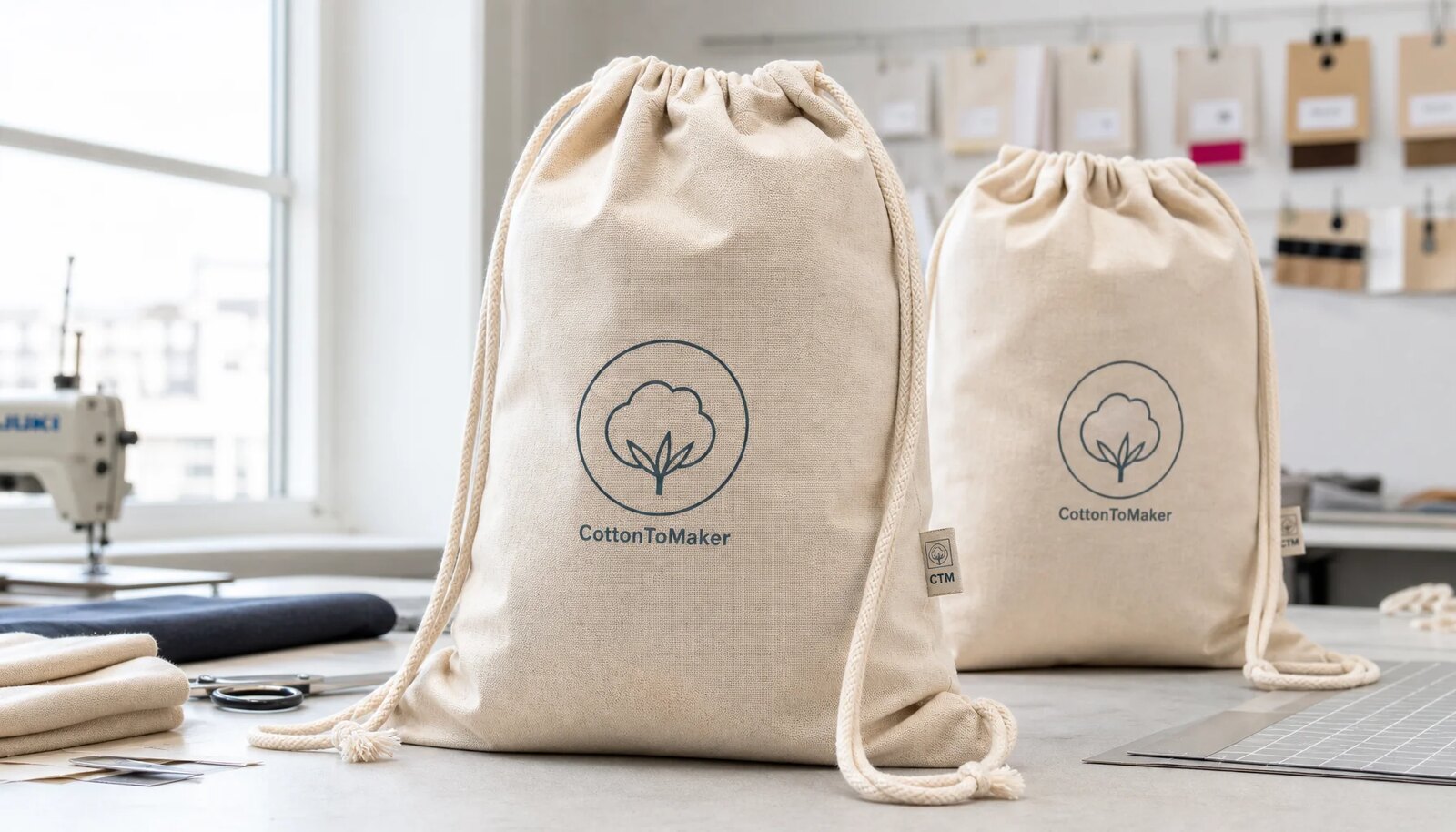
Start With the Use Case, Not the Bag
Farmers market buyers usually treat drawstring backpacks as a small accessory, but the spec should match the actual job. A vendor staff bag has different needs from a retail giveaway bag: staff bags get opened all day, stuffed with tape, gloves, keys, phone chargers, and water, while giveaway bags need a clean print, fold-flat packing, and a unit cost that leaves room for the rest of the kit. Decide which one you are buying before you ask for quotes, because the factory will optimize very differently for display value, handfeel, durability, or packing efficiency. The wrong brief usually creates the wrong quote comparison, which is how buyers end up paying for the wrong feature set.
If the bag is going on a market table, it needs enough structure to look intentional and not collapse into a wrinkle pile after it is folded and refolded. If it is going into a customer bundle, it needs to pack small and avoid loose lint, odor, or print rub-off. Start with target load, visible print area, and how the bag will be handed over. That three-point brief is enough to prevent most spec mistakes before they become sample revisions, and it gives the factory a real basis for recommending fabric weight, seam reinforcement, and packing style.
- Define the primary use: retail item, promo insert, or staff kit.
- State the target load in real terms, such as flat handouts, sample packs, or bottle-sized items.
- Describe how the bag will be displayed, folded, or handed to the end user.
Fabric Weight and Construction Decide Whether the Bag Feels Cheap
Fabric weight is the first cost lever buyers should lock. For a light promo bag, 120-130 GSM cotton sheeting or twill can work if the bag only carries flat handouts or lightweight market literature. For regular farmers market use, 140-160 GSM is the more practical range: it prints cleanly, feels less flimsy, and survives repeated stuffing without turning limp at the top edge. If buyers expect bottles, produce samples, or heavier vendor tools, move closer to 180 GSM or specify a reinforced base panel. The point is not to buy the heaviest cloth available. The point is to buy enough body to prevent a cheap-feeling bag that fails in front of customers or staff.
Construction matters just as much as fabric. Ask for double-needle seams on the side and bottom, reinforced cord tunnels, and a hem that will not curl after pressing. Natural cotton is usually easier to print on, but it can show slub, seed, or shade variation; bleached white gives a cleaner graphic but needs tighter shade control and may show stains faster in use. Set tolerances in the RFQ: body width and height within about 0.5 cm for a simple bag, cord length within about 2 cm, and no skipped stitches around load points. Without those limits, every supplier will interpret the sample differently and the comparison becomes meaningless.
- Use 120-130 GSM for low-cost promo runs and very light contents.
- Use 140-160 GSM for daily market use and a better handfeel.
- Move to 180 GSM if the bag will carry heavier items or needs more body.
- Specify double-needle seams and reinforced cord tunnels in the RFQ.
Print Method and Artwork Proofing Should Follow the Artwork, Not Habit
Print method should follow the artwork and use case, not personal preference. A one- or two-color screen print is still the best option for most cotton drawstring backpacks because the ink sits cleanly on cotton, the setup is manageable, and the finish usually survives normal handling better than a rushed digital substitute. If the artwork has gradients, small type, or multiple color transitions, a transfer print may hold more detail, but the buyer should test for cracking, stiffness, and wash durability before approving bulk. For premium retail use, a woven label or sewn patch can outperform a large print if the brand wants a quieter look and better wear resistance.
The proofing step should be measured, not visual only. Put the logo location in centimeters from the top edge and side seam, not just centered. Define the exact number of colors, the intended Pantone references, and the acceptable opacity on natural cotton. If the print sits too low, the bag looks off-balance when worn; if it sits too high, the cord tunnel can interfere with the art. Ask for a strike-off or pre-production sample on the actual fabric, because artwork that looks clean on paper can spread, deepen, or lose edge sharpness once it hits the weave of cotton. This is where many bulk rejects start.
- Use screen print for simple logos and repeat orders.
- Use transfer print only when detail matters more than long-term wear.
- Use woven labels or sew-on patches for a premium finish with less abrasion.
- Require a strike-off on the actual bag material before bulk approval.
Compare Supplier Routes Before Chasing the Lowest Number
The cheapest unit price is often not the best sourcing route. A direct factory can control fabric, print, and sewing, which matters when you need repeatability. A trade company can simplify communication and bundle multiple items, but you pay for the layer. A domestic decorator can move fastest for a small event order, but you may be stuck with stock blanks that do not match the bag you want to scale later. The comparison table above is most useful when you need to decide whether to optimize for speed, price, or exact spec control, because those priorities usually point to different suppliers.
For farmers market vendors, the key question is not who is cheapest. It is who can repeat this same bag next season without changing fabric handfeel, print density, or carton count. If your demand is one seasonal drop, a local route may be rational. If you expect reorders, direct factory sourcing usually wins after setup costs are spread out. Ask each supplier to quote the same bag spec and the same packing method; otherwise you are comparing unrelated products and the lowest number is not a real comparison.
- Direct factory sourcing gives the most control over the finished bag.
- Domestic decorators are useful for small pilots and urgent deadlines.
- Trading companies can help with communication, but the layer should be priced in.
- Compare routes on repeatability, not only on the first order.
Turn MOQ Into a Unit-Economics Decision
MOQ should be treated as a manufacturing constraint, not a sales tactic. Custom size, custom cord color, woven label, special print count, and dyed fabric all affect setup and waste. A supplier that quotes a low MOQ may be doing it by using stock fabric, a shared print screen, or a simpler pack. That can be fine, but the buyer should know exactly which part of the spec is standardized and which part is custom. If the answer is vague, the first bulk order often becomes a correction exercise, and the buyer ends up paying for the missing details later.
Quote the same bag at multiple quantities and make the factory show what changes at each break point. The most useful numbers are not just the top line; they are the setup fee, unit price at 500, 1,000, and 3,000 pieces, and whether label or packing changes trigger a new MOQ. Buyers who need several market colors or city-specific prints should consider one base bag with shared construction and separate decoration, because that usually lowers the combined MOQ and simplifies reorders. It also makes it easier to keep one golden sample file instead of managing several almost-identical versions.
- Ask what drives MOQ: fabric mill minimum, cutting loss, print setup, or carton pack.
- Request pricing at three quantity bands, not only one quantity.
- Separate one-time setup fees from recurring unit cost.
- Keep the body spec constant if you need multiple graphics or market variants.
Sample Approval Needs Real Acceptance Criteria
A pre-production sample is useful only if it is judged against a written standard. Measure the bag flat and under load, then record the front width, height, cord length, seam allowance, and print placement. For a farmers market use case, the bag should open and close smoothly with one hand, not require two hard pulls on the cords. If the cord tunnels bite into the fabric or the top edge ripples, the sewing density or reinforcement is wrong. One clean sample can still hide a weak bulk process, so the golden sample should be sealed and referenced in the production file.
Do not rely on appearance alone. Cotton can shrink, print can migrate, and some coatings or inks can feel acceptable on day one but crack after handling. A simple wash or rub test is enough to catch most avoidable failures. If you are buying for retail resale, check stitch symmetry and packaging presentation as carefully as the print itself. If you are buying for internal use, prioritize load performance and closure behavior over cosmetic perfection. The approval standard should match how the bag will actually be used, not how it looks in a single photo.
- Measure the actual finished size, not the cut size.
- Test cord pull and closure on a filled bag.
- Check print registration, opacity, and edge sharpness.
- Keep a sealed golden sample with photos and measurements.
Packing and Carton Planning Affect Freight More Than Most Buyers Expect
Cotton drawstring backpacks are light, but they still create freight waste if they are packed lazily. Flat-folding the bag and keeping the cord inside the body usually saves more carton space than most buyers expect. Ask whether the supplier packs by piece in polybags, by inner bundle, or loose in master cartons. For retail shelves or ecommerce, individual polybags can protect the print and keep the bag presentable. For bulk vendor kits, a bulk pack may be better if the local team will rebag them later. The right choice depends on whether you are buying display-ready units or warehouse stock.
Carton dimensions matter because the bag is compressible but not completely flat once cords and labels are included. A badly planned carton can raise freight cost more than a small unit-price difference. Confirm master carton count, gross weight, double-wall carton requirement, barcode label position, and whether moisture protection is needed for the route. If the market vendor will resell the bag, a clean side label or hanging hole can improve shelf presentation without adding much cost. If the bags move straight into kits, simpler packing is usually the safer choice and usually easier to receive in a warehouse.
- Confirm the flat-fold method and whether the cords are tucked inside the body.
- Specify inner pack count and master carton count.
- Request carton dimensions before production starts.
- Align label and barcode placement with your warehouse process.
Lead Time Is a Chain of Small Decisions, Not One Number
Lead time is a chain of small decisions, not one number. Artwork confirmation, fabric booking, print setup, cutting, sewing, QC, packing, and export booking each consume time. The fastest quotes usually assume that none of those steps will be revised. In practice, buyers lose days when the artwork file is low resolution, the cord color is not finalized, or the print position changes after sample review. The safest schedule is the one that freezes the spec early and reserves a small buffer for rework, especially before spring and early summer market launches when factories are already busy.
If the supplier only starts buying fabric after deposit, the lead time can move quickly or slowly depending on stock availability. Ask whether they hold standard cotton greige or need a fresh mill order, because that changes the schedule more than almost anything else. Also ask who is responsible if the pre-production sample is approved but the bulk print still shifts slightly; some factories will treat that as acceptable variation, while others will remake the lot. Clarify this before PO, not after shipment is already booked. That conversation is cheaper before production starts than after a deadline has already passed.
- Freeze artwork and cord color before sample sign-off.
- Build in buffer for print setup and rework.
- Ask whether fabric is stock, reserved, or mill-ordered.
- Confirm whether the factory can meet your seasonal launch date with margin.
Compare Landed Cost, Not the Ex-Factory Number
A buyer should compare landed cost, not just FOB or ex-works. The true number includes fabric, sewing, print, label, packaging, inland handling, ocean or air freight, duty, local delivery, and any rework risk. A quote that looks cheap on paper can become expensive if the cartons are oversized, the print is unstable, or the supplier adds surprise fees for artwork changes. If two suppliers are using different Incoterms, normalize them before choosing. Otherwise you are comparing a warehouse pickup quote with a delivered-to-door quote and calling it a price comparison.
For farmers market vendors, the most useful comparison is a simple worksheet with identical assumptions: same bag size, same fabric weight, same logo colors, same carton pack, same inspection level, and same delivery point. Once those inputs are fixed, the real differences become visible. Some suppliers are better at cheap bulk sewing, others at low-MOQ custom print, and others at organized export paperwork. Choose the route that is cheapest across the full chain and consistent enough for next season's reorder, not the route that wins only on the first line of the quote.
- Compare all quotes on the same Incoterm.
- Use the same art file, carton pack, and inspection standard.
- Include freight, duty, and local delivery in the worksheet.
- Favor repeatability when the bag will be reordered.
Specification comparison for buyers
| Spec decision | Recommended option | When it fits | Buyer risk to check |
|---|---|---|---|
| Pilot run under 500 pcs | Domestic decorator using stock blanks | You need a fast test order, a local pickup option, or a small event drop | The blank bag may not match the long-term factory spec you plan to reorder |
| Repeat order above 3,000 pcs | Direct cotton bag factory | You expect seasonal reorders and want better control of fabric, sewing, and packing | Confirm that the same fabric, cord, and carton plan will be used on repeat orders |
| One-color logo only | Direct factory screen print | You want the best balance of cost, durability, and clean branding | Screen setup can distort the economics on very small orders |
| Multi-color or fine-detail artwork | Transfer-print specialist or advanced decorator | Your design has gradients, tiny type, or photo-style elements | Check cracking, stiffness, and wash durability before approving bulk |
| Custom size or cord spec | Cut-and-sew factory | The bag must fit a specific kit, retail display format, or load requirement | MOQ usually rises when pattern, cord, or reinforcement details change |
| Need very fast turnaround | Regional supplier or domestic decorator | Your launch date is close and ocean transit is not practical | Unit cost is usually higher and material choice is narrower |
| Need export documents and repeat QC trail | Established export factory | You are importing regularly and need cleaner shipping paperwork | Verify the factory is the actual maker, not only a broker quoting the job |
| Lowest landed cost over two seasons | Direct factory with optimized pack and carton plan | You are buying for repeat programs where freight and packing matter as much as sewing | A cheap ex-works quote can lose after carton volume, freight, and rework are added |
Buyer checklist before sampling
- Write the use case in one sentence: retail sale, vendor staff kit, or promo insert.
- Lock the finished size, target load, and cord length before you request quotes.
- Choose the fabric weight and weave, then confirm whether the color is natural, bleached, or dyed.
- Decide the print method, number of colors, and exact logo placement in centimeters.
- Ask for a pre-production sample on the actual fabric, not only a paper proof.
- Separate one-time setup fees from recurring unit cost so the quote is easy to compare.
- Confirm MOQ by size, print count, label type, and packing method.
- Verify carton count, inner pack, barcode placement, and whether the bags will be individually polybagged.
- Normalize every quote to the same Incoterm, destination, and inspection standard.
- Keep a sealed golden sample with measured dimensions and photos for reorders.
Factory quote questions to send
- What exact fabric, GSM, weave, and finish are included in this quote?
- What is the MOQ for this size, print method, and label combination?
- What setup fees apply for screens, labels, packaging, or special cord colors?
- Can you quote 500, 1,000, and 3,000 pieces using the same spec sheet?
- What is the sample cost, sample lead time, and sample shipping method?
- How long is production after sample approval and deposit?
- How many pieces per carton, what are the carton dimensions, and what is the gross weight?
- Which inspection standard do you use, and what happens if defects exceed the limit?
- Which Incoterm is quoted, and which port or warehouse is used?
- Can you provide factory photos, recent bulk QC photos, and a pre-shipment inspection window?
Quality-control points to confirm
- Fabric GSM matches the approved spec within the agreed tolerance.
- Finished dimensions and cord length stay within the written tolerance.
- Side seams, bottom seams, and cord tunnels are straight, secure, and free of skipped stitches.
- Cord pull is smooth and the opening closes evenly without jamming or twisting.
- Print placement, opacity, and color match the approved strike-off or golden sample.
- No oil marks, holes, loose threads, or contamination are visible on the fabric.
- Labels, hang tags, and barcode stickers are fixed in the specified position.
- Sample wash or rub testing passes the agreed threshold for the print method.
- Carton count, inner pack count, and master carton marks are correct.
- Bulk production matches the sealed golden sample under the same lighting and handling conditions.