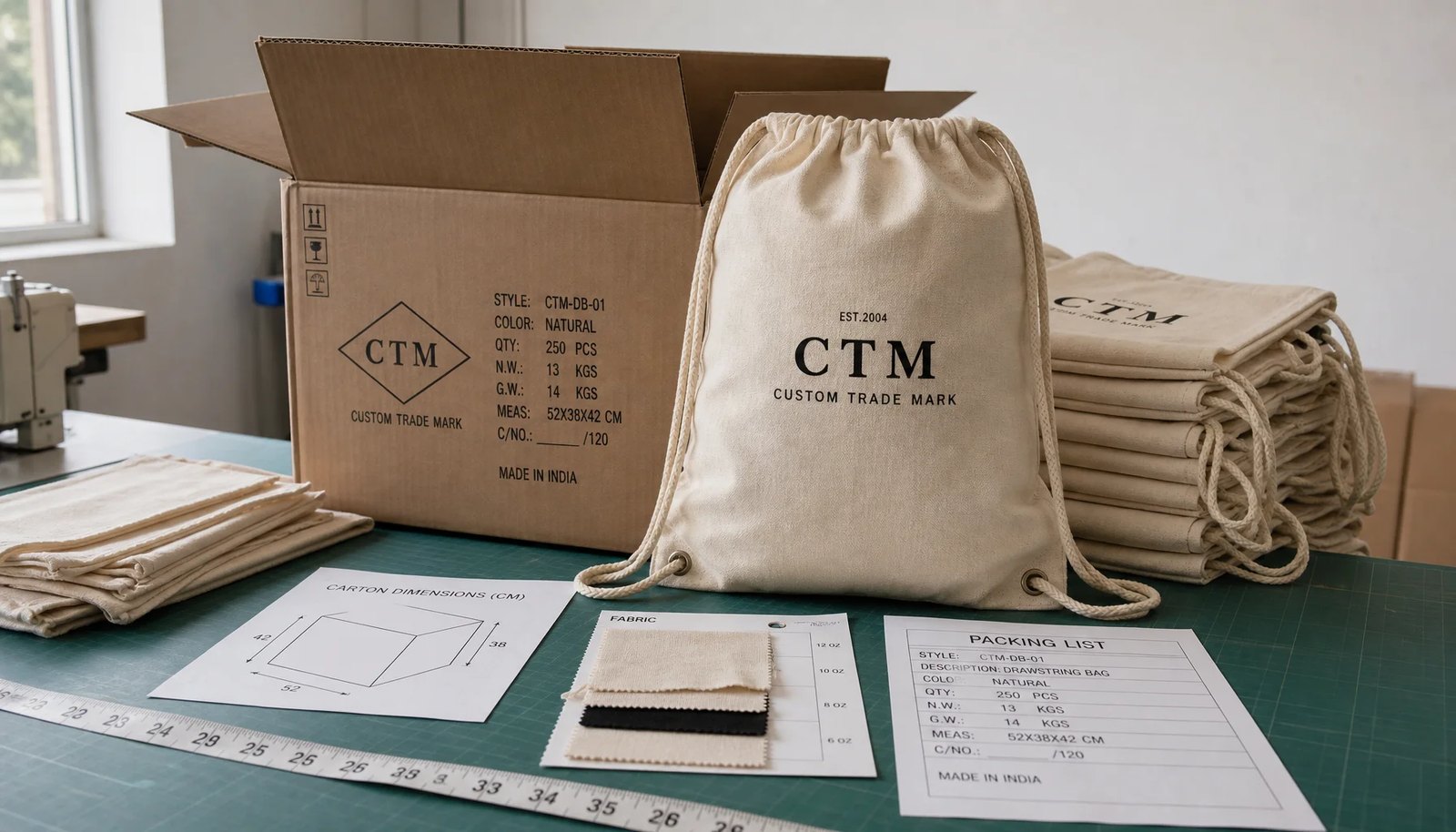
Treat The Bag As Freight From Day One
Wholesale cotton drawstring backpacks for trade show exhibitors are easy to think of as merchandise first. Procurement teams review the logo, the fabric feel, and the unit price. Then, late in the process, someone asks how many cartons are coming, how heavy they are, and whether booth staff can actually move them. That order of decisions creates avoidable cost.
A drawstring backpack is light as a single unit, but trade show quantities quickly become a logistics project. Finished size, cotton GSM, cord thickness, logo coverage, folding method, individual packing, and SKU separation all change carton count and freight chargeable weight. The same 35 x 45 cm cotton backpack may pack efficiently as bulk bundles, then become much bulkier when each unit is polybagged or protected for a large heat transfer print.
The better RFQ asks for product data and carton data together. Buyers should not wait until production is complete to learn the master carton dimensions. Carton information helps compare supplier quotes, plan courier or pallet delivery, prepare advance warehouse labels, and decide whether cartons will fit in booth storage. It also prevents a common mistake: choosing the lowest unit price while accepting a packing plan that raises freight, handling labor, or risk of damaged prints.
- Ask for estimated pieces per carton, carton dimensions, net weight, gross weight, and carton count in the first quotation.
- Set a maximum carton gross weight target, often about 15-18 kg when manual handling is expected.
- Confirm whether cartons will be packed by artwork version, exhibitor, destination, booth number, or mixed bulk quantity.
- Request carton mark details before purchase order approval, especially for show name, PO number, booth number, SKU, and sequential carton numbering.
- Treat packing format as a specification item because bulk bundles, paper bands, and polybags all change carton cube.
Write A Spec That Suppliers Can Price Cleanly
The phrase cotton drawstring backpack leaves too much open to interpretation. One supplier may quote lightweight promotional cotton. Another may assume midweight canvas. A third may include dyed twill, recycled cotton blend, or a heavier premium fabric. All may call the item a cotton drawstring backpack, but the products will not pack, print, cost, or perform the same way.
A strong buying specification starts with finished dimensions in centimeters. Common trade show sizes include 33 x 42 cm and 35 x 45 cm, but buyers should also define measurement tolerance, drawstring channel width, and opening size. A typical commercial tolerance for simple sewn cotton backpacks may be around +/-1 cm. If tighter tolerance matters because the bag must hold a catalog, product sample, or insert, state that before sampling.
Fabric should be described by composition, weave, and weight. For many exhibitor giveaways, 6 oz to 8 oz cotton canvas, roughly 200-270 GSM, balances hand feel, printability, durability, and carton efficiency. A 10 oz canvas, often about 320-340 GSM, can be a better choice for premium kits or reuse positioning. It also increases fabric cost, folded thickness, carton gross weight, and sometimes sewing stress at the lower cord points.
Procurement language should remove hidden substitutions. State whether the cotton may be natural, bleached, dyed, organic, recycled, or blended. Confirm whether the quoted GSM is measured before or after dyeing, washing, printing, or finishing. If cotton-poly blends are acceptable, say so. If the program requires cotton-only positioning, make that clear in the RFQ and keep an approved swatch on file.
- State finished dimensions, tolerance, drawstring channel width, and opening size.
- Specify fabric composition, weave, GSM or ounce weight, color process, and accepted shade variation.
- Define expected carrying load, such as literature only, up to 2 kg, or up to 3 kg with light product samples.
- Confirm whether labels, hangtags, inserts, belly bands, or individual bags are included in the carton estimate.
- Ask every supplier to quote against the same written spec so unit prices and freight data can be compared fairly.
Choose Fabric With Use And Presentation In Mind
Cotton fabric has two jobs at a trade show. It needs to look credible when handed to a visitor, and it needs to survive hurried, imperfect use. Attendees may carry brochures, badge wallets, chargers, a water bottle, small samples, and personal items. A fabric that looks fine flat on a desk may still disappoint if it wrinkles sharply, stretches at the bottom corners, or lets dark ink strike through.
Natural unbleached cotton is popular because it has a familiar reusable-giveaway look. Buyers should remember that seed flecks, slubs, and shade variation are part of many natural cotton bases unless a cleaner grade is specified. If the logo area must be especially clean, call out the front-panel standard. Bleached or dyed cotton can look more uniform, but it adds shade approval steps and may change hand feel. Recycled cotton blends can support sourcing goals, but composition, strength, and color consistency should be verified rather than assumed.
Construction deserves the same attention as fabric weight. Cotton rope supports a natural look. Braided polyester cord may slide more smoothly and provide more color consistency. Metal eyelets can add perceived value, but they need rust checks and pull checks. Stitched fabric loops avoid metal, yet they should be reinforced well enough to handle repeated opening, wearing, and pulling. The drawstring channel must be wide enough for the cord to move after sewing, pressing, printing, and packing.
For heavier event kits, the lower cord attachment is usually more important than an extra ounce of fabric. Reinforced lower corners, secure knots, proper stitch density, and clean inside seams matter because failures happen in public. When an attendee picks up a loaded bag and the corner tears, the brand impression is immediate. That is why the expected carrying load belongs in the RFQ, not only in an internal note.
- Define whether cotton is natural, bleached, dyed, organic, recycled, or blended.
- Set an acceptable range for natural cotton specks and slubs, especially across the logo area.
- Request reinforced lower cord points for heavier literature packs or multi-day event use.
- Specify cord material and diameter; thin cords can feel uncomfortable when the bag is loaded.
- Inspect inside seams, channel stitching, and stress points, not only the outside presentation.
Match Logo Method To Artwork And Carton Pressure
Decoration method affects far more than appearance. It changes setup cost, drying time, folding direction, print protection, and carton packing. Screen printing is usually the practical choice for one to three spot colors, clean vector logos, sponsor marks, and repeat corporate programs. It gives predictable unit cost when artwork is simple, but it still needs proper artwork control.
For screen print, the RFQ should include vector files, Pantone references, logo size, print position, and any minimum line thickness concerns. Cotton texture matters. Fine reversed type, small legal copy, and strokes under about 1 mm can fill in or look rough unless they are tested on the actual fabric. Large solid areas need attention too, especially on darker fabric where opacity, hand feel, and curing all affect the final result.
Heat transfer or digital print can be useful for gradients, photographic artwork, city-specific versions, or small sponsor runs where screen setups become inefficient. These methods come with their own checks. A large transfer may feel stiffer than ink, show a film edge, or pick up pressure marks when cartons are packed tightly. Digital printing can vary with cotton absorbency and pretreatment. Neither method should be approved from a generic sample on a different textile.
Print approval and packing approval should happen together. A logo may look clean when the bag is laid flat, then scuff, block, transfer, or take cord impressions after several days of compression. If the artwork uses dark ink, metallic ink, large solid coverage, or a transfer placed near a fold line, request a small stacking test or packed bundle review before mass packing.
- Provide vector files, Pantone references, print dimensions, and placement from top edge and side seam.
- For dark fabric, approve underbase opacity, edge sharpness, and hand feel on the exact fabric.
- For heat transfer, approve film edge, flexibility, compression behavior, and any wash expectation.
- Avoid placing fine text across seams, heavy slub areas, or fold lines when possible.
- For multiple logos, assign SKU codes and confirm setup charges and carton separation before production.
Use A Lot Table For MOQ And Version Control
MOQ is not always one number. A trade show order of 10,000 backpacks may turn into several production lots once it is split by fabric color, cord color, logo version, packing format, destination, or booth assignment. Each split can require separate print setup, counting, inspection, carton labels, and packing documentation.
Procurement teams should send the RFQ as a lot table rather than a paragraph. List quantity by artwork version, fabric color, print method, packing type, and destination. Then ask whether the MOQ applies to blank bags, printed bags, each fabric color, each print design, each cord color, each packing style, or each destination split. This is especially important for distributor programs and sponsor packages where the same base bag carries different branding.
Version control also matters for overages and shortages. A 2 percent shortage can sound small on the total purchase order, but it may be serious if it falls entirely on one sponsor's logo. The PO should state whether overproduction is accepted, whether extra pieces are billable, whether shortages are credited or replaced, and how rejected units are handled close to the event date.
The fewer unnecessary versions in a tight schedule, the better. Buyers may still need sponsor-specific logos or city versions, but each version should have a clear purpose. Every extra split adds artwork approval, setup, packing, inspection, and carton-marking work. When the delivery deadline is fixed, simplifying the lot structure can be as valuable as negotiating a lower unit price.
- Request MOQ by fabric color, print design, cord color, packing method, and shipment destination.
- Show quantities per sponsor, exhibitor, city, or booth in the RFQ.
- Ask whether split packing, special labels, or sequential carton numbering add labor cost.
- Define overage and shortage tolerance per SKU and per destination.
- Avoid unnecessary versioning when the event date is close and production capacity is limited.
Calculate Cartons Before You Compare Landed Cost
Carton planning is where a low unit price can lose its shine. Cotton compresses, but too much compression can crease panels, press cord marks into logos, weaken cartons, and make boxes hard to move. Underfilled cartons create the opposite problem: wasted dimensional freight, unstable stacking, and poor use of booth or warehouse storage.
The essential data points are simple: pieces per carton, carton length, width, height, net weight, gross weight, carton count, packing style, and carton material. Net weight is the product weight. Gross weight includes the carton and packing materials. For air and courier shipments, freight providers often calculate chargeable weight using actual weight or dimensional weight, whichever is higher. Without final packed dimensions, landed cost comparisons are incomplete.
For larger orders, ask the supplier to model two packing options. One option can be freight-efficient, with more pieces per carton if the print and fabric allow it. The other can be event-handling friendly, keeping cartons below a gross weight target such as 15-18 kg. The right answer depends on the receiving route. Palletized freight to an advance warehouse has different constraints from courier pieces delivered to a temporary booth.
Carton strength should not be treated as a generic detail. Ask for carton board grade, bursting strength, or edge crush information when cartons will be stacked, courier-handled, palletized, or routed through a show contractor. A weak carton can arrive crushed even when the bags inside were made correctly. If bags are individually packed, use final packed measurements for freight quotes, not estimates from blank bulk bags.
- Request packed carton dimensions in centimeters and gross weight in kilograms for each SKU or packing style.
- Confirm whether carton dimensions are estimates, pre-production trial data, or final packed measurements.
- Compare air and courier quotes using dimensional weight as well as actual weight.
- Ask for a packed carton photo showing bundle arrangement, scale weight, and carton marks.
- Use a packed carton trial for 10 oz canvas, oversized bags, large transfers, or urgent air shipments.
Select Packing Around The Booth Workflow
Packing should follow the way the backpacks will be received, counted, staged, and handed out. Bulk packing is often the best format for simple booth giveaways because it reduces packaging, saves carton space, and lets staff open a carton and place bundles directly at the stand. Good bulk packing still needs control: counted bundles, consistent folding, an inner liner when needed, and clear carton marks.
Individual polybags are useful when backpacks are resold, routed through fulfillment centers, placed into attendee kits, or stored where cleanliness rules are strict. They also add cost, labor, unpacking time, and carton volume. Paper bands or belly bands can be a middle option, especially when buyers want a cleaner handout presentation without full polybagging. Test them for transit durability and for marking on natural cotton.
For multi-exhibitor orders, packing is a risk-control system. If cartons are separated by artwork version or destination, receiving teams can stage materials quickly and avoid wrong-version handouts. If mixed cartons are unavoidable, the packing list must state exactly what is inside each carton. The carton label should make the mix obvious before the box is opened.
Think through the on-site labor. A carton of loose bags may look efficient at the factory, but it can slow down booth setup if staff must count, sort, and flatten each unit. A carton of overprotected individually bagged backpacks may create unnecessary trash and unpacking work. The best format is the one that protects the product and matches the actual event workflow.
- Use counted bulk bundles for simple giveaways and faster booth setup.
- Use individual polybags when resale, fulfillment, cleanliness, or kitting requirements justify the added cube.
- Add inner liners, tissue, or slip sheets when print scuffing, dust, or moisture exposure is a concern.
- Label cartons with SKU, artwork version, PO number, destination, quantity, carton number, and gross weight.
- Confirm whether labels must include booth number, advance warehouse address, show name, or contractor reference.
Approve Samples That Prove The Whole Order
A sample should prove production, not merely show a neat version of the idea. Buyers sometimes approve a sample made with available cotton, a temporary cord, or a hand-applied logo. Bulk production then arrives with a different fabric weight, a different drawstring, or a tighter fold. With trade show timing, there may be little room for correction.
The approval package should include the actual fabric or sealed swatch, actual cord, actual print method, finished dimensions, logo placement, folding method, and any packaging material that affects carton size. Measure the sample. Pull the cords. Check the lower corners. Inspect the inside seams. Fold the bag the way it will be packed. This is not overkill; it is how procurement catches small assumptions before they become full-order issues.
Print approval should include a strike-off on the same cotton base used for bulk. Compare color after curing under consistent light. Check edge sharpness, opacity, hand feel, and print position. If the order uses a heat transfer, look for film edge, adhesive bleed, edge lift, cracking, and surface dents after folding. If the print area is large, ask how the factory will keep printed faces from rubbing during packing.
For high-volume or time-sensitive programs, a packed carton trial is worth requesting. The supplier can pack a small bundle or a full trial carton using the proposed fold and protection method, then report pieces per carton, dimensions, net weight, gross weight, and any print condition changes after compression. This is especially useful for heavy canvas, large transfers, dark ink coverage, or shipments moving by air or courier.
- Approve actual production fabric, cord, print method, size, fold, and packing method together.
- Measure width, height, opening, cord length, and print position on the sealed sample.
- Keep one sealed sample with the buyer and one with the factory for inspection reference.
- Approve a print strike-off before bulk printing, especially for dark fabric or sponsor colors.
- Do not release bulk production until carton quantity assumptions match the approved sample and packing method.
Inspect Product Quality And Carton Accuracy Together
Quality control for cotton drawstring backpacks should combine product inspection and packing inspection. Product checks confirm that bags match the approved specification: fabric weight, dimensions, stitching, cord function, print color, print placement, cleanliness, and finishing. Packing checks confirm that the right quantities and versions are in the right cartons with the right labels. For a trade show buyer, a well-made bag in the wrong carton can still cause a problem at the venue.
Inspection criteria should be written before production starts. Common major defects include wrong fabric, wrong logo, incorrect print color, severe stains, mold odor, open seams, loose cord attachments, rusted eyelets, short cords, print transfer, poor opacity, and incorrect carton quantity. Minor defects may include loose threads, slight shade variation within the approved range, or small natural cotton specks away from the logo area. Define these categories for the program instead of leaving them to a last-minute judgment call.
Carton-level inspection is essential for multi-logo and multi-destination orders. Inspectors should count by SKU, verify bundle counts, check carton labels against the packing list, and confirm sequential carton numbering. They should also check carton dryness, tape sealing, corner condition, dimensions, and gross weight. If cartons are palletized, pallet count, stretch wrap, pallet labels, and stacking direction should match the logistics plan.
When the packing plan is complex, inspect during packing rather than only after cartons are sealed. Once cartons are taped and stacked, mixed-count errors become harder to find without reopening boxes. A short in-process packing check can save hours of sorting at the advance warehouse or booth.
- Use the approved sample, fabric swatch, and print strike-off as inspection references.
- Check GSM, finished size, seams, cords, eyelets, print color, print placement, rubbing, and cleanliness.
- Verify carton quantity by SKU and artwork version before cartons are sealed.
- Check carton marks, carton condition, moisture, sealing, dimensions, gross weight, and packing list accuracy.
- Inspect during packing for complex orders; final sealed-carton inspection may miss mixed-count errors.
Build The Calendar Backward From Receiving
Trade show delivery is unforgiving. A cotton drawstring backpack that arrives after the booth opens may have little value, even if it is beautifully made. The planning date should be the required receiving deadline, which may be the advance warehouse cutoff, the show contractor's receiving window, or a venue delivery appointment. The show opening date is usually too late to use as the main planning anchor.
A realistic calendar includes artwork finalization, quotation, purchase order, deposit, fabric procurement, lab dip if custom dyed, sample production, sample shipping, approval, bulk cutting, printing, curing, sewing, trimming, packing, inspection, export documents, freight booking, customs clearance, domestic delivery, and venue receiving. Small approvals often create the delay: a late sponsor logo, an unapproved strike-off, a missing carton label format, or a revised packing list.
When timing is tight, simplify the specification. Stock fabric colors, fewer artwork versions, standard bulk bundles, and clear carton labels can reduce risk. Custom dyed fabric, large full-color transfers, individual packing, and destination splits may still be necessary, but each one needs calendar space. Procurement should make those tradeoffs visible instead of discovering them after the PO is issued.
Landed cost should be compared with the same discipline. Product price, print setup, samples, special packing, carton labeling, inspection, inland freight, international freight, duty, customs fees, final delivery, and venue handling can all change the real cost per usable bag. Carton dimensions and gross weight are not secondary details; they are part of wholesale cotton drawstring backpacks for trade show exhibitors shipping carton planning.
- Work backward from the advance warehouse, show contractor, or venue receiving deadline.
- Add buffer for sample shipping, inspection, customs clearance, and local delivery appointments.
- Use stock fabric colors and fewer artwork versions when the schedule is tight.
- Compare suppliers using FOB price, packed carton data, sample timing, QC plan, and delivery route.
- Confirm carton labels, packing list format, and freight booking data before goods leave the factory.
Specification comparison for buyers
| Procurement decision | Recommended specification | Best fit for exhibitors | Carton and delivery risk to control |
|---|---|---|---|
| Standard giveaway fabric | 6 oz to 8 oz cotton canvas, usually about 200-270 GSM; confirm measured GSM tolerance such as +/-5% or the supplier's normal textile tolerance | Visitor bags for badges, brochures, notebooks, chargers, and light samples under about 2 kg total load | Fabric below about 180 GSM can feel thin, wrinkle sharply, and show print strike-through; fabric above about 300 GSM raises gross weight and reduces pieces per carton |
| Premium kit fabric | 10 oz cotton canvas, commonly about 320-340 GSM; state whether the quoted weight is before or after dyeing, washing, or finishing | VIP kits, internal sales meetings, sponsored gift packs, gift shop resale, and bags expected to be reused after the event | Heavier cloth adds sewing stress at lower cord points, increases folded thickness, may need larger cartons, and can push master cartons above manual handling targets |
| Finished size and tolerance | Common finished sizes include 33 x 42 cm and 35 x 45 cm; typical commercial tolerance is +/-1 cm unless tighter control is agreed before sampling | Standard exhibitor handouts where the bag must fit literature, a badge wallet, light catalogs, and small promotional items | Oversized bags increase fabric usage and packed cube; inconsistent sizing affects folding, bundle count, carton count, and booth presentation |
| Simple logo decoration | Spot color screen print using vector artwork, Pantone references, approved strike-off, print size, and placement measured from the top edge and side seam | One to three color exhibitor logos, sponsor marks, distributor branding, and repeat programs needing predictable unit cost | Fine reversed text, strokes under about 1 mm, large solids, metallic inks, and dark fabric need opacity, rubbing, and curing checks before bulk packing |
| Full-color decoration | Heat transfer or digital print tested on the exact cotton base; approve film edge, hand feel, curing, folding direction, and compression behavior | Gradient artwork, photographic graphics, city-specific versions, or short sponsor runs where screen setups are inefficient | Transfer film can create a stiff panel, show pressure marks in tight cartons, or crack if temperature, coating, and folding are not controlled |
| Cord and bottom attachment | Cotton rope, braided polyester cord, or blended cord with reinforced lower corners, metal eyelets, or stitched fabric loops | Programs positioning the backpack as reusable, natural, or higher quality than a disposable event tote | Cord diameter, knot security, eyelet rust resistance, stitch density, and pull strength need inspection because failures are obvious during visitor use |
| Bulk packing | Counted bundles in a lined master carton, commonly 25 or 50 pieces per bundle depending on fabric weight, size, and decoration | Booth giveaways opened on site, central warehouse distribution, and lower-packaging programs | Loose bulk packing can cause wrinkling, dust transfer, print scuffing, and count disputes unless fold direction, bundle quantity, liner use, and carton marks are fixed |
| Individual packing | One bag per polybag, paper band, belly band, or kit-ready sleeve when required by fulfillment, resale, or cleanliness rules | Retail resale, attendee kits, distributor fulfillment, pre-packed exhibitor materials, or shipments handled by third-party warehouses | Unit packing increases labor, carton cube, unpacking time, and freight chargeable weight; freight quotes must use final packed dimensions |
| Carton gross weight target | Plan master cartons under about 15-18 kg where manual handling is likely; confirm local warehouse, courier, or show contractor limits where applicable | Convention center receiving, courier delivery, temporary booths, and buildings without easy pallet access | Overfilled cartons can crush prints and become difficult to move; underfilled cartons waste dimensional freight and storage space |
Buyer checklist before sampling
- Define finished backpack dimensions in centimeters, such as 33 x 42 cm or 35 x 45 cm, and state measurement tolerance for width, height, drawstring channel, and opening.
- State fabric composition, construction, and weight clearly, for example natural 8 oz cotton canvas about 270 GSM, dyed cotton twill, organic cotton, recycled cotton blend, or cotton-poly blend if accepted.
- Confirm whether fabric weight is quoted before or after dyeing, washing, printing, or finishing, and request the supplier's normal GSM tolerance in writing.
- Define the expected carrying load, such as literature only, light samples up to 2 kg, or heavier kits up to 3 kg, so the supplier can select cord diameter, stitch density, and lower-corner reinforcement.
- Send vector artwork with Pantone references, print size, print position from top edge and side seam, minimum line thickness concerns, and sponsor logo spacing rules.
- Choose print method before requesting final carton data because screen print, heat transfer, and digital print can require different drying time, stacking protection, and folding direction.
- Decide whether backpacks are bulk bundled, individually polybagged, paper-banded, kitted, separated by destination, or packed by exhibitor before the supplier calculates carton dimensions.
- Request pieces per carton, carton length, width, height, net weight, gross weight, carton board grade, inner liner use, bundle count, and carton marks before approving the purchase order.
- Set inspection criteria for GSM, finished size, fabric stains, shade variation, print color, print position, print rubbing, cord length, eyelet security, stitching, carton count, and carton condition.
- Build the delivery calendar backward from the advance warehouse, show contractor, or convention center receiving deadline, not only from the show opening date.
Factory quote questions to send
- What fabric weight, weave, composition, shrinkage range, and color process are included in this quote, and is the cotton greige, bleached, dyed, organic, recycled, or blended?
- Is the quoted GSM measured before or after dyeing and finishing, what tolerance is applied, and can you provide a cut swatch or test report for approval?
- What finished size tolerance is quoted after sewing and pressing, and are measurements taken flat before packing or after unpacking from the carton?
- What cord material, cord diameter, cord length, knot method, lower-corner reinforcement, eyelet material, or fabric loop construction is included?
- Which print method is quoted, how many colors are included, what Pantone matching tolerance is used, and what setup charges apply for each artwork version?
- For screen print, what ink type, curing method, print hand feel, maximum print area, and expected rubbing performance are included on this cotton base?
- For heat transfer or digital print, what film or ink system is used, what temperature and pressure are applied, and how will packed cartons prevent film pressure marks?
- What is the MOQ per fabric color, print design, cord color, packing style, and destination split?
- How many pieces are packed per export carton, and what are the estimated carton length, width, height, gross weight, net weight, and carton count for the full order?
- What carton board grade, bursting strength, or edge crush specification is used, and will the carton be suitable for stacking, courier handling, palletizing, or convention center receiving?
Quality-control points to confirm
- Fabric GSM should be verified by weighing a measured panel sample or using the factory's standard textile test method, not only by relying on the supplier's description.
- Finished width, height, cord channel width, and opening size should remain within the agreed tolerance, commonly +/-1 cm for basic drawstring backpacks unless tighter tolerance is specified.
- Fabric composition and construction should match the approved swatch, especially when recycled cotton, organic cotton, or cotton-poly blends are quoted.
- Fabric color should be checked against approved swatch or lab dip under neutral light, with natural cotton shade variation accepted only within a defined range.
- Print color should be compared against the approved Pantone reference or strike-off after curing, using consistent lighting and the same cotton base.
- Print placement should be measured from the top edge and side seam because cotton panels can shift during cutting, sewing, pressing, and manual print positioning.
- Print durability should be checked with dry rubbing and stacking simulation, especially for dark ink, metallic ink, heat transfers, and large solid logo areas.
- Heat transfers should be checked for edge lift, film cracking, adhesive bleed, surface dents, and pressure marks after folding and short-term compression.
- Cord length should be consistent, comfortable for adult wear, and long enough for the opening to function without hanging excessively below the bag.
- Bottom cord attachment should withstand repeated pull testing without tearing fabric, opening the stitch line, loosening the knot, or deforming the eyelet.