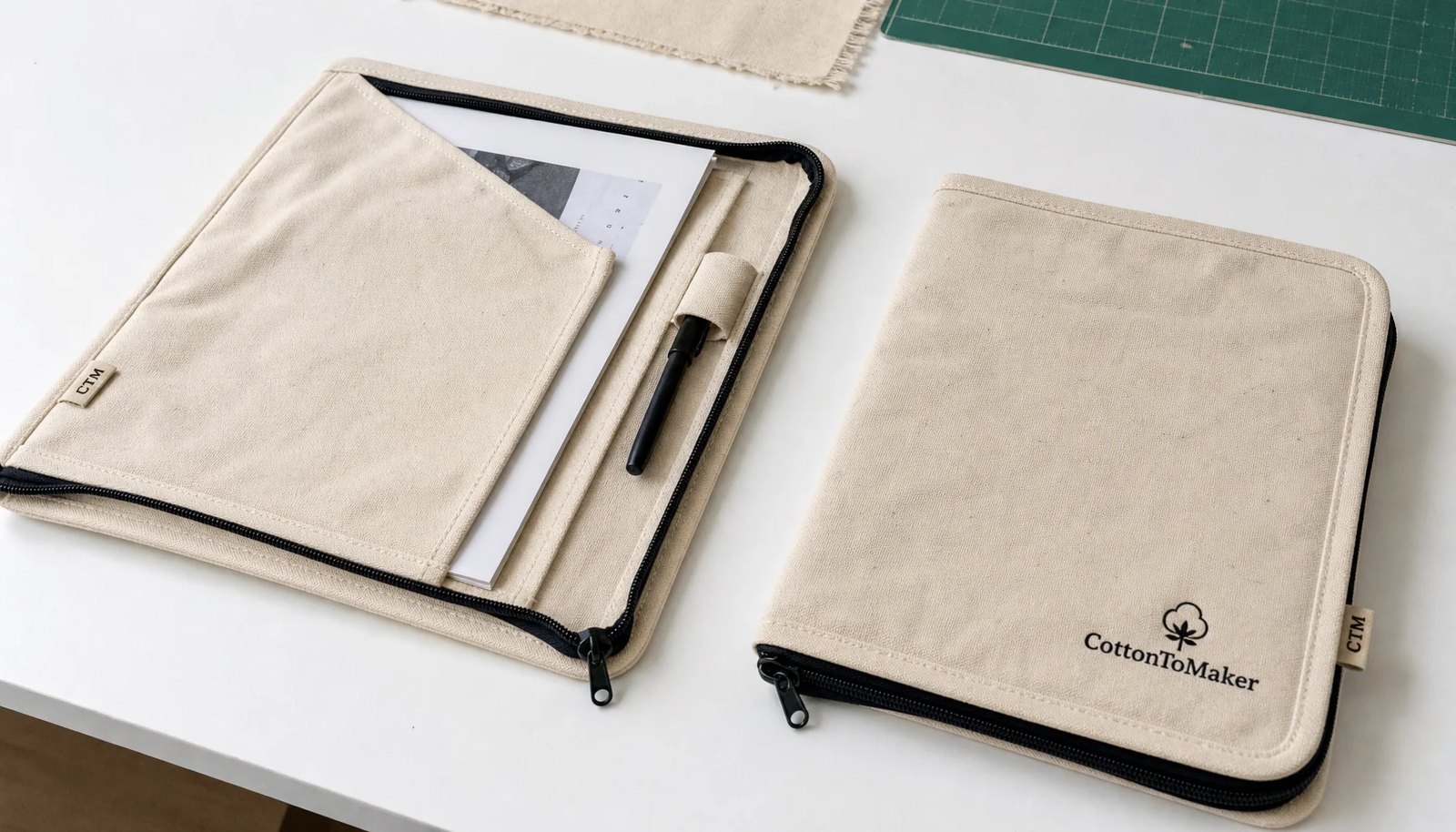
Why This Product Needs a Real Specification
At first glance, wholesale canvas zipper portfolios for university bookstores look simple. They are flat canvas business bags with a zipper, a logo, and maybe a few pockets. In a bulk order, though, that simple description leaves too much room for interpretation. The portfolio has to protect documents, show licensed branding cleanly, fit planned inserts, scan correctly at receiving, and arrive before a fixed retail, orientation, alumni, or graduation date.
Most quality problems start before production. One supplier may quote 10 oz canvas, a small zipper, no reinforcement, and bulk packing. Another may include 12 oz canvas, a #5 nylon coil zipper, reinforced corners, individual barcode sleeves, and a final inspection process. Both may call the item a canvas zipper portfolio, but they are not quoting the same product.
Procurement teams get better pricing and fewer surprises when the RFQ removes guesswork. Define the program, contents, finished size, usable size, fabric weight, zipper system, logo method, interior layout, packing, carton marks, and quality inspection checklist before comparing quotes. The goal is not to overcomplicate the product. The goal is to make price, quality, and lead time comparable.
- Start with the bookstore program and the actual contents, not only the target price.
- Ask every supplier to quote the same canvas, zipper, logo, interior, and packing specification.
- Approve physical swatches and strike-offs because canvas texture changes color and print behavior.
- Treat barcode accuracy, SKU separation, carton flatness, and moisture control as quality requirements.
- Keep one production file with the approved swatch, zipper card, strike-off, sample, measurements, and packing standard.
Match Construction to the Bookstore Program
A university bookstore may buy the same general product for very different reasons. A licensed retail SKU needs consistent shelf appearance, clean packaging, accurate barcode placement, and tight logo control. An orientation portfolio may carry maps, handbooks, student forms, stickers, pens, lanyards, and event schedules. A graduation certificate carrier must stay flat and clean. A department welcome kit may be filled by staff after receiving, so pockets and pen loops need to be easy to use.
Do not rely on broad phrases such as fits A4, fits letter size, or suitable for tablets. A sleeve that fits loose sheets may not fit a file folder. A folder that fits alone may become tight when a spiral notebook and pen are added. If tablets are involved, confirm the device model or maximum device dimensions, and decide whether students are expected to use protective cases. If padding is required, specify it separately; a canvas document portfolio is not automatically a padded tablet case.
Use case also changes what people notice. Retail shoppers notice print alignment, shade consistency, thread trimming, and packaging. Orientation recipients notice whether the zipper works and whether everything fits. Warehouse teams notice carton labels, SKU separation, and scannable barcodes. A useful sourcing file turns those expectations into measurable requirements.
- Retail merchandise: prioritize licensed color, clean presentation, barcode placement, hangtag, and SKU separation.
- Orientation kit: prioritize capacity, pocket usability, pen loops, zipper reliability, and loaded-fit testing.
- Certificate carrier: prioritize flatness, clean fabric surface, smooth sleeve entry, and carton pressure control.
- Tablet sleeve: prioritize usable opening, lining, optional padding, zipper clearance, and reinforced corners.
- Department bundle: prioritize repeatable pocket dimensions, efficient packing, and receiving accuracy.
Size, Fit, and Interior Layout
Finished size and usable size are not the same. Outside dimensions help the factory cut panels, calculate fabric consumption, and estimate carton volume. Usable internal dimensions determine whether the bookstore’s inserts actually fit. Zipper tape, seam allowance, lining, binding, pocket panels, and rounded corners can all reduce usable space. A portfolio can pass an outside measurement check and still fail when the buyer loads the intended folder or certificate.
The specification should state outside length and width, usable inside length and width, zipper opening length, pocket depth, pocket opening width, pen-loop circumference or flat width, and logo position. For many flat document portfolios, ±5 mm is a practical finished-size tolerance. When the insert set is tight, use stricter controls such as ±3 mm for usable openings, pocket placement, or logo placement. If the portfolio must hold a tablet, include device dimensions plus allowance for a case if needed.
Interior features should earn their place. One document sleeve, one slip or mesh pocket, and one or two pen loops often give enough organization for bookstore programs without creating unnecessary sewing complexity. Card slots, elastic straps, backing boards, mesh pockets, and extra dividers can add value, but each one adds cutting, alignment, stitch, and inspection risk. Test the pre-production sample with the real insert set before approving bulk cutting.
- Record outside dimensions, usable inside dimensions, zipper opening, corner radius, and finished-size tolerance.
- Set pocket depth, pocket opening, pen-loop width, and placement tolerance in millimeters.
- Test fit with the actual folder, notebook, certificate, tablet, pen, charger, or orientation-kit contents.
- Keep pen loops and bulky pockets away from the zipper path and high-pressure carton areas.
- Avoid interior features that do not improve the bookstore program, retail value, or user experience.
Canvas Weight, Finish, and Shade Control
Canvas is both a cost driver and a visible quality signal. For many university bookstore programs, 12 oz cotton canvas, about 380-400 GSM, gives a practical balance of structure, printability, sewing efficiency, and carton weight. A 10 oz canvas, roughly 300-340 GSM, may work for light document holders or budget giveaways. A 14 oz canvas, roughly 450-475 GSM, feels more substantial but can create thicker seams, tougher zipper sewing, higher needle-break risk, and heavier cartons.
Quote fabric in both oz and GSM. Suppliers and mills do not always describe fabric in the same way, so the purchase order should include the target weight and production tolerance. ±5% is a common starting point for canvas, unless the buyer needs a tighter range. Also define finish type and shrinkage expectation. Pre-shrunk or stabilized canvas helps size consistency. Washed canvas gives a softer look but may increase measurement and shade variation. Coated or water-repellent canvas may improve practicality, but it can affect odor, ink adhesion, and print sharpness.
Natural canvas has character, not perfect uniformity. Flecks, slubs, and seed marks may be acceptable when they are within the approved standard. Heavy slubs through the logo area, stains, oil marks, finishing residue, and mismatched panels should be treated as defects. Dyed canvas needs lab dip approval and bulk shade review. Bleached canvas can make school logos look brighter, but it also shows dirt and abrasion more easily. Keep the approved swatch and check bulk goods under consistent light, ideally D65 or daylight-equivalent lighting.
- Standard retail option: 12 oz / 380-400 GSM canvas with ±5% GSM tolerance.
- Budget document option: 10 oz / 300-340 GSM canvas for light papers and simple giveaway programs.
- Premium option: 14 oz / 450-475 GSM canvas when heavier hand feel justifies cost and sewing risk.
- Finish controls: define natural, bleached, dyed, washed, laminated, coated, or water-repellent treatment.
- Shade controls: approve swatch or lab dip, bulk lot, panel matching, and surface defect limits.
Zipper, Puller, Seams, and Reinforcement
The zipper is the part students and store staff will test immediately. A #5 nylon coil zipper is usually the safest default for canvas zipper portfolios because it runs smoothly, bends around corners better than many metal zippers, keeps weight moderate, and is widely available. A #3 zipper may lower cost, but it can feel weak on a retail item and is less forgiving when the portfolio is loaded. Metal zippers can look premium, but they add weight and may scratch documents or tablets if the interior is not designed carefully.
A complete zipper specification covers size, coil type, tape color, coil color, slider material, puller style, puller length, end-stop method, and zipper path. If the design uses an L-shaped or three-sided opening, the corner radius matters. Poor alignment creates wavy edges, fabric catching, and slider resistance. Ask for a zipper card or close-up component photo before sampling, then test the pre-production sample through repeated full-path opening and closing. For bookstore portfolios, 20 full open-close cycles on selected samples is a practical inspection check unless a formal laboratory cycle test is required.
Seams carry the load even when the product looks flat. Stress concentrates at zipper ends, corners, pocket joins, pen loops, and binding starts or stops. The approved sample should show seam allowance, stitch density, thread appearance, and reinforcement method. For heavy canvas, 7-9 stitches per inch is a useful reference unless the sample establishes another standard. Reinforcement may include backstitching, bar tacks, double stitching, binding tape, or folded seam construction.
- Use a #5 nylon coil zipper for most bookstore programs unless the design intentionally requires another zipper.
- Approve zipper tape, coil, slider, puller, stops, zipper path, and corner behavior before production.
- Check 20 full open-close cycles on selected samples during final inspection unless another test is agreed.
- Inspect zipper ends, corners, pocket joins, and pen loops for reinforcement, not only neat appearance.
- Avoid oversized pullers or sharp hardware that may mark canvas, catch packaging, or create safety concerns.
Logo Application and Licensed Artwork
University bookstore merchandise often carries licensed school marks, department logos, alumni graphics, or private-label bookstore branding. That makes logo control a commercial issue as well as a quality issue. Screen printing is commonly suitable for bold one- to three-color marks because it is efficient for bulk orders and can be durable when ink, curing, mesh, and fabric preparation are correct. Still, canvas texture affects opacity and edge sharpness. Fine text, thin outlines, gradients, and mascot details need careful review before the buyer commits to screen print.
A physical strike-off on final canvas is essential. A digital proof or print on substitute fabric will not show how the ink behaves on the actual fabric weight, finish, and shade. The strike-off should confirm print size, position, Pantone target, perceived color, opacity, registration, edge sharpness, curing, dry rub, and bend performance. For many flat portfolios, ±3 mm print-placement tolerance is practical. Licensed artwork may need tighter alignment if the brand approval rules require it.
Other branding methods can work well when chosen deliberately. Embroidery adds texture but can pucker lighter canvas and distort small letters. Heat transfer can handle detail, but adhesion on textured, dyed, coated, or water-repellent canvas must be tested. Woven labels are useful for subtle bookstore branding or multi-campus variation. Patches, PU labels, leather labels, and debossed labels can lift perceived value, but they add tooling, MOQ, sewing time, and inspection points.
- Screen print: best for bold marks, moderate color counts, and repeat bookstore programs.
- Heat transfer: useful for detail, but adhesion on textured or treated canvas must be tested.
- Embroidery: premium option requiring backing, stitch-count review, and pucker inspection.
- Woven label: practical for subtle branding, bookstore private label, or campus variation.
- Patch branding: higher perceived value but adds tooling, MOQ, placement, and sewing QC requirements.
RFQ Details That Make Quotes Comparable
A strong RFQ makes supplier assumptions visible. Ask each factory to quote the same construction and call out any substitution. If a supplier changes canvas weight, zipper size, lining, pocket count, logo method, or packing to meet a target price, that change should be written into the quote. Otherwise, the lowest quote may simply be a lighter fabric, weaker zipper, thinner carton, or missing barcode work.
Separate cost drivers into materials, labor, branding, packing, and compliance. Materials include canvas GSM, fabric finish, dyeing, zipper, puller, lining, mesh, binding tape, thread, labels, patches, and backing board. Labor rises with pockets, curved zipper sewing, binding, lining, trimming, and reinforcement. Branding cost depends on print colors, screen setup, ink type, embroidery stitch count, patch tooling, label minimums, and approval steps. Packing cost includes individual sleeves, hangtags, barcode labels, desiccant, layer boards, carton strength, carton marks, and SKU separation.
MOQ should be discussed by variable, not only by total order quantity. Stock natural canvas with a black zipper and one-color print may be practical at 500-1,000 pieces per artwork. Custom dyed canvas, custom zipper tape, branded pullers, patches, woven labels, embroidery, and multiple barcode versions can raise MOQ and lead time because each material or setup must be handled separately. Multi-campus orders should be priced with clear splits by logo, canvas color, zipper color, packing version, and destination.
- Request itemized assumptions for canvas, zipper, interior, logo, packing, inspection, and Incoterms.
- Ask for MOQ by canvas color, artwork, zipper color, puller, label, patch, barcode, and packing version.
- Compare CBM, carton quantity, gross weight, and packing method because freight affects landed cost.
- Clarify whether samples, strike-offs, lab dips, barcode labels, hangtags, and inspection support are included.
- Require written approval before any supplier substitutes fabric, zipper, logo method, accessory, or packing.
Sampling Workflow and Approval Records
Development samples are helpful, but they are not always production standards. They may use available canvas, substitute zipper colors, temporary labels, or approximate printing. That can be acceptable during concept development if everyone documents what is not final. Before bulk production, require a pre-production sample made with final canvas weight, final finish, final zipper, final puller, final logo method, final pocket layout, final labels, and final individual packing.
Review the pre-production sample as both a product and an inspection standard. Load it with the intended bookstore contents. Check whether it lies flat, whether the zipper closes without strain, whether pockets remain usable, whether pen loops create pressure marks, and whether the logo looks clean on the chosen canvas. Measure outside size, usable inside size, zipper opening, pocket depth, logo placement, and sample weight. Open and close the zipper repeatedly. Bend the printed area lightly and perform a dry rub check with a clean white cloth.
Approval notes must be specific. Keep the approved fabric swatch, lab dip if applicable, zipper card, print strike-off, sample photos, measurement sheet, and packing standard together. If the sample is approved with corrections, write exact changes such as move logo 8 mm upward or increase pocket depth from 170 mm to 185 mm. Avoid vague notes like improve zipper unless they are tied to a required component change, sewing correction, or resample.
- Approve swatch, lab dip, zipper card, strike-off, pre-production sample, and packing sample as linked standards.
- Measure the sample and record outside size, usable opening, pocket depth, logo placement, and sample weight.
- Test the loaded sample with real inserts before authorizing bulk cutting, printing, and sewing.
- Use exact written corrections and require resampling for critical material, zipper, size, or logo changes.
- Store approval photos and measurements so final inspectors can compare bulk goods to the same standard.
Quality Inspection Checklist for Production
Quality control should begin before final inspection. Canvas zipper portfolios are hard to rework after fabric has been cut, printed, sewn, trimmed, and packed. In-line checks should cover incoming material, cutting, printing, zipper attachment, pocket sewing, reinforcement, trimming, and packing. Early checks catch wrong GSM, shade mismatch, miscut panels, print curing problems, zipper wave, and pocket placement errors before the full order is affected.
Final random inspection should combine AQL workmanship review with functional checks. Many buyers use general inspection levels and AQL limits for consumer soft goods, but the exact plan should be stated in the purchase order. Critical defects should have zero tolerance. Examples include unsafe sharp hardware, broken zipper sliders, wrong licensed artwork, mildew odor, severe contamination, foreign objects, or mixed restricted logos. Major defects include failed usable fit, zipper jamming, open seams, incorrect pocket placement, wrong barcode, severe print shift, or size outside tolerance. Minor defects may include limited thread tails, small cosmetic irregularities, or natural slub variation within the approved standard.
Make the checklist measurable. Inspectors should measure finished size, usable opening, pocket depth, and logo position. They should open and close the zipper through the full path, load selected pieces with representative inserts, perform dry rub on printed logos, pull stress points by the agreed hand method, and check odor when cartons are opened. Packing inspection should verify individual packaging, barcode placement, carton count, SKU separation, carton marks, gross weight, and visible moisture condition.
- Incoming QC: verify canvas GSM, shade, fabric defects, zipper type, labels, patches, and accessory colors.
- In-line QC: check cutting accuracy, logo position, print curing, zipper sewing, pocket placement, stitch density, and reinforcement.
- Function QC: test zipper cycling, loaded fit, seam stress points, pocket usability, and print rub resistance.
- Appearance QC: inspect stains, shade panels, slubs, print defects, embroidery pucker, loose threads, odor, and surface marks.
- Packing QC: verify barcode, hangtag, individual packing, SKU separation, carton quantity, carton marks, gross weight, and flatness.
Packing, Labeling, Cartons, and Moisture
Canvas zipper portfolios are usually shipped flat, but flat products still deform. Overfilled cartons can create bent corners, zipper impressions, puller marks, and center bowing. Underfilled cartons allow pieces to slide, crease, and abrade. The packing specification should define individual packaging, inner bundle quantity, pieces per export carton, carton dimensions, maximum gross weight, layer protection, desiccant if required, carton marks, and carton numbering.
University bookstore receiving depends on SKU accuracy. Cartons should be separated by campus, logo, color, barcode, packing version, and destination when allocation matters. Mixed cartons may save time at the factory, but they can create receiving errors and delay floor placement. Barcode labels should scan easily without damaging presentation. Hangtags, paper sleeves, and insert cards should be positioned so they do not press marks into the canvas during long transit.
Packaging material should match the channel. Recyclable paper sleeves or belly bands may support sustainability goals, but they protect less against dust, moisture, and abrasion than polybags. Polybags protect canvas better but may conflict with retailer packaging policies. Natural and white canvas need extra care because dirt, dark paper transfer, and carton abrasion are easy to see. For humid routes, ocean freight, or seasonal storage, include moisture-control checks before shipment release.
- Define individual pack type, pieces per carton, carton dimensions, maximum gross weight, and layer protection.
- Pack flat without compressing zipper sliders, metal pullers, patches, or hangtags into the canvas face.
- Separate SKUs by campus, logo, color, barcode, packing version, PO, and destination as required.
- Use carton marks with PO number, SKU, color, logo version, quantity, carton number, gross weight, and destination.
- Inspect cartons for moisture, odor, crushing, barcode accuracy, carton count, and product flatness before release.
Specification comparison for buyers
| Spec decision | Recommended option | When it fits | Buyer risk to check |
|---|---|---|---|
| Canvas body fabric | 12 oz cotton canvas, about 380-400 GSM, with written GSM tolerance of ±5% unless otherwise agreed | Core bookstore retail, orientation, and alumni programs needing structure without excessive carton weight | Supplier may quote lighter 10 oz fabric while calling it heavy canvas; verify GSM by swatch, bulk fabric report, and incoming inspection |
| Canvas finish | Natural, bleached, or dyed canvas with approved shade standard, shrinkage expectation, and surface defect limit | Licensed school colors, natural-campus aesthetic, or private-label bookstore programs | Natural flecks and slubs are normal, but panel-to-panel mismatch, heavy seed marks, stains, or finishing residue should be defined as defects |
| Finished size and opening | Outside dimensions plus usable inside dimensions; typical tolerance ±5 mm on length/width and ±3 mm on pocket placement | A4, US letter, certificate, tablet, notebook, or orientation-kit inserts | A product can meet outside size but fail usable fit because zipper tape, seam allowance, lining, or curved corners reduce the opening |
| Zipper system | #5 nylon coil zipper with matching tape, smooth slider, secure top/bottom stops, and approved puller | Most canvas zipper portfolios where repeated opening, bend performance, and cost control matter | Cheap sliders snag at corners, coil can separate, and zipper tape can wave; test full-path opening at sample and final inspection |
| Seam and reinforcement | Lockstitch construction, 7-9 stitches per inch, backstitching or bar tack at stress points, and consistent seam allowance | Student use with papers, pens, notebooks, small accessories, or bookstore kit inserts | Open seams, skipped stitches, weak corners, and loose zipper-end reinforcement often appear only after loading the sample |
| Interior organization | One document sleeve, one slip or mesh pocket, and one or two pen loops with measured placement | Orientation gifts, stationery bundles, alumni merchandise, department welcome packs, and retail SKUs | Every added pocket increases cutting, sewing, alignment, and inspection risk; define usable pocket depth and opening, not only appearance |
| Logo application | Screen print for bold 1-3 color marks; woven label or patch for subtle bookstore branding; embroidery only with pucker testing | Licensed marks, department logos, bookstore private label, alumni programs, and repeat bulk orders | Canvas texture changes ink opacity and edge sharpness; approve a strike-off on final fabric under consistent light before bulk production |
| MOQ and order split | 500-1,000 pcs per color/artwork for stock materials; higher for custom dyed fabric, custom pullers, patches, or many packing versions | Seasonal bookstore replenishment, campus launches, orientation kits, and multi-department programs | Small splits by campus, logo, zipper color, barcode, or packaging version can create setup charges and material minimums |
| Packing method | Individual recyclable polybag or paper sleeve; flat packed 20-40 pcs per export carton with carton quantity, CBM, and gross weight stated | Wholesale receiving, distributor warehouses, campus stores, and ecommerce fulfillment | Over-tight cartons cause zipper impressions and bent corners; loose cartons cause sliding, creasing, and dirty canvas |
Buyer checklist before sampling
- Confirm the buying program: licensed retail item, orientation giveaway, alumni gift, graduation certificate carrier, department welcome kit, stationery bundle, or tablet/document sleeve.
- List the actual contents to be carried and measure the largest insert, including folders, spiral notebooks, certificates, tablets, pens, chargers, lanyards, stickers, or printed handbooks.
- Specify outside dimensions, usable internal dimensions, zipper opening length, corner radius if relevant, pocket depth, pen-loop width, and size tolerances before requesting price.
- State canvas weight in both oz and GSM, acceptable production tolerance, finish type, shrinkage expectation, shade standard, surface cleanliness limits, and whether the fabric is stock or custom dyed.
- Confirm zipper size, coil type, tape color, coil color, slider material, puller style, end-stop method, zipper path, and required smooth operation through corners.
- Provide licensed artwork as vector files with Pantone references, print size, print location, safe margin from seams and zipper, minimum line width, and allowed color tolerance.
- Require a logo strike-off on the final bulk fabric, not on substitute fabric, and check color, opacity, edge sharpness, curing, dry rub, and bend performance.
- Define internal features with measured drawings: document sleeve opening, pocket stitch line, mesh weight if used, pen-loop circumference, lining fabric, backing board, and seam allowance.
- Ask for a pre-production sample made with final canvas, final zipper, final logo method, final label, final pocket layout, final hangtag or barcode, and final individual packing.
- Set measurable QC thresholds for GSM, finished size, zipper smoothness, seam strength, corner reinforcement, print adhesion, odor, stains, shade panels, loose threads, and carton deformation.
Factory quote questions to send
- What exact canvas weight are you quoting in oz and GSM, what production tolerance applies, and is the fabric stock, custom woven, custom dyed, washed, laminated, coated, or water-repellent treated?
- What are the finished outside dimensions, usable inside dimensions, zipper opening length, pocket depth, seam allowance, corner shape, and size tolerance included in the quotation?
- Which zipper specification is included: #5 or another size, nylon coil or metal, tape color, coil color, slider material, puller finish, end stops, zipper path, and supplier grade?
- Can you provide a zipper card or close-up component photo showing coil, tape, slider, puller, end stop, and color before the pre-production sample is made?
- What logo method are you pricing: screen print, heat transfer, embroidery, woven label, cotton label, PU patch, leather patch, debossed patch, or combined branding?
- How will you control licensed logo color on natural or dyed canvas, and will you provide a physical strike-off on final bulk fabric before mass production?
- What is the MOQ per canvas color, zipper color, logo artwork, patch design, custom puller, hangtag, barcode, and packing version if the order is split by campus or department?
- Does the quote include inner document sleeve, mesh pocket, slip pocket, pen loops, lining, backing board, binding tape, hangtag, barcode sticker, desiccant, carton marks, and export cartons?
- What sample schedule is included for fabric swatch, lab dip if applicable, logo strike-off, development sample, pre-production sample, and revised sample if corrections are required?
- How many calendar days are needed for fabric booking, material arrival, cutting, printing, curing, sewing, trimming, in-line inspection, final inspection, packing, and export handover?
Quality-control points to confirm
- Bulk canvas GSM should match the approved swatch within the agreed tolerance; ±5% is a common production allowance for canvas unless the buyer sets a tighter range.
- Finished length and width should remain within the approved tolerance; ±5 mm is common for flat document portfolios, while zipper opening and pocket placement may require tighter controls such as ±3 mm.
- Bulk shade should match the approved swatch or lab dip under consistent lighting, ideally D65 or daylight-equivalent light, with no obvious panel-to-panel mismatch on the same portfolio.
- Natural canvas should meet the approved slub, fleck, seed mark, stain, and yarn-defect limit; normal natural variation should be separated from retail-visible defects.
- The usable opening should fit the intended insert set without forcing the zipper, especially for A4 folders, US letter folders, certificates, notebooks, tablets, or orientation kit contents.
- Zipper should open and close smoothly through the full path without slider jamming, skipped coil, coil separation, loose stops, fabric catching, wavy zipper tape, or uneven zipper stitching.
- Inspection samples should include zipper cycling; for bookstore portfolios, a practical check is 20 full open-close cycles on selected samples unless the buyer specifies a laboratory cycle test.
- Zipper ends, corners, pocket joins, handle or puller areas if present, and other stress points should be reinforced by the approved method, such as backstitching, bar tack, binding, or doubled seam.
- Top stitching should be straight and secure, typically 7-9 stitches per inch for heavy canvas unless the approved sample states otherwise, with no skipped stitches, broken thread, needle cuts, or open seams.
- Thread tails should be trimmed to the agreed limit; many buyers use no visible thread tails longer than 3 mm on exterior surfaces and no loose thread nests inside.