Why This Product Needs a Real Specification
Canvas zipper portfolios look simple on a website. In production, they behave more like soft business bags than flat stationery. A university bookstore may use the same item as a shelf SKU, an admissions folder, an orientation kit component, a course-material bundle, an alumni gift, or a department staff supply. Those use cases do not need identical construction, and that is where many wholesale buying problems begin.
Suppliers may describe similar items as canvas file holders, zipper business bags, school folders, document pouches, organizer sleeves, cotton canvas portfolios, or tablet pouches. The name tells you very little. Cost and quality are driven by finished size, fabric weight, zipper grade, lining, padding, binding, pocket layout, logo method, packing, and inspection standard. If those items are not written into the RFQ, each supplier will quote a different product while using the same product title.
The buyer’s job is not to overbuild the portfolio. It is to make the intended use measurable. A retail bookstore SKU may justify 14 oz or 16 oz canvas, cleaner edge binding, individual protective packing, UPC application, and AQL inspection. A one-time orientation item may prioritize cost and delivery date, but it still needs a smooth zipper, acceptable school-color match, and packing that does not deliver dirty or bent stock.
- Define the channel first: retail shelf, admissions kit, orientation kit, course bundle, alumni gift, staff supply, or department event.
- Replace broad terms such as heavy canvas, premium zipper, retail quality, tablet friendly, and eco packing with measurable details.
- Require every supplier to quote finished size, canvas GSM, zipper type, lining, pocket layout, logo method, packing, carton data, and inspection level.
- Ask suppliers to list assumptions and exceptions in writing so quotes can be compared by construction instead of by product name.
Size the Portfolio Around Real Campus Contents
A portfolio that is a little too small creates daily frustration. Papers catch on the zipper. Spiral notebooks scrape the seam. The corners of handouts bend before the product even reaches the student. A portfolio that is too large has the opposite problem: it feels floppy, uses more canvas, increases carton volume, and may not sit neatly on a bookstore shelf.
Start with the actual load. For a bookstore program, that may include US letter papers, A4 handouts, a campus map, orientation schedule, stickers, a pen, a calculator, a charger cable, a small tablet, or a thin course packet. Add clearance for seam allowance, lining thickness, binding, foam if used, and the zipper path. A common US letter program may work at about 13 x 10 inches finished. A4 programs often need about 34 x 25 cm or more, depending on the opening and internal pockets. Treat these as starting points, not universal rules.
The opening matters as much as the outside rectangle. A one-side zipper is closer to a document pouch and is usually cheaper. A two-side zipper makes loading easier. A three-side zipper gives a stronger portfolio feel because the product opens wider, but it uses more zipper, adds sewing time, and puts more stress on the corners. If the item will be marketed as tablet compatible, name the device size and say whether the tablet sits in the main compartment, a padded sleeve, or an elastic-secured pocket.
- State finished size, not cut size, because seam allowance, binding, padding, and lining all reduce the usable opening.
- Use a written tolerance such as +/-5 mm for width and height, measured empty, flat, and zipped unless another method is agreed.
- Specify whether the zipper opens on one side, two sides, or three sides; wider access usually means higher cost and more corner control.
- Ask the supplier to load the sample with buyer-specified contents and provide open, closed, side, and corner photos before approval.
- For any tablet claim, define sleeve width, sleeve depth, padding thickness, closure method, and target device size.
Choose Canvas by Weight, Finish, and Handfeel
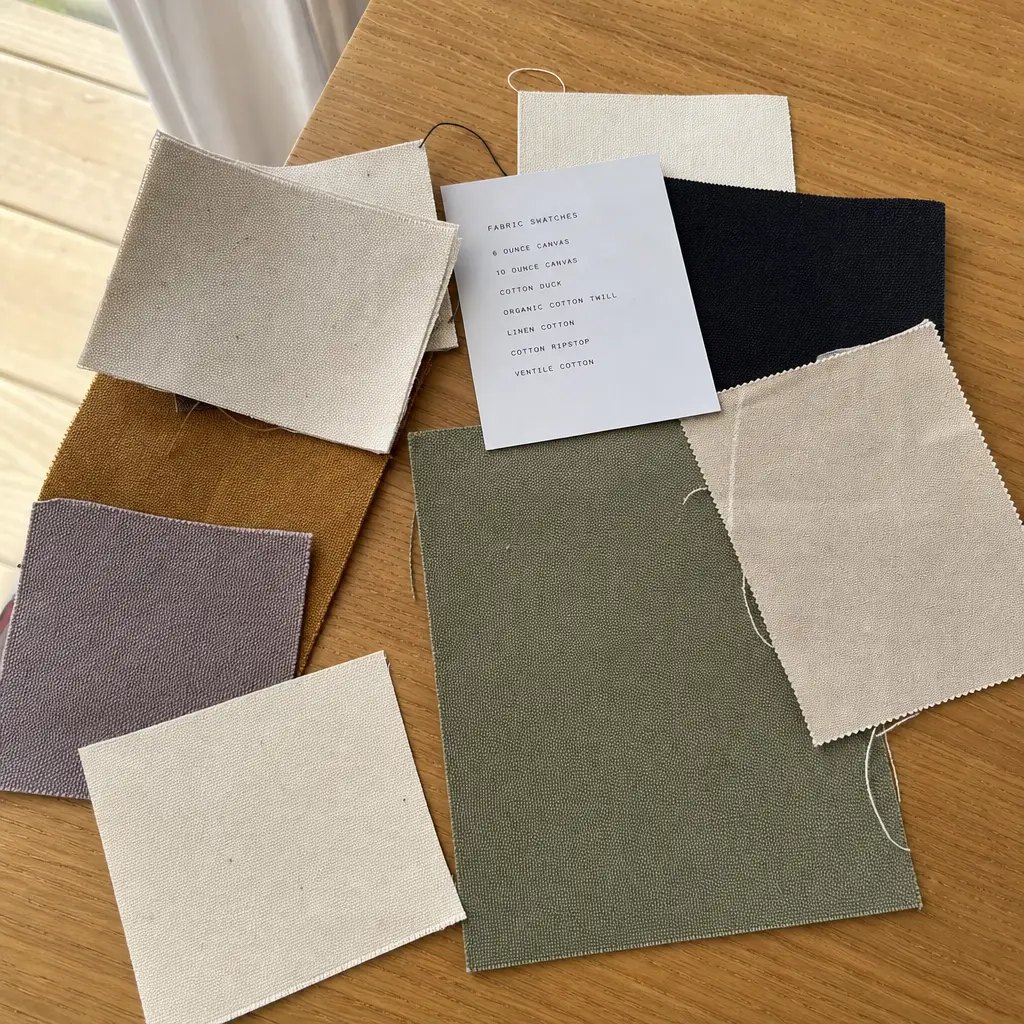
Canvas weight is one of the first levers suppliers use to reduce price. That is why buyers should state both ounces and GSM. Light 8 oz to 10 oz cotton canvas can work for a short event giveaway or very basic document sleeve, especially if lined. For most university bookstore canvas zipper portfolios, 12 oz to 16 oz cotton canvas, roughly 340-450 GSM, is a practical range. It gives the product enough body for regular handling without making zipper corners too bulky.
Heavier is not automatically better. Canvas above 18 oz can look premium, but it can also create thick corner stacks, uneven binding, needle damage, and higher freight weight. A lined 12 oz portfolio may feel cleaner and more stable than an unlined heavier one. If foam padding is used, the outer fabric may not need to be as heavy, but the factory must control where the foam stops so the zipper path does not become stiff or lumpy.
Finish and color need the same discipline. Natural canvas has a familiar campus merchandise look and can support lower MOQs, but seed flecks, yarn slubs, and shade movement are normal unless limits are written. Dyed canvas supports school-color merchandising, yet it adds lab dip approval, dye-lot MOQ, rubbing risk, and possible variation between batches. Dark colors such as navy, black, maroon, forest green, and royal blue should be checked for dry and wet rubbing against light paper, clothing, and display surfaces.
- Specify cotton canvas in both oz and GSM, plus fabric composition if blended fabric is allowed or prohibited.
- Use 12 oz with lining for value retail or orientation programs where structure matters but budget is controlled.
- Use 14 oz to 16 oz for sturdier bookstore merchandise only after checking corner sewing, puckering, and needle marks.
- For dyed canvas, approve lab dip and bulk shade before cutting, and define shade tolerance against the approved swatch.
- For natural canvas, set limits for seed flecks, slubs, dark yarns, weaving holes, odor, dampness, and visible shade variation.
Do Not Leave the Zipper to Chance
The zipper is the part customers test first. If it drags, catches, waves, or separates at the corner, the whole item feels cheap. For most canvas zipper portfolios, a No. 5 nylon coil zipper is the safest default. It bends around soft corners, opens smoothly, controls cost, and is less likely to scratch papers or devices than metal teeth. A metal zipper may fit a premium trim direction, but it is heavier and should be checked for burrs, plating quality, and corner behavior.
The RFQ should name the zipper size, tape color, teeth color, puller material, puller shape, zipper length, and opening path. A molded puller is economical and consistent. A metal puller often feels stronger, but inspection should include plating, attachment strength, and sharp edges. Branded pullers can look polished, yet they may require tooling, a separate MOQ, and extra lead time.
Test the zipper with the portfolio loaded. An empty sample can zip smoothly while a loaded one catches the lining, hesitates at the corners, or bows along the edge. Binding and zipper-end reinforcement also deserve close review. Clean topstitching, even corner turns, secure bartacks, and covered raw edges separate bookstore-ready merchandise from a low-grade promotional pouch.
- Use No. 5 nylon coil zipper as the default unless the trim strategy or price target clearly requires another zipper.
- Define zipper tape, teeth, puller, pull tab, opening path, end stops, and zipper-end reinforcement in the tech pack.
- Add bartacks or reinforced stitching at zipper stress points, pull tabs, corner turns, handles, and loop attachments.
- During sample review, open and close the loaded zipper at least 20 cycles and record catching, drag, separation, or corner hesitation.
- Reject wavy zipper tape, loose end stops, sharp puller edges, lining caught in the slider, uneven corner travel, and exposed raw edges.
Match Branding to University Artwork
University marks are not ordinary decoration. They may include official seals, mascots, department names, class years, event lockups, clear-space rules, Pantone references, and restrictions on distortion. Canvas texture changes how those marks print. Small type, thin outlines, mascot details, and large solid ink areas may look crisp on a PDF proof but broken or uneven on coarse fabric.
Screen printing is often the practical choice for bold one-color to three-color marks. It controls cost and works well when the artwork is simple. Fine detail is a different story. Woven labels, cotton labels, embroidered patches, and PU patches can give repeat bookstore programs a cleaner and more controlled appearance, although they may add setup charges and separate MOQs. Heat transfer can reproduce detailed art or gradients, but it must be tested for cracking, peeling, edge lift, handfeel, and whether the finish looks too synthetic on cotton canvas.
Placement should be measured, not described loosely. State the logo width and height, distance from bottom edge, distance from side edge, orientation, and acceptable tolerance. A common logo placement tolerance is around +/-3 mm to +/-5 mm, but the purchase order should state the actual rule. If several departments share one base portfolio, use a standard placement grid so the family looks consistent across SKUs.
- Use screen print for bold school names, simple seals, class years, and event marks with limited colors.
- Use woven or cotton labels for repeat programs when the buyer wants consistent branding across different body colors.
- Use PU patches only after checking stitching strength, edge finish, thickness, color match, and adhesion if heat-applied.
- Test heat transfers for cracking, peeling, edge lift, rub resistance if relevant, and handfeel on textured canvas.
- Approve a physical strike-off on actual bulk canvas, including Pantone target, logo size, placement tolerance, print coverage, and acceptable texture show-through.
Keep the Interior Useful, Not Overbuilt
Interior features can make a canvas zipper portfolio more valuable, but every extra panel adds material, labor, bulk, and another possible defect point. Many bookstore programs do well with a simple layout: one main document area, one pen loop, and one flat accessory pocket for a card, receipt, stickers, or small cable. That gives the product a real function without turning it into a complex organizer.
Write interior measurements with the same care used for the outside. Define pocket entry width, pocket depth, divider height, pen loop flat width, elastic length, and closure method. If the product is meant for US letter papers, test it with letter paper and a spiral notebook. If it is meant for A4, test with A4. If it carries a tablet, name the device size range and decide whether the sleeve needs 2-3 mm foam, soft lining, elastic, hook-and-loop, or no closure.
The inside should not fight the zipper. Loose lining, sagging pockets, rough seam ends, long threads, and poorly anchored dividers can catch in the slider. Pocket openings should remain accessible when the portfolio is partially full. Elastic should recover without curling. Mesh, if used, should be checked for stretch, snagging, and edge binding. Customers often open these items in-store, so the interior finish is part of the retail impression.
- Start with one document area, one pen loop, and one flat accessory pocket before adding complex organizer panels.
- Define pocket width, pocket depth, divider height, pen loop width, elastic length, and closure method in millimeters or inches.
- Test with actual contents: papers, notebook, pen, charger, calculator, campus map, and named tablet if used in the claim.
- State whether foam covers the full panel, tablet sleeve only, or stops before the seam allowance.
- Reject twisted lining, blocked pocket access, rough edges, loose elastic, sagging panels, and any interior component that catches the zipper.
Build MOQ Logic Before Departments Choose Variants
University bookstore orders often split across departments, admissions, athletics, alumni programs, class years, staff teams, and multiple campuses. MOQ can become messy fast. A supplier may say the minimum is 1,000 pieces, but that may mean one body color, one zipper color, one lining color, one pocket layout, one logo, and one packing method. It may not mean 100 pieces each across ten different versions.
The cleanest sourcing strategy is to standardize the base first. One natural canvas body with one zipper color and several printed logos is easier to make than several dyed body colors with matching zipper trims, unique patches, and different labels. If departments need identity, change the print, hangtag, belly band, or barcode label before changing the fabric or trim. A shared base also makes reorders, inspection, and inventory transfer easier.
Review MOQ at four levels: total order MOQ, fabric color MOQ, trim MOQ, and decoration MOQ. Decoration minimums may apply to screen printing, woven labels, embroidery, PU patches, rubber patches, or custom pullers. Separate setup charges from unit price, because first-order math and reorder math are not the same. If the bookstore expects annual reorders, ask how long screens, cutting patterns, patch molds, label artwork, and puller tooling are retained.
- Quote a base option with one body color, one zipper color, one lining color, one pocket layout, one logo, and one packing method.
- Quote a logo-split option while keeping fabric, zipper, lining, pocket layout, carton count, and packing identical.
- Quote a color-split option only when different body colors or school-color merchandising are truly needed.
- Separate screen charges, patch tooling, label setup, embroidery digitizing, custom puller tooling, barcode setup, sample fees, and freight.
- Ask for reorder MOQ, reorder price, retained-tooling policy, and sample requirements before approving a multi-department program.
Make the Pre-Production Sample Earn Approval
A rough prototype can confirm size and general layout, but it should not be the final control sample for a wholesale bookstore order. The pre-production sample should use the bulk canvas weight, actual zipper, final lining, final logo method, final pocket layout, correct labels, and proposed retail packing. This is the sample production and inspection will be measured against.
Review the sample like a receiver, a customer, and an inspector. Measure width, height, gusset, zipper opening, logo placement, pocket depth, pen loop width, and any tablet sleeve. Load it with the intended contents and zip it closed. Open and close it repeatedly while watching the corners and lining. Inspect both panels under consistent light for stains, shade variation, wrinkles, print coverage, pressure marks, and loose threads.
When revisions are needed, separate design changes from quality corrections. Adding padding, changing logo method, widening a pocket, switching zipper color, or changing packing can affect cost and lead time. Fixing skipped stitches, crooked labels, zipper catching, oil marks, wrong logo position, or dirty canvas is a quality correction. After approval, keep one signed or sealed control sample with the factory and one with the buyer or inspection team when practical.
- Measure width, height, gusset, zipper opening, pocket depth, pen loop width, tablet sleeve size, and logo position.
- Load the sample with real papers, notebook, pen, charger, and tablet sample if those items are part of the selling claim.
- Compare canvas GSM, handfeel, shade, lining, zipper, puller, label, patch, print finish, and packing to approved references.
- Approve one signed or sealed pre-production sample as the control sample for cutting, sewing, printing, packing, and inspection.
- Record every approved deviation in writing so later QC decisions are based on the PO and control sample, not memory or photos.
Ask for Quote Data That Supports Landed Cost
A low unit price is not useful if the quote leaves out the material standard. For wholesale canvas zipper portfolios, a complete quote should show fabric weight, fabric finish, lining, padding, zipper type, zipper size, pocket count, logo method, packing, carton data, production lead time, sample cost, payment terms, and trade term. Without those fields, procurement teams cannot compare a bag factory, trading company, decorator, or promotional reseller fairly.
Require suppliers to price the same specification and identify exceptions. One quote may include 14 oz canvas, polyester lining, No. 5 zipper, screen print, individual polybag, UPC label, and FOB terms. Another may include 10 oz canvas, no lining, a generic zipper, bulk packing, and EXW terms. The second may look cheaper, but it is a different product and a different landed cost.
One-time charges should not be buried. Screen setup, label weaving, patch molds, embroidery digitizing, barcode application, sample freight, custom carton marks, and special packing can all be reasonable, but they change how the first order compares with a reorder. For annual bookstore SKUs, a setup charge may be acceptable if it improves presentation and consistency. For a short event order, simpler decoration may be the better choice.
- Require clear FOB port or EXW factory address; do not compare quotes with unclear or mixed trade terms.
- Request carton dimensions, quantity per carton, gross weight, net weight if available, and estimated CBM for landed-cost planning.
- List included packing items: protective sleeve, polybag, paper belly band, hangtag, UPC sticker, silica gel if used, inner carton, and master carton marks.
- Ask whether the price assumes buyer-ready vector artwork or includes supplier artwork cleanup, proofing, and color separation.
- Compare fabric GSM, zipper grade, lining, padding, logo method, pocket layout, packing, MOQ, lead time, payment terms, and setup charges line by line.
Packing Must Protect Retail Appearance
Canvas zipper portfolios are flat, but they still get damaged in transit. Tight cartons can bend corners, press zipper pulls into the fabric, and mark printed logos. Loose cartons allow shifting, dirty edges, distorted panels, rubbed labels, and mixed SKU stacks. Packing should protect the retail look while keeping carton cube and handling weight reasonable.
Bookstore presentation varies by program. An individual recyclable polybag or protective paper sleeve keeps canvas clean during import, warehouse handling, and backroom storage. A paper belly band gives a more natural shelf feel, but it protects less against moisture and dirt. A hangtag can help merchandising, yet it can bend or catch if placed poorly. Some buyers use protective import packing plus a factory-applied barcode label or belly band. State who applies UPC labels, where labels go, and whether price stickers are excluded.
Carton rules should match the receiving operation. Set a carton quantity that keeps gross weight within the buyer’s handling limit; many importers prefer roughly 12-18 kg when that fits their warehouse standard. Use flat stacking with consistent orientation. Add thin board or paper separators if zipper pulls, patches, or prints create pressure points. Carton marks should include PO number, SKU, color, logo version, quantity, carton number, and country of origin when required.
- Set maximum carton gross weight based on the buyer’s warehouse rules, such as 12-18 kg if that fits the receiving standard.
- Use flat stacking with consistent orientation to reduce corner stress, panel distortion, zipper pressure marks, and label rubbing.
- Add tissue, paper, or thin board separators if zipper pulls, patches, or printed faces may rub during freight.
- Define barcode placement, hangtag attachment, belly band position, inner quantity, master carton quantity, SKU separation, and carton marks.
- Review moisture exposure, compression risk, carton strength, and drop-handling risk for sea, air, courier, or domestic truck freight.
Specification comparison for buyers
| Spec decision | Recommended option | When it fits | Buyer risk to check |
|---|---|---|---|
| Finished size | Letter programs: about 13 x 10 in finished; A4 programs: about 34 x 25 cm finished; write tolerance as +/-5 mm for flat dimensions | Bookstore retail, admissions folders, orientation kits, and course-material bundles that need documents to slide in without scraping the zipper | Do not approve from a photo only; load the sample with actual papers, notebook, pen, and target tablet before confirming finished size |
| Outer fabric weight | 12 oz to 16 oz cotton canvas, approximately 340-450 GSM, with approved handfeel and shade range | Retail-grade university merchandise that must hold papers, notebooks, small chargers, and stationery while keeping a clean rectangular shape | Under 10 oz may feel like a giveaway unless lined; over 18 oz can create bulky zipper corners, uneven binding, and higher freight weight |
| Lining and padding | 150D-210D polyester lining for basic protection; 2-3 mm foam padding only when tablet positioning is part of the spec | Programs that need cleaner interior finish, reduced fabric lint, or a more structured retail feel | Padding can migrate or bunch near the zipper; specify thickness, coverage area, and whether padding stops before seam allowances |
| Closure | No. 5 nylon coil zipper with reinforced end stops and metal or molded puller; three-side opening for portfolio-style access | Most bookstore use where smooth opening, moderate cost, and lower scratch risk matter | Cheap zipper tape can wave after sewing; inspect corner travel, puller attachment, end stops, and repeated loaded opening cycles |
| Edge construction | Bound edges with even topstitching, zipper-end bartacks, and clean corner turning | Retail shelf sales, alumni gifts, admissions merchandise, and department welcome packs where appearance matters | Loose binding, exposed raw edges, skipped stitches, or bulky corners make the item look promotional rather than retail-ready |
| Branding method | Screen print for bold 1-3 color marks; woven label, cotton label, embroidered patch, or PU patch for repeat retail programs | University marks, class years, department logos, mascot lockups, and bookstore private-label programs | Textured canvas can break fine artwork; specify Pantone target, artwork file type, logo size, placement tolerance, and physical strike-off approval |
| Interior function | One main document area plus pen loop and one flat accessory pocket; add tablet sleeve only with named device-size target | Broad bookstore appeal without overbuilding the SKU or creating unnecessary defect points | Vague claims like laptop friendly cause disputes; define pocket depth, entry width, padding, closure, and contents to be tested |
| MOQ strategy | Standardize body color, zipper color, lining, and construction; split only logo versions when possible | Bookstores buying for departments, admissions, alumni, sports, orientation, or multiple campuses under one program | A 1,000-piece MOQ may not mean 100 pieces each across ten versions; quote total MOQ, color MOQ, trim MOQ, and decoration MOQ separately |
| Packing | Individual protective sleeve or recyclable polybag, optional paper belly band or hangtag, flat-stacked export carton under buyer weight limit | Receiving teams that need clean shelf-ready stock, barcode handling, SKU separation, and predictable carton counts | Over-tight cartons bend corners and mark print areas; define units per carton, carton size, gross weight, separator use, barcode placement, and carton marks |
Buyer checklist before sampling
- Define the selling use first: retail shelf SKU, orientation kit, admissions packet, alumni gift, course bundle, staff supply item, department event, or conference merchandise.
- State finished size in width by height by gusset, if any, and write the measurement tolerance, commonly +/-5 mm for flat dimensions and +/-3 mm for logo placement unless tighter limits are agreed.
- Specify outer canvas by oz and GSM, fabric composition, color, finish, dye method if applicable, lining material, padding thickness, and whether the sample must pass a handfeel reference.
- List zipper type, zipper size, tape color, teeth color, puller material, puller shape, end-stop reinforcement, and whether the zipper opens on one, two, or three sides.
- Provide logo artwork in vector format with Pantone references, maximum print size, exact placement from edges, orientation, acceptable placement tolerance, and rules for official university marks.
- Define interior layout with measurements: document pocket width and depth, pen loop width, card pocket size, tablet sleeve target, padding coverage, elastic band length, and closure method if used.
- Request a pre-production sample made with bulk canvas, bulk zipper, final lining, final logo method, final pocket layout, and proposed retail packing before mass cutting.
- Set acceptance criteria for print position, zipper smoothness, seam strength, stains, odor, loose threads, skipped stitches, lining twist, pocket access, corner shape, and barcode accuracy.
- Define retail packing: individual bag or sleeve, paper belly band, hangtag, UPC or SKU sticker, master carton marks, units per carton, carton gross weight limit, and SKU separation.
- Ask suppliers to quote MOQ by total order, body color, zipper color, lining color, logo version, label version, patch version, and packaging version so split costs are visible.
Factory quote questions to send
- What exact canvas weight is included in the unit price in both oz and GSM, and is the canvas natural, dyed, washed, brushed, laminated, enzyme-washed, or otherwise finished?
- What fabric composition is quoted, and can you provide fabric weight tolerance, such as +/-5%, plus shade approval through lab dip or bulk swatch before cutting?
- Is the quoted zipper a No. 5 nylon coil zipper, and what tape color, teeth color, puller material, puller shape, zipper length, and end-stop reinforcement are included?
- What are the minimum quantities for one body color, each additional body color, zipper color, lining color, logo artwork, print color, woven label, patch, or retail packing version?
- Can the pre-production sample be made with actual bulk fabric, bulk zipper, final lining, final logo method, final pocket layout, and proposed packing, and what is the sample lead time?
- Which branding method is included in the price: screen print, heat transfer, embroidery, woven label, cotton label, PU patch, leather patch, rubber patch, or another method?
- What tolerances do you accept for finished dimensions, logo placement, print registration, seam allowance, pocket depth, zipper alignment, and shade variation against the approved sample?
- How will portfolios be packed to prevent bent corners, zipper pressure marks, print transfer, moisture exposure, dust, odor transfer, and carton compression during freight?
- What quote terms are included: FOB port, EXW factory address, carton dimensions, gross weight, estimated CBM, HS code suggestion, payment terms, sample charge, and production lead time?
- Do you perform in-line inspection before final packing, and can you support AQL inspection with critical, major, and minor defect classification written before production?
Quality-control points to confirm
- Finished size should stay within the written tolerance, commonly +/-5 mm for flat portfolio dimensions unless a different tolerance is approved in the purchase order.
- Canvas should match approved GSM, handfeel, color shade, weave density, and surface cleanliness without oil marks, weaving holes, excessive slubs, mildew smell, dampness, or strong chemical odor.
- For dyed canvas, shade should match the approved lab dip or bulk swatch, and dark colors should be checked for dry and wet rubbing risk against light papers or clothing.
- Zipper should open and close smoothly for repeated cycles while loaded, without catching lining fabric, separating at corners, waving severely along the edge, or showing loose end stops.
- Logo color, size, print coverage, registration, label sewing, patch edge finish, and placement should match the approved strike-off or pre-production sample within written tolerance.
- Binding, corner turns, and zipper-end bartacks should be even, secure, and free of skipped stitches, exposed raw edges, broken thread, needle damage, open seams, or excessive puckering.
- Interior pockets should fit the intended document, notebook, or tablet size without tight entry, sagging fabric, twisted panels, rough edges, blocked access, or loose elastic.
- Padding and lining, if used, should lie flat without bubbling, migration, hard lumps, trapped thread, adhesive bleed-through, or visible glue marks through the canvas.
- Individual packing should keep each portfolio flat and clean without pressure marks on print, zipper pulls, labels, patches, corners, barcode stickers, or hangtags.
- Cartons should meet agreed units per carton, carton marks, gross weight limit, SKU separation, moisture protection, and export packing standard suitable for the selected freight route.