Why this product category matters for startup programs
Wholesale canvas zipper portfolios sit between a simple document pouch and a premium onboarding accessory, which is why the buying decision matters more than the category name suggests. For tech startups, the bag often carries notebooks, chargers, tablets, cables, investor decks, sales samples, or event materials. It has to look polished enough for a brand moment, but it also has to survive bulk distribution, repeat handling, and the occasional overstuffed desk drawer. A weak spec creates a chain reaction: if the body is too soft, the bag feels cheap; if the zipper is underbuilt, the puller fails early; if the print is too small or too detailed, the logo loses clarity on textured canvas.
The right buying approach is to define the use case first, then build the quote around that use case. A procurement team sourcing for a conference kit has different priorities than a distributor planning a retail assortment or an operations team ordering onboarding packs across multiple offices. The portfolio should be sized and finished for the actual load, not for an abstract product name. That means deciding whether the item is mainly for documents, device protection, internal travel, or a customer-facing gift before you ask suppliers to quote.
For B2B buyers, the category is less about fashion and more about repeatability. Startups often reorder the same bag for hiring events, accelerators, investor meetings, and field teams, so the first order sets the standard for every later run. If sample approval is loose, the brand can end up with inconsistent zipper colors, logo placements, or packing formats that make replenishment harder and raise internal rework cost.
A good spec also helps procurement compare vendors fairly. When one supplier quotes a slim canvas pouch and another quotes a heavier portfolio with better construction, the cheaper unit may not be the cheaper option in practice. Asking for a consistent checklist up front makes the differences visible and reduces back-and-forth during approval.
In practice, the purchase is not just a bag order. It is a brand-control decision and an operations decision. Treating it that way makes the RFQ cleaner, the sample process faster, and the final shipment less risky.
- Use a portfolio spec when the user needs flat document carry with a structured look.
- Use a zipper closure when loose contents, chargers, or event materials need extra protection.
- Keep the spec simple if the bag is a giveaway; add lining and hardware only if the user will keep it.
- Write the use case into the RFQ so suppliers do not optimize for the wrong outcome.
How to define the portfolio before you request quotes
Before a supplier can quote accurately, the buyer has to lock the commercial definition of the bag. That starts with the finished size, then moves to gusset depth, zipper opening, handle style, lining, and any add-ons such as a pen loop, card pocket, or internal divider. The most common procurement mistake is asking for a portfolio quote before the team has decided what actually needs to fit inside it. If the intended load is a laptop, charger, and notebook, the interior depth and opening width must be checked against those dimensions before any price comparison is meaningful.
The finished size should be specified in a way that leaves little room for interpretation. If the bag is meant for A4 documents, say so. If it is intended to hold a 13-inch tablet, note the device dimensions and case thickness, not just the diagonal screen size. If your team wants a portfolio that can fit both documents and a slim laptop sleeve, make that explicit as a functional requirement. Clear use-case language helps suppliers choose the right cutting template and avoids size disputes after production starts.
You should also decide whether the portfolio is meant to stand upright, lie flat, or fold into a larger kit. Structure matters here. A 10 oz canvas body can be fine for a flexible document pouch, but a presentation piece may need 12 oz or 14 oz with a more stable hand. Likewise, a wrist strap may be enough for internal distribution, but a more premium program may justify a reinforced carry loop or detachable shoulder strap. The key is to define which features are essential and which are optional so the quote does not become inflated with unnecessary hardware.
Finish language matters too. Terms like natural canvas, washed canvas, and dyed canvas can mean different things across factories, especially if one supplier is sourcing stock fabric and another is weaving or dyeing to order. Ask the factory to confirm the base color, whether the canvas is pre-shrunk or enzyme-washed, and what effect that finish has on final dimensions and print clarity. This prevents avoidable confusion later, especially for buyers trying to align sample approval across regions or business units.
Once these basics are locked, the RFQ can actually do its job: produce comparable quotes that can be evaluated on cost, quality, and delivery rather than on vague product descriptions.
- State the exact use case: documents, tablets, onboarding kits, or event packs.
- Define the finished size using internal load requirements, not only screen size or marketing language.
- Lock the carry style, lining decision, and any interior organizers before requesting prices.
- Ask the supplier to confirm whether the canvas is pre-shrunk, washed, or stock-dyed.
Fabric weight, body, and print behavior
For most canvas zipper portfolios, 10–12 oz canvas is the commercial sweet spot. Ten oz keeps cost under control for bulk programs and promotions, while 12 oz gives the bag more body, cleaner corners, and a more premium hand feel. If the portfolio needs to stand up on a desk, protect devices from abrasion, or hold its shape when partially filled, 14 oz can be justified, but only if the buyer accepts a higher fabric cost and a slightly stiffer finish. Buyers should think of fabric weight as a balance between appearance, durability, print behavior, and freight volume rather than as a simple premium-versus-budget choice.
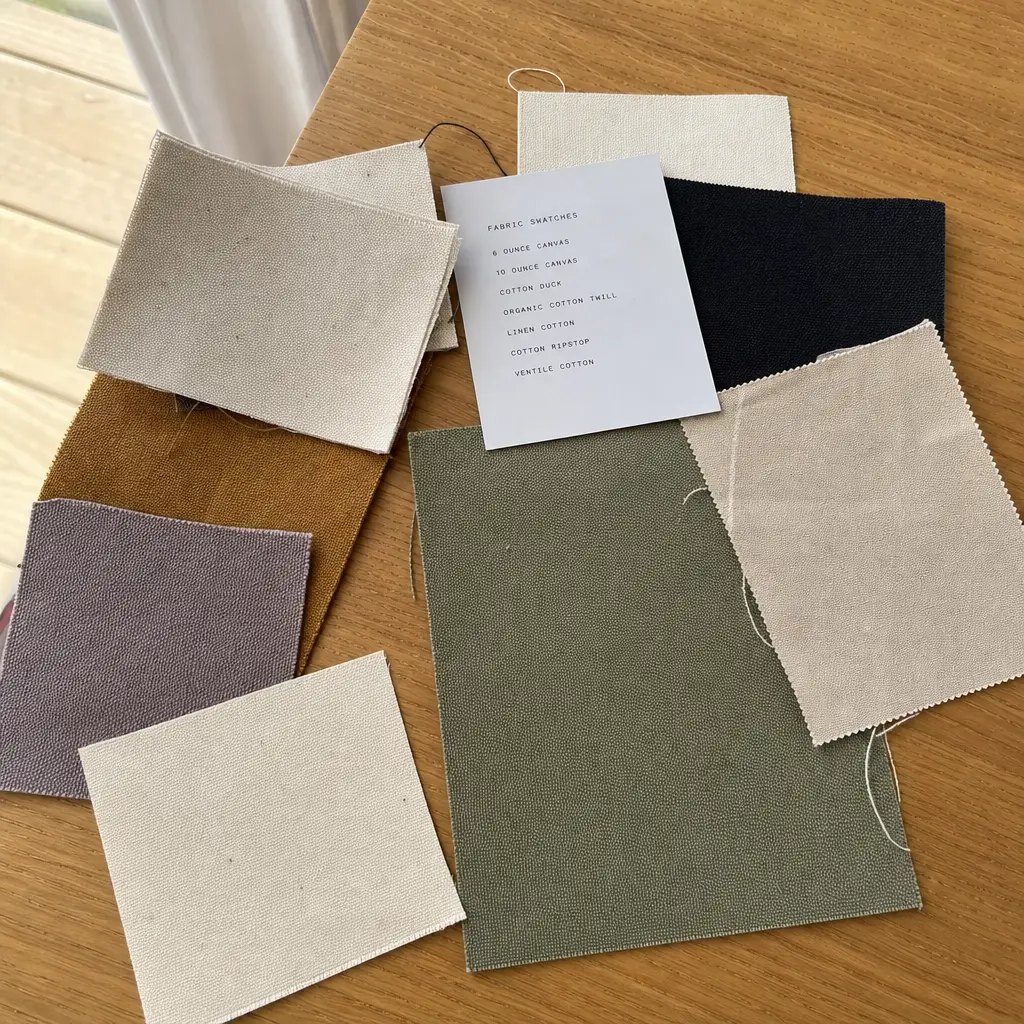
Canvas texture affects how the logo reproduces. A tight, even weave generally supports cleaner prints, while slubbed, rustic, or heavily washed canvas can break up fine detail. That does not mean textured canvas is a bad choice; it means the artwork should be adapted to the surface. For example, small serif text, hairline strokes, and intricate line art may need to be simplified or enlarged so the imprint remains legible after the fibers absorb ink. If the brand identity requires a precise color or sharp edge, the supplier should be asked how they compensate for the canvas texture in production.
The buying team should also understand how fabric finish affects shrinkage and consistency. If the material is not pre-shrunk, the supplier should state expected shrinkage after washing or environmental exposure. This is especially important for startup programs that will be distributed at events or shipped across climates. A portfolio that looks accurate in a sample room but tightens after steam, storage, or transit is a poor commercial outcome. Better to ask for the expected tolerance up front than to discover that a logo sits too close to a seam after cutting and sewing.
Print method and canvas weight should be evaluated together. Screen print often gives the best economics for simple logos and repeat orders, but it needs enough flat area and a stable base cloth to reproduce cleanly. Heat transfer and digital methods can help with multicolor art, short runs, or smaller proofing batches, but the buyer should test whether the surface can accept the print cleanly without edge lift, cracking, or surface gloss. The most practical choice is not the trendiest one; it is the one that holds detail, stays readable, and fits the order profile.
From a procurement perspective, a reliable fabric spec also improves replenishment. Once the team has approved a canvas weight, weave style, and finish that perform well, the next orders can be repeated more confidently. That consistency matters when the bag is part of a multi-quarter startup program or a branded kit that needs the same look across offices, events, and partners.
- 10 oz: best for promotional runs and tighter landed-cost targets.
- 12 oz: best all-around option for B2B office kits and premium giveaways.
- 14 oz: use when structure and tactile value matter more than freight cost.
- Ask the supplier how the finish changes shrinkage, hand feel, and print clarity.
Print proofing that prevents avoidable rework
Print proofing is where many orders succeed or fail. The main risk is not color alone; it is placement, scale, and legibility on a textured surface. A strong proof should show the logo at actual size, the exact distance from seam and zipper, and the ink color against the chosen canvas shade. If the art uses small type, reverse text, thin rules, or multiple colors, ask for a production-direction proof rather than a generic mockup. That proof should reflect the exact print technique the factory will use, not a showroom rendering that hides practical problems.
For buyer approval, the sample must answer three questions. First, does the logo read clearly at arm’s length? Second, does the ink hold its edges on the weave without bleeding or pinholing? Third, does the placement avoid zipper interference, top-edge distortion, and side seam curvature? If the portfolio folds in the middle or is packed flat for distribution, the logo should also be checked in the folded state so it does not disappear under the zipper line or crease at the wrong point.
Good proofing also means specifying what success looks like. Instead of saying make the logo larger, define the logo width in millimeters. Instead of saying match our brand blue, state whether the factory must hit Pantone exactly or only approximate the color within a stated tolerance. For canvas goods, a practical color tolerance is often better framed as a delta from the approved swatch or master sample than as a vague approval note. If the order is sensitive to brand color, the buyer should approve the ink on the final canvas shade, not on a white sample cloth or a different weight fabric. That is especially important on natural canvas, where the base color affects how opaque the ink appears.
For procurement teams, the proof should be stored as a decision record, not just a photo. Capture the approved artwork file, the date of sign-off, the exact sample label, and any notes on placement, zipper color, or stitch changes. That record helps if there is a later dispute about whether the production run matched the approved sample. It also makes repeat orders far easier because the next buyer or internal stakeholder can compare against a known reference rather than a vague email thread.
A robust proofing process does not slow the project down; it prevents the rework that causes the real delay. When a startup uses the bag for a launch or onboarding deadline, there is no room for correcting logo size after production is complete. The time spent clarifying the proof usually returns as fewer revisions, cleaner communication, and better first-pass approval.
- Approve logo width in millimeters, not only by visual reference.
- State whether Pantone matching is required or only approximate color matching.
- Request a strike-off or printed sample on the final canvas shade, not a different base cloth.
- Store the approved proof with date, sample code, and exact artwork file name.
MOQ logic and how suppliers build price
MOQ on zipper portfolios is usually driven by fabric cutting efficiency, print setup, zipper sourcing, and carton packing. A supplier may quote one MOQ for blank goods, a higher MOQ for printed goods, and a separate MOQ if you want a nonstandard zipper color, puller shape, or lining. Buyers often miss that the lowest unit price is usually tied to one stable spec: one fabric color, one print color, one zipper style, one packing format, and one production schedule. As soon as the order asks for variation, the supplier’s setup cost rises.
That does not mean low MOQ orders are a bad idea. For a startup, a pilot order can be the right commercial decision if it validates a new onboarding kit, supports a founder event, or tests how a branded accessory performs with a specific audience. The point is to understand the tradeoff before the purchase order is issued. Some factories lower MOQ by using stock fabric or standard zipper components, which can be perfectly acceptable if the buyer is told in advance. Others reduce MOQ by simplifying the build in ways that may change the feel, durability, or visual consistency of the final bag.
It is also important to ask whether MOQ is based on total quantity or quantity per color and per style. An order of 1,000 pieces may still be treated as three separate lines if the buyer requests three canvas colors or two different logo placements. That can change the pricing structure more than the buyer expects. If the project is multi-division or multi-region, the procurement team should ask for a consolidated program quote and a split-by-SKU cost breakdown so internal stakeholders can decide whether to standardize or diversify.
There is a second pricing issue that procurement teams should not ignore: setup amortization. Screen print screens, tooling, zipper sourcing, and packaging prep all have costs that need to be spread across the run. On a larger order, those fixed costs are diluted. On a smaller one, they become visible. A quote that looks inexpensive at first glance can become expensive after setup charges, sample freight, color upcharges, and carton upgrades are added. The most useful way to compare suppliers is to request an all-in quote with every known charge listed separately.
Once those variables are made visible, the buyer can make a rational decision about whether to prioritize minimum commitment, lower landed cost, or a higher-finish product. That is the real value of understanding MOQ: it gives procurement control over the tradeoff between flexibility and unit economics.
- Ask whether MOQ changes with fabric color, print count, zipper style, or lining.
- Request both per-SKU MOQ and program-level MOQ if the order has multiple variants.
- Compare the real delivered price, not just the ex-factory unit price.
- Ask which materials are stock and which are made or sourced specifically for your order.
Comparison of sourcing routes and supplier behavior
The buying route matters as much as the bag spec. Factory-direct sourcing is usually the best path when the portfolio will repeat across multiple programs and the buyer can write a clear spec sheet. It typically gives the best visibility into material choice, sample flow, and production control, especially when the order is large enough to justify direct communication with the line that makes the product. A factory that can describe how it checks fabric, prints, trims, and carton packing is usually easier to manage than one that only gives a price.
Trading routes can still be useful. They make sense when the buyer needs mixed-product consolidation, very fast coordination across categories, or one contact point for a broader promotional package. The tradeoff is accountability. If the order runs late or a zipper color differs from the approved sample, the buyer may be dealing with a middle layer that did not physically control the work. That does not make trading routes wrong, but it means the procurement team should ask sharper questions about who owns quality, who owns rework, and how substitutions are approved.
For tech startup buyers, the cleanest route is the one that reduces ambiguity on artwork and packing. If the supplier can show prior production structure, offer a sample flow that ends in a true pre-production sample, and explain how they control fabric and zipper lot matching, that supplier is easier to manage than a cheaper quote that cannot document how the bag will actually be built. The same is true for communication: a supplier that confirms details in writing after each revision is more reliable than one that only answers informally through messages.
When comparing suppliers, look for signs of commercial discipline. Do they quote the same spec back to you in their own words? Do they flag risks in the art or zipper choice? Do they explain whether they hold stock fabric, buy from mills on order, or rely on whatever is available in the warehouse? These signals matter because the best supplier is not the one with the nicest brochure. It is the one that understands how to turn a written spec into a repeatable production result.
If the program is strategic, the buying team should also ask what happens when a repeat order is placed months later. Can the factory match the prior shade, zipper style, and print position? Can they find the same cutting pattern? Can they confirm whether the original material lot is still available? Those questions separate a one-time supplier from a repeatable program partner.
- Use factory-direct sourcing for repeat SKUs and clearer production control.
- Use trading routes when you need category consolidation or one-stop coordination.
- Ask who owns quality checks, substitutions, and rework before you compare prices.
- Request written confirmation of every revised spec after each review round.
Sample approval: what must be right before mass production
A useful sample process is not just a visual sign-off. It should confirm the exact fabric shade, stitch density, zipper movement, handle strength, and print location. For a zipper portfolio, the first sample often exposes issues that are invisible in a drawing: the logo may sit too close to the zip, the gusset may reduce internal width more than expected, or the puller may rub against the print area. Those are expensive mistakes if discovered after the purchase order is released and material has already been cut.
Ask the factory to label the sample stage clearly. A blank sample is for size and construction only. A printed strike-off is for artwork placement. A pre-production sample should reflect final material, final zipper, final print, final packing, and any inserts that will ship with the bag. If the buyer approves a mixed-stage sample, the mass run can drift from what was signed off. For startup programs, where timing and brand consistency matter, that drift can cause more damage than a slightly higher sample cost would have caused.
The sample should be tested in the same way the buyer expects the final product to be used. If the portfolio is meant for paper documents, insert a standard stack and confirm the zipper closes without strain. If the bag will carry electronics, check that the interior width and lining allow a charger or slim device to fit without exposing rough seam edges. If the printed area sits near a bend or fold line, open and close the bag repeatedly to see whether the logo cracks, distorts, or rubs during handling.
The approval record should include more than a yes-or-no response. Capture the sample code, date, revision number, approved artwork file, zipper style, canvas color, and any comments on packaging. If possible, keep one approved physical sample in-house and ask the supplier to retain a controlled reference sample too. That way, if production quality shifts later, both sides are comparing against the same target. For repeat orders, that reference sample becomes one of the most valuable tools in the procurement process.
In practical terms, the sample is the buyer’s insurance policy. It costs a little more time up front, but it protects the order from avoidable mistakes in print location, construction detail, and presentation quality.
- Measure flat width, gusset depth, zipper opening, and handle drop on the physical sample.
- Cycle the zipper at least 10 times and test for snagging at each end stop.
- Inspect logo edges under bright light for pinholes, bleed, or uneven pressure.
- Keep one approved reference sample on the buyer side and one on the supplier side.
Packing, carton count, and export handling
Packing affects damage rate and freight cost more than many buyers expect. Canvas portfolios tend to crease if packed too tightly, while printed surfaces can scuff if they rub against zipper teeth or uncoated carton walls. Bulk polybag packing with a clean carton liner is usually enough for B2B use, but retail-ready packing may be required if the product lands directly in stores or as a premium kit component. The packing decision should be linked to the delivery route and the brand experience, not copied from a previous unrelated order.
Carton count should be based on volume efficiency and deformation risk, not only on what the factory normally uses. Too many units per carton can compress the bag body and distort the printed face; too few units increase carton count and handling cost. The quote should state the exact pack count, carton dimensions, gross weight, and whether desiccant or moisture protection is included for humid routes. If the destination involves long sea transit or warehouse storage, moisture control becomes more than a nice-to-have.
The buyer should also define how individual units are protected inside the carton. Should the zipper puller be wrapped? Should the printed face be backed by tissue or a separator sheet? Should the inner polybag be clear, frosted, or recycled material? These decisions affect presentation, scuff risk, and packaging sustainability goals. If the procurement team has packaging standards, the supplier should receive them early so the factory does not build a quote around a default pack style that later has to be changed.
For importers and distributors, export marks and carton labels are not a side detail. They determine receiving speed, warehouse accuracy, and claim resolution. The packing list should match the carton content exactly, including SKU names, sizes, quantities, and any mixed-carton arrangement. If the buyer needs barcode labels, the exact format and placement should be approved before the run starts. It is far cheaper to review one carton photo than to sort mislabeled cartons at destination.
A clean packing spec protects the product and the operation. It helps the bag arrive ready for distribution instead of arriving as a quality problem the receiving team has to fix.
- Keep zipper pullers from pressing into printed areas during packing.
- Use consistent polybag thickness so bags do not scuff in transit.
- Confirm carton marks, SKU labels, and quantity labels before shipment release.
- Define moisture protection if the route includes long transit or warehouse storage.
Lead time, schedule risk, and quote comparison
Lead time on canvas zipper portfolios is a chain of smaller timelines: fabric availability, cutting, print approval, assembly, packing, carton booking, and freight handoff. A quote that promises a short lead time without showing when the sample is approved is not especially useful. Buyers should separate sample time from mass production time and also ask what happens if artwork is revised after proofing. If a launch date is fixed, the schedule needs buffers for revision cycles, not just production.
When comparing quotes, put every supplier onto the same worksheet. One supplier may quote a lower unit price but add charges for print setup, zipper upgrade, carton change, sample shipping, or rush handling. Another may look higher at first but include better packing and a more controlled proof process. The practical comparison is the landed cost with all known extras written down, plus the schedule risk attached to each line. Procurement should look for hidden variables such as stock fabric availability, dye lot timing, and whether the zipper and puller are standard or special order.
Lead time also depends on how quickly the buyer closes decisions. If artwork is not final, if the logo file needs cleanup, or if internal stakeholders keep changing the placement, the project loses days before the factory even starts. For that reason, the RFQ should name the decision owner and state how many revision rounds are allowed before the schedule resets. That small governance step reduces delay and helps the supplier plan capacity more accurately.
The safest way to compare suppliers is to ask for the same things from each one: confirmed dimensions, confirmed material, confirmed print method, confirmed MOQ, confirmed packing, and confirmed lead time after sample approval. Once those are aligned, the differences are easier to understand. Some buyers also ask for a risk note from each supplier, which can be extremely useful because the supplier often knows where the order is likely to slow down. That is especially true if a certain zipper color or canvas finish must be sourced to order.
In short, a good lead time is not just fast. It is explainable, repeatable, and tied to an approval path that the buyer actually controls.
- Separate sample lead time from bulk lead time.
- Include artwork revision time in the launch schedule.
- Compare total order value after packaging, freight mode, and carton costs.
- Ask suppliers to state which materials are in stock and which require sourcing.
What to compare in landed cost, not just unit price
The unit price on a quote often hides the real cost. Canvas weight, print count, zipper choice, lining, and packing density all change the landed cost materially. For example, a better-looking 12 oz portfolio with a cleaner print may cost more ex-factory, but if it improves acceptance rate and lowers rework risk, it can be the cheaper buying decision. The same is true for freight: a lower-cost bag that packs poorly can become expensive once carton volume goes up. Procurement should compare not only the product price but also the operational cost of getting the product into use.
A useful landed-cost worksheet should include sample cost, print setup, unit price, packing adders, carton dimensions, estimated freight impact, destination charges, and any likely customs or warehouse handling fees if relevant. If the quote includes a premium zipper, lining, or special insert, those should be separated from the base product cost. That way, internal stakeholders can decide whether the upgrade is worth it for the program. Without that split, the team may either overpay or strip out features that were actually valuable.
The buyer should also factor in rework risk. One quote may use thinner canvas or a less stable print method, which can reduce the immediate unit price but increase the likelihood of rejects. Another may quote a slightly higher cost with tighter QC and better packing, which lowers the chance of hidden expenses later. This is especially important for startup programs where the bag is part of a brand experience. If the first shipment arrives with crooked logos or weak zippers, the damage is not just financial; it affects credibility.
The cleanest comparison is to score each quote against the same criteria. A simple matrix can include price, print clarity, zipper quality, sample control, packing quality, and lead time reliability. That helps procurement avoid being trapped by a low headline number that does not reflect the full job. It also gives the team a defensible rationale if leadership asks why the selected supplier was not the cheapest on paper.
For buyer teams managing annual programs, landed cost becomes even more important over time. Reorder stability, defect rates, and packing efficiency can change the real cost per usable unit far more than the quoted price itself. A dependable supplier with a clear proofing process often saves money in the second and third order because the team spends less time correcting avoidable mistakes.
- Compare ex-factory price, sample cost, print setup, and packing adders.
- Add estimated freight impact from carton size and gross weight.
- Include rework risk when one quote uses thinner canvas or a less stable print method.
- Score each quote against price, print clarity, zipper quality, QC, and lead time reliability.
Specification comparison for buyers
| Spec decision | Recommended option | When it fits | Buyer risk to check |
|---|---|---|---|
| Canvas weight | 10–12 oz for most bulk programs; 12 oz is the safest default; 14 oz only when structure and desk presence matter more than packability | Conference kits, onboarding packs, investor decks, and reusable document carriers | Light canvas can sag and telegraph wrinkles; heavy canvas can reduce print sharpness and raise freight volume |
| Print method | Screen print for one or two solid colors; heat transfer or digital print for short runs, gradients, or small proofing batches | Programs with stable artwork, repeat orders, or simple logo marks | Fine type and thin lines can close up on textured canvas; confirm legibility at final size |
| Zipper build | Nylon coil zipper for cost control and smooth daily use; metal zipper only if the program needs a premium visual cue | Internal office use, event kits, and brand-facing presentation bags | Poor tape alignment creates waviness; oversized pulls can rub print and accelerate wear |
| Interior finish | Unlined or lightly lined for document use; full lining for device carry or premium presentation | Use lining when the bag holds tablets, chargers, samples, or retail inserts | Unlined bags may show seam allowances; light fabrics may show stitch-through at corners |
| Carry option | Reinforced hand-carry loop as the default; add wrist strap or shoulder strap only when the use case justifies it | Meeting kits, campus recruiting packs, and portable document sets | Extra hardware adds cost, lead time, and failure points |
| MOQ route | Standard factory MOQ for a stable spec; shared-material MOQ for pilot runs if the supplier allows it | First launch batches, limited internal programs, and multi-office tests | Lower MOQ often means higher unit price, fewer trim options, or simplified packing |
| Sample stage | Pre-production sample after artwork placement and zipper spec sign-off | Any brand-sensitive or repeatable SKU | Skipping a true pre-production sample is the fastest way to invite size or placement disputes |
| Packing route | Bulk pack in polybag plus export carton; retail-ready insert only when shelf presentation matters | Corporate fulfillment, distributors, and event giveaways | Overpacking increases freight volume; underpacking increases scuff and deformation risk |
| Supplier route | Factory direct for repeat SKUs; trading route only if you need mixed-category sourcing or one-stop consolidation | Ongoing portfolio programs with clear specs and stable annual demand | Trading layers can blur responsibility for print quality, dye lot control, and carton contents |
Buyer checklist before sampling
- Define finished size, gusset depth, opening width, and usable load in writing before requesting quotes.
- Specify canvas weight, weave style, finish, color tolerance, and shrinkage expectation.
- Send vector artwork and state logo width in millimeters, placement distance from seams, Pantone references, and minimum text size.
- Ask for a digital proof, a printed strike-off if needed, and one physical pre-production sample before bulk approval.
- Agree carton count, inner polybag requirements, barcode or hangtag needs, and shipment marks before production.
- Record inspection checkpoints for stitching, print adhesion, zipper function, stains, odor, and quantity count.
- Ask for photo confirmation of the packed sample, carton label, and master carton before release.
- Document who approves artwork, who approves the sample, and what happens if materials are substituted.
Factory quote questions to send
- What canvas weight, weave count, and finish are you quoting, and what changes the price between 10 oz, 12 oz, and 14 oz?
- Which print method is included in the quoted price, and what is the setup charge for each additional color or location?
- What is the exact MOQ by fabric color, print color, zipper color, and lining option, and can any of those be mixed without a penalty?
- What sample stages are included: blank sample, printed strike-off, pre-production sample, and shipment reference sample?
- What packing standard is included in the quote, and how many pieces per inner polybag and export carton?
- What lead time applies after sample approval, and what delays it if artwork, fabric, zipper components, or trims are not in stock?
- What is the allowed tolerance for canvas color variation, logo placement, and finished size, and how do you measure it?
- Will you use the exact quoted materials in mass production, or do you reserve the right to substitute stock fabric or zipper parts?
Quality-control points to confirm
- Measure canvas GSM or ounce weight on incoming fabric before cutting; reject rolls that drift outside the agreed tolerance.
- Inspect weave consistency, slub level, and color shade against the approved swatch before any mass cutting starts.
- Set an acceptance target for logo placement, such as within 3 mm of the approved seam reference on each axis, and reject visible drift beyond that.
- Measure the printed logo size and compare it to the approved artwork spec instead of relying on visual judgment only.
- Open and close each pilot sample zipper at least 10 cycles to confirm smooth travel, correct pull direction, and no fabric bite at the ends.
- Check stitch density at stress points such as zipper ends, handle anchors, gusset corners, and top edge turnings for skipped stitches or loose threads.
- Inspect the interior for exposed seam allowances, loose threads, and stray fibers that may affect presentation or device safety.
- Verify carton count, inner polybag clarity, carton marks, and label match against the approved packing list before shipment release.