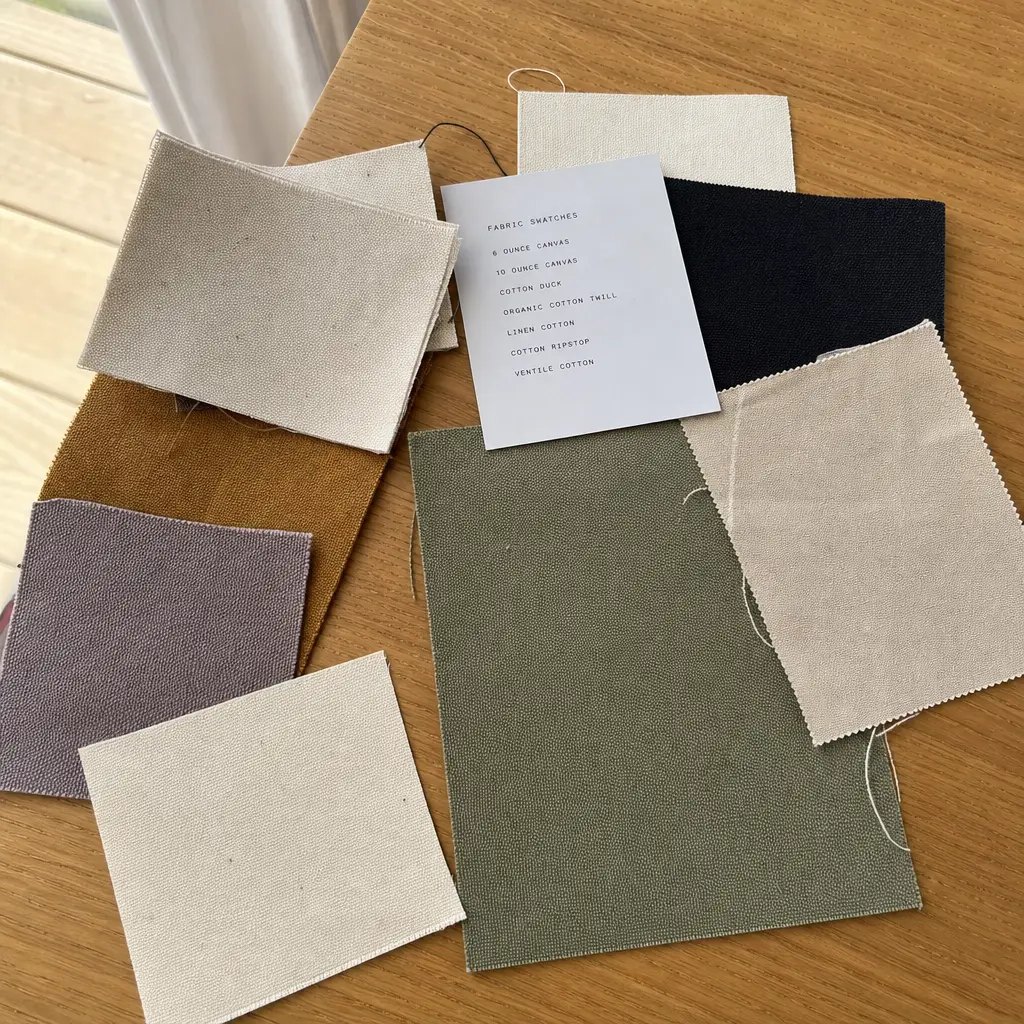
Start With the Load, Not the Fabric Swatch
For wholesale canvas zipper portfolios for tech startups, fabric weight should be chosen after the buyer defines what the portfolio must hold. A portfolio carrying only a notebook and stickers can use a different shell than one carrying a tablet sleeve, charger pouch, onboarding documents, and retail hangtag. Many quote mistakes happen because the RFQ says “heavy canvas portfolio” without giving the supplier a real load case.
A practical RFQ should list the finished contents and the expected handling route. A welcome kit shipped directly to employees needs better shape recovery and carton protection than a conference giveaway handed out from a booth. A retail buyer may care more about shelf presentation, barcode placement, and repeatable color. The same zipper portfolio can look acceptable in a sample room but fail when 3,000 pieces are stacked in cartons with inserts already loaded.
- Light document use: notebook, brochure, pen, stickers, and badge inserts.
- Medium kit use: notebook, charging cable, small accessory card, pen, and founder letter.
- Heavier tech use: tablet, slim power bank, cable organizer, and printed manuals.
- Retail use: portfolio must keep shape, scan correctly, and show consistent front panel finish.
- Distributor use: packing, carton labeling, and repeat reorder consistency matter as much as sample appearance.
Fabric Weight Choices That Actually Change Performance
Canvas weight is normally discussed in ounces per square yard or GSM. For buyer comparison, 10 oz is roughly 340 GSM, 12 oz is roughly 407 GSM, and 14 oz is roughly 475 GSM, but mills and finishing methods can create small variation. Always clarify whether the supplier is quoting greige fabric weight, dyed fabric weight, or finished fabric weight. A finished dyed 12 oz canvas and a loosely described “12 oz look” are not the same buying standard.
For most tech startup kits, 12 oz canvas is the safer middle point. It gives the portfolio enough hand feel for a paid or premium gift program while still allowing clean sewing around zipper corners. 10 oz can be acceptable for budget events, but it needs good lining and disciplined packing. 14 oz feels stronger and more premium, but the buyer must accept higher sewing difficulty, possible corner bulk, and higher carton volume.
- Use 10 oz / 340 GSM only when contents are light and the budget is the main driver.
- Use 12 oz / 407 GSM when the item must feel durable without becoming stiff or bulky.
- Use 14 oz / 475 GSM when the program is premium and the portfolio may carry heavier contents.
- Avoid changing fabric weight after sample approval unless a new pre-production sample is made.
- Compare quotes by finished GSM, not only by supplier descriptions such as thick, strong, or premium.
Outer Canvas, Lining, and Structure Work Together
A zipper portfolio is not judged only by the outside cloth. Lining affects how smoothly documents slide in and whether the zipper catches loose fabric. A 150D polyester lining is common for clean interior finish; 210D gives a little more body and better resistance when buyers insert cables, pens, or hard-edged cards. Cotton lining can look more natural but may increase lint, shrinkage risk, and cost.
If the buyer wants a structured portfolio, the factory may add board, nonwoven reinforcement, foam, or interlining. This improves flatness and photography, but it changes packing volume and can make the item less forgiving during compression. For ecommerce or employee kit fulfillment, overly rigid portfolios can arrive with bent corners if the carton design is not upgraded. Structure is useful, but it must be specified as part of the full packing plan.
- Soft construction: lower freight volume and easier packing, but less shelf presence.
- Light interlining: improves front panel smoothness for printing and branding.
- Board reinforcement: better presentation, higher CBM, and greater risk of corner damage.
- Polyester lining: clean sliding surface and easier color control.
- Cotton lining: natural feel, but needs shrinkage and colorfastness attention.
Zipper Specification Is a Cost and Failure Point
The zipper is often the first functional part a user notices. A No. 5 nylon zipper is a practical default for canvas portfolios because it is flexible enough for corners and strong enough for normal document or kit use. Metal zippers can look premium, but they add weight, cost, and may feel too rigid on a soft canvas body. For large startup kit orders, a reliable nylon zipper with a good puller usually creates fewer service complaints than an under-specified decorative zipper.
The RFQ should define zipper tape color, tooth color if visible, slider finish, puller type, and opening direction. If the portfolio opens on three sides, corner sewing and zipper tension become more important than the slider material alone. During sample approval, run the zipper with the actual lining and any inner pocket installed. A zipper that works on an empty shell may snag when the lining is loose or when documents push against the seam.
- Default zipper: No. 5 nylon for most A4 or letter-size canvas portfolios.
- Puller choice: metal puller for premium feel, rubber puller for softer handling and color branding.
- Opening design: top-only zipper is cheaper; three-side opening improves access but needs better sewing control.
- Inspection method: test repeated opening around corners, not only one straight pull.
- Common defect: zipper waviness caused by fabric stretch, poor pressing, or uneven sewing tension.
Logo Method Depends on Artwork and Reorder Plan
For tech startups, the logo usually needs a clean, modern look rather than a large decorative print. Screen printing works well for one- or two-color logos on flat canvas panels and keeps unit cost predictable at wholesale volume. Heat transfer can handle gradients or small details, but buyers should test edge durability and hand feel. Embroidery adds texture, but fine startup logos with small type may lose sharpness on canvas.
For repeat programs, a woven side label can be more stable than changing print plates for every batch. It also keeps the front panel cleaner and reduces risk when the same zipper portfolio is used across different regions or sales channels. The tradeoff is label MOQ, lead time, and the need to approve label artwork before bulk production. A buyer comparing quotes should separate logo setup, label setup, and unit decoration cost.
- Screen print: best for flat-color logos, fast sampling, and controlled unit cost.
- Heat transfer: useful for fine detail, but needs peel and rub testing.
- Embroidery: premium texture, but avoid very small text or thin icon lines.
- Woven label: strong for repeat programs and clean retail presentation.
- Position tolerance: define allowable movement, commonly a few millimeters on soft goods.
MOQ Logic Behind the Quote
MOQ is not only the factory's preference. It usually comes from fabric dyeing, zipper tape color, lining color, label production, print setup, and sewing line efficiency. A natural canvas body with stock black zipper and stock lining may have a much lower workable MOQ than a custom-dyed body, custom zipper tape, matching lining, and woven label. Buyers who understand this can adjust specs without forcing a weak quote.
A good wholesale quote should show which components drive MOQ. If the buyer needs 800 pieces, the supplier may recommend stock fabric and standard zipper colors. If the buyer needs 5,000 pieces across several startup departments or distributor customers, custom dyeing and custom labels become more practical. Splitting a small order into many colors often raises cost more than increasing fabric weight.
- Lowest MOQ path: natural or black stock canvas, standard zipper, screen print, simple polybag.
- Medium MOQ path: stock body color, custom print, standard lining, optional woven label.
- Higher MOQ path: custom dyed canvas, custom zipper tape, custom lining, and branded packaging.
- Hidden MOQ item: woven label and printed inner care label may have separate minimums.
- Quote comparison rule: request MOQ by component, not only one total order MOQ.
Sample Approval Must Prove Production Behavior
A visual sample is not enough for canvas zipper portfolios. The approved sample should use the same fabric weight, lining, zipper size, logo method, and reinforcement planned for bulk production. If the sample uses available substitute fabric, mark it clearly and do not approve bulk color, weight, or hand feel from that sample. For procurement teams, the safest sequence is material swatch approval, construction sample, then pre-production sample.
The sample should be tested with the real contents. Fill it with the notebook, papers, insert card, pen, or device accessory planned for the program. Then check whether the zipper closes without strain, the corners remain smooth, and the front panel still looks clean. If the product will be shipped pre-packed with other kit items, approve a packed sample too. Many defects appear only after the portfolio has been pressed in a carton for several days.
- Measure finished size with the portfolio empty and filled.
- Test zipper movement after loading the real kit contents.
- Rub printed logo and inspect cracking on folded or compressed areas.
- Compare fabric color under daylight and store lighting if retail sale is planned.
- Approve packing sample with carton direction, inner bag, label, and carton mark.
Quote Data Needed for Landed Cost Comparison
Unit price alone is a poor way to compare canvas zipper portfolio suppliers. Fabric weight, carton quantity, gross weight, CBM, packing style, and defect allowance all affect landed cost. A 14 oz structured version may look only slightly more expensive per piece, but if carton quantity drops sharply, sea freight and warehouse handling cost can change the real comparison. For distributors and importers, quote data must support landed-cost calculation before purchase order approval.
Request quotes for two or three fabric weights using the same size and logo. This lets the buyer see whether the perceived upgrade is worth the added cost and freight. The supplier should also state sample charge, logo setup, label cost, carton cost if special, and inland freight to port or forwarder. If the quote hides these numbers, later revisions become harder to negotiate.
- Required quote fields: fabric weight, material composition, finished size, logo method, lining, zipper type, MOQ, and lead time.
- Packing data: pieces per carton, carton size, gross weight, net weight, and estimated CBM.
- Commercial data: sample fee, setup fee, unit price by quantity tier, payment terms, and quote validity.
- Shipping data: port, incoterm, inland freight if applicable, and whether cartons are export grade.
- Comparison method: calculate cost per usable delivered piece, not only factory unit price.
Packing Decisions Affect Shape, Claims, and Warehouse Work
Flat packing is usually best for wholesale canvas zipper portfolios because it saves space and keeps the product easy to count. Individual polybags protect against dust and moisture during transit, while glassine or paper-based bags may fit sustainability requirements if the buyer accepts different moisture protection. If the portfolio includes board or foam, cartons should not be overfilled because compression can mark the front panel or bend zipper ends.
Retail buyers need packing that supports barcode scanning and shelf handling. Importers and distributors need carton marks that match purchase orders and warehouse receiving rules. If portfolios are part of a larger startup kit, decide whether the factory ships empty portfolios, pre-inserts paper items, or packs them with other accessories. Each route changes labor cost, carton volume, and inspection method.
- Basic bulk route: individual bag, flat stacked, export carton, outer carton marks.
- Retail route: barcode sticker, hangtag or insert card, cleaner individual packing, stricter visual inspection.
- Kit fulfillment route: packing direction and inner content placement must be approved with photos.
- Moisture control: use dry cartons and add silica gel when storage or sea route requires it.
- Carton risk: heavy stacking can deform zipper corners and structured panels.
Lead Time Risks to Build Into the Buying Calendar
Lead time for zipper portfolios is affected by more than sewing capacity. Fabric booking, dyeing, logo proofing, label production, zipper color availability, sample revisions, inspection, and freight cutoff all sit before delivery. For a tech startup event, missing the launch date is often more expensive than paying a little more for a cleaner spec. Buyers should lock artwork and material decisions early instead of revising logo size after fabric is cut.
A realistic calendar separates approval milestones. The clock should not start only from deposit if the artwork is still changing or the fabric color is unapproved. For repeat orders, keeping the same fabric, zipper, and label reduces schedule risk. For first orders, allow time for one sample revision because zipper tension, logo placement, or lining fit often needs small adjustment.
- Fastest route: stock fabric, stock zipper, screen print, standard packing, no custom dyeing.
- Schedule risk: custom color matching, woven label production, and late artwork changes.
- Inspection timing: book final inspection when goods are at least mostly packed, not only sewn.
- Event orders: include buffer for customs clearance, warehouse receiving, and kit assembly.
- Repeat orders: reserve approved materials early if the same startup kit program will reorder.
Specification comparison for buyers
| Spec decision | Recommended option | When it fits | Buyer risk to check |
|---|---|---|---|
| Outer canvas weight | 12 oz / 407 GSM cotton canvas for most startup portfolio orders | Good balance for onboarding kits, pitch event packs, and retail bundles where the portfolio must feel substantial but still ship efficiently | Very light canvas can wrinkle around the zipper; very heavy canvas can make corners bulky and increase freight cost |
| Premium outer fabric | 14 oz / 475 GSM canvas when the portfolio carries tablets, chargers, or higher-value welcome kit items | Works for executive gifts, investor event packs, distributor samples, and stores positioning the item above a simple document pouch | Confirm sewing allowance and corner turning because heavy fabric plus lining can create uneven zipper curves |
| Economy outer fabric | 10 oz / 340 GSM canvas with reinforcement only if the load is light | Suitable for short-cycle trade show giveaways, light document folders, or cost-sensitive bulk campaigns | The body may collapse after packing; require a sample filled with the actual insert weight before approval |
| Lining construction | 150D to 210D polyester lining for clean inside finish and lower friction | Best when the portfolio includes papers, stickers, notebook, pen, cable card, or small electronics accessories | Loose lining can catch in the zipper; specify edge binding, seam allowance, and lining colorfastness |
| Zipper choice | No. 5 nylon zipper with metal or rubber puller matched to brand position | Reliable for A4 or letter-size zipper portfolios shipped flat or lightly filled | Cheap zipper tape can wave after pressing; test 30 open-close cycles and inspect slider movement around corners |
| Logo method | Screen print for simple one- or two-color startup logos; woven side label for repeat programs | Screen print fits launch campaigns and fast sampling; woven label supports long-term retail or distributor continuity | Logo size must avoid zipper distortion zones; request print position tolerance and color reference before mass production |
| Shape retention | Add 200 to 300 GSM board or foam layer only when the buyer wants a structured portfolio | Useful for retail shelves, sales rep kits, or premium bundles that must photograph well after unpacking | Extra structure raises CBM and may change packing method; confirm carton quantity and compression limits |
| Packing format | Flat pack in individual polybag or glassine bag with silica gel if required by destination | Works for importers consolidating with notebooks, pens, lanyards, or electronic accessories | Over-tight cartons can bend zipper ends; define max carton weight, carton size, and inner packing direction |
Buyer checklist before sampling
- Define finished size by contents, not by a generic A4 or letter label; include notebook, tablet, inserts, and cable card dimensions.
- Select outer canvas weight in GSM or ounces and state whether the figure is greige, dyed, washed, or finished fabric weight.
- Specify zipper size, zipper tape color, slider finish, puller type, opening direction, and whether the zipper must pass cycle testing.
- Confirm lining material, inside pockets, pen loop, card sleeve, binding tape, and whether the inside color must match brand artwork.
- Choose logo method with artwork size, print color reference, position tolerance, and approval standard for edge sharpness.
- Request a pre-production sample made with actual fabric weight, lining, zipper, label, and packing method, not only a visual mock sample.
- Set acceptance criteria for seam strength, zipper smoothness, print fastness, fabric stains, size tolerance, and carton compression.
- Ask for carton dimensions, pieces per carton, gross weight, net weight, estimated CBM, HS code suggestion, and packing photos before shipment.
- Separate one-time sample charges, mold or label charges, unit price, export carton cost, and inland freight in the quote.
- Build the order calendar around artwork approval, fabric dyeing or stock fabric booking, sample revision, production queue, inspection, and vessel cutoff.
Factory quote questions to send
- What finished size do you recommend for our actual kit contents, and what seam allowance will remain after zipper installation?
- Is your quoted canvas weight measured before dyeing, after dyeing, or after finishing, and can you provide GSM test data for the production lot?
- Which zipper brand or grade is included in the quote, and how many open-close cycles do you test on production samples?
- What MOQ applies to the fabric color, zipper tape color, lining color, woven label, and printed logo separately?
- Can you quote 10 oz, 12 oz, and 14 oz versions using the same size and logo so we can compare unit price, CBM, and perceived value?
- Which logo method do you recommend for our artwork, and what is the minimum line thickness or color limitation for that method?
- Will the sample be made by the same workshop and sewing method used for bulk production, or is it only a hand sample?
- What size tolerance, print position tolerance, and color tolerance do you use for zipper portfolios in mass production?
- How many pieces fit per export carton under flat packing, and what carton strength do you use for sea freight or courier shipment?
- What production lead time starts after which approval point: deposit, artwork confirmation, fabric approval, or pre-production sample approval?
Quality-control points to confirm
- Measure finished length, width, gusset if any, and zipper opening; typical tolerance should be agreed before production, often plus or minus 5 mm for soft canvas goods.
- Weigh cut fabric or finished shell samples to confirm the ordered GSM or ounce level instead of relying only on supplier wording.
- Open and close the zipper at least 30 times on inspection samples, including corner movement and puller strength.
- Check seam density, skipped stitches, loose threads, binding alignment, and stress points near zipper ends and handle or loop attachments if included.
- Rub the printed logo dry and wet according to the buyer's market requirement; reject sticky ink, cracking, heavy bleeding, or visible pinholes.
- Inspect lining for puckering, trapped fabric near zipper teeth, inside stains, loose pocket seams, and sharp edges around board inserts.
- Confirm color consistency between approved sample, bulk fabric, zipper tape, lining, binding, and label under the same light source.
- Drop-test packed cartons when shipping by courier or mixed consolidation, especially if portfolios include rigid board or pre-inserted accessories.
- Review packing direction inside cartons so zipper pulls, corners, and structured panels are not crushed during storage or container loading.