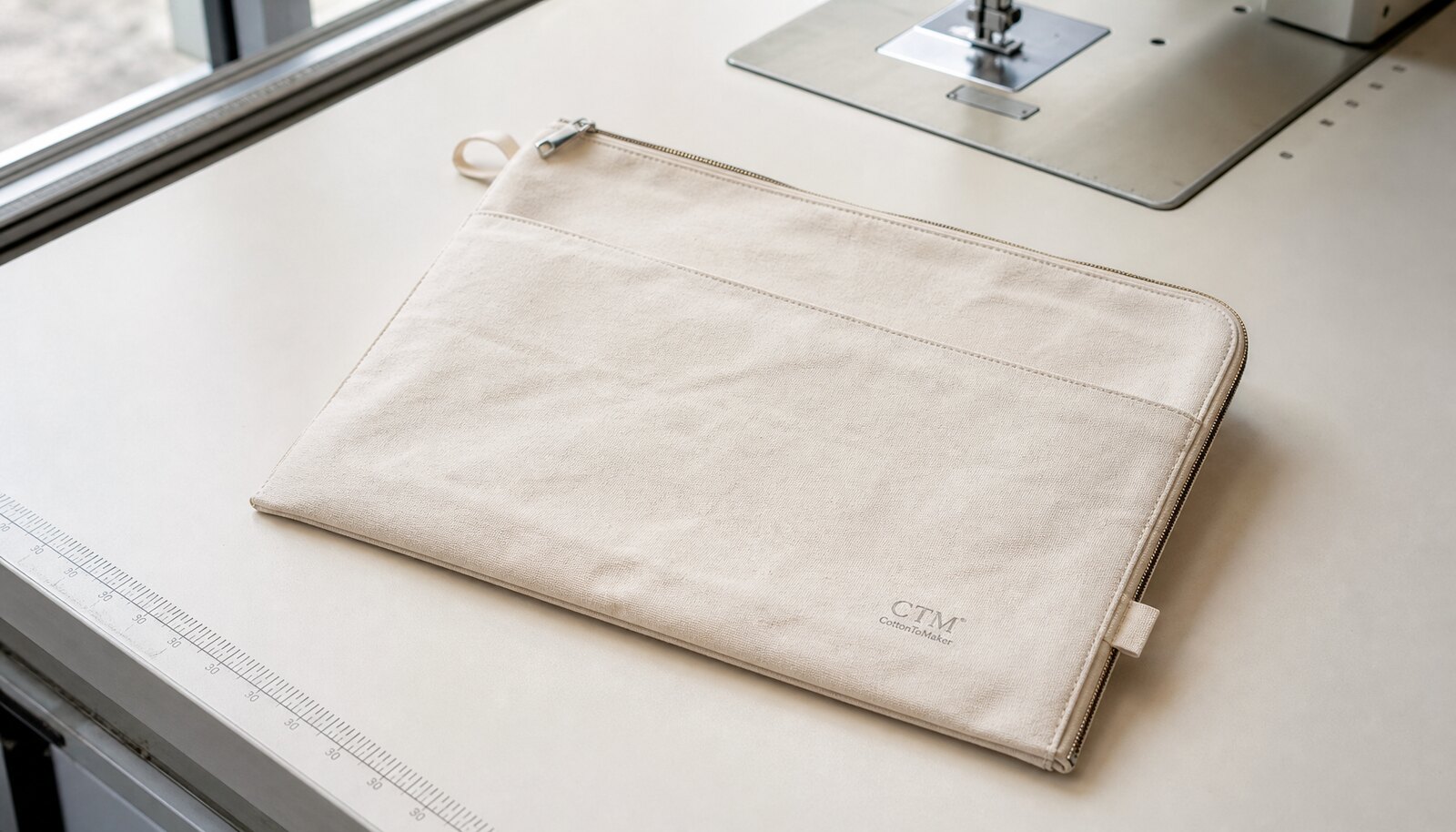
Why this checklist matters for gift shop buyers
Wholesale canvas zipper portfolios look straightforward, but they fail in the places buyers rarely see until the goods are already in transit. A gift shop buyer is usually focused on shelf appeal, logo placement, and retail margin, yet the real cost often shows up later in zipper jams, weak seams, bent corners, or cartons that do not match the receiving spec. A supplier compliance checklist is what turns a visually similar offer into a comparable commercial quote.
The phrase wholesale canvas zipper portfolios for gift shops supplier compliance checklist is useful because it forces the buying conversation away from generic product language and toward the decisions that actually change outcomes. The goal is not to make the item expensive. The goal is to make the quote auditable, the sample repeatable, and the production line accountable when a supplier says the bulk order matches the approved sample.
- Treat the portfolio as a functional retail item, not only as a print surface.
- Use one written spec across every supplier so the quotes are comparable.
- Make the checklist cover both product quality and document quality.
Lock the product spec before you ask for price
Most pricing confusion starts with an incomplete spec. If one supplier is quoting a 10 oz natural canvas body with a standard zipper and another is quoting 12 oz washed canvas with reinforced corners, the lower price is not a better offer. It is a different product. The same problem appears with zipper tape width, puller finish, seam allowance, and print method, all of which affect both the shelf feel and the actual factory cost.
A good spec for a portfolio used in a gift shop should start with the intended contents. If it carries documents, state the usable inside dimensions and the document size it must fit. If it is sold as a gift set or premium accessory, define how stiff the body should feel, whether the bag needs a gusset to stand upright, and whether the zipper opening should stop short of the side seams for strength. The factory can only quote accurately when the build intent is clear.
- Define outer dimensions and usable inner dimensions separately.
- Name the zipper type, gauge, puller, and tape width.
- State the decoration method before sample approval.
- Specify whether the canvas is natural, dyed, washed, or bleached.
Compare supplier types on more than just unit price
The supplier route changes the risk profile as much as the price. A direct sewing factory usually gives the best line of sight into material source, trim control, and production feedback, but only if the sales team can actually enforce what the floor does. A specialist bag factory is often stronger on construction details like zipper joins, bar-tacks, and retail finishing. A trading company can be useful when you need mixed-category consolidation or small trial orders, but the factory may change from order to order unless that relationship is controlled tightly.
For procurement, the question is not which supplier type sounds easiest. The question is which one gives the best mix of price stability, QC visibility, and compliance documentation for the order size you are buying. Small test orders may justify a faster and less rigid route. Repeated retail programs usually need a supplier who can reproduce the same trim package and paperwork without re-litigating the spec every season.
- Ask who owns the production decision if the sample and bulk order disagree.
- Confirm whether the named factory is the actual production site.
- Check whether the supplier can show batch photos and component records, not only catalog images.
Normalize quotes before you compare landed cost
The biggest quoting mistake is comparing unit prices without normalizing the assumptions. One supplier may include print setup, individual polybags, and carton markings, while another excludes all of them and adds fees later. If you want a clean comparison, reduce every quote to the same baseline: same art, same number of colors, same packing format, same Incoterm, same carton count, and same sample assumption. Otherwise, the cheapest quote is often just the least complete one.
A practical landed-cost formula for this category is simple enough to use in a spreadsheet: ex-works unit price, plus print or embroidery setup amortized across quantity, plus packing materials, plus inland factory handling, plus export documents, plus freight per unit, plus duty and destination fees, plus a small scrap or damage allowance. If a quote cannot be translated into that formula, it is not ready for procurement approval. For seasonal gift shop buying, that matters more than a nominal price cut of a few cents.
- Normalize every quote to one Incoterm before making a decision.
- Separate setup fees from recurring unit cost.
- Add destination-side handling, duty, and inspection cost before you rank suppliers.
- Use the same carton count and pack count across all bids.
Compliance documents buyers should actually request
Compliance is where many supplier promises become vague. Buyers do not need a long list of generic test claims; they need the right documents for the market they sell into. For the EU, ask whether the materials have been screened against REACH Annex XVII restrictions and whether the supplier can provide azo dye and heavy metal information for the fabric, print, and any metal components. If the item includes coated fabric, PVC trim, or a metal zipper pull, those parts may need separate checks because the compliance risk is component-specific, not just product-wide.
For the U.S., the first question is whether the portfolio is sold as an adult accessory or could be marketed to children. If there is any children’s-use scenario, CPSIA assumptions may apply and you should not rely on adult-bag test language. For California sales, buyers often ask about Prop 65 exposure for relevant chemical categories. For the UK, buyers should confirm the equivalent chemical controls and origin labeling expectations. In every market, ask for country of origin marking, fiber composition where required, batch traceability, and a written no-substitution policy for approved materials.
- Ask for REACH screening, azo dye, heavy metal, and formaldehyde information where applicable.
- If there are metal parts, ask about nickel release or surface coating data as relevant to your market.
- If there is PVC or coated trim, ask for phthalate-related information instead of assuming the main fabric report covers it.
- Request batch traceability for fabric, zipper, and print lots.
- Ask for the label proof and country-of-origin mark before production starts.
QC that is operational, not generic
Quality control should be defined in the factory language that operators can actually follow. For a canvas zipper portfolio, the critical checks are zipper function, seam strength, print durability, dimension control, and carton accuracy. If the sample already shows a crooked zipper line, loose stitch ends, or weak top stitching at the zipper tape, the bulk line will rarely correct it on its own. The point of QC is to catch repeatable process defects before they become a full shipment issue.
A useful inspection plan usually has three layers. First is pre-production approval, where the factory proves that the approved sample can be reproduced with the actual material lots. Second is in-line inspection, where the line checks zipper alignment, seam allowance, and print registration while there is still time to correct drift. Third is final inspection, where AQL controls the lot and the packout is verified. For this product, a practical starting point is AQL 0 for critical defects, 2.5 for major defects, and 4.0 for minor defects, with the buyer defining what each defect class means in retail terms.
- Use at least 100 zipper open-close cycles on sample approval.
- Check seam allowance at the zipper tape and reinforced corners.
- Set a pull-test target for handles or stress points if the style uses them.
- Inspect for print rub-off, needle damage, oil marks, and broken threads.
- Run a carton drop check on packed goods before shipment if the master carton will move through normal warehouse handling.
Packing and labeling need to match the buyer's warehouse reality
Packing is not an afterthought; it is part of the landed cost and part of the defect risk. A quote that includes bulk packing only is cheaper on paper, but it may cost more once the buyer has to sort, label, and rework goods on arrival. A quote that includes retail-ready packing can save labor at destination, but only if the buyer has already confirmed the barcode, hangtag, and carton marking format. This is where many supplier offers stop being comparable.
For gift shop programs, ask whether the retailer wants the portfolio flat-packed, polybagged, and individually labeled, or whether a simple bulk carton is enough. If the product must hang or display in-store, confirm the orientation of the hangtag and whether the barcode remains scannable after packing. Also confirm carton dimensions, gross weight, and moisture protection. A low carton count may reduce damage risk, but it can also raise freight cost if the carton is underfilled. The right answer depends on the destination warehouse and the retailer's receiving rules, not on the factory's default style.
- Confirm whether each piece goes into an individual polybag and whether that bag needs a warning label.
- Align barcode placement with the buyer's warehouse scanning process.
- Ask for carton dimensions and gross weight before freight is booked.
- Check that master carton marks match the packing list exactly.
MOQ and lead time should be broken into changeable parts
MOQ is usually not one number. It changes with color, decoration, trim, and packing. A stock natural canvas body with standard zipper parts may support a lower threshold than a dyed body with custom puller and retail inserts. If you only ask for one MOQ number, you risk misreading the supplier's real minimum. For repeat orders, the more useful question is which line items force a new setup and which can be repeated without new cost.
Lead time should be split into sample development, pre-production preparation, mass production, and packing. If the supplier gives a single date without those stages, the schedule is not yet controlled. For seasonal gift shop buying, the real risk is usually not the sewing time; it is the delay caused by artwork revisions, trim changes, or approval loops. A good supplier should also explain what happens if a zipper color, carton print, or label supplier slips by a week. That answer tells you whether the factory actually manages production or only forwards problems.
- Ask whether MOQ applies per color, per art file, or per total order.
- Confirm which changes trigger a new sample charge or setup fee.
- Separate sample time from bulk production time in the quote.
- Ask how the supplier handles trim substitution if a component is late.
Use a scorecard that matches procurement priorities
A simple scorecard keeps the decision from drifting toward the loudest salesperson or the cheapest first quote. For this category, a 100-point model works well: 25 points for price normalized to landed cost, 20 for QC capability, 20 for compliance documents and traceability, 15 for lead time reliability, 10 for packing and labeling, and 10 for communication and reorder control. If your business is retail-heavy or compliance-sensitive, move more weight into QC and documents and less into unit price.
The scorecard should also include mandatory gates. If a supplier cannot name the actual production site, cannot show a sample matched to the spec, or refuses to define defect classes, it should not matter how low the quote is. A supplier who fails the compliance gate is not a candidate that can be repaired later with a discount. That is especially true for wholesale canvas zipper portfolios for gift shops, where the buyer is paying for visual quality and repeatability, not only for a sewing operation.
- Use price only after normalization, not before.
- Give compliance and QC enough weight that a cheap but weak quote does not win by default.
- Reject any quote that cannot state the exact pack count and carton data.
- Shortlist only suppliers that can support reorders without re-engineering the product.
Red flags that usually show up before a shipment problem
The most useful warning signs are small. A supplier who says the product is the same as the sample but cannot identify the fabric lot or zipper spec is asking you to trust a memory, not a system. A quote that changes the carton count after sample approval usually means the packing assumption was never stable. If the sales contact avoids the question of who does final inspection, that is another signal that the quote is not yet procurement-ready.
You should also be cautious when the supplier makes the compliance language sound broader than the evidence. A general statement that a factory is compliant is not the same thing as a component-level test report, a traceability trail, or a market-specific declaration. For a bag-style product, the real control points are visible and measurable. If a supplier cannot discuss seam allowance, zipper cycles, defect classes, and destination packing with the same clarity as they discuss price, the commercial risk is probably being moved onto the buyer.
- Watch for vague phrases like same as sample without a spec sheet.
- Treat missing lot numbers or missing zipper details as a risk, not an administrative gap.
- Do not accept a compliance claim that has no market, component, or date attached to it.
- If the supplier cannot explain final inspection ownership, keep the order in quoting mode.
Specification comparison for buyers
| Supplier option | What to verify | Commercial advantage | Buyer risk to control |
|---|---|---|---|
| Direct sewing factory | zipper source record, production-line zipper test photos, approved trim card, cutting marker photos, and final open-carton count | Better sample-to-bulk control and faster production feedback | May be weaker on export paperwork or branded packing unless checked early |
| Trading company | Factory name, production photos, trim-source proof, and who owns QC decisions | Can coordinate small mixed orders and extra services | Markup can hide real factory capability and slow defect decisions |
| Specialized bag workshop | zipper gauge, zipper tape width, puller finish, binding tape, corner reinforcement, seam allowance, and document-size tolerance | More practical for detailed construction, trims, and repeat programs | Capacity may be limited during peak seasons |
| Low-price general supplier | 300D-600D polyester, 10-12 oz canvas, or recycled PET with backing stiffness matched to document weight | Useful for simple promotional runs with loose specs | Material downgrades, weak packing, and vague inspection scope can erase savings |
| Retail-ready supplier | flat packing, insert board if needed, SKU bundles, carton weight limit, moisture protection, and barcode visibility | Can handle labels, SKU separation, carton marks, and receiving rules | Higher unit cost must be compared against reduced warehouse work |
| Compliance-focused supplier | Fabric records, labeling review, test plan, and production traceability | Safer for retail programs and repeat brand orders | Documentation claims need evidence, not only sales language |
| Local sample room plus bulk factory | Signed sample, bulk factory handoff, first-piece photos, and deviation owner | Good for complex branding before large production | Sample room quality may not match bulk line unless handoff is controlled |
Buyer checklist before sampling
- Define the finished product in use-case terms first: document carrier, gift set pouch, travel portfolio, or conference folder.
- Lock the critical dimensions in writing: outer size, usable inner size, gusset depth, zipper opening length, and pocket layout if any.
- Specify canvas weight, weave, finish, and color basis, including whether the fabric is natural, dyed, washed, or bleached.
- State the zipper spec by type, gauge, tape width, puller finish, and whether a named brand or equivalent is acceptable.
- Set the decoration method, art placement, Pantone targets if relevant, and the acceptable tolerance for color shift or print registration.
- Identify every reinforcement point: side seams, zipper ends, corners, handle attachments, and bar-tacks if the style uses them.
- Ask for a compliance document list before sampling, not after order approval.
- Require a pre-production sample against a written spec sheet and a physical reference sample, not only a photo.
- Agree the defect classes and AQL before production: critical 0, major 2.5, minor 4.0 is a practical starting point for this category.
- Specify packing details: individual polybag or bulk pack, barcode placement, hangtag requirement, desiccant use, and carton marks.
Factory quote questions to send
- What is the exact canvas weight, finish, and shrinkage assumption behind your quote?
- Which zipper type, zipper gauge, tape width, and puller material are included, and can you show the equivalent standard if no brand is named?
- How many stitch rows are used on the load-bearing seams, and what seam allowance do you follow at the zipper tape and corners?
- What reinforcement is used at the handle or stress points, and is bar-tack included in the base price?
- What is the MOQ per color, per print design, and per trim change, and what triggers a new setup charge?
- Can you break the price into fabric, trim, print, labor, packing, and setup so I can compare it against other quotes?
- What compliance documents can you provide for the fabric, print ink, metal parts, and carton materials, and which market do they cover?
- Do you have batch-level traceability for fabric and zippers, and can you map lot numbers to finished cartons?
- What is your sample charge policy, and is any part of it credited back against the bulk order?
- What is the lead time for sample development, pre-production approval, mass production, and final packing separately?
Quality-control points to confirm
- Agree the approved sample as the master reference and keep a measured spec sheet attached to it.
- Set a canvas weight tolerance that is practical for the build, with about plus or minus 5 percent as a normal starting band if your material standard does not specify otherwise.
- Check critical dimensions on the finished bag, especially the usable inner width and height, so the portfolio still fits A4 or letter documents after sewing variance.
- Use a seam allowance check at the zipper tape and main side seams; a practical starting point is 8 to 10 mm if the style does not have a different engineering standard.
- Require consistent stitch density on load-bearing seams; 7 to 9 stitches per inch is a reasonable baseline for many canvas portfolio builds, but the factory should confirm its own approved standard.
- Test zipper function on the sample and on spot-checked production units with at least 100 open-close cycles, then watch for snagging, tooth skipping, puller loosening, or seam creep.
- If the portfolio has handles or reinforced carry points, define a pull test with a real-use target. As a practical starting point, many buyers use about 30 lb or 13.6 kg on the attachment area for a simple accessory, then adjust by application.
- Check print durability with a rub test that matches the decoration method. The key failure mode is not only color shift, but also cracking, smearing, or transfer onto packaging or hands.
- Inspect for oil marks, needle damage, broken threads, and distorted corners under strong light, because these defects read as retail damage even when the bag is functional.
- Tie AQL to defect classes: critical defects should be 0, major defects can use 2.5, and minor defects can use 4.0 if your customer does not require a tighter retail spec.