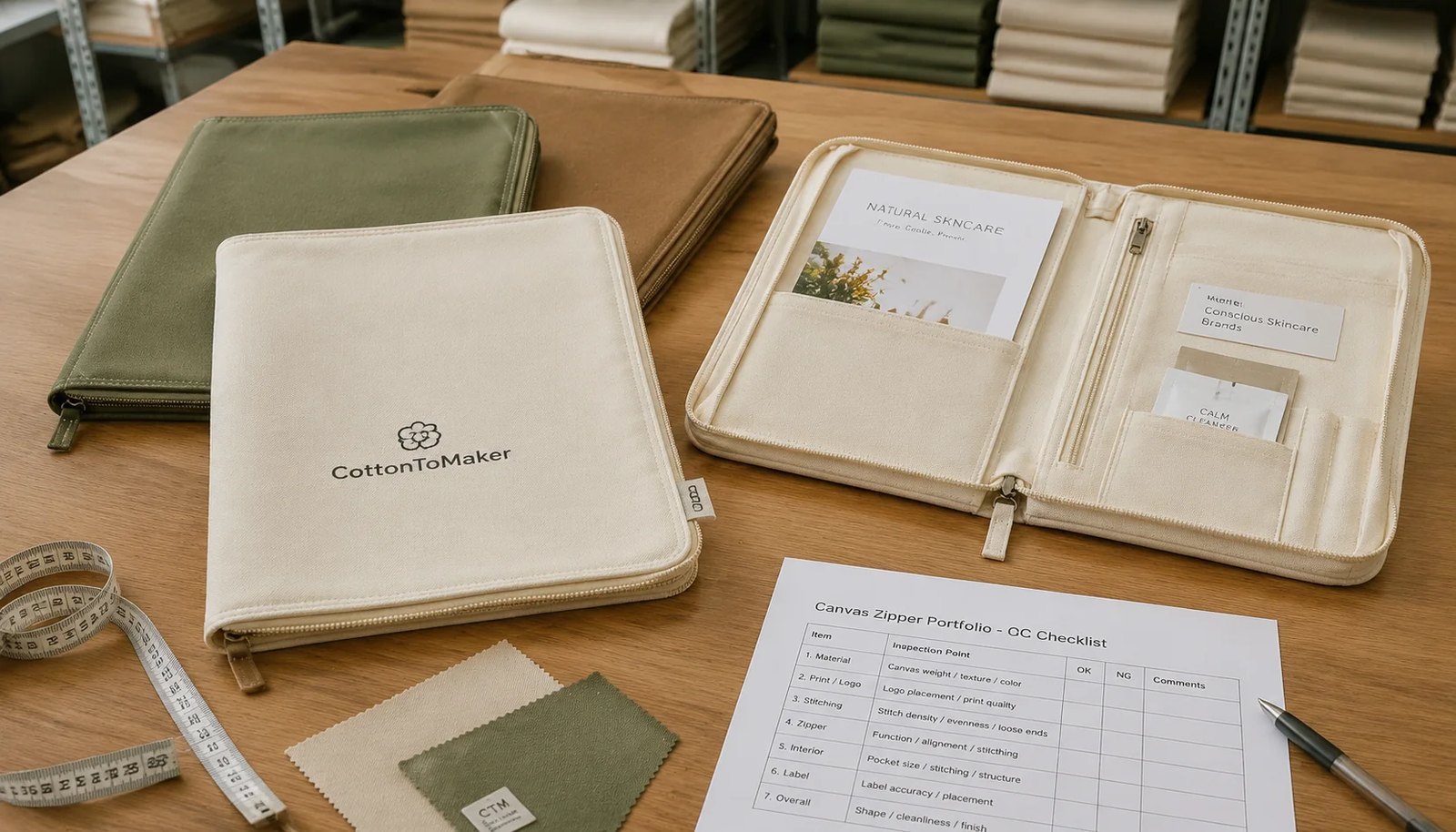
Why skincare brands run into trouble with canvas zipper portfolios
Canvas zipper portfolios look simple, but skincare programs usually use them for more than document storage. Buyers often want a neat package for treatment menus, ingredient cards, tester sachets, spa membership inserts, or launch materials for retail staff. That changes the product from a basic zip pouch into a semi-structured organizer. If the RFQ only says "canvas portfolio with zipper," suppliers will quote very different constructions and the lowest price will rarely match the use case.
The main buying problem is spec drift between concept, sample, and bulk. One supplier may quote 10 oz soft canvas with no interlining, another may use 14 oz with a thin board insert, and both will call it a zipper portfolio. The result is uneven quotes, weak sample comparisons, and QC arguments after production. For skincare brands, appearance matters because these pieces are used in salons, counters, PR kits, or distributor meetings. A portfolio that wrinkles, bows at the zipper, or scuffs its logo quickly becomes dead stock even if it technically meets the PO.
- Common failure point: portfolio looks flat when empty but bulges badly once brochures and sachets are inserted.
- Common quote gap: supplier omits inner pocket count or pocket dimensions, then charges extra after sample review.
- Common appearance issue: dark dyed canvas shows chalk marks, print rub, or seam impression after compressed carton packing.
Start the RFQ with the real use case, not only dimensions
A better RFQ begins with what the portfolio must hold. If your sales team will carry A5 treatment cards and foil sachets, that is a different structure from a PR folder holding a slim brochure and business card. The loading requirement drives panel stiffness, pocket depth, zipper opening range, and whether edge binding is enough or a reinforced panel is needed. Give the factory the actual insert list with dimensions and approximate filled weight.
For skincare buyers, the most useful RFQ note is often a simple load map: front panel logo area, inner left document sleeve, inner right 3 stitched pockets for sample cards, and one top pocket for 3 to 5 sachets. This saves rounds of sample revision. It also makes quotes comparable because suppliers are no longer guessing whether the item is a pouch, folio, or presentation organizer.
- State finished size closed and open in mm.
- Include insert dimensions for brochures, sachets, cards, or leaflet packs.
- Show whether the zipper runs on 3 sides or only top closure.
- Define whether the product must stand up to repeated field use or one-time promotional distribution.
Choose canvas weight and structure based on how full the portfolio will be
For most skincare zipper portfolios, 12 oz to 14 oz canvas, roughly 340 to 400 GSM, is the safest starting point. It gives enough body to look clean on a table, while still sewing well around zippers and pocket stacks. Lighter 8 oz to 10 oz canvas may be acceptable for flat document holders, but once you add internal sample sachets or multiple stitched pockets, the body usually feels too soft and edge waviness becomes visible after packing. Heavier canvas can look premium, but it also raises sewing difficulty and may create bulky seam turns at the zipper corners.
Fabric weight alone does not solve shape retention. Some portfolios need a light interlining or a hidden board panel to keep the front and back from collapsing. If your brand needs a cleaner, presentation-grade piece, mention whether a soft hand feel is acceptable or whether the item should maintain a squared outline when filled. A supplier may otherwise quote the cheapest all-fabric build, which saves cost but produces a loose, pouch-like result rather than a folio.
- 8 oz to 10 oz, about 225 to 285 GSM: only for light-use folders with limited inserts.
- 12 oz to 14 oz, about 340 to 400 GSM: standard range for better shape and sales-kit use.
- 16 oz and above, about 450 GSM plus: only when a very rigid look is needed and sewing capacity is proven.
- If dyed fabric is used, request shade consistency across panels and between lots, especially for black, olive, nude, or pastel skincare palettes.
Logo method, color finish, and appearance risks on textured canvas
Skincare branding often relies on clean minimal artwork, small typography, and controlled color palettes. Canvas is textured, so not every logo method will hold that look. Screen print is still the most reliable for simple one-color logos, especially if the artwork is bold and not too fine. For small detailed branding, a woven label or a stitched logo patch often gives cleaner edges than direct print. Heat transfer can work for multicolor art, but it may feel too plastic on natural canvas and can crack if the portfolio is folded tightly.
Fabric finish matters as much as logo method. Natural canvas shows flecks and slubs, which many clean-beauty brands like, but that same texture can break thin print lines. Dyed canvas gives stronger brand color control, but dark shades show lint, seam shine, and pressure marks after transit. Before bulk, buyers should approve a strike-off on actual production fabric rather than only on paper or smooth sample swatch.
- Screen print: best for simple logos, solid coverage, medium MOQ, lower setup cost.
- Woven label: best for fine detail, small logo area, less risk of ink inconsistency.
- Embroidery: suitable for casual brand look, but can distort lighter panels unless stabilized.
- Deboss patch or PU badge: can elevate appearance, but changes eco-positioning and cost structure.
What really moves the quote: cost drivers buyers can control
The biggest cost drivers are usually fabric weight, internal construction, zipper quality, print method, and labor content from inside pockets. A plain outer shell with one zipper and no internal organization is straightforward. Add four stitched pockets in different sizes, card slots, foam backing, custom pullers, and individual polybags, and the labor cost rises faster than most buyers expect. This is why quote spreads from different suppliers can be wide even when the outer dimensions look identical.
MOQ logic also affects price more than many teams plan for. If the order is split across many skincare sub-brands or seasonal colorways, the supplier may need separate print setups, fabric lots, or barcode sorting. Unit cost climbs because the portfolio is labor-led, not just material-led. Importers comparing quotes should request a line-item view or at least a clear note on included construction elements. Without that, a cheap quote can hide lighter canvas, fewer internal parts, or lower zipper grade.
- Material cost drivers: GSM, dyed versus natural fabric, lining or interlining, zipper quality, branded pullers.
- Labor cost drivers: pocket count, binding, topstitching, corner handling, label sewing, manual thread trimming.
- Packing cost drivers: individual bags, tissue separators, barcode stickers, carton split by SKU, desiccants.
- Sampling cost drivers: custom print screens, revised pocket layout sample, courier, and approval rounds.
Use a pre-production sample to test function, not only appearance
A showroom sample can look fine when empty and newly pressed. A real approval sample must be loaded with actual brochures, cards, and sachets. This is where many problems appear: zipper catches at full load, inside pockets are too shallow, front panel print bends across a bulge line, or the outer edge ripples because the pocket assembly is pulling the body panel. The sample stage should therefore include a fill test and a simple handling test, not just color approval.
The cleanest method is to approve one sealed reference sample with inserts inside and notes attached. That sample should define logo placement, fabric hand feel, pocket dimensions, stitch line, zipper puller, and acceptable edge shape when filled. If the portfolio includes multiple compartments, request one inside photo with a ruler for the signed record. This reduces disputes later because the supplier cannot claim the sample was approved only for empty appearance.
- Run the zipper 20 to 30 times on the sample with actual contents inserted.
- Test whether card and brochure edges catch on pocket seams during insertion.
- View the sample from the front after 24 hours packed flat to see pressure marks and warping.
- If using screen print, rub with dry cloth after curing to check early ink flaking or powdering.
Quality inspection checklist for bulk canvas zipper portfolios
Final inspection should focus on function plus presentation. For skincare brands, a minor sewing defect may still force rejection if the product is intended for client-facing use at counters, spas, or beauty events. Bulk inspection should sample multiple cartons across the run and include both empty and loaded checks. AQL levels vary by buyer, but even when defects are technically minor, visible front-panel issues should be treated more strictly because brand impact is immediate.
The practical point is to convert taste-based comments into measurable acceptance criteria. Instead of writing "good quality stitching," specify no skipped stitches on visible outer seams, no open seams, thread ends trimmed to agreed standard, and no color mismatch beyond approved sample tolerance. Instead of saying "zipper works well," require full-track smooth operation with no jam or tape twist. Measurable language gives the factory and third-party inspector the same target.
- Measure finished size on closed portfolio and key internal pockets.
- Weigh random units if gross underweight may indicate lower fabric GSM or omitted insert board.
- Check front and back panel shade consistency under neutral light.
- Inspect zipper corner turns for puckering, exposed tape, or seam stress.
- Load selected samples with approved inserts to verify fit and closure.
- Review logo clarity, pinholes, off-position print, and woven label skew.
- Open internal seams and pocket tops for missed back-tack at stress points.
- Verify carton count, SKU split, barcode labels, and shipping marks.
Packing standards that protect appearance without inflating freight
Packing is often treated as an afterthought, but it directly affects delivered appearance. Canvas portfolios with printed logos can pick up zipper impressions, fold memory, or print scuffing if compressed too tightly. On the other hand, over-packing with thick individual bags and low carton counts can waste cubic volume. The right solution depends on logo type, fabric color, and whether the goods travel by sea in humid conditions or move quickly by air.
For most wholesale orders, buyers should decide early whether the product is retail-ready or simply transit-protected. If it is going into a gift set or direct retail channel, individual packing may be justified. If it is for distributor field use, bulk packing with simple separators may be enough. A supplier should quote both options when the order value is freight-sensitive. This is especially important for importers balancing landed cost against presentation.
- Use tissue or soft separator sheets between printed faces if stacked print-to-print.
- Consider individual polybag only for dark fabric, light print, or premium finish that scuffs easily.
- Keep carton weight within practical handling range to avoid zipper crushing at lower layers.
- Request master carton dimensions before PO approval to calculate sea freight cube impact.
- If shipping by sea, moisture barrier and desiccant may be useful for dyed canvas in humid seasons.
Lead time planning: where delays usually happen
Lead time on canvas zipper portfolios is not just sewing time. Delays often come from color approval, print strike-offs, zipper and puller matching, and sample revisions after the brand team sees the first filled prototype. A buyer who assumes a simple canvas item can be approved in a few days usually loses a week or more in artwork adjustments and fit changes. This gets worse when inner pockets are designed around inserts that are not yet finalized.
A realistic schedule should separate development, approval, and production. For example, lab dip or fabric color approval may need several days; pre-production sample after artwork confirmation may need another cycle; bulk material prep and cutting may only start after sign-off. If the program includes custom zipper pullers or mixed SKUs by language market, packing lead time also expands. Put the critical path in writing before deposit payment.
- Fabric color approval can delay start if the brand needs close match to carton, label, or skincare primary packaging.
- Pocket revisions often add time because pattern adjustment affects sewing balance and finished dimensions.
- Custom woven labels, pullers, or patches may have separate supplier lead times.
- Carton assortment by region or SKU can slow final packing even when sewing is complete.
How to compare quotes on landed cost, not unit price alone
For importers and distributors, the right comparison is landed value per usable piece, not simply ex-works unit cost. A cheaper portfolio with lower GSM, rougher zipper action, or poor packing may create claim risk, repacking labor, or lower brand acceptance at retail. A slightly higher unit price can be the better buy if it reduces transit damage and passes inspection with less variance. This is especially true for skincare brands using the product in launches or gift-with-purchase campaigns where timing matters as much as cost.
When comparing quotes, normalize them against the same assumptions: outer GSM, inside layout, logo process, packing method, sample count, and carton efficiency. Then look at what each quote leaves out. If one supplier is lower because individual packing, interlining, or improved zipper grade is excluded, that quote is not truly cheaper. Procurement teams should maintain a quote comparison sheet tied to the approved sample spec rather than vendor descriptions.
- Compare ex-works versus FOB on the same basis and note who bears inland and export handling costs.
- Estimate carton cube and freight cost per piece; bulky packing can erase a lower unit price.
- Add likely extra costs: revised sample, barcode application, custom puller tooling, or split-pack by SKU.
- Rate each supplier for quote transparency, not only final number; hidden omissions are a major sourcing risk.
Specification comparison for buyers
| Spec decision | Recommended option | When it fits | Buyer risk to check |
|---|---|---|---|
| Outer fabric weight | 12 oz to 14 oz canvas, about 340 to 400 GSM | Best for skincare portfolios that carry brochures, treatment cards, and sachet kits without feeling flimsy | Below about 300 GSM often looks soft at edges and may wrinkle heavily after packing |
| Fabric construction | Cotton canvas with pre-shrunk or washed finish if color consistency matters | Suitable when brand presentation is premium and flatness after sewing is important | Unwashed greige canvas can shrink after printing or steaming and distort zipper alignment |
| Zipper type | Nylon coil zipper with matched tape and metal puller | Fits most cosmetic brand portfolios because it runs smoother around corners than chunky metal zippers | Cheap zippers snag at corner turns; require opening and closing test on production samples |
| Inside layout | One document sleeve plus 2 to 4 stitched pockets sized for cards, masks, or sample sachets | Good for sales kits, launch folders, spa treatment packs, and distributor presentations | Pocket dimensions often fail if buyer only approves artwork and not filled product fit test |
| Logo method | Screen print for simple logos; woven label for cleaner branding on textured canvas | Screen print works for bold one- or two-color art; woven label works when logo detail is small | Fine-line artwork can bleed on coarse canvas; woven labels can be placed crooked if no placement tolerance is set |
| Edge finish and piping | Bound seam or turned edge with reinforcing tape on stress points | Recommended when portfolio must hold shape through repeated sales-team use | Raw or lightly turned edges can wave, especially on darker dyed canvas after humidity change |
| MOQ structure | Single color MOQ often 300 to 500 pcs per size; multi-color programs split by fabric availability | Practical for importers testing one main SKU plus one secondary color | Very low MOQ usually increases unit price sharply or forces stock fabric compromises |
| Packing method | Individual polybag only if print rub risk exists; otherwise bulk packed with tissue between prints | Useful for controlling carton volume while protecting logo finish during sea transit | Overpacking adds freight cost; underpacking can cause zipper impression marks and print scuffing |
Buyer checklist before sampling
- Define finished size closed and open, with tolerance in mm, not only a sketch.
- Specify canvas weight in GSM or oz and whether washed, dyed, or natural greige finish is acceptable.
- State intended contents: brochure set, treatment menu, mask sachets, cards, mirror, pen loop, or empty promotional folder.
- Approve zipper type, zipper tape color, puller finish, and whether corners must open fully or only three sides.
- Provide logo file and select print method based on artwork detail: screen print, heat transfer, embroidery, deboss patch, or woven label.
- Request a pre-production sample loaded with actual inserts to verify pocket depth, closure smoothness, and bulging at edges.
- Set appearance tolerances for print placement, skewed labels, edge waviness, thread color match, and visible glue if any stiffener is used.
- Confirm packing count per carton, carton size limit, barcode or carton marks, and whether moisture protection is needed for sea freight.
- Separate quote line items for sample charge, mold or screen charge if any, unit price by quantity break, and carton count estimate.
- Tie bulk approval to one sealed reference sample with signed color, print, and stitching notes.
Factory quote questions to send
- What canvas weight and weave are you quoting, and is the fabric stock or custom dyed?
- Does the quoted structure include interlining, foam, board, or any stiffener inside the panels?
- What zipper brand or grade is used, and how do you test smooth running at curved corners?
- What is the standard tolerance for finished size, pocket placement, print placement, and label position?
- Which print method are you quoting for this artwork, and what artwork details may lose sharpness on canvas texture?
- What MOQ applies by color, by logo, and by size, and can mixed colors share one bulk fabric lot?
- Can you provide a fit sample loaded with our brochures and sachets before pre-production approval?
- How many days for lab dip or strike-off, sample revision, bulk production, and final packing after approval?
- What packing method is included in the price, and what is the estimated pieces per carton and carton gross weight?
- What AQL level or internal final inspection standard do you normally use for stitched zippered portfolios?
Quality-control points to confirm
- Finished size within agreed tolerance, typically ±5 mm on width and height unless portfolio is structured with stiffener.
- Canvas weight and color match bulk approval sample; no mixed shade panels within one unit.
- Zipper opens and closes smoothly through full run with no tooth skip, tape puckering, or corner jamming.
- Logo print placement, label placement, and pocket alignment follow approved artwork and measurement sheet.
- Stitch density is even, no loose threads longer than agreed trim standard, and back-tacking is present at stress points.
- Interior pockets fit approved inserts without excessive stretching, sagging, or exposed raw edge.
- No obvious oil marks, rust stains, glue bleed, needle holes outside seam line, or severe slub concentration on front panel.
- Carton packing count, inner packing, and carton markings match shipping marks and approved packing spec.