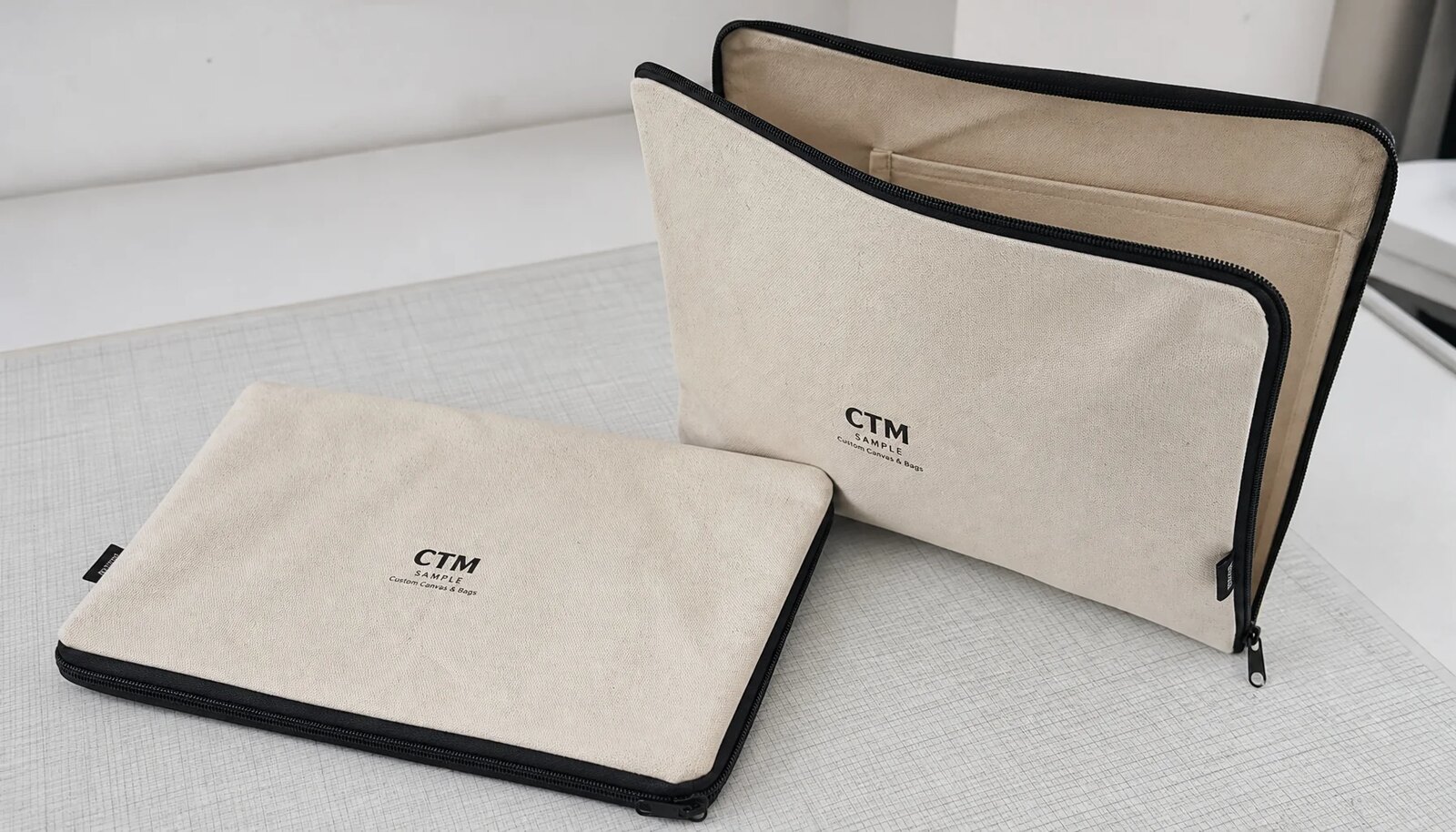
Start With the Real Buying Problem
A wholesale canvas zipper portfolio looks simple until it reaches bulk production. It is a sewn bag, a printed brand surface, and a hotel retail item at the same time. The canvas must feel substantial without becoming bulky. The zipper must run smoothly after the seams are closed. The logo has to sit square on a panel that may shift during cutting, sewing, turning, pressing, and packing. If the item is sold in a gift shop or placed in a guest room, small visual flaws become more visible than they would on a purely functional pouch.
For procurement teams, the question is not just, can this supplier print our logo on canvas? The better question is, can the approved sample be repeated across the full order while controlling canvas shade, zipper alignment, sewing tolerance, print curing, packing abrasion, and retail presentation? A PDF proof can make the layout look finished, but it cannot show ink absorption, zipper bulk, fabric slubs, seam pull, or carton pressure. Those details appear only when the proofing process includes real materials and a finished sample.
A strong RFQ brings construction, artwork, components, packaging, and inspection into one document. When the print brief is separated from the zipper spec, quotes become hard to compare. When packing is decided after sampling, the product may pass the sample stage and still arrive with scuffed print or bent corners. Treat the item as part of the Zipper Business Bags category: functional first, branded second, retail-ready always.
- Classify the item internally as a sewn zipper product, not only as a promotional print job.
- Use proof approval as a production gate for material, logo position, color, curing, handfeel, zipper function, and retail look.
- Confirm zipper seam allowance, pocket stitch lines, corner radius, lining, and usable front-panel area before approving logo placement.
- Compare supplier prices only after canvas GSM, zipper grade, print method, lining, packing, sample scope, and excluded charges are aligned.
- Add the inspection checklist to the purchase order or specification sheet so it becomes part of the commercial agreement.
Define the Contents Before the Size
Size decisions should start with what the portfolio will carry. A pouch for one welcome letter does not need the same structure as a gift-shop portfolio holding menus, resort maps, amenity cards, spa vouchers, pens, and a retail insert. A tablet sleeve has different clearance needs again. Catalog dimensions can be useful for orientation, but they should not replace the actual insert size and thickness.
Finished outside size and usable inside size are different numbers. Seam allowance, zipper tape, lining, rounded corners, and internal pockets all reduce usable space. If the product must fit A4 paper, US Letter documents, menu cards, or a fixed collateral set, send the real measurements in millimeters. A good sample approval should include an insert-fit photo with the zipper fully closed, then opened, with the intended contents inside.
Hotel retail handling also matters. A portfolio stacked flat on a boutique shelf needs protection from zipper pullers and neighboring printed faces. A guest-room amenity holder needs a clean surface, low odor, and consistent shape. A distributor program may need barcodes, hangtags, inner cartons, carton marks, or retail sleeves. These requirements change packing cost and lead time, so include them in the original RFQ rather than adding them after the unit price has been agreed.
- State the intended contents: A4 documents, US Letter paper, menus, resort maps, amenity cards, spa vouchers, tablets, retail inserts, or kitted gift sets.
- Define finished outside size, usable inside size, zipper opening length, and measurement tolerance in millimeters.
- Confirm whether the portfolio ships empty, filled as a welcome kit, used as an amenity holder, or sent to a distributor for later kitting.
- Specify display needs such as flat stacking, hanging, shelf presentation, barcode sticker, hangtag, paper sleeve, or gift wrap.
- Require an insert-fit photo during sample approval when the portfolio must hold a specific document or collateral set.
Canvas Weight, Finish, and Shade
For many hotel retail canvas zipper portfolios, 10 oz to 12 oz cotton canvas, roughly 280 to 340 GSM, is a balanced starting point. It has more body than lightweight canvas but does not usually create excessive seam bulk around the zipper and corners. An 8 oz canvas can lower cost and freight weight, yet the finished product may feel more like a soft pouch. A 14 oz canvas can look premium, but it increases cutting resistance, seam thickness, zipper stress, carton weight, and corner puckering risk.
Ask how the quoted fabric is defined. Is it 100 percent cotton, a cotton-rich blend, recycled cotton blend, or another composition? Is the GSM measured before dyeing and washing, after finishing, or taken from a nominal stock description? Cotton canvas can shrink, soften, stiffen, or change shade after finishing. If print placement is tight or the zipper path is long, fabric behavior matters. A physical swatch and measured sample are more useful than a vague promise of heavy canvas.
Canvas finish sets the retail mood. Natural canvas may show cotton seed flecks, neps, slubs, and shade variation. That can suit a resort, spa, or eco-oriented brand, but it should be approved deliberately. Bleached canvas gives a cleaner base for colored logos but may show dirt more easily. Dyed canvas helps match a hotel palette, although it introduces dye-lot variation and matching questions for zipper tape, thread, lining, labels, and print ink. Washed canvas can feel softer, but it may reduce print edge sharpness and make placement less predictable.
- Economy build: 8 oz to 10 oz canvas, unlined body, standard No. 5 zipper, one-color screen print, and basic individual or bulk packing.
- Balanced hotel retail build: 10 oz to 12 oz canvas, clean seam finish or lining, smooth No. 5 zipper, controlled logo placement, and protected packing.
- Premium build: 12 oz to 14 oz canvas, lining, inner pocket, custom puller, woven side label, upgraded hangtag, and tighter pre-production approval.
- Natural canvas standard: define acceptable fleck level, shade range, slub frequency, and whether dark cotton specks are acceptable on the front print area.
- RFQ control point: require buyer approval if canvas lot, finish, shade, or supplier stock source changes after sample approval.
Specify the Zipper Like Hardware
The zipper is small compared with the canvas body, but buyers notice it every time the portfolio is opened. A No. 5 nylon coil zipper is often the safest choice for canvas zipper portfolios because it bends with textile edges, sews cleanly, and is widely available in standard colors. Still, standard zipper is not a specification. The RFQ should name zipper tape color, visible coil color if relevant, slider finish, puller type, opening direction, and end-stop appearance.
Puller choice affects perceived value and packing risk. Metal pullers can feel durable and premium, but they may scratch screen-printed faces if portfolios are packed without tissue or orientation control. Cord pullers can reduce scratching and fit a softer resort look, but knots, fraying, and colorfastness need checking. Enamel or coated pullers can support a brand palette, yet custom pullers may add tooling charges, higher MOQ, and extra lead time.
Internal construction should be locked before quotation. An unlined body may be enough for a simple document pouch. A lined portfolio can hide seams, improve handfeel, and protect contents. Dividers, pen loops, card pockets, mesh pockets, and stitched panels add usefulness, but they also add inspection points. If a pocket stitch line crosses the front panel, it may interfere with the logo. If a pocket is attached only to lining, the lining has to support the intended load.
- Specify No. 5 nylon coil zipper unless the project has a documented reason to use another size, molded tooth zipper, or metal zipper.
- Define zipper tape color, slider finish, puller material, puller shape, opening direction, and end-stop appearance in the RFQ.
- Check zipper function after sewing and trimming because seam pressure, lining edges, and loose threads can change smoothness.
- Map all internal pockets before artwork approval so pocket stitch lines do not cross, pucker, or visually distort the logo area.
- Test packed stacking to confirm pullers, hangtags, and zipper sliders do not dent, scratch, or transfer ink onto printed faces.
Choose the Print Method by Risk
Screen printing is usually the practical choice for solid hotel logos, resort names, monograms, and simple brand marks. It can give clean coverage and predictable cost when the artwork uses limited colors. The RFQ should define Pantone references, print size, number of colors, ink type, and whether the graphic includes large filled areas. Heavy ink coverage can stiffen canvas, lengthen curing time, and increase transfer risk if products are stacked too soon.
Heat transfer can work well for multi-color graphics, gradients, fine detail, or retail artwork that would require too many screens. It still needs proofing on the actual canvas. Textured cotton is not a smooth polyester surface. Film edges, adhesive halos, gloss differences, or slight lifting can become visible after bonding. Ask for a strike-off, then check light bending, rubbing, edge lift, and how the transfer behaves under packing pressure.
Embroidery can look premium, but it is not automatically better. Dense embroidery can pucker cotton canvas and distort a flat front panel, especially on lighter fabric. If the item is unlined, the back of the embroidery may also need coverage. Small crests, initials, patches, and badges are safer than large filled embroidery areas. For hotel groups with several properties, woven labels or printed patches can allow one base construction with different property branding.
- Use screen print for solid marks, clean Pantone targets, repeat wholesale orders, and controlled decoration cost.
- Use heat transfer for detailed multi-color artwork only after checking bonding, edge lift, rub resistance, gloss, and texture compatibility on actual canvas.
- Use embroidery for small crests, initials, or badges; avoid large dense stitch areas that pucker the front panel.
- Use woven labels or patches when different hotel properties need separate branding on the same base construction.
- State print size in millimeters and placement from finished edges, not only as centered, large, small, or same as mockup.
Build a Proofing Sequence
A digital layout is only the first proof. It confirms the visual idea, not production reality. Cotton may absorb ink differently than expected. Natural canvas may shift the perceived logo color. Zipper seams can pull the panel slightly. Packing can scuff a print that looked perfect on the table. A safer approval path moves from artwork confirmation to material swatch, print strike-off, finished pre-production sample, packed sample review, and sealed reference sample.
Artwork placement should be measured from finished edges, not from the cut panel alone. On a zipper portfolio, the usable branding area is shaped by zipper tape width, seam allowance, lining bulk, corner radius, and pressing. A centered logo on the flat cut piece can look off-center after assembly. The proof sheet should show logo width, logo height, distance from top finished edge, distance from left or right finished edge, print orientation, print method, and allowed tolerance.
For many sewn canvas portfolios, plus or minus 3 mm to 5 mm for logo placement is a realistic starting point. If the brand standard requires tighter control, ask the supplier to quote it before sampling. Tighter placement may require printing jigs, extra sorting, slower sewing, or additional rejects. The finished pre-production sample should use actual production canvas, zipper, thread, lining, pocket structure, label, print method, and proposed packing. If a sample uses substitute materials, label it as a construction sample, not final approval.
- Approve vector artwork before any screen, transfer, label, patch, or embroidery setup is made.
- Approve material swatches for canvas color, texture, weight, zipper tape, puller finish, thread, lining, and labels.
- Approve a print strike-off on actual canvas to confirm color, edge sharpness, ink coverage, curing, handfeel, and odor.
- Approve a finished sample after sewing to confirm size, logo position, zipper function, corners, lining, pockets, label, and retail appearance.
- Approve packing by photo or physical sample when scuffing, barcode placement, retail sleeve presentation, or puller contact matters.
- Keep one sealed approved sample at the factory and one with the buyer for production and final inspection comparison.
Compare Quotes on Landed Cost
MOQ is usually driven by material and process minimums, not only by a supplier preference. Standard natural canvas with a standard black zipper is usually more flexible than custom-dyed canvas with matched zipper tape, custom pullers, woven labels, lining, and several logo versions. If a hotel group wants one base portfolio with different property logos, the factory may combine sewing quantity while still charging separate screens, transfers, labels, embroidery digitizing, or setup fees for each design.
Ask suppliers to separate the base product from decoration, setup, sampling, packing, and logistics assumptions. A low unit price may exclude screen charges, sample fees, label setup, barcode stickers, hangtags, individual bags, tissue, inner cartons, stronger export cartons, or inspection support. Request carton dimensions, pieces per carton, gross weight, net weight, and total CBM. Canvas products can become costly to ship when retail packing adds volume or cartons are underfilled to protect printed faces.
Before ranking prices, align the assumptions. One supplier may be quoting 10 oz unlined canvas with bulk packing, while another is quoting 12 oz lined canvas with tissue, barcode stickers, and paper sleeves. Those are different products. A useful comparison worksheet lists canvas GSM, body color, zipper type, print method, print size, lining, pocket structure, labels, packing, MOQ by variable, sample scope, lead time, excluded charges, carton data, delivery term, and inspection support.
- Material cost drivers: canvas weight, fabric color, lining, zipper tape, slider, puller, thread, labels, patches, stiffening, and pocket components.
- Process cost drivers: cutting, printing, drying or curing, sewing, trimming, inspection, pressing, folding, interleaving, and packing.
- Setup cost drivers: screens, transfer film, embroidery digitizing, woven label setup, patch setup, custom puller mold, barcode labels, and sample development.
- Logistics cost drivers: individual packing volume, pieces per carton, carton strength, gross weight, CBM, palletization, and delivery term.
- Comparison rule: identify what is included, what is excluded, and which changes trigger re-quotation or timeline reset.
Check the Supplier Route
Several supplier routes can produce canvas zipper portfolios, but the control risks are different. A cut-and-sew bag factory may manage construction well and need clear decoration standards. A print shop may produce attractive graphics but outsource sewing, which can weaken control over zipper smoothness, seam tolerance, and final packing. A trading company can consolidate hotel retail items, but communication layers make sample traceability more important. A stock distributor may move quickly on simple decoration, yet offer limited options for canvas weight, lining, zipper hardware, and private-label packing.
Supplier evaluation should focus on evidence. Ask for photos of comparable zipper construction, physical canvas swatches, print samples on similar fabric, zipper detail photos, lining and pocket examples, packing photos, carton data, and a written outline of inspection steps. A supplier that understands this category should be able to explain where logo distortion can happen and how cutting, printing, sewing, trimming, pressing, and packing are controlled.
Clarify which steps are in-house and which are subcontracted. Subcontracting is not automatically a problem, but it needs documented approvals. If printing is outsourced, the sewing factory still needs to control panel orientation, post-print handling, and curing time. If sewing is outsourced, the print supplier must still define zipper and seam requirements. If packing is handled by a warehouse, packing layout and carton marks should be approved before shipment.
- Factory-direct route fits controlled specifications, repeat wholesale orders, private-label packing, and tighter sample traceability.
- Trading route fits multi-item hotel retail programs, but buyers should require clear sample custody and subcontractor transparency.
- Print-shop route fits artwork-heavy programs if zipper sourcing, sewing quality, and final inspection are independently verified.
- Stock-distributor route fits urgent low-customization orders but is limited for custom canvas, lining, pullers, labels, and carton requirements.
- Request comparable samples, swatches, print close-ups, zipper photos, packing photos, carton data, and inspection capability before awarding bulk orders.
Set Sample Acceptance Criteria
The sample process should answer production questions, not just create a nice-looking unit for approval. A fabric swatch confirms color, texture, weight, and acceptable natural variation. A print strike-off confirms logo color, edge detail, ink coverage, curing, and handfeel. A finished sample confirms outside size, usable space, zipper performance, corners, lining, pocket layout, logo position, and retail appearance. A packed sample confirms whether the product can travel without print abrasion, bent corners, puller dents, barcode damage, or sleeve scuffing.
Acceptance criteria should be measurable. For many standard portfolios, plus or minus 5 mm finished-size tolerance is practical, but document-fit requirements may need tighter control. Print placement often starts at plus or minus 3 mm to 5 mm, depending on construction and artwork size. Stitch density for canvas bag construction is often around 7 to 9 stitches per inch, though the factory should confirm what works for the selected fabric and seam thickness. Zipper smoothness must be judged after the item is sewn and trimmed, not from loose zipper tape.
Write down who can approve changes. If the brand team approves print color but procurement later changes packing, the schedule and cost may shift. If the supplier changes fabric lot after approval, require a new swatch, photo confirmation, or written acceptance before cutting. If artwork size changes after screen setup, screens may need to be remade. Clear criteria reduce disputes over subjective words such as premium, clean, heavy, centered, or same as sample.
- Sample photos should show front, back, inside, zipper close-up, puller close-up, corner detail, print close-up, lining, pocket, label, hangtag, and packing.
- Written tolerances should cover finished size, usable inside size, logo position, print color, stitch density, zipper alignment, fabric shade range, and carton count.
- Production should not start until artwork size, print method, canvas color, zipper color, lining, label, and packing style are locked.
- Any material substitution after approval should require buyer confirmation before bulk cutting, printing, or sewing continues.
- The approved sample should be sealed, dated, signed or labeled, and referenced on the purchase order and inspection checklist.
Control QC Before Cartons Close
Inspection should not start after the goods are already sealed. Printed canvas zipper portfolios need stage-by-stage control. After cutting, panels should be checked for size, grain direction, stains, shade difference, unacceptable slubs, and correct quantity by design. After printing, panels should be checked for placement, color, curing, ink coverage, smudging, registration, and surface contamination. After sewing, finished items should be checked for zipper function, seam straightness, corner shape, lining position, loose threads, and final size.
Defects should be classified before inspection begins. Critical defects may include wrong artwork, wrong size that causes document-fit failure, broken zipper, sharp metal burrs, mold, severe odor, unsafe hardware, or missing required barcode or legal labeling. Major defects may include crooked print, visible ink cracking, stuck slider, wavy zipper tape, seam puckering, skipped stitches, dirty canvas, mismatched zipper color, or wrong packing. Minor defects may include small thread ends or approved natural cotton flecks within the agreed standard.
Hotel retail raises the visual bar. A slightly crooked logo can weaken shelf presentation. Ink transfer can cause returns before the product reaches the guest. A zipper that catches the lining makes the item feel poorly made, even if the canvas is acceptable. Final inspection should compare bulk goods against the sealed approved sample, purchase order, packing instruction, carton marks, and written QC checklist.
- Cutting QC: panel size, fabric direction, shade, stains, correct design allocation, and unacceptable weaving defects.
- Printing QC: logo placement, Pantone target, curing, ink edge quality, registration, smudging, cracking, rub resistance, and transfer resistance.
- Sewing QC: straight seams, consistent stitch density, clean corners, secured backstitching, lining fit, pocket placement, and no loose thread near zipper teeth.
- Zipper QC: smooth full-length opening, no catching, no broken coil, no sharp puller edge, no excessive wavy tape, and correct opening direction.
- Packing QC: print protection, barcode accuracy, hangtag placement, carton count, carton marks, gross weight, moisture condition, and product flatness.
Specification comparison for buyers
| Spec decision | Recommended option | When it fits | Buyer risk to check |
|---|---|---|---|
| Canvas body fabric | 10 oz to 12 oz cotton canvas, approximately 280-340 GSM; confirm whether the weight is greige, finished, dyed, or washed | Hotel retail portfolios for documents, welcome kits, spa menus, resort maps, amenity cards, boutique gift sets, and corporate gifting | Below about 260 GSM can feel limp; above about 380 GSM can create bulky zipper seams, higher freight weight, needle breakage risk, and corner puckering |
| Canvas color and finish | Natural, bleached, dyed, or washed canvas approved by physical swatch with lot-control note | Programs where the portfolio must match hotel room amenities, retail fixtures, gift-shop palette, or brand standards | Natural flecks, slubs, and shade bands must be defined as acceptable or defective; dyed lots may need zipper tape, thread, and print re-approval |
| Zipper type | No. 5 nylon coil zipper with smooth slider, matched tape, specified puller, and secured end stops | Most Zipper Business Bags where smooth opening, flexible sewing, and moderate durability are required | Low-grade coil tape can wave after sewing; incorrect slider direction, rough pullers, or sharp burrs can create rejects and print scratches |
| Portfolio structure | Unlined flat body for economy orders; lined body with 150D-210D polyester, cotton lining, or divider for premium retail | Unlined works for simple retail pouches; lining works for document sets, amenity kits, and more polished guest-facing presentation | Lining adds tolerance stack-up; pocket stitching can show through the front panel unless construction and artwork placement are mapped |
| Print method | Screen print for solid marks; heat transfer for multi-color detail; woven label, patch, or small embroidery for premium accents | Hotel logos, resort names, boutique retail graphics, private-label distributor programs, and multi-property branding | Large screen-print coverage can stiffen canvas; transfers can lift on textured surfaces; dense embroidery can pucker or telegraph inside threads |
| Logo position | Measure from finished edges; keep at least 20 mm from zipper seam, folded edge, corner radius, and heavy stitch lines | Clean hotel retail presentation for flat stacking, face-out display, or insertion into guest welcome kits | Placement based on cut-panel center can look off after sewing; printing too close to seams can cause broken ink, heat marks, or visual distortion |
| MOQ structure | 500-1,000 pieces per color for standard canvas and zipper is common; higher quantities may apply to custom dye, custom pullers, labels, or split artwork | Wholesale replenishment, hotel retail launches, distributor catalog orders, and multi-property programs | Low MOQ may exclude setup, use stock materials only, limit colors, or raise unit price; clarify MOQ by body color, zipper color, logo, and packing style |
| Packing method | Individual polybag, recycled polybag, paper sleeve, or tissue wrap; tissue between printed faces; export cartons usually kept near 15-18 kg gross weight | Retail-ready goods that must arrive without scuffed print, bent corners, zipper dents, moisture marks, or barcode damage | Tight cartons can deform corners; loose cartons allow abrasion; plastic-free packing may require rub and humidity checks before approval |
| Proof approval | Digital layout, material swatch, print strike-off, finished pre-production sample, packed sample photo, and sealed reference sample | Orders where logo size, canvas shade, zipper color, sewing tolerance, retail look, and carton packing must be controlled | A PDF proof alone does not confirm ink absorption, handfeel, curing, zipper bulk, seam distortion, packing abrasion, or final usable capacity |
Buyer checklist before sampling
- Define the finished outside size in millimeters, the usable inside size, the zipper opening length, and the intended insert size; do not rely only on A4, US Letter, or catalog dimensions.
- State whether the portfolio will hold paper, menu cards, spa vouchers, amenity cards, maps, tablets, retail inserts, or a kitted set; send actual insert measurements and thickness where possible.
- Specify canvas weight in both oz and GSM, fiber composition, weave, color, finish, shrinkage expectation, and whether the quoted weight is measured before or after dyeing, washing, or finishing.
- Approve a physical canvas swatch under consistent light before sampling, especially for natural, bleached, black, navy, beige, or custom-dyed hotel colors.
- Define acceptable natural-canvas character: cotton flecks, slubs, neps, shade variation, and weaving marks should be listed as acceptable, limited, or rejected.
- Specify zipper size, zipper tape color, slider finish, puller material, puller shape, opening direction, end-stop appearance, and smoothness requirement after the item is fully sewn.
- Provide vector artwork with Pantone references, print dimensions in millimeters, exact placement from finished edges, and minimum clearance from zipper seam, folded edge, pocket stitch lines, and corner radius.
- Choose the decoration method by artwork and use case: screen print for solid marks, heat transfer for detailed multi-color graphics, woven label or patch for multi-property programs, and embroidery only for small accents.
- Require a real print strike-off on the selected production canvas, not paper, substitute fabric, or only a digital mockup; approve ink coverage, edge sharpness, color, curing, odor, and handfeel.
- Request a finished pre-production sample using production canvas, zipper, thread, lining, pocket structure, label, print method, and proposed packing materials.
Factory quote questions to send
- What exact canvas weight, GSM, fiber composition, weave, color, and finishing process are included in the quoted price?
- Is the quoted canvas weight based on greige fabric, finished fabric, dyed fabric, washed fabric, or a nominal stock specification?
- Can you provide available canvas swatches, thread cards, zipper tape swatches, lining swatches, and puller finish photos before making the pre-production sample?
- Is the MOQ based on total order quantity, each body color, each zipper color, each lining color, each artwork, each label, or each packing style?
- Which zipper size and grade are quoted, and can you confirm coil type, slider type, puller material, puller finish, tape color, end stops, and opening direction?
- Which print method is quoted, how many colors are included, what maximum print size is included, and what ink or transfer type will be used on cotton canvas?
- Are screen charges, transfer setup, embroidery digitizing, woven label setup, custom puller tooling, sample fees, barcode labels, and hangtags included or listed separately?
- Can you make a print strike-off on the actual production canvas before sewing the finished sample?
- Can you provide a finished pre-production sample using the actual canvas, zipper, lining, pocket, label, decoration, and packing materials?
- What are your normal tolerances for finished size, usable inside size, print placement, logo color, stitch density, zipper alignment, and fabric shade variation?
Quality-control points to confirm
- Finished outside size should normally be controlled within plus or minus 5 mm for standard portfolios unless the buyer defines a tighter fit requirement; usable inside space must be checked with the actual insert.
- Logo placement tolerance should be agreed before production; plus or minus 3 mm to 5 mm is realistic for many sewn canvas zipper portfolios, while tighter tolerance may require jigs, extra sorting, and higher cost.
- Logo color should be checked against the approved strike-off under consistent light, recognizing that cotton canvas texture and base shade can affect perceived Pantone matching.
- Screen-print ink should be fully cured, should not crack after light bending near the edge, and should not transfer when printed faces are stacked after the approved curing time.
- Heat transfers should be checked for edge lift, bubbling, adhesive halo, gloss mismatch, and bonding over the woven canvas texture.
- Embroidery should be checked for puckering, loose threads, backing visibility, needle damage, and distortion of the front panel.
- Zipper must open and close smoothly across the full length without catching canvas, lining, loose thread, pocket edges, seam allowance, or zipper end tabs.
- Zipper tape should sit flat without heavy waviness, twisting, broken coil, exposed sharp end, or visible mismatch from the approved zipper color.
- Stitching should be straight on visible edges with agreed stitch density, no skipped stitches, no broken thread, no loose backstitching, and no exposed seam allowance.
- Corners should be shaped consistently without puckering caused by heavy canvas, lining mismatch, poor trimming, or excessive seam bulk.