Why natural grocers should spec this like a business tool, not a giveaway bag
A canvas zipper portfolio may look simple, but for a natural grocer it often supports real operating work. It can carry vendor packets, training sheets, nutrition-program materials, onboarding forms, event documents, category-review notes, or private-label paperwork. That changes the buying standard. A product meant for repeated office and store use needs more control than a low-cost promotional pouch.
This is where many sourcing projects drift off course. The request goes out as 'canvas zip portfolio with logo,' and three factories answer with prices that seem comparable. On closer review, they are not. One supplier may be pricing a lighter shell with raw interior seams and a basic zipper. Another may be pricing a heavier fabric, bound seams, and cleaner packing. Same product name, different build.
For procurement teams, vague wording creates hidden cost. A quote that looks attractive at the RFQ stage can become expensive once sample changes, QC failures, or rework begin. If the portfolio is intended to represent a natural grocer brand in vendor meetings or store programs, visible shortcuts stand out quickly: rippled zipper lines, weak corners, uneven print, or interiors that shed fibers onto documents.
A stronger approach is to lock the style around function first, then around measurable construction details. In practice, that means defining document size, finished dimensions, canvas weight, zipper grade, internal finish, print method, and packing route before unit prices are judged. The phrase wholesale canvas zipper portfolios for natural grocers quality inspection checklist only becomes useful when the checklist is tied to a real specification.
The main point is straightforward: buy an inspection-ready product standard, not just a sample photo that happens to look acceptable. Photos can hide weight differences, corner bulk, zipper drag, and interior shortcuts. Specifications make those issues visible early.
- Typical uses include onboarding documents, supplier packets, event handouts, training materials, and merchandising forms
- Top buyer priorities are repeatable dimensions, smooth zipper action, clean logo execution, and consistent replenishment quality
- The most common sourcing mistake is comparing prices before fixing fabric weight, zipper construction, inside finish, and packing assumptions
- A portfolio that appears minimalist still needs technical detail to avoid subjective approval disputes
Start with use case, insert size, and finished dimensions
Before discussing fabric or logos, define what the portfolio must actually hold. Will it carry A4 sheets, US letter pages, folded inserts, a slim notepad, or mixed-format documents? Does the buyer want a flat sleeve-style portfolio, or a more organized interior with pockets and holders? Those choices affect pattern size, zipper length, sewing steps, and carton efficiency.
Size language should be explicit and practical. List the closed size and open size separately in millimeters. If the opening width matters for inserting papers smoothly, write that too. If there is an inner sleeve, pocket mouth, or notepad slot, those dimensions should be controlled as functional points rather than treated as afterthoughts.
This matters because a portfolio can pass visual review and still fail during use. A piece may look balanced on a table yet be too narrow for standard paperwork, too shallow for a welcome packet, or too tight at the inside opening. Procurement teams often discover these issues only when the first physical sample is loaded with real documents.
Natural grocer branding tends to lean toward quiet, earthy presentation. That visual simplicity can be deceptive. A plain rectangular zip portfolio still depends on accurate panel cutting, stable zipper insertion, and enough internal clearance for documents. Minor pattern errors become obvious once the portfolio is opened and filled.
To keep the RFQ clean, describe the intended use in one sentence, the target contents in one line, and the dimensions in a simple measurement block. That small amount of discipline makes supplier comparison much easier and reduces later arguments about whether a unit is 'close enough.'
- State the target paper format clearly: A4, US letter, custom insert, or mixed contents
- List dimensions as closed width x closed height and open width x open height in mm
- If needed, specify inner pocket width, pocket depth, and notepad sleeve measurements
- Say whether the item should stay relatively flat when filled or remain soft and flexible
- Add dimension tolerances to the RFQ instead of waiting until the purchase order stage
Canvas specification: weight, composition, appearance, and tolerance language
Terms such as heavy canvas, premium cotton, or natural fabric are not purchasing specifications. For B2B sourcing, buyers should ask for finished fabric weight and define how that weight is judged. In this category, many programs land around 12 oz to 14 oz canvas, or roughly 340 to 400 GSM finished weight. That range usually gives enough body for brochures and forms without making corners too bulky for clean zipper sewing.
The tolerance discussion matters as much as the nominal weight. If a supplier quotes 360 GSM, ask whether that refers to finished fabric after processing and whether variation is controlled by tested sample average, roll average, or lot average. Without that clarity, a reorder can feel noticeably softer than the approved sample even if the mill claims it is within normal commercial variation.
Composition should also be written precisely. Many buyers are comfortable with 100% cotton canvas because it is familiar, workable, and often the easiest route for repeatability. If a sustainability program calls for organic or recycled content, define the scope in plain terms. Is the requirement only for the shell fabric, or for the full bill of materials including zipper tape, labels, thread, binding, and lining? Broad wording creates mismatched quotes and approval delays.
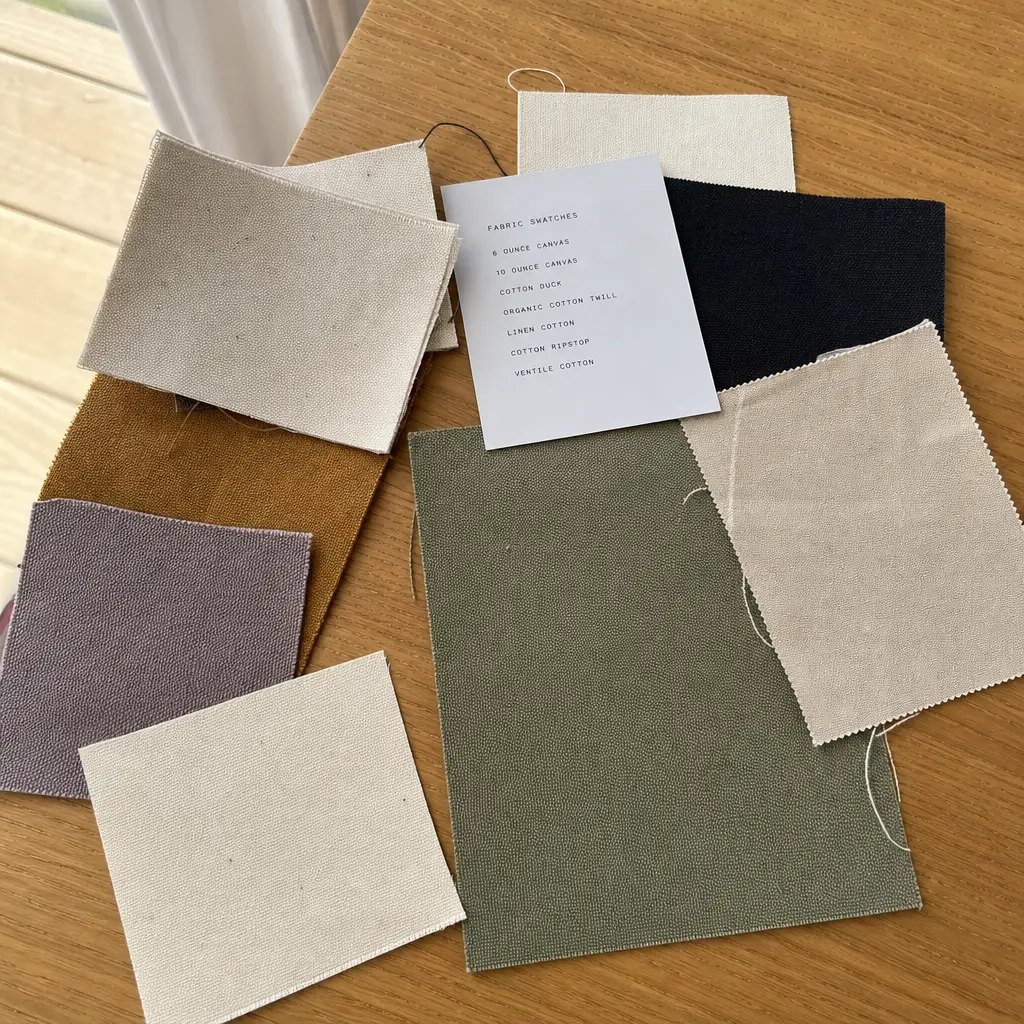
Natural shades deserve special attention. Off-white, oat, beige, olive, stone, and muted earth tones often reveal slub concentration, nep visibility, or minor panel mismatch more than dark shades do. Some natural irregularity may be acceptable and even expected, but the acceptable limit should be tied to the approved sample. Otherwise inspectors are forced to make subjective calls at final inspection.
Hand feel is another point that tends to be under-discussed. A softer shell may be fine for a one-time event packet. A portfolio meant for repeated internal use usually needs a little more body so the front panel sits cleaner and documents are easier to insert. This is why swatch approval alone is not enough. The fabric should be judged in a production-intent sample with the zipper and print already applied.
- Practical B2B baseline: 340 to 400 GSM finished cotton canvas
- Below about 300 GSM often means more wrinkling, less structure, and higher zipper waviness risk
- Much above about 450 GSM can add body but also increases corner bulk, sewing difficulty, and freight weight
- If sustainability claims apply, define whether they cover the shell only or the full bill of materials
- Approve natural-fabric appearance limits for slub, nep, seed-speck visibility, and panel shade variation
Zipper construction: the small component most likely to generate claims
On a canvas portfolio, the zipper is touched every time the product is used. That alone makes it one of the highest-risk components. For many document portfolios, nylon coil #5 is a sound baseline because it usually handles corner travel better than lighter constructions while still keeping the product relatively slim and practical.
But calling for a zipper is not enough. Buyers should ask exactly what is being quoted: chain size, tape color, slider type, puller finish, stopper construction, and whether the slider is standard auto-lock or another setup. A sample can look neat when zipped closed on a table, yet still fail after repeated use if stops are weak or the tape is inserted under tension.
Corner performance is especially important in this category. A portfolio often has eased corners or a rounded top path where the zipper turns. If seam allowance is inconsistent or the material stack is too thick from binding, lining, and pockets, the slider may drag at exactly those points. Users then pull harder, and that extra force can lead to stop failure or coil distortion.
A good review process treats zipper performance as functional, not decorative. During sample approval and inline checks, units should be opened and closed repeatedly. The buyer or inspector should watch for drag, tape ripple, top-edge waviness, misalignment, and resistance near corners. If the face panel puckers when the zipper is installed, the problem is usually structural, not cosmetic.
For RFQ language, specificity helps everyone. Instead of asking for a strong zipper, ask for '#5 nylon coil, matched tape, standard auto-lock slider, secure top and bottom stops, and smooth operation through full opening path.' That can be quoted, sampled, and inspected with much less ambiguity.
- Commercial default for many portfolios: nylon coil #5
- Confirm tape color, slider style, puller finish, and stop construction in writing
- Check zipper travel through corners, not just along straight sections
- Watch for layer buildup where binding, pockets, and zipper seams intersect
- Review repeated open-close cycles during both sample approval and inline QC
Inside construction: where quote gaps often hide
The exterior may be the first thing a buyer sees, but interior construction is where many low quotations quietly cut cost. One supplier may quote a basic shell with raw inside seams. Another may include seam binding, a cleaner pocket finish, and reinforcement at stress points. If the RFQ does not spell that out, the prices will not be truly comparable.
For many natural grocer programs, bound inside seams are a practical middle ground. They improve appearance, reduce fraying, and keep loose fibers away from inserted documents without always requiring a full lining. A fully lined interior can still make sense when the layout is more structured or when the buyer wants a more polished finish, but it adds material, labor, and more seam bulk near the zipper path.
The interior layout should be described feature by feature. A plain shell, one document pocket, two slip pockets, a card-slot panel, a pen loop, a notepad sleeve, or an elastic holder all require different sewing steps. Those differences affect cost, lead time, and defect risk. They also influence how much room is left for the actual documents once the portfolio is assembled.
Reinforcement details matter more than they seem. If the design includes a pen loop, holder, or stitched attachment point, specify whether a bartack or reinforced back-tack is expected. If a pocket edge is frequently handled, define whether the top edge should be folded, bound, or left as a turned seam. Small construction choices have a direct impact on service life and visual neatness.
For quality control, the principle is simple: the interior should match the approved sample exactly where finish type is concerned. A factory should not swap bound seams for raw seams or remove an organizer feature because the exterior still looks similar. Those are not cosmetic changes. They alter utility and perceived quality.
- Bound seams are often the most balanced option for B2B canvas document portfolios
- Full lining works when a more refined presentation or a more complex inside layout is required
- Each pocket, slot, sleeve, or loop should be listed separately in the RFQ and quotation
- Stress points may need bartack or reinforced back-tack depending on intended use
- Interior finishing should be checked against the approved sample, not just against artwork or photos
Logo application, print placement, and what 'clean branding' really means
Branding on natural grocer portfolios is often restrained, but subtle artwork still needs process control. In many cases, a simple one-color or two-color screen print is the most practical method because it is repeatable, cost-effective at volume, and well suited to canvas texture. The key point is to choose the method intentionally rather than leaving it to supplier assumption.
Print method should always be reviewed together with panel layout. Artwork placed too near a seam, zipper edge, fold area, or corner can distort even when the file is correct. On natural canvas, a small degree of texture show-through is normal because the weave remains visible. What should not pass are smeared edges, major pinholes, ghosting, poor cure, obvious off-shade color, or placement drift beyond the approved tolerance.
Heat transfer can still make commercial sense for detailed logos, smaller runs, or artwork that is not efficient for screen setup. However, it creates a different feel. Transfers can stiffen the panel surface and become more vulnerable in areas that bend repeatedly. If transfer is used, the print zone should be chosen carefully and kept away from heavy fold stress where possible.
Placement language should be measurable. 'Centered logo' sounds clear until the first production lot arrives slightly high, slightly left, or too close to the zipper. It is better to define artwork size and location by millimeter distance from the panel edge, seam line, or centerline. That gives factories a repeatable setup target and gives inspectors a usable standard.
Color expectations also need to be realistic. If Pantone matching is required, state it and approve against the relevant standard. If the desired look is more organic and exact Pantone alignment is less critical, say that too. The goal is not to over-spec a simple logo. It is to remove preventable ambiguity.
- Screen print is usually the first-choice method for simple repeat logos on canvas
- Heat transfer can be suitable for detailed or lower-volume artwork but may stiffen the panel
- Define logo size and placement in mm from seam, edge, or panel centerline
- State whether Pantone matching is mandatory or approximate brand-color alignment is acceptable
- Check cure quality and rub resistance during sample approval, not only after bulk production
Sampling protocol: what a PP sample should confirm before you approve bulk
A development sample is useful for discussing shape, but it should not be the final commercial approval point if it uses substitute fabric, temporary zipper, or unfinished print work. For this product, the pre-production sample should be as close to the bulk build as possible: final fabric quality, final zipper type, final branding method, final interior finish, and intended packing route.
The sample should be handled as a working item, not just displayed. Insert the actual documents the program will use. Open and close the zipper repeatedly. Check whether the opening is practical, whether the shell holds shape well enough, whether the front panel stays presentable when filled, and whether the inside finish sheds lint or catches on paper edges.
This stage often reveals issues that swatches and flat photos miss. A canvas that looked acceptable by itself may feel too limp once stitched into the final pattern. A zipper path that seemed neat in one photo may drag at the corners during repeated cycles. A pocket that looked correctly proportioned on screen may turn out to be too narrow for standard forms.
Procurement teams should document what they approve. Record measurements, shade reference, logo placement, zipper specification, interior layout, and packing notes. Clear approval photos taken beside a ruler or measurement board can prevent avoidable disputes during final inspection. Without that record, teams may end up comparing production to memory rather than to a real standard.
It also helps to retain one approved sample as the shipment reference sample. That sounds basic, but it is one of the easiest ways to avoid confusion between an early concept sample, a revised sample, and the actual PP sample signed off for production.
- PP sample should use production-intent materials, trims, print, and finishing
- Test the sample with real inserts rather than evaluating it empty only
- Cycle the zipper repeatedly and pay attention to corner travel and tape shape
- Record approved dimensions and logo position with photos and measurements
- Keep one sealed reference sample for later comparison during final inspection
How to compare supplier quotations without being misled by a low unit price
A zipper portfolio involves more labor and process sensitivity than a plain canvas tote. Zipper insertion, panel alignment, corner handling, print setup, internal finishing, and careful packing all affect cost. Because of that, a very low quote often means that something in the build has been reduced, omitted, or interpreted differently.
The usual differences are not always obvious at first glance. One quote may assume lighter canvas. Another may be based on smaller dimensions, raw inside seams, a lower zipper grade, or minimal packing. Print assumptions vary too. One supplier may include a one-color screen print at a fixed size, while another assumes a smaller print area or a different method entirely.
To make comparisons useful, ask suppliers to confirm key build elements in practical terms: shell fabric, finished dimensions, zipper type, inside finish, logo method, and packing assumptions. A full internal cost sheet is not necessary, but enough detail should be visible to confirm that all factories are pricing the same product standard.
MOQ should be discussed separately from product construction. A manageable MOQ is often possible with stock fabric shades and stock zipper tape. Once custom-dyed colors or tightly matched trims are required, the MOQ and lead time picture changes. It can be helpful to ask for two paths: a standard-material route and a full-custom route. That shows the cost of customization clearly instead of hiding it inside one blended quote.
Packing assumptions are another common blind spot. One supplier may include individual protection, flat orientation, and a sensible carton weight. Another may include only basic export packing. That difference may look minor on paper, but it can directly affect scuffing, creasing, receiving issues, and rework at the destination. In many cases, the most transparent quote is the safest quote, even if it is not the cheapest opening number.
- Ask what is included and excluded rather than comparing total unit price alone
- Check whether dimensions, zipper spec, inside finish, and logo assumptions are aligned across quotes
- Request separate quote paths for standard-material and full-custom options when relevant
- Review packing details as part of landed-risk evaluation, not as a side topic
- Treat major unexplained price gaps as a specification issue before treating them as a negotiation success
Build the quality inspection checklist before production, not after
A useful quality inspection checklist starts before sewing begins. It should connect directly to the approved sample, the RFQ, and the purchase order. Generic comments such as good quality, nice finish, or as per sample are too loose for a B2B buying program, especially when repeat orders may follow.
At minimum, the checklist should cover dimensions, fabric consistency, zipper function, print position, stitching, inside finishing, cleanliness, and packing compliance. Outer size should be measured in millimeters. If the product includes pockets, sleeves, or insert openings, those should also be checked because function can fail even when the exterior dimensions appear correct.
Fabric inspection needs both visual and physical review. Inspectors should look for major panel mismatch, contamination, and obvious inconsistency in body across sampled units. On natural canvas, the acceptance standard should refer back to the approved sample so that normal texture variation is not confused with uncontrolled quality drift.
Zipper inspection should involve repeated operation tests, not a single open-close demonstration. Watch for resistance, ripple, twisted tape, weak stop setting, and corner binding. If the zipper installation causes face-panel waviness, it should be flagged because users will see it immediately in the field.
Print inspection should verify artwork size, location, edge clarity, and rub resistance against the approved sample. Interior checks should confirm that seam binding, lining, organizer features, and raw-edge coverage match what was approved. Cleanliness is equally important. Oil marks, mildew odor, rust transfer, dampness, or visible dirt can make an otherwise usable lot commercially unacceptable.
Inline control is often what prevents shipment-stage surprises. A first-run or inline review can catch repeated mistakes such as logo drift, zipper puckering, or seam inconsistency while correction is still practical. Waiting until final random inspection increases the odds of broad rework and shipping pressure.
- Prepare the QC checklist from the PP sample, PO, and approved spec sheet
- Measure functional points such as pocket openings and insert sleeves, not just shell size
- Run repeated zipper checks on sampled units and note corner behavior
- Inspect interior finishing closely for raw-edge exposure or feature omissions
- Include cleanliness, odor, and packing condition in final acceptance criteria
Packing, shipment readiness, and the lead-time questions buyers should ask
Packing is not just a warehouse topic for this product. Canvas can crease, printed surfaces can scuff, corners can deform, and zipper lines can be stressed if units are packed loosely. For that reason, packing should be approved before bulk output is completed, ideally during the sampling or pre-production stage.
The right packing route depends on buyer policy and intended use. Some programs avoid individual polybags for sustainability reasons. Others require them for cleanliness because the portfolios will be redistributed to stores, vendors, or event sites. Either route can work if the carton plan still protects the product from dust, moisture, rubbing, and shape distortion.
Carton details should be written clearly. Specify quantity per carton, maximum carton weight, unit orientation, any interleaving requirement, and carton marks or barcode labels. If a dark logo sits on light canvas, face-to-face rubbing deserves special attention. A simple interleaf or controlled alternating orientation can reduce avoidable scuff claims.
Lead time should also be broken down into milestones instead of treated as one vague promise. For a canvas zipper portfolio, delays often begin before sewing starts: artwork approval, material booking, zipper sourcing, PP sample revision, or packing confirmation. If those points are still open, a quoted production lead time may not reflect real readiness.
Procurement teams can get a clearer picture by asking direct operational questions. Which material has the longest lead? When is the order considered fully approved for bulk? What defects trigger mandatory rework before packing? At what stage will the factory run inline checks? These questions do more than clarify timing. They show whether the supplier is planning the order with enough control.
For natural grocer programs tied to openings, training cycles, or vendor events, timing often matters as much as price. A portfolio delivered after the program date may have little practical value. Milestone-based follow-up is one of the simplest ways to protect that schedule.
- Define whether individual polybagging is required, optional, or prohibited
- Set carton quantity and maximum weight based on warehouse handling needs
- Use flat or controlled orientation packing to protect shape and zipper line
- If scuff risk exists, specify interleaf or alternating face direction
- Ask for milestone-based lead time tied to approvals, production, inspection, and booking date
Specification comparison for buyers
| Spec decision | Recommended option | When it fits | Buyer risk to check |
|---|---|---|---|
| Canvas weight | 12 oz to 14 oz canvas, approximately 340 to 400 GSM finished weight | Best for natural grocer portfolios that need enough body for brochures, forms, welcome packets, vendor documents, and repeat office handling | Below about 300 GSM the face may wrinkle more, zipper waviness is easier to see, and the item may feel underbuilt for B2B presentation use |
| Cotton type | 100% cotton canvas, or declared certified shell fabric only when the program requires documentation | Works for most wholesale programs where consistent hand feel, lot stability, and replenishment repeatability matter more than broad sustainability wording | If organic or recycled content is requested, confirm whether the claim applies only to shell fabric or also to zipper tape, labels, thread, binding, and any lining |
| Zipper grade | Nylon coil #5 with color-matched tape, standard auto-lock slider, and secure top and bottom stops | Good balance for light to moderate document load, smoother corner travel, and lower field-failure risk than very light zipper constructions | Weak sliders, poorly set stops, tape distortion, or excessive corner bulk can create failures not obvious in a tabletop photo sample |
| Inner construction | Bound inside seams, or partial/full lining only where the layout requires extra coverage or structure | Useful when portfolios will be reused by store staff, category teams, suppliers, field reps, or event coordinators | Raw seams can fray, shed fibers onto inserts, and reduce perceived quality during vendor meetings or store-level use |
| Print method | Screen print for solid or simple logos; heat transfer only when artwork detail or lower quantity makes it necessary | Screen print suits most natural grocer branding where artwork is understated, repeatable, and usually one or two colors | Heat transfer can stiffen fold zones or crack with repeated bending; screen print still needs Pantone sign-off, cure control, and placement tolerance |
| Closure and puller | Standard zipper puller in metal or coated metal, with optional fabric extension only if easier grip is required | Helps store teams open portfolios quickly without adding bulky decoration or excess packing thickness | Oversized decorative pulls can snag, increase unit cost, create uneven carton thickness, and add inconsistency across runs |
| MOQ route | Standard size, stock canvas color, stock zipper tape, one-color logo | Best route for launch programs that need manageable MOQ, simpler approvals, and cleaner supplier comparison | Low-MOQ custom dyeing or trim matching may create shade variation risk, longer lead times, and surcharge-heavy costing |
| Packing format | Optional individual polybag per buyer policy, then export carton with controlled flat packing and carton weight limit | Suitable when portfolios must stay clean, flat, and presentable through import warehousing and redistribution | Loose packing can crease panels, deform corners, distort zipper shape, or scuff printed fronts in transit |
| Inspection stage | PP sample approval, first-run inline check, and final random inspection against approved sample and PO specs | Best for preventing repeated defects across the run instead of discovering them only at shipment stage | Final-only inspection catches problems too late, when rework may affect booking dates, carton marks, or launch timing |
Buyer checklist before sampling
- Define finished size both closed and open in millimeters, plus tolerance by dimension, because size affects zipper length, document fit, panel yield, and carton efficiency.
- State target canvas weight as finished GSM or finished oz per square yard, and define tolerance clearly, for example by lab average, roll average, or lot average.
- Clarify fabric composition in writing, such as 100% cotton shell, and state whether any sustainability requirement applies to shell only or to the full bill of materials.
- Specify desired hand feel and structure: soft foldable, medium body, or firmer feel with interlining support if the portfolio must present papers flat.
- Name zipper type, chain size, tape color, slider style, stopper requirement, and the minimum smooth-opening expectation after repeated open-close testing.
- Define exact internal layout: plain shell, single document pocket, double pocket, pen loop, card slots, notepad sleeve, elastic holder, or no organizer features.
- Document print method, Pantone references where relevant, artwork size, print location from seams or panel centerline, and acceptable placement tolerance in millimeters.
- Approve a pre-production sample made with final fabric, final zipper, final print method, final seam finish, and intended packing method rather than substitute materials.
- Set workmanship criteria for panel skew, seam puckering, stitch density, exposed raw edges, loose thread ends, zipper bite defects, print smudging, and contamination.
- Clarify packing method, unit orientation, carton quantity, carton weight limit, barcode and carton mark requirements, and whether interleaving is needed for printed faces.
Factory quote questions to send
- What exact shell fabric composition and finished fabric weight are included in the quote, and how is that weight measured after finishing?
- What finished size is quoted, measured closed and open, and what dimension tolerance can you hold consistently in production?
- Is the zipper nylon coil, molded plastic, or metal, and what exact chain size, tape quality, slider type, puller, and stop construction are included?
- Does the quote include seam binding, lining, interlining, pockets, pen loops, card slots, or only a basic empty-shell portfolio?
- What print method is priced, how many colors, what print size or area assumption is used, and what placement tolerance can you control in production?
- What is the MOQ for a standard build with stock canvas and stock zipper tape, and what changes if custom-dyed fabric or custom trim colors are required?
- How many sample rounds are included, what sample charges apply separately, and will the PP sample use actual bulk fabric and trims?
- What are the packing assumptions in the quoted price: individual polybag, tissue or interleaf, silica gel if any, carton quantity, master carton size, and carton weight?
- What internal QC checks do you run for this style, and which defects trigger mandatory rework before final packing?
- What is the quoted lead time counted from: deposit date, artwork approval, PP sample approval, receipt of final trim confirmation, or all approvals complete?
Quality-control points to confirm
- Canvas weight should match the approved finished specification within the agreed tolerance, and random units from the same lot should not show major body inconsistency.
- Fabric shade should be consistent across front, back, pockets, binding, and zipper-adjacent areas under the agreed light source, with any natural slub variation kept within approved standard.
- Finished dimensions must meet approved tolerance, especially closed width, closed height, open width, zipper opening length, corner squareness, and pocket opening width.
- Zipper must open and close smoothly without coil damage, tape twisting, slider resistance, stop failure, corner binding, or misaligned installation that causes face-panel waviness.
- Print position must follow approved placement tolerance, with clean edges, no obvious ghosting, no major pinholes, no smear, and no visible rub-off after proper curing.
- Seams should show even stitch density, no skipped stitches, no unraveling thread tails, secure back-tacking or bartack where specified, and no severe puckering that distorts the face.
- Any pull tab, pen loop, inside attachment point, or stress-area seam should withstand appropriate light pull testing for the intended document load and daily office handling.
- Inside binding or lining must be neat, secure, and consistent with the approved sample, with no exposed raw edges where a finished edge was specified.
- Units must be free from oil marks, mildew odor, damp packing, rust transfer, excessive wrinkles, insect contamination, and visible dirt that would affect presentation use.
- Carton count, assortment, carton marks, unit orientation, barcode labels, and PO references must match shipping instructions exactly to avoid receiving disputes or relabeling costs.