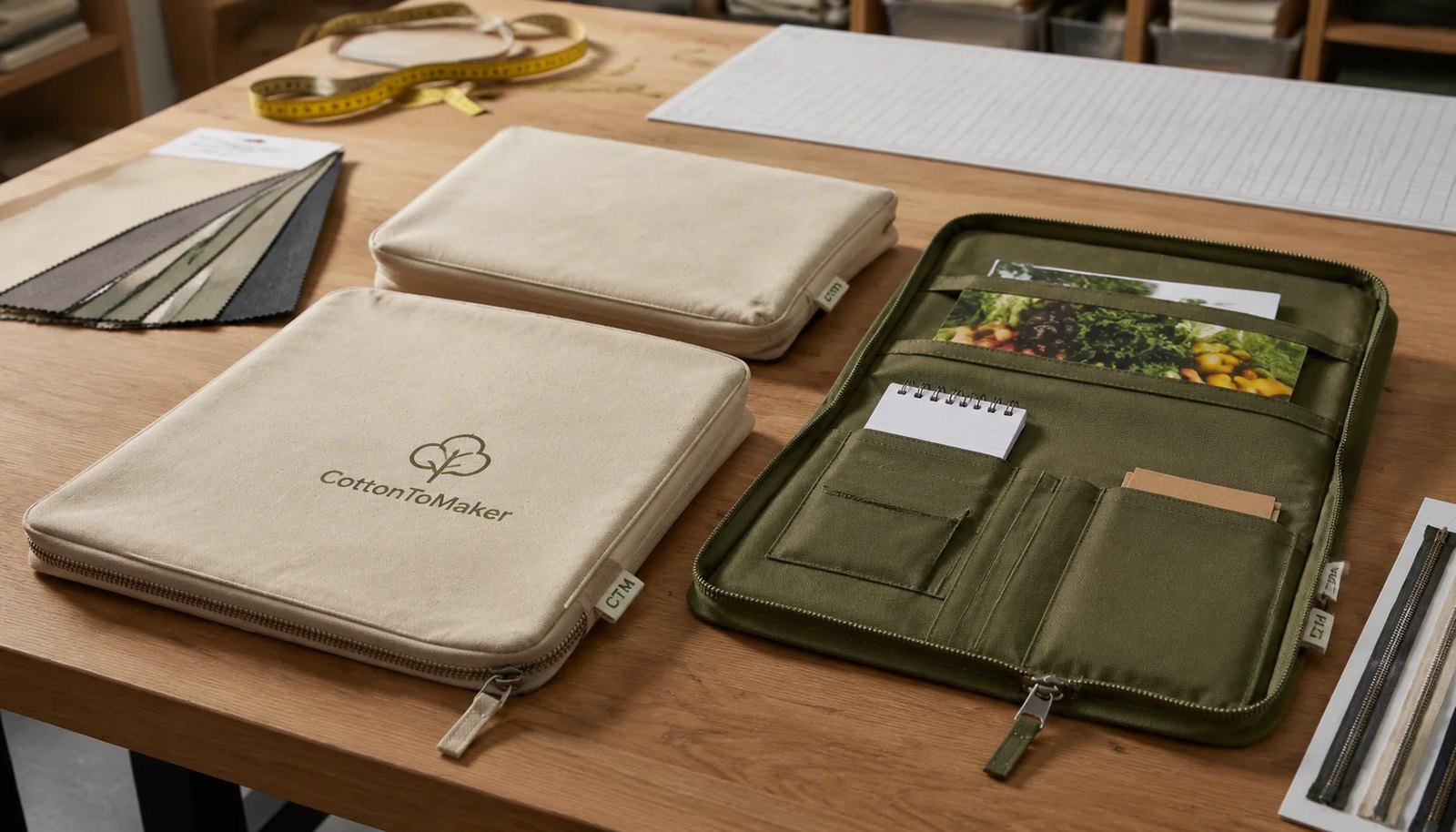
Why material selection is the main cost and complaint driver on canvas zipper portfolios
For natural grocer programs, the usual buying problem is not finding a factory that can sew a zipper portfolio. It is getting the portfolio to feel sturdy and brand-right without paying for unnecessary weight, lining, or hardware that adds little retail value. Many buyer complaints come later from issues that were set at the material stage: soft body that collapses on shelf, zipper waves caused by unstable canvas, print that looks dull on raw fabric, or cartons that cube out because the style was overbuilt.
Canvas zipper portfolios sit in an awkward middle zone between a soft pouch and a structured business bag. If the canvas is too light, the front panel buckles and the zipper line twists. If it is too heavy, the bag becomes bulky, expensive to print, and slower to turn at the corners. The best sourcing outcome usually comes from locking the use case first: document organizer, onboarding folder, in-store training kit, seasonal vendor packet, or member sign-up holder. That use case determines how much structure is actually needed.
- Main complaint sources: curling panels, zipper snagging at corners, logo inconsistency on natural canvas, fraying interior seams, and carton over-weight
- Main cost levers: canvas GSM, lining material, interior organization complexity, zipper quality, logo method, and packing density
- Most common over-spec mistake: choosing heavy canvas plus full cotton lining for a simple brochure holder
Choose canvas weight by function, not by habit
For most wholesale canvas zipper portfolios, 12 oz to 14 oz canvas, roughly 340 to 400 GSM, is the practical range. This gives enough body for a clean rectangular shape while keeping the product flat-packable. For a portfolio carrying paper documents, forms, and a thin notebook, 12 oz is usually enough if the internal seams are bound and the zipper area is reinforced. If the portfolio also carries sample cards, a small tablet, or multiple stitched compartments, moving up toward 14 oz can reduce panel distortion.
Buyers often default to heavier fabric because heavier sounds safer. In practice, very heavy canvas can create new problems. It can fight the zipper curve, increase seam bulk at corners, and make screen print registration less crisp on uneven texture. It also increases cutting waste and freight. If the product is not intended to stand upright on its own, a slightly lighter body with strategic internal reinforcement is often the better commercial decision.
- 10 oz to 11 oz, about 285 to 315 GSM: workable for simple soft portfolios, but risk of floppy shape is higher
- 12 oz to 13 oz, about 340 to 370 GSM: common wholesale sweet spot for natural grocer brand programs
- 14 oz to 16 oz, about 400 to 455 GSM: use only when a structured feel or heavier contents justify extra cost
- Request both GSM and oz references on the quote to avoid conversion misunderstandings between mills and factories
Outer fabric, lining, and reinforcement combinations that actually make sense
The outer canvas gets most buyer attention, but the inside build determines how usable the portfolio feels. An unlined portfolio can work for low-cost document sleeves, but the inside seam allowance is exposed and fray risk rises. Once interior pockets or card holders are added, lining becomes more than a cosmetic upgrade. A 210D polyester lining is usually the most efficient option for import programs because it is thin, stable, and easier to keep clean. A cotton lining can support a stronger natural materials story, but it raises cost and seam bulk.
Reinforcement should be selective. You generally do not need board inserts or foam unless the portfolio is meant to behave like a rigid case. More often, a cleaner solution is a second canvas layer behind the front panel, a narrow reinforcement tape near the zipper ends, and proper binding on interior seams. This approach supports shape and durability without making the item difficult to fold, pack, and ship.
- Budget build: 12 oz cotton canvas outer, unlined, bound seams, one front print area
- Mid-range retail build: 12 oz to 14 oz outer, 210D lining, one or two interior slip pockets, pen loop, size 5 nylon zipper
- Premium natural build: 14 oz outer, 8 oz cotton lining, woven label, custom zipper pull, more hand work and longer sewing time
- Avoid paperboard inserts if the shipment may face humidity swings; warping and edge telegraphing can occur
Zipper selection matters more than most RFQs show
For portfolios, the zipper is not just a closure; it controls perceived quality every time the buyer or end user opens the product. Nylon coil zippers in size 5 are the most forgiving choice for this category. They travel more smoothly around corners than molded plastic tooth zippers and usually deliver lower rejection rates in production. A metal zipper may look more premium, but on canvas portfolios it often adds unnecessary weight and can scratch nearby contents if the puller is oversized.
The weak point is usually not the zipper chain itself but the zipper-end construction. If the tape is sewn into thick corner build-up without proper clipping and reinforcement, the portfolio puckers and becomes hard to close. This is where factory workmanship varies sharply. A portfolio quote that looks low on paper can become expensive if 3% to 5% of finished goods snag at inspection.
- Recommended baseline: size 5 nylon coil zipper, dyed-to-match tape, metal puller or canvas pull tab
- Request zipper color card confirmation against approved canvas color, especially for olive, kraft, and black programs
- Require testing examples such as repeated open-close cycles and corner-turn function on the pre-production sample
- Review zipper stop stitching and tape trimming under close photos, not only front-view product photos
Print method on natural canvas: what holds up and what creates disputes
Natural grocer branding often uses understated one-color logos, ingredient-theme graphics, or earthy palette artwork. That generally makes screen printing the best bulk option for canvas zipper portfolios. It is cost-efficient once volume is high enough, and the imprint holds well if the ink is properly cured. On natural unbleached canvas, however, the base fabric tone affects final color. A dark green or warm brown logo may shift visually between fabric lots if the natural base tone varies.
For smaller mixed-SKU programs, a woven side label can outperform print in cost control because it avoids repeated screen setup and color approvals across many low-volume variants. Heat transfer can work for detailed graphics, but on textured heavy canvas it may not bond as uniformly and can look too glossy for a natural grocery aesthetic. The safest route is to approve the logo on actual production fabric, not on a smooth substitute swatch.
- Screen print fits larger runs and simple logos; lower unit cost after setup is spread across quantity
- Woven label fits small runs, private label distributor programs, and multi-design assortments
- Water-based inks can look softer and brand-appropriate, but require reliable curing and rub testing
- Approve strike-offs on the same canvas weight and shade planned for bulk production
MOQ logic and quote structure: how to keep flexibility without paying for chaos
The cleanest MOQ structure for this category is one style, shared material platform, and controlled variation. For example, one portfolio size, one outer canvas, one zipper size, and one lining, while allowing several print artworks or colorways. That keeps cutting and sewing standardized. Once each variant starts changing zipper pullers, inner pockets, or lining colors, the order may look like one SKU family to the buyer but behaves like several separate mini-runs in the factory. Setup loss and material leftovers increase, and so does the quoted price.
A good quote should separate one-time and recurring costs. Buyers should be able to identify sampling cost, screen or label setup, unit cost, export carton cost if charged, and any surcharge for low colorway quantity. This matters when comparing suppliers. One supplier may show a lower unit price but hide setup charges in the sample stage or charge more for split packaging and carton marks later.
- Useful RFQ format: quantity by total style, then breakdown by colorway and logo version
- State whether all SKUs can share one main fabric roll plan and one zipper inventory
- Ask for price breaks at realistic tiers, such as 500, 1,000, 3,000, and 5,000 pieces
- If testing a new item, compare cost of one universal body with changeable printed inserts instead of multiple sewn internal layouts
Sample approval should follow a sequence, not a single yes-or-no decision
Many delays happen because buyers try to approve everything at once on one pre-production sample. That is too late to resolve material-level issues economically. A better route is staged approval. First approve the fabric swatch for color tone, weight, and hand feel. Then approve the print strike-off on actual canvas. Next review the full pre-production sample for size, shape, zipper movement, and internal layout. Finally approve the packing sample so there is no surprise on fold marks, barcode placement, or carton count.
This sequence matters especially for natural canvas because visual outcomes are less uniform than on synthetic materials. A logo that looked fine in artwork may sink into a rougher weave. A lining that seemed acceptable on paper may make the product too slippery or too bulky. Treat each sample stage as reducing one type of risk: appearance, construction, function, and logistics.
- Swatch approval should cover shade range, GSM target, weave appearance, and lint level
- Print strike-off should cover final color appearance, position, curing, and edge sharpness
- Pre-production sample should cover dimensions, pocket usability, zipper running, and workmanship
- Packing sample should cover fold direction, polybag requirement, carton count, shipping marks, and barcode placement
Packing and carton planning can change landed cost more than a small unit-price reduction
Canvas zipper portfolios are usually flat enough to ship efficiently, but interior construction and heavy fabric can make them spring open and consume carton volume. If your supplier packs each piece with thick paper stuffing or retail inserts that are not required, freight cost rises quickly. On the other hand, if goods are packed too tightly without enough protection, zipper pullers can mark neighboring units and folded panels can crease where the buyer did not intend.
For most import programs, the practical solution is flat packing with the portfolio closed, zipper partly open or fully closed depending the shape retention, one unit per polybag only when cleanliness matters, then master cartons sized to avoid crushing. Carton gross weight should stay manageable for warehouse handling. If the product is going into retail-ready distribution, inner pack counts should match store allocation logic rather than only factory efficiency.
- Request master carton dimensions and gross weight before placing the PO so freight planning is realistic
- Use desiccant if shipping in humid routes and the portfolio includes natural canvas plus metal pullers
- Avoid excessive hangtags or card inserts unless required by the sales channel
- If sending to multiple DCs, specify carton marking format early to avoid relabeling cost after production
QC thresholds that catch the real failures before shipment
For this product, quality control should focus on functional defects first, cosmetic defects second. A tiny natural slub in canvas may be acceptable in a natural-material retail program, but a zipper that catches at the corner is not. The inspection plan should reflect this. Buyers often write broad quality language without measurable thresholds, which leaves room for debate. It is better to define what is acceptable on natural canvas and what is not: for example, slight shade variation within approved swatch range may pass, while oil marks on the front panel, visible skipped stitches, and print misplacement beyond stated tolerance fail.
Dimensional consistency is also important because portfolios are frequently packed into store display bins, mailers, or training kits. Internal pockets that run small can make documents jam; oversized pockets can sag and distort the front panel. If several factories are quoting, compare not just whether they can make the sample, but whether they can maintain seam alignment and zipper smoothness over full production quantity.
- Typical critical fails: broken zipper, sharp hardware edge, mold, wrong logo, wrong carton count by SKU
- Typical major fails: severe print offset, visible stain on front panel, open seam, wrong dimensions beyond tolerance
- Typical minor fails: slight slub or weave variation within approved standard, light removable thread ends, small hidden shade difference inside seam area
- Use an AQL level suitable for your program and define visual inspection distance for appearance review
Lead time and schedule risk: where the delays usually happen
Canvas portfolios are not the most complex sewn item, but they can still miss schedule for predictable reasons. The first risk point is material approval, especially when buyers want exact natural cotton tone with low variation. The second is logo sign-off on actual fabric. The third is custom hardware or custom zipper pullers, which often have a different lead time from the sewing line. A quote that lists one total lead time without splitting these components is not giving the buyer enough planning control.
From a procurement standpoint, the safest timeline separates development, bulk material booking, sewing, and packing. If the product launch is tied to a seasonal natural grocer campaign, build buffer into the approval calendar rather than only into ocean transit. Once sewing starts, changing print tone, lining color, or interior layout can create dead stock and re-cutting delays that are much more expensive than waiting three extra days at the sample stage.
- Typical sample lead time example: around 5 to 10 working days after artwork and material confirmation
- Typical bulk lead time example: around 30 to 45 days after approval and deposit, depending on quantity and trim readiness
- Peak season risk points: canvas mill replenishment, print queue, and custom puller supply
- If the launch is fixed-date, consider standard hardware and standard lining colors to reduce schedule exposure
Specification comparison for buyers
| Spec decision | Recommended option | When it fits | Buyer risk to check |
|---|---|---|---|
| Outer canvas weight | 12 oz to 14 oz canvas, about 340 to 400 GSM | Best balance for natural grocer portfolio use where the bag must feel structured but still fold and ship efficiently | Light canvas under about 10 oz can wrinkle, distort near the zipper, and show print-through from inner seams |
| Cotton content and yarn quality | 100% cotton canvas with even yarn and low nep count | Suitable when the brand wants a clean natural retail look and more predictable print results on unbleached fabric | Irregular yarn causes specking, weak spots, and uneven screen print edges; request fabric photos and fabric lot consistency |
| Lining choice | 210D recycled polyester or 8 oz cotton lining depending brand position | Poly lining fits budget and easier wipe-clean use; cotton lining fits premium eco presentation | Unlined portfolios may collapse and expose seam allowance; lined units need seam-turning and pocket stitching checked |
| Zipper type | Nylon coil zipper size 5 with metal puller | Most practical for document portfolios because it runs smoother around corners and lowers rejection versus molded tooth zippers | Cheap zipper tape can shrink after printing or pressing; require zipper cycle test and corner run smoothness |
| Closure and edge construction | Bound interior seams plus reinforced zipper ends | Recommended when portfolios will hold catalogs, forms, tablets, or sample cards and need repeated opening | Raw seams fray on natural canvas; weak zipper stop area often fails first during drop and overfill use |
| Logo application | 1-color or 2-color screen print on outer panel; woven label for small runs with multiple SKUs | Screen print fits larger runs and bold natural grocery branding; woven labels reduce print setup waste across variants | Water-based ink on raw canvas can shift tone; request strike-off on actual fabric and rub test after curing |
| MOQ structure | Single style MOQ split by colorway or print with same fabric and zipper components | Useful for distributors or retail chains testing multiple store programs without overcommitting on each SKU | If each color uses different lining or zipper pull, effective MOQ rises due to extra cutting and setup waste |
| Retail packing | Individual polybag only if needed for cleanliness, then flat packed by master carton with desiccant | Works for importer warehouse receiving and keeps cartons cube-efficient | Overpacking each unit with inserts raises freight cost; underpacking causes corner abrasion and zipper impression marks |
| Sample approval route | Approve in sequence: material swatch, print strike-off, pre-production sample, then packing sample | Best for buyers trying to avoid rework from natural canvas shade variation or zipper mismatch | Skipping strike-off or packing sample often leads to logo color disputes and carton count errors after production |
Buyer checklist before sampling
- Define final portfolio size closed and open, plus whether it must hold A4 sheets, letter size sheets, catalogs, or tablets.
- State required outer fabric weight in GSM or oz canvas, and whether natural cotton shade variation is acceptable within a standard tolerance.
- Specify if the portfolio needs lining, interior pockets, pen loop, card slots, elastic holders, or document divider panels.
- Name zipper preference clearly: nylon coil or metal, size number, tape color, puller finish, and whether custom pullers are required.
- Choose branding method by SKU count and order volume: screen print, woven label, heat transfer, or embossed patch.
- Set sample approval stages before bulk: fabric swatch, print strike-off, pre-production sample, and packing sample.
- Request carton dimensions, unit count per carton, gross weight, and whether the factory can optimize for pallet or courier handling.
- Include acceptable defects and QC thresholds for seam alignment, print position, zipper function, odor, stains, and fabric holes.
- Clarify compliance needs for dyes, inks, recycled lining claim support, and packaging material restrictions for your market.
- State ship window, ex-factory target date, and whether partial shipment is allowed if one colorway is delayed.
Factory quote questions to send
- What is the quoted canvas specification in GSM, yarn count, weave, and fabric finish, and can you send the mill spec sheet or internal test data?
- Does the quoted price include lining, inner pockets, zipper puller, binding, logo application, and packing, or are any of these optional add-ons?
- What is the MOQ by style, by color, and by logo artwork, and how does the price change if the same material is split across several SKUs?
- Which print method are you quoting on natural canvas, and what print tolerance, color variance, and rub resistance can you support?
- How many sample rounds are included, what sample lead time applies after artwork approval, and are courier charges charged separately?
- What zipper brand or grade do you use for size 5 coil, and what in-house testing do you run for opening cycles and corner stress?
- How are the portfolios packed per inner and master carton, and what carton dimensions and gross weights do you expect for the quoted quantity?
- What is the standard production lead time in low season and peak season, and which materials in this quote create the highest delay risk?
- Can you provide photos of stitching at zipper ends, inside binding, and pocket attachment from recent production of similar canvas portfolios?
- What defects would your final inspection classify as critical, major, and minor for this item, and what AQL level do you normally work to?
Quality-control points to confirm
- Measure closed size, open size, pocket dimensions, and zipper opening against approved spec with a clear tolerance table.
- Verify actual outer fabric weight and hand feel against approved swatch; watch for mixed lots that change shade or stiffness.
- Run zipper open-close cycles and check corner turns, stopper security, tape waviness, and puller attachment.
- Inspect print position, color tone, curing, edge sharpness, and rub resistance on natural canvas rather than only on paper proof.
- Check seam density, skipped stitches, seam slippage at zipper ends, and reinforcement stitching on stress points.
- Review lining attachment and internal component alignment so pockets are square and documents slide in without catching seam allowance.
- Inspect for stains, oil marks, needle holes, slubs, and fabric holes, especially visible on natural unbleached canvas panels.
- Confirm packaging count, folded direction, barcode placement if used, carton marks, and carton drop integrity for long-distance shipment.