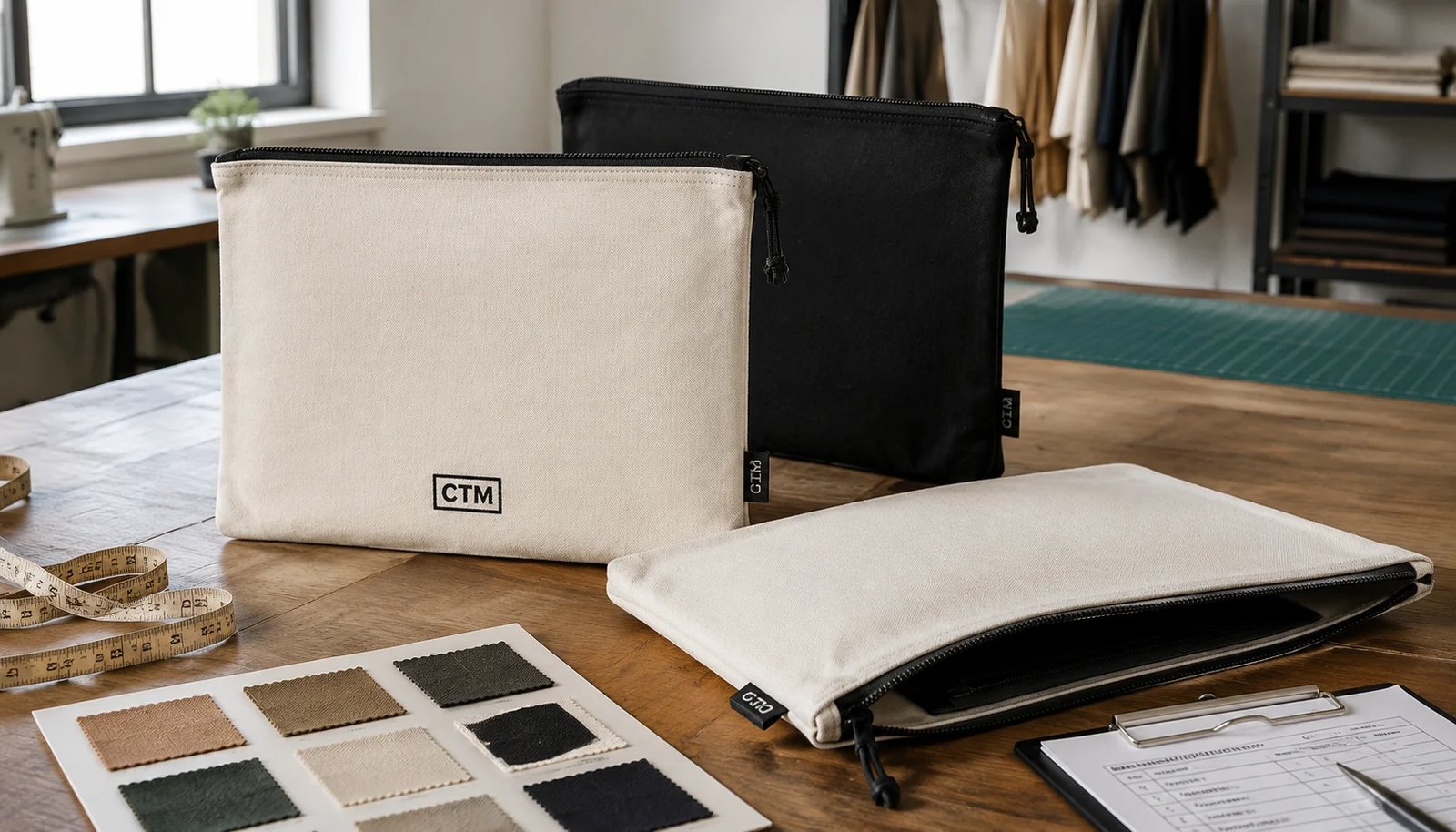
Why durability is the main buying problem for canvas zipper portfolios
Natural grocer programs often use zipper portfolios differently from gift or office channels. The item may hold staff onboarding packs, supplier presentation sheets, category review paperwork, refillable signage sets, or event materials that are opened and closed many times. A portfolio that looks fine in a photo sample can fail fast in actual use if the canvas is too soft, the zipper corners are under-reinforced, or the inside layout adds stress without enough structure.
The sourcing mistake is usually treating the product like a flat pouch. A zipper portfolio has more turning points, more edge handling, and more user friction than a simple zip bag. Durability depends on the interaction between fabric weight, zipper size, seam construction, and the fill volume inside. If a buyer only compares unit price and outside dimensions, the cheaper quote often hides a lighter fabric, a weaker zipper tape, or less reinforcement around the curved zip path.
- Most common failure points: zipper top corners, interior pocket distortion, seam opening near binding, print cracking on stiff folds
- Most common over-spec issue: using too heavy a canvas for a slim document portfolio, which raises freight and reduces zipper ease
- Buyer priority should be repeated-use performance, not just initial appearance
Choose the right canvas weight before discussing print or packaging
For most wholesale canvas zipper portfolios, 12 oz canvas, roughly 340-400 GSM depending weave and finish, is the most balanced starting point. It has enough body to feel substantial and resist corner collapse, but it still sews cleanly around zipper edges. For very slim portfolios holding only forms and a pen, 10 oz canvas around 280-340 GSM may work, but only if the pattern avoids wide unsupported panels. For portfolios designed to carry notebooks, tablets, or thicker document bundles, 14 oz canvas can be justified, though it will increase sewing difficulty and carton weight.
Fabric weight alone is not enough. A tighter weave at the same GSM can perform better than a loose, fluffy construction because it distorts less during cutting and logo printing. If the buyer wants a natural unbleached look, note that neps and minor shade variation are more visible on such fabric. That is not always a defect, but it must be aligned with the retail or brand standard before bulk production. If the portfolio will sit in backroom storage for long periods, pre-shrunk fabric is worth requesting so the finished size stays stable across humidity changes.
- Suggested baseline: 12 oz canvas for most repeat-use grocery program portfolios
- Use 10 oz only for low-fill or low-cost event packs where structure is not critical
- Use 14 oz when carrying heavier inserts, but confirm zipper corner sewing quality on sample
- Request actual measured GSM from the mill or finished fabric, not nominal marketing weight only
Zipper construction matters more than many buyers expect
On this product, zipper quality is a functional issue, not a trim detail. Nylon coil zippers are usually the safest choice because they flex more smoothly around corners than metal zippers and are less likely to distort medium-weight canvas. For slim portfolios, #5 coil is usually enough. If the item carries catalogs, notebooks, or multiple inserts that increase edge pressure, #8 gives a better safety margin. The slider and puller should match the use case: standard painted pullers are fine for volume programs, while custom metal pulls look better but can add MOQ and plating risk.
The actual weakness often appears at the zipper end corners, not in the middle run. The portfolio pattern needs enough seam allowance, secure tape insertion, and corner reinforcement so repeated opening does not split the stitching. If the factory is using binding tape internally, inspect whether the tape catches the zipper end cleanly. If the construction is turned and topstitched, inspect for skipped stitches or excessive bulk at the corner. A good pre-production sample should be opened fully and cycled repeatedly, not just viewed flat.
- Recommended zipper sizes: #5 for standard, #8 for heavier-fill portfolios
- Preferred zipper type: nylon coil for corner flexibility
- Ask whether corners use backtack, bartack, or hidden reinforcement patch
- Avoid decorative low-cost zipper options without evidence of repeat-use performance
Interior layout is a hidden cost driver and a hidden defect driver
Buyers often add pen loops, card holders, notebook sleeves, elastic retainers, mesh pockets, and tablet compartments into one portfolio. That can make the item look more valuable, but each extra feature adds labor minutes, pattern complexity, and more opportunities for misalignment. A natural grocer program usually gets better value from a cleaner layout: one full document sleeve, one smaller pocket, one pen loop, and possibly a notebook slot if there is a fixed insert size. Fewer operations usually mean more stable production quality and lower reject rates.
The practical issue is fit, not feature count. If the document pocket is too shallow, materials slide out when the portfolio is carried upright. If the notebook sleeve is too tight, the body bulges and puts strain on the zipper seam. If the interior includes lining, the pocket edge finish must stay smooth after repeated insertions. Buyers should provide insert dimensions in millimeters or inches, including thickness. A factory can then build tolerances around actual use instead of copying a generic pattern.
- Every added pocket changes labor cost and can change MOQ if materials differ
- Provide exact insert sizes for catalogs, forms, notebooks, or tablets
- Request an empty and loaded sample to compare body shape under real fill conditions
- Use minimal interior architecture unless the program needs a specific carrying function
Logo method affects durability, yield, and quote accuracy
For canvas zipper portfolios, screen printing is usually the most economical custom branding method, especially on natural cotton grounds. It works well for one- or two-color logos and larger placements. A woven label is often the better choice if the branding is subtle and premium, because it avoids ink rub issues and keeps the natural canvas surface visible. Embroidery can work, but only if the panel is heavy enough and the stitch area is not close to a zipper bend or a slim pocket edge where puckering becomes obvious.
From a durability angle, the wrong print recipe can crack or abrade where the portfolio folds. Water-based inks often feel softer, but pigment opacity on natural canvas can vary. Plastisol-style systems may give stronger coverage but can feel heavier. Buyers should not evaluate print only by Pantone similarity under ideal light. They should also review edge sharpness, strike-through on the reverse side if the fabric is unlined, and dry rub performance after folding the portfolio multiple times. This is one area where a realistic sample is more important than a polished digital proof.
- Screen print: best value for larger logos and standard bulk quantities
- Woven label: better for understated branding and fewer print variables
- Embroidery: use carefully on heavier fabric with proper backing
- Request fold and rub review on approved print sample before mass production
MOQ logic: where pricing becomes efficient and where it becomes misleading
For custom canvas zipper portfolios with custom logo, lining choice, and packaging, many factories become efficient around 1,000 to 1,500 pieces per design. That quantity helps spread sampling, screen setup, cutting, and trim sourcing over enough units to keep the quote realistic. Lower volumes are possible, but buyers should expect compromises such as stock zipper colors, fewer body colors, or higher unit cost due to mixed-line scheduling. A very low quote at a low MOQ often assumes stock materials that may not match the approved sample exactly.
MOQ should also be viewed per colorway and per packaging style, not only per total order. If one colorway is only 200 units and another is 1,300 units, the smaller color can carry more waste and setup cost. The same applies if half the order needs retail belly bands and half uses plain polybags. Procurement teams comparing suppliers should ask how MOQ changes when adding custom woven labels, embossed pullers, hangtags, or inner inserts. Those small details often create hidden re-quoting after the first sample round.
- Efficient custom production often starts at 1,000-1,500 pcs per design
- Confirm MOQ by colorway, logo version, and packaging variation
- Low MOQ quotes may rely on stock trims or shared production slots
- Ask which custom details trigger revised MOQ or setup charges
Sample approval should simulate real use, not just visual sign-off
Many buying teams approve samples based on logo placement and overall look, then discover production issues only after the shipment lands. A stronger sample process separates visual approval from performance approval. Start with a blank construction sample if the pattern is new. That lets the team review dimensions, fill capacity, zipper path, pocket usability, and handfeel without waiting for print setup. After those points are fixed, move to a branded pre-production sample made with bulk-intent materials.
For durability-focused approval, the sample should be loaded with the exact paper pack, notebook, or device it is expected to carry. Open and close it repeatedly, hold it by the edge, place it on a shelf upright, and inspect whether the side profile twists or the zipper corners strain. If the buyer wants a natural grocer look with low-plastic presentation, also review whether the portfolio stays clean enough during handling, because natural canvas can pick up marks more easily than dyed synthetics.
- Use at least two stages: blank fit sample and branded pre-production sample
- Load sample with real inserts before approval
- Review zipper travel over repeated cycles, not just first-open feel
- Record approved dimensions, fabric handfeel, and pocket fit in writing for production reference
Packing decisions influence damage rate and landed cost
Because zipper portfolios are flatter than messenger bags but more structured than pouches, packing should balance wrinkle control with carton efficiency. Standard export packing is usually one piece per polybag, then packed into master cartons with the zipper closed and portfolios stacked uniformly. If the brand wants less plastic, a paper band or tissue wrap can work, but buyers should think through dust, moisture, and scuff risk during ocean transit. Natural canvas especially shows friction marks if packed too loosely in a rough carton environment.
Carton planning should account for gross weight, not just count per carton. Heavier 12-14 oz canvas portfolios with lining can push carton weight up faster than expected. For easier warehouse handling, many buyers prefer a moderate carton count rather than maximum compression. Compression can save freight volume, but if the zipper edge is crushed too tightly, the product may arrive with permanent edge distortion. Packing orientation also matters when a portfolio contains a rigid insert board for retail presentation.
- Typical inner packing: one unit per polybag or paper wrap depending channel requirement
- Avoid over-compression that bends zipper edge or creases logo area
- Set gross weight limit per carton for safer receiving and pallet handling
- Approve carton dimensions early if freight is quoted on CBM
Lead time risk sits in materials, artwork approval, and mixed assembly steps
Canvas zipper portfolios are not the longest-lead textile item, but delays are common when the buyer finalizes layout late or when trims are customized after fabric booking. The typical risk chain runs like this: artwork revised after screen is prepared, zipper pull changed after sample sign-off, or lining color adjusted after cutting plan starts. Each small revision can push the factory to wait for replacement trims or to recalculate yield. When the product includes multiple interior features, assembly balancing also becomes slower than a simple pouch line.
Buyers should separate normal lead time from vulnerable lead time. A repeat order using the same canvas, same zipper, and same print screen is much more predictable than a first order with custom labels and revised pocket dimensions. Even when a supplier gives an example timeline, the purchasing team should identify which components are stocked and which are made to order. This is especially important if the shipment must align with store resets, trade events, or onboarding kits tied to calendar dates.
- First orders carry more timeline risk than repeats because pattern and trim decisions are still moving
- Custom zipper pullers, woven labels, and lining colors can extend schedule more than buyers expect
- Late artwork changes often trigger screen, print, and packing delays together
- Request a milestone plan: sample approval, material booking, cutting, sewing, packing, ex-factory
How to compare supplier quotes without choosing the wrong low number
The cheapest quote on a canvas zipper portfolio can be accurate, or it can be incomplete. To compare fairly, buyers need the same cost basis across suppliers: fabric weight, lining, zipper size, interior layout, logo method, individual packaging, and carton assumptions. If one supplier quotes 10 oz canvas with #3 zipper and no lining while another quotes 12 oz with #5 zipper and lined pockets, the unit prices are not comparable. The lower number may simply be a different product hiding behind similar dimensions.
A practical quote sheet should separate material and process drivers wherever possible. Buyers do not need factories to reveal confidential internal margins, but they should understand where cost moves. Fabric weight changes material cost and freight. More pockets change labor. Different print methods change setup and reject risk. Added packaging changes both labor and carton efficiency. Once quotes are normalized, procurement can judge which supplier is offering the best value, not just the lowest headline price.
- Normalize quotes by GSM, zipper size, lining, and pocket count before price comparison
- Compare ex-factory assumptions and carton data, not unit cost alone
- Flag any quote missing sample charges, packaging details, or trim source notes
- Use landed-cost thinking when heavier construction changes freight enough to offset unit savings
Specification comparison for buyers
| Spec decision | Recommended option | When it fits | Buyer risk to check |
|---|---|---|---|
| Outer fabric weight | 12 oz canvas, about 340-400 GSM | Best for grocery loyalty, staff kits, vendor folders, and repeat-use store programs | Below about 300 GSM often feels too soft for structured portfolios and can distort around zipper corners after repeated use |
| Fabric construction | Cotton canvas with tight weave and pre-shrunk finish | Suitable when buyers want a natural handfeel with better shape retention | Loose weave can skew during cutting and printing; ask for shrinkage result after wash or humidity exposure if program stores product long term |
| Lining choice | 210D RPET or 8-10 oz cotton lining depending sustainability story | RPET works for cleaner interior and lower cost; cotton lining fits natural-material positioning | Unlined bodies may save cost but show seam allowances and reduce perceived quality in retail-facing programs |
| Zipper grade | Nylon coil #5 for standard, #8 for heavier fill or frequent use | Use #5 for slim document portfolios, #8 for portfolios carrying catalog packs, notebooks, or tablets | Decorative low-grade zippers often fail at top corner stress; request zipper cycle test evidence and brand/source of slider |
| Handle or carry feature | No handle or short side tab unless end use truly needs carry | Best for shelf programs, conference kits, and in-store document organization | Added handles increase stitch load, carton volume, and weak-point risk if reinforcement is not upgraded |
| Logo method | Screen print for solid graphics; woven label for subtle branding; embroidery only on heavier fabric panels | Screen print fits larger logos at lower MOQ; woven label fits cleaner premium look | Large dark prints can crack on untreated canvas; embroidery on light canvas may pucker if backing and stitch density are wrong |
| Closure and organizer layout | Full zip-around or three-side zipper with one document sleeve, pen loop, and card pocket | Works for supplier packets, training materials, and promotional office use | Too many interior components raise labor minutes and defect rate; confirm dimensional tolerances for inserts and notebook fit |
| MOQ structure | 1,000-1,500 pcs per design for efficient custom trim, print, and packaging | Most balanced point for import buyers needing custom logo, color, and insert card | Very low MOQs usually force stock zipper colors, fewer material options, or higher unit cost from mixed-line production |
Buyer checklist before sampling
- Define actual use case: document sleeve, training folder, vendor packet, tablet carrier, or promotional portfolio, because durability requirements change with fill weight and opening frequency.
- State target fabric weight in GSM or oz canvas and whether body must hold shape when empty.
- Specify if natural grocer branding needs natural cotton appearance, organic claim support, or recycled lining story.
- Set zipper expectation clearly: nylon coil size, slider finish, puller style, and whether the zipper must run around two sides or three sides.
- List interior components with dimensions: A4 or letter pocket, pen loop, card slot, notebook insert, elastic holder, or tablet sleeve.
- Define logo method and placement size, including whether slight color variation on natural canvas is acceptable.
- Request pre-production sample showing stitching density, zipper corner finish, edge binding or turn-in method, and exact seam allowance at stress points.
- Approve packing method early: individual polybag or paper band, master carton quantity, carton gross weight limit, and drop-test expectation for import handling.
- Set QC acceptance thresholds for stitching, zipper function, print alignment, odor, stains, and carton marks before mass production starts.
- Require quote breakdown by fabric, lining, print, packaging, and sample charges if comparing multiple factories.
Factory quote questions to send
- What canvas weight do you recommend for a zipper portfolio that carries catalogs, forms, and a notebook without corner collapse, and what is the actual tested GSM tolerance?
- Is the fabric pre-shrunk or washed before cutting, and what shrinkage percentage have you observed in warp and weft?
- Which zipper supplier and zipper size are included in your base quote, and can you share internal zipper cycle test method or historical failure rate?
- How are zipper end corners reinforced: bartack, backstitch count, binding tape, or internal patch?
- What print method is best for our logo on natural canvas, and what are the likely color tolerance and rub resistance limits?
- How many labor operations are in the proposed interior organizer layout, and which layout details materially increase defect risk or unit cost?
- What is your standard MOQ by colorway, logo, and packaging configuration, and where do MOQs change if we add custom zipper pullers or woven labels?
- Can you quote lined versus unlined construction separately with carton count, unit weight, and packing volume differences?
- What sample stages do you provide: digital artwork mockup, blank fit sample, printed pre-production sample, and shipping sample from bulk line?
- What are your normal production lead times for first order versus repeat order, and which raw materials create the biggest schedule risk?
Quality-control points to confirm
- Fabric weight within agreed tolerance, typically plus or minus 5 percent against approved sample or mill spec
- Body dimensions within agreed tolerance, commonly plus or minus 0.5 cm for finished portfolio width and height
- Zipper runs smoothly end to end with no tooth skip, wave, slider snag, or open seam at top corners
- Seam density and reinforcement match approved sample, especially at zipper ends, pocket openings, and any handle attachment points
- Interior pockets fit intended paper size or notebook insert without twisting or under-width construction
- Logo placement centered within approved tolerance and print edges clean with no ghosting, pinholes, or excessive strike-through
- Canvas surface free from oil marks, weaving slubs beyond approved natural standard, needle damage, and obvious color inconsistency
- Lining secured without bubbling, torque, or raw-edge exposure where closed construction was specified
- No sharp trim edges, exposed metal burrs, broken needles, or odor above buyer tolerance for enclosed retail packing
- Cartons packed to approved quantity, gross weight limit, shipping marks, and inner pack orientation