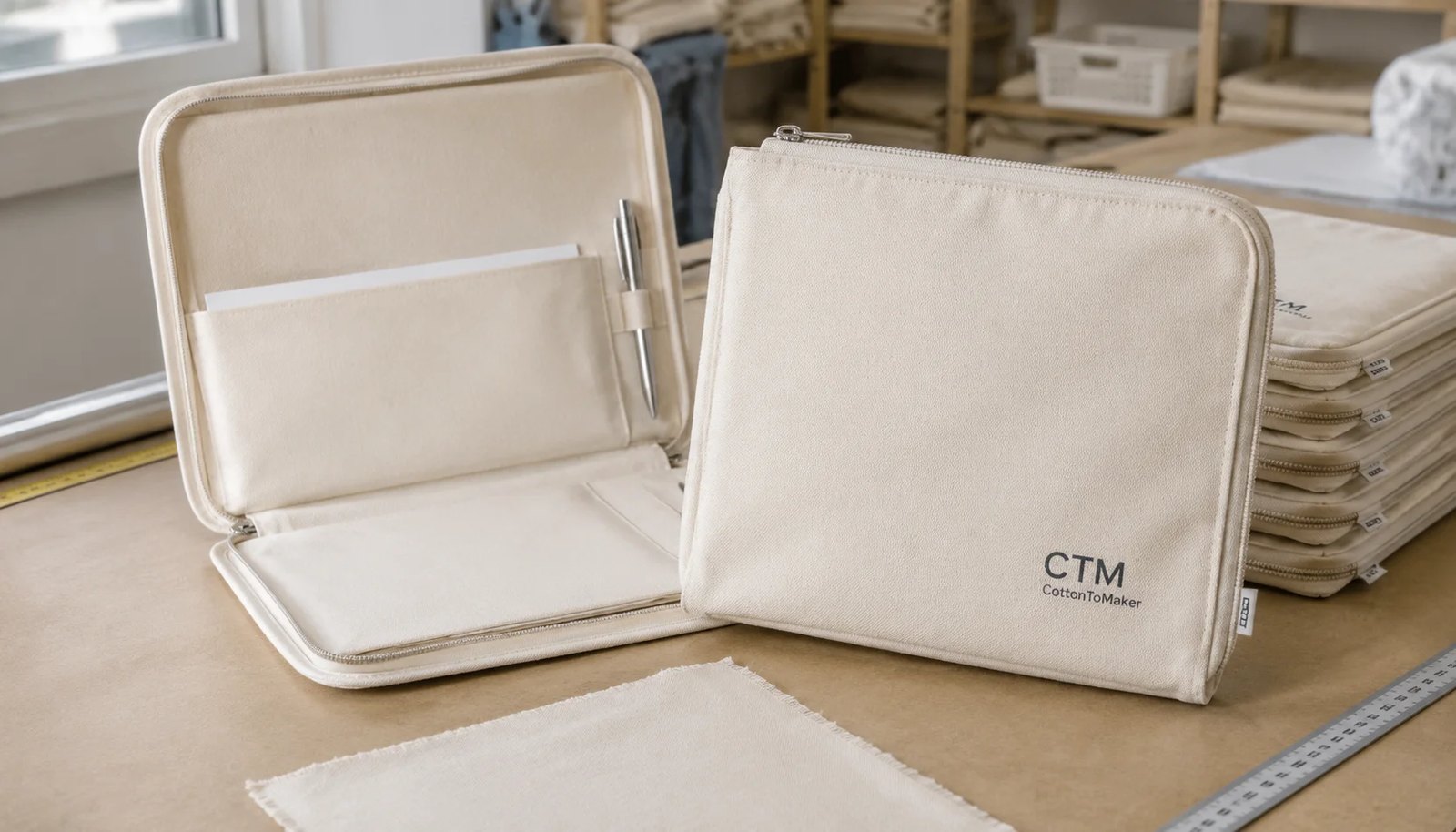
Buying Problem
A canvas zipper portfolio for a natural grocer is not just a flat pouch with a logo. It usually carries training paperwork, vendor sell sheets, regional product launch documents, certificates, membership packets, or buyer meeting materials. The product has to look aligned with a natural grocery brand, but it also has to protect documents, open smoothly, stack cleanly in cartons, and survive repeated handling by store teams.
Most quote problems start when the RFQ says only "canvas zipper portfolio, natural color, printed logo." That description leaves the factory to guess fabric weight, lining, zipper size, pocket layout, reinforcement, packing, and print method. Two suppliers can quote the same drawing with a 20-35% price difference because they are not quoting the same construction. A useful buying checklist turns those hidden decisions into comparable line items.
- Best use cases: store opening kits, natural grocery staff training, vendor sample documents, buying office portfolios, loyalty program folders.
- Poor use cases: heavy electronics protection, wet produce handling, refrigerated storage, or premium leather-look executive gifts.
- Core buying objective: enough structure for paper and brand presentation without turning the item into an expensive padded tech case.
Base Specification
Start with the paper and contents, then build the portfolio around them. For US natural grocers, letter-size documents are common, so a finished size around 10 x 13 inches can work for a simple flat portfolio. If the contents include catalogs, sample cards, coupon sheets, or multiple store training packets, a shallow gusset of 1-1.5 inches may be needed. For export programs serving mixed markets, A4 compatibility should be stated clearly because a portfolio sized only for letter paper can feel tight for A4 inserts.
The shape should also reflect how the item will be used. A full three-side zipper gives better containment, but it adds zipper length and requires cleaner corner sewing. A top zipper is cheaper and faster, but documents may bend or shift. Natural grocery buyers often prefer a clean, low-plastic appearance, yet the product still needs a reliable closure. Do not let the visual preference remove the function that the program needs.
- Common closed size: about 10 x 13 inches for letter documents, adjusted after testing the actual insert pack.
- Gusset choice: flat for light paper sets, 1 inch for thicker kits, 1.5 inches only when the added cube is justified.
- Interior layout: one document sleeve plus one card pocket is usually enough; extra pockets add labor and inspection points.
- Closure: three-side zipper for secure kits, top zipper for lower-cost document handling.
Fabric Weight
Canvas weight is the first major cost and performance driver. A 10 oz cotton canvas, roughly 300-340 GSM depending on weave, can work for budget event folders or short-term programs. For most wholesale canvas zipper portfolios for natural grocers, 12 oz canvas, roughly 380-410 GSM, is the more practical starting point because it holds shape better, accepts screen print well, and still folds into cartons without excessive bulk.
A 14 oz canvas can look stronger in a sample room, but it is not automatically better. The zipper line becomes thicker, the corners are harder to sew cleanly, and the carton CBM rises. If the buyer wants a rigid document case, ask whether a thin interlining or reinforced panel would solve the problem more efficiently than moving to very heavy canvas. Natural cotton shade variation should also be accepted or controlled in the spec; natural canvas is not a bright white laboratory material.
- 10 oz canvas: lower cost, softer hand, better for giveaways, weaker structure.
- 12 oz canvas: practical default for repeated office, store, and merchandising use.
- 14 oz canvas: stronger look, higher freight cube, harder zipper sewing, higher needle break and puckering risk.
- Pre-shrunk or washed canvas: useful when dimensional stability matters, but it can change handfeel and color tone.
- Natural shade tolerance: approve a real swatch range instead of relying only on a Pantone reference.
Zipper And Sewing
The zipper is where many low-priced portfolios fail. For a fabric portfolio carrying paper and light samples, a No. 5 nylon zipper is normally the safest commercial choice. It is flexible around corners, lighter than metal, and less likely to stain natural canvas. The slider should move smoothly without catching on seam allowance. If the design uses a three-side zipper, the corner radius and sewing tension should be reviewed on the physical sample, not only on the drawing.
Sewing details matter because canvas shows puckering and uneven seams. Stress points at the zipper ends, handle area if any, and pocket openings should be back-tacked or reinforced. Thread color should be specified because natural canvas with bright white thread can look mismatched, while dyed thread may reveal shade variation after washing or abrasion. For a buyer comparing quotes, a lower price often means thinner zipper tape, fewer reinforcements, or less careful interior finishing.
- Preferred zipper: No. 5 nylon coil for flexible portfolio construction.
- Use caution with metal zipper: premium appearance, but heavier, less flexible, and more staining risk on natural canvas.
- Reinforcement: zipper ends and high-use pocket openings should be back-tacked.
- Stitch density: keep consistent and approve a factory standard on sample, especially around corners.
- Thread trimming: loose threads inside document pockets are a common defect because they catch papers and look unfinished.
Print Method
For natural grocery programs, the artwork is often a simple logo, produce mark, store name, department icon, or supplier event graphic. On cotton canvas, screen printing is usually the most stable option for 1-3 solid colors. Water-based ink gives a softer hand and fits the natural look, but it can appear less bright on unbleached fabric. Plastisol-style ink can give stronger coverage, but some buyers dislike the heavier surface feel. The correct choice depends on brand standards and claim requirements.
Artwork should be approved at actual size. Small type, thin leaf shapes, QR codes, and detailed certification marks can fill in or break on canvas texture. If the logo includes a light green, beige, or pale yellow, the color may disappear against natural cotton. A print strike-off on the same fabric is more useful than a digital proof. For zipper portfolios, also keep the print away from heavy seam areas and zipper curves because the front panel may not stay perfectly flat during production.
- Screen print: best for solid logos, good cost control at wholesale quantities.
- Heat transfer: useful for gradients or small runs, but test edge adhesion and handfeel on canvas.
- Embroidery: durable and premium, but small text and large fill areas can distort the panel.
- Woven label: clean for subtle branding and reduces print risk, but has tooling and MOQ considerations.
- Approval rule: mass production should follow a printed pre-production sample on actual fabric, not a PDF proof only.
MOQ And Cost Drivers
MOQ depends on which parts are standard and which are custom. If the factory has stock natural canvas, standard zipper colors, and a simple screen print, a practical MOQ may start around 500-1,000 pieces. If the buyer wants custom dyed canvas, custom zipper tape, branded zipper pullers, special lining, retail packaging, or multiple store versions, each option can create its own MOQ. Splitting a 1,000-piece order into five logos may make the print setup inefficient even if the body construction is the same.
The unit price is usually driven by fabric consumption, fabric weight, zipper length, pocket labor, print color count, packing method, and inspection requirements. A factory can reduce cost by shrinking the finished size, using one standard zipper color, limiting pocket complexity, or choosing a label instead of a large print. Those changes should be intentional. A quote that is cheap because it removed lining, reduced canvas weight, or used a weak zipper is not a real saving if the portfolio fails in store use.
- High-impact cost items: canvas GSM, zipper length, lining, number of pockets, print colors, and individual packing.
- Medium-impact cost items: label type, thread color, zipper puller finish, carton labeling, and sample revisions.
- Hidden cost items: artwork setup, print screens, custom dye lot, sample freight, inspection fee, and extra cartons for store allocation.
- MOQ logic: separate the MOQ for body fabric, print design, zipper color, lining color, and retail packaging.
Sample Approval
A good sample process separates construction approval from print approval. The first sample can be a blank construction sample using close available materials. It proves size, document fit, zipper path, pocket layout, sewing quality, and handfeel. After construction is accepted, the printed sample should use the approved fabric, actual print method, actual logo size, and correct placement. Combining all decisions into one rushed sample increases the chance that a buyer approves a pretty logo on the wrong construction.
The sample should be tested with the real contents. Insert the thickest document packet, close the zipper several times, stack ten pieces, and look for corner bending. Rub the print lightly with a white cloth after curing, inspect the inside for loose threads, and check whether papers catch on pocket seams. If the portfolio will be packed with coupons, vendor sheets, or certificates, test those inserts before mass production. A factory cannot correct document fit after panels are cut.
- Blank sample approval: size, gusset, zipper movement, pocket layout, structure, sewing.
- Printed sample approval: color, ink coverage, logo size, placement tolerance, curing, handfeel.
- Content test: load the actual paper pack, not a single sheet from the office printer.
- Approval record: keep dated photos, measurement notes, swatch references, and signed sample comments.
- Do not approve: stuck zipper, twisted corners, oily odor, uneven logo coverage, or pockets that are too tight for documents.
Packing And Cartons
Natural canvas picks up dust and carton rub marks easily. Individual packing may feel like an added cost, but it often prevents claims at warehouse receiving. Recycled polybags are common and protective. Paper sleeves or glassine-style sleeves can support a lower-plastic packaging direction, but they need testing because paper can tear and does not protect as well against moisture. If the portfolio is going directly into store opening kits, barcode labels, size labels, or store allocation labels should be included in the packing plan.
Carton planning affects landed cost more than many buyers expect. A heavy 14 oz canvas portfolio with gusset and lining may ship far fewer pieces per carton than a flat 12 oz version. Cartons that are too large can crush lower layers; cartons that are too heavy may exceed warehouse handling limits. For wholesale programs, ask for carton dimensions, gross weight, net weight, piece count, and estimated CBM before approving the purchase order. This data belongs in the quote comparison, not after production is finished.
- Typical inner packing: one piece per protective bag or paper sleeve, printed side protected from abrasion.
- Typical master carton: 25-50 pieces depending on size, gusset, fabric weight, and warehouse weight limit.
- Carton marks: PO number, item name, color, quantity, gross weight, net weight, carton size, country of origin if required.
- Avoid over-compression: it can crease corners, press zipper teeth into fabric, and transfer ink.
- For store distribution: request carton sorting by store, region, or program version before shipment if needed.
Lead Time Risk
Lead time is not only the factory sewing days. A realistic schedule includes artwork cleanup, fabric sourcing, blank sample, sample revision, print strike-off, pre-production sample, bulk material preparation, cutting, printing, sewing, finishing, inspection, packing, export handling, and freight. If the portfolio is needed for a store opening, trade show, seasonal supplier meeting, or new product launch, the buyer should build the schedule backward from the in-hand date.
The biggest schedule risks are custom materials, late artwork approval, split logo versions, and packaging changes after sampling. Natural canvas is often available as stock fabric, but a custom dyed canvas or certified material can add weeks. Air freight can rescue a late order, but it may destroy the landed cost advantage of a wholesale canvas item. The better approach is to freeze the construction and artwork early, then leave enough inspection and transit time before the event or warehouse deadline.
- Typical sequence: RFQ, quote comparison, sample order, blank sample, print approval, pre-production sample, deposit, bulk production, inspection, shipment.
- Schedule buffer: keep extra time for fabric shade approval and sample transit.
- Risk flag: multiple store names or sponsor logos require a version control sheet.
- Risk flag: changing from flat to gusseted construction after sample approval usually requires pattern revision.
- Risk flag: retail packaging added late can change carton count, barcode work, and warehouse receiving setup.
Quote Comparison
A useful quote sheet should let procurement compare identical assumptions. Put fabric weight, finished size, zipper spec, lining, pocket layout, print method, print size, packing, MOQ, sample cost, production lead time, carton data, and Incoterms into one table. If one supplier quotes FOB and another quotes delivered warehouse, the unit price cannot be compared until freight, duty, customs handling, and inland delivery are normalized.
Do not reward the lowest price until the quote explains what is included. For example, one supplier may include individual packing, print screen charge, and carton labels, while another excludes them. One may quote 12 oz canvas, while another quietly uses 10 oz. One may include a printed pre-production sample, while another provides only a digital proof. Procurement teams should make the quote data complete before negotiating price; otherwise the negotiation only pushes ambiguity into production.
- Required quote fields: finished size, fabric GSM, canvas color, lining, zipper size, pocket layout, print method, print size, packing, MOQ.
- Commercial fields: unit price, tooling charge, sample fee, sample lead time, bulk lead time, payment terms, Incoterms, port.
- Logistics fields: pieces per carton, carton dimensions, gross weight, net weight, total CBM, HS code if available.
- Comparison rule: calculate landed cost per usable approved unit, not only factory unit price.
- Negotiation lever: simplify construction before reducing material quality that affects daily use.
Specification comparison for buyers
| Spec decision | Recommended option | When it fits | Buyer risk to check |
|---|---|---|---|
| Outer canvas fabric | 12 oz cotton canvas, about 380-410 GSM, pre-shrunk where available | Good balance for reusable store staff portfolios, vendor meeting kits, and natural grocery brand programs | Too light may collapse at corners; too heavy raises freight and can make the zipper curve bulky |
| Portfolio structure | Soft zipper portfolio with document pocket, card sleeve, and optional pen loop | Best when buyers need a practical carrier for price sheets, training notes, certificates, or member packets | Overbuilt foam padding can make the item feel like a laptop sleeve and increases carton cube |
| Zipper specification | No. 5 nylon zipper with smooth slider and reinforced zipper ends | Suitable for frequent opening during store training, field merchandising, and buyer appointments | Metal zippers look premium but can stain natural canvas or fail more easily if the curve radius is tight |
| Print method | Water-based or discharge-style screen print for 1-3 solid colors on natural canvas | Works for grocery logos, produce icons, event marks, and store department programs | Fine type and pale ink can sink into natural fabric; approve actual fabric strike-off before mass printing |
| Interior lining | Unbleached cotton lining or 210D recycled polyester lining, specified by program use | Cotton lining supports a natural feel; polyester lining improves wipeability for store and field use | Lining choice changes handfeel, cost, cleaning behavior, and sustainability claims |
| MOQ planning | Start from 500-1,000 pieces for standard fabric and simple print; expect higher MOQ for dyed fabric or custom zipper pull | Useful for regional grocer chains, distributor sales kits, and seasonal supplier programs | Small runs can carry high setup cost per unit; splitting colors or versions can push each SKU below efficient MOQ |
| Packing method | Individual recycled polybag or glassine-style paper sleeve, then 25-50 pieces per export carton | Keeps natural canvas clean during ocean or air freight and protects printed panels | No individual protection can cause dust marks, zipper scratches, and ink transfer in transit |
| Compliance and claims | Document fabric composition, print chemistry, country of origin, and any requested cotton or recycled content evidence | Needed when the portfolio is sold, included in retail kits, or tied to natural grocery sustainability messaging | Do not print organic, recycled, or eco claims unless the supplier can provide matching documentation |
Buyer checklist before sampling
- Define the use case first: staff onboarding, vendor appointment kit, retail resale, loyalty member gift, or distributor sales folder.
- Specify closed size, document size, gusset depth, zipper path, and whether the portfolio must hold letter, A4, catalog sheets, or sample cards.
- Choose fabric weight by structure: 10 oz for lighter giveaways, 12 oz for most wholesale programs, 14 oz or laminated canvas only when extra rigidity is needed.
- State whether the canvas should be natural, bleached, dyed, washed, or pre-shrunk, and whether cotton slubs are acceptable.
- Provide logo artwork in vector format and set minimum line thickness, ink color references, print position, and tolerance from zipper and edges.
- Decide the interior layout before sampling, including document sleeve, card pocket, pen loop, elastic band, mesh pocket, or label placement.
- Lock zipper material, zipper size, slider color, puller style, and end reinforcement so quote comparisons are equal.
- Request one blank construction sample and one printed pre-production sample before approving bulk production.
- Set measurable QC thresholds for size tolerance, seam strength, zipper smoothness, print registration, stains, odor, and carton drop condition.
- Confirm packing, carton size, carton weight, barcode or hangtag needs, and whether units ship to a warehouse, store network, or event location.
Factory quote questions to send
- What exact fabric weight in oz and GSM will be used for the outer canvas, and is it stock fabric or made to order?
- Can you provide a fabric swatch showing natural color, weave density, handfeel, and expected shrinkage?
- What zipper size, zipper tape material, slider type, and puller finish are included in the quoted price?
- Is the quoted print method screen print, heat transfer, digital print, embroidery, woven label, or a combination?
- What is the maximum print area on the front panel without distortion near the zipper seam or fold line?
- Does the unit price include interior pockets, pen loop, elastic strap, card sleeve, lining, and reinforcement patches?
- What MOQ applies to the portfolio body, each print design, each fabric color, and each zipper or puller color?
- How many days are needed for blank sample, printed sample, bulk production, inspection, and shipment after approval?
- What packing is included: individual bag, tissue, paper sleeve, carton liner, master carton, barcode label, or retail hangtag?
- Which quality documents can be supplied before shipment, such as inspection photos, measurement report, carton mark list, and material declaration?
Quality-control points to confirm
- Finished size tolerance should normally stay within plus or minus 5 mm for flat dimensions unless a tighter tolerance is agreed before production.
- Zipper must open and close smoothly around corners for repeated cycles without slider catching, tape waviness, or thread blockage.
- Main seams should be straight, back-tacked at stress points, and free of skipped stitches, loose threads, and puckering on the printed panel.
- Fabric panels should be free from oil stains, water marks, mildew odor, heavy slub clusters, and visible shade mismatch within the same carton.
- Print position should remain within the approved tolerance, commonly plus or minus 3 mm for logo placement on a flat front panel.
- Ink coverage must be even on natural canvas, with no pinholes that break key logo elements, barcode marks, or small type.
- Interior pockets should fit the agreed paper size without tight insertion, curling, or seam interference.
- Each carton should meet agreed piece count, carton mark, gross weight, and packing method, with no excessive compression that bends portfolio corners.