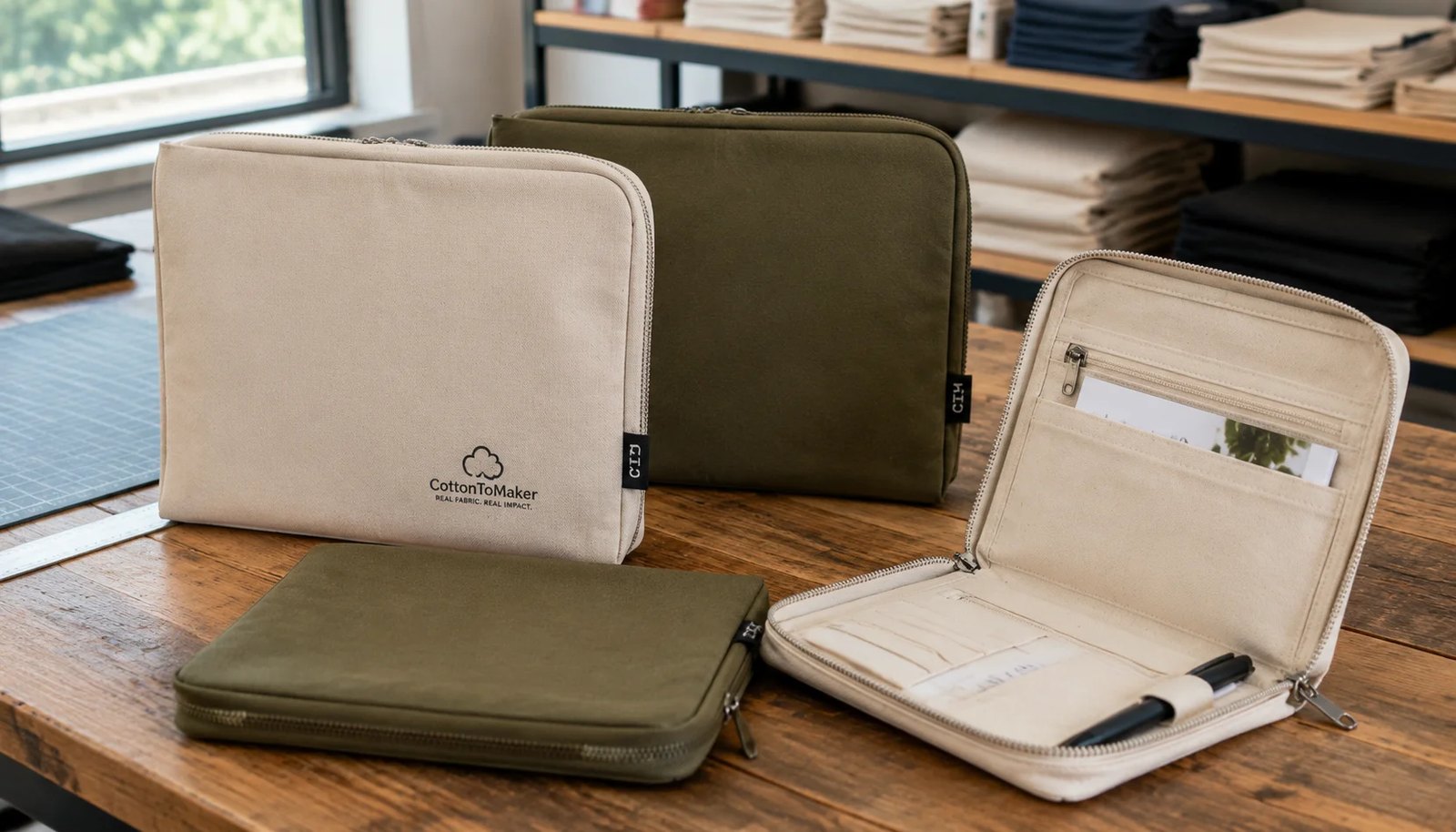
1. What natural grocer buyers are really purchasing
For a natural grocer, a canvas zipper portfolio is usually not just a giveaway. It may be used for supplier meetings, store launch materials, wellness event packets, onboarding documents, field merchandising notes, HR forms, or regional manager kits. That means the buyer is purchasing a working business bag with brand visibility, not only a low-cost promotional folder.
This distinction matters because two products can share the same name and have very different commercial value. One supplier may quote a light unlined shell with a small zipper and minimal finishing. Another may quote heavier canvas, a lined interior, a reinforced document sleeve, better zipper tape, and cleaner packing. If procurement compares only unit prices, the cheaper offer may simply be a thinner specification.
Natural grocery brands also tend to favor understated materials. Stock natural canvas, muted olive, black, kraft-like beige, cotton webbing, matte zipper tape, one-color print, and woven side labels usually fit the category better than glossy transfers or heavy synthetic trim. Those choices are not only aesthetic; they affect MOQ, print testing, sample timing, and QC.
The best sourcing approach is to decide the route first: stock canvas for a budget-controlled pilot, custom color for a larger brand program, or premium lined construction for repeated internal use. Once the route is set, pricing becomes much easier to compare.
- Common uses: supplier packets, training folders, store opening kits, field rep documents, event materials.
- Core buying risk: accepting a low quote based on lighter canvas, weaker zipper, or stripped-down interior.
- Best early decision: stock route, custom route, or premium route before asking for final bulk pricing.
- Useful internal reviewers: procurement, marketing, operations, and the team that will load or distribute the portfolios.
2. Build the bulk pricing plan before you request quotes
A pricing plan should give suppliers the same target product and the same volume scenarios. Without that structure, every quote becomes an interpretation. For zipper portfolios, the most useful model is a three-route comparison: stock canvas baseline, custom-dyed brand route, and premium lined route. Then request prices at several order quantities for each route.
The numbers below are not a promise of market pricing. They are a procurement worksheet format. Actual pricing depends on country, factory, labor cost, currency, fabric market, logo method, packing, and freight. The point is to force every supplier to answer in a comparable way: same dimensions, same artwork, same interior layout, same carton assumptions.
For a natural grocer program, a practical baseline might be a letter-size portfolio in 12 oz natural canvas, size 5 nylon zipper, one document sleeve, one pen loop, and one-color screen print. From there, the buyer can ask for cost impact if moving to custom-dyed canvas, lining, upgraded zipper, or woven label. This makes trade-offs visible before stakeholders fall in love with a feature-heavy sample.
A good bulk pricing plan also includes setup and packing charges. A supplier may offer a lower unit price but charge separately for screens, sample development, inner labels, insert cards, barcode stickers, split packing, or carton relabeling. These charges can matter more at 300 pieces than at 5,000 pieces.
- Use the same base size, artwork, and interior layout for all suppliers.
- Ask for price tiers at 300, 500, 1,000, 2,500, and 5,000 pieces where practical.
- Separate unit price from setup, sample, logo, packing, and special labeling charges.
- Request carton quantity and carton size with every tier so freight can be estimated early.
3. Sample tiered pricing worksheet for RFQ comparison
The table below is a quoting worksheet structure procurement teams can send to suppliers. Fill in quoted prices from each factory; do not treat the placeholders as universal rates. The value is in the tier logic: it shows where MOQ, setup, and customization start changing the total cost picture.
For smaller orders, setup cost and sampling charges can dominate. A 300-piece order with custom color, woven labels, and multiple packing versions may have a weak landed-cost profile even if the unit price looks reasonable. At higher volumes, the same upgrades may become acceptable because setup and material booking are spread across more units.
Buyers should ask factories to quote the same construction route across all quantities, then provide optional adders separately. For example, quote the baseline portfolio at 500, 1,000, and 2,500 pieces, then list the added cost for lining, upgraded zipper, extra pocket, woven label, or individual barcode sticker. This keeps the pricing plan readable.
- Baseline route: stock natural canvas, one-color print, unlined or simple inside sleeve.
- Custom route: custom-dyed canvas or matched zipper tape, same layout as baseline.
- Premium route: lined interior, stronger zipper, reinforced pocket edges, or added label package.
- Decision rule: compare total program cost, not only the lowest unit price.
4. MOQ scenarios and break-even thinking
MOQ is usually tied to material risk and production efficiency. Stock natural canvas, stock zipper tape, and a single screen print require fewer dedicated materials, so suppliers may support lower quantities. Custom-dyed canvas, matched trims, multiple logos, and private packing versions require more factory commitment, so MOQ usually rises.
A buyer testing a regional program may be better served by a 500-piece or 1,000-piece stock canvas order than by forcing a fully custom color at a low MOQ. The stock route may have cleaner sampling, shorter lead time, and fewer shade approval issues. If the program repeats, the next order can move toward custom color or premium construction.
Break-even analysis should include setup. Suppose Supplier A offers a lower unit price but adds screen charges, sample charges, split carton charges, and special packing fees. Supplier B may show a higher unit price but include more of those items. At 300 pieces, the included-cost supplier may be cheaper overall. At 5,000 pieces, the lower unit price may win. The pricing plan should calculate both scenarios.
MOQ should also be checked by variation. A 2,000-piece order may sound simple until it becomes four regional logos, two canvas colors, and three barcode versions. Ask whether the MOQ applies to the total PO or to each color, each logo, and each packing style.
- Lower-MOQ scenario: stock canvas, stock zipper, one logo, one packing method.
- Higher-MOQ scenario: custom dye, color-matched zipper, multiple logo versions, special inserts.
- Ask for MOQ by color, logo, and packing variation—not only total order quantity.
- Use a stock route for pilots unless the brand color requirement is non-negotiable.
5. Specification decisions that move price the fastest
The main cost drivers are fabric, structure, zipper, interior layout, decoration, and packing. If those are not defined, the lowest quote may simply be the least complete version of the product.
For business-use portfolios, 12 oz to 14 oz canvas, roughly 340 to 400 GSM, is a sensible starting range. Lighter canvas may work for a short-term event packet, but it can sag when loaded. Heavier canvas can feel premium, yet it may add sewing difficulty at corners and increase carton weight. If the product is lined or interlined, the outer canvas may not need to be excessively heavy.
The zipper deserves a line item in the spec. A size 5 nylon coil zipper is common for normal document loads. A size 8 zipper may be more appropriate if the portfolio will be filled with thicker paper sets or used frequently by field staff. Puller material and shape also affect perceived quality. Avoid allowing the supplier to define only a “standard zipper” without size and type.
Interior features add labor quickly. A document sleeve and pen loop are efficient. Card slots, tablet sleeves, mesh pockets, elastic holders, and multiple divided compartments add cutting, stitching, alignment, and inspection time. Natural grocer buyers often get the best value from a clean, simple layout that supports real use without unnecessary sewing complexity.
Decoration can be economical or expensive depending on method. One-color screen print is often the best balance for canvas. Woven labels are useful for subtle branding. Embroidery, patches, and heat transfers may fit certain premium programs but should be tested for appearance, durability, and brand tone.
- Good baseline: 12 oz to 14 oz canvas, size 5 nylon zipper, one sleeve, one pen loop, one-color screen print.
- Cost adders: custom dye, lining, interlining, size 8 zipper, extra pockets, embroidery, woven label, barcode packing.
- QC adders: more pockets and trims mean more alignment checks and more possible defects.
- RFQ habit: ask for optional adders separately from the baseline unit price.
6. Carton math and landed-cost worksheet
A bulk pricing plan is incomplete without carton data. Two suppliers can quote similar FOB prices while producing different landed costs because one packs 25 pieces per carton and another packs 40 pieces per carton. Carton cube, gross weight, and protection method affect freight, warehouse handling, and damage risk.
Ask each supplier for pieces per master carton, carton dimensions, gross weight, net weight, and whether the product is flat packed, folded, or supported with an insert sheet. For zipper portfolios, flat packing with zipper closed is usually preferred. A light insert sheet may protect the logo and help maintain shape, but heavy boards can increase freight cost.
A simple landed-cost worksheet should include: product unit price, logo setup, sample cost not credited, packing adders, inland freight to port or warehouse, export fees if applicable, ocean or air freight estimate, duty or tax assumptions, customs brokerage, final delivery, inspection, and allowance for rejects or rework if your company uses one. Even if some values are estimates, the worksheet prevents the buyer from selecting a supplier based on incomplete FOB pricing.
For example, compare Route A and Route B at 1,000 pieces. Route A has a lower unit price but uses larger cartons and separate barcode fees. Route B has a slightly higher unit price but packs more efficiently and includes barcode labeling. The best choice depends on total landed cost and timeline reliability, not the first unit-price line.
- Request carton data with the quote: quantity per carton, dimensions, gross weight, and packing method.
- Check whether individual polybags, insert sheets, barcode stickers, and carton marks are included.
- Calculate cost per delivered unit, not only FOB or ex-factory unit price.
- Avoid overpacking; it can raise freight cost without improving the product.
7. Branding choices for a natural grocery look
Canvas portfolios for natural grocers usually look best with restrained branding. One-color screen print, small woven labels, muted ink colors, and natural or earthy fabric tones are typically easier to align with the category than glossy, oversized, or highly synthetic decoration.
Screen print is the most common practical method because it works well on flat canvas panels, keeps cost controlled, and supports simple logos. However, canvas texture affects print edges. Fine serif type, hairline rules, and small reverse text may break up. Buyers should request a strike-off on the actual or production-equivalent canvas before approving bulk.
Woven labels can be a strong alternative when the front panel should stay quiet. They also help if the same portfolio body will be used for several accounts or departments. The spec should define label size, fold type, base color, thread colors, and exact seam placement.
Heat transfers may reproduce detail, but they can create a film surface that feels less natural. Embroidery can look premium, but it can distort lighter canvas and increase cost. Patches can work for a higher-end route, but they should be reviewed against the natural grocer’s sustainability and simplicity expectations.
Placement should be dimensional. “Centered” is not enough because zipper borders, rounded corners, and seam allowances change visual balance. Define logo distance from the bottom seam, side seam, and zipper edge. For woven labels, define which seam captures the label and how far it sits from the corner.
- Best default: one-color screen print with physical strike-off approval.
- Subtle option: woven side label sewn into a specified seam.
- Avoid untested fine-line artwork on slubbed canvas.
- Set logo placement tolerance, commonly plus or minus 3 mm to 5 mm for standard work.
8. Sampling approval that prevents bulk surprises
The approval sample should prove function, not only appearance. A portfolio can look attractive empty but fail when loaded with the actual paper stack. The sample review should include zipper operation, document fit, pocket usability, logo readability, panel flatness, and packed appearance.
Insist that the sample use production-equivalent materials. If substitute canvas, substitute zipper, or a different print method is used, mark the approval as provisional. Many bulk disputes begin when a buyer approves a salesman sample that cannot be reproduced exactly in production.
A useful sample approval package includes the sewn sample, canvas swatch, lining swatch if used, zipper and puller reference, print strike-off, label sample, packing sample, and signed specification sheet. This package becomes the reference for production and inspection.
Test the sample with real contents. Insert the intended document set, close the zipper, and check whether corners strain or papers catch. Open and close the zipper repeatedly. Review the print after handling. Place the packed sample in its proposed polybag and carton orientation to see whether the logo creases or the zipper bends.
Do not approve based only on front-view photos unless the order is very low risk. For a natural grocer rollout, the portfolio’s texture, hand feel, zipper movement, and internal usability are all part of the buying decision.
- Sample test: load with actual paper set, close zipper, open flat, inspect pocket access.
- Reject sample if zipper waves badly, panel twists, logo is off-position, or pockets are unusable.
- Keep a signed reference sample for factory, buyer, and inspector.
- Approve packed sample if the front logo or canvas surface is sensitive to creasing or rub.
9. Measurable QC standards to put in the PO
General phrases such as “good quality” or “same as sample” are not enough. The PO or specification sheet should list measurable tolerances and defect classifications so the factory, inspector, and buyer apply the same standard.
For finished size, a common tolerance is plus or minus 0.5 cm on closed dimensions unless the design requires tighter control. For fabric weight, use the approved GSM or oz with an agreed tolerance, often plus or minus 5 percent. For logo placement, define a position tolerance such as plus or minus 3 mm to 5 mm from approved artwork location. These numbers should be agreed before production, not argued after shipment.
Zipper function should be tested during sample and inspection. The zipper should run smoothly from end to end with no stuck points, missing teeth appearance, loose top stop, tape twist, or severe wave. Zipper ends and corners should have secure stitching or reinforcement appropriate to the design.
Natural canvas requires stricter appearance handling than dark synthetic fabric. Visible oil marks, dirt, ink transfer, needle cuts, or large front-panel flaws should be treated as major defects. Loose threads and minor internal stitch variation may be minor if they do not affect appearance or function, but front-panel issues deserve tighter control.
Interior function also needs inspection. A document sleeve must accept the specified paper size without catching. Card slots must fit the intended cards. Pen loops must hold a standard or specified pen diameter. If the pocket is sewn but not usable, it should be classified as a functional defect.
Packing inspection should confirm zipper closed, portfolio flat, logo protected, polybag size correct, barcode readable, carton marks accurate, and cartons not over-compressed. Many avoidable disputes come from goods that were acceptable at sewing but damaged or distorted in packing.
- Size tolerance: commonly plus or minus 0.5 cm on closed dimensions.
- Fabric tolerance: commonly plus or minus 5 percent if stated in the specification.
- Logo tolerance: commonly plus or minus 3 mm to 5 mm from approved placement.
- Major defects: stuck zipper, front stain, severe print skew, seam opening, unusable pocket, distorted shape.
- Packing defects: wrong barcode, crushed carton, folded logo panel, missing assortment label.
10. Lead time, quote comparison, and final supplier selection
Lead time should be broken into stages: artwork preparation, sample development, sample approval, material booking, cutting, printing, sewing, in-line QC, final inspection, packing, and shipment handoff. If custom dye is involved, add lab dip approval and bulk fabric shade approval. If there are multiple logo versions, add time for artwork control and setup changes.
Do not schedule from the factory’s sewing time alone. Zipper portfolios often lose time in sample revisions, color approval, packing confirmation, or barcode data. A buyer working toward a store launch, training event, or seasonal campaign should work backward from the in-hand date, including freight, customs, warehouse receiving, and any document insertion work after arrival.
When comparing quotes, use a scorecard. Price matters, but it should not outweigh unclear specs, weak sample discipline, missing carton data, or vague QC standards. The best supplier for a natural grocer program is usually the one that can quote the same construction clearly, explain MOQ by variation, provide production-equivalent samples, and give usable carton and lead-time details.
Before placing the PO, confirm the final specification sheet, approved sample reference, artwork file, packing instruction, inspection standard, carton marks, and delivery terms. This prevents the most common bulk-order problems: wrong material route, unexpected logo charges, poor packing efficiency, and disagreement over defects.
A strong bulk pricing plan gives the buyer options. It does not force a premium build for every project, and it does not chase the lowest possible unit price at the expense of usability. It compares stock, custom, and premium routes on total cost, brand fit, QC risk, and delivery reliability.
- Use a scorecard with price, MOQ, sample quality, carton efficiency, QC clarity, and lead-time confidence.
- Confirm all setup charges before PO release.
- Tie production to an approved sample and signed spec sheet.
- Choose the route that matches program value: pilot, repeat rollout, or premium long-use tool.
Specification comparison for buyers
| Procurement route | Typical MOQ logic | Best fit | Cost and risk notes |
|---|---|---|---|
| Stock natural canvas + custom one-color print | Often the lowest practical MOQ because fabric and zipper are standard components | Pilot programs, regional natural grocer rollouts, distributor tests, employee kits, event folders | Usually the best first pricing route. Watch for lighter canvas substitutions, print strike-off quality, and whether setup charges are included. |
| Stock dyed canvas + custom print or woven label | Moderate MOQ; supplier may already hold colors such as black, olive, navy, or natural beige | Programs needing brand color direction without custom dye development | Can control appearance better than natural canvas, but shade consistency still needs approval against a physical sample. |
| Custom-dyed canvas + matched zipper tape | Higher MOQ because fabric and zipper tape become order-specific | Chain-wide programs with stable repeat demand and strict color standards | Adds lab dip approval, longer material lead time, and leftover-material risk. Compare against stock route before committing. |
| Unlined economy build | Lower sewing labor and fewer panels | Short-term handouts, simple document packets, lower-budget event use | Can wrinkle or collapse when filled. Require clean internal seam finish and loaded-sample review. |
| Lined business build | Moderate to higher unit cost due to lining panels and extra operations | Store manager folders, vendor meeting kits, sales documents, onboarding packs | Better finished appearance and pocket support. Inspect lining alignment, shade match, and hidden seam quality. |
| Premium reinforced build | Highest cost route; heavier canvas, interlining, upgraded zipper, more pockets, or badge branding | Repeat-use field tools, executive vendor meetings, long campaign life | Useful only if the use case justifies it. Extra compartments and trims increase labor, inspection points, and carton weight. |
Buyer checklist before sampling
- Define the use case: event folder, field rep document case, store manager kit, onboarding pack, or supplier meeting portfolio.
- State required paper fit: US letter, A4, clipboard sheets, brochures, or a defined insert stack thickness.
- Set finished closed size and tolerance, commonly plus or minus 0.5 cm unless the design requires tighter control.
- Specify outer canvas weight by oz or GSM; for business use, 12 oz to 14 oz, about 340 to 400 GSM, is a common starting range.
- Confirm whether the canvas is stock natural, stock dyed, washed, coated, or custom dyed; do not let color route remain vague.
- Choose zipper type, size, tape color, and puller finish; size 5 nylon coil is common for normal document loads, while size 8 may suit heavier fill.
- Limit interior features to what the user needs: document sleeve, pen loop, small pocket, card slot, tablet sleeve, or mesh pocket.
- Define logo method, color count, print area, and placement measured from seams or zipper edge.
- Request a print strike-off on actual or equivalent canvas, not only a digital proof.
- Ask for MOQ by canvas color, logo version, and packing variation.
Factory quote questions to send
- What exact canvas are you quoting: cotton content, finished GSM or oz, and acceptable weight tolerance?
- Is the canvas stock natural, stock dyed, or custom dyed? If custom dyed, what is the minimum fabric booking and lab dip timeline?
- What zipper is included: nylon coil or molded, size 5 or size 8, tape color, puller material, and end-stop construction?
- Does the quoted price include lining, interlining, document sleeve, pen loop, card slots, or only the outer shell?
- How many sewing operations or added charges apply if we add one inside pocket, card slots, or a tablet sleeve?
- Which branding method is included: screen print, heat transfer, woven label, embroidery, or patch? How many colors are priced?
- Are print setup, screen charge, sample charge, and artwork adjustment fees included or listed separately?
- What is the MOQ by color, by logo version, and by packing variation? Can split shipment or mixed carton packing be supported?
- Can you provide a pre-production sample in production-equivalent fabric, zipper, lining, and logo method?
- What are your dimensional tolerances for closed size, pocket opening, zipper alignment, and logo placement?
Quality-control points to confirm
- Finished closed size should match the approved spec within the agreed tolerance, commonly plus or minus 0.5 cm for standard portfolio dimensions.
- Canvas weight should be checked against the approved reference within the agreed range, commonly plus or minus 5 percent if specified in the PO.
- Zipper must open and close smoothly end to end at least 10 cycles during sample review, with no stuck points, skipped teeth appearance, loose top stop, or tape wave that distorts the panel.
- Logo placement should stay within an agreed tolerance, commonly plus or minus 3 mm to 5 mm from approved position for standard screen print work.
- Screen print edges should be readable on canvas texture with no severe feathering, ink voids, transfer film lift, or smearing.
- Topstitching should be even enough for business presentation, with no skipped stitches, broken thread, seam opening, or loose reinforcement at zipper ends and pocket corners.
- Document sleeves must accept the intended paper size and insert stack without catching on seam allowance or interfering with zipper closure.
- Pen loops and card pockets should be tested with target items; they should not be too tight to use or loose enough for contents to fall out easily.
- Natural or light canvas should be free of visible oil marks, dirt, ink transfer, needle damage, and large slub defects on the front panel.
- Dyed canvas, lining, and zipper tape should be compared to the approved sample under consistent light before packing.