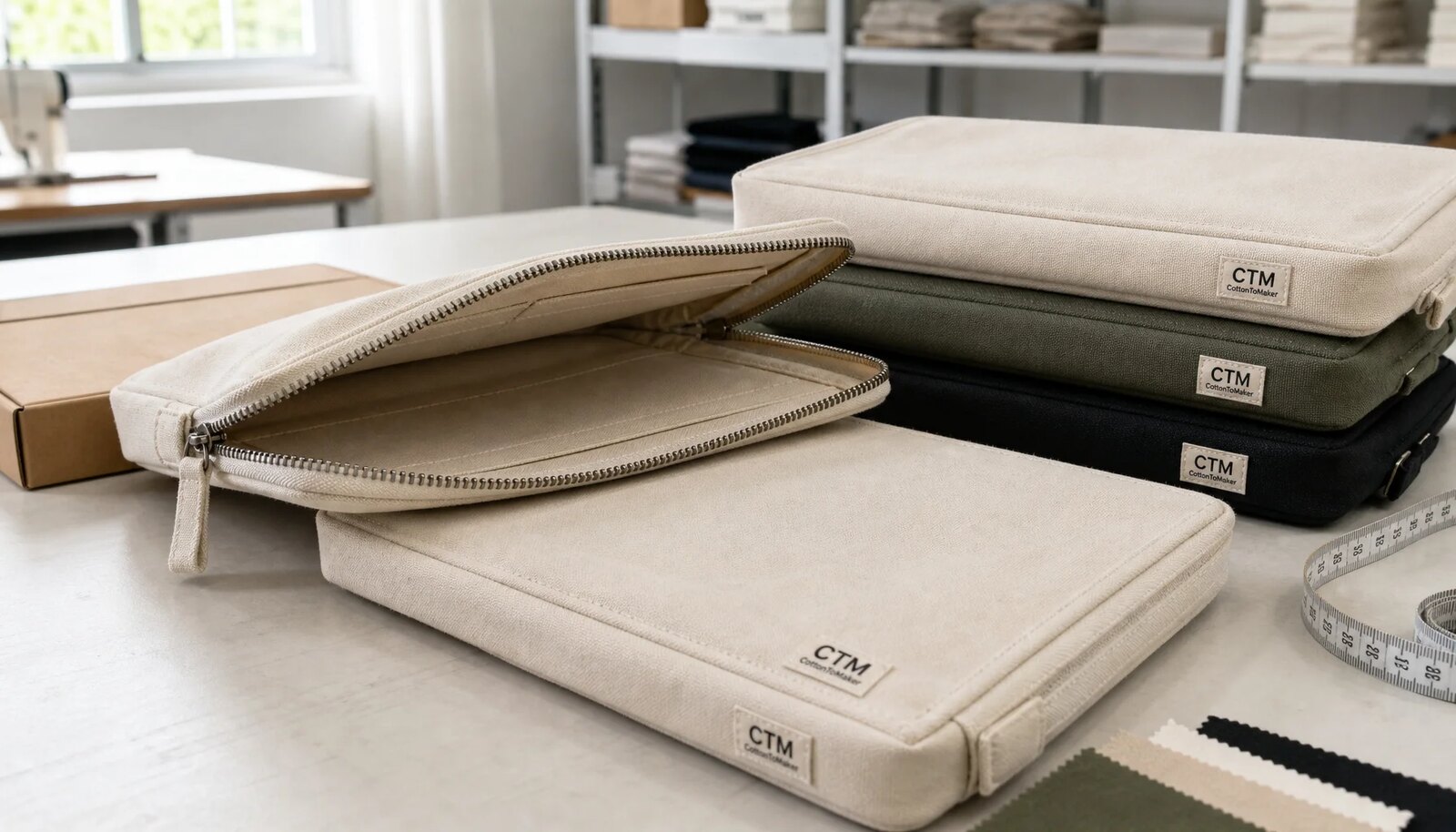
1. What MOQ Means For A Zipper Portfolio
For canvas zipper portfolios, MOQ is not just a factory policy number. It is the point where setup labor, cutting waste, printing screens, zipper sourcing, and packing time become efficient enough for the supplier to accept the order. If your spec is simple and uses stock materials, the MOQ can stay modest. If you need custom canvas weight, custom zipper tape, branded pulls, or special packing, the same order becomes much harder for the factory to price cleanly.
Event planners usually buy these portfolios as practical carry items for proposals, checklists, contracts, and registration materials. That means the product has to look branded, open smoothly, and survive repeated handling, not just pass a visual review. The buying problem is usually not whether the supplier can make it. It is whether the MOQ you negotiate still leaves room for quality, on-time delivery, and a quote that your margin can absorb.
- MOQ is driven by setup cost, not only by fabric consumption.
- A portfolio with one-color print is much easier to negotiate than one with multiple panels, trims, and custom packing.
- The lowest MOQ is not always the best quote if it hides tooling or packaging costs elsewhere.
2. Spec Choices That Move The MOQ Fastest
The fastest way to lower MOQ is to reduce the number of custom decisions. Start with a stock canvas weight such as 12 oz / 340 gsm or 14 oz / 400 gsm, then pick a standard zipper size and a simple logo position. If you ask for custom dye, custom zipper tape, multiple print locations, and retail packaging at the same time, the factory will usually respond with a higher minimum or a much higher unit cost.
Canvas zipper portfolios also react strongly to construction complexity. A flat body with one internal sleeve is easier to sew than a gusseted organizer with multiple pockets and pen holders. For event buyers, a clean exterior and one functional interior layout often sell better than a busy spec sheet. Keep the build practical, then spend the budget on reliable zipper action and clean branding.
- Choose stock canvas first, then customize only where the customer will notice it.
- Use one logo placement unless there is a clear merchandising reason for more.
- Avoid custom trims unless the design needs a premium retail finish.
3. Compare Sourcing Routes Before You Negotiate
A direct factory is usually the best route when you need more control over MOQ, sample timing, and production details. You can see how the supplier handles cutting, printing, sewing, and packing, which matters if you need repeat orders or a program that grows over time. A trader or sourcing agent can sometimes move faster on small orders, but you often lose visibility into where the real MOQ comes from and where the cost is being added.
For branded portfolios, the question is not only who has the lowest quote. It is who can keep the same spec across reorders. If the first lot ships with one zipper supplier and the second lot quietly changes the zipper pull, the item stops being a stable program. Use the first quote to test whether the supplier has real control over materials, not just access to a catalog.
- Direct factories are usually stronger on repeat consistency and material control.
- Trading routes can be useful for mixed products, but they often add less transparency.
- Ask where the zipper, canvas, lining, and label are sourced before you compare prices.
4. How To Negotiate MOQ Without Damaging The Quote
The cleanest MOQ negotiation is to trade complexity for volume, not to push for a tiny minimum on a fully custom spec. If you want a lower starting quantity, give the factory something that reduces their risk: standard canvas, one artwork file, stock zipper color, and simple packing. Then ask for a stepped quote so you can see the price at the MOQ, at a target reorder volume, and at a longer-term annual run.
This approach gives you leverage without forcing the supplier to guess. It also exposes where the real cost sits. If the quote drops sharply at a modest volume increase, the factory is absorbing setup cost across the run. If the quote barely changes, the supplier may be padding labor or planning to recover cost through packaging, sample fees, or a loose tolerance on defects.
- Offer a repeat-order path if the first run performs well.
- Ask for the same spec in two packing formats if you need flexibility.
- Push for a lower MOQ only after the supplier has quoted the full production method.
5. Sample Approval Should Test Function, Not Just Appearance
The sample stage is where many portfolio orders fail quietly. A nice-looking sample can still have zipper drag, weak corner stitching, or a pocket that is too shallow for the documents your buyers carry. Treat the sample as a working prototype. Open and close the zipper repeatedly, load it with papers, and check whether the body twists or the seams pucker once the portfolio is full.
For print approval, look at more than color. Confirm artwork placement, edge sharpness, ink coverage on the canvas weave, and whether the print sits flat after the zipper is pulled closed. If the branding method is a woven label or patch, inspect stitching density and corner lift. A sample that passes on screen but fails in use usually means the factory is optimizing for appearance over assembly.
- Test zipper travel at least 20 to 30 open-close cycles on the approved sample.
- Check the actual filled shape, not just the empty portfolio.
- Approve one master sample for print, stitching, and packing reference.
6. QC Thresholds That Keep The Order Saleable
With zipper portfolios, quality failures tend to show up in the same places: corners, zipper ends, and logo alignment. These are not cosmetic details. If the zipper catches at the seam or the stitches wander near a stress point, the item feels cheap immediately. Buy with a defined acceptance standard, even if it is simple, so the factory knows where the line sits.
The right threshold is usually practical rather than extreme. You do not need luxury-bag tolerances for an event planner portfolio, but you do need repeatable stitching, consistent zipper motion, and a logo that matches the approved proof. If the supplier cannot describe their own inspection standard in plain language, assume the order will be judged informally and inconsistently.
- Define acceptable print position and color range before bulk starts.
- Require reinforcement at handle points and zipper anchors.
- Set a clear rule for visible stain, thread end, or fabric flaw rejection.
7. Packing For Events Is A Cost Decision, Not A Side Detail
Packing affects MOQ more than many buyers expect. Bulk polybag packing is the easiest route when the portfolios are going into warehouse stock, event kits, or distributor channels. Retail-ready packaging, inserts, barcode labels, and individual boxes add labor, materials, and carton volume. If you do not need shelf-ready retail presentation, do not pay for it in the first run.
For event buyers, the better question is how the product will be distributed. Some orders ship directly to venues in smaller unit counts, while others go through a distributor or fulfillment center. That changes carton size, outer label format, and moisture protection needs. A factory quote that ignores packing detail is not complete enough to compare fairly.
- Use bulk packing unless the channel requires retail display.
- Confirm carton count per size and per color before production.
- Make sure the packing list matches the actual event distribution plan.
8. How To Read The Quote Like A Buyer
A real quote should tell you what is driving the number, not just give you a unit price. You need to see the canvas weight, zipper type, printing method, packing method, sample charge, and lead time as separate items if possible. When those components are blended into one line, it becomes difficult to know whether the lower MOQ is genuine or whether the factory is quietly changing material quality or cutting corners on packing.
Ask for more than one volume breakpoint. A quote at the lowest acceptable MOQ, a target run, and a repeat-order level will show how quickly the unit cost drops once setup cost is spread across more pieces. That is the cleanest way to decide whether to place a test order now or wait until you can combine demand into a larger run.
- Separate sample fees, tooling, printing, and packing in the quote.
- Compare the same incoterms across suppliers before judging price.
- Look for overrun and underrun tolerances in writing.
9. Lead Time Risk And Release Strategy
Lead time is usually where small MOQ orders become expensive in practice. A simple stock-material portfolio may move quickly, but any custom canvas color, zipper change, or special packaging adds decision points and waiting time. If your event calendar is fixed, do not treat sample approval and mass production as one timeline. Separate them and protect the release date with a realistic buffer.
The best release strategy for event planners is often a staged order. Start with a confirmed pilot quantity, approve the sample fast, then lock the repeat order once the first run is sold or distributed. This reduces the risk of sitting on excess stock while still giving the factory enough confidence to hold materials. If the supplier cannot support a staged workflow, they may be relying on one-time orders rather than a stable program.
- Treat sample approval as a milestone, not a formality.
- Do not commit to a launch date until material availability is confirmed.
- Keep a buffer for print rework, packing corrections, and shipping delays.
Specification comparison for buyers
| Spec decision | Recommended option | When it fits | Buyer risk to check |
|---|---|---|---|
| Sourcing route | Direct factory with in-house cutting, printing, and packing | You need lower MOQ flexibility, tighter control of logo placement, and fewer handoffs | Confirm whether the factory is actually making the item or only trading it; request process photos and a recent production record |
| Canvas weight | 14 oz / 400 gsm for a balanced portfolio body | You want a structured hand feel that still keeps shipping weight reasonable | Thin canvas can warp after printing; ask for a physical swatch and compare weight after coating or washing |
| Zipper construction | No. 5 nylon coil zipper with a matching puller | Most event planner portfolios need smooth opening, low snag risk, and moderate cost | Metal zippers look premium but can add noise, dent pages, or snag corners; test zipper travel on the approved sample |
| Branding method | Screen print for simple logos, woven label or PU patch for more durable branding | You need a clean logo at a controlled MOQ without making the item too expensive | Fine gradients and tiny text can blur on canvas; insist on artwork size limits and a print proof |
| Inside structure | One document sleeve plus a pen loop or slim organizer pocket | Buyers want the portfolio to hold papers, contracts, and notes without bulky construction | Extra pockets increase labor and reject rate; verify pocket dimensions and stitch alignment on the sample |
| Packing route | Bulk packed in polybags and export cartons, with retail pack only if required | You are shipping to distributors, event kits, or warehouse stock | Retail inserts and individual boxes raise labor and carton volume; confirm if packing is part of the quote or a separate charge |
| MOQ structure | Base MOQ per color or print run, with a separate allowance for repeat orders | You want to test market demand before committing to a larger program | A very low MOQ can hide setup charges in the unit price; request pricing at 300, 500, and 1,000 pieces to see the real step-down |
| Lead time strategy | Standard fabric and zipper colors, custom print only | You need a realistic delivery window for an event calendar | Custom-dyed canvas, specialty pulls, or mixed packaging can add weeks; ask what is in stock versus made to order |
Buyer checklist before sampling
- Confirm the exact portfolio size, internal pocket layout, and finished thickness before asking for price
- Approve canvas weight in gsm or oz, not only by visual description
- Decide whether the logo is screen printed, woven, embroidered, or applied as a patch
- Define the zipper type, puller shape, and color match requirement
- State the packing method, carton count, and whether retail inserts are needed
- Request sample photos showing the seam corners, zipper ends, and logo placement
- Ask for MOQ pricing at more than one volume so setup cost is visible
- Confirm the lead time for sample, pre-production sample, and bulk shipment separately
- Check overrun/underrun tolerance before approving the PO
Factory quote questions to send
- What is the MOQ by color, by artwork, and by packing format?
- Which canvas weight are you quoting, and is that before or after any coating or washing?
- Is the zipper standard stock, or will it require a custom puller, tape color, or size?
- What is included in the unit price: printing, labeling, polybag, carton, and export marks?
- How much is the sample charge, and is it refundable against bulk order?
- What are the exact lead times for sample, PPS approval, and mass production?
- What defect standard do you use for stitching, print alignment, and zipper function?
- Can you quote three breakpoints, such as lower MOQ, target MOQ, and repeat-order MOQ?
- What carton size, carton weight limit, and packing quantity per carton do you recommend?
- What documents will you provide with shipment, including packing list, commercial invoice, and carton labels?
Quality-control points to confirm
- Zipper opens and closes smoothly across the full length without catching at the corner seams
- Stitching is straight, evenly spaced, and reinforced at all stress points with bar-tacks where needed
- Logo placement matches the approved sample for position, size, and color tolerance
- Canvas weight and hand feel match the approved swatch, with no unexpected stiffness or limp body
- Inner pocket dimensions hold the intended documents without tearing at the seam edge
- Binding or edge finishing does not pucker after the portfolio is filled and zipped shut
- Polybag, hangtag, and carton labels match the packing list and carton count
- Carton compression does not deform the portfolio shape during export stacking