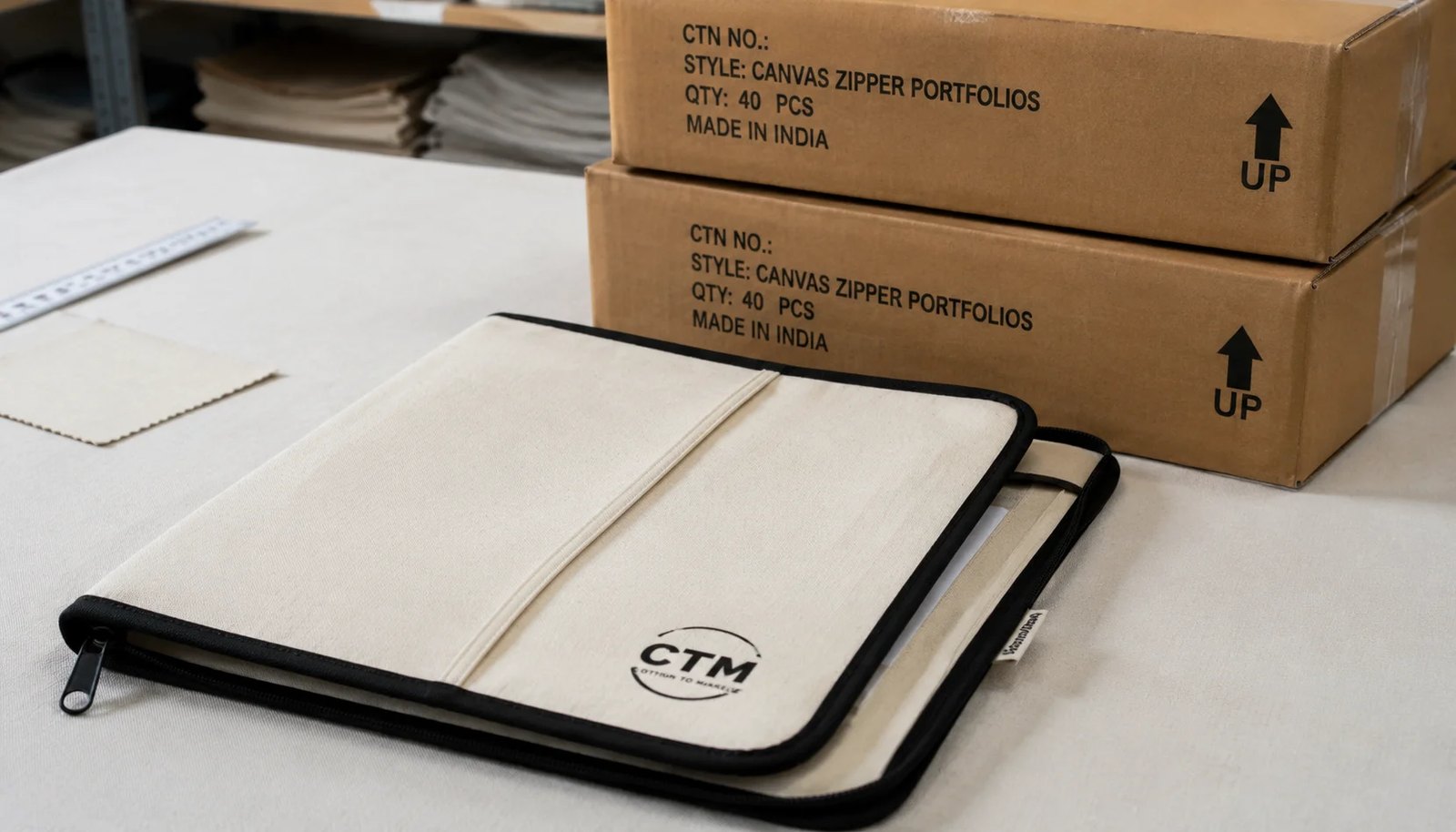
Start With the Retail Job, Not the Bag Name
A canvas zipper portfolio for a liquor retailer is usually a working document carrier, not a generic promotional pouch. It may hold tasting notes, club enrollment forms, distributor account paperwork, compliance sheets, training materials, event credentials, or premium customer documents. The buying specification should begin with those contents because the contents determine size, pocket layout, zipper clearance, canvas structure, and packing method.
The long-tail need behind wholesale canvas zipper portfolios for liquor retailers carton packing plan is practical: procurement wants the goods to arrive clean, flat enough to use, correctly branded, and efficient to ship. Repeating the phrase in every heading does not help buyers. The useful work is defining the portfolio and the carton together so unit price, freight cube, warehouse handling, and damage risk can be compared on the same basis.
Do not let the factory quote only from a photo. A photo does not define usable inner space, zipper path, corner radius, canvas finish, pocket depth, puller thickness, or carton pressure. These details decide whether the sample works with real liquor retail documents and whether the bulk order survives packing and transit.
- List the documents or inserts the portfolio must carry.
- Confirm A4, US letter, tasting card, receipt, or custom insert fit.
- Define the product and packing method in the same RFQ.
- Compare unit price with carton CBM and gross weight, not unit price alone.
Core Specification for Procurement Control
The first specification line should separate closed size, open size, and usable inner document area. A portfolio can appear large enough from the outside and still catch paper corners under the zipper or binding. If the item must hold US letter paper, A4 sheets, or a fixed retail insert, state the required clearance and test it with real paper before production approval.
Canvas weight should be selected by use, not by a broad belief that heavier is always better. A 10 oz canvas may work for a short event handout. A 12 oz to 14 oz cotton canvas is often a practical middle range for reusable retail programs because it offers structure without excessive carton bulk. A 16 oz canvas can feel more premium, but it may raise CBM, increase sewing resistance, and create stiffer zipper corners. These ranges are practical procurement references, not universal engineering standards; the approved sample and inspection tolerance should control the final decision.
Construction should stay as simple as the program allows. One flat document pocket plus one card or receipt pocket is often enough for tasting-room, club, and account paperwork. Extra pockets, padding, lining, branded pullers, and thick binding can improve perceived value, but they also add labor, thickness, and more failure points. If a feature does not help the intended retail task, it should be challenged before it becomes part of the PO.
- Specify closed size, open size, and usable inner area separately.
- State document fit with clearance, not only nominal size.
- Use heavier canvas only when presentation value offsets freight and sewing impact.
- Freeze pocket count, binding width, zipper path, and puller style before quote comparison.
Material and Zipper Choices That Affect Cartons
Packing performance is shaped by material choices. Heavy canvas has body, but it can hold pressure marks when over-compressed. Light canvas packs efficiently, but it may wrinkle or collapse around the edges. Coated, washed, dyed, or laminated canvas can behave differently from plain natural canvas, so the RFQ should identify the finish and ask whether the quoted weight is before or after finishing.
For most flat document portfolios, a No.5 nylon coil zipper is a sensible default because it bends around corners, keeps thickness moderate, and is widely available. A No.8 nylon coil can suit oversized or padded styles, but it should not be chosen automatically. Metal zippers may look premium, yet they can add weight, scratch adjacent pieces, and create more sewing difficulty around curves. If the portfolio must pack flat, zipper bulk matters.
Zipper quality should be tested in use, not only viewed in a sample room. Insert the intended documents, close the portfolio, and run the zipper through the full corner path repeatedly. Catching, uneven tension, slider separation, or tape fray are early warning signs. QC should also check that zipper pulls do not press into the next piece when stacked in the carton.
- Confirm canvas weight, GSM, finish, and tolerance.
- Use No.5 nylon coil for most standard document portfolios.
- Test zipper travel with real inserts inside the portfolio.
- Check whether the puller or zipper corner creates pressure marks in stacked packing.
Artwork Approval on Textured Canvas
Liquor retail branding often includes fine serif type, crests, bottle illustrations, small legal text, metallic references, or heritage-style marks. Cotton canvas is textured and may include natural slubs, so print results will not look like coated paper. The approval process should show the real production result, not only a digital mockup.
Screen printing is usually suitable for solid logos, bold marks, and one- or two-color artwork. Heat transfer can handle gradients and tight multicolor details, but it changes the surface feel and may look less natural on canvas. Embroidery can be attractive for small marks, but it can distort lighter panels. A woven label is useful when the buyer wants a clean branded detail without large ink coverage.
The key control is a strike-off on the same production canvas. This is especially important for white ink, dark ink, metallic-effect ink, large coverage, fine text, or heat transfer. Approve logo size, placement, opacity, color tone, and acceptable edge character. Placement should be measured from fixed seams or edges so inspection has a clear standard.
- Approve artwork at actual size on the real panel.
- Require a strike-off for high-risk print methods or large coverage.
- Measure logo placement from seams or edges.
- Check rub resistance if portfolios will be handled at counters or events.
Supplier Route and Quote Comparability
A direct factory is often the better route when the portfolio itself is the main custom item. The factory can adjust pattern, zipper installation, packing count, carton dimensions, and QC details from actual production knowledge. This matters for repeat liquor retail programs where the buyer wants the same fit, logo position, and carton plan across multiple orders.
A trading company or sourcing partner can still be useful when the portfolio ships with other retail items such as wine bags, aprons, bottle wraps, jute shoppers, or bar accessories. Consolidation can simplify booking and documentation. The risk is accountability. If one party controls print, another controls sewing, and another controls packing, the buyer must define who owns final product quality and carton performance.
Quotes should be normalized before review. Ask each supplier to quote the same size, canvas weight, zipper, print method, pocket layout, individual packing, pieces per carton, carton dimensions, gross weight, Incoterms, and lead-time trigger. Missing carton data is not a small admin gap; it prevents freight and warehouse comparison.
- Use direct factory sourcing when custom product control is the priority.
- Use consolidation only when multi-item shipment value is clear.
- Ask who owns sample revisions, carton marks, inspection access, and corrective action.
- Reject quote comparisons that omit carton size, weight, CBM, or packing method.
Carton Packing Math Buyers Can Use
A practical carton plan starts with the approved finished sample. Measure stack height with the actual zipper, puller, binding, pockets, label, and individual packing included. If ten finished pieces measure 15 cm high under light hand pressure, the estimated average thickness is 1.5 cm per piece. A 30-piece stack would be about 45 cm before allowance for carton clearance and compression. This simple measurement is more reliable than copying a carton count from another bag style.
CBM is calculated as carton length x width x height in meters. For example, a carton measuring 56 x 38 x 48 cm equals 0.56 x 0.38 x 0.48, or about 0.102 CBM per carton. If that carton holds 30 pieces, the packing cube is about 0.0034 CBM per piece before pallets. For a 3,000-piece order, that would mean 100 cartons and about 10.2 CBM, again before pallet space or loading loss. The actual numbers must come from the supplier's packed-carton trial.
Gross weight also needs a target. Many retailer and warehouse programs prefer cartons that stay in a manageable manual-handling range, often around 15 to 18 kg gross, but buyer rules, country practice, and warehouse contracts vary. If the retailer has a maximum carton weight, it overrides any general range. When cartons will be palletized, confirm cartons per layer, layers per pallet, pallet height, pallet gross weight, label orientation, and whether overhang is allowed.
Carton marks should be approved before production packing. A basic mark may include buyer name or code, PO number, item number, color, quantity, carton number sequence, net weight, gross weight, carton dimensions, country of origin, and destination code. Retailer-specific labels or barcodes should be treated as controlled packing materials, not last-minute stickers.
- Measure actual sample stack height before approving carton count.
- Use CBM formula: length x width x height in meters.
- Calculate cartons needed: order quantity divided by pieces per carton.
- Check gross weight against retailer or forwarder limits.
- Confirm pallet height, label side, and carton sequence if palletized.
Sample Approval Must Include Pack-Out
Many buyers approve a pre-production sample for appearance and function but leave packing until the factory is ready to ship. That is too late for a product where compression, zipper position, and logo rub can affect sellable condition. Product approval and packing approval should be separate checkpoints under the same PO.
A useful pack-out trial does not require full bulk production. The supplier can pack approved samples or early production pieces in the planned orientation and carton count. Photos should show the open carton, layer direction, side clearance, top clearance, individual packing, sealed carton, and carton marks. If zipper pulls are nested, alternated, or protected by tissue, the photos should prove that method.
The buyer should test the same sample after packing pressure. Look for panel creases, distorted corners, zipper imprint, print rub, and paper dust. Insert real documents again after the sample has been stacked. If the portfolio no longer sits flat enough or the zipper path has changed, the carton count or packing orientation should be revised before mass shipment.
- Approve product sample, strike-off, and packing reference as linked records.
- Ask for open-carton and sealed-carton photos.
- Check print rub and zipper marks after packed storage.
- Do not allow carton count changes without buyer approval.
Inspection Standard and QC Scope
For this product, QC should cover loose pieces and packed cartons. If inspection checks only sewing quality, the buyer may still receive crushed cartons, wrong barcode labels, incorrect carton marks, or over-compressed goods. The inspection plan should reference an agreed sampling standard, such as ANSI/ASQ Z1.4 or ISO 2859-1 when appropriate, plus defined AQL levels or buyer-specific acceptance rules. If the buyer has its own warehouse compliance standard, that standard should be attached to the PO.
Critical checks include fabric weight, shade consistency, finished size, usable inner area, zipper function, logo placement, print quality, binding, pocket position, cleanliness, odor, and loose threads. Packed-carton checks should include piece count, inner packing, carton dimensions, gross weight, carton condition, shipping marks, barcode readability, and whether the approved orientation was followed.
Defects should be classified before inspection. A torn zipper, wrong logo, mildew odor, unsafe sharp edge, or severely incorrect carton mark may be critical or major depending on buyer policy. Minor slub variation on natural canvas may be acceptable if it matches the approved standard. The point is to define the boundary before the inspector is standing in the factory.
- Use an agreed inspection standard and AQL or buyer acceptance rule.
- Inspect loose product and packed cartons.
- Define critical, major, and minor defects in advance.
- Include carton dimensions, gross weight, and mark accuracy in final inspection.
Lead Time, Incoterms, and Shipment Boundaries
Lead time should state when the clock starts. A supplier may count from deposit, artwork approval, strike-off approval, pre-production sample approval, material arrival, or final packing approval. If this is unclear, a four-week lead time can mean different things to buyer and factory. Liquor retail campaigns tied to seasonal events, club drops, tastings, or store openings need milestone dates, not vague timing.
A clean timeline includes artwork approval, strike-off approval, pre-production sample approval, fabric and trim booking, production start, inline check, carton-mark approval, final inspection, cargo-ready date, and shipment date. Custom dyed canvas, special zipper tape, branded pullers, custom labels, barcode systems, or revised carton specifications can extend the timeline because they depend on upstream suppliers.
Incoterms should be stated in the quote because responsibility changes by term. EXW, FOB, FCA, CIF, DAP, and other terms place different obligations on the seller and buyer for inland transport, export handling, freight, insurance, import clearance, and delivery. Procurement should also confirm the port, pickup point, or delivery warehouse used for the quote. Packing decisions affect freight bookings, so carton dimensions and pallet plans should be locked before shipping rates are finalized.
- Define the lead-time trigger in writing.
- Break the schedule into approval, production, inspection, and shipment milestones.
- State Incoterms and named place clearly.
- Treat carton changes as logistics changes that can affect cost and timing.
Final RFQ Package for Internal Signoff
The strongest RFQ package gives purchasing, merchandising, quality, and logistics the same reference point. It should include the product drawing or measured spec, approved artwork, canvas and zipper requirements, pocket layout, individual packing, carton plan, inspection standard, Incoterms, and required delivery window. This prevents the common problem where procurement buys one version, QA inspects another version, and logistics receives a third set of assumptions.
For internal comparison, summarize suppliers in a matrix that separates product specification, commercial terms, and packing plan. A low unit price should not win if the supplier cannot state carton CBM, gross weight, carton board, sample lead time, or inspection access. The better buying decision is based on cost per usable delivered piece, not only ex-factory price.
Before issuing the PO, check that every supplier promise is converted into a controlled line item: canvas weight, zipper size, logo method, sample approval, carton count, carton dimensions, gross-weight target, carton marks, barcode requirements, and approval responsibilities. This is the practical way to make a canvas zipper portfolio program repeatable instead of renegotiated from memory each season.
- Attach specification, artwork, strike-off, packing plan, and inspection rules to the PO.
- Compare suppliers by delivered usable cost.
- Require carton data before landed-cost approval.
- Keep approved packing photos for repeat orders.
Specification comparison for buyers
| Packing plan option | Best fit | Commercial advantage | QC or logistics risk to control |
|---|---|---|---|
| Flat pack, 20 pcs per carton | Heavier 14 oz to 16 oz canvas, lined portfolios, larger pullers, premium account kits, or retailer programs with strict appearance requirements | Lower compression, better shape recovery, easier open-carton inspection, reduced risk of zipper or puller marks | Higher carton count and CBM; confirm freight impact and pallet height before PO approval |
| Flat pack, 30 pcs per carton | Most standard 12 oz to 14 oz canvas document portfolios for tasting sheets, club paperwork, POS documents, or staff materials | Balanced carton weight, cube efficiency, and product protection when the portfolio is not padded | Requires measured sample stack height; weak cartons may bow if board grade is underspecified |
| Flat pack, 40 pcs per carton | Lightweight 10 oz to 12 oz unlined portfolios with simple pockets and low-profile zipper pulls | Lower carton count and potentially lower handling cost | Over-compression can crease panels, distort zipper corners, and create logo rub during long transit |
| Nested alternating direction | Portfolios with zipper pulls, labels, or bindings that create uneven stack height | Spreads thickness more evenly and can reduce pressure points between pieces | Factory must follow the approved layer pattern; inspection should check orientation inside cartons |
| Polybag per piece with vent holes | Retail DC receiving, barcode control, cleaner storage, or mixed-carton handling | Protects against dust and handling marks; simplifies unit identification | Unvented bags can trap moisture; bag size and warning text must follow buyer and destination requirements |
| Paper band or belly wrap | Lower-plastic programs, event kits, or natural-canvas presentation where full bags are not required | Less plastic and easier unpacking at store or event level | Bands can rub dark prints or transfer paper dust; test with actual logo and carton pressure |
| Tissue interleaf between pieces | Large ink coverage, dark logos, heat transfers, or hardware that may mark adjacent panels | Reduces print rub and surface marking during movement | Adds labor, material cost, and packing variation; specify tissue size and placement |
| Five-ply export carton | Standard ocean or truck shipment where cartons are handled as master cartons or palletized in moderate stacks | Common export solution with reasonable cost and compression resistance | Board strength varies by supplier; confirm ECT or burst strength where retailer or forwarder requires it |
| Reinforced carton or palletized load | Long transit, high stacking, mixed loads, warehouse cross-docking, or strict retailer receiving rules | Better protection against crushed corners and side-wall collapse | Higher cost and larger logistics footprint; align pallet height, labels, and Incoterms before quoting |
Buyer checklist before sampling
- Define the exact use case: tasting room folder, bottle club welcome pack, distributor account kit, staff training folder, sales meeting portfolio, or gift-with-purchase document carrier.
- Confirm the document format the portfolio must hold: A4, US letter, legal sheet, tasting cards, membership inserts, receipts, or mixed paperwork.
- Lock closed size, open size, usable inner document area, zipper path, corner radius, puller style, binding width, pocket layout, and logo position before comparing quotes.
- Select canvas weight by program need: lighter canvas for short-term events, 12 oz to 14 oz for most reusable retail programs, and heavier canvas only when the premium handfeel justifies added CBM and sewing difficulty.
- State whether the quoted fabric weight is before or after washing, dyeing, coating, lamination, or finishing.
- Approve artwork at actual scale on the real panel size, especially for liquor logos with serif type, crests, fine borders, metallic ink references, or small compliance text.
- Require a strike-off on production canvas for white ink, dark ink, metallic ink, heat transfer, large print coverage, or tight registration.
- Define zipper expectations: smooth corner travel, no skipped coil, no exposed sharp edges, no tape fray, no slider separation, and no fabric catching.
- Choose individual packing before final quote comparison: vented polybag, paper band, tissue interleaf, barcode sticker, hangtag, inner bundle, or bulk pack.
- Calculate carton count from measured finished thickness, target gross weight, carton board strength, and retailer warehouse limits, not from supplier habit.
Factory quote questions to send
- What canvas weight in oz and GSM are you quoting, and is that weight measured before or after finishing?
- Is the fabric stock natural canvas, stock dyed canvas, or custom dyed fabric, and what MOQ or surcharge applies to each option?
- What zipper size, coil material, tape color, slider level, puller style, and puller finish are included in the quoted price?
- Which print method is included, what print area is included, and what extra charge applies for larger coverage, additional colors, or metallic-effect ink?
- Can you provide a strike-off on the same production canvas before pre-production sample approval, and what are the fee and lead time?
- What finished-size tolerance, logo placement tolerance, sewing tolerance, and pocket placement tolerance will you accept in bulk production?
- How many pieces are packed per inner pack and per master carton, and what are the estimated carton dimensions, net weight, gross weight, and CBM?
- Will pieces be packed fully flat, nested, folded, or compressed, and how will zipper pulls, corners, and printed panels be protected from marking?
- What carton board grade are you quoting, and can you meet our retailer or forwarder requirements for carton strength, gross weight, and pallet height?
- What is excluded from the quote: sample fee, print screen, artwork setup, barcode labels, upgraded cartons, palletization, inspection support, inland freight, or export documents?
Quality-control points to confirm
- Fabric weight should match the approved specification within agreed tolerance, with shade, weave, slub level, and finish consistent with the approved sample.
- Finished width, height, zipper opening, and usable document area should stay within approved tolerance after sewing, pressing, and packing trial.
- Zipper should open and close smoothly across the full path without catching canvas, lining, pocket edges, or loose thread; slider should not separate under normal hand force.
- Zipper start and end points should be reinforced as approved, with secure backstitching or bar tack and no broken thread in stress areas.
- Logo print should match approved size, placement, color target, opacity, edge sharpness, and rub resistance on actual canvas texture.
- Large print areas should be checked for pinholes, ghosting, misregistration, heat-transfer lift, ink spread, and visible contamination.
- Binding should be even in width and tension, with clean corners, no raw edge exposure, no skipped stitches, and no puckering that distorts the panel.
- Interior pockets should hold the intended inserts without blocking zipper closure, bulging excessively, or sitting visibly crooked when the portfolio is closed.
- Each piece should be clean, dry, odor-free, and free from oil marks, mildew smell, heavy creasing, chalk marks, loose threads, needle cuts, frayed zipper tape, or damaged pullers.
- Individual packing should match the PO, including barcode, hangtag, warning text, paper band, recycled-content claim, tissue interleaf, and polybag ventilation if required.