Start with the date, not the drawing
For wholesale canvas zipper portfolios, the biggest sourcing risk is usually not the basic shape. It is the chain of decisions behind the shape: canvas booking, zipper sourcing, decoration setup, sampling, bulk sewing, inspection, packing, and freight. A quote may look competitive until you learn it assumes lighter fabric, a stock black zipper, no lining, basic carton marks, or a production clock that starts only after approvals you have not scheduled yet.
That is why lead time belongs inside the product spec. Treat it as a design constraint, just like size or fabric weight. If the portfolio supports a wholesale market appointment, apparel launch, press kit, trade show, showroom visit, retail bundle, or buyer mailing, a late accessory still creates a real operational problem even when the apparel is on time.
Procurement teams get cleaner quotes when they explain the use case early. A one-day booth handout can be simpler. A buyer-facing portfolio carrying line sheets and swatches needs better structure and cleaner finishing. A retail accessory needs a more polished interior, label plan, and packing method. Once the supplier understands the job the item must do, they can quote the correct canvas, zipper, logo method, lining, and production path.
- Put the required in-hand date in the RFQ, not only the purchase order.
- Ask the supplier for the latest safe approval date for artwork, material, and pre-production sample.
- Clarify whether the portfolio is for trade shows, retail sale, wholesale appointments, press kits, internal teams, or customer packaging.
- Identify what stops the production clock from starting, such as missing artwork, deposit timing, zipper approval, material substitution, or packing instructions.
- Compare suppliers using the same timing assumptions, not just the same quantity.
Define what the portfolio must carry
A canvas zipper portfolio is only successful if it fits the contents without forcing, bending, or looking overstuffed. Before comparing fabric swatches, define the real load: line sheets, order forms, invoices, lookbooks, swatch cards, hangtags, tablets, sample cards, buyer gifts, or a full appointment kit. A flat 9 x 12 inch document pouch and a structured 10 x 13 inch portfolio are not the same product from a pattern, sewing, or costing standpoint.
Finished size matters, but the usable opening matters more. Zippers, seam allowances, binding, and rounded corners can reduce the practical space inside the bag. If the portfolio must hold standard documents, test the opening with those documents during sampling. If it must hold a tablet, confirm the device size plus any sleeve or insert. If it carries thick swatches or catalogs, decide whether a gusset is needed.
Pocket layout should be specified before sampling. A single open compartment is cheaper and faster. Internal dividers, card pockets, pen loops, or tablet sleeves add usefulness but also add sewing time, measurement risk, and inspection points. For wholesale buyer kits, a simple internal divider may be worth the added cost because it keeps line sheets separate from swatches. For basic promotions, it may be unnecessary.
Do not rely on a photo reference alone. Photos communicate style; they rarely communicate usable dimensions, zipper clearance, or contents. A procurement-ready brief should tell the factory what the portfolio must hold, how often it will be handled, and what level of presentation is expected.
- List the exact items the portfolio must carry before requesting quotes.
- Specify finished width and height, usable opening, gusset if needed, and pocket depth.
- Confirm whether documents must fit flat without curling at the zipper ends.
- Decide whether internal pockets are functional requirements or optional upgrades.
- Test samples with the real contents, not with an empty bag.
Choose canvas by structure, claim, and documentation
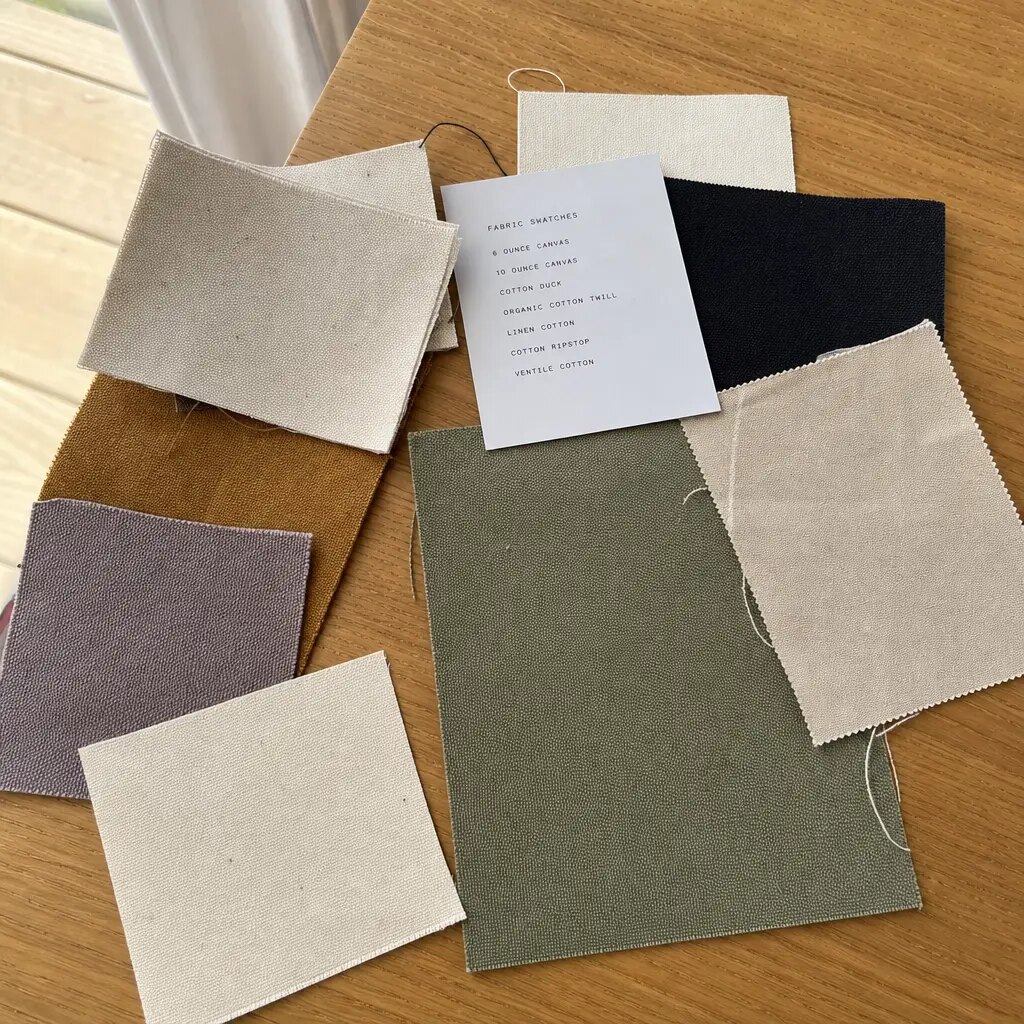
Canvas weight affects the feel of the finished portfolio, but a swatch does not tell the whole story. Once fabric is cut, sewn, lined, printed, folded, and packed, the hand feel changes. A 10 oz canvas can work for light promotional use where price is the main priority. For most wholesale canvas zipper portfolios for eco apparel brands, 12 oz canvas is the practical baseline because it gives better body without making the unit feel overly heavy or expensive. A 16 oz canvas is a stronger choice when the piece needs a premium retail feel or will be handled repeatedly by sales teams, buyers, or customers.
Material story also matters. Eco apparel brands may want conventional cotton canvas, organic cotton canvas, recycled cotton blend canvas, undyed natural canvas, washed canvas, or another lower-impact option aligned with their apparel positioning. The important procurement rule is simple: only use claims that can be supported. Ask what documentation is available before adding organic, recycled, undyed, or other sustainability language to customer-facing copy.
Shade should be discussed early. Natural canvas can vary by lot, and undyed fabric may show slubs, seed flecks, or small visual irregularities. Some brands like that look; others want a cleaner, more uniform surface for logo printing. If the logo is light, fine-lined, or color-sensitive, request a print test on the actual canvas, not a generic panel.
Lining changes both quality and schedule. Unlined portfolios are cheaper and may move faster, but the interior can show seam allowances, loose threads, and raw construction details. A light cotton, cotton twill, or polycotton lining improves presentation and helps the item hold shape. It also adds another material to source, approve, cut, sew, and inspect. For retail, showroom, and buyer-facing use, lining is often worth quoting as a separate option.
- Use 10 oz canvas for light promotional programs where structure is less important.
- Use 12 oz canvas as the baseline for most B2B portfolio orders.
- Use 16 oz canvas for premium retail, repeated sales-rep use, or heavier contents.
- Ask whether the canvas is raw, washed, pre-shrunk, dyed, undyed, organic, recycled blend, or conventional cotton.
- Require written support before using sustainability claims in marketing or retailer product copy.
Do not let the zipper be an afterthought
The zipper is the part buyers touch first and blame quickly. A portfolio can look fine on a table, but if the zipper catches at the corner, the slider feels weak, or the tape color looks wrong against the canvas, the product immediately feels lower grade. Nylon coil zippers are usually the safest choice for canvas zipper portfolios because they are flexible, widely available, and easier to run smoothly across a flat opening. Metal zippers can look more premium, but they add weight and may create alignment issues if the opening is narrow or the sewing is inconsistent.
Specify the zipper the same way you specify fabric. Include zipper size, tape color, slider color, puller style, zipper length, opening direction, and end-stop reinforcement. Stock zipper tape can reduce lead time. Matching natural tape may look better on undyed canvas, but it can affect availability or MOQ. Custom-dyed tape can add both time and risk, especially when the launch calendar is tight.
Pullers deserve a practical discussion. A standard metal puller is predictable, durable, and easier to source. Leather-look tabs, woven pull tabs, branded tabs, or custom metal pullers can improve presentation, but they add sourcing steps and approval points. If the order is urgent, a standard puller plus a woven side label may create a better balance of branding and schedule control.
For repeat programs, record the trim references. Zipper tape shade, slider finish, puller type, thread color, binding, lining shade, and label material should be written into the spec sheet. Without that record, a reorder may arrive with a slightly different zipper or puller even when the factory believes it has matched the original order.
- Specify nylon coil zipper size, tape color, slider finish, puller style, and opening direction.
- Ask whether zipper tape is in stock, custom dyed, or purchased after order confirmation.
- Require reinforcement at zipper ends and inspect the corner turns for tight pull or caught fabric.
- Avoid custom puller tooling unless the calendar includes artwork, tooling, approval, production, and inspection buffer.
- Keep a trim reference file for bulk production and reorders.
Write an RFQ that removes guesswork
A vague RFQ creates quotes you cannot compare. If you ask for a canvas zipper portfolio with logo, one supplier may price 10 oz unlined canvas with a stock zipper and one-color print. Another may price 12 oz lined canvas with reinforced seams, stronger carton packing, and better trim. The unit prices will be different, but you will not know whether the difference is quality, material, labor, or margin.
A strong RFQ should include finished dimensions, usable opening, canvas weight, canvas type, lining, pocket layout, zipper specification, thread color, seam finish, logo method, logo size, logo placement, label requirements, packing method, carton requirements, target quantity, price-break quantities, sample plan, and target ship window. If the portfolio must hold specific documents or kits, include that list too.
Artwork instructions need the same precision. Send vector artwork where possible. Include color references, print size, placement distance from seams or zipper edges, and whether the logo must remain visible when the portfolio is filled. For screen print on natural canvas, ask about ink coverage, minimum line thickness, and rub resistance. For embroidery, ask about backing, stitch density, distortion, and how the inside will look.
Ask for price breaks on the same spec. A 500-piece launch may become a 2,000-piece reorder, and the economics can change. Request separate costs for sample fees, print setup, label setup, custom puller tooling, packing upgrades, and carton changes. That separation helps you see what is one-time, what repeats, and what can be adjusted without weakening the product.
- Send one RFQ covering size, contents, canvas, lining, zipper, logo, packing, carton data, and timing.
- Attach artwork files and state logo size, placement, color reference, and approval process.
- Request price breaks at realistic quantities such as 500, 1,000, 3,000, and 5,000 units when relevant.
- Separate sample fees, tooling, print setup, label setup, packing changes, and freight-ready carton data.
- State whether the quote must include barcode labels, retailer carton marks, inspection support, or special warehouse requirements.
Understand MOQ before negotiating price
MOQ is not just a number a supplier chooses. For wholesale canvas zipper portfolios, MOQ may be driven by fabric roll length, fabric width, dye lot, zipper supplier minimums, zipper tape color, print setup, label MOQ, custom puller tooling, lining availability, or sewing line changeover. A factory may be willing to sew a low quantity, while one component still forces a higher material purchase.
The lowest practical MOQ usually comes from staying close to standard materials. Natural 12 oz canvas, stock zipper tape, one-color screen print, and a simple pocket layout are much easier to source than custom-dyed canvas, contrast lining, custom zipper tape, branded puller, and several internal dividers. If the brand needs a custom look for a first order, consider standardizing the base construction and customizing the logo, side label, or hangtag first.
Compare MOQ with total cost. A low-MOQ quote can hide extra costs in sample fees, print setup, trim surcharges, inefficient carton packing, or higher freight cube. A higher MOQ may be more efficient if it uses stable materials and creates a clean reorder path. The right choice depends on whether the portfolio is a one-time event item, a pilot for wholesale accounts, or a repeat accessory program.
When you negotiate, ask the supplier what change would reduce MOQ or cost without reducing function. They might recommend stock zipper tape, a standard puller, one lining color across several logo versions, fewer internal dividers, or a fabric already in stock. Those suggestions can be useful, but check them against the actual use case. A cheaper portfolio that cannot hold the line sheets or match brand presentation is not a win.
- Ask which component controls MOQ: fabric, zipper, logo process, label, puller, lining, or sewing setup.
- Use one base construction across multiple logo versions when possible.
- Separate first-order MOQ from reorder MOQ because stocked trims may change later economics.
- Compare total landed cost, not only the lowest MOQ and lowest unit price.
- Document any cost-saving change and confirm it does not alter the approved use case.
Use sampling to protect the calendar
Sampling is where many schedules quietly slip. A supplier may quote bulk production as a certain number of days after approval, but that does not include artwork correction, material review, sample making, sample transit, buyer review, revision, or second sample approval. If sampling is treated as informal, the project can be late before bulk production begins.
A clean sample process usually moves from material swatch to counter sample to pre-production sample. Not every order needs every step, but each sample should have a purpose. A swatch proves fabric, shade, and hand feel. A counter sample proves size, pattern, zipper path, pockets, and construction. A pre-production sample proves the final reference for bulk: actual canvas, zipper, lining, logo method, label, stitch details, and packing.
Review important samples physically whenever the order is buyer-facing or retail-facing. Photos cannot reliably show canvas body, zipper glide, pocket clearance, or crease recovery. Insert the real contents. Open and close the zipper several times. Measure width, height, usable opening, pocket depth, and logo placement. Check the interior after the portfolio is filled, not only while it is empty.
Approval needs a paper trail. The approved sample should have a date, version number, artwork reference, material notes, and any agreed exceptions. If the factory changes a component after approval, the change should be written and reapproved. The phrase same as sample only works when everyone knows which sample is the production standard.
- Define what each sample round must prove before requesting it.
- Approve fabric, zipper, lining, logo method, label, construction, and packing before bulk production starts.
- Test the sample with the actual line sheets, swatches, catalogs, tablet, or appointment materials.
- Record sample version, approval date, artwork reference, and approved exceptions.
- Do not release bulk production while artwork size, zipper color, or pocket layout is still open.
Build the lead time plan backward
A realistic lead time plan starts with the in-hand date and works backward. Eco apparel brands often coordinate accessories with seasonal launches, wholesale market weeks, retailer meetings, pop-ups, sales appointments, or e-commerce drops. If the portfolio supports one of those dates, production days alone are not enough.
Map the full path: RFQ review, quote comparison, material confirmation, artwork release, sample production, sample transit, buyer review, revision buffer, deposit, bulk production, in-line checks if needed, final inspection, packing, freight booking, customs or import handling, warehouse receiving, and any internal kitting. Each step needs an owner and a deadline.
Clarify the production start condition in writing. Many factories count production lead time only after deposit, final artwork, material confirmation, packing instruction, and pre-production sample approval are complete. If one item is missing, production may not be scheduled even if the purchase order has been sent.
Build in one revision cycle for buyer-facing or retail programs. That buffer protects against normal corrections such as logo scale, zipper shade, pocket depth, stitch color, or packing fold. If the first sample passes, the buffer can absorb inspection scheduling or freight delays. If it does not, the project does not immediately become an emergency.
Also account for external timing. Holidays, factory workload, material availability, print capacity, and freight space can all affect delivery. If air freight becomes necessary, carton cube matters because flat canvas goods can be bulky. Packing decisions made late can change freight cost and receiving plans.
- Plan backward from the in-hand date, not forward from the purchase order date.
- Ask the supplier to define exactly when bulk production lead time starts.
- Include one planned revision cycle for retail, showroom, or buyer-appointment programs.
- Add buffer for holidays, material booking, print capacity, inspection scheduling, freight booking, and warehouse receiving.
- Share the calendar with the supplier so impossible approval dates are flagged early.
Lock packing before freight is quoted
Packing is both a quality decision and a landed-cost decision. Canvas zipper portfolios are often flat-packed to reduce carton cube, but the method has to be controlled. If the units are compressed too tightly, the canvas can arrive with hard creases, distorted corners, or pressure marks around the zipper. If they are packed too loosely, cartons become larger and freight cost rises.
Unit packing depends on the channel. Trade show handouts may only need simple protection or grouped inner packing. Retail items may need individual bags, barcode labels, hangtags, warning labels if applicable, SKU stickers, or cleaner fold presentation. Warehouse and retailer routing guides may require carton labels, carton numbering, scannable barcodes, single-SKU cartons, or specific carton marks. These details belong on the purchase order before production packing begins.
Moisture protection is especially important for cotton-based canvas. Canvas can pick up odor, dust, humidity, or mildew risk if packed poorly. Ask whether the factory uses inner polybags, carton liners, desiccant, or other moisture-control measures for the export route. Confirm carton strength as well. A good final inspection does not help if weak cartons collapse during handling.
Request carton data before booking freight: units per carton, carton dimensions, gross weight, net weight, and total carton count. If carton size changes after the quote, landed cost can change. Normalize packing assumptions when comparing suppliers. A lower unit price can disappear if the shipment uses inefficient cartons or requires repacking after arrival.
- Approve unit packing, fold method, carton count, carton dimensions, and gross weight before shipment planning.
- Request packing photos or a packed sample for retail-facing orders.
- Confirm barcode placement, SKU label format, carton marks, and single-SKU or mixed-carton requirements.
- Check crease recovery and zipper shape after opening the packed sample.
- Use the same carton assumptions when comparing landed cost across suppliers.
Inspect the details that make the product feel reliable
Quality control should cover function, appearance, and consistency. The visible issues are easy to notice: stains, shade variation, crooked logos, uneven stitching, loose threads, poor folding, and rough zipper alignment. The more damaging issues are functional: zipper failure, tight openings, weak corners, pockets that do not fit the intended contents, or dimensions that drift outside tolerance.
The approved sample should guide inspection, but written tolerances make the standard clearer. Define acceptable tolerance for finished width, height, gusset, pocket depth, usable opening, zipper length, and logo position. For a buyer-facing portfolio, even small logo shifts can look careless when units are displayed together.
Zipper testing should be hands-on. Inspectors should open and close the zipper repeatedly on sampled units, check for fabric caught in the teeth, confirm the slider does not detach, and inspect reinforcement at zipper ends. If the zipper curves around corners, the corner area needs extra attention because puckering and tight pull are common there.
Logo QC depends on the method. Screen print should be checked for ink coverage, registration, edge sharpness, smudging, color match, and rub resistance. Embroidery should be checked for thread tension, distortion, backing, loose threads, and interior appearance. Woven labels should be checked for placement, straightness, fold, stitching, and frayed edges. Heat transfers should be checked for adhesion, scorching, gloss difference, and peeling risk.
Packing QC matters too. Confirm unit count, inner packing, carton marks, barcode accuracy, carton condition, and moisture protection. If the portfolio is retail-facing, inspect the fold and presentation consistency. A product can pass sewing inspection and still create receiving or merchandising problems if labels are wrong or cartons are inconsistent.
- Inspect fabric shade, stains, odor, loose threads, seam finish, and needle damage.
- Test zipper glide, end stops, puller strength, and corner movement on sampled units.
- Measure finished size, usable opening, pocket depth, and logo placement against written tolerances.
- Check logo quality according to the actual method: screen print, embroidery, woven label, or heat transfer.
- Verify carton count, SKU labels, barcode placement, shipping marks, carton condition, and moisture protection before release.
Specification comparison for buyers
| Spec decision | Recommended option | When it fits | Buyer risk to check |
|---|---|---|---|
| Fabric weight | 12 oz canvas as the baseline; 16 oz for premium retail or repeated rep use | Daily-use portfolios, wholesale line reviews, showroom kits, trade show handouts, and retail bundles | Confirm the finished hand feel after lining, zipper, binding, and print. A fabric that looks adequate as a swatch can feel too soft once sewn into a finished bag. |
| Canvas type | Conventional cotton canvas, organic cotton canvas, recycled cotton blend, or undyed natural canvas, depending on brand claim | Eco apparel brands that need the accessory story to align with apparel positioning | Ask what documentation supports the claim. Do not describe a sustainability attribute in customer-facing copy unless the supplier can back it with written evidence. |
| Print method | Screen print for bold logos; woven label or embroidery for premium branding; heat transfer only when the artwork requires it | One- to two-color logos, recurring wholesale programs, and buyer-facing presentation pieces | Check minimum line thickness, color registration, rub resistance, and whether the decoration changes the hand feel or interior finish. |
| Zipper spec | Nylon coil zipper with matching tape and a standard metal puller; custom puller only when timing allows | Most portfolio programs that are handled often or shipped in bulk | Verify open-close cycles, slider strength, tape color consistency, end-stop reinforcement, and whether the sample and bulk use the same zipper source. |
| Supplier route | Direct bag factory for custom specs; trading partner for consolidation; local decorator for urgent low-volume blank customization | Programs needing cost control, custom trim management, direct QC input, or fast domestic finishing | Confirm who owns zipper sourcing, sample approval, in-line inspection, final inspection, and carton packing decisions. |
| MOQ strategy | Start with a standard base spec and custom logo, then add custom trims after reorder confidence | Launches, seasonal drops, new wholesale accounts, and test orders | Low MOQ can hide cost in sample fees, print setup, trim surcharges, or inefficient carton packing. |
| Sampling route | Material swatch, counter sample, then pre-production sample when artwork and trims are final | Orders where logo placement, zipper color, pockets, or retail presentation must be locked | Do not approve from photos alone. Verify zipper glide, canvas body, stitching, logo size, and actual document fit. |
| Lining choice | Unlined for basic promotions; light cotton, polycotton, or cotton twill lining for retail and buyer-facing use | Retail accessory bundles, wholesale appointment kits, showroom folders, and premium brand collateral | Unlined bags may show seam allowances and loose threads. Lined bags add cost and can extend production if fabric is not in stock. |
| Packing method | Flat pack with controlled carton size, moisture protection, and SKU-ready labeling | Export cartons, warehouse receiving, retailer routing guides, and e-commerce fulfillment preparation | Confirm carton cube, gross weight, net weight, barcode placement, carton marks, and crease recovery before freight booking. |
Buyer checklist before sampling
- Define the finished size, usable opening, pocket layout, zipper direction, zipper color, logo placement, and packing method before requesting final quotes.
- Specify canvas weight in oz or GSM, canvas type, lining requirement, zipper grade, puller style, seam finish, stitch density, and reinforcement points in the RFQ.
- State whether the portfolio must hold specific items such as lookbooks, line sheets, swatch cards, invoices, tablets, hangtags, or buyer appointment materials.
- Request a material swatch and a counter sample before the pre-production sample when the order uses a new canvas, new zipper color, or new logo process.
- Approve the pre-production sample with the actual fabric, zipper, lining, logo method, label, and packing method intended for bulk production.
- Ask whether MOQ is driven by fabric availability, fabric width, print setup, zipper color, puller tooling, label MOQ, or total style count.
- Require a written tolerance for finished dimensions, logo placement, fabric shade, stitch appearance, and carton quantity.
- Ask for carton dimensions, units per carton, gross weight, net weight, inner packing, barcode position, carton marks, and moisture protection before approving the purchase order.
- Build a calendar that includes artwork release, material confirmation, sample production, sample transit, review buffer, revision time, bulk production, inspection, freight booking, and warehouse receiving.
- Keep the approved sample, spec sheet, packing instruction, and QC checklist together so inspection is based on the same reference used by production.
Factory quote questions to send
- What canvas weight, canvas type, and finished hand feel do you recommend for this portfolio size and end use?
- Is the quoted canvas conventional cotton, organic cotton, recycled cotton blend, undyed natural canvas, washed canvas, or another material? What documentation is available?
- Is the MOQ based on fabric stock, fabric dyeing, zipper color, print setup, label MOQ, puller tooling, or total order quantity?
- Which logo method is included in the quoted price, and what are the setup charges, color limits, minimum line widths, and lead time impact?
- Will the zipper tape, puller, lining, thread, binding, and reinforcement be identical on the approved sample and bulk production?
- What must be frozen before the production lead time starts: artwork, deposit, sample approval, material booking, zipper color, label artwork, or packing instruction?
- What is the standard lead time for sample, pre-production sample, bulk production, inspection preparation, and carton packing?
- How many units are packed per carton, what are the carton dimensions and gross weight, and can you provide a packing photo before shipment?
- What measurement tolerance do you use for width, height, gusset, pocket depth, logo placement, and zipper length?
- Can you share your QC checklist for fabric defects, stitching, zipper function, logo placement, shade matching, loose threads, packing, and carton labeling?
Quality-control points to confirm
- Canvas weight, canvas type, and hand feel match the approved sample within agreed tolerance and do not feel noticeably lighter, thinner, or softer than expected.
- Fabric shade is consistent within the shipment, with no obvious lot variation, yellowing, water marks, oil stains, dust marks, or odor.
- Zipper opens and closes smoothly through repeated cycles, with no caught fabric, bent teeth, loose slider, rough corners, missing end stops, or weak puller attachment.
- Zipper tape color, puller finish, thread color, lining shade, label style, and binding match the approved sample and written spec.
- Logo placement stays within the approved position and size tolerance, with no print shift, uneven ink coverage, embroidery distortion, heat marks, or label misalignment.
- Stitching is even and secure at stress points, especially zipper ends, corners, pocket edges, binding turns, and reinforced seams.
- Finished dimensions match the tolerance window for width, height, gusset, pocket depth, usable opening, and internal divider position.
- Interior finishing is clean, with no exposed loose threads, raw seam issues, needle damage, trapped fabric, or bulky corners that prevent documents from fitting cleanly.
- Unit packing protects the canvas from moisture, dust, and compression marks, and retail-facing units are folded consistently with acceptable crease recovery.
- Cartons are strong enough for export handling and show correct unit count, SKU, carton number, gross weight, destination marks, barcodes if required, and clean sealing.