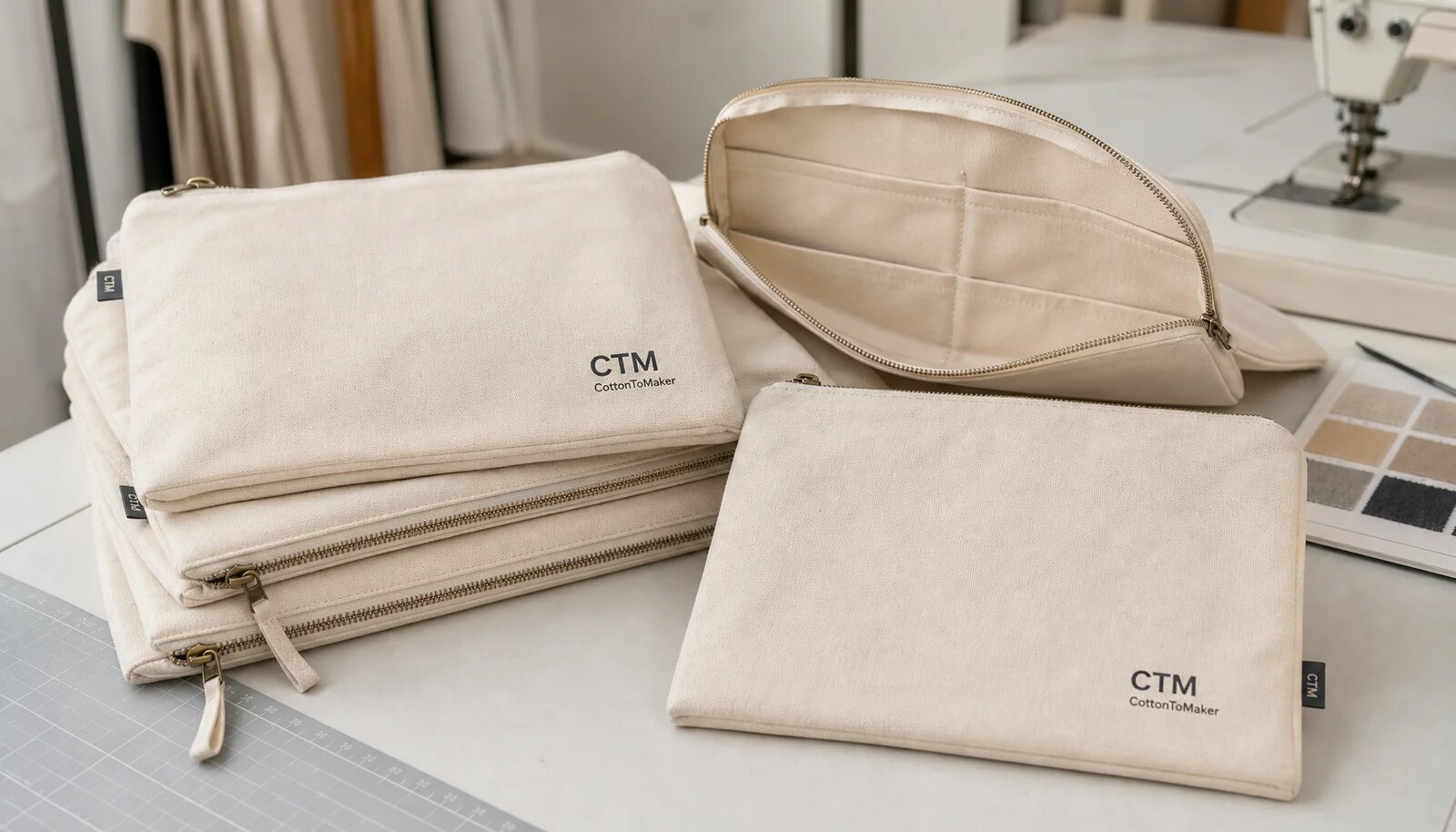
Start With the Real MOQ Driver
MOQ is rarely one clean number for wholesale canvas zipper portfolios for hotel retail. The factory is managing minimums across canvas rolls, dye lots, zipper tape, sliders, pullers, lining fabric, labels, printing screens, ink, hangtags, barcode labels, packing materials, cutting setup, sewing line changeover, inspection, and export cartons. If the RFQ says only "canvas zipper portfolio with hotel logo, best MOQ," the supplier has to guess. One supplier may quote a low price using stock materials and bulk packing. Another may protect itself with a higher MOQ because the construction is unclear.
A stronger negotiation starts by separating your commercial goal from the factory's production logic. Tell the supplier whether the order is a hotel gift shop test, a spa retail launch, a conference merchandise run, a guest welcome kit, or a replenishable portfolio used across several properties. Add the expected order quantity, number of body colors, number of hotel logos, destination split, delivery dates, and likely reorder pattern. With that information, the factory can point to the real MOQ driver instead of treating the whole item as one vague minimum.
Total volume and SKU volume also need to be discussed separately. A 1,000-piece order can be efficient if all pieces use one natural canvas body, one zipper color, one print method, one packing style, and one shipment date. The same 1,000 pieces can become awkward when split across five hotel logos, three body colors, two barcodes, and staggered delivery windows. Each split may require separate material allocation, print setup, packing control, carton marking, and inspection records.
- Ask whether MOQ is driven by fabric roll, dye lot, zipper tape, slider finish, label minimum, print setup, packing separation, or line changeover.
- Keep one base construction across properties where possible, then vary only the hotel logo, barcode, or carton destination.
- Treat each body color, logo design, trim color, label version, packing version, and delivery batch as a separate MOQ variable.
- Negotiate a first-run surcharge or reorder tier instead of pushing for below-cost bulk pricing on a trial order.
- Reject low-MOQ offers that depend on substitute fabric, mixed dye lots, unapproved trim, or unclear defect responsibility.
Specify Canvas by GSM, Finish, and Shrinkage
Canvas weight affects the product in ways buyers notice: hand feel, structure, shelf presentation, sewing bulk, carton weight, and landed cost. In sourcing conversations, 10 oz cotton canvas is often around 300-320 GSM, 12 oz is often around 360-380 GSM, and 14 oz is often around 420-450 GSM. These are useful planning ranges, not universal conversions. Yarn count, weave density, finishing, and fabric width all matter, so a serious B2B quote should state both oz and actual tested GSM, with a written tolerance such as +/-5% unless your program requires another range.
For many hotel retail portfolios, 12 oz canvas is a sensible starting point. It usually has enough body to feel retail-ready without making the zipper corners too bulky. A 10 oz version can work for a value document sleeve, conference insert pouch, or welcome kit where lower cost and lighter freight are priorities. A 14 oz version can support a more premium boutique position, but procurement should expect thicker seams, slower sewing at intersections, higher carton weight, and possibly fewer units per carton.
Finish needs the same attention as weight. Natural unbleached canvas gives the relaxed look many resort shops and spa retailers want, but it can include seed flecks, slubs, neps, and shade variation. Those features are not automatically defects; they become problems only when the approved standard is vague. Bleached canvas gives cleaner print contrast but shows dirt and handling marks quickly. Dyed canvas can match a property palette, but it usually needs lab dips, shade-band approval, and MOQ confirmation per color. If recycled cotton or organic cotton is requested, ask what documentation is available before making that claim in retail copy, hangtags, or packaging.
- Quote canvas in oz and GSM, with fabric width, finish, color, and GSM tolerance written into the specification.
- Ask for shrinkage data before cutting, especially for washed, dyed, steam-pressed, or lined construction.
- Approve natural canvas visually: slub size, seed fleck density, shade band, and front-panel standard.
- Use dyed canvas only after lab dip approval and confirmed MOQ per color.
- Confirm whether fabric is inspected before cutting and how defects are marked, avoided, or replaced.
Build the Portfolio Around Contents
A zipper portfolio should be designed around what the hotel guest, retail shopper, event attendee, or staff member will actually carry. A portfolio for A4 documents needs different clearance from one made for US letter papers, spa menus, resort maps, guest vouchers, stationery kits, room documents, or tablet accessories. If the finished size is too tight, papers bend at the corners and the zipper takes extra stress. If the portfolio is too large, it wastes fabric, raises CBM, and may look loose or underfilled on a retail shelf.
Send actual inserts whenever possible. For A4 papers, the supplier needs to know whether the item holds a few flat sheets, a brochure stack, a menu set, or a folder insert. For tablet accessory use, define whether it must hold charging cables, adapters, pens, cards, and papers, because bulkier contents may require a gusset, padding, or wider zipper opening. A flat canvas portfolio is not automatically suitable for hard or bulky contents.
Measurement method should be part of the specification, not a late-stage argument. State whether width and height are checked flat before packing, after pressing, after packing recovery, or when filled with the intended contents. For many flat sewn cotton goods, +/-5 mm is a practical general tolerance. Critical document-fit points may need tighter control, especially zipper opening length and pocket opening width. Logo placement needs its own tolerance, typically measured from fixed edges to the print center or print boundary.
- Send actual inserts or exact content dimensions instead of relying on a catalog photo or rough size name.
- Define finished width, height, gusset depth if any, zipper opening length, pocket opening, and corner shape.
- State whether the zipper opens left-to-right, right-to-left, or along a specific edge.
- Use one flat inner slip pocket as the MOQ-friendly base; add pen loops, card slots, or dividers only when they add retail value.
- Confirm tolerances separately for body size, pocket size, zipper opening, and logo placement.
Control Zipper and Hardware Specs
The zipper is one of the first components a hotel retail customer touches. It is also one of the easiest places for a vague specification to become a quality problem. A No. 5 nylon coil zipper is a reliable default for most canvas zipper portfolios because it is flexible, widely available, and suitable for flat sewn goods. It also reduces scratching risk compared with many metal options and is easier to pack safely against light canvas or printed panels.
Metal zippers can make sense for premium boutique programs, executive conference merchandise, or upscale gift sets where the hardware supports a higher retail price. They also bring more inspection risk. Metal teeth or sliders can mark natural canvas, scratch the printed face panel, or feel sharp if finishing is poor. If metal is selected, require edge checks, slider checks, finish confirmation, and a packing method that prevents the puller from pressing into the logo or front panel during transit.
The RFQ should identify zipper type, gauge, tape color, slider finish, puller material, zipper length, and end reinforcement. Contrast zipper tape can add visual value, but it may create a separate trim MOQ. Custom metal pullers, leather pulls, embossed tabs, or branded sliders may involve tooling and longer lead time. For first runs, many buyers get better value by using a proven stock slider and spending the budget on better canvas, cleaner printing, and stronger retail packing.
- Specify nylon coil, metal, or plastic molded zipper; do not allow the supplier to choose silently.
- Use No. 5 nylon coil as the standard quote unless the brand concept requires another style.
- Confirm zipper tape color, slider finish, puller shape, puller material, and whether the tape must match the body fabric.
- Require zipper-end reinforcement for frequent-use portfolios or tight document loading.
- Check samples by opening and closing the zipper across the full length several times, not just once for a photo.
Choose Lining, Pockets, and Reinforcement Carefully
Unlined construction is usually the most MOQ-friendly route. It reduces material types, cutting layers, seam complexity, colorfastness risk, and inspection points. For simple document sleeves, welcome kit wallets, or conference paper organizers, an unlined 10 oz or 12 oz canvas body may be enough if the inside seams are clean and the zipper tape is neatly finished. Still, the buyer should define whether raw edges are acceptable or whether seams need overlock, binding, or enclosed construction.
Lining improves perceived value and protects contents, but it changes the sourcing calculation. Cotton lining can support a natural canvas story, while 210D polyester lining can be smoother and easier to wipe clean. Both need color and shrinkage checks. Dark lining against natural or bleached canvas can create color transfer risk if the goods face moisture, heat, or pressure. If the portfolio is sold as a premium hotel retail organizer, lining may be worth the cost, but it should be specified clearly rather than assumed.
Pockets and reinforcement should follow function, not decoration alone. One flat inner slip pocket is a practical base for vouchers, documents, postcards, or menus. Pen loops, elastic loops, card slots, mesh pockets, divider panels, gussets, or padding can add utility, yet each feature adds cutting pieces, sewing minutes, and tolerance risk. Reinforcement is most useful at zipper ends, corners, pocket openings, label seams, and any stress point guests will pull, load, or flex repeatedly.
- State lining material, color, GSM or denier, seam finish, and colorfastness expectation.
- Define usable pocket opening and pocket depth, not only the visual pocket layout.
- Avoid multiple pocket variations across properties when negotiating low MOQ.
- Add reinforcement where the product is pulled, opened, or loaded rather than everywhere by default.
- Check that pockets do not distort the front panel, block the zipper path, or create visible pressure marks.
Match Logo Method to Artwork Risk
Screen printing is usually the most efficient branding method for canvas zipper portfolios when the artwork uses one to three solid colors. It can produce clean hotel logos at a practical setup cost, but the buyer should approve a physical print on the actual canvas. Ink color can shift on natural, bleached, dyed, or dark fabric. Canvas texture can soften edges compared with paper, PU, or coated synthetic materials. A digital proof helps with layout, but it is not a final standard for color, opacity, or adhesion.
Woven labels, cotton labels, and patches are strong options for repeat hotel retail programs. A label can be produced once and applied across several body colors or replenishment orders, which may help MOQ planning when multiple properties share a brand mark. PU, leather, or cotton patches can raise perceived value, but they need checks for edge finish, stitch quality, colorfastness, thickness, and pressure marks in packing. Custom labels and patches may have their own MOQ even if the portfolio MOQ is lower.
Heat transfer, embroidery, metallic ink, large solid prints, and fine reversed text need extra proofing. Heat transfer must be tested for adhesion, edge lifting, cracking, and hand feel on textured canvas. Embroidery may pucker lighter canvas or interfere with inner pockets. Metallic ink may require special handling and may not match a digital metallic effect. Any logo placed close to a zipper, seam, rounded corner, or pocket stitch line should be tested at actual size before bulk approval.
- Provide vector artwork, Pantone references, print size, placement from edges, and approved orientation.
- Use screen print for solid hotel logos and moderate MOQ programs.
- Use woven or cotton labels when one brand mark repeats across several SKUs or properties.
- Require physical approval for fine text, metallic ink, heat transfer, embroidery, or large ink coverage.
- Set logo placement tolerance, measured from the nearest edge to print center or print boundary.
Negotiate MOQ With Practical Trade-Offs
A supplier can often lower MOQ when the buyer changes the part of the specification that creates the minimum. If fabric is the constraint, use stock natural canvas, reduce body colors, or combine multiple hotel logos on one base material run. If print setup is the constraint, reduce color count, avoid special ink, or batch logos efficiently. If trim is the constraint, use stock zipper tape and a standard slider finish. If packing is the constraint, standardize the retail sleeve, barcode format, and carton rules across destinations.
The cleanest negotiation structure is a shared base style. Keep the same finished size, canvas weight, zipper, lining, pocket layout, reinforcement, and packing method across properties. Change only the logo, barcode, or carton destination when needed. This lets the supplier cut and sew more efficiently while still giving the hotel group, resort operator, or distributor property-specific branding. It also makes QC easier because inspectors compare one construction instead of many small variations.
When the buyer needs a small trial order, ask for transparent pricing rather than unrealistic bulk pricing. A first-run surcharge, sample charge, print setup charge, or higher unit price may be more honest than a low MOQ that hides substituted materials or loose tolerances. If repeat orders are likely, ask for tiered pricing at trial quantity, reorder quantity, and annual forecast quantity. A forecast is not a purchase order, but it helps the supplier judge whether supporting a lower first run is commercially sensible.
- Standardize body construction first; negotiate logo and packing splits second.
- Ask the factory to identify the exact MOQ blocker before changing the order quantity.
- Use stock canvas, stock zipper tape, standard slider, and one-color print for the lowest MOQ path.
- Offer a higher first-run price with confirmed reorder tiers when testing hotel retail demand.
- Do not accept below-MOQ terms that remove lab dips, samples, inspection, or material approval.
Read Quotes Beyond Unit Price
Two suppliers can quote the same product name and still be quoting different products. One may assume 10 oz unlined canvas, a basic stock zipper, one-color print, and bulk packing. Another may include 12 oz canvas, lining, reinforced zipper ends, a woven side label, individual retail packing, barcode stickers, stronger export cartons, and inspection support. The lower unit price is not automatically better if the portfolio needs to arrive shelf-ready for hotel retail or pass distributor receiving rules.
A complete B2B quote should identify finished size, fabric GSM, fabric finish, zipper type and gauge, lining, pocket construction, logo method, setup charges, sample cost, MOQ by variable, lead time, packing method, carton data, incoterm, payment terms, and inspection responsibility. If carton dimensions and gross weight are missing, the buyer cannot compare landed cost accurately. Canvas goods can be bulky relative to value, and a small packing change may affect CBM, courier charges, warehouse handling, or palletization.
Incoterms also need careful comparison. EXW, FOB, FCA, CIF, DAP, and DDP quotes include different responsibilities and costs. A low EXW price can become expensive if local handling, export clearance, trucking, inspection, or packing upgrades are not included. For hotel retail buyers using distributors or 3PL warehouses, the receiving standard may matter as much as the factory price. Barcode accuracy, carton marks, packing list detail, and SKU separation should be in the quote, not added after the purchase order.
- Compare quotes only after aligning canvas GSM, zipper, lining, pockets, logo method, packing, and inspection assumptions.
- Request units per carton, carton size, gross weight, net weight, carton count, and estimated CBM.
- Separate tooling, screen, label, patch, sample, material surcharge, and bulk unit cost.
- Confirm whether inspection, sorting, rework, or replacement is included or billed separately.
- Ask suppliers to state assumptions when quoting from a sketch, reference photo, or incomplete tech pack.
Approve Samples With Measurable Records
A polished sample photo is not enough for a wholesale hotel retail order. The approval sample should use the nominated canvas weight, actual zipper, intended lining, correct pocket layout, approved logo method, labels, hangtags, barcode, and proposed packing. If the first prototype uses substitute fabric, missing trim, approximate dimensions, or a different print method, label it as a prototype only. Bulk production should not start until a true pre-production sample represents the order construction.
Sample approval should include function checks, not just appearance. Load the intended documents or inserts and confirm they fit without bent corners or excessive zipper tension. Open and close the zipper several times and feel for rough spots at the corners or stops. Check whether the slider or puller scratches the print when pieces are stacked. Measure finished width, height, pocket opening, zipper opening, logo placement, and label position. View natural canvas and logo contrast under normal retail lighting, not only under factory lights.
The approval record should be written and shared. Keep one sealed sample at the factory and one with the buyer or inspection team. Create a revision sheet that lists approved details and required corrections: GSM, shade, zipper feel, lining color, pocket size, print color, print placement, print adhesion, seam quality, label location, hangtag, barcode, individual packing, carton marks, and carton quantity. Chat approvals are helpful for speed, but they are weak as the final standard if a dispute occurs.
- Approve a sealed pre-production sample before cutting bulk fabric.
- Record sample deviations in a revision sheet with measurements and photos.
- Use the actual contents to test loading, pocket usability, and zipper stress.
- Require print rub or adhesion checks after curing, especially for heat transfer or heavy ink coverage.
- Confirm the approved sample includes final retail packing, not only the product body.
Set QC Thresholds Before Shipment
QC should define function, appearance, safety, and retail readiness before production begins. Critical defects include the wrong hotel logo, unsafe sharp hardware, unusable zipper, incorrect SKU, or a portfolio that cannot hold the intended contents. Major defects include open seams, broken slider, severe stain, wrong dimensions, missing barcode, incorrect label, obvious print defect, mixed carton, or packing that damages the product. Minor defects may include small loose threads, slight non-functional wrinkles, or natural canvas features within the approved visual standard.
A zipper portfolio inspection should not be copied from a generic tote bag checklist. Inspectors should check zipper operation across the full length, zipper-end reinforcement, seam strength at corners, stitch density, pocket usability, logo placement, print adhesion, fabric cleanliness, lining color transfer, label attachment, barcode accuracy, and carton separation by SKU. For hotel retail programs with multiple property logos, assortment accuracy is a major commercial risk. A well-made item in the wrong carton can still create chargebacks, receiving delays, and store allocation problems.
If AQL inspection is used, define the sampling plan, inspection level, and defect classification before final goods are packed. Share the purchase order, approved sample, measurement sheet, artwork proof, packing instruction, barcode list, carton marks, and defect list with the inspector. Inspection should cover both loose finished goods and packed cartons. Packed-carton checks verify SKU separation, carton marks, barcode application, carton count, gross weight, and whether retail packing protects the print and zipper.
- Classify wrong logo, unsafe hardware, unusable zipper, and wrong SKU as critical defects.
- Classify open seams, severe stains, broken sliders, wrong dimensions, and missing barcodes as major defects.
- Measure body size, zipper opening, pocket opening, logo placement, and carton data during inspection.
- Check light canvas for oil, water, dirt, pencil, rust, glue, color transfer, and packing marks.
- Inspect packed cartons as well as loose goods before shipment release.
Specification comparison for buyers
| Spec decision | Recommended buying specification | When it fits | Quote or QC risk to check |
|---|---|---|---|
| Canvas weight | Quote in both oz and tested GSM. As a planning guide, 10 oz cotton canvas is often about 300-320 GSM, 12 oz about 360-380 GSM, and 14 oz about 420-450 GSM, depending on weave and finish. | 10 oz suits value document sleeves and welcome kits. 12 oz is a strong default for hotel retail portfolios. 14 oz works for premium boutique retail when extra seam bulk and freight weight are acceptable. | Oz-to-GSM conversion varies. Require swatches, an approved GSM tolerance such as +/-5%, and shrinkage results before cutting. |
| Canvas finish | Natural unbleached canvas for a relaxed retail look; bleached canvas for cleaner logo contrast; dyed canvas only after lab dip approval, shade band approval, and MOQ confirmation per color. | Natural fits resort shops, spa retail, and eco-positioned gifting. Dyed canvas fits property palettes, corporate brand programs, and color-coded SKUs. | Natural canvas may show seed flecks and slubs. Dyed canvas may vary by lot. Define acceptable shade range against signed swatches. |
| Finished size and tolerance | Specify finished width, height, gusset if any, zipper opening length, pocket opening, and measurement method. For flat sewn goods, +/-5 mm is common; document-fit areas may need tighter control. | A4 document wallets, US letter portfolios, conference pouches, spa retail kits, stationery sets, resort map sleeves, menu card organizers, or tablet accessory holders. | A portfolio that is 5-8 mm too small can fail the intended insert even if the sewing looks fine. Send actual inserts or exact content dimensions. |
| Zipper construction | No. 5 nylon coil zipper with a smooth slider is the practical default. Quote metal zipper only when premium positioning justifies scratch, sharp-edge, and packing checks. | Nylon coil suits volume hotel retail and distributor replenishment. Metal suits premium gift shop ranges, executive meeting merchandise, or boutique gift sets. | Low-grade sliders can jam, split, or scratch the product. Require full-length operation checks, zipper-end reinforcement, and confirmation of tape color, slider finish, and puller material. |
| Lining and reinforcement | Unlined for cost-sensitive portfolios; cotton lining or 210D polyester lining for cleaner interiors; add interlining, binding, padding, or reinforcement only where function requires it. | Unlined fits simple document use. Lined fits retail organizers, tablet accessories, premium stationery kits, or gift sets where the inside finish is visible. | Lining adds shrinkage, colorfastness, seam allowance, and puckering risk. Dark lining or trim can stain light canvas under pressure or moisture. |
| Pocket layout | MOQ-friendly base: one main zip compartment plus one flat inner slip pocket. Add pen loops, card slots, elastic, mesh, divider panels, or gussets only when the retail use case needs them. | Useful for guest documents, vouchers, menus, maps, stationery, conference inserts, spa forms, or small travel papers. | Small pockets increase sewing time and measurement failures. Define usable opening width, pocket depth, stitch position, and whether contents must fit after sewing. |
| Logo method | Screen print for 1-3 solid colors; woven label or cotton label for repeat programs; patch branding for premium lines; heat transfer only after adhesion and edge-lift testing on the actual canvas. | Screen print fits seasonal hotel logos. Labels fit multi-property replenishment. Patches fit boutique retail when thickness, stitching, and packing are controlled. | Fine serif type, reversed text, metallic ink, large ink coverage, and printing near zippers or seams need physical proofing plus rub and adhesion checks. |
| Packing plan | Individual polybag, paper sleeve, glassine bag, tissue wrap, paper band, or carton divider, then export cartons separated by SKU, logo, barcode, destination, and delivery batch. | Hotel gift shops, spa retail, distributor warehouses, property-specific allocations, barcode-controlled replenishment, and retail-ready receiving. | Bulk loose packing can cause zipper scratches, print transfer, crushed corners, dirty handling, carton mix-ups, and receiving disputes. |
| MOQ negotiation lever | Negotiate by the actual MOQ driver: fabric roll yield, dye lot, zipper tape, slider finish, label minimum, print setup, packing separation, and sewing line changeover. | Best when the buyer can standardize construction, combine base production, reduce logo colors, use stock materials, or commit to practical reorder tiers. | Forcing low MOQ while keeping custom colors, trims, multiple logos, and special packing can lead to substituted materials, rushed samples, or inflated unit pricing. |
Buyer checklist before sampling
- Define the use case by contents: A4 documents, US letter papers, spa forms, menus, resort maps, conference inserts, stationery sets, guest vouchers, welcome letters, or tablet accessories.
- Provide finished dimensions in millimeters, zipper opening length, opening direction, corner radius, seam allowance expectation, pocket depth, and whether measurements are checked flat, filled, pressed, or after packing recovery.
- Specify canvas weight in both oz and GSM, fabric width if known, finish, color, shrinkage requirement, and whether the fabric is natural, bleached, dyed, washed, recycled cotton, organic cotton, or blended canvas.
- Confirm acceptable visual standards for natural canvas: slubs, seed flecks, neps, uneven yarn, shade variation, and weaving irregularities on front, back, and inside panels.
- State zipper type, gauge, tape color, slider finish, puller material, puller shape, zipper-end reinforcement, and whether the zipper must pass a repeated open-close check.
- Confirm whether the portfolio is unlined, self-lined, cotton lined, polyester lined, padded, interfaced, bound, or reinforced at zipper ends, corners, pocket openings, and label attachment points.
- Provide logo artwork as vector files with Pantone or brand color references, print size, placement from edges, maximum placement tolerance, print method preference, and approved orientation.
- Separate MOQ by body color, logo design, print color count, zipper tape color, label version, packing version, barcode, delivery date, and destination so the supplier can quote honestly.
- Request a pre-production sample using the nominated fabric, zipper, lining, logo method, pocket layout, label, hangtag, barcode, and packing method rather than relying on a similar showroom sample.
- Create a sample revision sheet covering size, GSM, shade, zipper feel, pocket usability, print color, print adhesion, logo placement, seam quality, label position, packing, and carton marks.
Factory quote questions to send
- What is your practical MOQ per body color, per logo design, per print color count, per zipper tape color, per label version, per packing version, and per delivery batch for this construction?
- Which cotton canvas weights do you keep in regular stock, and what are the actual GSM range, fabric width, roll length, shrinkage rate, color availability, and estimated cutting loss?
- Can you quote 10 oz, 12 oz, and 14 oz versions separately with estimated unit weight, carton quantity, carton dimensions, gross weight, and CBM so we can compare landed cost?
- Is the quoted zipper nylon coil, metal, or plastic molded, and what gauge, tape color, slider finish, puller material, zipper length, and zipper-end reinforcement are included?
- Does the price include lining, inner pocket, pen loop if any, reinforcement, screen print, woven label, care label, hangtag, barcode sticker, individual packing, master carton, and carton marks?
- What logo method do you recommend for our artwork, and what are the screen, plate, mold, patch, label, or setup charges by color, logo version, and repeat order?
- Can the pre-production sample be made with the same fabric lot or approved bulk fabric quality, zipper, lining, pocket layout, logo method, label, packing, and carton standard used for bulk?
- If a prototype uses substitute material, zipper, lining, print method, or packing, how will you identify those deviations before the true pre-production sample is approved?
- What lead time is required for artwork proof, material sourcing, lab dip if dyed, sample making, sample revision, material booking, cutting, printing, curing, sewing, finishing, inspection, packing, and shipment booking?
- What are the carton dimensions, units per carton, gross weight, net weight, carton quantity, estimated CBM, palletization option if any, and maximum carton weight for our order size?
Quality-control points to confirm
- Canvas GSM should match the approved specification within the agreed tolerance, commonly +/-5% unless the buyer sets another limit, and must not feel noticeably thinner, looser, or softer than the signed sample.
- Fabric shade should match the approved swatch or shade band under agreed lighting, with natural canvas slubs, seed flecks, and neps limited to the approved visual standard for retail-facing panels.
- Finished width, height, zipper opening, pocket opening, and gusset if any should stay within the agreed tolerance; +/-5 mm is common for flat sewn goods, but insert-fit areas may need tighter control.
- Zipper must open and close smoothly across the full length without skipped teeth, loose slider, broken puller, sharp edge, twisting tape, misaligned ends, or puckering that affects function or appearance.
- Zipper tape should be securely caught in the seam, reinforced ends should not pull out under normal hand use, and the slider should not scratch light canvas or printed panels during packing.
- Seams should be straight, properly back-tacked at stress points, and free from open seams, skipped stitches, broken threads, exposed raw edges, loose thread clusters, or seam allowance rolling beyond the approved standard.
- Stitch density should be consistent across the body, zipper seam, corners, pocket openings, labels, patches, and binding; high-stress areas should not show needle damage or thread breakage.
- Print should match the approved proof for color, size, placement, opacity, and registration, with no obvious pinholes, smearing, cracking, poor curing, dye migration, or weak adhesion after light rub testing.
- Inner pockets, pen loops, card slots, or dividers should be usable at the intended size and should not block the zipper path, distort the front panel, or create pressure marks visible from the outside.
- Light-colored canvas should be inspected for oil marks, water stains, dirt, pencil marks, color transfer, rust marks, glue residue, printing residue, and packing material stains.