Start With The Arrival Date
A canvas zipper portfolio looks like a straightforward hotel retail item: fabric, zipper, logo, pack, ship. In practice, the schedule can become tight fast. The order touches textile sourcing, zipper selection, logo testing, sewing, retail labeling, carton marking, inspection, and freight. If one approval stalls, the whole program can miss a hotel opening, seasonal boutique launch, conference date, or resort gift shop reset.
Work backward from the date the goods must be usable at the hotel property, distributor warehouse, or retail stockroom. A factory ship date is not the finish line. After production, the order still needs final inspection, packing closeout, export handover, international transit, customs clearance, domestic delivery, receiving, and sometimes property-level allocation. If the portfolios support a launch event, do not plan arrival for the morning the event starts. Build a receiving buffer.
Also separate factory time from buyer time. A supplier may quote 35 days for bulk production, but that usually starts after pre-production sample approval and material readiness. It rarely includes late vector artwork, unresolved barcode files, brand review, revised sample comments, or delayed hangtag copy. In hotel groups, approvals may move through merchandising, procurement, brand, operations, property management, and a distributor. Those internal days belong on the lead time plan.
- Set the required property or warehouse arrival date before confirming the purchase order.
- Use approved pre-production sample plus material readiness as the bulk production trigger.
- Track buyer approval dates for artwork, fabric shade, zipper color, labels, barcode, and packing.
- Reserve time for final inspection, carton corrections, export documents, and freight booking.
- Create a decision deadline for each SKU version, not only for the total order.
Define The Retail Job First
Before asking for pricing, decide what the portfolio is supposed to do. A hotel boutique product has different needs from a conference document pouch, spa menu holder, staff issue bag, or premium in-room welcome gift. Retail stock may need a barcode, hangtag, neat individual packing, and SKU-level carton labels. A welcome kit may care more about presentation and brand feel. A staff document pouch may put durability and replacement cost first. These choices should appear in the first RFQ, not after the factory has quoted a generic pouch.
The contents drive the size. A portfolio that holds loose A4 sheets may not hold the same sheets inside a branded folder. US letter paper needs a different clearance. Spa menus and resort activity sheets may be laminated or printed on thicker stock. Tablets should be measured with the protective case on, not from the device spec sheet. If the guest kit includes brochures, invoices, room cards, or welcome inserts, send dimensions and estimated stack thickness.
Hotel retail also brings channel requirements. POS systems need scannable barcodes. Multi-property distribution may require cartons separated by property code, SKU, PO number, logo version, or delivery address. Shelf presentation may matter more than carton efficiency if the item sits in a boutique basket or display tray. A slightly cheaper carton plan can become expensive if it leaves creased corners, zipper marks, or mixed assortments that staff must sort manually.
- Define whether the portfolio is sold, gifted, issued to staff, used at events, or packed into a welcome kit.
- State actual insert size, thickness, and loading quantity rather than only saying A4 or letter size.
- Measure tablets with cases, chargers, paper inserts, or menu sleeves if they will be carried together.
- Identify POS, distributor, and property-level labeling requirements before comparing prices.
- Decide early whether shelf appearance or maximum carton efficiency is the higher priority.
Build A Quote-Ready Specification
A strong specification sheet makes quotes comparable. For wholesale canvas zipper portfolios for hotel retail, include finished size, usable internal size, fabric weight, fabric finish, lining, zipper, puller, stitch color, seam finish, pockets, logo method, labels, packing, carton requirements, inspection tolerance, and target delivery terms. If these fields are missing, each supplier will fill the gaps differently. The lowest quote may simply be the quote with the most assumptions.
Show dimensions in a simple diagram. Mark width, height, gusset if any, corner radius, zipper opening length, zipper start and stop points, logo centerline, pocket opening, label position, and seam allowance notes. For a flat portfolio, usable internal space is just as important as outside measurement. A document can catch at the zipper stop or corner seam even when the outside size looks correct on a ruler.
Separate must-have requirements from options. For example, the base quote may require 14 oz natural canvas, No. 5 black nylon coil zipper, one-color screen print, and individual barcode label. Then ask for alternate prices for lining, pen loop, woven label, paper sleeve, custom puller, or reinforced panel. This approach gives procurement a cleaner view of cost, MOQ, and lead time without forcing the supplier to guess what matters most.
- Attach a dimension diagram with all measurement points and logo placement references.
- Define canvas by oz and GSM, plus finish stage and approved color standard.
- Specify zipper size, tape color, slider finish, puller type, and opening path.
- List every internal feature with size, seam finish, and reinforcement requirement.
- Quote mandatory specs and optional upgrades as separate line items.
- Ask suppliers to flag any item that changes MOQ, tooling, sample time, or material lead time.
Choose Canvas By Feel And Function
Canvas weight affects structure, sewing efficiency, freight, shelf appearance, and how the product feels in a guest’s hand. For many hotel retail zipper portfolios, 12 oz to 16 oz cotton canvas is a practical range, roughly 340 to 450 GSM depending on finishing and supplier conversion. A 12 oz canvas can work for cost-sensitive flat pouches and larger retail programs. A 14 oz canvas often balances structure, printability, and sewing efficiency. A 16 oz canvas gives a firmer hand, especially for unlined products or larger document formats.
More weight is not always an upgrade. At 18 oz and above, the portfolio can become bulky at corners and zipper ends. Sewing may slow down. Needle wear, skipped stitches, puckering, and wavy zipper tape become more likely if the pattern and machine setup are not adjusted. Heavier canvas also increases carton gross weight and freight cost. Approve the full construction, not just a fabric swatch with a higher oz number.
Finish changes the look, the handfeel, and the schedule. Natural canvas feels relaxed and resort-friendly, but it can show slubs, seed flecks, and shade variation. Dyed canvas helps match a brand palette, yet it adds dye-lot approval and may extend sourcing time. Washed or enzyme-washed canvas feels softer but may shrink, twist, or vary more from lot to lot. A light coating can improve wipe-clean function, though it may show needle holes, fold marks, or weaker print adhesion. Photos are useful for screening; final approval should be physical.
- Use 10 oz only for budget flat sleeves where softer structure is acceptable.
- Use 12 oz for cost-controlled hotel retail portfolios with simple construction.
- Use 14 oz when structure, printability, and production efficiency all matter.
- Use 16 oz when the item needs firmer shelf presence or is unlined.
- Test 18 oz and heavier only after checking zipper corners, seam bulk, and carton weight.
- Approve fabric shade, slub level, stiffness, and shrinkage with a physical standard.
Specify Zipper, Lining, And Sewing
The zipper carries most of the daily-use risk, so it deserves the same attention as the canvas. A No. 5 nylon coil zipper is usually suitable for A4 or US letter flat portfolios because it is flexible, common, and easier to sew around corners. A No. 8 zipper may suit oversized, padded, or heavier business bag formats, but it can look oversized on a slim hotel retail portfolio. The RFQ should name the zipper size, tape material, tape color, slider finish, puller style, and zipper path.
The opening style affects cost and defects. A straight-top zipper is faster to sew than an L-shape or three-side opening. Rounded corners need accurate pattern work and controlled sewing tension. A three-side opening improves access but adds zipper length, corner risk, and inspection time. If the portfolio must open flat, state it clearly. Also define whether the zipper end is hidden or exposed and where reinforcement is required.
Lining is not just an aesthetic choice. Unlined construction can look clean and natural if seams are bound or neatly overlocked. A 210D or 300D polyester lining improves the inside view and hides seam allowances, but it adds cutting, sewing, flatness checks, and color approval. If the design includes pockets, define their dimensions and the exact contents they must hold. A loose request for “inside organizer pockets” almost always creates pricing variation and sample rework.
- Specify straight, L-shape, or three-side zipper opening with start and stop positions.
- Approve zipper tape color against the actual canvas, especially for natural and off-white tones.
- Define puller material: standard metal, molded, cord pull, branded tab, or custom shape.
- State whether inner seams are raw, overlocked, bound, turned, or hidden by lining.
- Reinforce zipper ends, pocket corners, and label attachment points for heavier contents.
- Test the approved sample for smooth closure, flatness, and document insertion.
Test Branding On Real Materials
Hotel logos can be tricky on canvas. Many include fine serif text, crests, thin lines, tone-on-tone marks, or small property names. Canvas texture can break fine lines, absorb ink unevenly, and make small lettering look soft. Screen printing is efficient for one- to three-color solid artwork, but opacity and edge sharpness must be checked on the actual canvas. Heat transfer can hold fine detail, though it may look less natural and needs adhesion testing. Embroidery can feel premium, but dense stitching may pucker a flat panel if backing and stitch count are not controlled.
Placement depends on construction. Printing before sewing usually gives the cleanest result because the panel is flat. The tradeoff is that cutting and sewing must be accurate so the logo lands in the right final position. Printing after sewing can improve final placement, but seams, zipper teeth, bulky corners, and pockets may limit the printable area. For multi-property hotel programs, woven labels, side tabs, or patches may let the buyer keep one common base portfolio while changing the branded component.
A digital proof is not enough for production approval. Procurement should approve a physical strike-off, embroidery test, woven label, or patch on production canvas. Review every logo version, not just the master brand mark. A large logo may print well while a small property name loses clarity. Keep an approval record with artwork file name, Pantone targets, logo size, placement measurement, sample version, and approval date.
- Use screen print for bold artwork and repeatable unit cost.
- Use woven labels for small property names or multi-logo programs.
- Use embroidery only after approving puckering, backing, and thread shade.
- Use patches after checking attachment strength, edge finish, and compliance requirements.
- Keep logos away from zipper teeth, thick seams, fold lines, and pocket edges.
- Approve a physical branded sample or strike-off before bulk printing or sewing.
Plan MOQ And Version Splits
MOQ is rarely just one finished-unit number. The real minimum may be driven by canvas availability, dye lot, zipper tape color, lining color, woven label production, patch tooling, print setup, hangtags, barcode labels, or packing materials. A buyer may describe the order as 2,000 pieces, while the factory sees four property logos, two canvas colors, three barcode files, and several carton mark versions.
Show the full version matrix in the RFQ. List quantity by hotel property, logo, fabric color, zipper color, lining color, retail SKU, barcode, delivery address, and packing method. If you want a common base portfolio with late-stage branding, ask whether the workflow is practical. It can reduce material complexity in some programs, but it may add handling, sorting, and inspection time in others.
Compare quotes beyond the unit price. One supplier may include screen setup, barcode application, hangtag attachment, and basic final inspection in the price. Another may quote a lower number and add these later. Ask for one-time costs separated from repeat-order costs, and request price breaks at realistic quantities. This makes reorder planning easier and prevents the first PO from setting a misleading cost baseline.
- Provide total quantity and quantity per logo, property, colorway, barcode, and destination.
- Ask whether MOQ applies per material color, per logo, per label, or per packing version.
- Request price breaks at 500, 1,000, 2,500, and 5,000 pieces where relevant.
- Separate unit price, setup charges, sample charges, packing costs, and freight assumptions.
- Confirm which costs disappear or reduce on repeat orders.
- Identify the smallest version split that still protects quality and delivery timing.
Use Sampling To Remove Risk
Sampling does not have to wait for a finished portfolio. When timing matters, approve fabric shade, zipper tape, lining color, thread, patch material, and logo method early. A full sample rejected for the wrong canvas tone or zipper color wastes calendar days. Early material review is especially useful when hotel brand approval may take several days or pass through multiple teams.
The pre-production sample should be the physical version of the production agreement. It should show final fabric, finish, size, zipper, puller, lining, pockets, logo, labels, hangtags, individual packing, and carton marking direction if available. After approval, any change should be handled as a documented change order. Moving from unlined to lined construction, changing print to woven label, or switching from bulk pack to individual retail sleeves can affect cost, lead time, and inspection scope.
Make sample comments measurable. “Make it more premium” may be true, but it does not tell the factory what to change. Strong comments are specific: increase canvas from 12 oz to 14 oz, move the logo 10 mm lower, change zipper tape from off-white to black, widen the internal sleeve by 8 mm, reinforce the zipper end, or reduce carton quantity to prevent creasing. Clear comments keep revision cycles short.
- Approve fabric, lining, zipper, thread, label, and patch materials before full sampling where possible.
- Approve logo strike-off or branded component on production fabric before bulk branding.
- Review fit sample for size, zipper path, pocket function, and actual insert clearance.
- Approve final pre-production sample with packing and labels before bulk cutting.
- Keep one sealed approved sample with the buyer and one at the factory for QC reference.
- Record sample version, approval date, approved changes, and remaining open issues.
Map Lead Time By Gate
A useful lead time plan separates development, production, and logistics. RFQ clarification may take several business days if size, artwork, packing, or SKU splits are incomplete. Sampling is usually faster with an existing pattern and longer with a custom size, lining, internal pockets, binding, padded panel, special puller, dyed canvas, woven label, or multiple logo versions. Bulk production should be counted only after the approved pre-production sample, confirmed commercial terms, and material readiness.
Inside production, there are smaller gates that can affect the ship date. Fabric and trims must be booked, received, checked, cut, printed or branded, sewn, trimmed, inspected, packed, and carton marked. If panels are printed before sewing, artwork approval must happen before cutting and printing. If hangtags or barcode stickers arrive late, finished goods may sit unpacked. If final inspection finds label or carton errors, corrections can take days even when the portfolios themselves pass.
Freight planning should start before the order becomes urgent. Courier or air freight can support a small launch quantity, but canvas goods can be expensive to fly because fabric weight and carton volume add up. Sea freight is usually more economical for larger replenishment orders, with a longer calendar. A split shipment can work well: send a small air shipment for the opening date and move the balance by sea. The packing list and SKU allocation must be controlled so the urgent units are the right ones.
- RFQ phase: lock size, contents, material, branding, packing, SKU split, and delivery terms.
- Sampling phase: approve materials, logo strike-off, fit sample, and pre-production sample.
- Material phase: book canvas, zipper, lining, labels, hangtags, and cartons after approval.
- Production phase: cut, brand, sew, trim, inspect, pack, and mark cartons by SKU.
- Shipment phase: complete final inspection, export documents, freight handover, customs, and domestic delivery.
- Buffer phase: allow time for buyer approval delays, shade issues, holiday closures, and carton corrections.
Pack For Retail And Receiving
Packing is part of the product, not a warehouse detail to solve later. A canvas zipper portfolio may be packed in an individual polybag, paper sleeve, glassine-style sleeve, tissue wrap, or bulk stack. It may need a hangtag, barcode sticker, fiber label, country-of-origin mark, warning label if applicable, or property-specific carton label. Each component adds artwork approval, purchasing, handling time, and inspection points.
Flat canvas goods can crease, deform at the corners, or take zipper impressions when cartons are overfilled. A high carton count may reduce freight cost, but it can damage retail presentation. A lower carton count may cost more to ship, yet protect shelf appearance. Approve pieces per carton, carton dimensions, gross weight, stacking direction, and whether portfolios should be alternated to distribute zipper bulk.
Distribution rules should be final before packing begins. A hotel group may need cartons separated by property, SKU, logo version, purchase order, or destination. A distributor may require scannable master carton labels and a maximum carton weight. A resort property may prefer smaller cartons that staff can move safely. Final inspection should happen after goods are packed enough to verify labels, assortment, and carton marks, but early enough to correct problems before vessel or flight cutoff.
- Define individual packing format and whether plastic reduction, dust protection, or shelf presentation is the priority.
- Approve barcode size, placement, SKU data, and scan readability before mass application.
- Specify hangtag size, string type, attachment point, and whether it can mark the canvas.
- Set pieces per carton, carton dimensions, gross weight, and stacking direction.
- Avoid folding unless crease recovery is approved by the retail team.
- Require carton marks with item name, SKU, PO, color, logo version, quantity, carton number, and destination where needed.
Specification comparison for buyers
| Procurement decision | B2B specification to request | Typical range or control point | Quote and QC risk to check |
|---|---|---|---|
| Finished size and usable capacity | State external width/height and usable internal width/height after seam allowance and zipper clearance | External size tolerance often +/-5 mm for non-washed flat portfolios; internal usable space should be tested with the real insert | A portfolio can meet outside dimensions and still fail to hold A4, US letter, menus, or tablets if the zipper seam allowance reduces clearance |
| Outer canvas weight | Specify oz and GSM, and ask whether weight is greige, finished, dyed, washed, coated, or pre-shrunk | 12 oz to 16 oz cotton canvas is common for structured flat portfolios; roughly 340-450 GSM depending on finishing and supplier conversion | Below 10 oz may feel weak and crease easily; above 18 oz can add bulk at zipper corners, increase carton weight, and slow sewing |
| Canvas finish and shrinkage | Approve natural, dyed, enzyme-washed, pigment-washed, or lightly coated finish with a physical shade standard | For washed canvas, ask for shrinkage expectation and whether bulk dimensions are measured before or after washing | Washed or dyed lots can vary in shade and dimension; coated canvas can show needle marks or reduce print adhesion |
| Lining and internal seams | Choose unlined, bound seams, overlocked seams, or 210D/300D polyester lining with defined pocket construction | Lined versions need separate lining color approval and flatness inspection; unlined versions need neat seam finishing | Adding lining after quotation changes consumption, labor, inspection time, carton weight, and sample approval sequence |
| Zipper specification | Request zipper size, tape material, tape color, slider/puller type, opening path, zipper stop position, and cycle test expectation | No. 5 nylon coil is usually suitable for A4 or letter-size flat portfolios; No. 8 is for larger, padded, or heavy-duty formats | Low-grade zipper tape may wave after sewing; weak pullers, rough sliders, and tight corners create retail returns and inspection failures |
| Logo and branding method | Specify screen print, embroidery, woven label, PU/leather patch, debossed patch, or heat transfer with artwork size and placement | Logo placement tolerance is commonly +/-3 mm to +/-5 mm from a fixed seam, depending on logo size and construction | Digital mockups are not enough on textured canvas; approve a strike-off or branded component on production fabric |
| Version and MOQ logic | Break order by fabric color, logo artwork, zipper color, lining color, barcode/SKU, carton mark, and delivery address | MOQ may apply per material color, per logo setup, per woven label, or per packing version, not just total order quantity | A 2,000-piece program split into five hotel logos may price and schedule like several smaller orders |
| Packing and retail presentation | Define individual bag or paper sleeve, hangtag, barcode, fiber label, origin marking, carton count, carton weight, and carton marks | Set carton gross weight and pieces per carton before PO; avoid over-compression for shelf-ready flat goods | Late packing artwork, POS barcode files, or destination carton labels can block shipment after production is complete |
| Inspection standard | Agree AQL level, defect classification, size tolerances, zipper function tests, logo inspection, carton label checks, and approved sample reference | Many buyers use general inspection sampling with critical/major/minor defects defined in writing; exact AQL should match buyer risk tolerance | Without written defect definitions, factories and third-party inspectors may judge slubs, shade variation, loose threads, or logo offset differently |
Buyer checklist before sampling
- Confirm the product use: hotel boutique retail, resort welcome kit, spa menu holder, conference document pouch, staff issue, guest gift, or distributor stock.
- Measure the actual contents: A4 sheets, US letter sheets, tablet with case, room-card insert, spa menu, invoice packet, brochure set, or retail display card.
- Specify finished external size and usable internal size, including zipper seam clearance, corner radius, gusset if any, and acceptable insertion clearance.
- Define canvas by oz and GSM, and clarify whether the quoted weight is greige, finished, dyed, washed, coated, laminated, or pre-shrunk.
- Request physical fabric standards for color, surface slub level, stiffness, coating handfeel, and shrinkage expectation before approving bulk material.
- Decide lined, unlined, bound seam, or overlocked seam construction before asking for final price because each option changes material consumption and labor minutes.
- Confirm zipper size, zipper tape color, slider finish, puller style, opening direction, start/stop points, and whether the portfolio must open flat.
- Send vector artwork with Pantone targets, logo size, placement reference from fixed seams, minimum line thickness, and acceptable registration or placement tolerance.
- List every SKU split by hotel property, logo, colorway, barcode, packing version, carton mark, delivery address, and expected reorder cadence.
- State required retail components: hangtag, barcode sticker, fiber content label, country-of-origin mark, warning label if applicable, individual sleeve, and master carton label.
Factory quote questions to send
- What exact outer canvas options are available for this style, and are the oz/GSM figures measured before or after dyeing, washing, coating, or finishing?
- What shrinkage, shade variation, and surface slub variation should we expect for the proposed natural, dyed, or washed canvas lot?
- Is the MOQ based on total finished quantity, each fabric color, each zipper tape color, each logo artwork, each lining color, each woven label, or each packing version?
- Which zipper size, zipper grade, tape material, slider finish, and puller type are included in the unit price, and what upgrades change cost or lead time?
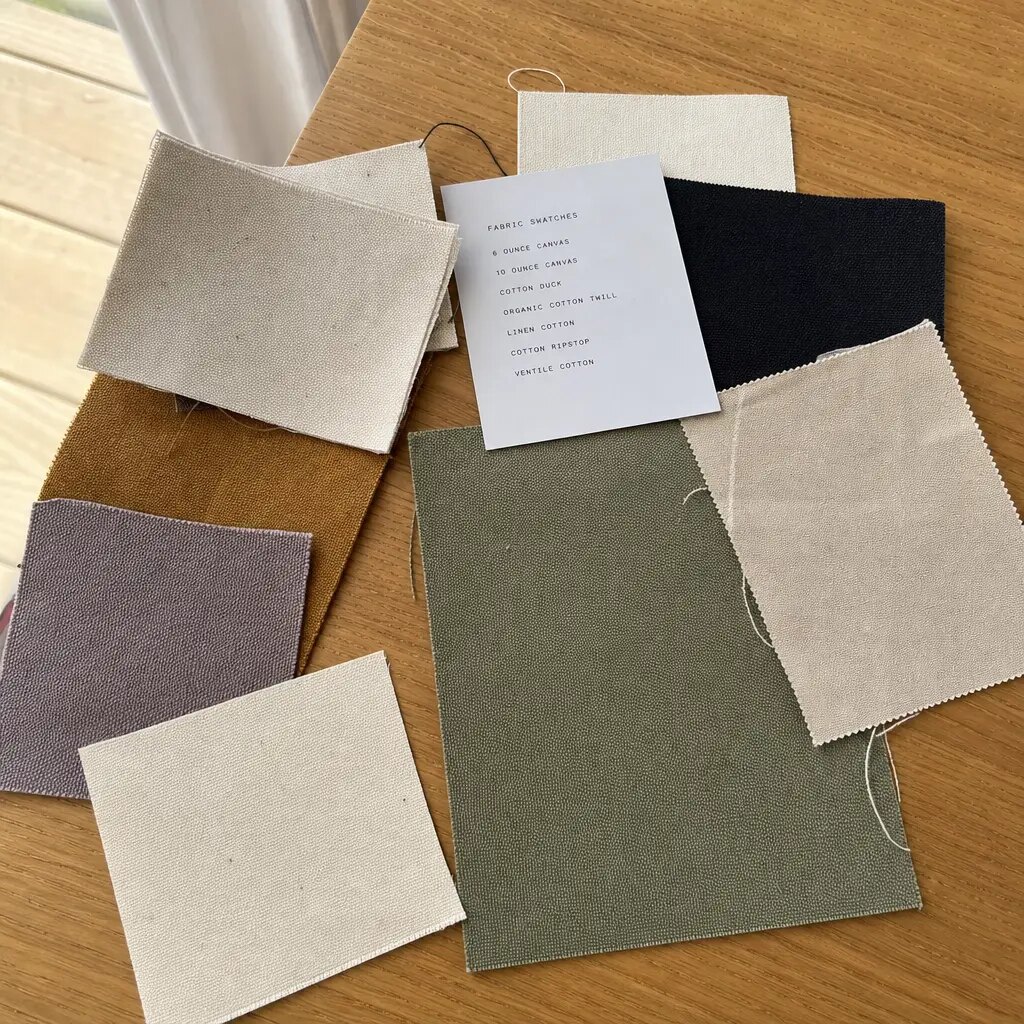
- Can you provide physical canvas swatches, zipper tape cards, lining swatches, thread cards, label samples, and patch materials before the full prototype?
- Can you make a logo strike-off, embroidery test, woven label sample, or patch sample on the same canvas and finish planned for bulk production?
- What is the sample lead time for an existing portfolio pattern versus a custom size with lining, internal pockets, binding, padded panel, or special puller?
- What changes after sample approval will require a revised price, revised sample, new setup charge, or reset of the production lead time?
- What is the bulk lead time after approved pre-production sample, confirmed payment terms, and material readiness, not simply after deposit receipt?
- What material booking date is required for canvas, zipper, lining, labels, patches, hangtags, and barcode stickers to protect the requested ship window?
Quality-control points to confirm
- Finished external width and height should normally be controlled within +/-5 mm for non-washed flat portfolios unless the approved tolerance table allows wider variation for washed fabric or irregular shapes.
- Usable internal width and height must be checked with the intended insert, such as A4, US letter, tablet, spa menu, or document pack, because seam allowance and zipper stops reduce real capacity.
- Logo placement should be measured from fixed seams, zipper edge, panel centerline, or approved template, with a typical tolerance of +/-3 mm to +/-5 mm depending on logo size and method.
- Logo color, ink coverage, embroidery density, label color, and patch shade should be compared against approved strike-off or approved physical sample under consistent lighting.
- Screen print should be checked for pinholes, smearing, poor opacity, ink cracking, color contamination, registration shift, and loss of fine details on textured canvas.
- Embroidery should be checked for puckering, loose threads, broken stitches, backing visibility, distortion of fine lettering, and correct thread shade.
- Zipper should open and close smoothly from end to end without skipped teeth, jammed corners, twisted tape, wavy stitch line, loose slider, weak puller, or sharp metal burrs.
- Zipper ends, pocket corners, puller attachment points, and side labels should be reinforced according to approved sample, with no weak bar tacks or loose thread nests.
- Topstitching should be even and secure, with no broken stitches, skipped stitches, needle cuts, excessive seam puckering, exposed raw edges beyond the agreed finish, or untrimmed long threads.
- Canvas surface should be free from visible oil marks, dye stains, mold, strong odor, unacceptable slubs in the logo area, deep carton creases, abrasion marks, and coating cracks if coated fabric is used.