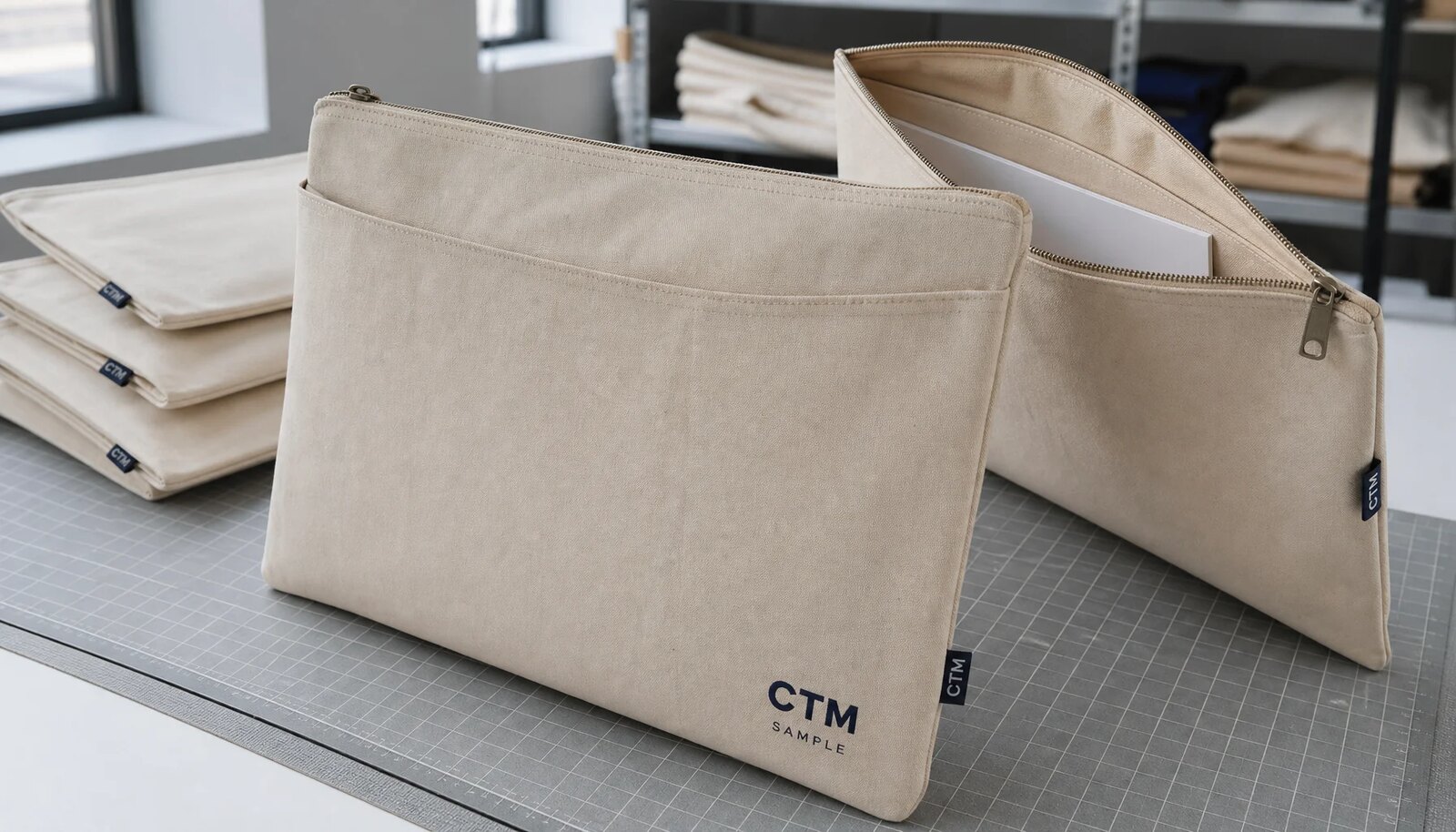
Start With The Real Pricing Problem
Wholesale canvas zipper portfolios look simple at first glance: flat canvas body, zipper closure, maybe one pocket, maybe a logo. That simplicity is exactly why quote comparisons can go wrong. Two suppliers may respond to the same product photo with the same finished size and a similar front logo, yet their prices may be based on different canvas weights, zipper gauges, seam reinforcement, stitch density, packing protection, and inspection assumptions. Those hidden differences affect how the portfolio feels in a guest’s hand, how it sits on a hotel retail shelf, and how often it creates receiving or return issues.
For a hotel retail buyer, a cheap portfolio is not automatically a good value. A product can photograph well and still feel too soft when filled with menus, jam near the zipper corner, pick up carton dust on natural canvas, or arrive with barcode labels that do not scan at the property warehouse. Bulk pricing only becomes meaningful when the RFQ controls the same details across every supplier quote.
Start by deciding what the portfolio must do. A resort gift shop resale item needs a cleaner face panel, consistent branding, and stronger individual protection than a short-life conference document pouch. An in-room welcome-kit portfolio may need to hold a room letter, spa menu, property map, restaurant card, and receipts without bulging. A distributor catalog item needs repeatable material codes and trim colors so reorders do not drift from one season to the next.
The better negotiation is not simply, “Can you reduce the price?” It is, “Which specification can change without damaging the program?” A buyer might accept a stock puller but keep 12 oz canvas. Another may choose a simple polybag instead of a printed paper sleeve but still require barcode accuracy and clean front panels. This approach prevents several unseen downgrades from happening at once.
- Define the end use first: resale, amenity kit, conference folder, spa document pouch, loyalty gift, or distributor SKU.
- Set non-negotiables before the RFQ: fabric structure, zipper function, logo clarity, clean front panel, barcode accuracy, and packing protection.
- Ask for savings options one variable at a time, such as 10 oz versus 12 oz canvas or belly band versus polybag plus belly band.
- Compare FOB unit price only after material, trim, construction, logo, packing, carton data, lead time, and inspection terms are aligned.
- Keep one approved specification sheet with the PO so sample approval, bulk production, and final inspection follow the same standard.
Lock The Fabric Specification Before You Discuss Price
Canvas is the largest visible cost driver and one of the first quality signals a guest notices. For most hotel retail canvas zipper portfolios, 12 oz cotton canvas, commonly about 380-410 GSM after finishing, is a practical default. It has enough body for documents and guest materials without creating the sewing difficulty, corner bulk, and carton weight that can come with heavier canvas.
A 10 oz canvas, often around 300-340 GSM, can work for budget event pouches or light promotional folders. It is not wrong, but it changes the handfeel and shelf presence. For a hotel shop, it may feel underbuilt unless the brand intentionally wants a soft, lightweight pouch. A 14 oz canvas, usually around 430-470 GSM, can feel more premium, but it also increases material cost, needle stress, zipper setting difficulty, seam bulk, and freight weight. It should be sampled with the actual zipper path and final packing before the buyer approves it.
Specify both ounces and GSM. Fabric naming is not perfectly consistent across mills and suppliers, and finishing can shift the final feel. The quote should state whether GSM is taken from a mill sheet, measured before finishing, or measured after finishing. A quote that says only “12 oz canvas” leaves too much room for interpretation.
Composition deserves the same care. 100% cotton canvas gives the natural handfeel many hospitality programs expect. Cotton-poly canvas may reduce cost or improve dimensional stability, but the texture and brand positioning change. Recycled cotton blends may support certain sustainability programs, yet buyers should confirm shade consistency, fiber strength, and labeling requirements rather than accepting a broad recycled-content statement without documentation.
Finishing changes appearance and tolerance. Natural canvas looks warm and familiar but can show seed flecks, shade movement, and stains. Bleached canvas looks cleaner but is less forgiving during freight and warehouse handling. Dyed canvas supports brand color programs but usually needs shade-lot approval and may push MOQ higher. Washed canvas feels softer, yet it can shrink or distort if the approved sample is not made with production fabric. The safest path is to approve an actual bulk fabric cutting before mass cutting begins.
- Recommended default: 12 oz cotton canvas, about 380-410 GSM, for structured hotel retail portfolios.
- Budget option: 10 oz canvas, about 300-340 GSM, only if the buyer accepts a softer handfeel and lighter shelf presence.
- Premium option: 14 oz canvas, about 430-470 GSM, only after confirming zipper corners, needle performance, and carton weight.
- Shrinkage target: ask the factory to declare expected shrinkage and confirm finished-size tolerance after sewing, not only fabric shrinkage.
- Shade control: approve natural, bleached, washed, or dyed lots under consistent light and keep a swatch with the sealed sample.
- Fabric inspection: reject obvious oil marks, heavy creases, color streaks, strong odor, severe slubs, and stains visible on the retail-facing panel.
Define Size, Fit, And Interior Layout In Measurable Terms
“A4 size” or “letter size” is not enough for a bulk order. The factory needs finished outside dimensions, usable inside dimensions, zipper opening length, pocket depth, seam allowance, corner shape, and tolerance. A pouch can be large enough on paper and still annoy users if the zipper opening is short or the pocket becomes tight after sewing.
For paper documents, a clearance of 15-25 mm beyond the intended insert is usually safer than a tight fit. Canvas has thickness. Seams take space. Zipper tape reduces the opening. Normal sewing variation can shrink usable capacity even when the outside measurement is within tolerance. That is why outside size and usable inside size should be treated as separate inspection points.
Hotel buyers should test real contents during sampling. A4 welcome letters, US letter invoices, folded property maps, spa menus, restaurant cards, guest information booklets, tablets, and receipt packs all load differently. If the same portfolio must work for several regions, do not assume A4 and US letter are interchangeable. A4 is taller; US letter is wider. A universal size can work, but only if the buyer builds in enough clearance and accepts the carton impact of a larger product.
Keep the first layout simple unless there is a strong reason to add features. A single main compartment plus one flat document pocket is easier to cut, sew, inspect, and pack. Pen loops, elastic holders, card slots, mesh panels, lining, padding, and dividers may be useful, but each one adds sewing operations and alignment risk. Quote those features as options, not as vague additions inside the base price.
- State finished outside width and height, usable inside width and height, zipper opening length, pocket depth, and tolerance.
- Use +/-5 mm tolerance for smaller portfolios and +/-8 mm for larger document sizes unless the supplier confirms a tighter production capability.
- Specify whether the item must fit A4, US letter, menus, maps, folded brochures, tablets, receipts, or mixed welcome-pack contents.
- Add 15-25 mm clearance for paper documents so materials slide in easily after normal sewing variation.
- Quote optional pockets, loops, card slots, lining, padding, and dividers separately instead of bundling them into a vague design brief.
- Record the fit test with actual hotel inserts during sample approval and repeat it during final inspection.
Control Zipper And Sewing Details Because Guests Touch Them First
The zipper is one of the first components a guest handles, so it should never be left as generic trim. A No. 5 nylon coil zipper is usually the safest choice for wholesale canvas zipper portfolios. It is smooth, widely available, durable enough for document use, and cost-efficient. It also works well around gentle curves or corners when the sewing line is properly controlled.
Metal zippers can look premium, but they bring trade-offs: added weight, plating considerations, tooth alignment risk, and possible marking on light canvas. Smaller No. 3 zippers may reduce cost, yet they can feel weak on a structured portfolio and may be less forgiving near end stops. If a supplier quotes without naming the zipper size and type, the quote is incomplete.
The zipper specification should include tape color, slider finish, puller style, zipper length, end-stop method, and whether the trim is stock or custom. Stock tape colors usually help MOQ and lead time. Custom-dyed tape or branded pullers can support premium retail positioning, but they add approvals and may require separate minimums. Even puller size matters. An oversized puller can press into natural canvas during packing and leave a visible mark if cartons are compressed.
Sewing details carry just as much weight. The factory should confirm stitch type, stitch density, seam allowance, thread color, reinforcement points, and backtack locations. For heavy canvas, buyers often see around 6-8 stitches per inch depending on fabric, machine setup, and seam thickness. The exact standard should be agreed with the factory rather than assumed. Zipper ends, corners, pocket openings, and pull areas need reinforcement because those points take the most repeated stress.
- Use No. 5 nylon coil zipper for most hotel retail programs unless the design specifically requires metal or specialty trim.
- Specify zipper tape color, slider finish, puller shape, zipper length, end-stop type, and stock versus custom trim status.
- Require smooth function across the full opening, especially the first and last 30-50 mm near end stops and corners.
- Confirm lockstitch construction, thread color, seam allowance, topstitching, backtacks, and reinforcement at zipper ends and pockets.
- Reject loose pullers, sharp burrs, twisted tape, skipped teeth, open seams, thread nests, and crooked visible topstitching.
- Check packed samples for zipper puller pressure marks before approving final carton quantity.
Match Branding To The Reality Of Canvas Texture
Hotel retail branding should look deliberate, not forced onto a rough surface. One-color screen printing is usually the most efficient decoration method for clean hotel marks, resort icons, destination graphics, and simple word logos. It gives predictable pricing and good repeatability when the artwork is suitable for canvas.
Not every logo that looks sharp on a PDF will work on textured cotton. Fine lines, tiny serif type, weak contrast, and very large solid ink areas can break up or look uneven. That does not mean screen print is unreliable. It means the buyer needs a physical strike-off on production canvas before mass printing begins.
Heat transfer can handle gradients, multicolor artwork, and detailed graphics, but it changes surface feel and may not suit a natural cotton look. It also needs adhesion testing because canvas texture can create edge-lift risk. Embroidery can look premium for boutique hotels and resort programs, yet dense stitches may pucker the panel or distort the zipper path if backing, stitch count, and logo size are not tested. Woven labels are often a strong B2B option because they provide repeatable branding with less front-panel print risk.
There is also a smart SKU strategy here. If a multi-property hotel group uses the same sewn portfolio across locations, property-specific messaging can move to belly bands, hangtags, or barcode labels. The product stays stable, while the retail identity changes by property or season. That often reduces MOQ pressure and keeps reorders cleaner.
- Screen print: best for simple 1-3 color artwork, strong contrast, controlled cost, and repeat hotel retail orders.
- Heat transfer: use for complex artwork only after checking adhesion, edge lift, handfeel, and compatibility with cotton texture.
- Embroidery: sample first for puckering, backing visibility, stitch density, thread color, and panel distortion.
- Woven label: useful for subtle repeat branding and lower print risk across reorders.
- Belly band: practical for property-specific messaging, barcode changes, or seasonal retail presentation without changing the sewn item.
- Strike-off standard: approve physical logo color, clarity, size, placement, rub resistance, and acceptable texture break.
Use MOQ Logic Instead Of Guesswork
MOQ is not just a supplier rule. It reflects fabric lot size, cutting efficiency, zipper and label sourcing, print setup, sewing-line planning, packing labor, and inspection work. For wholesale canvas zipper portfolios using standard canvas and stock trims, 500-1000 pieces per color is often a realistic planning range. Lower quantities may be possible with stock natural canvas and simple printing, but the unit cost rises because setup labor and sampling are spread across fewer units.
Many hotel retail buyers increase cost accidentally by over-assorting the first order. A 2000-piece order in one body color, one zipper color, one logo, one barcode, and one packing format is operationally clean. The same 2000 pieces split across four body colors, two zipper colors, six property logos, and separate barcode stickers behaves more like a group of small orders. Each SKU needs material separation, print setup, packing control, carton marking, and inventory tracking.
A stronger first-order plan protects the product while limiting variation. Natural canvas, one zipper tape color, one logo placement, and one retail packing method keep the quote comparable and production stable. If assortment is necessary, use two body colors while keeping zipper, labels, barcodes, and carton specs consistent. That gives the hotel buyer some shelf variety without turning the PO into a production puzzle.
Ask for first-order MOQ and reorder MOQ separately. Hotel retail programs often test in a few properties before seasonal replenishment. A supplier may accept a higher initial order to set up labels and materials, then support smaller replenishment orders if the same fabric, trims, and packing remain available. Get that agreement in writing before the launch order.
- Request price breaks at 500, 1000, 2000, and 5000 pieces to see where fabric buying and setup efficiency improve.
- Track MOQ by total order, body color, fabric lot, zipper color, print design, label design, barcode, and packing format.
- Use stock canvas, stock zipper tape, standard pullers, and one decoration method to keep first-order MOQ manageable.
- Avoid property-specific sewn labels on a test order if a shared label plus property belly band can meet retail needs.
- Ask whether sample, setup, and label costs are one-time charges or repeat charges on future POs.
- Share realistic reorder forecasts, but do not rely on unapproved volume to justify current pricing.
Build A Quote Sheet That Procurement Can Actually Compare
A professional quote should show the product behind the price. A single all-in unit price is not enough because it hides the choices that control quality. The RFQ and supplier quote should list fabric composition, oz weight, GSM, fabric finish, zipper details, construction method, decoration, labels, packing, sample charges, production lead time, carton data, trade term, payment term, inspection responsibility, quote validity, and exclusions.
Without those fields, the lowest price may simply be the weakest specification. One supplier may include 12 oz canvas, retail belly band, barcode sticker, carton marks, and a pre-production sample. Another may quote 10 oz canvas, basic zipper trim, no barcode, no label setup, and no inspection support. On paper, the second price looks better. In a hotel retail program, it may not be cheaper once missing details are added back.
For importers, distributors, and hotel procurement teams, FOB is often a practical comparison basis because freight, duty, insurance, and local distribution can be modeled separately. EXW requires the buyer to add local pickup and export handling. CIF, DDP, or delivered quotes may be useful, but buyers should still request carton dimensions, gross weight, packing method, and HS code suggestion for internal landed-cost review. Flat canvas goods can become surprisingly inefficient if cartons are bulky or underfilled.
Separate one-time charges from recurring unit costs. Screen setup, woven label setup, custom puller tooling, barcode setup, pre-production samples, and courier fees should be visible. If setup is hidden inside the unit cost, reorder pricing becomes unclear. If setup is excluded, the buyer may receive extra charges after approval. A clear quote sheet lets procurement ask targeted cost-saving questions instead of pressuring the factory to cut corners.
- Fabric fields: composition, oz, GSM, color, finish, shrinkage expectation, shade tolerance, fabric MOQ, and fabric approval step.
- Trim fields: zipper size, zipper type, tape color, slider finish, puller style, thread color, label type, and reinforcement details.
- Decoration fields: method, logo size, number of colors, Pantone reference, placement, setup charge, strike-off cost, and tolerance.
- Packing fields: polybag, belly band, hangtag, barcode, tissue, units per carton, carton dimensions, gross weight, carton marks, and pallet notes.
- Commercial fields: trade term, payment term, sample lead time, production lead time trigger, inspection terms, quote validity, and excluded costs.
- Comparison fields: alternate pricing for 10 oz, 12 oz, and 14 oz canvas; basic versus retail packing; stock versus custom zipper; and quantity breaks.
Approve Samples In Stages, Not From Photos Alone
Sampling should move in a controlled sequence. A rough prototype confirms size, construction, zipper path, pocket layout, and general handfeel. It is useful, but it should not become the final bulk standard if production fabric, zipper, or decoration will change later. A decoration strike-off confirms print clarity, color, scale, position, and rub behavior on production canvas. A revised sample may be needed if size, fit, or logo placement changes.
The sealed pre-production sample is the important one. It should combine final fabric, final zipper, final construction, final logo, final labels, final packing, and carton marking. If the pre-production sample does not include the retail band, barcode, polybag, or hangtag, the buyer has not really approved the retail product.
Sample review should be measured and recorded. Check outside dimensions, usable inside dimensions, zipper opening length, pocket depth, logo size, print position, seam allowance, label position, and packed appearance. Insert the actual hotel documents or retail inserts. Open and close the zipper repeatedly. Look for corner distortion, puller pressure marks, uneven topstitching, panel puckering, and front-panel stains. These checks catch problems that supplier photos often miss.
One approved sample should stay with the buyer, and one counter sample should stay with the factory. If third-party inspection is planned, the inspector should receive the specification sheet, sample photos, tolerance table, defect list, packing instructions, carton mark layout, and barcode requirements. The goal is simple: production, inspection, and procurement should all judge the same product against the same standard.
- Prototype approval: confirm size, construction, zipper path, interior layout, document fit, and general handfeel.
- Strike-off approval: confirm logo clarity, ink color, print placement, rub resistance, and artwork scale on production canvas.
- Pre-production approval: confirm final fabric, zipper, thread, labels, logo, packing, carton marks, and barcode data.
- Measurement record: document width, height, usable inside size, zipper opening, pocket depth, logo location, and tolerance.
- Function record: test zipper movement, document loading, seam security, pocket stress, puller attachment, and packed pressure marks.
- Change control: require written approval if fabric lot, zipper trim, logo method, label, packing, or carton quantity changes after approval.
Set QC And AQL Standards Before Production Starts
Canvas products need realistic QC standards because natural fabric can include small slubs, seed flecks, and texture variation. Realistic does not mean vague. Hotel retail buyers should define critical, major, and minor defects before production starts. A broken zipper, unsafe burr, wrong logo, wrong color, missing required label, severe stain, mold, or unusable size should be treated as critical or major. A small natural slub may be minor if it matches the approved canvas character and is not prominent on the retail-facing panel.
Inspection should focus on the issues that create guest complaints and receiving delays: zipper function, seam strength, cleanliness, print clarity, label accuracy, barcode scan, packing protection, and carton quantity. Many buyers use a general final random inspection based on ANSI/ASQ Z1.4 or ISO 2859-1 sampling concepts, often with AQL levels such as critical 0, major 2.5, and minor 4.0. The exact plan should be written into the PO or inspection booking. If the hotel retailer has stricter requirements, state them before production.
Measurable tolerances reduce arguments. Finished size should be measured flat after smoothing, not stretched. Print position should be measured from fixed seams or edges. Zipper function should be checked through repeated open-close cycles on sampled units. Stains should be assessed at normal viewing distance under consistent light. Barcode scan should be verified before shipment, not after the hotel warehouse rejects a carton.
Do not skip incoming fabric and trim checks. Once stained canvas is cut, the problem is expensive to fix. Once poor zipper tape is sewn in, replacing it may not be practical. A brief pre-cutting review of fabric shade, odor, stains, GSM record, zipper smoothness, and label accuracy can prevent many final inspection failures.
- Critical defects: unsafe burr, broken zipper, wrong logo, wrong color, missing mandatory label, severe stain, mold, or unusable size.
- Major defects: open seam, twisted zipper, failed barcode, visible print shift, dirty front panel, wrong packing, poor corner shape, or incorrect carton quantity.
- Minor defects: small natural slub, slight thread tail, minor shade variation within approved range, or small internal mark not visible in normal use.
- Measurement checks: outside size, usable inside size, pocket depth, zipper length, logo position, label placement, and carton weight.
- Functional checks: zipper cycle, document fit, seam pull, pocket stress, puller attachment, and packing pressure mark review.
- Packing checks: correct SKU, barcode scan, retail band alignment, polybag condition, carton marks, quantity, gross weight, and moisture control.
Plan Packing For Retail Presentation And Freight Protection
Packing affects both shelf presentation and landed cost. Individual polybags provide strong basic protection for natural and bleached canvas during freight, warehouse handling, and multi-property distribution. They help prevent dust, humidity marks, zipper abrasion, and carton rub. Some hotel retailers prefer kraft belly bands, paper sleeves, or reduced-plastic presentation to match a natural hospitality brand image. That can work, but the buyer still needs a method to keep the canvas clean inside the master carton.
Retail components should be quoted before sample approval. A belly band needs paper specification, band size, artwork, folding method, barcode position, and adhesive or closure method. A hangtag needs tag stock, cord type, hole position, and attachment point. A barcode label needs scan quality, placement, destination data, and adhesive that does not transfer to canvas. Each component adds labor and inspection points, so each one belongs in the quote and sealed sample.
Carton planning is not only a logistics issue. Canvas portfolios are flat, but zipper pullers, folds, bands, and stacked pressure can create dents or marks. Overpacking reduces freight volume but may increase compression defects. Underpacking protects the product but raises carton count and handling cost. Before PO approval, confirm units per carton, carton dimensions, net weight, gross weight, carton strength, moisture protection, carton marks, and any warehouse pallet limits.
For hotel retail bulk programs, barcode and carton accuracy deserve special attention. A beautiful product that arrives under the wrong SKU creates receiving delays and internal chargebacks. Confirm whether barcode labels sit on the polybag, belly band, hangtag, or master carton. Then scan the approved sample and include the barcode position in the packing instruction sheet.
- Polybag: strongest basic protection for light canvas during export freight, storage, and multi-property distribution.
- Kraft belly band: useful retail presentation, but it does not replace dust, moisture, and abrasion protection.
- Paper sleeve or tissue: premium presentation option that adds material cost, packing labor, and approval steps.
- Barcode sticker: confirm scan grade, placement, retail data, adhesive behavior, and whether it sits on polybag, band, or hangtag.
- Master carton: define export carton strength, units per carton, dimensions, gross weight limit, liner if needed, and moisture-control method.
- Carton marks: include item number, PO number, SKU, color, quantity, carton count, gross weight, destination, and barcode if required.
Specification comparison for buyers
| Spec decision | Recommended option | When it fits | Buyer risk to check |
|---|---|---|---|
| Outer fabric weight | 12 oz cotton canvas, typically about 380-410 GSM after finishing, with the fabric weight verified from the mill sheet and bulk cutting lot | Hotel gift shops, resort retail, conference desks, welcome-folder programs, and distributor catalogs that need structure without excessive carton weight | A lower quote may use 10 oz or loose-weave canvas that meets a broad weight claim but feels limp, wrinkles more, or shows contents through the body |
| Finished size and tolerance | A4 or US letter body with 15-25 mm document clearance; write finished outside size, usable inside size, zipper opening, and tolerance of +/-5 mm to +/-8 mm depending on size | Programs holding menus, welcome letters, spa sheets, guest maps, invoices, travel documents, or conference collateral | A portfolio can be technically A4-sized but still hard to load if the zipper opening is short, seam allowance is wide, or pocket depth is not measured |
| Zipper construction | No. 5 nylon coil zipper with stock tape color, smooth slider, specified puller, secure end stops, reinforced corners, and zipper length stated in the quote | Most wholesale canvas zipper portfolios where reliable guest handling is more important than decorative metal teeth | Unspecified zippers may be downgraded to a smaller gauge, rough slider, weak puller, or mismatched tape color after sample approval |
| Seam and stitching standard | Lockstitch construction with neat topstitching, backtacks at stress points, and a typical 6-8 stitches per inch on heavy canvas unless a different factory standard is agreed | Flat document portfolios with one main compartment, one slip pocket, and moderate daily handling | Loose stitch density, skipped stitches, thread nests, and weak pocket openings can look acceptable in photos but fail in retail use |
| Branding method | One-color screen print for clean hotel marks; woven side label for repeat programs; embroidery only after panel puckering and backing tests | Hotel retail, resort shops, loyalty gifts, spa programs, and corporate hospitality channels with controlled brand presentation | Fine lines, small serif type, large solid ink areas, and dense embroidery can fail on textured canvas without a physical strike-off |
| Interior layout | Single main compartment plus one flat document pocket; quote pen loops, card slots, mesh panels, tablet padding, and dividers as separate options | Travel papers, welcome kits, menu folders, guest information packets, invoice pouches, and conference programs | Extra features add sewing minutes, alignment defects, inspection time, and MOQ complexity; they should not be hidden inside a broad quote |
| MOQ structure | 500-1000 pcs per color for standard fabric and trims; request price breaks at 500, 1000, 2000, and 5000 pcs | First hotel retail launch, multi-property replenishment, distributor test order, or seasonal resort program | Splitting one PO across many colors, logos, zipper colors, barcode rules, or packing formats can turn one efficient order into several small production runs |
| Retail packing | Individual clear polybag for protection; kraft belly band, paper sleeve, hangtag, or barcode label added only after costing labor and inspection requirements | Light canvas retail items that must arrive clean, scan correctly, and present well on hotel shop shelves | Natural canvas can pick up carton dust, moisture stains, zipper pressure marks, and adhesive transfer if packing is treated as an afterthought |
| Quote basis | FOB quote itemized by fabric, zipper, decoration, labels, packing, sample charges, carton data, lead time, payment terms, exclusions, and quote validity | Importers, hotel procurement teams, retail buyers, and distributors comparing supplier offers before PO approval | A single unit price hides cost drivers and makes it easy to approve lower fabric weight, cheaper zipper trim, or incomplete packing by mistake |
Buyer checklist before sampling
- Define the commercial use before quoting: hotel gift shop resale, in-room welcome kit, conference retail pack, spa document pouch, travel desk folder, loyalty gift, or distributor catalog item.
- Specify fabric by composition, weave, oz weight, GSM range, finishing state, color, shade tolerance, shrinkage expectation, and whether natural, bleached, dyed, washed, recycled blend, or cotton-poly canvas is acceptable.
- State exact finished dimensions: outside width and height, usable inside width and height, zipper opening length, pocket depth, seam allowance expectation, document clearance, and tolerance.
- Confirm the document standard: A4, US letter, oversized menu, folded brochure, welcome booklet, tablet sleeve, receipt pack, or mixed hotel collateral.
- Choose zipper size, zipper material, tape color, puller style, slider finish, end-stop method, zipper length, and whether the zipper is stock trim or custom-dyed trim.
- Set construction requirements: number of compartments, slip pocket size, lining if any, reinforcement points, thread color, stitch type, topstitching, and backtack locations.
- Send vector logo artwork and confirm print size, print position, Pantone or thread reference, orientation, decoration method, and strike-off approval on production canvas.
- Decide all retail identity components before quoting: woven label, printed care label, barcode sticker, hangtag, belly band, price label, care card, tissue wrap, polybag warning text, or destination-specific label.
- Limit first-order variations unless the MOQ supports efficient cutting and packing; track every body color, zipper color, logo version, label version, barcode, and packing format as a separate SKU.
- Require staged samples: rough prototype for fit, decoration strike-off for logo, revised sample if needed, and sealed pre-production sample made with production fabric, zipper, logo, labels, and packing.
Factory quote questions to send
- What exact canvas weight will be used in oz and GSM, and is that value measured before finishing, after finishing, or taken from the mill specification sheet?
- Is the quoted fabric 100% cotton canvas, cotton-poly canvas, recycled cotton blend, dyed canvas, washed canvas, bleached canvas, or natural greige canvas, and what shade-lot tolerance applies?
- Can you provide the fabric mill sheet or internal fabric inspection record showing GSM, width, shrinkage expectation, shade lot, and any finishing process?
- Will the fabric be pre-shrunk, sanforized, washed, or otherwise stabilized, and what finished-size tolerance can you hold after cutting, sewing, pressing, and packing?
- What zipper size, material, slider type, puller style, puller finish, tape color, zipper length, end-stop finish, and supplier grade are included in the quoted unit price?
- What stitch type, stitch density, seam allowance, thread type, reinforcement method, and backtack positions are included for the main seams, zipper ends, and pocket openings?
- What MOQ applies per total order, per body color, per fabric lot, per zipper color, per print design, per label design, per barcode, and per packing format?
- Does the quote include screen setup, print strike-off, woven label setup, care label, barcode stickers, hangtags, retail belly bands, tissue, polybags, carton printing, and inspection support?
- What are the sample costs and sample lead times for a rough prototype, decoration strike-off, revised fit sample, sealed pre-production sample, and duplicate counter sample?
- Which sample is considered the approved bulk standard, and will the factory keep a sealed counter sample on the production floor during cutting, printing, sewing, trimming, inspection, and packing?
Quality-control points to confirm
- Finished size tolerance should normally be written as +/-5 mm for smaller portfolios and +/-8 mm for larger document sizes unless the PO requires a tighter or looser tolerance.
- Usable document space should be measured separately from outside dimensions because seam allowance, zipper tape, pocket depth, and corner shape reduce actual capacity.
- Canvas shade should be checked under consistent light against the approved sample because natural, bleached, washed, and dyed canvas can vary between fabric lots.
- Fabric handfeel and weave density should match the approved production sample; nominal GSM alone does not prevent a looser weave from feeling weak or stretching during use.
- Bulk fabric should be checked for stains, oil marks, weaving defects, strong creases, color streaks, odor, and excessive slubs before cutting.
- Zipper opening must run smoothly across the full length without skipped teeth, twisted tape, loose pullers, sharp burrs, weak end stops, or corner jams.
- Zipper function should be tested by repeated open-close cycles on sampled pieces, with special attention to the first 30-50 mm near each end stop and each curved corner.
- Zipper ends, corners, and pocket openings should include backtack or reinforcement where repeated guest use creates stress.
- Print position should be measured from fixed seams or edges, not judged by eye; bulk tolerance should be agreed before mass printing begins.
- Screen print should pass dry rub checks and reasonable scratch resistance on actual canvas texture before mass production, especially on dark, dyed, or rough canvas.