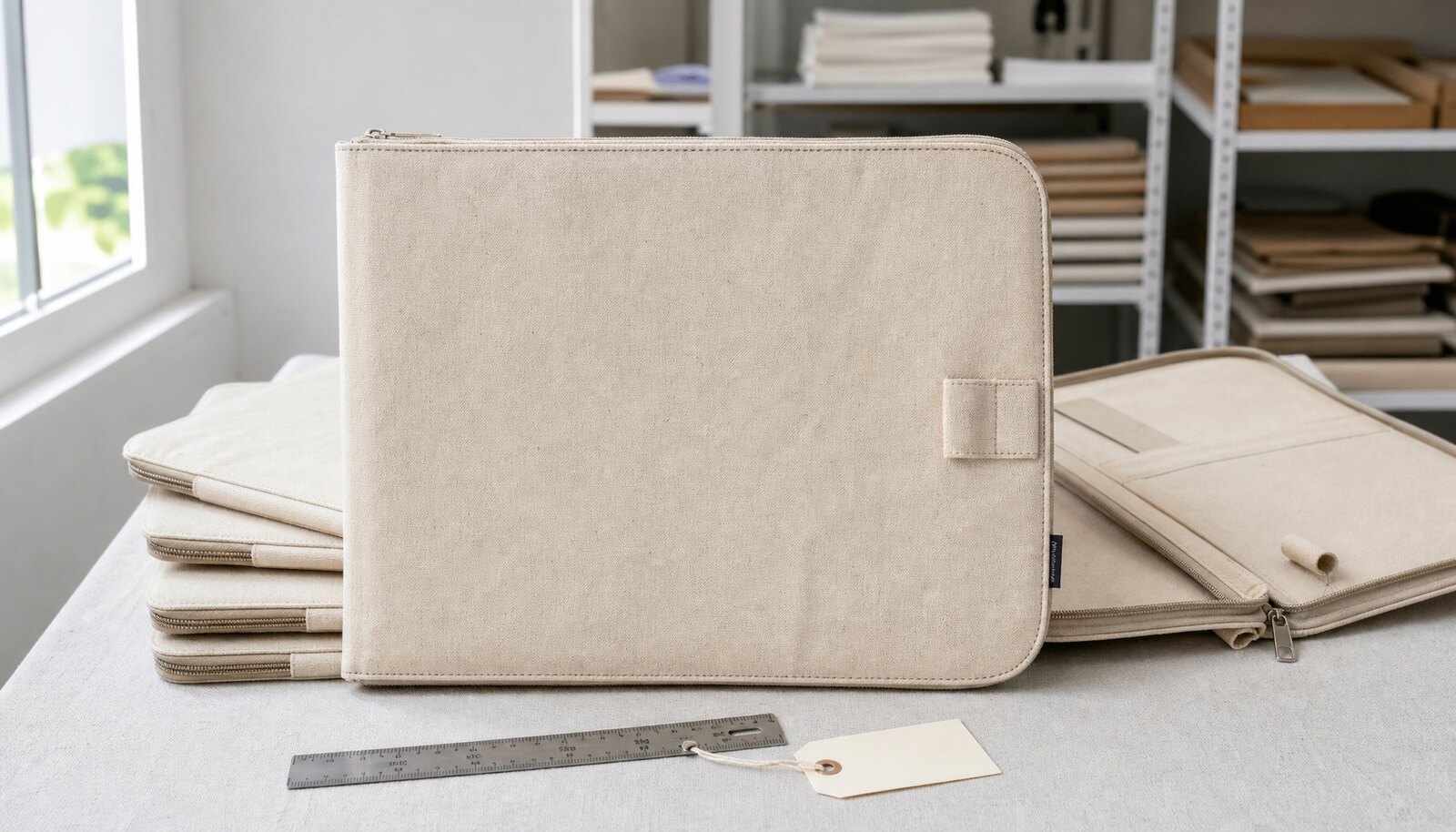
1. What gift shop buyers are really judging in a canvas zipper portfolio
A gift shop buyer is not evaluating a canvas zipper portfolio as a generic pouch. They are judging whether it can sit on a shelf, support a retail price, and survive repeated customer handling without looking flimsy. That means the product has to do three things at once: hold its shape, open smoothly, and display the artwork clearly from a short distance. If any one of those fails, the item tends to get downgraded in merchandising review even when the unit price looks attractive.
For wholesale canvas zipper portfolios for gift shops, the sourcing brief should reflect retail reality rather than only factory convenience. A portfolio that collapses when set down can look cheap beside structured stationery cases. A zipper that drags once in store can create an impression of poor workmanship. And a print that looked acceptable on a digital mockup can become dull or blurry once it is applied to the weave of real canvas. Buyers are usually protecting presentation, not just function.
The practical takeaway is simple: define the purchase around shelf appearance, handling feel, and re-order consistency. That means buyers should ask how the portfolio will be displayed, how often the zipper will be used, and what kinds of contents it must carry. A gift-shop item that holds postcards only has different requirements from one that needs to handle notebooks, maps, or presentation inserts. Procurement gets easier when the end use is known before the quote stage.
- Judge the portfolio by shelf appearance, not only by the sample in a meeting room.
- Treat zipper smoothness, body structure, and print clarity as commercial features, not afterthoughts.
- Compare the product against the real retail shelf it will sit on, not just against a spec sheet.
2. Fabric, weave, and finish: the decisions that shape feel and durability
For most gift shop programs, 12 oz canvas is a reasonable starting point because it balances structure, cost, and appearance. It usually gives the portfolio enough body to look neat without making it feel overly stiff or expensive. If the product must carry heavier notebooks, guidebooks, stationery sets, or presentation inserts, 14 oz canvas is often safer. The extra weight can help the body stand up better and reduce rippling near the zipper line.
Do not rely on the phrase 'good canvas.' Ask the supplier for gsm or ounce weight, the finish, and the acceptable batch tolerance. If the supplier offers pre-washed, pre-shrunk, or sanforized canvas, note which one is being quoted. Pre-shrunk material can be worth the added cost because it helps reduce finished-size drift after pressing, storage humidity changes, or repeated handling. That matters when artwork placement and pocket alignment must remain consistent.
Finish matters as much as weight. A rough, overly slubby canvas can create a more rustic feel, but it can also distort print edges and make seam lines look uneven. A smoother finish may cost a little more, yet it often improves perceived quality in a gift shop setting. When comparing supplier quotes, the buyer should make sure every offer is based on the same fabric basis rather than a similar-looking swatch that hides different performance.
- Write the fabric spec as gsm or oz with tolerance.
- Use 12 oz for standard retail programs; move to 14 oz for more structure or heavier loads.
- Ask whether the fabric is raw, pre-shrunk, or finished, and keep the answer in the quote file.
3. Zipper, puller, and seam reinforcement: where retail complaints start
A portfolio can look good and still fail at the zipper. In retail use, customers open these products repeatedly and often load them unevenly. That means the zipper needs a smooth run, stable tape, and reinforced end stitching. Nylon coil zippers are usually the safest choice for this category because they run smoothly, are less likely to scratch, and are easier to match with soft canvas construction. If a supplier proposes a metal zipper, ask why it is necessary, because metal hardware can add weight, noise, corrosion risk, and sharper edges.
The quote should identify the zipper size, tape color, puller finish, and end-stop construction. A supplier who only says 'standard zipper' leaves too much room for substitution. On gift shop programs, buyers often want the zipper to blend with the body fabric rather than distract from the print. Matching or self-fabric pull tabs can make the portfolio feel more coordinated, while a bright mismatched puller can look accidental unless it is part of the design intent.
Seam reinforcement is not optional near the zipper ends. The stress area at both zipper stops should include secure backstitching or a bar-tack style reinforcement depending on the pattern and factory capability. If the product is gusseted or includes inner pockets, the seam load goes up. That should be reflected in the inspection checklist because weak reinforcement may not fail during a quick sample review, but it can open up during repeated customer handling.
- Prefer nylon coil zippers for most retail canvas portfolios.
- Specify zipper size, tape color, puller style, and end-stop detail in the RFQ.
- Require reinforced stitching at zipper ends and other stress corners.
4. Print method, artwork limits, and logo placement rules
Print is usually what makes the item retailable, so it should be specified with more precision than many buyers use in first-round quotes. For repeat wholesale runs, one-color screen print is typically the most reliable and cost-effective method. It works well on canvas, holds up under handling, and usually looks cleaner than a low-cost transfer when the artwork is simple. For a museum shop, tourist retail line, or gift shop assortment with consistent branding, screen print often gives the most stable result across reorders.
Transfer methods can still be useful when the artwork is multi-color, highly detailed, or intended for a small test run. The tradeoff is that the surface may feel less integrated with the canvas and may show edge lift or cracking after flexing. If the item is expected to be handled often, ask the supplier what durability differences they expect and what transfer process they are using. Do not accept a generic answer such as 'high quality print' without naming the method.
Logo placement should be controlled in millimeters. Canvas weave, seam allowances, zipper tape, and stitching all affect how a design sits on the finished product. A quote should state the print area, the visual center, and the allowable offset. If the logo sits close to a seam, ask the supplier to mark a reference line on the pattern before production. That is a small step, but it reduces disputes over whether a print was 'visually centered' while still being technically wrong.
- Use screen print for simple, repeatable branding.
- Use transfer only when artwork complexity justifies the tradeoff.
- Approve artwork on actual canvas and define placement in millimeters, not just by eye.
5. Supplier comparison: factory, trading company, or mixed sourcing route
The right supplier route depends on how much control the buyer needs. Direct factory sourcing usually gives better visibility into fabric sourcing, zipper choice, sewing details, and packing sequence. That matters when a team wants reorder consistency, because a factory is more likely to keep the same production method across repeated orders if the contract and drawings are clear. For portfolios sold in gift shops, consistency is important: if the first order feels premium and the second order arrives lighter or with weaker print, the retail program can suffer.
Trading companies and sourcing agents can still be useful. They may help when the buyer needs several product categories in one shipment or wants a single point of communication. The risk is that the real factory and the actual material substitutions can become less visible. If a trader is used, the buyer should still demand the same level of detail requested from a factory: exact canvas weight, zipper type, print method, carton count, and inspection standard.
A useful procurement comparison is not just about unit price. One supplier may quote lower but use a lighter canvas or a cheaper zipper. Another may quote higher but include better sewing reinforcement and cleaner packing. The lowest invoice price is not always the lowest landed cost, especially if the product is sold in a gift shop where appearance and shelf quality affect sell-through. Ask for evidence, not just reassurance: business registration, production photos, sample traceability, and a clear statement of which steps are done in-house versus outsourced.
- Direct factory: best for repeatability and material control.
- Trading company: useful for consolidation, but verify the actual factory and process flow.
- Compare full spec equivalency before ranking quotes by price.
6. A real comparison table should help you judge landed cost, not just product specs
Many supplier comparison tables stop at fabric and zipper choices. That is useful, but procurement buyers need more than a spec list. A better comparison asks what each choice does to landed cost, defect risk, and retail performance. For example, a 14 oz canvas portfolio may cost more per unit than a 12 oz version, but if it reduces returns, looks more premium on shelf, and better supports heavier contents, the higher price may be justified. The same logic applies to packing. Bulk packing is cheaper, but individual retail-ready packing may save labor at destination and reduce handling damage.
When comparing quotes, include sample charges, setup fees, packing adders, and expected carton volume. A quote that looks cheaper at ex-factory level can become more expensive once the buyer adds the cost of extra packing, larger cartons, or a second round of approval samples. In a gift shop program, the retail presentation cost matters because the product is judged visually. This is especially true for museum, tourist, and souvenir channels where customers touch the item before buying.
A more useful side-by-side view is to compare actual supplier routes and their commercial implications. For example, a factory may offer tighter control but require longer communication cycles; a trading company may speed communication but add another layer between the buyer and the line operator. The buyer should decide which risk matters more for the specific program instead of assuming the cheapest quote is automatically the best quote.
- Compare landed cost, not just ex-factory unit price.
- Include sample, setup, packing, and carton volume in the comparison.
- Treat defect risk as a financial variable because returns and rework have real cost.
7. Sample approval stages that reduce production mistakes
A disciplined sample process saves time later. Start with a blank sample to confirm the fabric feel, the body shape, the zipper action, and the basic opening geometry. Then request a printed sample or strike-off on the actual canvas so you can judge color density, edge clarity, and placement. If the design includes a pen loop, interior pocket, special lining, or gusset depth, request a pre-production sample. Those details affect sewing order and can change the finished appearance even when the outer dimensions stay the same.
The sample should be inspected like a production unit, not treated as a display piece. Open and close the zipper several times. Press on the corners to see whether the shape twists. Check whether the zipper ends are reinforced. Measure the sample in at least three points and compare it with the approved drawing. If the print sits near a seam, verify the offset in mm. If the supplier resists producing a revised sample after a design change, that is a warning sign about production discipline.
Keep the approval record simple but traceable. Save photos of the blank sample, the printed sample, and any written comments on measurements or print position. If you later need to discuss a defect, the approval trail matters more than memory. It also helps future reorders because the team can compare against the exact version that was approved.
- Blank sample: structure and material check.
- Printed sample: logo and placement check.
- Pre-production sample: final sewing sequence, packing, and label check.
8. Quality control standards: AQL, defect categories, and measurable limits
This is the part that makes a sourcing checklist useful to procurement teams. Vague language like 'good quality' is not enough for bulk buying. For wholesale canvas zipper portfolios for gift shops, define clear acceptance rules. A common commercial approach is to inspect to AQL 2.5 for major defects and AQL 4.0 for minor defects, with critical defects at zero acceptance. If your internal standard is stricter, write that into the PO or inspection instructions. The supplier should never have to guess what acceptable means.
A major defect is one that affects function, appearance, or retailability. Examples include a zipper that snags, a seam that opens, a print that is visibly off-position, or a portfolio whose finished size is outside tolerance. Minor defects are less severe but still visible, such as light thread ends, slight label misplacement, or small surface marks that do not affect use. Critical defects are the ones that create safety, compliance, or severe quality problems, such as a broken needle left in the product, a sharp metal burr on a zipper puller, or contamination that would make the item unsellable.
For practical inspection, include measurable checks. A zipper cycle test of 20 open-close cycles on sampled units is a useful buyer-defined baseline for this product category. If you are supplying a premium retail chain or a higher-use program, you can require 30 to 50 cycles, but that should be defined by the buyer rather than treated as universal. Stitching can be checked for even density and no skipped stitches, while size tolerances can be set by dimension. The point is not to create a laboratory standard; it is to make sure the supplier knows what will be rejected before production begins.
Inspection should also cover packaging. Count accuracy, barcode placement, carton marking, and color assortment need to match the purchase order. If the buyer is selling by retail set or coordinated color assortment, mix errors can create downstream sorting work and loss at warehouse receiving. Finally, check master cartons for crushing, water damage, or broken corners. A retail-ready portfolio can still arrive in poor commercial condition if the outer pack is weak.
- Use AQL 2.5 for major defects and AQL 4.0 for minor defects unless your policy says otherwise.
- Set critical defects to zero acceptance.
- Require a zipper cycle test, size tolerance check, print placement window, and carton count verification.
9. Packing, labeling, and carton planning for gift shop inventory
Packing is often underestimated because it sits at the end of production, but it strongly affects cost and arrival condition. Bulk packing usually reduces labor and keeps unit cost low. Individual polybagging, insert cards, and hang tags improve retail readiness, but they add cost and can increase carton volume. The right choice depends on how the buyer receives and displays the product. If the store or distribution center will do final merchandising, bulk packing may be enough. If the unit must go directly to shelf, the retail pack format needs to be decided before production starts.
Ask for the exact master carton dimensions and gross weight in the quote stage. Freight costs are sensitive to carton volume, and a seemingly small change in the portfolio fold or bag format can move the shipping total. Also confirm where labels are applied. Some buyers want barcode stickers applied only after final inspection so rejected units do not enter the retail pack stream. Others want labels applied before packing to save labor. There is no single correct method, but it should be written down.
If the order includes mixed artwork or mixed color cartons, confirm the packing plan and receiving plan in advance. Mixed cartons can be efficient, but only when the warehouse has a sorting process. Without that plan, receiving teams waste time and may miscount inventory. For gift shops, a clean packing list is not a minor detail; it affects how fast merchandise reaches the selling floor.
- Choose bulk or retail-ready packing based on the real receiving process.
- Require carton dimensions, gross weight, and pack count in the quote.
- Match barcode labels, packing list, and actual assortment before shipment.
10. Lead time, MOQ logic, and how to avoid schedule surprises
Lead time for a canvas zipper portfolio is usually driven by fabric availability, printing queue, sewing capacity, and packing labor. If the supplier already has the right canvas in stock, a simple one-color order can move faster. If you request special zipper colors, custom labels, or pre-shrunk fabric that must be sourced first, the calendar stretches quickly. Buyers planning for seasonal gift shop launches should separate sample approval time from bulk production time, because those are not the same thing.
MOQ should be treated as a pricing structure, not a single number carved in stone. Ask whether the minimum is per design, per color, per artwork, or per total order. Then ask what changes in the cost ladder above that threshold. Some factories charge more below MOQ because cutting waste, setup time, and sewing changeover become less efficient. That is normal. What matters is transparency: the quote should show where the extra cost is coming from so internal procurement decisions are defensible.
A useful lead-time question is whether the factory can start production immediately after sample approval or whether materials still need to be purchased. This matters a lot when buyers are trying to hit a trade show, seasonal reset, or holiday delivery window. If the supplier cannot clearly separate material procurement from sewing and packing, the schedule risk is higher than the quote suggests.
- Separate sample lead time, material procurement lead time, and production lead time.
- State whether MOQ is per artwork, per color, or per total order.
- Treat zipper color changes and special labeling as schedule drivers, not minor extras.
Specification comparison for buyers
| Procurement option | What you gain | Tradeoffs | Buyer verification |
|---|---|---|---|
| Direct factory sourcing | Better visibility into fabric, zipper, sewing, and packing decisions; easier to enforce repeat-order consistency | Requires more buyer diligence on audit, QC, and communication | Ask for factory legal name, production-line photos, material traceability, and inspection records |
| Trading company or sourcing agent | Convenient for multi-item buys and consolidated communication | Less visibility into who makes what and whether materials were substituted | Request the real factory name, process flow, and written confirmation of who signs off on QC |
| 12 oz canvas with nylon coil zipper | Balanced cost, decent structure, and smoother retail handling for most gift shop programs | May feel too light for heavy inserts or premium shelf presentation | Confirm actual production lot weight, zipper size, puller style, and finished dimensions |
| 14 oz canvas with reinforced zipper ends | More structure and better perceived quality for heavier contents or premium assortments | Higher material cost and slightly more carton weight | Check whether heavier fabric affects folding, stitching, and opening effort |
| Bulk packed in master cartons | Lower unit cost and better freight efficiency | Requires destination handling or repacking before shelf display | Verify carton count, carton dimensions, pack accuracy, and barcode method |
| Individual retail-ready packing | Simplifies store display and reduces downstream labor | Adds cost and can increase carton volume | Confirm polybag, insert card, hang tag, and label positions before production |
Buyer checklist before sampling
- Define the use case first: document carry, stationery organizer, gift set packaging, or retail accessory. The end use should determine canvas weight, zipper grade, seam reinforcement, and packing format.
- Write the fabric spec in measurable terms: gsm or ounce weight, weave or finish if relevant, and acceptable tolerance. Avoid comparing quotes that only say 'good canvas' or 'high quality canvas.'
- State finished size in millimeters or inches and include tolerance for width, height, and gusset depth. Do not assume the sample size will hold through bulk production.
- Confirm whether the portfolio is lined or unlined. If lined, specify lining fiber, lining color, and which panels the lining must cover.
- Lock the zipper spec: coil size, tape color, puller finish, end-stop style, and whether the zipper must pass a defined opening-and-closing cycle test before packing.
- Specify logo details: print method, number of colors, print area, placement in millimeters, and required clearance from seams, zipper tape, stitching lines, and pocket openings.
- Request samples in stages: blank sample, printed sample, and pre-production sample if the design includes pockets, pen loops, card slots, gussets, or special labels.
- Set measurable quality limits for stitching, print position, zipper function, and packing. Ask the supplier which inspection system they can support, such as AQL or a buyer-defined defect chart.
- Clarify packing format: bulk pack, individual polybag, insert card, hang tag, barcode sticker, master carton count, and whether the priority is retail presentation or freight efficiency.
- Ask for lead time split into sampling, material procurement, production, and packing so schedule risk is visible before you commit to the purchase order.
Factory quote questions to send
- What is the exact canvas specification in gsm or ounce weight, and what tolerance do you allow per production batch?
- Is the quoted price based on direct factory production, and which processes, if any, are outsourced?
- Is the MOQ calculated per artwork, per color, per style, or per total order? What surcharge applies below MOQ?
- Which zipper type, zipper size, puller style, and tape color are included in the quoted spec?
- What is the print method, and does the price include screen/plate setup, color change charges, or a second print position?
- What are the finished dimensions, and what tolerance do you guarantee for width, height, and gusset depth?
- Do you have a blank sample lead time, a printed sample lead time, and a pre-production sample lead time? Are sample charges refundable against order?
- How do you inspect zipper function, stitch quality, and print placement before shipment? Please share your in-house inspection standard.
- Can you support AQL-based final inspection? If yes, which AQL level do you use for major, minor, and critical defects?
- What packing method is included: individual polybag, insert sheet, hang tag, barcode sticker, and how many units per master carton?
Quality-control points to confirm
- Fabric weight should match the agreed spec within the written tolerance. Measure production fabric, not only a pre-production swatch, and record the roll number or lot number used.
- Finished dimensions should be checked against the approved drawing. A common buyer-set tolerance is ±3 mm for smaller dimensions and ±5 mm for larger panels, but the final limit should be written in the PO rather than treated as universal.
- Stitching should be straight and even, with no skipped stitches, broken thread, open seams, seam puckering, or loose thread ends. Define how much thread trimming is acceptable at visible edges and stress points.
- Needle damage, oil stains, glue residue, fabric holes, and marking pen stains should be treated as visible-surface rejects unless the PO says otherwise. Hidden defects inside seam allowance should still be documented and classified before launch.
- Zippers should run smoothly end to end with no snagging, binding, misalignment, bent pullers, missing stops, or sharp edges. A practical buyer-defined cycle test is 20 open-close cycles on sampled units; heavier-use programs can require 30 to 50 cycles, but that should be set by the buyer, not assumed as a universal baseline.
- Set a measurable zipper acceptance rule: no functional failure and no recurring snag in the test sequence. If the zipper catches at the closing point, classify it as a major defect because the issue is immediately visible to retail customers.
- Print quality should be checked under normal lighting. The logo should match the approved strike-off in color density, edge sharpness, placement, and orientation. For screen print, define whether slight weave absorption is acceptable or whether the edge must remain crisp.
- If the design includes multiple panels, seams, or a zipper close to the artwork, define the allowed offset in millimeters. 'Centered by eye' is not strong enough for repeat orders.
- Packing count should match the PO and packing list exactly. Verify unit count per inner pack and master carton, color assortment, barcode labels, and outer carton marks before shipment leaves the factory.
- For final inspection, use a clear AQL basis if your company uses one. A common commercial setup is AQL 2.5 for major defects and AQL 4.0 for minor defects, with critical defects at zero acceptance, but companies with stricter rules should specify those instead.