Start With the End Use
Wholesale canvas zipper portfolios for trade show exhibitors are not generic zipper pouches. A procurement buyer usually needs a document carrier that can hold catalogs, contracts, line sheets, notebooks, pens, and sometimes a tablet without collapsing into a soft promotional item. The right spec depends on how the portfolio will be used: handed out at registration, carried by booth staff, included in a press kit, or shipped as a branded sales tool to distributors and field reps. If the use case is unclear, the quote will drift between a low-cost giveaway and a more substantial business accessory, and neither side will price it correctly.
Start by defining what the item must hold and how it should present on the show floor. If it needs to fit A4 or letter documents, state the clear internal opening and the minimum usable width and height after sewing. If a tablet is part of the load, call out the device size and add clearance for a sleeve or padding. If the buyer wants a premium presentation, the portfolio may need lining, structure, a more refined zipper pull, and cleaner edge finishing. If the goal is a fast handout, a simpler flat build is more efficient and easier to repeat.
- Define the user: booth staff, sales reps, distributor partners, or press-kit recipients.
- Define the load: papers only, papers plus tablet, or papers plus samples and accessories.
- Define the presentation: giveaway item, corporate gift, or resale-ready accessory.
- Define the timeline: one-off event, seasonal launch, or repeat trade show program.
Write the RFQ as a Production Spec
The RFQ should read like a build sheet, not a marketing brief. If a supplier has to guess the finished dimensions, zipper type, logo size, or interior layout, the quote will either be padded with contingency or rebuilt after sampling. The buyer should specify the finished closed size, gusset depth, seam allowance if it matters to fit, print area dimensions, placement from the edge, and any interior features such as card slots, pen loops, or a flat pocket. For a product that will be distributed at trade shows, it is also worth stating whether the item must ship flat, semi-folded, or fully folded so the packing method can be priced correctly.
This is also where quote comparability starts. Ask for the same incoterm, same artwork version, same carton count, and same proof steps from every supplier. If one factory prices EXW and another quotes FOB, the numbers are not directly comparable. If one supplier assumes a single digital proof and another includes a strike-off, you are not comparing the same job. The simplest way to keep the RFQ clean is to attach one final artwork file, one dimension sketch, one packing requirement, and one approval path. If it is not written, it is not priced.
- State the finished closed size and any minimum internal clear opening.
- Specify fabric weight, zipper type, lining, pockets, and any reinforcement areas.
- Define the logo size, placement, artwork file format, and proof requirement.
- Request a line-item quote with setup, sample, unit price, packing, and freight basis.
Choose Canvas Weight and Structure
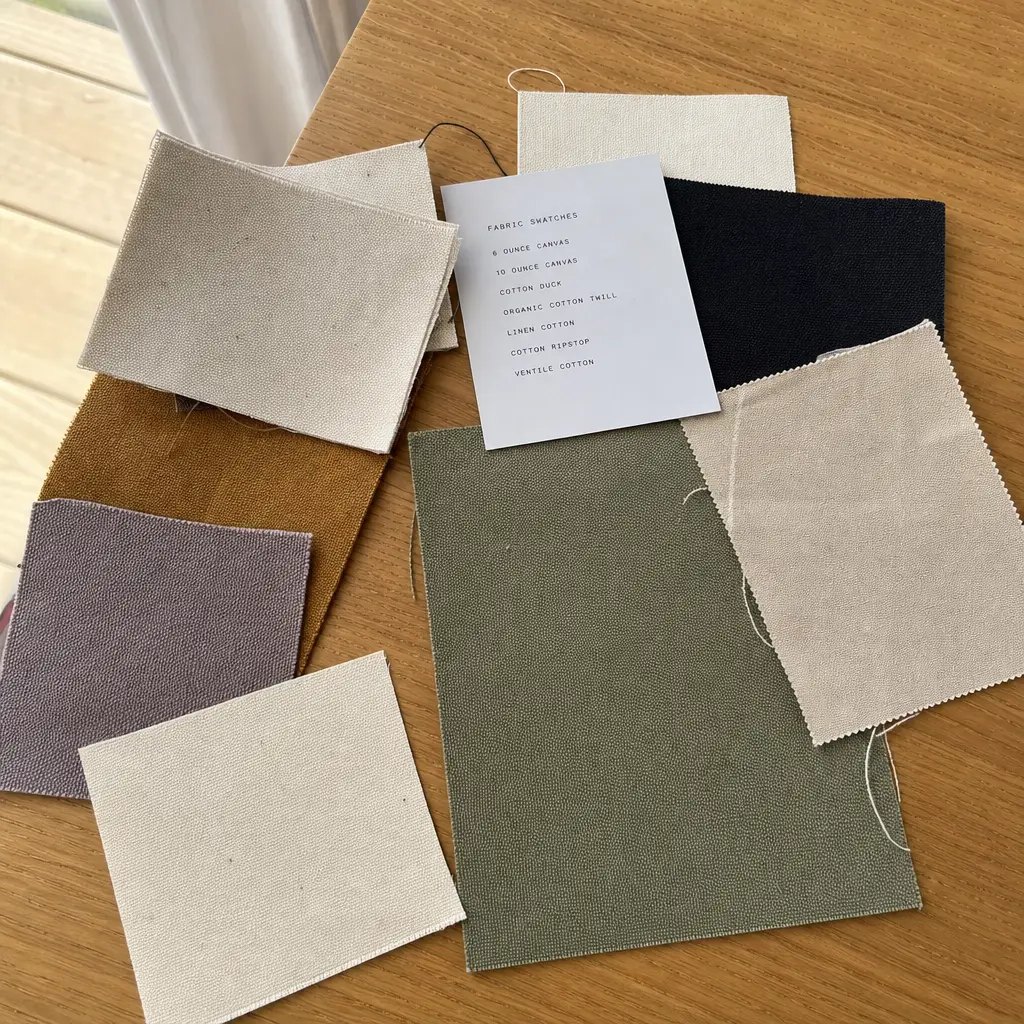
Canvas weight drives feel, print behavior, and shape retention. For many trade show programs, 12 oz finished canvas is the practical default because it balances structure, printability, and cost. Lighter 10 oz canvas can work for a simpler handout, but it will wrinkle more and feel less substantial. Heavier 16 oz canvas gives a stronger body and better shelf presence, but it can raise cost and make the portfolio feel overly stiff if the design is meant to stay slim. In GSM terms, buyers often see roughly 340 GSM, 400 GSM, and 540 GSM as common reference points, but the supplier should confirm the finished weight rather than only the base cloth spec.
The internal construction matters as much as the shell. A flat portfolio is better when the load is mostly documents, while a gusset of around 1.5 to 2 in is more practical when the kit must also hold brochures, a tablet, or small accessories. Ask whether the body is lined, whether interfacing is used, and where bar-tacks or reinforcements are placed. If the portfolio will be carried all day, pay attention to the zipper size and puller style. A #5 nylon coil zipper is a safe default for most business bags, while a larger size is justified only when the bag is heavier or the opening needs more strength.
- Use 10 oz for lighter handout items only if the presentation standard is modest.
- Use 12 oz as the common middle ground for professional trade show use.
- Use 16 oz when shape retention, abrasion resistance, or shelf presence matters more than unit cost.
- Decide on gusset depth, lining, and reinforcement before the supplier starts pricing sewing operations.
Match the Print Method to the Artwork
Print proofing is where many canvas portfolio orders go sideways. Canvas has texture, so small type, thin lines, and tight artwork can lose definition if the print method is not matched to the fabric. Screen print is usually the most cost-effective option for one or two solid colors and simple logos. Heat transfer or another transfer method is more suitable when the artwork has small text, gradients, or multiple colors that would be difficult to separate cleanly on canvas. A sewn patch or embroidered mark can look premium and hold up well, but the artwork usually has to be simplified, and the final size must be checked carefully so the mark does not look crowded on the front panel.
For procurement buyers, a digital mockup is only a layout tool. It can confirm placement, scale, and general composition, but it cannot prove how the ink sits on the actual canvas or how fine details behave at production size. The print proofing checklist should require a physical strike-off or pre-production sample on the intended fabric, with the intended ink or transfer method, before bulk release. If the logo includes brand-critical color, ask the supplier to reference a physical standard and record the viewing condition used for approval. The practical buyer rule is simple: the more sensitive the artwork, the less value a screen image has as a final sign-off tool.
- Use screen print for simple spot-color logos and repeat orders.
- Use transfer for small type, gradients, or more than a few colors.
- Use a sewn patch or embroidery only when the design can be simplified for the material.
- Require the factory to print the logo at the final size, not a scaled-up proof.
Read MOQ and Supplier Route Correctly
MOQ is not just a production number. It tells you how the supplier runs the job. A direct factory that cuts, prints, sews, and packs in the same operation can usually quote a clearer MOQ because the same team owns the bottlenecks. A trading company can be useful when you need several product types bundled into one program, but the buyer should still ask who actually controls print, sewing, and final inspection. A local decorator or short-run shop can be useful for a pilot run, but they may not control the base canvas or the zipper supply chain, which makes a reorder less predictable.
For wholesale canvas zipper portfolios for trade show exhibitors, the most efficient order band is often in the 500 to 2,000 piece range when the art is stable and the spec is frozen early. Below that range, setup costs have less volume to absorb them. Above that range, the unit price usually improves, but only if the approval path is disciplined and the factory can hold the same material and print process through the whole run. Ask the supplier to separate MOQ by base bag, print version, and packaging variant so you can see where the real constraint sits.
- Ask for MOQ by base construction, artwork version, and packing format.
- Check whether a second print color triggers a second setup fee or a new minimum.
- Compare pricing at 300, 500, 1,000, and 2,000 pcs to find the real break point.
- Require the supplier to explain reorder consistency and what they will archive for the next run.
Compare Quotes on Landed Cost
A good procurement comparison uses the same incoterm, the same proofing scope, and the same packing assumptions. Two quotes can look close on paper while hiding very different realities. One supplier may include a strike-off, carton marks, and export packing; another may leave those items out and add them later as the order moves into production. Sample courier charges, screen or plate charges, carton upgrades, split shipments, and rework risk can change the total landed cost more than a small difference in unit price. That is why a line-item quote is more useful than a single headline number.
For event programs, the buyer should compare three layers together: product cost, packing cost, and logistics cost. If the show date is fixed, the schedule itself becomes part of the landed cost because a late run can force a more expensive freight mode. A cheap EXW quote that needs urgent air freight is not cheap in practice. Ask every supplier to quote the same carton count, the same polybag count, the same proof stages, and the same destination basis. When the assumptions match, the numbers can be judged properly.
- Compare suppliers on the same incoterm, not mixed FOB and EXW assumptions.
- Ask for sample, setup, unit, packing, and freight-related charges as separate lines.
- Use the same carton quantity and packing method across all bids.
- Include any destination receiving rules that could affect palletization or carton size.
Approve the Sample Like a Bulk Part
A sample should be reviewed as a production part, not as a display piece. The most useful sample is built with the same canvas weight, zipper type, thread, print method, and packing plan that will be used in bulk. If the sample uses a different fabric lot, a faster print process, or a substitute zipper, the approval loses value and the buyer may still be exposed to a later change. When the sample arrives, compare it against the spec sheet, the artwork file, and the commercial quote line by line. The goal is to confirm that the supplier can reproduce the same result at scale, not just produce one good-looking unit by hand.
The approval record should be written. Note what is acceptable, what is intentionally different, and what must not change. If the logo is placed 20 mm from the top edge, write that down. If the zipper pull must sit on the right side when closed, write that down too. Keep one dated reference sample, a photo set of the approved unit, and the final art file in the same production file. For a print proofing checklist, this is the point where the buyer stops negotiating the concept and starts locking the production standard.
- Compare the sample against the approved spec, not from memory.
- Measure the final sewn dimensions after assembly.
- Open and close the zipper several times to catch seam interference or poor alignment.
- Document any approved variation so it cannot be disputed later.
- Keep one sealed reference sample from the first order for reorder comparison.
Lock Packing, Cartons, and Shipping Terms
Packing is part of the product when the order is destined for a trade show. If the portfolios arrive creased, dusty, or mixed by size, the buyer team has to solve a presentation problem before the event even starts. The RFQ should state whether each unit needs a polybag, whether a desiccant pack is required, how the carton should be marked, and whether cartons need to be sorted by client name, size, or artwork version. For distributor programs and multi-site show shipments, clear carton marking is not optional; it is what prevents the receiving team from opening every carton to identify the right units.
Carton design also affects freight efficiency. A portfolio packed too loosely wastes carton volume, while a carton that is too large can raise both air and ocean costs. If the event team will hand-carry cartons on site, keep the master carton weight reasonable, often under 15 kg is easier to handle than a heavier box. If the item is part of a branded kit, ask the supplier to confirm the fold direction so the print is protected without creating a hard crease across the logo. The practical goal is simple: the product should reach the booth in a condition where it can go straight from carton to presentation, not from carton to recovery work.
- Specify unit pack, master carton pack, and whether inner dividers are needed.
- State if the product must ship flat, semi-folded, or fully folded.
- Include PO number, SKU, artwork version, and destination on the carton mark.
- Ask for palletization rules if the receiving site or forwarder requires them.
Set QC and Acceptance Criteria Before Bulk Starts
Quality control on soft goods should be written before production begins, not discovered at the end. Agree on the inspection standard the supplier will use and the defects that are considered major versus minor. Many buyers use an AQL framework such as 2.5 major and 4.0 minor, but the exact threshold should be named in the PO or quality appendix if the supplier works to a different standard. The important point is consistency: if the same defect is handled differently from one batch to the next, the buyer has no stable basis for acceptance.
The QC checklist should include the measurements that matter to trade show use. Finished size should land within a defined tolerance, often +/- 0.25 in or +/- 5 mm unless the product is unusually tight. Print placement should be checked against the approved artwork position, commonly within +/- 0.125 in or +/- 3 mm for a logo that has visible margins. Stitching should be even, thread tails trimmed, and the zipper should run smoothly through repeated open-close testing. If the supplier measures color, the approval record should state the standard and the lighting condition used for review, such as D65 or a controlled daylight equivalent.
- Set the defect standard in writing before bulk starts.
- Agree on size, print, zipper, seam, and packing tolerances.
- Use the same lighting condition for sample approval and final inspection.
- Require a photo report for any rejected lot or corrected batch.
Protect Lead Time and Reorders
Lead time on canvas zipper portfolios is usually a queue management problem, not just a sewing problem. The order moves through artwork confirmation, proofing, material booking, cutting, printing, sewing, finishing, inspection, and carton booking. If print approval slips, the sewing line cannot simply continue without the printed panels. That is why procurement should ask for the lead time after sample approval and deposit, not a generic factory promise. The useful question is not only how long the order takes, but where the queue is today and which step is the bottleneck.
Reorders are where many programs lose consistency. The supplier should retain the approved artwork, trim details, and final sample reference so the next run can be compared against the first. Before a reorder is released, ask the factory to confirm whether any material source has changed, especially canvas weight, zipper supplier, thread color, or label construction. For trade show programs that repeat each season, the safest process is to freeze the spec, archive the approved sample, and require written notice for any substitution. That keeps the second order from becoming a new product with the same SKU.
- Ask for lead time after artwork approval, sample sign-off, and deposit.
- Build a buffer for proofing, freight booking, and event receiving.
- Archive the approved sample, spec sheet, and final artwork together.
- Require written notice before any material, trim, or packaging substitution on a reorder.
Specification comparison for buyers
| Spec decision | Recommended option | When it fits | Buyer risk to check |
|---|---|---|---|
| Artwork proof path | Digital layout plus one physical strike-off on the actual canvas | When logo color, placement, small text, or line weight must match a brand standard | Do not approve from a screen mockup alone if the canvas texture is visible or the mark has fine detail |
| Canvas weight | 12 oz finished canvas as the default starting point | Most trade show programs that need a professional hand feel without overbuilding the product | Ask for finished fabric weight, not only greige cloth weight, because coating and washing can change the result |
| Zipper grade | #5 nylon coil for most portfolios, #8 only when the item is oversized or heavily loaded | Standard document carriers, exhibitor kits, and branded handouts | A metal zipper can add cost, rigidity, and scuff risk if the body is still soft |
| Construction style | Flat body for papers only, 1.5 to 2 in gusset for catalogs or a tablet | When the portfolio must hold brochures, contracts, and small accessories without bulging | If the gusset is too shallow, the side seam will distort and the product will not close cleanly |
| Print method | Screen print for 1 to 2 spot colors, transfer for finer detail, sewn patch for premium branding | Simple logo programs, small type, gradients, or a more durable presentation | Thin lines can close up on coarse canvas; require the factory to print the actual logo size |
| MOQ band | 500 to 2,000 pcs for the most efficient trade show programs | Stable art files, repeatable specs, and buyers who can freeze the design early | Very low MOQ can hide setup fees, outsourced printing, or inconsistent reorder quality |
| Packing method | 1 pc polybag, clear carton marks, and a master carton size that keeps hand-carry weight manageable | Show-site delivery, distributor kits, and programs with multiple ship-to points | Mixed SKUs and weak carton labels create avoidable receiving errors at the venue |
| Quote format | Line-item quote with sample fee, setup fee, unit price, packing, and freight assumption | Any procurement process that needs comparable supplier bids | A cheap headline price is not useful if it excludes proofing, labels, cartons, or export packing |
Buyer checklist before sampling
- State the finished size in closed dimensions and, if relevant, the internal clear opening needed for A4, letter, or a tablet sleeve.
- Specify the canvas weight in oz or GSM and say whether you want a structured body, a softer hand feel, or a more rigid presentation.
- Call out the zipper type, zipper size, puller finish, and whether the zipper tape should match the canvas or contrast intentionally.
- Define the print method, artwork color count, Pantone target, and whether a physical strike-off is required before bulk production.
- List all inside features up front, including pen loops, card slots, lining, pockets, sleeves, and any brand label or patch.
- Ask the factory to quote sample fee, screen or plate fee, packing fee, carton fee, and any upcharge for patch, embroidery, or special labels.
- Set MOQ expectations separately for the base bag, each print version, and each packaging variant.
- Require a tolerance note for finished size, print placement, zipper alignment, and stitch quality before you release the PO.
- Confirm carton size, unit-per-carton count, carton markings, pallet requirement, and destination receiving rules for the event site.
- Ask for the production lead time after sample approval, not just the factory's general delivery estimate.
Factory quote questions to send
- Is the print done in-house, or is it outsourced to another decorator or print shop?
- What is the exact finished canvas weight, and do you measure it after washing or coating?
- What zipper spec are you quoting, including type, size, puller style, and color?
- What proof stages are included: digital layout, strike-off, pre-production sample, or all three?
- What tolerance do you hold for finished size, print placement, and zipper position after sewing?
- What MOQ applies to the base bag, the print setup, and each artwork color or logo version?
- Does the quote include polybagging, carton marks, master carton specification, and any palletization request?
- What is the lead time after artwork approval, sample sign-off, and deposit?
- What is your inspection standard, and do you ship to AQL 2.5 major / 4.0 minor or another threshold?
- Will you archive the approved artwork, sample spec, and trim details for the reorder, and for how long?
Quality-control points to confirm
- Finished size matches the approved pattern within +/- 0.25 in or +/- 5 mm, unless your spec sheet sets a tighter tolerance.
- Canvas weight and finish match the approved material reference, with no substitution of a lighter roll or a different coating.
- Print placement stays within the agreed position tolerance, commonly +/- 0.125 in or +/- 3 mm for logo centering.
- If color measurement is used, the supplier states the target standard and the acceptable Delta E in the PO or sample sign-off.
- Solid print areas are even, with no visible banding, skipping, bleeding, or pinholing on the front panel at normal viewing distance.
- Small text and fine lines remain legible on the approved canvas, with no closing up, filling in, or broken strokes.
- Zipper runs smoothly through at least 10 open-close cycles without catching, twisting, or separating at the end stop.
- Stress points, bar-tacks, handles, and seams show no loose threads longer than 5 mm and no skipped stitches in load areas.
- Thread density on load-bearing seams is consistent with the approved sample, typically in the 6 to 8 stitches-per-inch range if that is the factory method.
- Packing, polybags, carton marks, and SKU labels match the PO exactly, with no mixed versions in the same master carton.