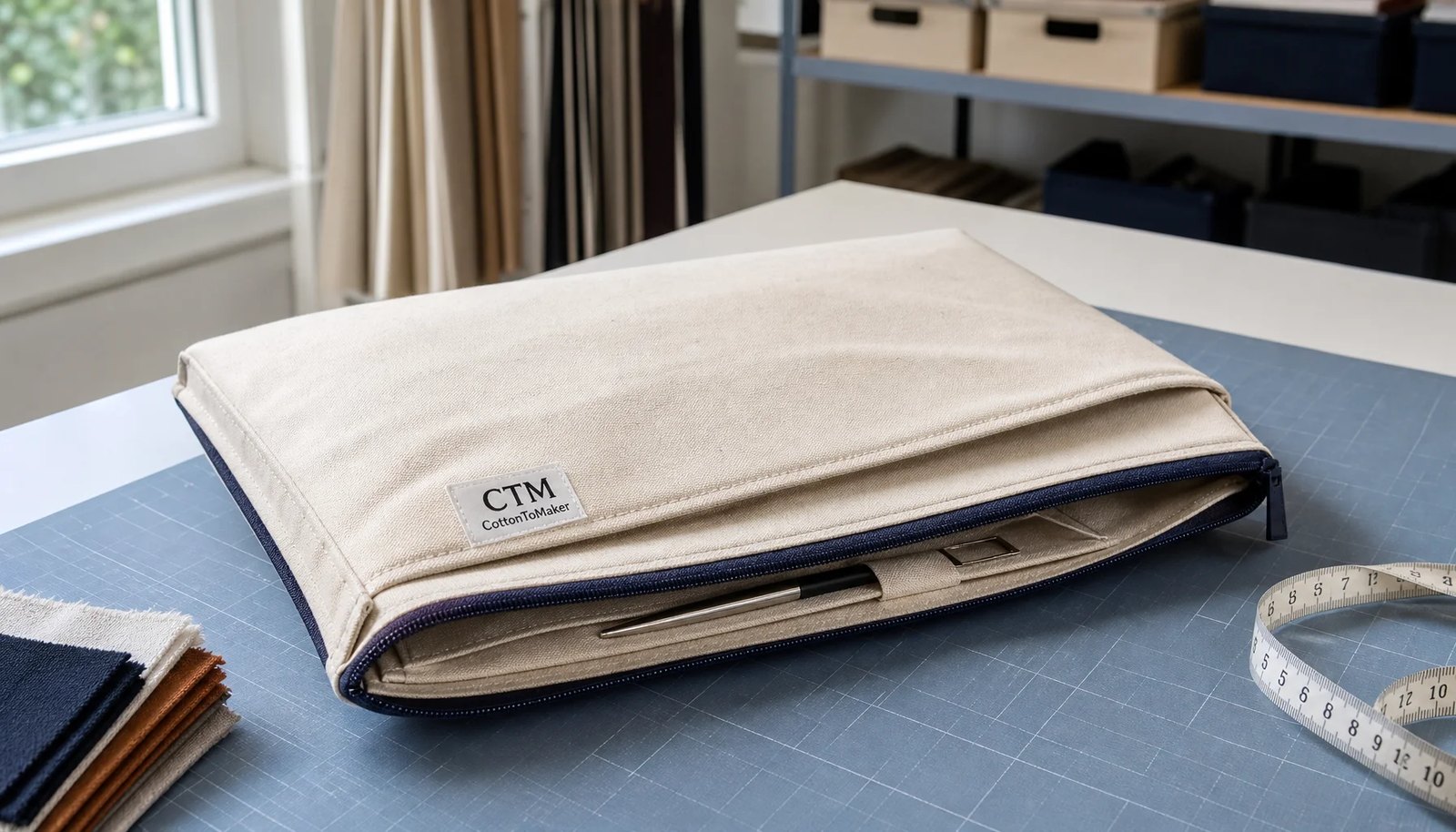
1. What You Are Really Negotiating
Trade show exhibitors do not buy canvas zipper portfolios only to save money on a line item. They need a product that carries brochures, contracts, notepads, and samples without looking messy on a booth table. MOQ negotiation is really a conversation about how much custom work the factory must absorb to make the bag look consistent, repeatable, and ready on time.
The fastest way to inflate MOQ is to treat the portfolio like a simple pouch. Once a buyer adds a custom size, multiple pockets, contrast zipper tape, a printed logo on both sides, and retail-style packing, the factory has to book separate materials and extra setup. A useful negotiation starts by deciding which details are brand-critical and which can be standardized for the first order.
- Keep the first run to one size and one logo placement if the volume is limited.
- Use the MOQ discussion to simplify the build, not just to pressure the unit price.
- Treat the portfolio as a functional event tool first, then a branded item second.
2. Lock the Spec Before You Discuss Quantity
For trade show use, the useful starting point is a clear construction spec. Typical buyer-friendly formats are around 12 x 9 inches or 13 x 10 inches, often with a 1 to 2 inch gusset, but the right size depends on the document stack you want to carry. Canvas weight should be chosen deliberately: 12 oz canvas, about 407 gsm, is usually enough for lightweight collateral, while 16 oz canvas, about 542 gsm, gives a firmer, more premium handfeel.
Ask the factory to quote the construction, not only the appearance. State whether you want a lining, a #5 or #8 nylon coil zipper, a woven label, a pen loop, a business card slot, or a plain interior. When each element is written as a specific component, it is easier to compare quotes and easier to negotiate around any item that pushes MOQ up.
- Use 12 oz canvas for lower freight and lighter document kits.
- Use 16 oz canvas when the portfolio will be reused or needs a sturdier profile.
- Freeze zipper size, pull style, and pocket layout before asking for pricing.
- Avoid hidden construction details unless they matter to your buyer.
3. Where MOQ and Unit Cost Actually Come From
On this product, MOQ is rarely set by the sewing line alone. It usually comes from fabric dye lot minimums, zipper procurement, print setup, and packing labor. A factory may be able to sew a few hundred portfolios, but the canvas mill may want a larger run for a custom color, or the zipper supplier may require a bigger trim purchase to justify the order.
This is why a buyer should ask for MOQ by item, not only by final bag count. One canvas color, one zipper color, one print position, and one packing spec often reduce risk more effectively than pushing for a discount. If the supplier can show you which line item is driving the constraint, you can decide whether to standardize it or keep it custom.
- Ask whether MOQ is per style, per color, or per total order.
- Separate fabric minimums from print setup minimums.
- Reduce the artwork color count if the launch quantity is small.
- Keep carton specs simple when the shipment is going to a distributor or warehouse.
4. Compare Sourcing Routes Before You Bargain
There are three common sourcing routes for wholesale canvas zipper portfolios. Direct factory sourcing gives the best control over material, dimensions, and final finish, but it requires stronger artwork discipline and a slower approval cycle. Trading company sourcing can bundle portfolios with other event items under one purchase order, which is useful when the procurement team is short on bandwidth, but the real production route is less transparent.
Stock blank plus local decoration is the fastest option when the show date is tight and the design can accept a standard size. It lowers the pressure on factory MOQ, but the quality of the final print or label depends on the downstream decorator. For a repeated program, it is often a bridge solution rather than the long-term answer.
- Use direct factory sourcing when construction detail and repeatability matter.
- Use a trading company when the PO mixes bags, pouches, and other event goods.
- Use stock blanks only when the specification is simple and the deadline is tight.
- If the supplier cannot explain the production route, the quote is incomplete.
5. Choose the Branding Method With the Use Case
Screen print is usually the first quote for a canvas zipper portfolio because it is efficient and readable on a flat panel. It works best for one- or two-color logos, large conference marks, and repeat programs where the buyer wants stable artwork cost. If the portfolio needs a cleaner, more premium look, a woven label or sewn patch often gives better durability than a heavy ink build.
Embroidery can work on thicker canvas, but it adds thread build-up and can distort a thinner panel if the structure is weak. Heat transfer is usually less convincing on textured canvas and may raise durability concerns after repeated handling. The correct branding method is the one that still looks good after stacking, zipping, and daily event use, not the one that looks the most decorative in a sample photo.
- Use screen print for simple logos and controlled setup cost.
- Use a woven label when the buyer wants a more retail-like presentation.
- Use embroidery only if the panel construction can support it cleanly.
- Keep the logo away from seams and zipper stress lines.
6. Build the Sample Like a Production Test
A useful sample proves construction, not just appearance. Measure the finished width, height, and gusset after the bag is fully assembled. Open and close the zipper repeatedly, load the portfolio with paper, a brochure stack, and a notepad, then watch whether the front panel buckles or the zipper track drifts. If the sample only looks clean in a static photo but fails under use, it is not a reliable approval piece.
Ask for a sample approval sheet that records the exact dimensions, logo placement, canvas weight, zipper type, and packing method. Freeze the sample only after you have checked handfeel, stitch density, zipper action, and carton packing. The approved sample should become the production standard, not just a sales reference that nobody can reproduce at scale.
- Measure at three points and record the average.
- Cycle the zipper at least 20 times on the approved sample.
- Confirm pocket depth, pen loop placement, and insert card fit.
- Keep one reference sample tied to the PO file on both sides.
7. Set QC Thresholds That Matter on Event Day
Trade show buyers care more about visible failures than tiny cosmetic noise. A zipper that snags, a logo that drifts off-center, or a bag that collapses on a table creates a public problem at the booth. QC thresholds should focus on the issues the end user notices first: opening action, seam strength, alignment, color consistency, and clean packing.
For canvas zipper portfolios, practical tolerance is more useful than a vague approval standard. Many buyers can work with a small dimensional variance if the shape stays square and the portfolio holds its form. Stitching should be straight, bartacks should be reinforced at stress points, and the zipper should run smoothly without wave distortion. If your program is premium, tighten the visual criteria before you ask the factory to reduce MOQ.
- Reject visible oil marks, skipped stitches, loose thread, or zipper mismatch.
- Define the acceptable logo shift before production starts.
- Test seam corners and zipper ends for puckering.
- State the inspection standard in the PO if you are using AQL.
8. Packing and Carton Choices Change the True MOQ
Packing is not a minor detail when the shipment is tied to a live event. If the bags go straight to a distributor warehouse, an individual polybag may be enough. If they are handed out at a trade show, a cleaner fold or a simple insert card can make the piece feel more polished. Every extra packing step adds labor, carton volume, and sometimes a higher effective MOQ because the factory must schedule more handling time.
The buyer should decide whether the portfolio is a presentation item or a utility item. Presentation items need better folding control, moisture protection, and stable carton marks. Utility items can ship more densely. Ask how many units fit per carton at the target size and whether the zipper pull can mark the canvas during transit. That answer usually tells you more about production discipline than a polished quote sheet.
- Define unit packing before the quote is finalized.
- Ask for carton dimensions, gross weight, and packing count.
- Use desiccants only when the route or climate justifies them.
- Keep carton marks consistent with the destination plan.
9. Lead Time Risk Starts Before Production
Lead time for a custom canvas zipper portfolio is usually a chain of smaller steps: sample approval, material booking, production, inspection, and dispatch. A simple order with standard components may move faster, but custom canvas color or a special zipper pull can add time before sewing even starts. The common mistake is to count only the sewing days and ignore the delay caused by artwork revision or slow sample sign-off.
Trade show programs need buffer because every day matters. Work backward from the date the goods must be on site, not from the factory ex-works date. Leave room for freight, customs, and a replacement window if the first lot fails inspection. A realistic schedule is more valuable than a fast promise that has no margin for rework.
- Freeze artwork before sample approval.
- Confirm raw material availability before issuing the PO.
- Build in time for rework or a second inspection if needed.
- Separate factory lead time from transit time in the internal schedule.
10. How to Read Quotes and Negotiate With Leverage
A useful quote should break out fabric, lining, zipper, branding, packing, carton, and any test cost, even if the supplier still gives one final unit price. Once those lines are visible, the buyer can see whether the MOQ problem comes from fabric minimums, print setup, or a special packing request. If two quotes look similar but one includes polybags, carton marks, and testing while the other does not, they are not actually comparable.
Negotiate around what the factory can standardize. A buyer with a limited run can often lower MOQ by accepting a standard canvas shade, a single logo color, a common zipper pull, or simpler packing. That is usually better than pushing for a discount on a highly customized build. The strongest leverage is a clear spec, fast decisions, and repeat business, not pressure alone.
- Request a line-item quote, not only a single all-in price.
- Compare sample fees, tooling, packing, and freight as separate buckets.
- Ask what changes the MOQ if you standardize the zipper or print.
- Use forecast language if you expect a reorder in the same style.
Specification comparison for buyers
| Spec decision | Recommended option | When it fits | Buyer risk to check |
|---|---|---|---|
| MOQ baseline | Direct factory with a standard spec | You want repeat orders and can commit to one size, one canvas color, and one logo placement | MOQ can still be driven by fabric dye lot or zipper minimums, not sewing capacity |
| Speed route | Stock blank plus local decoration | The show date is close and the portfolio can use a standard size and standard trim | Decoration quality and placement can vary after the factory shipment |
| Control route | Direct factory with a pre-production sample | Dimensions, pocket layout, and zipper feel are brand-critical | Approval takes longer, so late artwork changes become expensive |
| Bundled buying | Trading company sourcing multiple event items | You are buying portfolios with other trade show items under one PO | Margin layers can hide the real factory MOQ and the actual construction spec |
| Fabric weight | 12 oz canvas, about 407 gsm | Document carriers, lighter collateral kits, and lower freight targets | The bag may collapse if the load gets heavy or the client expects a premium handfeel |
| Premium build | 16 oz canvas, about 542 gsm with reinforced bartacks | Reusable kits, higher perceived value, or heavier inserts | Higher fabric cost, slower sewing, and more freight weight |
| Branding method | Screen print or woven label | Simple logos, limited artwork colors, and repeat production runs | Ink density, placement, and color match must be frozen before mass production |
| Packing route | Individual polybag plus master carton | Distributor handling, warehouse storage, or mixed-channel delivery | Extra packing labor raises cost and carton volume, which can affect landed cost |
| QC route | Pre-production sample plus third-party inspection | High-visibility trade show programs where failures are unacceptable | Adds time and inspection cost, so the schedule must include a buffer |
Buyer checklist before sampling
- Freeze the final finished size in both inches and mm before requesting quotes.
- Choose 12 oz or 16 oz canvas based on the document load and expected reuse.
- State one logo method, one logo position, and the exact artwork color count.
- Confirm zipper type, zipper size, pull style, and whether the zipper tape is standard or custom color.
- Decide whether the portfolio needs a lining, inner pocket, pen loop, or business card slot.
- Approve a pre-production sample only after measuring dimensions and testing the zipper cycle.
- Set packing requirements, including polybag, insert card, carton marks, and carton quantity.
- Ask for the MOQ by style, by color, and by print setup so the real constraint is visible.
- Build time into the schedule for sample approval, inspection, freight booking, and customs clearance.
- Collect a landed-cost view that separates product cost, packing, test fees, freight, and duty.
Factory quote questions to send
- What canvas weight, weave, and finish are you quoting, and is it 12 oz, 16 oz, or another spec?
- Is the zipper a nylon coil, resin, or metal zipper, and what size is it?
- What is the MOQ by style, by color, and by logo method?
- Which setup charges apply for screens, woven labels, embroidery files, or embossing tools?
- Can you quote with and without individual polybags and insert cards?
- What dimension tolerance will you hold on the finished portfolio?
- What stitch and bartack standard do you use at zipper ends and stress points?
- How many days do you need for sample making after artwork is approved?
- What is the production lead time after pre-production sample approval?
- What overrun, shortage, and replacement policy applies if the order is short or defective?
Quality-control points to confirm
- Measure finished width, height, and gusset at three points and keep the variation within the agreed tolerance.
- Check that the zipper opens and closes smoothly at least 20 cycles without snagging or wave distortion.
- Inspect stitch lines for skipped stitches, loose thread ends, oil marks, or uneven tension.
- Confirm bartacks at zipper ends, corners, and strap or pocket stress points are dense and clean.
- Verify logo position, size, and color against the approved sample before mass shipment.
- Confirm the inner pocket depth, pen loop placement, and card slot fit if those features are included.
- Check that the canvas surface is clean, with no shading problems, stain marks, or thread contamination.
- Count packed units per carton and verify carton marks, lot numbers, and destination labels.
- Run a simple load test with brochures or documents to see whether the portfolio keeps its shape.
- If your program uses AQL, state the major and minor defect limits in the PO so inspection is not subjective.