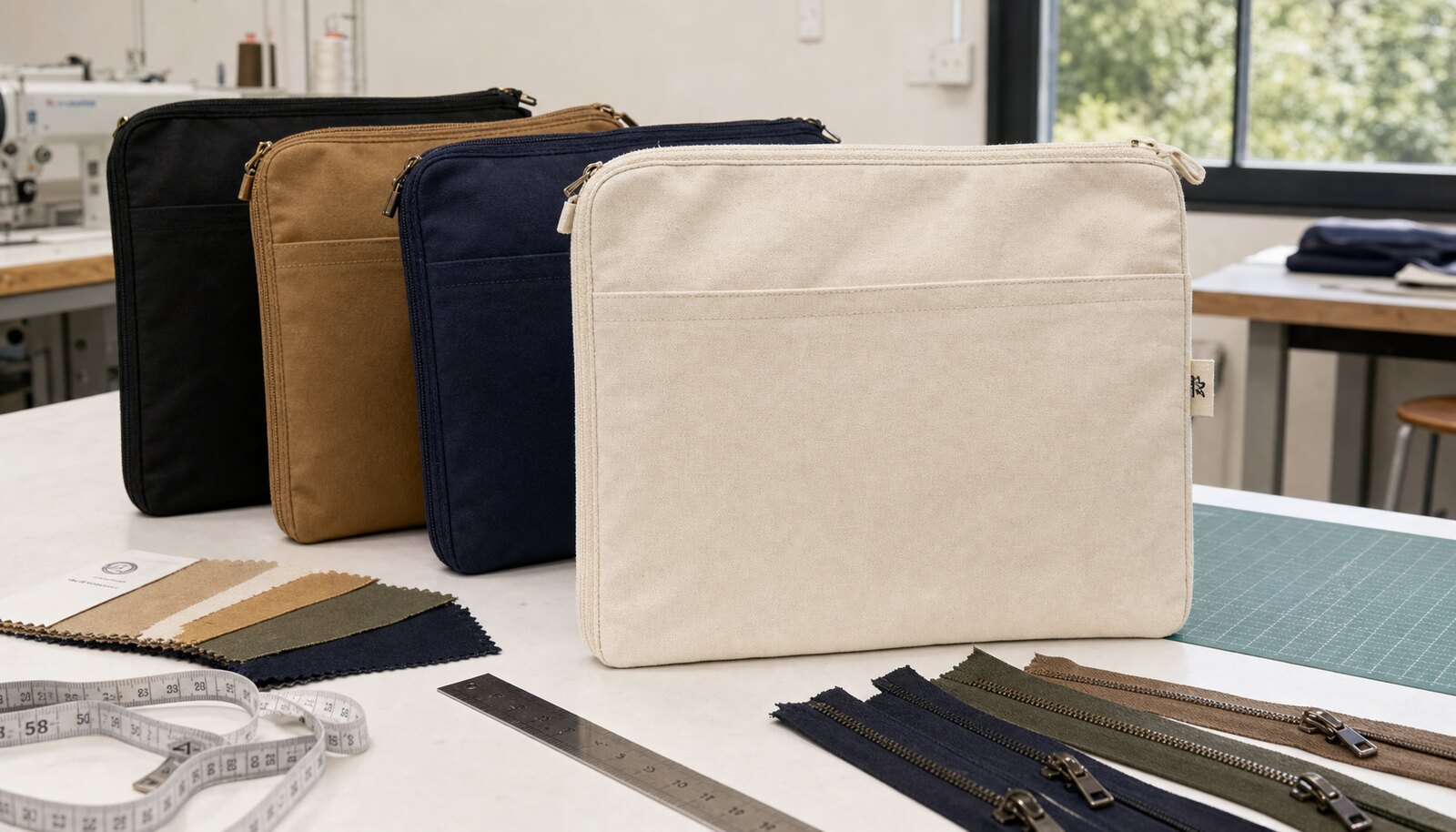
1) Start from the gift-shop selling job, not the bag category
Wholesale canvas zipper portfolios for gift shops should be specified around the shopping moment, not around a generic bag description. In this channel, the item often sits beside notebooks, postcards, maps, pens, and small souvenirs. That means the buyer is not only purchasing a carrying case. They are buying a shelf-ready retail item that must look neat from a distance, feel useful in hand, and survive repeated opening by casual shoppers who may not be careful with it.
The wrong starting point is to treat the product like an office file pouch. Gift-shop buyers usually need a more visual spec: what is the item meant to hold, how it should present on the shelf, and what price tier it needs to support. If the item is tied to a museum, hotel, attraction, or destination shop, the artwork and presentation need to support impulse purchase. If it is a utility add-on near stationery, function becomes more important than decoration.
Before requesting quotes, write down three things: the target retail context, the real insert size, and the expected customer handling pattern. That simple framing helps the factory choose a more appropriate build. A portfolio that is supposed to hold a ticket bundle and map does not need the same structure as one that must protect postcards and a gift card set. The more accurately you define the selling job, the less likely you are to overbuy material or underbuild the seams.
- Define the store type: museum shop, tourist destination, hotel gift shop, stationery counter, or general souvenir retail.
- Identify the shopper use case: document carry, postcard storage, light organizer, or souvenir presentation.
- State the handling pattern: occasional use, daily carry, or display-only retail handling.
2) Choose the size around the real insert, then protect the fit
Size is the first production decision that can quietly determine whether the product sells well or becomes a source of returns. The most useful way to size a portfolio is to start with the largest item the shopper should be able to insert without forcing the zipper or stressing the seams. A portfolio that is too small feels cheap and awkward. A portfolio that is too large can look loose, waste canvas, and fail to present neatly on a rack or shelf.
For gift-shop programs, the interior layout should be kept simple unless there is a clear merchandising reason to add structure. One main compartment is often enough for postcards, brochures, brochures plus a pen, or a slim notebook insert. A gusseted version makes sense when the item needs extra depth, but each additional pocket, divider, or loop adds sewing steps and more places where fit can go wrong. If the shop will sell a bundled set, test the portfolio with the full package, not with a single paper insert.
Use a tight but realistic tolerance plan. A buyer-friendly approach is to ask for finished dimension tolerance by panel, not just a generic statement like “within tolerance.” For many canvas products, a practical starting point is about ±3 mm on smaller dimensions and ±5 mm on longer panels, but that should be adjusted if the insert is a rigid card, a printed brochure, or a carton-style presentation pack. The sample should be checked with the real insert set so you can confirm zipper opening width, corner clearance, and whether the top seam crowds the contents.
- Lock finished dimensions before final artwork placement.
- Test with the real insert set, not empty product only.
- Ask the supplier to state tolerance by dimension and not as a vague promise.
3) Specify the canvas body for shelf feel, not just price
Canvas weight matters because it changes the retail impression. A lighter fabric can reduce cost and keep the item flexible, but if the body is too soft the portfolio may wrinkle, slump, or feel unstable when picked up. A heavier body looks more premium and gives better shape retention, but it can also feel stiff if the market expects a casual souvenir item. For many gift-shop buyers, the decision is less about chasing the highest GSM and more about matching the feel of the product to the shelf price.
Do not buy by GSM alone. Weave tightness, yarn count, finish, shrinkage behavior, and any coating or washing process all change the way the final item performs. Two fabrics with the same nominal weight can behave very differently once sewn. That is why a physical swatch is more useful than a spec sheet alone. Ask whether the canvas has been pre-shrunk, whether it is raw, dyed, washed, or coated, and whether there is any odor risk from treatment or lamination. In a small gift shop, a strong chemical smell is often noticed right away when shoppers open a zipper.
If the portfolio needs a cleaner front face, ask whether the supplier will use interfacing, a board insert, or another internal stiffener. Sewn-in support is usually safer than adhesive-only support for warm storage or long shipping lanes. Adhesive can be acceptable if the route is short and the supplier can prove bond stability, but buyers should ask directly about delamination risk, hot-weather storage, and whether the reinforcement changes the folding behavior. A clean, stable face is often worth a little extra cost if the item is meant to sit in a front-of-store display.
- Request fabric weight in GSM or ounces and insist on a physical swatch.
- Ask whether the body is raw, dyed, washed, coated, or pre-shrunk.
- Check whether the front panel needs interfacing or a board insert to keep the shape.
4) Match the zipper and trim to the handling pattern
The zipper is not a minor accessory. It is one of the main reasons the buyer either trusts or rejects the product on first touch. For wholesale canvas zipper portfolios, the zipper should run cleanly, sit straight, and open wide enough for the intended insert. A zipper that feels rough, catches at the ends, or pulls the fabric out of shape will create a negative impression even if the print is attractive. In gift retail, shoppers often open the item in store before they buy it, so zipper feel becomes part of the product review.
Ask for the zipper size or gauge, the tape color, the puller material, and whether the zipper is from an in-house source or bought from a standard trim vendor. If the portfolio will be merchandised in a premium environment, the puller finish and the end-stop neatness matter more than many first-time buyers expect. A metal pull can look more premium, while a plastic or coated pull may better suit a lighter souvenir line. The point is not to chase a trend; it is to make sure the trim matches the channel and does not add a hidden failure point.
The best procurement question is simple: what happens if the zipper color, pull style, or tape source changes during production? If the supplier cannot promise trim continuity across reorder, you need that risk priced into the deal. It is also worth asking whether the zipper tape must be color-matched to the canvas or intentionally contrasted. A contrast zipper can make the item look more designed, but it can also create more shade control issues and more rework if the color batch shifts.
- Confirm zipper size/gauge and pull style before sample approval.
- Ask whether trim colors are matched, contrasted, or fixed stock items.
- Test the zipper repeatedly and reject snagging, skipping, or crooked tape alignment.
5) Choose branding by durability and retail readability
Artwork is not only a design question. It is a production and retail-readability question. On canvas zipper portfolios, screen printing is often the most efficient route for a simple logo, a short message, or a one-to-three-color illustration. It is usually the right choice when the artwork is bold, the print area is moderate, and the buyer wants controlled cost. But if the design uses tiny type, fine strokes, or dense color blocks, the print may lose sharpness or feel heavy on the canvas surface. Buyers should approve the artwork on the actual fabric color, not just on a white digital proof.
There are valid reasons to choose a woven label, side label, sewn patch, or embroidery instead of a front print. A woven label gives branding durability without thick ink. A sewn patch can look more giftable if the channel likes a handmade or heritage feel. Embroidery can create a premium impression, but it also changes the hand feel and can distort a thinner front panel. For a souvenir line that needs visual clarity from a distance, a clean print may outperform a small label. For a more restrained premium line, a label may be the better answer.
When you request a quote, specify the minimum text size, line thickness, logo width, and allowed placement area. If the artwork is not tolerant of small production shifts, say so. Many print disputes happen because the buyer expected a perfect digital look while the factory used a method better suited for bold graphics. A good supplier will tell you when artwork needs to be simplified for cleaner production. That is useful feedback, not pushback.
- Approve artwork on the actual canvas shade and actual print method.
- State minimum line thickness and minimum text size for readable results.
- Choose a branding method that fits the channel: print, woven label, patch, or embroidery.
6) Build the MOQ and quote around variants, not just unit price
MOQ for this category is usually driven by fabric usage, dye lot planning, zipper booking, print setup, and packing efficiency. Once you add multiple canvas colors, more than one zipper color, or several logo versions, the effective MOQ rises. That is why a single headline MOQ often creates confusion. The smarter approach is to ask the factory to quote one base SKU first, then price every variant separately. That reveals which changes are cost-efficient and which ones break the production rhythm.
A usable quote should break down the body fabric, zipper, lining or reinforcement if included, print or embroidery, labor, packing, and master carton cost. If those lines are mixed together, you cannot tell where the money is going. For gift-shop buyers, this matters because retail packaging can have as much influence on sell-through as the bag itself. If one quote includes a barcode label, hangtag, and inner pack while another excludes them, the unit price comparison is meaningless. Ask the supplier to align the quote to the exact retail-ready spec.
Do not widen the style range too early. In many gift-shop programs, a small assortment with deeper stock depth performs better than many slight variants with thin inventory. That is especially true when you are dealing with seasonal launches, exhibition merchandise, or tourist-site ranges where replenishment speed matters. A simple assortment also makes QC easier because you are checking fewer combinations of fabric, zipper, print, and packing.
- Request the base SKU price first, then price each extra variant separately.
- Separate fabric, trim, print, labor, packing, and carton cost in the quote.
- Treat extra colors, extra logo versions, and special retail packs as priced options.
7) Compare supplier routes as a production-control decision
The route you buy through affects the level of control you really have. A direct factory with in-house sewing and printing usually gives the cleanest accountability for bulk repeatability, trim control, and sample-to-bulk consistency. A trading company can be helpful if your team needs coordination across more than one product type or wants sourcing support, but the buyer should still ask who actually makes the sample and who makes the bulk. A stock program can be fast, but it often limits control over size, trim, color, and packaging. In procurement terms, speed and customization usually trade off against each other.
For a gift-shop buyer, the right route depends on the role of the product. If the portfolio is a repeat seller, choose the supplier that can repeat the same canvas spec and zipper source on reorders. If it is a seasonal launch or a short-run branded item, speed and packaging readiness may matter more than long-term trim continuity. If the supplier cannot explain where the sample was sewn, where the print was done, and what line will run the bulk, you do not yet have a dependable supply chain. The maker of record matters.
A useful supplier comparison should include production ownership, sample consistency, and change-control clarity. In other words, ask not only “who is cheapest?” but also “who can keep the same BOM, same line, and same outcome when we reorder?” That question is more useful for procurement than a broad promise about service quality.
- Use direct factory when repeatability and trim control matter most.
- Use a trading company only if they disclose the actual maker and process control.
- Use stock routes for speed, but expect tighter limits on customization.
8) Approve the sample as a production gate, not a display piece
A sample should prove that the factory can make the same product in bulk, not just make one good-looking unit. That means the sample review needs to be operational. Check the finished dimensions, zipper opening, stitch alignment, print location, reinforcement points, and how the item behaves when loaded with the actual insert set. In a gift shop, the sample should also be looked at under real retail conditions: on a table, on a shelf, and in the shopper’s hand. A portfolio that looks good in a photo but opens crooked or feels awkward in use should not pass approval.
Set the acceptance criteria before bulk starts. If you do not define the target dimension tolerance, the supplier will use its own standards, and those may be wider than the fit demands of the product. If you do not define print placement tolerance, the factory may assume a looser visual standard than your brand can accept. A clear sample sheet should record material, trim, size, print placement, and any accepted deviation. If there is a deliberate concession in the sample, write it down so the bulk run cannot drift further without approval.
One practical way to avoid disputes is to treat the sample as a signed reference pack. Keep the approved sample, swatches, label proof, and carton spec together. If the supplier later proposes a zipper swap or a different fabric batch, compare it directly to the signed reference. That makes the approval process faster and far more objective.
- Inspect the sample with the actual insert load, not empty only.
- Write size, print, and stitch tolerances into the approval sheet.
- Keep the signed sample, swatches, and carton spec together as the production reference.
9) Package for retail handling, carton efficiency, and warehouse receiving
Gift shops care about the opening experience and the shelf presentation. That means the portfolio should arrive clean, flat, and ready to price or barcode. Polybag packing may be enough for simple retail, but some channels need a hangtag, a barcode sticker, or an insert card to support receiving and display. If the product is going into a distributor or chain warehouse, label placement becomes a real procurement issue because the receiving team needs consistent SKU logic. Changing pack style after sample approval can also change fold direction, carton count, and labor time.
Carton planning should be part of the quote, not a side note. Ask for inner pack count, master carton count, carton dimensions, and gross weight target. This matters for freight efficiency and for how many units fit into your storage and replenishment flow. If the item has a printed front panel, make sure the packing method prevents scuffs, crease marks, and pressure lines. If the product will travel through humid routes, ask whether the supplier uses desiccant or a moisture barrier. Even a good bag can arrive looking tired if the carton spec is weak.
Mixed cartons can make sense in some promotional programs, but only if the downstream warehouse can sort them without confusion. For most standard gift-shop replenishment, a clean single-SKU master carton is easier to receive, count, and store. If your retailer uses barcoded receiving, make sure the outer carton label matches the SKU naming used in the order system. Mismatched labels are a small mistake that can create an expensive receiving delay.
- Confirm whether packing is polybag-only, retail-ready, or shelf-ready with barcode labeling.
- Set inner pack count and master carton count before the bulk run starts.
- Ask for carton dimensions and gross weight so freight and storage planning are accurate.
10) Protect schedule and landed cost before release
Lead time is usually longer than the factory’s sewing time suggests because several earlier steps sit on the critical path. Fabric booking, zipper procurement, print approval, sample sign-off, and packing material prep all need to happen before bulk production can move cleanly. If artwork changes after booking, the schedule can slip even if the sewing line is ready. That is why the bulk should not be released until the final BOM, approved sample, and packaging plan are locked. The more custom the portfolio, the more important this becomes.
Landed cost should be evaluated on the same basis across suppliers. Compare the ex-factory price, sample policy, packing charges, inland transport, and freight assumption rather than focusing only on the unit price. If one quote looks unusually low, check whether the canvas is lighter, the zipper is a lower-grade stock item, the label is excluded, or the carton spec is less protective. The cheapest quote often hides the biggest variation in spec. A clear RFQ packet reduces that risk because every supplier is quoting the same finished item.
Keep a simple change log for any post-approval update. If you change print size, zipper color, carton count, or fabric finish after sign-off, record the impact on cost and lead time. That helps procurement stay in control when merchandising asks for a late adjustment. It also protects the reorder process because the approved version is documented instead of living only in email threads.
- Freeze artwork and packaging before bulk release.
- Compare landed cost on the same terms, including packing and inland charges.
- Use a change log for every post-approval update to fabric, trim, print, or carton spec.
Specification comparison for buyers
| Portfolio build choice | What it means in production | Best fit for gift shops | Buyer risk to verify |
|---|---|---|---|
| Single-compartment canvas zipper portfolio | One main cavity with a zipper closure and minimal internal structure | Best for postcards, brochures, slim notebooks, receipts, and simple souvenir sets | Check whether the zipper opening is wide enough for the intended insert without forcing the fabric |
| Gusseted portfolio with simple pockets | Adds depth and may include one or more slip pockets or organizer panels | Good when shoppers may carry papers plus a pen, ticket, map, or card pack | Confirm gusset depth, pocket stitch strength, and whether the added structure affects shelf flatness |
| Portfolio with reinforced front panel | Uses interfacing, board, or a stiffer canvas body to hold a cleaner shape | Useful for premium gift-shop presentation and front-facing display | Verify whether reinforcement is sewn or glued, and test for odor, warping, or delamination |
| Printed front-panel portfolio | Brand or artwork appears on the exterior face of the bag | Best for museum shops, attractions, and souvenir assortments | Approve print size, placement, and color on the actual canvas shade, not only on a digital proof |
| Label-led branded portfolio | Brand appears on woven, sewn, or side label instead of a large front print | Useful when the channel wants a subtle look or when artwork must stay minimal | Check label edge softness, sew quality, and whether the label placement interferes with handling |
| Mixed-material portfolio | Canvas body plus contrasting zipper tape, puller, lining, or trim | Works for gift shops that want stronger visual contrast and a more giftable look | Confirm trim color consistency across the full order and ask for pantone or physical trim approval |
| Flat retail-sleeve packed portfolio | Bag is packed for display, barcode, and retail handling rather than bulk utility | Good for stores that need shelf-ready receiving | Check carton count, pack fold direction, barcode visibility, and crease control |
| Special-size portfolio for a gift or tour format | Custom dimensions built around a specific brochure, map, or merchandise insert | Best when the item is tied to a venue, exhibition, or branded visitor experience | Verify the exact insert dimensions and build in a tolerance margin for printing and paper variation |
Buyer checklist before sampling
- Define the real use case first: postcards, brochures, documents, ticket bundles, slim notebooks, or a small souvenir kit.
- Lock the finished size, zipper opening width, and gusset depth before discussing artwork.
- Choose the canvas weight, finish, and body stiffness based on shelf feel, not only on price.
- Decide whether the portfolio should stay flat, stand neatly, or expand for thicker inserts.
- Select one branding method and specify exact placement, size, and allowed color count.
- Confirm zipper type, puller style, and whether zipper tape must match or contrast with the canvas.
- State whether the product needs lining, interfacing, a board insert, or an internal pocket layout.
- Request the same material and trim structure in the sample that will be used in bulk.
- Ask for a line-item quote that separates fabric, zipper, print, labor, packing, and carton costs.
- Set the accepted size tolerance, stitch standard, and print placement tolerance in writing.
Factory quote questions to send
- What is the exact canvas specification, including GSM, weave style, finish, and whether it is raw, dyed, washed, or coated?
- Can you provide a physical swatch or mill reference for the quoted canvas so we can compare hand feel and body?
- What zipper size or gauge is quoted, and is the zipper sourced in-house or from a third-party trim supplier?
- Is the zipper pull standard, custom branded, metal, or plastic, and what is the cost impact if we change it?
- What is the exact finished size, zipper opening width, and gusset depth used in the quote?
- What internal structure is included: no lining, partial lining, full lining, interfacing, or board reinforcement?
- How many print colors are included, what setup charges apply, and what is the cost for artwork changes?
- What is the MOQ per design, per canvas color, and per zipper color?
- If we add a second logo version, different label, or alternate retail pack, how does MOQ change?
- Will the bulk run use the same BOM, sewing line, and print method as the approved sample?
Quality-control points to confirm
- Finished dimensions should match the approved sample within the agreed tolerance. For a canvas portfolio, a practical control point is often about ±3 mm on smaller dimensions and ±5 mm on larger panels, unless the insert fit requires tighter control.
- Zipper travel should run smoothly end to end with no snagging, skipped teeth, or fabric catching at the zipper end. If a zipper sticks more than once during repeated opening and closing, treat it as a fail.
- Stitching should be straight and even, with no broken stitches, loose thread loops, or skipped seams at stress points. A common buyer threshold is no visible seam gap at the zipper ends, corners, or pocket joins.
- Print placement should align to the approved artwork map. A reasonable rejection trigger is visible shift, blur, color drift, or uneven ink deposit that changes the retail look from the approved sample.
- Canvas should be free from oil spots, heavy slubs in the front-facing area, stains, holes, broken yarns, and strong odor that would be noticeable when the pack is opened.
- Reinforcement at zipper ends, corners, and any handle or pocket stress point should show clean bar-tacks or secure backtacking. Loose reinforcement is a high-risk failure point in gift-shop handling.
- If a label or barcode is used, it must be readable after packing and carton compression. Smudged or partly hidden barcodes should be treated as a packing defect, not a minor cosmetic issue.
- Cartons should not crush the portfolios flat beyond the approved fold pattern. If the product is meant to open cleanly for retail display, crushed corners or permanent crease marks should fail inspection.
- For moisture-sensitive routes, add a simple route check: cartons should be dry, clean, and free from damp odor on arrival. If you ship through humid lanes, ask for desiccant or a moisture barrier.
- Bulk production should be compared against the signed sample sheet and BOM. Any substitution in canvas, zipper, thread, lining, label, or print method should be approved before shipment.