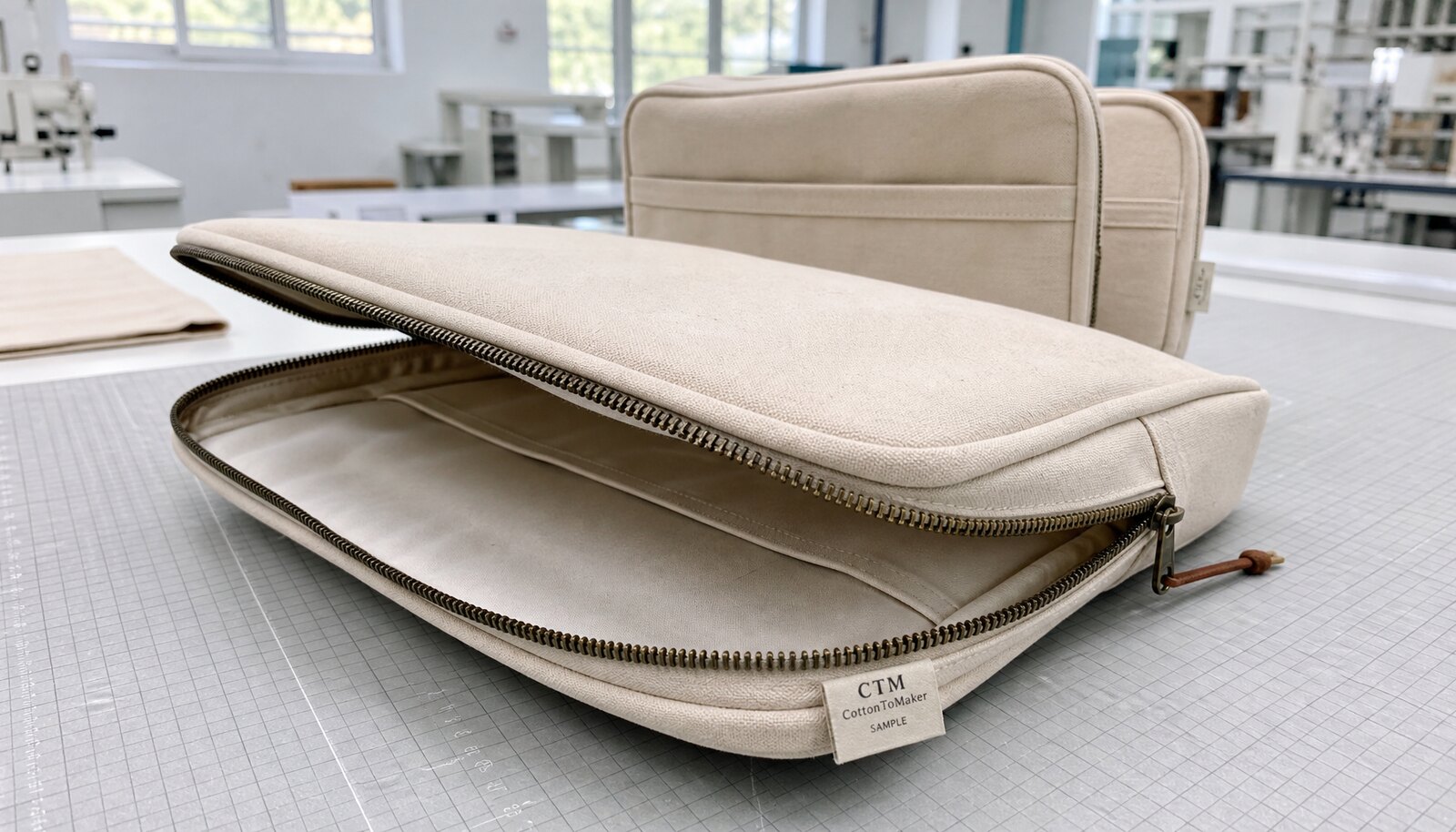
Define the Retail Job Before You Ask for Price
Wholesale canvas zipper portfolios for gift shops are not just document cases. They are shelf products that need to look clean, feel durable, and justify a gift-shop price point the moment a buyer picks one up. That is why the first sourcing decision should be the retail job, not the factory quote. If the portfolio is meant for planners, travel documents, museum stationery, or slim tech, the build has to support that use from the first sample or the result will be a product that looks fine online and disappoints in hand.
Buyers often lose margin by treating every portfolio as the same item. A gift shop buyer may need a flat profile that hangs neatly on a peg or sits without collapsing. A distributor may need a gusseted body that holds more inserts. A private-label program may care more about logo placement and repeatability, while a procurement team may care more about carton efficiency and reorder speed. Before you discuss MOQ, set the target retail price, the customer use case, and the internal usable size. If the item must fit A4, letter, or a tablet sleeve, write that into the spec as the primary requirement, not an afterthought.
- Decide the size based on what the customer will actually carry, not on the outside dimensions alone.
- Set the shelf price first so the factory can spec the right canvas weight and decoration method.
- Treat shape retention, zipper feel, and shelf presentation as core product value, not optional upgrades.
Benchmark MOQ, Sample Cost, and Lead Time Up Front
A useful procurement conversation starts with benchmarks, not guesses. For a simple canvas zipper portfolio, a common factory MOQ range is about 300-500 pieces per style or color when the build is straightforward and the artwork is simple. Once you add multiple colors, lining, pockets, or more involved branding, the MOQ often moves toward 500-1,000 pieces or more. If the order is a blank or near-stock item with only a small label change, some suppliers may offer lower entry quantities, but that usually comes with less room for custom features.
Sample costs should also be discussed before anyone spends time on mockups. A stock-like sample may be free or low cost, but the buyer usually still pays freight. A fully custom pre-production sample often lands in the $50-$150 range, depending on artwork, setup, and whether special materials need to be cut for one unit. Some factories credit the sample cost against the first bulk order, but not all do. Lead time is just as important. A realistic benchmark is 7-15 days for sampling and roughly 20-35 days for bulk production after approval on a simple build, with more complex builds or peak-season scheduling extending beyond that. Domestic wholesalers can ship much faster, often within 3-10 days, but the tradeoff is less control over exact spec and branding.
- Ask for MOQ per style, per color, and per logo method instead of one vague minimum.
- Request sample cost, freight cost, and whether any sample spend is credited on the bulk order.
- Get the lead time split into sample, material booking, production, inspection, and shipment booking.
Choose the Canvas Build Before You Negotiate MOQ
Canvas weight drives the quote more than many first-time buyers expect. For a retail portfolio, 12 oz or about 340 gsm is a practical entry point when the buyer wants a lighter body and a lower price band. A 14 oz or about 400 gsm canvas usually gives a cleaner shape and is a safer middle ground for gift shop shelving. If the portfolio needs a more premium hand feel or must carry heavier inserts without sagging, 16 oz or about 450 gsm can make sense, but it increases material cost and can make stitching slower.
The right canvas is not only about strength. Too-light fabric can make the print look washed out and can ripple around the zipper line. Too-heavy fabric can make the bag bulkier and harder to close smoothly. If the quote does not specify whether the weight is before or after finishing, ask. That one detail can change the actual material yield. Also ask whether the fabric is plain woven, enzyme washed, or otherwise finished, because the hand feel and color behavior can shift after treatment. In soft goods procurement, the canvas description is only useful if it is precise enough to reproduce the same result on reorder.
- Use 12 oz for price-sensitive, lightweight retail portfolios with simple branding.
- Use 14 oz when the product needs to stand up better on shelf and feel more substantial.
- Use 16 oz only when the portfolio must hold heavier content or support a premium price point.
Use the Comparison Math, Not Just the Supplier Type
The most common sourcing mistake is comparing quote totals without normalizing the source. A direct factory quote often looks best on unit price, but it may include a stricter MOQ and more work on your side for sampling, freight coordination, and issue handling. A trading company may price higher because it is stacking margin on top of factory production, yet it can reduce communication friction, consolidate mixed categories, and handle a smaller trial run more easily. A domestic wholesaler can be the best answer when the order is urgent or when you need a small replenishment without import lead time.
The right way to compare routes is landed cost at the actual quantity you can sell. For example, if a factory quotes lower at 500 pieces but your freight, duty, and internal coordination make that order slow and expensive to manage, the apparent savings can disappear. If a domestic wholesaler is pricier by unit but can deliver immediately for a seasonal gift shop display, the quicker sell-through may justify the higher entry price. The table is useful only if you treat it as a decision model, not a ranking of good versus bad suppliers.
- Compare landed cost at the volume you can actually commit to, not at an idealized volume.
- Normalize every quote to the same incoterm, same canvas weight, same zipper spec, and same pack level.
- If the supplier route changes the amount of coordination your team must absorb, count that as cost.
Build the RFQ So Quotes Are Actually Comparable
A clean RFQ should be short, but it cannot be vague. The supplier needs the finished size, the internal usable size, the canvas weight, the zipper type, the branding method, and the pack spec before the quote can mean anything. If you send a long email with half the details embedded in photos and half in text, you will get a quote that looks complete and still cannot be compared against another supplier. The goal is not to over-document every possible detail. The goal is to remove the places where a supplier can quietly substitute a cheaper material or a lighter build.
The best RFQ for this product usually has one page of product specs, one artwork file, and one packing note. Ask for price breaks at 300, 500, and 1,000 pieces so you can see the MOQ curve. Also ask the supplier to state what is included in the price: fabric, zipper, print or label, lining, packing, and carton marks. If the quote bundles everything into one line, you lose negotiation leverage because you cannot tell which part of the product is actually driving the cost. Clear quote structure is what turns a supplier conversation into a procurement decision.
- Use one drawing, one reference photo, and one pack chart instead of a long unstructured email.
- Make the supplier quote the same spec at 300, 500, and 1,000 pieces.
- Require a line-item explanation for what is included and what is not included in the unit price.
Vet the Supplier Before You Pay for Sampling
For canvas zipper portfolios, supplier vetting should focus on traceability, not just a polished sales deck. A factory does not need to have every certificate under the sun, but it does need to answer basic questions clearly. Ask whether it is a real manufacturer, a trader, or a hybrid. Ask to see the sewing area, cutting tables, inspection station, and packing area on a live video call or recent factory video. If the supplier is vague about where the product is actually made, that is a red flag before the first sample is ordered.
Material sourcing matters as much as the factory floor. Ask who supplies the canvas, whether the quoted weight is the finished weight or the base fabric weight, and whether they can confirm the zipper source and zipper type. For zipper quality, you want a direct answer on whether the zipper is nylon coil, molded, or metal, and what the factory does to check smooth travel and pull durability. If your destination market has compliance requirements, ask for the documents that are actually relevant to your market, such as social audit reports, quality system documentation, or material declarations. Do not ask for certificates as a checkbox exercise. Ask for the documents that prove the factory can repeatedly build the product you want.
- Request a live factory video or recent production footage showing sewing, QC, and packing areas.
- Ask exactly who supplies the canvas and zipper, and whether the same source is used for reorders.
- If your market needs documentation, ask what the supplier can actually provide before you pay for a sample.
Approve Samples With Measurable QC Gates
Sampling should prove function, not only appearance. A pre-production sample is the place to confirm the final canvas, zipper, print, lining, pocket layout, and finished dimensions. A sealed golden sample becomes the production reference. If the order is large enough to justify it, a pilot run or first-lot check gives you one more chance to catch drift before the entire order is sewn. Buyers often approve a sample because it looks right in a photo, then discover the bulk run changed the body shape or zipper behavior. That problem is avoidable if the sample is measured and tested, not just viewed.
The acceptance line needs to be specific enough that both sides can follow it. For soft goods, a reasonable benchmark is to agree on a tolerance band for key dimensions, logo placement, and stitch consistency before bulk production starts. A practical zipper test is to open and close random samples multiple times and confirm that the track does not catch at the corners or separate at the seam. Also inspect the stress points where the zipper ends meet the body. If the portfolio is supposed to feel premium, minor puckering or loose thread at those points will be visible to retail buyers and customers who handle the product in store.
- Approve one sealed golden sample and use it as the production reference.
- Measure dimensions, zipper action, and logo placement before giving bulk approval.
- Test a random sample through repeated open-close cycles instead of relying on a single smooth pull.
Plan Packaging, Cartons, and Barcode Work as Part of the Product
Packing is not a back-office detail; it changes cost, shelf readiness, and damage risk. If the portfolio is going into retail inventory or distributor stock, individual polybags, barcode labels, and clear master carton marks usually save time later. Loose packing may shave a small amount off the quote, but it often creates receiving delays, repacking labor, and surface damage if the cartons shift in transit. For a gift shop product, the packaging path should match the channel. What a warehouse can absorb is not always what a retail buyer wants to receive.
Carton count also affects the economics of the product. Too many units per carton can compress the canvas and leave permanent fold lines. Too few units per carton can inflate shipping cost and handling labor. Ask for the carton size, gross weight target, and units per carton before finalizing the order. If the item needs a hangtag, country-of-origin marking, or a suffocation warning for the destination market, bring that into the pack spec early. These are small details, but they are the kind that turn a neat product into a costly receiving problem if ignored.
- Use individual polybags when the product goes directly into retail inventory.
- Require barcode labels and carton marks if the order moves through a distribution center.
- Check carton count and gross weight before freight booking so the cube does not change at the last minute.
Negotiate the MOQ Without Weakening the Spec
The cleanest way to reduce MOQ is to simplify the production lot, not to bargain blindly. Keep one body color, one canvas weight, one zipper color, and one branding method. If you need variety for different stores, push that variety into labels or barcodes rather than changing the sewn product itself. Factories are much more willing to compromise on quantity when the run can stay on one cutting plan and one sewing flow. A buyer who splits demand into too many colorways often creates the very MOQ problem they are trying to avoid.
There is also a useful tradeoff between decoration and minimums. Removing a lining, reducing the print area, or switching from multi-color art to one-color art can lower setup friction and sometimes reduce the MOQ enough to make the first buy viable. If the supplier is open to it, ask for a plain prototype, then a decorated version, then the bulk quote for both. That lets you see exactly which feature is increasing cost. The best negotiation is specific: you are not asking for a discount in the abstract. You are agreeing to a cleaner spec in exchange for a more achievable production minimum.
- Consolidate colorways and artwork before asking for a lower MOQ.
- Keep the sewn body constant and vary labels or stickers if you need SKU flexibility.
- Ask the supplier to quote the plain version and the branded version side by side so the cost drivers are visible.
Write the PO So Reorders Stay Clean
The purchase order should repeat the approved spec in plain language and attach the golden sample reference. That means finished dimensions, canvas weight, zipper spec, branding method, packaging standard, carton count, tolerance band, and any document requirement for the destination market. If a future reorder changes the logo size or zipper color without a written spec update, the factory can claim it was building to the old version. Version control matters in soft goods because small changes are easy to overlook and expensive to unwind.
For gift shop programs, the first order is only the test. The real business is in the reorder. Keep a simple record of what the supplier delivered, how the sample differed from the bulk, and where the quotation had hidden assumptions. If the first run sold through, ask for a re-order price on the exact same spec before adding new features. The more disciplined the first PO is, the easier it is to scale the line later without renegotiating every component from scratch.
- Attach the approved sample photo or reference code to the PO.
- State the tolerance band and defect handling rules in writing.
- Keep the same incoterm and pack spec on reorders unless you intentionally change the landed-cost model.
Specification comparison for buyers
| Spec decision | Recommended option | When it fits | Buyer risk to check |
|---|---|---|---|
| Supplier route | Direct factory for repeat programs, trading company for mixed categories, domestic wholesaler for urgent top-up buys | Choose direct when you can commit to 300-1,000 pcs and want the lowest repeat unit cost. Choose a trading company when you need smaller trial volume, mixed SKUs, or a single English-speaking coordinator. Choose domestic wholesale when speed matters more than customization. | A factory quote can be $0.30-$1.20/unit lower on a repeat run, but only after you absorb sample time, freight, and any setup charges. A trading company may add 8%-20% margin but can reduce coordination cost. A domestic wholesaler may be 20%-60% higher on unit price, yet still win on landed cost for a 100-200 piece test. |
| Canvas weight | 12 oz / about 340 gsm for flexible retail portfolios, 14 oz / about 400 gsm for better body, 16 oz / about 450 gsm for a stiffer premium feel | Use 12 oz when the item needs to stay lightweight and price-sensitive. Use 14 oz when the portfolio must hold shape on the shelf. Use 16 oz only when the buyer wants a more substantial hand feel or the product carries heavier inserts. | If the canvas is too light, print can look washed out and the body can ripple near the zipper. If it is too heavy, sewing time rises and the zipper may feel stiff. Ask whether the quoted gsm is before or after finishing. |
| Branding method | One-color screen print, woven side label, or small sewn patch | Use screen print for a front-facing retail look and simple art. Use a woven label when you want a quieter premium presentation. Use a patch when the brand mark needs more texture but not a full-panel print. | Multi-color art, oversized graphics, and artwork that crosses seams raise setup cost and may push MOQ up. A bigger print area also increases the chance of misalignment in bulk production. |
| Interior build | Unlined body for entry pricing, light lining plus pocket for mid-tier, padded insert only if the portfolio must protect electronics | Keep the build simple when the product is sold as a stationery or document gift. Add lining or pockets only if the retail price supports the added labor and material cost. | Every extra layer changes sewing time and can create hidden cost in the quote. If the buyer cannot explain why the lining is needed, it usually should be removed. |
| Zipper spec | No. 5 nylon coil zipper with a matching pull for standard use, heavier No. 8 only if the portfolio will be overfilled | No. 5 is usually the right default for a slim gift-shop portfolio. Step up only if the item is regularly stuffed full or has a heavier internal structure. | Cheap zipper tape, weak stop placement, or poor seam alignment creates the fastest complaint cycle. Ask for a smoothness test and a pull-strength explanation before you approve the sample. |
| MOQ strategy | Consolidate colors and art into one body spec, then split only by label or print variant | Best for first runs, seasonal programs, and gift shops that want a wider SKU story without resetting the factory line for every version. | If every store gets a different colorway or print size, the factory may separate the order into smaller lots and charge a higher minimum. |
| Packaging level | Individual polybag with barcode sticker and master carton marks for retail-ready export | Use this when the product enters warehouse inventory, chain retail, or distributor receiving directly. | Loose packing looks cheaper at first but usually adds repacking labor, slows receiving, and increases the chance of scuffed print or folded corners. |
| Sample approval path | Pre-production sample, then sealed golden sample, then pilot run inspection if volume is meaningful | Use this for any order where size, zipper action, or logo placement can affect sell-through or returns. | Skipping the pilot run is how buyers discover seam drift, off-center print, or a zipper that binds only after full production starts. |
| Compliance proof | Factory registration, relevant social audit or quality system if available, and destination-market material declarations when needed | Important when the order will enter a regulated market or a chain account that asks for documentation. | If the supplier cannot explain fabric source, zipper source, or document availability, the offer is not ready for procurement review. |
Buyer checklist before sampling
- Confirm the finished size, internal usable space, and whether the portfolio must fit A4, letter, or a tablet sleeve.
- Lock the canvas weight in gsm or oz before discussing price, because the fabric grade changes both appearance and yield.
- State the logo method, logo size, number of print colors, and exact placement with one clean artwork file.
- Define zipper grade, zipper color, pull style, and whether the pull needs branding or a metal tag.
- Specify lining, inner pocket, pen loop, reinforcement at the zipper ends, and any extra padding.
- Ask for a quote at 300, 500, and 1,000 pcs so you can see how MOQ changes with scale.
- Request the sample cost, what it includes, whether it is credited on the first bulk order, and who pays freight.
- Get a written lead-time split for sample, material booking, bulk production, inspection, and export booking.
- Ask for the pack plan: individual polybag, barcode label, carton count, carton size, and target gross weight.
- Match every quote to the same incoterm and tolerance band before comparing prices.
Factory quote questions to send
- What is your MOQ per style, per color, and per logo method, and which part of the spec drives it?
- Can you quote 300, 500, and 1,000 pcs with and without lining so I can see the cost of each feature?
- What is the sample cost, what does it include, and is any of it credited on the first bulk order?
- Which canvas spec will you use, and can you share the weight, weave, finish, and color consistency method?
- Which zipper type, zipper source, and pull style do you recommend for this portfolio size?
- What packaging is included in the unit price, and what is extra if I need barcode labels or hangtags?
- What is your lead time for sample, bulk, final inspection, and shipment booking?
- What inspection criteria do you use for dimensions, zipper smoothness, stitching, and print placement?
- Which compliance documents can you provide for our destination market, and which are not available?
- What tolerance do you guarantee for finished size, logo placement, and carton count?
Quality-control points to confirm
- Canvas weight and finish match the approved swatch or sample reference.
- Finished dimensions stay within the agreed tolerance for width, height, and gusset depth.
- The zipper track is aligned, closes smoothly, and does not catch at the seam or corner.
- The zipper pull is firmly attached and does not loosen during repeated open-close testing.
- Stitch density is even at stress points, especially the zipper ends, corners, and side seams.
- Bar tacks or reinforcement at the zipper ends are present and consistent.
- Logo placement, size, and color match the sealed sample and stay centered on the panel.
- Print edges are clean, with no smearing, ghosting, or obvious misregistration.
- Interior pockets, lining, and pen loops are positioned correctly and do not twist the body.
- Thread trimming is clean, with no loose ends, skipped stitches, or seam puckering.