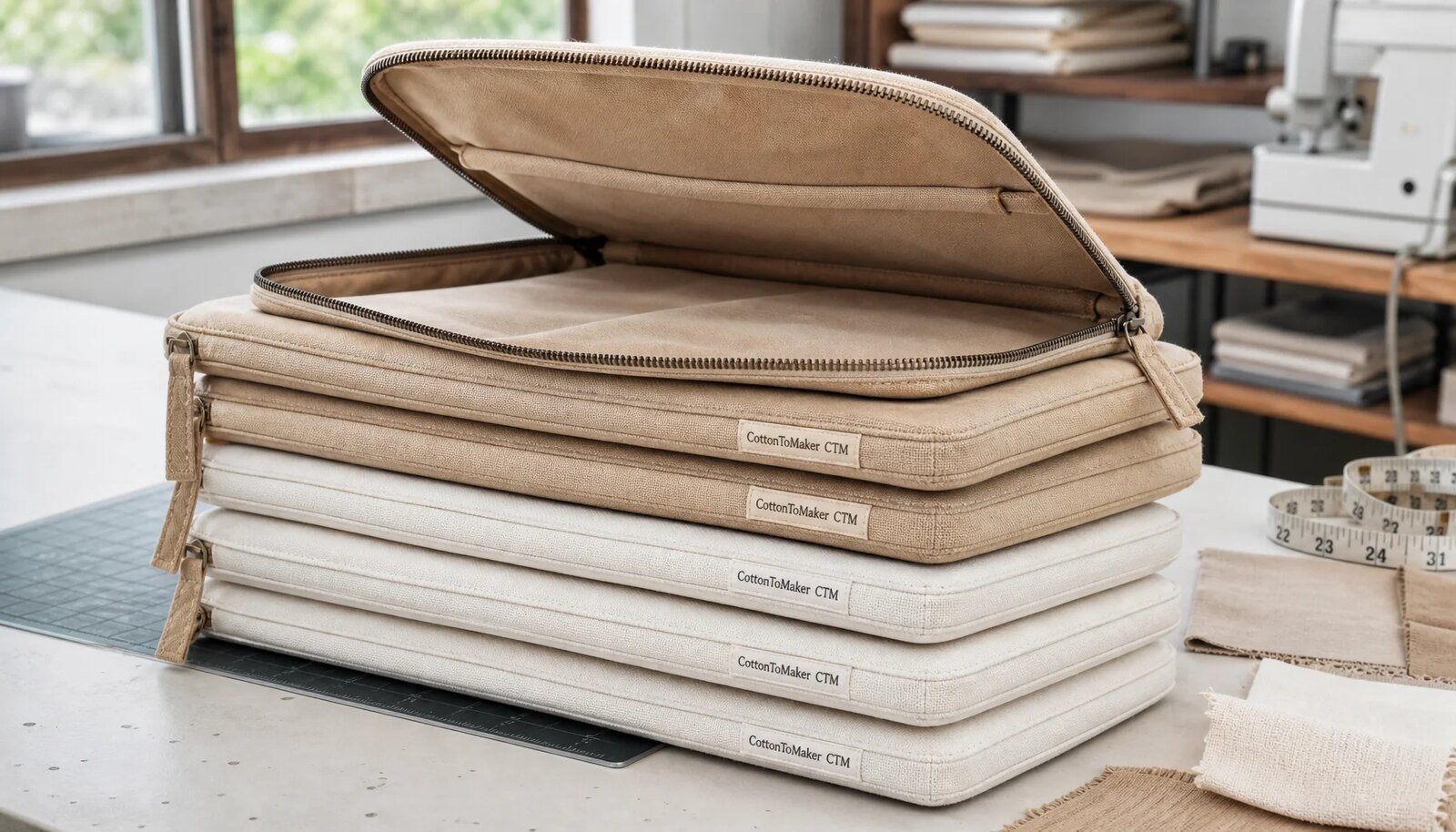
Buy the use case before you buy the canvas weight
Canvas zipper portfolios for farmers market vendors are easy to underestimate because the silhouette is simple. In use, they become working tools: a place for CSA forms, market maps, order pads, receipts, wholesale line sheets, pens, coupons, seed packets, and small booth documents. Some programs use them as onboarding kits for vendors. Others use them as branded folders for farmers market associations, regional food distributors, farm-to-school programs, or local retail promotions.
The sourcing decision should start with the load profile, not the ounce number. A portfolio that only carries papers can be lighter and flatter. A portfolio that holds a catalog stack, pens, or a tablet needs more space, better zipper clearance, and stronger stress-point construction. If the RFQ only says “14 oz canvas zipper portfolio,” suppliers will fill in the blanks differently. One may price a flat document sleeve. Another may price a gusseted, lined version with a better zipper. The quotes will look comparable but will not be buying the same product.
For B2B buyers, the clearer question is: what problem must the portfolio solve in the field? If it needs to look clean on a vendor table and survive repeated seasonal use, specify that. If it is a low-cost handout for one campaign, say that too. A well-written brief gives factories room to recommend a realistic build without overengineering the item.
- Document-only use: market maps, order sheets, certificates, coupons, or light brochures.
- Moderate booth kit: line sheets, receipts, CSA forms, price cards, pens, and repeated opening throughout the day.
- Heavier field kit: catalog stack, tablet, clipboard, rigid inserts, or product sample cards.
- Buyer rule: specify contents, thickness, and reuse expectations before asking suppliers to recommend fabric weight.
Fabric weight: 12 oz, 14 oz, and 16 oz in real purchasing terms
Fabric weight changes more than the unit price. It affects structure, sewing difficulty, zipper feel, carton weight, print appearance, and how the finished portfolio sits when partially filled. The common conversions used in sourcing discussions are approximately 12 oz at 407 gsm, 14 oz at 475 gsm, and 16 oz at 542 gsm. Treat those as reference conversions, not proof that two fabrics will behave the same. Weave density, yarn size, finishing, washing, coating, and mill source can make two nominally identical weights feel different.
A 12 oz canvas is usually best for paper-only portfolios or promotional programs where shipping weight, foldability, and cost matter. It can look natural and accessible, which fits farmers market branding well. The tradeoff is structure. If the vendor puts a pen bundle, small catalog, or rigid insert inside, the fabric may telegraph the contents or wrinkle at the corners.
A 14 oz canvas often sits in the middle of the category. It gives more body than 12 oz without making sewing and zipper movement unnecessarily difficult. Many buyers start here for reusable vendor kits, then adjust after sampling. A 16 oz canvas is better reserved for heavier-duty or premium briefs. It can feel substantial, but it requires more careful patterning. If the zipper path is tight or the corner radius is too small, the portfolio can feel stiff rather than durable.
The important procurement step is to approve the physical swatch and finished sample, not the weight label alone. Ask the supplier to state whether the quoted number refers to raw fabric, finished fabric, or a stock description. Then test the complete portfolio with the intended contents.
- Use 12 oz for lightweight paper carriers and low-bulk handouts.
- Use 14 oz when the program needs reusable structure without too much corner bulk.
- Use 16 oz only when the contents or brand position justify higher cost, weight, and sewing complexity.
- Approve weight, hand-feel, print behavior, and packed appearance together.
How to write a fabric spec suppliers can price accurately
Fabric descriptions often cause quote gaps. Some suppliers quote from a stock fabric code. Some quote a mill fabric they expect to source after order placement. Others use the ounce number as a commercial description rather than a measured result. A precise RFQ reduces the chance that a low price is based on a lower-grade or less stable material.
Write the canvas spec with both oz and gsm, composition, color, finish, and sourcing status. Composition matters because 100% cotton, cotton-poly blends, and recycled-content blends can differ in shrinkage, surface texture, ink absorption, stability, and price. Natural canvas may support the farmers market aesthetic, but it can show stains, slubs, and shade variation more visibly than darker colors. Dyed canvas improves brand control but may raise MOQ and lead time.
If the program will reorder, ask whether the fabric is stock, mill-stock, or custom. Stock fabric can reduce lead time and minimums, but the supplier may change lots without much notice unless the purchase terms require notification. Custom fabric can improve control but normally increases commitment. Neither route is automatically better; the right choice depends on volume, color requirements, and how much visual consistency matters across seasons.
- Specify oz and gsm, and ask which measurement basis the supplier uses.
- State composition: cotton, cotton-poly, recycled blend, or another agreed material.
- Define finish: natural, bleached, dyed, washed, coated, preshrunk, or untreated.
- Ask whether the fabric is stock or custom, and how that affects MOQ and reorder lead time.
- Keep an approved swatch and fabric code on file for future comparison.
Size and fit: the hidden source of returns and rework
A portfolio can meet the outside size on the spec sheet and still fail in use. Seam allowance, zipper tape, lining, binding, and gusset shape all reduce internal usable space. If the item must fit US Letter, A4, a clipboard, or a specific stack of line sheets, outside dimensions alone are not enough.
Specify the intended content stack in plain terms: document size, sheet count, pad thickness, pen quantity, catalog thickness, or device dimensions. Then request both outside dimensions and internal usable dimensions after sewing. If the portfolio is meant to close around a 0.5 inch stack, the factory needs to know that before making the pattern. A flat sleeve designed for papers will not behave like a gusseted pouch designed for stacked contents.
Dimensional tolerances should be agreed with the supplier rather than assumed as universal. For many sewn canvas accessories, buyers use approximate tolerances such as plus or minus 1/4 inch on smaller dimensions and plus or minus 3/8 inch on larger dimensions, but the right tolerance depends on fabric, lining, construction, and inspection method. If the item must fit rigid inserts, tighter control or a larger clearance allowance may be needed.
Sampling should include a real fit test. Put the intended contents inside, close the zipper, and check whether the slider moves smoothly without pulling the corners out of shape. This one step catches more practical issues than a flat measurement alone.
- Specify outside dimensions and internal usable dimensions.
- List contents by size, count, and thickness.
- Add clearance for zipper tape, seam allowance, lining, and gusset depth.
- Agree tolerances with the supplier based on construction, not as a generic rule.
- Test the sample with the actual content stack before approval.
Construction choices that change cost and performance
The cheapest portfolio is usually a flat, unlined sleeve with a zipper. That can be the right product when the contents are mostly papers and the buyer wants a simple branded item. Problems start when that same construction is expected to carry thicker booth kits. The product may still close, but the zipper carries too much strain, the corners distort, and the portfolio looks underbuilt.
A shallow gusset or boxed bottom adds cost but improves usability when the portfolio holds pads, pens, catalogs, or several document groups. Lining or bound seams improve presentation and protect contents from raw edges, though they also add layers that reduce internal space. Interior dividers, pen loops, card pockets, and exterior slip pockets can make the item more useful, but each feature adds sewing operations, inspection points, and potential MOQ complexity.
For procurement, the best approach is to separate must-have features from optional upgrades. If the portfolio is part of a vendor onboarding kit, an inside divider and pen loop may be worth the extra cost. If it is a seasonal handout, a flat body with a good zipper and clean logo may be enough. Over-specifying pockets and trim can push the item into a higher price tier without improving field use.
Construction also affects supplier selection. Many cut-and-sew factories can make a flat pouch. Fewer are consistently strong at heavier canvas, clean binding, multiple pockets, and tight logo placement. If the design is feature-heavy, prioritize factories that can show similar construction samples rather than only a low unit price.
- Flat sleeve: lowest complexity, best for papers and light handouts.
- Shallow gusset: better for vendor kits with pens, pads, catalogs, or thicker inserts.
- Lined or bound interior: cleaner presentation but higher cost and reduced usable space.
- Interior features: useful only when they match the actual workflow.
- Supplier fit: heavier construction requires stronger sewing capability, not just cheaper labor.
Zippers, pulls, and reinforcement: small parts that decide perceived quality
The zipper is one of the first quality signals the vendor will feel. A canvas body can look strong, but a weak slider or poorly reinforced end stop makes the whole product feel unreliable. Farmers market vendors may open the portfolio with one hand, use it outdoors, toss it into a tote, and close it around uneven contents. The closure should be specified as a functional component.
For most flat or lightly gusseted portfolios, a No. 5 nylon coil zipper is widely available and flexible enough for canvas. Heavier No. 8 coil or resin zippers can suit thicker builds, but they add bulk and cost. They also cannot compensate for a poor pattern. If the zipper path is too tight around corners, a larger zipper may still snag. The sample must be tested with the intended contents inside.
The RFQ should include zipper type, size, tape color, slider material, puller style, and end-stop reinforcement. Tape color matters more than buyers expect: off-white canvas, natural cotton, black print, and metal pulls can look mismatched if trim is selected casually. End stops should be secured with backstitching, bar tacks, folded tape capture, or another agreed method appropriate to the design.
Ask the supplier what zipper grade is included. A low price can hide a lower-grade slider, thinner tape, or less consistent coil. If the portfolio is customer-facing or intended for repeated seasonal use, paying slightly more for better zipper components may prevent the most visible failure mode.
- Specify zipper type, size, tape color, slider, puller, and reinforcement.
- Use No. 5 nylon coil for most flat or lightly gusseted builds.
- Consider No. 8 or resin only for heavier constructions that need it.
- Cycle-test samples with contents inside, not empty on a table.
- Inspect zipper ends because failures often start at the stops.
Branding on canvas: print method, artwork limits, and placement control
Farmers market programs usually benefit from clear branding rather than complicated decoration. Canvas has texture, so artwork that looks crisp on a digital proof may lose detail on fabric. Small type, thin lines, tight registration, gradients, and pale colors need extra review. A logo that prints well on smooth polyester may not behave the same way on natural cotton canvas.
Screen printing is often efficient for one- or two-color logos, repeat orders, and stronger solid marks. It can be cost-effective at volume, but setup and screen charges matter when there are many regional logo versions. Heat transfer can be useful for multicolor artwork, short pilots, or seasonal graphics, but buyers should check adhesion, edge lift, cracking, and rub performance before bulk approval. Woven labels, sewn patches, and side tabs can provide quieter branding with fewer large-surface print risks.
The most important buyer control is the strike-off. Require the print test on actual production canvas, not substitute fabric. Approve print size, location, color, opacity, edge sharpness, and artwork readability. Placement should be measured from fixed edges, not judged visually. If the portfolio has a zipper curve, label seam, pocket, or gusset, ensure the artwork does not land too close to a construction feature.
If there are multiple market regions or vendor groups, avoid turning one simple product into many small custom runs unless the volume supports it. A common base portfolio with variable labels or carton allocation may be cleaner than separate print versions, depending on branding needs.
- Use screen print for simple, repeatable solid-color logos.
- Use heat transfer for multicolor or pilot programs after adhesion testing.
- Consider woven labels or patches for subtle repeatable branding.
- Approve strike-offs on production canvas.
- Measure logo placement from fixed edges and define acceptable shift.
MOQ and price drivers: where the quote really moves
MOQ is not one number. For canvas zipper portfolios, minimums may change by fabric color, fabric source, zipper tape color, slider, print method, logo version, construction, and packing format. A supplier may offer a low MOQ for stock natural canvas but require a much higher minimum for custom-dyed fabric or custom zipper tape. Buyers should ask for each MOQ driver separately rather than accepting a blended answer.
Price is driven by more than fabric weight. Heavy canvas costs more, but sewing time, gussets, lining, pockets, zipper grade, print setup, label type, packing requirements, and quality documentation also move the quote. A 16 oz lined portfolio with an interior divider and custom puller is not a small upgrade from a flat 14 oz sleeve; it may require different equipment settings, slower operators, and more inspection time.
Regional manufacturing constraints also matter. Some regions have strong access to cotton canvas but longer lead times for custom zipper tape or specialty pullers. Others may be faster on cut-and-sew but depend on imported fabric, which affects reorder timing and color consistency. Natural stock canvas may be easy to source in many production hubs, while certified recycled blends, organic cotton, or custom-dyed shades can narrow the supplier pool. Ask suppliers what they can control in-house and what depends on upstream mills or trim vendors.
For quote comparison, request price breaks at the same specification: 500, 1,000, 2,500, and 5,000 pieces, or the quantities relevant to your program. Do not compare a low price based on flat construction against a higher price that includes gussets, lining, stronger zipper, and SKU-separated packing. If the first order is a market test, simplify variables: one fabric, one zipper tape color, one logo version, one packing method.
- Ask MOQ by fabric color, logo version, zipper tape color, construction, and packing.
- Separate setup charges, sample fees, screen fees, custom puller charges, labels, and special packing.
- Request price breaks using the same exact spec at each quantity.
- Use stock materials for first-order testing when brand requirements allow.
- Ask which materials are locally available and which depend on upstream mills or trim vendors.
Samples and approvals: make the sample answer production questions
A sample should not only look good in a photo. It should prove that the production materials, construction, print, and packing can work together. Substitute fabric or substitute trim can be acceptable for an early concept mockup, but it should not be treated as a production approval for a wholesale order.
A useful sample path starts with fabric swatches and trim confirmation, then moves to a blank construction sample, print strike-off, and pre-production sample if the order size or risk justifies it. Smaller programs may combine steps, but the buyer should still know what is being approved. If the sample uses a different zipper or canvas, write that down and require a corrected pre-production sample before bulk cutting.
Sample review should be physical and measured. Check outside size, internal usable space, zipper movement, logo placement, seam finishing, pocket function, and carton packing. Fill the portfolio with the intended contents. If it will be packed flat in cartons, test whether the zipper puller marks the canvas or whether corners crease. If it will be kitted with other items, test that format as well.
Once approved, freeze the standard. Late changes to logo size, zipper color, pocket depth, or carton quantity can affect material planning and production line setup. If a change is necessary, issue a revised approval with photos and updated measurements rather than relying on email comments alone.
- Confirm whether each sample uses production fabric, zipper, thread, print, and packing.
- Test fit with the actual intended contents.
- Photograph approved zipper ends, seam finish, logo placement, and interior features.
- Keep one sealed approval sample for inspection and reorders.
- Document every approved deviation before bulk cutting.
QC and pre-shipment inspection: focus on defects buyers actually feel
Canvas zipper portfolios do not require complicated inspection, but they do require disciplined inspection. The main complaint drivers are wrong size, poor fit, zipper failure, weak seams, dirty canvas, print misplacement, shade mismatch, and carton mistakes. These are practical defects that affect receiving, distribution, and vendor use.
Before production, define critical, major, and minor defects. Critical defects may include mold, sharp exposed metal, severe odor, contamination, or unsafe packing. Major defects may include a zipper that splits, a seam that opens, an unreadable or misplaced logo, incorrect SKU, or internal space too small for the required documents. Minor defects may include slight loose threads or small shade differences within the approved range. The exact thresholds should be agreed with the supplier because tolerance norms vary by factory, material, and inspection plan.
Inspection should sample across cartons, colors, and logo versions. Measure outside dimensions and internal usable dimensions. Cycle the zipper repeatedly. Check end-stop reinforcement. Pull lightly on pockets, dividers, pen loops, and labels. Inspect the print with a ruler and perform a dry rub or edge-lift check where relevant. Review cleanliness under consistent lighting because natural canvas shows marks easily.
Packing deserves its own check. Vendor programs often involve allocation by region, association, store, or sales team. Mixed cartons, wrong labels, unreadable barcodes, and inaccurate carton counts can cost more in warehouse labor than the defect itself. Require carton labels that match the purchase order and packing list, and ask for pre-shipment photos if you are not using an in-person inspection.
For larger orders, a third-party pre-shipment inspection may be worth the cost. For smaller orders, require supplier measurement reports and photo documentation at minimum. The goal is not to add paperwork; it is to catch simple mistakes before they become distributed problems.
- Agree inspection plan, sample size, and defect definitions before production.
- Measure both outside and internal usable dimensions.
- Cycle-test zippers and inspect zipper stops.
- Check print position, rub resistance, cleanliness, and seam strength.
- Verify carton labels, SKU separation, barcode readability, and packing list accuracy.
Specification comparison for buyers
| Spec decision | Recommended option | When it fits | Buyer risk to check | Cost and supplier tradeoff |
|---|---|---|---|---|
| Fabric weight | 12 oz canvas, roughly 407 gsm if the supplier is using the common oz-to-gsm conversion | Paper-only inserts, market maps, coupons, order forms, seed packets, or light vendor handouts | May wrinkle, sag, or telegraph contents if used for clipboards, tablets, catalogs, or bulky inserts | Usually easier to sew and ship; can look too casual if the program expects a structured kit |
| Fabric weight | 14 oz canvas, roughly 475 gsm, approved by swatch rather than number alone | Reusable booth kits with line sheets, receipts, pens, CSA forms, price cards, and moderate handling | Different mills can produce noticeably different hand-feel at the same nominal weight | Often the best cost-to-structure range, but stock availability and finish consistency matter |
| Fabric weight | 16 oz canvas, roughly 542 gsm, only after testing the full construction | Premium kits, distributor folders, rigid inserts, multi-season use, or heavier field sales materials | Bulkier corners, tighter zipper movement, and higher seam stress if the pattern is not adjusted | Higher material cost, slower sewing, higher freight weight, and more supplier variation in heavy-duty capability |
| Construction | Flat sleeve with zipper | Simple document carrier, low-bulk handout, retail-style giveaway, or first program test | Contents can bend, shift, or strain the zipper if buyers later add thicker inserts | Lowest construction cost and simplest MOQ path; easiest to place with a wide range of factories |
| Construction | Shallow gusset or boxed bottom | Vendor admin kits, catalogs, forms, pens, card packs, or seasonal onboarding sets | If gusset depth is underspecified, the zipper may close poorly when full | More pattern work and sewing time; requires better sample review but reduces field complaints |
| Construction | Lined interior or bound seams | Higher presentation, cleaner inside finish, or programs where contents snag easily | Added layers can shrink usable space and create bulk at zipper corners | Raises cost and sewing complexity; improves perceived quality if executed cleanly |
| Zipper | No. 5 nylon coil zipper | Most flat or lightly gusseted canvas portfolios | Low-grade sliders, weak end stops, and tight curves can cause snagging or splitting | Broadly available and cost-efficient; supplier quality varies by zipper source |
| Zipper | No. 8 coil or resin zipper | Thicker 16 oz builds, premium feel, or portfolios carrying heavier contents | Can make the product stiffer and does not fix a pattern that is too tight | Costs more and may raise MOQ if tape color or puller is custom |
| Branding | Screen print, one to two solid colors | Repeat programs, simple logos, market association branding, and cost-sensitive volume | Fine type can fill in on textured canvas; off-white canvas can shift perceived color | Efficient at scale but requires setup; best when artwork versions are limited |
Buyer checklist before sampling
- Define the portfolio’s job: paper carrier, booth admin pouch, vendor onboarding kit, distributor folder, branded giveaway, or sales sample holder.
- List the intended contents by count and thickness, such as 25 sheets, one order pad, two pens, seed packets, a tablet, or a 0.5 in catalog stack.
- Specify both outside dimensions and internal usable dimensions after sewing, including whether the item must fit US Letter, A4, a clipboard, line sheets, or rigid inserts.
- Name the preferred canvas weight in oz and gsm, and require the supplier to state whether the figure is raw cloth weight, finished fabric weight, or a stock fabric description.
- Ask for fabric composition, finish, shrink-control method if relevant, color source, and whether the quoted fabric is stock or custom.
- Choose the construction before quoting: flat sleeve, shallow gusset, lined body, bound seams, inside divider, pen loop, card pocket, exterior slip pocket, woven label, or patch.
- Define zipper type, size, tape color, slider material, puller style, zipper path, corner radius, and reinforcement at both ends.
- Set seam expectations for visible seams, zipper attachment, pocket openings, stress points, labels, and any handles or tabs.
- Confirm thread color, thread type, seam allowance, binding or overlock finish, and whether raw inside edges are acceptable.
- Provide logo files, Pantone or brand color references, print size, placement from fixed edges, and durability expectations for handling, rubbing, or light cleaning.
Factory quote questions to send
- What exact canvas weight are you quoting in oz and gsm, and is that raw cloth weight, finished fabric weight, or a supplier stock description?
- Is the canvas 100% cotton, cotton-poly, recycled-content blend, or another composition, and can you provide a fabric test report if needed for our compliance file?
- Is the fabric greige, natural, bleached, dyed, washed, coated, or otherwise finished after weaving?
- Is the quoted fabric in stock, mill-stock, or custom-made for this order, and how does that affect MOQ and reorder lead time?
- What lot-to-lot shade variation do you normally see for this canvas, and will you notify us before changing fabric source or finish?
- What finished outside dimensions and internal usable dimensions are included in the quote?
- What dimensional tolerance do you recommend based on your sewing process, fabric weight, and construction type?
- Which construction elements are included in the base price: flat body, gusset, lining, inside pocket, pen loop, divider, exterior pocket, woven label, or side tab?
- What zipper specification is included: coil, resin, or metal; zipper size; tape width; slider type; puller material; and end-stop reinforcement?
- What zipper brands or grades are available at this price level, and what changes if we request a higher-grade slider or custom puller?
Quality-control points to confirm
- Canvas weight verification: use a defined sample size or qualified fabric test method, then compare against the approved specification and agreed tolerance before or during bulk cutting.
- Fabric composition and finish: verify the production fabric matches the approved swatch, fabric code, finish description, and hand-feel approved for bulk.
- Fabric shade control: compare production fabric with the approved swatch under consistent lighting and keep a sealed reference for future reorders.
- Fabric surface inspection: check for visible slubs, stains, weaving bars, oily marks, heavy creases, odor, coating residue, and print-contaminating defects, especially on natural or off-white canvas.
- Dimensional accuracy: measure outside dimensions and internal usable dimensions after sewing, because seam allowance, zipper tape, lining, and gusset depth can reduce fit.
- Load-fit check: place the intended content stack inside sampled units and close the zipper without forcing the slider.
- Zipper function: cycle inspected samples through repeated full open-close passes; the slider should not split, snag, jam at corners, catch threads, or separate under normal hand use.
- Zipper-end reinforcement: inspect bar tacks, backstitching, folded ends, tape capture, and seam cover at both zipper stops.
- Stitch quality: check skipped stitches, loose top thread, broken thread, uneven tension, seam wandering, puckering, and open seams under moderate hand pull.
- Pocket and divider security: pull-check pocket openings, divider corners, pen loops, and label seams so inserts do not tear them during use.