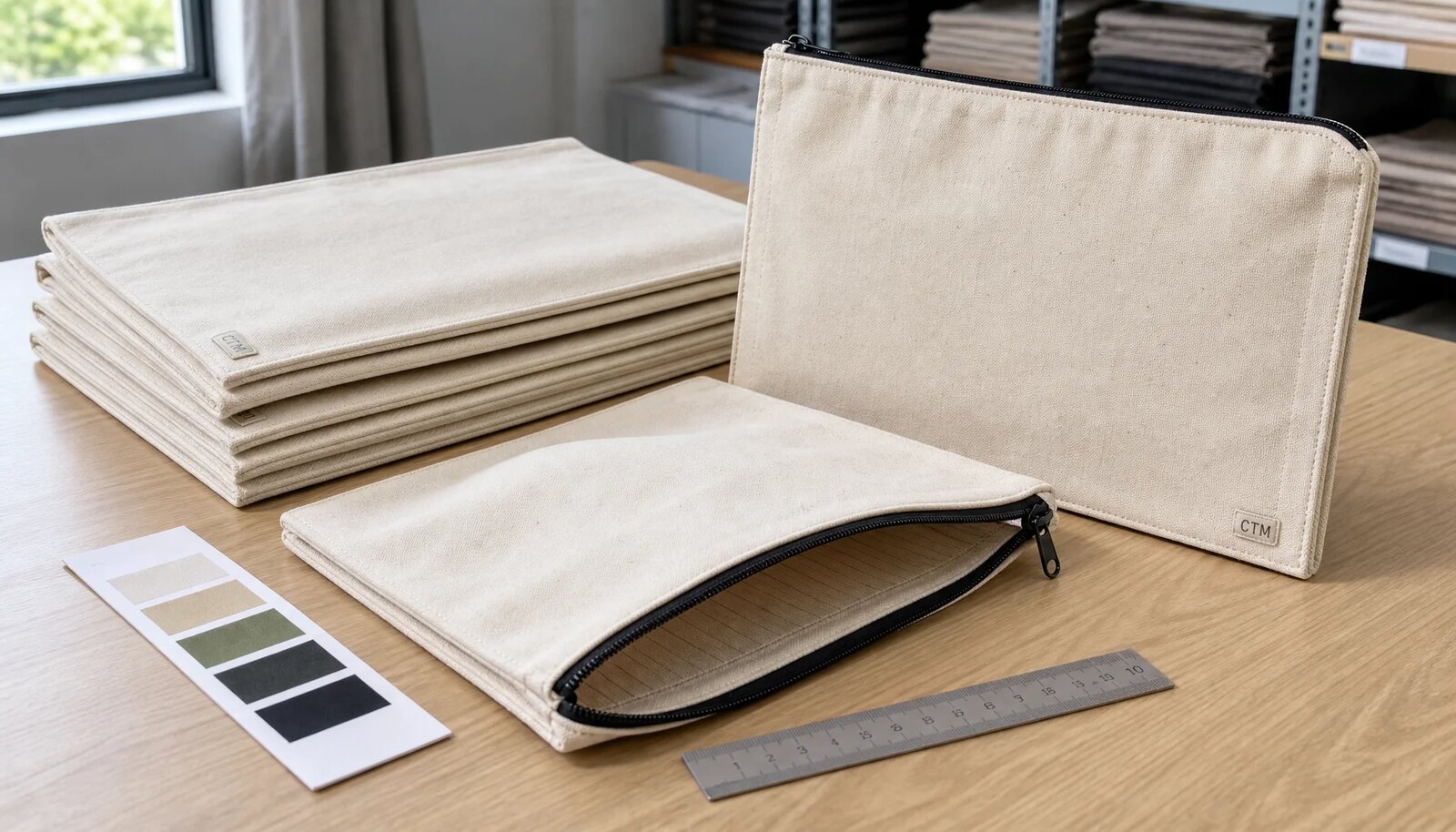
Start With What Goes Inside
Wholesale canvas zipper portfolios for event planners should be built around contents first. The logo matters, of course, but the items inside decide whether the product works. A planner portfolio may carry agendas, venue maps, rooming lists, badge inserts, meal cards, show-floor plans, emergency contacts, sponsor one-sheets, pens, badge reels, charging cords, and small adapters. Those are not interchangeable loads. Paper needs smooth clearance. Hardware needs pressure relief. Repeated venue use needs stronger corners and a zipper that does not fight the user.
Start the RFQ by naming the document format and filled thickness. State whether the portfolio must hold A4, US letter, legal-size sheets, half-letter schedules, badge sheets, or a custom event guide. Add the maximum sheet count, then list bulky pieces separately. A flat canvas sleeve can look tidy in a photo and still bow badly once a charger, pen, and badge reel are added. For attendee welcome packs, a slim document case may be enough. For onsite staff or sponsor managers moving between check-ins, a gusset, lining, and reinforced zipper ends may be worth more than a lower base price.
Clearance is a small number with a large effect. For paper-only contents, many buyers allow about 10-15 mm beyond the largest insert on each side so sheets slide in without bent corners. Mixed kits often need a pocket or gusset instead of a larger flat shape. Also tell the supplier how the goods will be handed over: empty, pre-kitted, packed into a larger tote, or filled at the venue. Packing pressure changes the way canvas sits, creases, and presents at registration.
- Measure the largest insert and define clearance instead of requesting only a vague A4 or letter-size portfolio.
- Separate paper from hard goods, because pens, chargers, badge clips, and reels create different pressure points.
- State whether the piece must lie flat in a tote, fit into a kit box, stack at registration, or travel with staff.
- Name the use case: attendee gift, exhibitor packet, speaker folder, planner toolkit, staff pouch, or sponsor document case.
Turn the Idea Into a Priceable Spec
A good sourcing package lets each supplier price the same product. Without it, one quote may be based on 12 oz canvas with a #5 zipper and lining, while another assumes lighter fabric, a smaller zipper, no lining, and bulk packing. The numbers may look comparable, but the products are not. Your spec sheet should cover finished dimensions, zipper opening, gusset depth, canvas weight, fabric color standard, decoration method, artwork placement, lining, pockets, thread color, packing, carton requirements, sample steps, and inspection tolerances.
Soft goods need tolerances because canvas stretches, folds, turns, and compresses during production. For many canvas zipper portfolios, a reasonable starting point is +/-5 mm on finished width and height and +/-3 mm on logo placement. Gusset depth, zipper opening, and pocket dimensions should have their own tolerances based on the contents. If a sponsor kit needs tighter alignment, say so before sampling. Tighter tolerances can affect sewing speed, reject rates, and cost, so they belong in the quote stage, not in a complaint after bulk production.
Use fixed measurement points. Lower right corner is not a measurement point; 35 mm from the right side seam and 28 mm from the bottom edge is. Add the artwork file name, version number, approval date, and a simple placement diagram. Event artwork changes quickly, and the old logo file has a way of lingering in inboxes. A dated, measurable spec gives procurement, brand, factory, and print team the same reference.
- Include finished width, height, zipper opening, gusset depth, pocket dimensions, and tolerances.
- Specify fabric in both oz and gsm where possible, and confirm whether the weight refers to finished fabric.
- Place artwork from fixed construction points such as zipper tape, side seam, bottom edge, pocket edge, or label edge.
- Require written approval for substitute fabric, zipper, slider, lining, label, thread, decoration method, or packing material.
Choose Canvas by Use, Not Habit
Canvas weight should match the event program. A 12 oz canvas, roughly 340 gsm, is often a good fit for lighter document portfolios, welcome packets, exhibitor folders, and internal planner kits. It keeps the product flexible, helps manage carton weight, and is easier to sew neatly around corners. A 14 oz canvas, roughly 400 gsm, gives more body and a firmer handfeel for executive events, sponsor kits, or repeat-use programs. Heavier canvas can look substantial, but it also adds bulk, freight cost, needle stress, and corner thickness.
The surface finish matters as much as the weight. Natural canvas may show fiber specks and shade variation. Bleached canvas offers cleaner contrast for logos but may lose some of the rustic look. Dyed canvas needs shade and rub checks. Washed canvas can feel softer but may vary more in finished size. Pigment-coated or laminated surfaces may change ink behavior and handfeel. If the event brand is sensitive to color, approve decoration on the actual canvas shade and finish, not on a convenient fabric from a sample shelf.
Set a realistic shade standard. Cotton canvas is not molded plastic; a natural base will not be perfectly uniform from piece to piece. That does not mean color control is optional. Approve a swatch, sealed sample, or agreed photo standard, then ask how the supplier will track fabric lots. If more than one fabric lot is used, carton-level lot tracking helps isolate shade drift before it becomes a receiving problem.
- Use 12 oz canvas for lighter document sets, internal kits, and cost-sensitive event distribution.
- Use 14 oz canvas when stronger handfeel, structure, or repeat-use positioning is important.
- Confirm whether the fabric is natural, bleached, dyed, washed, pigment-coated, laminated, or otherwise finished.
- Check dyed or dark canvas for rub-off risk against light paper, apparel, table linens, and kit inserts.
- Approve a swatch or sealed sample as the practical shade reference for bulk inspection.
Specify the Zipper Like a Component
The zipper is touched every time the portfolio is used, so it should never be treated as a vague accessory. A #5 nylon coil zipper is often a practical choice for canvas zipper portfolios because it is flexible, smooth, widely available, and suitable for soft textile construction. Still, the quote should name zipper size, zipper type, tape color, slider finish, puller style, slider function, and end-stop construction. A line item that says zipper included tells procurement almost nothing.
Test zipper function with the expected contents inside. Empty samples can zip smoothly while filled portfolios drag near corners, strain at the end stops, or distort the tape. If the piece will be opened repeatedly at registration desks, sponsor check-ins, venue walk-throughs, or staff briefings, ask for reinforced zipper ends and consistent pull force. Auto-lock sliders may help when the portfolio must stay closed in transit, but they are not automatically needed for every program.
Sewing details deserve the same precision. Ask for stitch density, seam allowance, thread color, binding width, bartack placement, and reinforcement points. Stress zones usually include zipper ends, gusset turns, corners, strap attachments, pocket openings, and any point where the user pulls. On canvas, wavy zipper tape, skipped stitches, loose thread, uneven binding, and bulky corners are visible. They also affect the buyer's first impression when the item is handed to attendees, sponsors, or staff.
- Specify #5 nylon coil zipper or another named zipper type instead of accepting an undefined closure.
- Confirm zipper tape color, slider finish, puller shape, end stops, and whether auto-lock function is required.
- Test zipper travel on filled samples, not only empty approval samples.
- Use bartacks or reinforcement at zipper ends, strap ends, pocket openings, gusset turns, and high-stress corners.
- Include stitch density, seam allowance, binding width, and thread color in the written spec.
Match Decoration to Artwork Risk
Decoration choice affects appearance, lead time, MOQ, setup cost, and defect risk. Screen printing is usually efficient for bold spot-color artwork with clean shapes. On canvas, however, the weave can cause ink gain, uneven edges, and reduced clarity in fine details. Embroidery can feel premium, but dense stitching may pucker lighter canvas or feel rough inside an unlined portfolio. Woven labels and stitched patches can hold small sponsor marks more consistently, though they add label setup and sewing placement checks. Transfers may support complex color, but buyers should check adhesion, edge feel, heat marks, and surface durability.
The safest decoration method is the one that suits the artwork at final size. If a sponsor logo includes tiny legal text, a thin tagline, a URL, or close registration marks, ask the supplier to recommend minimum line width and minimum readable text height on the exact canvas. A production proof should show whether the small elements remain legible after ink, heat, stitching, or label weaving. Pantone references help, but ink on cotton canvas does not behave like ink on coated paper. Visual approval on real material is the point.
Also ask when decoration happens. Printing flat panels before sewing usually provides smoother pressure and cleaner registration, but the factory must control panel orientation and later sewing alignment. Printing after assembly can help align the logo to finished edges, but seams, zippers, and gussets may limit the print area. The quote and the sample should use the same process intended for bulk production.
- Use screen print for bold one-color or two-color artwork with limited fine detail.
- Use woven labels or patches when small sponsor marks, fine text, or repeated brand programs need stable detail.
- Use embroidery only after checking canvas weight, backing, stitch density, pucker risk, and interior comfort.
- Ask whether decoration happens before sewing on flat panels or after assembly on finished portfolios.
- Track artwork file name, version number, color reference, placement diagram, approval date, and approver.
Build a Real Print Proofing Checklist
A print proofing checklist protects the schedule. Event dates do not move just because a logo printed too light or a sponsor name became unreadable on canvas. Digital mockups are useful for layout discussions, but they cannot show ink opacity, weave distortion, heat shine, edge sharpness, or true placement near a zipper. Final production approval should come from a strike-off or pre-production sample made on the actual canvas shade, weight, finish, decoration process, curing method, and artwork size.
Proofing should cover brand approval and manufacturing approval. Brand teams usually focus on logo shape, color, sponsor lockups, clear space, and event naming. Procurement also needs measurable placement, registration, opacity, curing quality, rub behavior, and repeatability. Event operations may care whether the logo faces outward when the portfolio is stacked, whether the zipper opens from the preferred side, and whether different sponsor versions are easy to separate during kitting.
Keep two references when possible. One sealed golden sample is used for inspection. One working sample is used for zipper testing, filled-thickness checks, rub checks, and handling. If approval is remote, ask for straight-on ruler photos, close-up detail photos, and angled-light photos. A pretty perspective shot can hide a logo that is several millimeters off target or an ink layer that is too thin.
- Use a digital mockup for layout, but approve production from an actual strike-off or pre-production sample.
- Confirm canvas shade, ink color, opacity, registration, edge sharpness, curing, and heat effects.
- Measure logo placement from zipper edge, side seam, bottom edge, pocket edge, or label location.
- Set minimum readable text height for sponsor names, URLs, legal lines, and event identifiers.
- Ask for ruler photos and angled-light photos before approving remote proof images.
- Reject proofs where artwork size, canvas shade, decoration method, or placement differs from the written spec.
Compare Supplier Routes Clearly
The supplier route shapes risk. A direct cut-and-sew factory can give strong control over fabric purchasing, sewing, sample retention, and production timing, especially when printing is in-house or managed through a documented subcontractor. A trading company can be useful when one commercial contact must coordinate fabric, trim, decoration, packing, and export paperwork. In that case, procurement should still know the named factory, named print shop, and who is responsible for corrections. A domestic decorator or stock wholesaler may be best for urgent local replenishment, but custom construction options are usually narrower.
Compare quotes from one controlled specification. Ask each supplier to mark inclusions, exclusions, substitutions, and assumptions line by line. One quote may include lining, #5 zipper, individual polybag, production proof, and carton marks. Another may include none of those. The lower number can become expensive once sample revisions, trim upgrades, print setup, and packing are added.
Communication quality is part of sourcing quality. A supplier that answers tolerance, proofing, and QC questions clearly is easier to manage than one that only sends a unit price. For event planners, the best supplier is often the one that can repeat the approved sample, flag production risks early, and release consistent cartons before the deadline.
- Ask for the production site and print location, not only the sales office name.
- Require suppliers to mark every exception against the RFQ specification.
- Separate base product cost, decoration cost, setup cost, packing cost, sample cost, and freight assumptions.
- Confirm who owns rework responsibility if printing, sewing, or packing differs from the approved sample.
- Score suppliers on proof accuracy, response clarity, lead-time realism, and documentation, not unit price alone.
Understand MOQ and Cost Drivers
MOQ is usually tied to setup, material purchasing, trim minimums, and line planning. A single natural canvas body with one screen-printed logo may support a lower MOQ than a program with multiple body colors, zipper colors, lining colors, label versions, and artwork variants. Every variation can add fabric waste, separate print setup, trim purchasing minimums, production changeover time, packing segregation, and inspection work. Ask whether MOQ applies to the total order, each body color, each artwork version, each zipper tape color, each lining color, each label version, or each packaging format.
Small design choices can move the cost. A gusset changes cutting and sewing. A lining adds fabric, turning, topstitching, and more inspection points. Custom pullers may require tooling or higher trim minimums. Woven labels have setup and quantity requirements. Individual polybags, barcode labels, inner cartons, desiccants, and special carton marks all add labor or material. None of these features are wrong. The problem is discovering them after a budget has been approved.
Cost control is usually cleaner when the master body is stable. Use one size, one zipper spec, one lining color, and one packing method where possible, then vary artwork only when the program requires it. Ask for price breaks at realistic quantities: the forecasted order, the possible reorder, and the next practical production tier. That gives procurement numbers that reflect the actual buying plan.
- Ask whether MOQ applies by total order, body color, artwork version, zipper color, lining color, label, or packing format.
- Request price breaks tied to event forecast, possible replenishment, and the next practical production tier.
- Confirm screen charges, digitizing fees, label setup, custom puller tooling, sample revisions, and courier costs.
- Use one master size and construction where possible to reduce setup, inspection, and packing complexity.
- Check carton dimensions early because bulky soft goods can affect freight cost even when unit weight is low.
Approve Samples Before Bulk Starts
A pre-production sample should prove the whole portfolio, not only the logo. Approve fabric shade, canvas weight, handfeel, zipper action, finished dimensions, stitching, lining, pocket size, decoration, fold direction, polybag, and carton plan. If the sample uses substitute canvas, a different zipper, or a different print process, call it a construction mockup. Do not treat it as the production approval sample unless the differences are documented and accepted.
Define defect classes before production begins. Critical defects might include unsafe sharp components, mold, strong chemical odor, broken zippers, or wrong artwork versions. Major defects might include unreadable logos, logo placement beyond tolerance, stains, broken stitches, missing lining, incorrect pockets, or zipper failure. Minor defects might include small loose threads or slight natural shade variation within the approved range. The exact standard should be written down so the buyer and supplier are judging the same thing.
Inspection should pull from random cartons, not only top-carton pieces or samples set aside by the sewing line. Measure finished width, height, zipper opening, gusset depth, pocket depth, and logo placement. Open and close filled portfolios. Check print rub lightly, especially on dark ink, dyed canvas, or heat transfers. Review carton labels against SKU, color, logo version, destination, and count. Good QC is not about rejecting harmless natural variation. It is about stopping defects that disrupt receiving, kitting, brand presentation, or attendee use.
- Keep one sealed golden sample for inspection and one working sample for handling tests.
- Define critical, major, and minor defects before bulk production starts.
- Measure random cartons for size, logo placement, pocket dimensions, and zipper opening.
- Test zipper function with expected contents inside the portfolio.
- Record defects with photos, carton numbers, measurement readings, sample size, and rework decision.
Plan Packing for Event Receiving
Packing is part of the product for event buyers. Canvas can collect dust, absorb odor, crease under pressure, and show scuffs if cartons are loose, overloaded, or poorly protected. Bulk packing with interleaving can work when portfolios are distributed internally or inserted into welcome bags by a fulfillment team. Individual polybags make sense for mixed kits, regional shipments, longer storage, retail-style handout, or barcode-controlled receiving. The right choice depends on the receiving workflow, not only the lowest unit cost.
Carton details should be set before freight is quoted. Ask for units per carton, carton dimensions, gross weight, net weight, carton material, inner pack method, and carton marks. Canvas portfolios can be light but bulky, so volume may affect landed cost. Set a carton weight that warehouse and venue teams can handle safely. Overfilling cartons may save space on paper while creating crushed corners, deep creases, or awkward receiving work.
Version control becomes important when an event has sponsor editions, staff editions, VIP editions, or destination-specific kits. Carton marks should show item code, color, logo version, quantity, carton number, destination, and any required origin or compliance information. Request packed-carton photos before release, including outer marks and the inner arrangement. This is a simple final check that can catch mixed artwork, wrong labels, missing polybags, or compression before goods leave the supplier.
- Define whether portfolios ship flat, lightly folded, interleaved, individually bagged, or barcode labeled.
- Set units per carton, carton dimensions, gross weight, net weight, and maximum carton weight.
- Use separate carton marks for different logo versions, colors, destinations, or kit types.
- Require moisture protection when goods pass through humid ports or long storage periods.
- Ask for packed-carton photos showing outer labels, inner packing, and representative product condition.
Specification comparison for buyers
| Spec decision | Recommended option | When it fits | Buyer risk to check |
|---|---|---|---|
| Supplier route | Direct cut-and-sew factory with controlled printing or a documented print subcontractor | Best for custom canvas weight, zipper spec, lining, pocket layout, repeat event programs, and bulk QC control | Confirm the factory can issue a measurable spec sheet, pre-production sample, material approvals, defect standard, and carton-level inspection report |
| Supplier route | Trading company with named factory, named print shop, and written sample ownership | Useful when one commercial contact must coordinate fabric, trim, decoration, packing, and export paperwork | Risk is specification drift unless each exception, substitute, sample revision, and artwork version is confirmed in writing |
| Supplier route | Domestic decorator or stock wholesaler | Fits urgent local replenishment, small rush runs, or simple imprinting on available blank zipper portfolios | Risk is limited fabric, zipper, size, lining, and carton control, often with higher unit cost and less custom construction authority |
| Finished size | Document format plus clearance: common clearance is 10-15 mm on each side for paper-only contents, more for mixed kits | Needed for A4, US letter, badge sheets, maps, sponsor inserts, show guides, and planner documents | Too little clearance bends corners; too much clearance makes documents shift and can make the product look oversized |
| Dimension tolerance | Typical soft-goods target of +/-5 mm for width and height, +/-3 mm for logo placement, and agreed tolerance for gusset depth | Useful for fair inspection of sewn canvas goods where fabric tension and turning create variation | Rejecting normal sewing variation or accepting uncontrolled drift are both costly; define the standard before sampling |
| Print proofing method | Production-matched strike-off on the actual canvas weight, shade, finish, and decoration process | Needed for sponsor logos, small text, Pantone-sensitive colors, registration marks, and repeated brand programs | Digital mockups do not show ink gain, opacity loss, weave distortion, heat marks, or true placement on the sewn panel |
| Decoration choice | Screen print for bold spot-color art; woven label, patch, transfer, or embroidery for detailed marks | Works when the artwork is matched to the fabric surface, minimum line width, minimum text height, and desired handfeel | Forcing small type or detailed sponsor marks into the wrong method causes unreadable logos and reprint arguments |
| Fabric weight | 12 oz, about 340 gsm, for lighter event kits; 14 oz, about 400 gsm, for stronger handfeel and repeat-use programs | Good balance for welcome packs, exhibitor folders, venue walk-through kits, staff pouches, and reusable planner sets | Heavy canvas can raise freight, bulk, needle breakage, and corner thickness without improving actual use |
| Closure and zipper | #5 nylon coil zipper with specified tape color, slider finish, puller style, end stops, and smooth travel | Suitable for portfolios opened repeatedly at registration desks, briefings, venue inspections, and sponsor check-ins | Check zipper drag, wavy tape, weak end stops, mixed slider finishes, loose pullers, and uneven pull force across cartons |
Buyer checklist before sampling
- Define the exact contents: A4, US letter, legal, badge sheets, maps, agendas, pens, chargers, badge reels, sponsor inserts, or planner documents.
- Measure the largest insert and state finished portfolio width, height, zipper opening, gusset depth, filled thickness, and target clearance for paper to slide in without bending.
- Specify canvas weight in oz and gsm where possible, plus weave, color process, shrinkage expectation, finish, and whether the base is natural, bleached, dyed, washed, or coated.
- State dimensional tolerances before sampling, such as +/-5 mm for finished size, +/-3 mm for logo placement, and any tighter tolerance that is truly required.
- Lock decoration method, logo size, logo placement, color reference, minimum line width, minimum readable text height, and whether printing occurs before sewing or after assembly.
- Require a production-matched strike-off or pre-production sample on the actual canvas shade, canvas weight, zipper spec, and decoration process before bulk approval.
- Confirm zipper size, zipper type, tape color, puller shape, slider finish, slider function, end-stop construction, and whether an auto-lock slider is required.
- Decide whether the portfolio needs lining, binding, slip pocket, mesh pocket, pen loop, business card slot, hand strap, gusset, or reinforced corners.
- State MOQ expectations by body color, artwork version, zipper tape color, lining color, label version, and packaging format so price breaks are comparable.
- Ask suppliers to separate base portfolio cost, decoration cost, setup fees, sample fees, packing cost, inland freight, export paperwork, courier charges, and revision fees.
Factory quote questions to send
- What exact canvas weight in oz and gsm, weave construction, yarn count if available, finish, color process, and shrinkage expectation are included in the quote?
- Is the canvas natural, bleached, dyed, washed, pigment-coated, or laminated, and how will shade variation be controlled across fabric lots and cartons?
- What finished-size tolerance, logo-placement tolerance, zipper-opening tolerance, and pocket-dimension tolerance can you hold in bulk production?
- Which decoration method is priced: screen print, digital transfer, heat transfer, woven label, embroidery, stitched patch, leatherette patch, or a combination?
- What minimum line width and minimum readable text height do you recommend for this artwork on this exact canvas surface?
- Will the print proof or strike-off be made on the same canvas weight, color, finish, ink system, curing method, and production equipment as bulk production?
- Is MOQ calculated per total order, per body color, per artwork version, per zipper tape color, per lining color, per label version, or per packaging option?
- Are screen charges, digitizing, plate charges, woven-label setup, custom puller tooling, sample fees, courier charges, and sample revision fees included or separate?
- What zipper size, zipper type, tape color, slider finish, puller style, slider function, and end-stop construction are quoted?
- What lining fabric, pocket dimensions, binding width, stitch density, seam allowance, bartack placement, and reinforcement details are included?
Quality-control points to confirm
- Verify canvas weight, weave, finish, shade, and handfeel against the approved pre-production sample before cutting and again at final inspection.
- Check logo color, size, registration, opacity, edge sharpness, curing, rub resistance, and placement from zipper edge, side seam, bottom edge, pocket, handle, or label reference points.
- Measure finished width, height, zipper opening, gusset depth, pocket dimensions, and logo location from random cartons instead of only top-carton samples.
- Open and close the zipper repeatedly on filled samples to catch snagging, uneven pull force, loose sliders, weak end stops, wavy tape, or tape distortion.
- Inspect stitch density, seam allowance, thread color, skipped stitches, broken threads, loose ends, bartacks, binding finish, and corner reinforcement.
- Confirm lining fabric, pocket depth, pen loop position, card slot size, gusset construction, zipper tape color, puller shape, and slider finish match the approved spec sheet.
- Check natural canvas shade variation between cartons against the approved swatch or sample, and separate any lots that visually drift beyond the agreed range.
- Perform light rub checks on printed or dyed areas, especially dark dye, dark ink, and heat transfers that may contact light paper, apparel, or table linens.
- Review fold direction, interleaving, polybag condition, carton count, carton marks, SKU labels, barcode placement, desiccant or moisture protection, and carton weight before release.
- Reject pieces with oil stains, ink smears, loose zipper pulls, broken coils, mixed artwork versions, wrong label placement, strong odor, mold marks, unapproved color drift, or crushed corners.