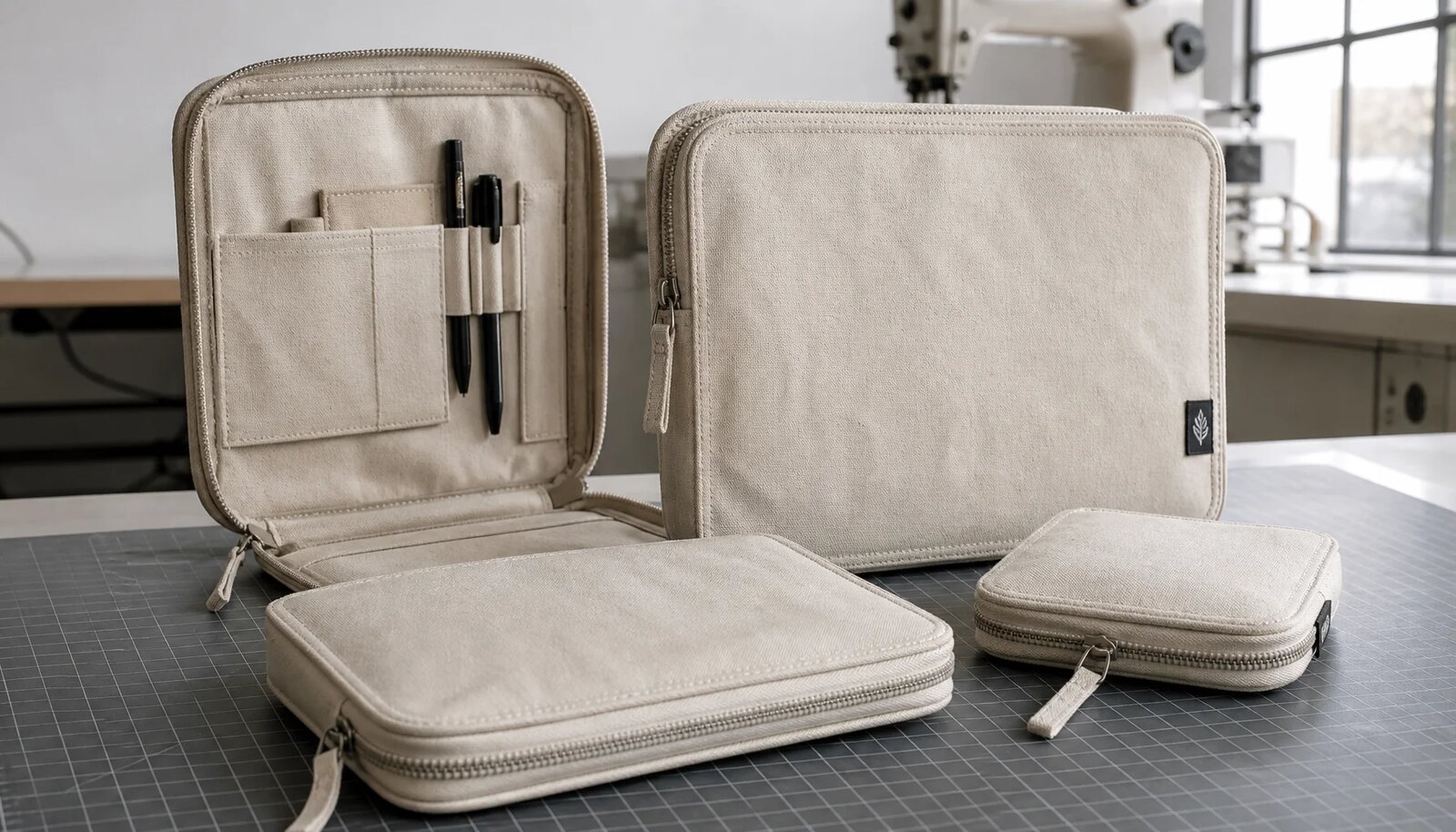
Work Backward From the Event, Not the Product Photo
Wholesale canvas zipper portfolios for event planners live on a hard calendar. The event date rarely moves, and the portfolios usually need to arrive before staff training, kit assembly, sponsor staging, or VIP packing begins. A supplier lead time of 25-35 production days is only one part of the schedule. It does not automatically include artwork cleanup, sample making, sample transit, revisions, material purchasing, decoration, final inspection, export handling, freight, customs, receiving, counting, and downstream packing.
Start with four dates: the event date, the date goods must be counted and usable, the kit assembly start date, and the latest purchase order release date. For multi-city programs, repeat the exercise by location. A New York venue, a Las Vegas fulfillment warehouse, and a regional sales team may all need different carton marks, delivery appointments, and receiving windows. The portfolio itself may be the same, but the logistics plan is not.
The product brief should describe what the portfolio must carry during the event. A check-in team may need badge sheets, pens, credentials, and a phone. Attendees may receive agendas, sponsor brochures, notebooks, and printed tickets. An executive gift may need heavier canvas, cleaner lining, tighter logo placement, and individual packaging. These are different sourcing briefs, even when every supplier calls the item a canvas zipper portfolio.
The easiest way to lose time is to ask for a final lead time while the spec is still moving. Factories can estimate early, but reliable timing depends on material availability, zipper choice, decoration method, quantity, sample path, packing format, and shipment mode. A practical wholesale canvas zipper portfolios for event planners lead time planning guide turns those decisions into written inputs before the PO is released.
- Set the event date, kit assembly date, in-hand date, and PO release deadline before final quoting.
- List actual contents by size and quantity: documents, contracts, badge sheets, pens, phones, tablets, sponsor inserts, or gifts.
- Plan each delivery destination separately when goods ship to several venues, warehouses, or teams.
- Ask suppliers to state lead time from signed pre-production sample approval, not from first inquiry.
Translate the Use Case Into a Spec Buyers Can Compare
A procurement-ready spec keeps suppliers from filling gaps with assumptions. For canvas zipper portfolios, the core details are outside dimensions, usable inside dimensions, zipper opening width, gusset depth, canvas weight, lining, interior layout, zipper type, decoration, packing, and carton marks. If those points are unclear, one quote may be for a lightweight unlined sleeve while another is for a structured organizer with a sewn patch and individual bags. The prices will look far apart because the products are far apart.
Dimensions need to connect to the inserts. If the portfolio must hold US letter documents, A4 sheets, brochures, tablets, or contracts, state the exact content size and whether it must slide in flat without curling. Outside size alone is not enough. A portfolio can look large in a photo but have a zipper opening that is too narrow for fast event use. For document programs, specify minimum opening width and usable internal clearance after seam allowance.
Canvas weight should be written in ounces and approximate GSM. A 10-12 oz cotton canvas, roughly 340-410 GSM, is a practical option for lighter document kits and cost-sensitive distribution. A 14-16 oz canvas, roughly 475-540 GSM, gives more body and a more substantial hand. Heavier is not always better. It can add seam bulk, carton weight, air freight cost, and sewing difficulty around zipper ends.
Interior organization should be intentional. Pen loops, card slots, tablet sleeves, mesh pockets, elastic holders, zipper pockets, and divider panels can improve usefulness, but every part adds cutting, placement, stitching, and inspection work. A one-day attendee kit may need one main compartment and a sleeve. A multi-day staff operations folder may justify measured pockets and stronger reinforcement.
- Specify outside size, usable inside size, zipper opening width, gusset depth, and seam allowance assumptions.
- List each pocket, loop, divider, or sleeve with dimensions, placement, and intended contents.
- State whether the portfolio must fit US letter, A4, tablet, notebook, badge sheet, or mixed inserts.
- Write canvas weight as oz and GSM, with acceptable weight tolerance when the buyer has a standard.
- Include decoration and packing in the product spec because both affect price and lead time.
Choose Canvas, Finish, and Lining With Production in Mind
Canvas is not just a fabric choice. It affects sample timing, sewing performance, decoration, carton weight, and the final feel in hand. Natural cotton canvas works for many corporate events, education programs, nonprofit meetings, and casual executive gifts because it has a familiar texture and neutral appearance. Dyed canvas can support brand colors, but custom dyeing may require higher MOQ, lab dip approval, and extra days before cutting starts.
Finish matters. Washed canvas feels softer and more relaxed. Untreated canvas usually feels crisper. Coated or laminated canvas can add body or resistance, but buyers should ask whether it changes print adhesion, odor, folding behavior, or needle performance. If the logo is printed, test the print on the final canvas finish, not on a smooth substitute swatch.
Fabric weight must match construction. A flat unlined portfolio in 10 oz canvas may be flexible, economical, and easy to pack. The same shape in 16 oz canvas can look more premium but may create thick corners, visible zipper wave, or slower sewing. If the design includes lining, binding, a gusset, patch branding, or internal dividers, ask the factory what similar construction they have already produced with that canvas weight.
Lining adds a cleaner interior but also adds material, cutting, turning, stitching, and inspection. An unlined portfolio may be the right answer for kit assembly and simple document use. A lined interior may be worth the cost for VIP gifting or resale-style presentation. If lining is required, specify material, color, GSM, and whether pockets attach to the lining or to the body panel.
- Use 10-12 oz canvas when speed, cost, and lighter contents are the priority.
- Use 14-16 oz canvas when structure, hand feel, and heavier inserts matter more than carton weight.
- Ask whether dyed, washed, coated, or laminated canvas changes MOQ, shade approval, sampling, or print testing.
- Specify lining fabric, color, GSM, pocket construction, and interior seam finish.
- Define reinforcement at zipper ends, corners, pocket joins, divider seams, label seams, and strap or handle points if included.
Lock Zipper Details Early
The zipper is one of the highest-risk functional parts on a canvas portfolio. For most canvas zipper portfolios, nylon coil is a practical choice because it is flexible, smooth, and easier to sew around flat edges or mild curves. A #5 nylon coil zipper is often a sensible starting point for portfolio-sized items, though the right choice depends on canvas weight, finished size, load, and brand expectation.
The quote should name the zipper type, size, tape color, slider color, puller style, zipper length, and end stop construction. Phrases like good zipper or standard zipper are not enough for procurement. If the buyer wants matte black hardware, antique brass metal, color-matched tape, or a branded puller, those choices may require special sourcing, higher MOQ, sample approval, or additional production days.
Zipper length is tied to usability. The finished opening must be wide enough for documents to slide in without bending. The tape should be sewn evenly, and the slider should move without catching on lining, seam allowance, or binding. Some zipper wave can appear on soft fabric products, but excessive wave makes the portfolio look poorly controlled. The pre-production sample should establish the acceptable standard.
Inspection should include real zipper cycling on units pulled from different cartons. Inspectors should open and close the zipper fully, check both ends, tug lightly on the puller, look for skipped teeth or loose sliders, and confirm that the zipper does not snag on interior fabric. At an event, a failed zipper is not a small defect. It can make the item unusable exactly when it is handed out.
- State zipper type, size, tape color, slider finish, puller style, length, and end construction in the RFQ.
- Use nylon coil for most flexible canvas portfolio constructions unless the style brief requires metal or molded teeth.
- Confirm finished opening width, not just outside dimensions.
- Treat custom zipper colors and branded pullers as lead time risks that need approval time.
- Include zipper smoothness, zipper alignment, and zipper-end reinforcement in QC.
Match Branding to Artwork, Fabric, and the Calendar
Branding often decides the sample path. A one-color screen print is usually the most direct option for clean logos and schedule-sensitive event orders. It is straightforward to price and inspect, but it still needs testing on the actual canvas. Cotton texture can affect edge sharpness, ink coverage, and opacity. The factory should confirm curing and rub resistance before bulk production.
Heat transfer can handle more detail, small type, or gradients, but it should be tested on the final canvas finish. Coarse weave, washing, coating, and fabric movement can affect adhesion and edge quality. A transfer that looks sharp on a smooth synthetic sample may not behave the same on cotton canvas. Request a strike-off or decorated sample when the artwork has fine lines, multiple colors, or tight registration.
Woven labels, sewn brand labels, PU labels, debossed patches, leather patches, and embroidered patches can make the portfolio feel more finished. They also introduce separate trim sourcing. Label weaving, patch tooling, thread matching, die cutting, debossing, adhesive backing, and sewing placement can each add approval steps. When the event calendar is tight, a simple screen print or stocked woven label may carry less schedule risk than a custom patch.
Logo placement should be measured from fixed construction points. Do not rely on a mockup alone. State the distance from the top seam, side seam, zipper edge, or panel centerline. For sewn fabric goods, placement tolerance such as +/-5 mm or +/-10 mm may be realistic, depending on construction and logo size. If the logo must align exactly with a pocket, label, or zipper line, say so before sampling.
- Choose screen print for simple, low-color logos and predictable production.
- Use heat transfer after testing adhesion and appearance on the final canvas finish.
- Use woven labels or patches when the brand needs a tactile, retail-style detail.
- Provide vector artwork, logo size, color targets, placement measurements, and tolerance.
- Approve a decorated physical sample before bulk production when brand presentation matters.
Compare Supplier Routes Before Comparing Unit Price
The lowest unit price may simply describe a cheaper construction. A direct factory can be the right route when the specification is stable and the buyer wants one production owner for cutting, sewing, decoration coordination, packing, and final inspection. This works well for repeat event programs and larger quantities where dimensions, zipper quality, and branding consistency matter. Still, ask which steps are in-house and which are subcontracted.
A trading company or sourcing office may be useful when the event program includes several categories: portfolios, tote bags, lanyards, badge holders, notebooks, apparel, or accessories. The value is coordination and consolidation. The risk is unclear accountability. Procurement should ask who owns the factory relationship, who has authority to stop production, who pays for rework, and whether the buyer can see factory-level sample and inspection information.
Stock blank plus local or regional branding can be the best route when the event date is close. Development time may be shorter because the body already exists. The tradeoff is limited control over canvas weight, color, zipper, size, and interior layout. Before committing, inspect a physical blank from the same inventory lot where possible and test decoration on that blank. Photos cannot confirm hand feel, shade consistency, or zipper function.
Supplier comparison should normalize the spec first. If one quote is for 10 oz unlined canvas with bulk packing and another is for 16 oz lined canvas with a sewn patch and individual polybags, the second supplier is not necessarily expensive. They are quoting a different item. Align fabric, trim, construction, decoration, packing, incoterm, and destination before judging price.
- Use a direct factory when single-product control and repeatability matter most.
- Use a sourcing office when multi-SKU consolidation is the larger need.
- Use stock blanks when speed matters and standard materials are acceptable.
- Ask each supplier to disclose outsourced operations and rework responsibility.
- Compare sample process, QC support, and cargo-ready accountability alongside unit price.
Build an RFQ That Shows the Real Cost Drivers
A strong RFQ makes quotes comparable. Every supplier should price the same size, quantity, canvas GSM, lining, zipper, interior layout, decoration method, packing format, incoterm, and destination. If a supplier wants to offer a lower-cost option, keep it in a separate option column. That way a thinner canvas, smaller zipper, missing lining, or simpler packing method does not look like a better price without explanation.
Separate cost lines help buyers make decisions. Ask for the blank portfolio cost, decoration setup, screen charge, label or patch tooling, sample fee, artwork adjustment, individual polybag cost, barcode label cost, hangtag cost, carton labeling, inspection support, and inland handling if relevant. A bundled unit price may be convenient for approval, but procurement still needs to know what changes when the spec changes.
MOQ should be reviewed by variable, not just by total quantity. A factory may accept 1,000 units total but require 500 units per canvas color, 300 units per artwork version, or a higher MOQ for custom zipper tape, lining, woven labels, or patches. Event programs often split by sponsor, city, department, or attendee group. Those version breaks can create cost and timing issues even when the total quantity looks comfortable.
Commercial timing belongs in the quote comparison. Ask what reserves the production slot and what starts the lead time. Some suppliers count from deposit; others count from artwork approval, material arrival, or signed pre-production sample approval. For a hard event date, use the most conservative trigger: approved sample, deposit received, and all materials confirmed. Also record quote validity so internal approval delays do not surprise the budget.
- Require the same baseline specification in every supplier quote.
- Separate product cost from setup, sample, trim, packing, labeling, and handling charges.
- Check MOQ by canvas color, logo version, zipper color, lining color, patch version, and packing version.
- Ask whether lead time starts at deposit, PO, artwork approval, material arrival, or sample approval.
- Record quote validity and production slot reservation requirements.
Use Samples as Formal Approval Gates
Samples are production controls, not presentation extras. A digital mockup can show logo direction, but it cannot prove canvas hand feel, zipper smoothness, finished dimensions, pocket access, lining behavior, print opacity, or seam strength. For custom wholesale canvas zipper portfolios tied to an event date, plan a physical pre-production sample made as close as possible to final bulk production.
Different sample types answer different questions. A prototype helps confirm structure: size, gusset depth, pocket placement, zipper opening, and insert fit. A decoration strike-off confirms print, transfer, embroidery, label, or patch quality. The pre-production sample is the key gate because it should represent final materials, final construction, final decoration, and final packing where practical. Once signed, it becomes the golden sample for production and inspection.
Approval comments should be specific and measurable. Instead of saying the logo is too low, write move logo 15 mm upward from current sample. Instead of saying the pen loop is tight, state the target pen diameter or increase the loop opening by 3 mm. Instead of saying the zipper feels cheap, specify the approved zipper size, slider finish, puller style, and smoothness expectation. Measured feedback shortens revision cycles.
Do not release bulk production while core details remain unsettled. If canvas shade, zipper color, logo placement, label design, or pocket layout is pending, the factory may cut or decorate material that cannot be reused. That risk is higher for custom-dyed fabric, custom woven labels, patches, and branded zipper pullers. A clear sample gate protects the buyer, supplier, and event calendar.
- Use prototypes for construction and pre-production samples for final production approval.
- Approve decoration strike-offs when print, transfer, embroidery, labels, or patches are material to the brand standard.
- Keep one signed golden sample with the factory and one with the buyer or inspection team when feasible.
- Write revisions with measurements, colors, material names, and placement references.
- Start bulk production only after final sample approval is documented.
Set QC Around Event-Critical Failures
Quality control should begin with failures that disrupt the event. A slightly uneven stitch line may be minor depending on the approved standard. A non-working zipper, wrong logo, wrong size, unusable pocket, mildew odor, or short shipment can affect the handoff directly. Define critical, major, and minor defects before production and share those definitions with the supplier and inspection provider.
Functional checks should cover zipper operation, finished dimensions, pocket fit, seam reinforcement, and loading with intended contents. Inspectors should pull units from multiple cartons, not only from the top of one box. The zipper should open and close fully without snagging, skipped teeth, slider looseness, or puller failure. Pockets should accept the intended cards, pens, documents, badge sheets, cables, or tablets without forcing.
Visual checks should compare bulk goods against the golden sample. Canvas shade, fabric hand, weave, thread color, lining color, zipper tape, slider finish, logo placement, print opacity, patch edges, and label stitching can drift if materials are substituted or production is rushed. If the order includes several artwork versions, each version needs its own proof reference and carton allocation check.
Packing inspection matters for event planners because a correct portfolio in the wrong carton can still miss the handoff plan. Check carton marks, piece counts, polybag or bulk pack method, barcode labels, venue labels, sponsor version labels, and master carton condition. Canvas can pick up moisture, odor, and stains during storage or transit, so cartons should be dry, clean, and strong enough for the route.
- Define critical defects such as non-working zipper, wrong artwork, wrong dimensions, severe odor, mildew, and unusable pockets.
- Define major defects such as poor print adhesion, open seams, loose pullers, visible stains, incorrect labels, or mixed shades.
- Define minor defects such as trimable loose threads or slight cosmetic variation within the approved standard.
- Inspect multiple pieces across multiple cartons and artwork versions.
- Require photos of measurements, zipper tests, decoration checks, and carton marks before shipment release.
Plan Packing, Freight, and Receiving as One Schedule
Packing is part of procurement, not an afterthought. It affects labor, cube, cost, labeling, freight, and event handling. Bulk packing often works best when portfolios will be unpacked and inserted into kits. It can reduce packaging material and speed downstream assembly. The buyer should still ask how the factory prevents scuffing, corner crushing, zipper puller marks, and shade transfer during carton packing.
Individual polybags, barcode labels, hangtags, belly bands, tissue, warning labels, and retail inserts may be needed for resale, VIP gifting, inventory scanning, or direct attendee distribution. These requirements belong in the RFQ and lead time plan. Applying barcode labels and sorting by version can add labor, especially when the same portfolio body carries several sponsor logos or ships to multiple venues.
Request carton data before freight is finalized. Ask for pieces per carton, carton dimensions, net weight, gross weight, total carton count, and estimated volumetric weight. Canvas portfolios can be bulky, and air freight may charge by dimensional weight when cartons take more space than their physical weight suggests. For ocean or ground freight, cube, palletization, carton strength, moisture protection, and storage conditions still matter.
Lead time should end at counted receipt, not factory completion. Cargo-ready date is only one milestone. Booking, pickup, export clearance, international transit, import clearance, final delivery, warehouse receiving, counting, and kit assembly all take time. For hard event dates, a split shipment can protect the first wave, but only if quantities, destinations, carton marks, and ship modes are written into the PO before packing begins.
- Choose bulk packing when portfolios will be inserted into kits and retail presentation is unnecessary.
- Choose individual packing when scanning, resale, VIP gifting, or direct attendee handout requires it.
- Request carton dimensions, pieces per carton, gross weight, net weight, and total carton count before freight booking.
- Check dimensional weight when air freight is considered.
- Plan delivery through counted receipt and kit assembly, not only cargo-ready date.
Specification comparison for buyers
| Procurement decision | Recommended option | Best fit | Lead time or quality risk to verify |
|---|---|---|---|
| Supplier route | Direct factory with cutting, sewing, decoration coordination, packing, and final inspection under one production plan | Repeat event programs, fixed specifications, larger quantities, and orders where one owner must control dimensions, trim, and inspection | Confirm which steps are actually in-house. Printing, woven labels, patch making, zipper sourcing, and carton printing may still be outsourced even when sewing is factory-owned. |
| Supplier route | Trading company or sourcing office with named production factory and written responsibility split | Programs that combine portfolios with other event items such as totes, lanyards, badge holders, apparel, or notebooks | Ask who holds the golden sample, who approves corrective action, who pays for rework, and whether inspection is performed at the sewing factory before goods move. |
| Supplier route | Stock blank portfolio plus local or regional branding | Short calendars, small runs, emergency replenishment, or simple one-position logos | Verify actual blank inventory by quantity and color, canvas GSM, zipper size, shade consistency, decoration compatibility, and whether blanks are from one production lot. |
| Canvas weight | 10-12 oz cotton canvas, approximately 340-410 GSM | Document folders, staff check-in kits, simple sponsor inserts, and cost-sensitive event distribution | Check finished body stiffness, corner collapse, fabric transparency, shrinkage from washing or finishing, and whether heavier inserts bend the portfolio. |
| Canvas weight | 14-16 oz cotton canvas, approximately 475-540 GSM | Premium client gifts, executive portfolios, resale programs, heavier inserts, and structured presentation | Higher GSM may increase needle breakage, seam bulk, carton weight, air freight cost, and sample revision time. Confirm machines and seam construction can handle the thickness. |
| Structure | Flat zipper portfolio with one main compartment and optional internal sleeve | Fastest route for schedules, contracts, name badges, pens, and light documents | Confirm usable inside dimensions, zipper opening width, seam allowance, corner shape, and whether letter or A4 sheets slide in without curling. |
| Structure | Gusseted portfolio with interior pockets, pen loops, card slots, or tablet sleeve | Multi-day conferences, staff operations kits, VIP packs, training events, and sponsor sets with several inserts | Every internal part adds cutting dies or templates, placement tolerances, sewing operations, and inspection points. Approve a physical pre-production sample. |
| Zipper | Nylon coil zipper, commonly size #5 for portfolio applications unless the design requires heavier duty | Most canvas zipper portfolios because it is flexible, smooth, and easier to sew around flat or curved edges | Confirm zipper size, tape color, slider finish, puller shape, end stops, zipper length tolerance, and smooth operation after sewing into bulk fabric. |
| Zipper | Metal or molded plastic zipper only when the style brief requires the look or heavier trim | Retail-style gifts, rugged branding, or designs where zipper appearance is part of the product identity | Metal can add weight and may mark fabric; molded teeth are less flexible on tight curves. Test opening feel, scratching risk, and packing protection. |
Buyer checklist before sampling
- Event date, in-hand date, receiving location, kit assembly date, and latest acceptable delivery date by venue or warehouse
- Total order quantity plus allocation by city, venue, sponsor version, department, or attendee group
- Final outside dimensions, usable inside dimensions, zipper opening width, gusset depth, document size, and expected insert stack thickness
- Canvas type, color, finish, target weight in oz and GSM, acceptable fabric weight tolerance, and whether shade must match a physical standard
- Lining requirement, lining material, lining GSM, interior seam finish, and whether the product should feel soft, semi-structured, or firm
- Interior layout with measured pocket openings, sleeve dimensions, pen loop diameter, card slot width, tablet size, and zipper pocket position
- Stress-point requirements at zipper ends, corners, pocket joins, divider seams, label seams, handle points, wrist strap points, and any reinforced panels
- Zipper type, zipper size, zipper tape color, slider color, puller style, puller logo requirement, zipper length, and smoothness expectation
- Branding method, artwork file format, logo size, color count, Pantone or thread target if relevant, placement measurement, and placement tolerance
- MOQ by canvas color, artwork version, zipper color, lining color, packing version, shipping destination, and carton marking version
Factory quote questions to send
- What canvas oz and GSM are included in the quote, and what fabric weight tolerance will you hold in bulk production?
- Is the canvas greige, dyed, washed, enzyme washed, coated, laminated, printed, or lined, and how does that finish affect shrinkage, odor, color shade, and print adhesion?
- Can you state finished outside dimensions, usable inside dimensions, zipper opening width, gusset depth, seam allowance, and dimensional tolerance for bulk goods?
- What zipper type are you pricing: nylon coil, metal, or molded plastic; what zipper size; what slider; what puller; and what tape color?
- Are the zipper tape color, slider finish, puller shape, zipper length, lining color, labels, patches, and thread colors stock options or custom sourced materials?
- Which operations are completed in-house: cutting, sewing, printing, heat transfer, embroidery, label sewing, patch application, trimming, packing, and final inspection?
- If any operation is outsourced, who controls the approved sample, who inspects the outsourced work, and who is responsible for rework cost and timing?
- What is the MOQ by canvas color, by artwork version, by zipper color, by lining color, by label or patch version, and by packaging version?
- Can you separate blank portfolio cost, decoration setup, label or patch tooling, sample fee, artwork adjustment, individual packing, carton labeling, and inland handling charges?
- What sample stages do you recommend, what does each sample cost, and how many working days are needed after complete artwork and specification approval?
Quality-control points to confirm
- Canvas weight, weave, color shade, finish, shrinkage behavior, and hand feel match the approved golden sample, with no unexpected coating, thin panels, oil marks, mildew, or uneven weaving
- Finished outside dimensions, usable inside dimensions, zipper opening width, gusset depth, pocket placement, pen loop size, sleeve fit, and card slot spacing stay within agreed tolerance
- Portfolio lies acceptably flat when empty and loaded, with no excessive zipper wave, twisted panels, warped binding, distorted corners, or uneven gusset shaping beyond the approved sample standard
- Zipper opens and closes smoothly from end to end on samples pulled from different cartons, with no snagging, skipped teeth, loose sliders, sharp ends, broken pullers, or misaligned zipper tape
- Zipper ends, corner seams, pocket joins, internal dividers, label seams, wrist strap points, and handle points if included are reinforced exactly as approved
- Stitch density, thread color, stitch straightness, backtack quality, seam allowance, binding alignment, and loose-thread trimming match the approved production standard
- Screen print, heat transfer, embroidery, woven label, PU label, leather patch, or fabric patch placement matches approved artwork and agreed tolerance, commonly stated in millimeters from seams or edges
- Decoration shows no smearing, cracking, peeling, severe ink bleed, poor opacity, crooked alignment, loose label edge, patch distortion, puckering, or color mismatch against the approved standard
- Interior pockets fit the intended documents, business cards, pens, badge sheets, cables, or tablet size without tearing, excessive tightness, blocked access, or seam strain
- No loose threads, broken stitches, stains, needle holes, odor problems, fabric scuffs, crushed corners, damaged zipper pullers, mixed shades, or visible rework marks