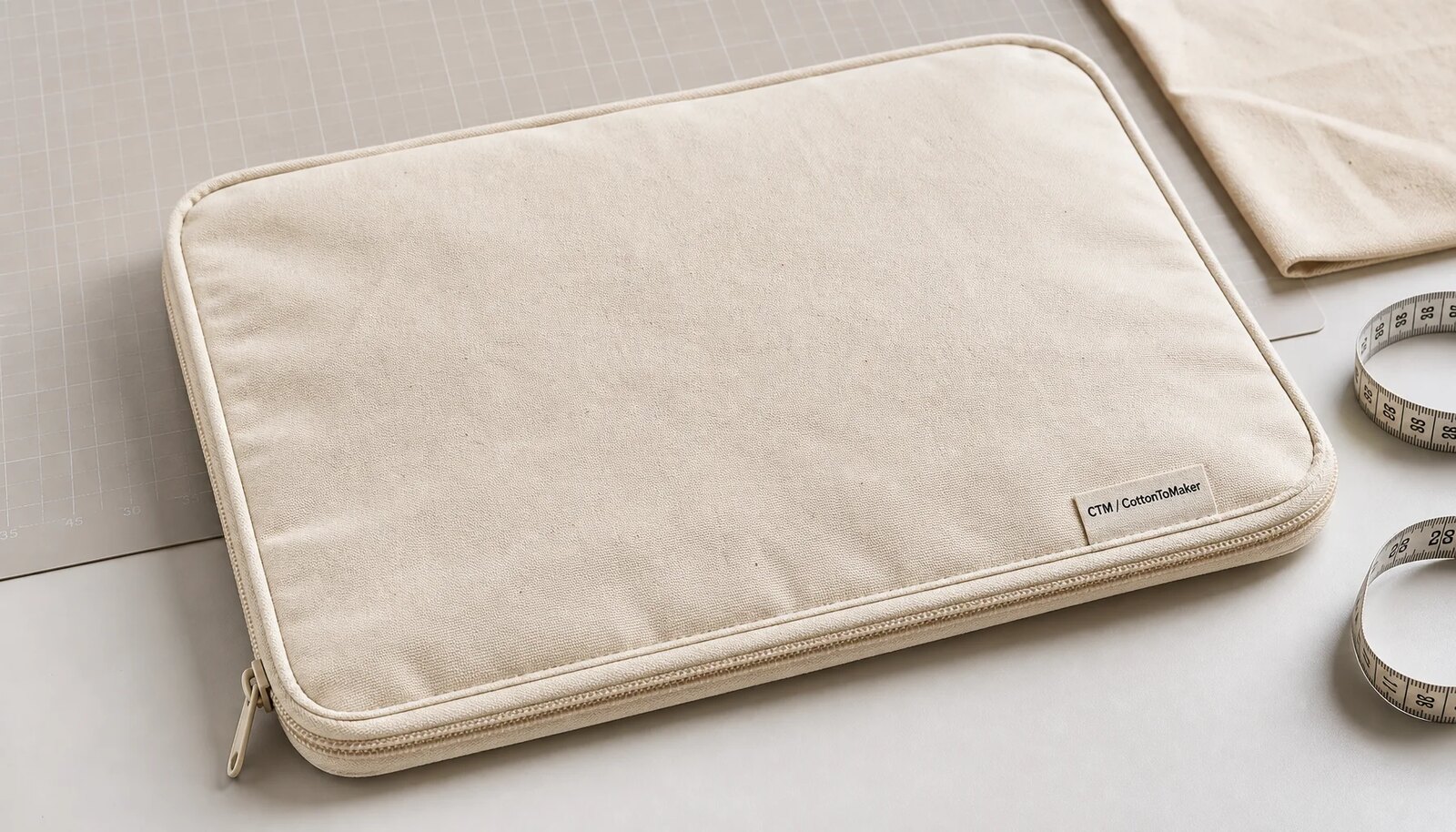
What this portfolio has to do in the field
Event planners buy zipper portfolios to move paper, schedules, vendor notes, proposal packs, and sometimes tablets without the contents curling or falling out. That sounds simple, but the product has to perform as both a document carrier and a presentation item. If the zipper catches, the canvas collapses, or the logo looks off-center, the buyer sees a weak product, not just a weak sample.
Start with the job, not the decoration. A portfolio for conference kits may only need to hold letter-size documents and a few flat inserts, while a sales portfolio for planners or venue teams may need more structure, a gusset, and a better zipper pull. The wrong spec usually shows up first as a quote mismatch, then as a complaint after the first event season.
- Define the document size it must hold: A4, letter, or a custom insert.
- Decide whether the portfolio needs to lie flat on a table or stand up with internal structure.
- Separate one-time event use from repeat-use programs, because the durability target changes the spec.
Choose canvas weight and body construction first
Canvas weight is one of the first places factory quotes diverge. For this product type, 10oz canvas is usually the light end of the range, 12oz is the common middle ground, and 16oz gives a more structured, premium feel. In metric terms, that is roughly 340gsm, 400gsm, and 540gsm, although mills and regions can vary slightly. The right choice depends on whether the buyer wants a soft document sleeve or a portfolio that still feels firm after packing and unpacking.
Construction matters as much as raw fabric weight. A lighter canvas can work if the body is lined or interfaced correctly, while a heavier canvas can still look cheap if the seams buckle or the cut edges are not finished cleanly. Ask the factory how the portfolio is reinforced at the corners, zipper ends, and stress points. If the item is meant for daily use at events or by field teams, a neat build usually matters more than pushing to the heaviest canvas available.
- Use 10oz to 12oz canvas for lighter document kits and lower carrying stress.
- Use 12oz to 16oz canvas when the portfolio needs a more rigid presentation feel.
- Ask whether the quote includes lining, interfacing, binding, or only single-layer body fabric.
The zipper and lining determine how premium it feels
For canvas portfolios, the zipper is not a small detail. A smooth nylon coil zipper is usually the most practical option because it runs cleanly, handles curve transitions better than many metal styles, and keeps weight under control. If the portfolio is overfilled or the buyer wants a larger format, a sturdier zipper size may be needed, but increasing the zipper gauge should also trigger a review of the zipper tape, puller, and seam reinforcement. A weak zipper makes even good canvas feel like a commodity item.
Lining decisions are easy to underestimate. A lined portfolio feels more finished, helps hide internal stitching, and can improve the way the product opens and closes. A plain unlined interior lowers cost, but then the stitching, seam finishing, and zipper tape alignment need to be cleaner because everything is visible. For event planners, the interior often gets noticed when the item is opened on a table, so the inside cannot look like a stripped-down sample room prototype.
- A smooth nylon coil zipper is usually the safest default for document portfolios.
- Match zipper color to the canvas or to the brand system before production starts.
- If the portfolio is meant to be overstuffed, test zipper travel with real documents, not just an empty sample.
Decoration should match volume, color count, and durability
Print method is not just a branding decision; it changes the quote and the production risk. Screen printing is usually the strongest value choice for one or two solid colors with enough volume to justify setup. It gives a clean logo on canvas, but the buyer needs to watch ink build-up, alignment, and fold marks after packing. Heat transfer is more flexible for complex art or small runs, but it can introduce feel, cracking, or edge lift if the item is handled heavily.
For a more premium look, a woven label or sewn patch often reads better than a large printed block. That is especially true on darker canvas, where a stitched brand cue can look more controlled than a heavy ink layer. Embroidery can work in some cases, but dense stitches can distort light canvas panels or create stiffness in the wrong place. The main rule is simple: if the logo must survive repeated folding, packing, and opening, the decoration method should be chosen for durability first and style second.
- Use screen print for simple logos, strong contrast, and repeatable production.
- Use woven labels or sewn patches when the brand wants a cleaner premium signal.
- Treat heat transfer as a specific solution, not a default answer for every artwork file.
Pick the sourcing route that matches your MOQ logic
The best supplier type depends on what is driving the order. A direct factory is usually the right route when the buyer wants control over fabric weight, zipper spec, stitching detail, and reorders. A trading company can be useful when the program includes several bag styles or the buyer wants one contact point across multiple factories. Domestic converters and local decorators make sense when the calendar is tighter than the margin, but they usually trade away some control on body fabric and packaging detail.
MOQ is not a single number pulled from nowhere. It is often the result of setup cost across cutting, sewing, print preparation, zipper color booking, and packaging allocation. If a supplier offers a very low MOQ, the buyer should look for the tradeoff: stock sizes only, stock colors only, one artwork location only, or simplified packing. For a serious recurring program, a quote that explains why the MOQ exists is usually more useful than a quote that just says yes to everything and hides the compromise somewhere else.
- Direct factory: best for spec control and repeat programs.
- Trading company: useful when you need a wider supply base or multi-item consolidation.
- Local converter: useful when speed matters more than unit cost.
- Stock blank route: useful for low-risk trials, but verify shade and size consistency.
Build the RFQ so factories quote the same thing
Most quote problems start with missing detail, not with bad intent. A factory can only price what it understands, so the RFQ should state the finished size, flat size if relevant, canvas GSM, lining choice, zipper type, zipper length, print method, logo size, and placement. It should also specify whether the portfolio needs a gusset, pen loop, pocket, or any internal divider. If the buyer wants a close comparison across vendors, the same RFQ needs to define packing, carton quantity, destination, and incoterm as well.
Quote data should also include the commercial logic behind the order. Is this a one-off event project or a repeat purchase after a sample round? Is the buyer willing to accept a small color variance, or does the brand need a tighter match? Does the supplier need to quote an overs allowance, and if so, at what percentage? When these details are missing, the buyer gets a cheap-looking unit price that turns into change orders after sample approval.
- State the exact use case and the documents or items the portfolio must carry.
- Specify the artwork file, print position, and the number of print colors.
- Include destination terms, carton requirements, and target delivery window.
- Ask for a line-by-line quote instead of one rolled-up unit price.
A pre-production sample must prove the real build
A sales sample can be useful for shape and presentation, but it should not be mistaken for production approval. The pre-production sample should use the bulk canvas, the bulk zipper, the final print method, and the final packing method whenever possible. That is the only way to see whether the portfolio still hangs straight, closes cleanly, and keeps the logo where the buyer approved it. If the sample is built from different stock, it may look close but still fail once the production lot starts.
The sample review should be measured, not casual. Check finished dimensions, zipper travel, seam alignment, print registration, and the feel of the finished body after it is folded and reopened several times. For this product, a practical acceptance threshold is usually tighter on size and zipper action than on minor surface texture, because event planners will feel the opening and closing behavior immediately. If the buyer wants a premium result, the sample has to prove that the portfolio opens smoothly when full, not just when empty on a table.
- Approve the pre-production sample only after bulk materials are confirmed.
- Measure finished size against the spec sheet and record the acceptable tolerance.
- Open and close the zipper repeatedly with real inserts, not only with empty fabric.
Packing and labeling decide whether the order is ready for distribution
Packing choices affect both damage rate and warehouse speed. A flat-packed portfolio with a clean inner polybag and clear carton marks is usually easier for distributors, importers, and retail buyers to handle than a loosely folded item with no label logic. If the product is going directly to corporate clients or event venues, the buyer may want a simpler bulk pack. If it is going through retail or e-commerce, then barcode placement, hangtag language, and inner pack counts matter more than a few cents saved per unit.
Carton planning should happen before production, not after packing starts. The factory should confirm the number of units per carton, carton dimensions, gross weight targets, and whether extra protection is needed for printed faces. If the product is being shipped with inserts, cards, or promotional material, those items should be accounted for in the carton math because they change cubic volume and can push freight costs up faster than the buyer expects.
- Lock the inner pack count and carton count before production begins.
- Confirm whether the order needs retail labels, barcode stickers, or only bulk identification marks.
- Keep printed surfaces from rubbing against zipper pulls or hard inserts during transit.
Lead time slips when approvals and trims are left open
A realistic schedule starts with sample approval and works backward from the ship date. For example, a simple sample may take around a week, while a custom pre-production sample can take longer if the factory is waiting on zipper color booking, artwork confirmation, or a specific canvas lot. Production for a straightforward order may fall into a few weeks after approval, but that window can stretch when the buyer changes packing text, revises the logo, or asks for a different zipper puller late in the process. The point is not to promise a fixed timeline; it is to identify the steps that actually move the calendar.
Trim and artwork issues are the most common schedule risk. A factory cannot move bulk production cleanly if the buyer is still debating logo placement or if the zipper color was only approved verbally. The safest way to keep momentum is to freeze the spec sheet before mass production, then make any change requests visible as commercial changes, not casual comments. For event planner programs, a missed delivery window often hurts more than a slightly higher unit cost, because the product is usually tied to a launch, show, or conference date.
- Sample approval, material booking, print setup, and packing sign-off should all have owners and dates.
- Add buffer time for peak season, holiday shutdowns, and port congestion.
- Treat any late spec change as a new cost and new timeline, not a small revision.
Compare landed cost, not only the unit price
A low unit quote is not automatically a good quote. The buyer should normalize every offer to the same basis: same canvas weight, same zipper spec, same decoration method, same packing, same carton count, and same incoterm. After that, compare the cost of freight, duty, local handling, sampling, and likely rework. A quote that looks slightly higher can still land cheaper if it avoids re-prints, repacking, or unexpected carton overages.
The best supplier is usually the one that reduces correction cycles. If a factory gives a clean breakdown of fabric, zipper, print, labor, packing, and lead time, the buyer can compare it against another factory without guessing what is hidden inside the number. For wholesale canvas zipper portfolios for event planners, the commercial win is not just a low purchase price. It is a product that arrives on time, matches the approved sample, and can be reordered without redesigning the spec every time.
- Normalize all quotes to the same spec before comparing prices.
- Add freight, duty, local handling, and expected damage allowance to the unit cost.
- Choose the quote with the clearest spec and the fewest hidden assumptions, not just the lowest number.
Specification comparison for buyers
| Spec decision | Recommended option | When it fits | Buyer risk to check |
|---|---|---|---|
| Sourcing route | Direct factory with a bag sewing line | 3,000+ units, custom size, repeat program, or multiple colorways | Confirm the factory controls cutting, sewing, zipper sourcing, and final QC instead of passing work out without disclosure |
| Sourcing route | Trading company with a stable factory network | You need one RFQ covering several bag SKUs or multi-destination delivery | Verify who owns the spec, who signs off on samples, and whether the quote includes extra handling margins |
| Sourcing route | Domestic converter with local print and finishing | Short lead time, small reorder windows, or local compliance requirements | Expect higher unit cost and less flexibility on canvas weight, zipper color, and carton customization |
| Sourcing route | Stock blank importer plus local decoration | Low MOQ trial orders or rush event programs with limited artwork changes | Check shade variation between stock lots and confirm that the blank portfolio size is still consistent |
| Sampling route | Pre-production sample made from bulk materials | Artwork, zipper color, and packaging are already fixed | Sales samples can hide the real hand feel, zipper stiffness, and final color match |
| Decoration route | Screen print with one or two spot colors | Simple logo, strong contrast, and medium to high volume | Check ink build-up near seams and confirm rub resistance after folding and packing |
| Decoration route | Woven label or sewn patch | Premium programs, darker canvas, or repeat orders that need a cleaner brand cue | Confirm label placement, stitch bulk, and whether the label changes finished dimensions |
| Packaging route | Flat-packed with size-coded inner bags and carton marks | Distributor fulfillment, warehouse intake, or mixed-SKU programs | Make sure carton count, barcode data, and inner pack quantities are locked before production |
Buyer checklist before sampling
- Confirm the finished size, not just the flat cut size, for the documents the portfolio must hold.
- Set the canvas weight target in GSM and decide whether the body needs lining or interfacing.
- Lock the zipper type, zipper length, puller style, and zipper color before quoting.
- Approve the logo method, artwork file format, and print placement with a measured mockup.
- State the expected order quantity, reorder potential, and color count so MOQ logic is realistic.
- Specify packing format, inner pack quantity, carton marks, and whether retail labeling is needed.
- Request a pre-production sample made with bulk materials, not a sales sample built from substitute stock.
- Ask for the quote to show incoterm, sample charge, tooling charge, packing charge, and any overage allowance.
- Define acceptable tolerances for size, color, stitching, and zipper function before mass production starts.
- Confirm the shipping window and add buffer time for print approval, trim booking, and freight handoff.
Factory quote questions to send
- What finished size and dimensional tolerance are you quoting for the portfolio?
- Which canvas GSM, weave type, and lining option are included in the quoted price?
- What zipper type, zipper gauge, zipper length, and zipper color are included?
- What logo method is priced, and how many print colors or stitch colors are included?
- Does the quote include reinforcement at stress points, binding, and full seam finishing?
- What is the MOQ by color, by artwork version, and by packing configuration?
- Are sample charges refundable against production, and what sample lead time should we expect?
- Which packing details are included: polybag, insert card, barcode, desiccant, and carton marks?
- What incoterm is the quote based on, and what charges are excluded from that price?
- What is the production lead time after sample approval and deposit, and what can delay it?
Quality-control points to confirm
- Bulk canvas matches the approved swatch for shade, weave, and hand feel.
- Finished size stays within the agreed tolerance on width, height, and gusset depth.
- The zipper runs smoothly from end to end without snagging, waviness, or tooth skip.
- Seams are even, with no skipped stitches, loose thread ends, or puckering near corners.
- Logo placement matches the approved artwork position and is centered within the allowed tolerance.
- Reinforcement stitches or bartacks are present at handles, zipper ends, and other stress points if specified.
- Lining, if used, is cleanly turned and does not twist, bunch, or expose raw edges.
- Packing matches the approved method, including polybag count, labels, carton marks, and barcode data.
- Cartons hold the agreed quantity and pass a basic stacking and drop check for transit use.
- Pre-production sample, top-of-line approval sample, and bulk production sample all use the same key materials whenever possible.