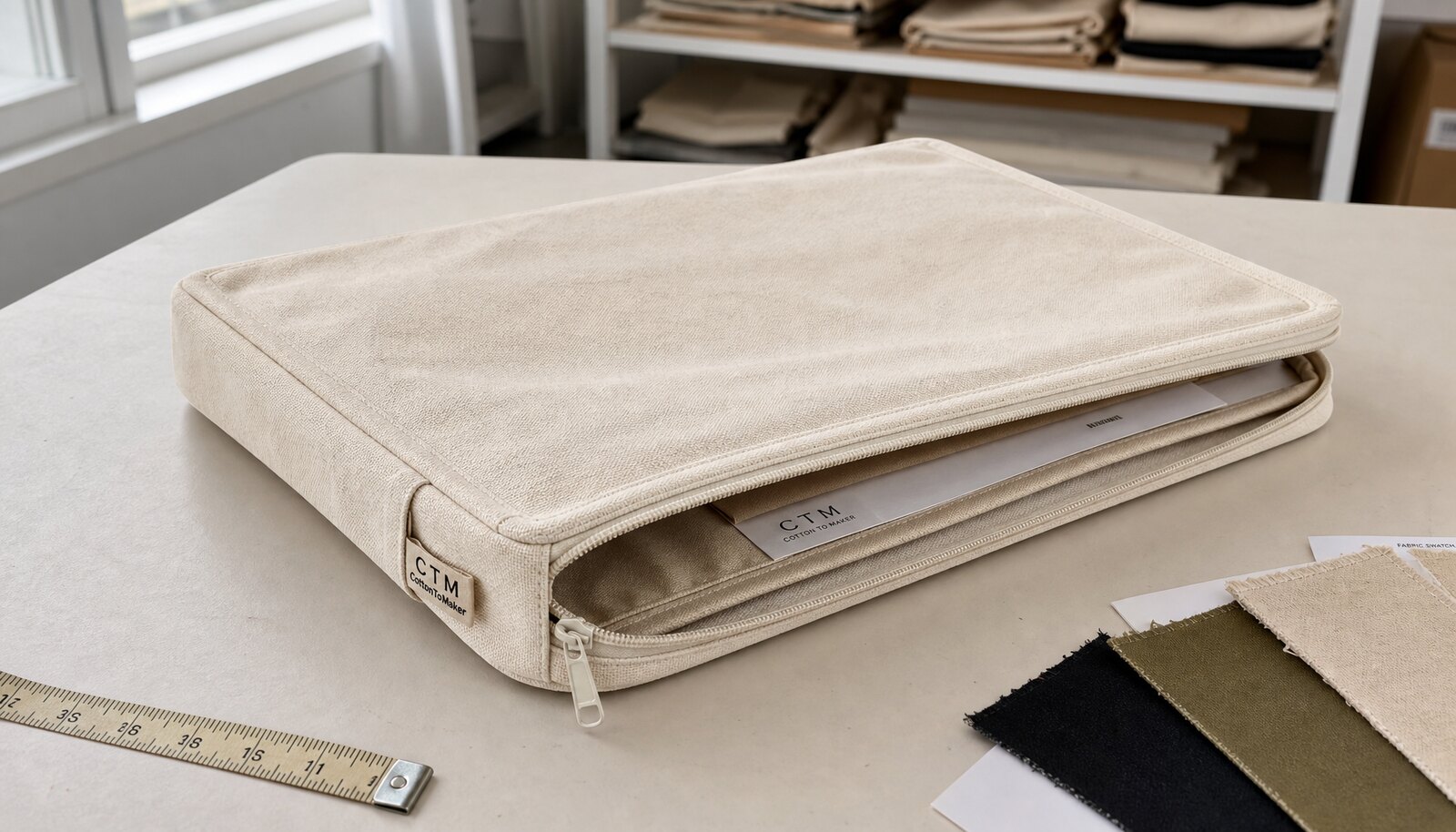
Start With the Winery Use Case, Not the Swatch
Wholesale canvas zipper portfolios for boutique wineries work best when the buyer defines the job before the fabric. A tasting room portfolio carrying menus, club forms, and note cards has a very different wear pattern from a sales kit that moves between distributors, events, and retail counters. The first use case is about presentation and speed at the counter. The second is about handling, transport, and the ability to survive being packed and unpacked several times a week without looking tired.
That difference affects more than appearance. If the portfolio needs to carry a tasting menu, a reservation card, and a multi-page club packet, the buyer should state the paper size, the usable opening width, and the target insert thickness in the RFQ. If it also needs to hold a tablet, sample sheet, or pen, the pattern has to account for bulk at the spine and the stress that creates at the zipper ends. The best spec is the one that reflects actual winery workflow, not a generic stationery accessory.
- Name the end user: tasting room, sales team, VIP gift, or distributor kit.
- State the contents and maximum thickness in millimeters or sheet count.
- Tell the factory where the wear will concentrate: zipper line, corners, or front panel.
- Avoid vague words like "premium" unless they map to a measurable build choice.
Choose Canvas Weight for How the Portfolio Will Be Handled
Canvas weight is the most visible buying decision, but it is not enough on its own. For this category, 12 oz to 14 oz canvas is usually the practical range because it gives the portfolio enough body to keep a clean shape without turning it into a rigid case. In metric terms, that is roughly 407 to 474 gsm. A 10 oz canvas can work if the item is closer to a soft document sleeve, but it will wrinkle sooner and make the product feel less substantial at the tasting table.
The finish matters as much as the nominal weight. Two fabrics with the same stated ounce weight can feel different if one is pre-shrunk, lightly calendared, or woven more tightly. That matters for wineries because the portfolio is often touched in front of customers, passed across counters, and photographed on the spot. Natural canvas can look refined, but it also records every shortcut: uneven weave, shade variation, or a fabric finish that makes the surface look sloppy under daylight. Ask for the actual mill spec, not just the fabric weight.
- Choose 10 oz only when the item is closer to a sleeve than a structured case.
- Choose 12 oz when you want the best balance of structure, cost, and print clarity.
- Choose 14 oz when daily handling and a firmer first impression matter more than freight cube.
- Ask whether the canvas is pre-shrunk, washed, or calendared, and whether repeat lots will match.
Specify the Zipper as a Functional Component, Not a Line Item
The zipper determines whether the portfolio feels smooth in use or annoying in hand. For wholesale canvas zipper portfolios, a #5 nylon coil zipper is usually the right starting point because it runs well on curved openings, handles paper loads without much friction, and is less likely than metal teeth to scratch inserts. For winery use, that matters because the portfolio is often opened and closed in a hurry while a guest is waiting or a sales rep is moving through a meeting.
The better quote names the whole zipper system: tape width, slider type, pull finish, and whether the tape must match the body or contrast intentionally. An auto-lock slider helps when the portfolio is carried inside bags or sample kits because it reduces accidental opening. The corner geometry is just as important as the chain. If the zipper path is too short, the opening feels cramped. If the tape is not reinforced at the ends, the first failure will usually show up there, not in the teeth themselves.
- State zipper size, tape width, slider type, and pull finish in the spec sheet.
- Ask whether the zipper is stock or custom sourced, because that changes MOQ and lead time.
- Require reinforced ends and bartacks where the zipper tape meets the canvas.
- Reject samples that show wave, twist, or puckering along the zipper line.
Build the Interior Around Paper, Cards, and Insert Thickness
Interior construction should follow the content the winery actually uses. If the portfolio holds tasting menus, order forms, and club packets, the inside needs enough flat space and enough clearance at the zipper so the stack does not bind. If it also holds a pen loop, divider, or pocket for business cards, those additions should be placed so they do not create a bulge at the front panel. The more layers you add, the more important the sewing order becomes, because a clean-looking sample can still distort under load.
An unlined build is acceptable when the natural canvas look matters and the buyer wants the lowest unit cost. A 210D lining gives the inside a cleaner finish and hides seam tails, but it also adds labor, a bit of weight, and some risk of misalignment if the line is rushed. For boutique wineries, a light-colored lining can improve usability in dim tasting rooms because staff can see what is inside faster. The decision should come down to presentation, not habit.
- Confirm the usable opening width, not just the closed size.
- If the portfolio will hold a thicker stack, ask the factory to test the loaded closure before approval.
- Use lining when the inside finish is visible to the customer or needs to conceal seam tails.
- Keep pockets and loops clear of the zipper travel path.
Match Branding to the Canvas Surface and the Brand Mood
Canvas is a good branding substrate, but its texture punishes vague artwork. Screen printing is the most common option when the winery logo needs to be readable from a distance and the mark is large enough to sit cleanly on the front panel. It is also efficient for recurring wholesale orders. Still, a digital mockup does not show how ink behaves on the actual weave, so a print strike-off on the final cloth is worth the time. The goal is to see edge softness, color density, and whether the print feels too heavy against the fabric grain.
A woven side label or sewn patch is a better fit when the brand wants something quieter and more durable. That approach usually survives repeat production better than a small printed logo placed too close to a seam or zipper head. For boutique wineries, the brand is often more restrained than a consumer retail label, so a subtle woven tag can look more deliberate than a large print panel. The key is to choose a branding method that can be repeated on the next order without chasing a different color or placement every time.
- Use vector artwork and a Pantone reference when color consistency matters.
- Ask for a strike-off or sample print on the actual fabric, not a generic swatch.
- Keep artwork away from seam lines, zipper stops, and fold points.
- For small marks, a woven label or side tag is often more reliable than direct print.
Use Case Drives the BOM: Tasting Room, Club, Sales, or Trade Event
A winery portfolio does not have one fixed requirement. A tasting room version may need to look polished at first touch, with a clean exterior, simple branding, and a light interior that keeps menus easy to find. A wine club packet may need a pocket or divider for welcome materials, membership forms, and insert cards. A sales kit needs more structure because it gets carried, stacked, and reopened repeatedly, so the seam build and zipper hardware matter more than a subtle brand treatment.
Trade events and distributor meetings add another layer. Those kits often travel with more paper weight, and they can include bottle specs, pricing sheets, or region maps that make the portfolio bulkier than a simple presentation item. This is where the buyer should reconsider zipper length, canvas weight, and reinforcements at the corners. The right answer is not to build one universal version and hope it covers every use. It is to define the primary use, then decide whether a second SKU is justified for a different audience.
- Keep tasting-room items cleaner and lighter; keep sales kits sturdier.
- Use pockets only when they actually solve an insert problem.
- If one SKU must serve multiple teams, test it with the heaviest expected content.
- Do not force one decorative version to carry the same load as a field-use version.
Compare Suppliers on Landed Cost, Not the First Price You See
The quote for a canvas zipper portfolio should be broken into visible cost blocks. If the supplier only gives one all-in number, the buyer cannot tell whether the price is being driven by sewing labor, zipper sourcing, decoration, packing, or a one-time setup charge. A procurement-ready comparison needs a common spec sheet, the same packing assumptions, and the same trade term. Otherwise the cheapest quote is often only cheap on paper. It can become expensive once the hidden steps are added back in.
Supplier type matters too. A direct factory with in-house sewing, zipper assembly, and printing usually gives the best control when the program is repeatable and the BOM is stable. A trading company can help if the buyer needs several product variations or wants one contact point, but the production site and trim source still need to be disclosed. A domestic converter can make sense for a small launch or a rapid re-order, especially if the buyer wants to test the portfolio with a winery program before committing to an import run. Example: a quote that starts $0.30 lower can easily lose that advantage if lining, custom zipper color, and larger cartons increase the landed cost by more than the unit delta.
- Ask where the fabric is woven or dyed, where the bag is sewn, and where it is packed.
- Request quotes on the same Incoterm, preferably FOB or EXW if you control freight.
- Compare carton dimensions as well as unit price, because volume drives shipping cost.
- Include customs duty, brokerage, and destination trucking when calculating landed cost.
Understand What Actually Moves MOQ and Setup Cost
MOQ is usually driven by trim sourcing and setup risk, not by a number the factory invents at random. Standard canvas with stocked zippers and a single-color print can often support a lower minimum than a build that adds a custom zipper color, woven label, lining, or a nonstandard size. If the supplier is pricing a fully custom article as though it were stock, the result is usually one of two problems: a sample that cannot be repeated in bulk, or a bulk order that quietly substitutes cheaper materials to protect margin.
The quote should separate recurring unit cost from one-time charges. Screen setup, woven label tooling, custom zipper pulls, and special packing inserts should not be buried inside the piece price. That separation matters for wineries because programs often repeat seasonally. A first run for a holiday club kit may justify extra setup. A reorder for the same tasting room portfolio should not pay the same setup twice unless the BOM changed. If a quote includes a low unit price but a large tooling line, the buyer should ask how many orders it takes to amortize that cost.
- Treat custom zipper pulls, lining, and woven labels as MOQ multipliers.
- Separate one-time setup costs from recurring unit cost before comparing vendors.
- Use the same currency, Incoterm, and carton assumption across all offers.
- Ask when a reorder can use the same BOM without new tooling.
Approve Samples Against the Materials, Not Just the Look
A sample should approve the bill of materials, not only the visual appearance. The buyer needs one golden sample that reflects the exact canvas, zipper, label, seam construction, and packing intended for bulk production. If approval happens before the supplier locks the material list, the bulk run can drift away from the signed-off sample through trim substitutions or a lighter lining. That is a common procurement failure because the first sample looks good, but the bulk order is built from a different set of inputs.
The review should be dimensional and practical. Measure the closed size, open the zipper several times, check whether the body lays flat when empty, and confirm the insert thickness the portfolio can actually accept without distortion. Then inspect the edges, corners, and logo placement under consistent light. For a winery buyer, the useful question is not whether the sample looks premium in a photo. It is whether the same product can be reproduced at scale with the same tolerances and the same defect threshold.
- Approve one physical golden sample and tie it to the purchase order.
- Measure the finished size at several points so asymmetry is caught early.
- Write down acceptable variation for print position, zipper alignment, and seam finish.
- If a material substitution is proposed, require a revised sample before production release.
Write the Packing, Storage, and Reorder Plan Early
Canvas portfolios are not fragile, but they still pick up damage if they are packed loosely or moved through the warehouse without clear labels. For wholesale orders, individual polybags plus a size sticker are usually enough, followed by master cartons with item code, color, quantity, carton number, gross weight, and net weight. That makes receiving easier and helps a winery or distributor avoid the common problem of getting the right product in the wrong pack configuration. The packing spec should be part of the quote, not a separate afterthought.
Freight planning belongs in the spec because packing volume changes the landed cost. A portfolio with lining, a wider zipper panel, or a firmer canvas can increase carton cube enough to move the best shipping mode. If the shipment is going to a humid climate or a long transit lane, ask about carton strength, moisture control, and whether the factory uses inner packs that keep the product from rubbing during transport. For reorders, keep the approved BOM, carton spec, and label format in one place so the next buying cycle does not have to rebuild the order from memory.
- Specify polybagging, inner pack count, and master carton quantity in writing.
- Require carton dimensions, gross weight, and net weight before freight booking.
- Use SKU and barcode labels that match the PO, not a generic factory code.
- If the route is long or humid, ask about carton grade, desiccant, and compression risk.
Specification comparison for buyers
| Spec decision | Recommended option | When it fits | Buyer risk to check |
|---|---|---|---|
| Sourcing route | Direct factory with sewing, zipper assembly, and print control in-house | Repeat orders, custom size, or buyers who need stable BOM control | A quote can look cheap until print or zipper work is outsourced and the bulk sample no longer matches. Ask where each step happens and compare landed cost, not just EXW price. |
| Canvas weight | 12 oz to 14 oz canvas, roughly 407 to 474 gsm | Most boutique winery portfolios that need structure without becoming board-stiff | Too light wrinkles fast; too heavy raises seam stress and freight volume. A 12 oz sample may still feel different from another 12 oz cloth if the weave and finish are not controlled. |
| Zipper type | #5 nylon coil with auto-lock slider and matched tape color | Daily opening and closing with paper inserts, menus, or club forms | Low-grade sliders can jam, back off, or separate after repeated use. Metal teeth can look premium but are more likely to scratch paper inserts if the bag is handled roughly. |
| Interior build | Unlined for value or 210D lining for a cleaner interior finish | Unlined when the natural canvas look matters; lined when the buyer wants a retail-grade inside | Unlined bodies can show seam tails; lining adds labor, alignment risk, and cube. A $0.20 to $0.40 build add can become more after packing and freight. |
| Branding method | Screen print for larger logos, woven side label for subtle branding | Orders that need readable branding without overcomplicating construction | Small logos can fill in on textured canvas; labels too near the zipper can pucker. Ask for the artwork on the actual cloth, not a digital mockup. |
| Seam spec | 8 to 10 stitches per inch with 3/8 in to 1/2 in seam allowances and bartacks at stress points | Portfolios carried daily by tasting rooms, sales teams, or retail staff | Weak corner build and thin bartacks are the first failure points in bulk use. If the factory cannot name its reinforcement points, the product is not ready for repeat handling. |
| Packing route | Individual polybag with size sticker, then master cartons on a known carton count | Wholesale shipments to a warehouse, winery, or distributor DC | Loose pack-outs cause scuffs, count errors, and label mismatch at receiving. Carton size can also change the freight class enough to affect landed cost. |
| Trade term | FOB or EXW for repeat imports with buyer-controlled freight; DDP only for small urgent orders | When the buyer wants transparent landed cost and route control | A low unit price can hide origin trucking, export docs, brokerage, or inflated freight handling. Ask for a clean breakdown before comparing vendors. |
Buyer checklist before sampling
- Final closed size, internal usable size, zipper opening width, and target insert thickness.
- Canvas weight in oz and gsm, plus weave type, finish, and whether the fabric must be pre-shrunk, washed, or calendared.
- Zipper size, tape width, slider type, pull finish, and whether the pull needs a branded end or matte hardware.
- Stitch standard, seam allowance, bartack locations, and any corner reinforcement requirement.
- Logo artwork in vector format, print size, placement, Pantone reference, and proof method on the final fabric.
- Interior build details: lining, pocket count, card slot, pen loop, divider, or tablet sleeve.
- Packing format, carton quantity, barcode label format, palletization needs, and humidity-control requirements.
- Target order quantity, repeat order expectation, acceptable MOQ for color or trim changes, and the destination port or warehouse ZIP for freight quoting.
Factory quote questions to send
- What exact canvas construction, weight, finish, and shrinkage allowance will you use for the bulk run?
- Is the zipper sourced by your factory, and what size, tape width, slider type, and pull specification will be used?
- What stitch density, seam allowance, and reinforcement pattern will you use at corners and zipper ends?
- What is included in the quoted unit price: body sewing, zipper assembly, print, labels, packing, cartons, and export paperwork?
- What MOQ changes if I adjust the canvas weight, zipper color, logo method, lining, or pocket structure?
- Can you produce a pre-production sample from the same materials, same trims, and same production line as the bulk order?
- What size tolerance, stitch standard, print registration limit, and defect threshold do you accept before a unit is rejected?
- How will the order be packed, and what are the carton dimensions, net weight, gross weight, and carton count per master case?
- What is the production lead time after sample approval, and which steps add time if the order is revised or materials are not in stock?
- Which Incoterm are you quoting, and what freight or origin charges are excluded from the unit price?
Quality-control points to confirm
- Finished size should stay within a written tolerance, ideally within plus or minus 3 mm on body dimensions and plus or minus 5 mm on zipper opening width unless the spec says otherwise.
- Canvas weight should match the approved sample, with no obvious shade jump or hand-feel mismatch between panels from different fabric lots.
- Zipper should open and close smoothly through repeated cycles without snagging, splitting, missing teeth, or exposing the coil.
- Stitching should stay straight, at the agreed stitch density, with no skipped stitches and no loose thread tails longer than 5 mm.
- Logo placement should match the approved artwork position, with clear edges, no visible ink bleed, and no registration drift beyond the approved limit.
- Corners and zipper ends should show secure bartacks or equivalent reinforcement, with no seam pop when the portfolio is flexed and loaded.
- Interior surfaces should be clean, dry, and free of oil marks, pen marks, odor, lint, or trimming debris.
- Carton count, SKU label, and pack configuration should match the purchase order exactly before shipment release; define major defects and minor defects in advance, and use a stated AQL or a written acceptance rule if the buyer and factory have not used one before.