Source from the shipment backward
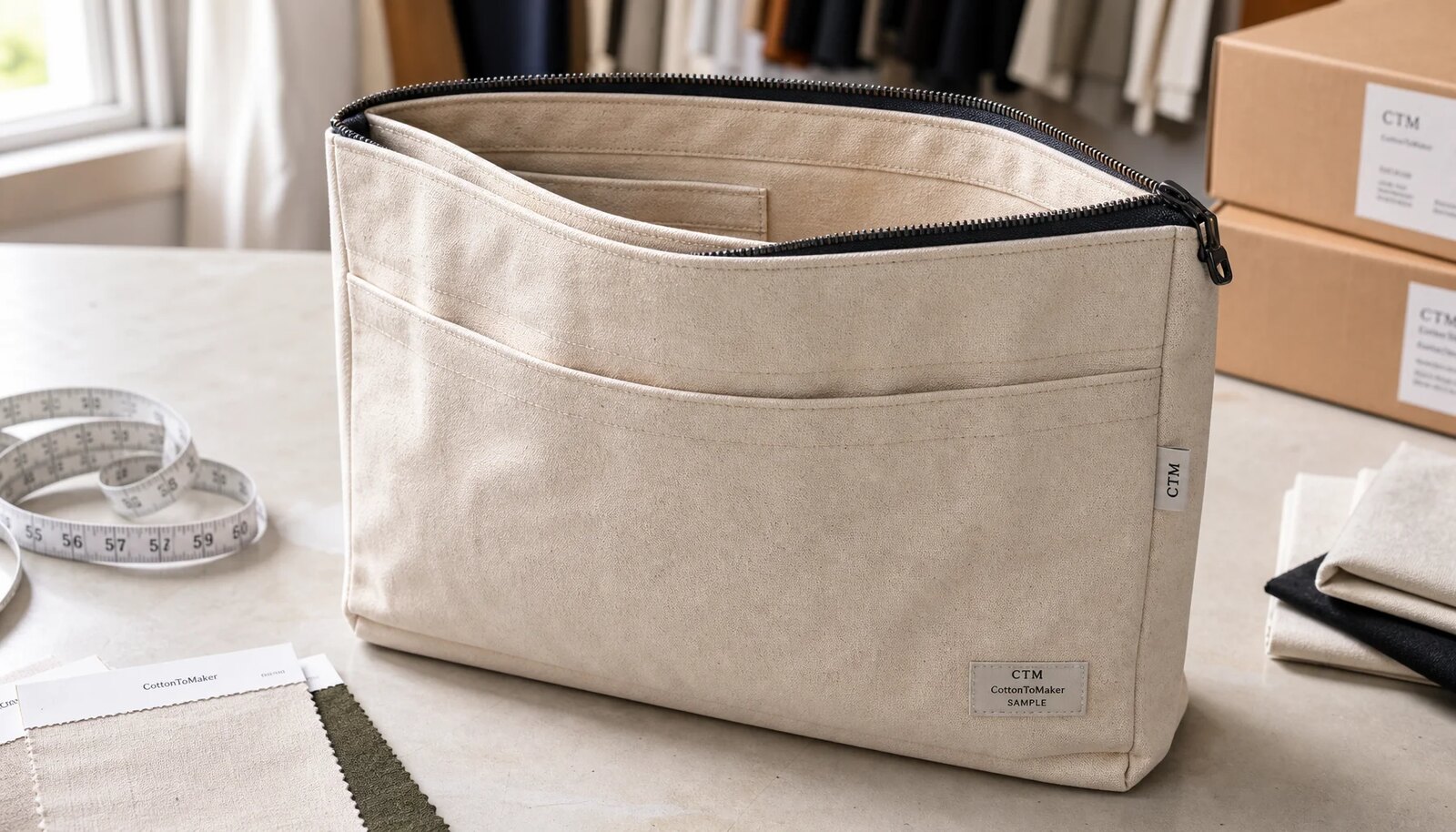
Wholesale canvas zipper portfolios for farmers market vendors are easy to underestimate because the product appears flat in a drawing. In production, the shipment is shaped by canvas thickness, zipper tape, slider height, seam allowance, binding, inner pockets, labels, hangtags, polybags, inserts, and master cartons. For procurement buyers, that makes shipping carton planning part of the product specification, not a separate logistics detail.
Farmers market programs usually involve practical handling: vendor permits, price sheets, order forms, business cards, cash envelopes, stamp cards, receipts, seasonal menus, and onboarding documents. The portfolio needs enough body to be handled weekly, but it also needs carton data that warehouse teams can receive without surprises. A low unit price is not useful if the supplier guessed the pack count, used a weak carton, or quoted a carton size that cannot close flat in bulk.
The most reliable starting point is the packed sample. Measure the item exactly as it will ship: zipped, folded if applicable, placed in the final polybag, with tissue, chipboard insert, barcode label, hangtag, and any desiccant included. Ask every supplier to quote that same configuration. When the packed thickness and master carton method are equal, the landed-cost comparison becomes much cleaner.
- Treat carton cube, gross weight, and pack count as required product data.
- Do not compare suppliers until each quote shows unit price, packed dimensions, pieces per carton, carton size, net weight, gross weight, and CBM.
- Ask for a carton test-pack photo when the proposed carton count seems aggressive.
- Keep one approved packing method across suppliers so price differences reflect real production differences.
Define the vendor use case
A canvas zipper portfolio can be a light document pouch, a durable field organizer, or a retail-ready branded accessory. The correct build depends on how the end user will handle it. A vendor carrying the portfolio between a truck, canopy, cash table, and storage bin needs a stronger zipper path and better corner construction than someone storing papers at home. Procurement teams should describe the usage environment before asking for price, because factories otherwise tend to quote the easiest standard construction.
Canvas weight is the first major decision. A 12 oz canvas is often used for value programs and light document handling; depending on how the supplier measures and finishes the fabric, it may be quoted around 340-407 gsm. A 14 oz canvas is more substantial and is commonly around 475 gsm before heavy washing or coating. It usually gives better body for weekly farmers market use. A 16 oz canvas, often around 540 gsm, can feel premium but should be tested carefully because extra thickness changes zipper smoothness, packed thickness, carton count, and gross weight.
Finishing affects performance as much as the headline ounce weight. Natural cotton canvas may show seeds, slubs, and shade variation. That can be acceptable for an earthy vendor-market look, but it should be approved intentionally. Dyed canvas needs shade-control limits. Washed or enzyme-finished canvas can feel softer, but buyers should confirm whether the quoted weight is measured before or after finishing. Coating or water-repellent treatment may add stiffness, odor, or testing requirements.
- Use 12 oz canvas when price, lower gross weight, and promotional use matter most.
- Use 14 oz canvas for repeat weekly handling, stronger hand feel, and less collapse in use.
- Use 16 oz canvas only after testing zipper corners, packed thickness, and carton count.
- State whether natural slubs, seed marks, and shade variation are acceptable.
- Require fabric weight in both oz per square yard and gsm to avoid sourcing confusion.
Specify zipper performance, not just zipper type
The zipper is the component that turns a simple canvas sleeve into a usable business portfolio. For most canvas zipper portfolios, a No. 5 nylon coil zipper is a practical baseline because it bends more smoothly around corners than metal and keeps the finished weight moderate. Metal zippers can look heavier and more premium, but they are less forgiving on tight curves and can mark canvas during compressed packing. A quote should never say only "standard zipper." It should identify zipper type, gauge, tape width, tape color, slider material, slider finish, puller length, and end-stop construction.
Zipper tape tension is a frequent hidden defect. If the tape is stretched during sewing, the finished edge may ripple or curl. If it is sewn too tight around a corner radius, the slider can drag or jam. Buyers should test samples both empty and lightly filled with expected contents such as papers, an order pad, or a thin insert. The slider should move around the full path without needing the user to flatten the fabric with a second hand.
Zipper pull height also affects carton planning. A larger puller may improve usability for busy vendors, but stacked pullers can create pressure points in cartons. If all pullers face the same direction, the stack may bulge on one side. The packing method should define orientation, alternating direction if needed, and whether tissue or a thin separator is required.
- Specify No. 5 nylon coil zipper unless the design has a documented reason to use another type.
- Approve tape color, slider finish, puller shape, puller length, and end-stop construction.
- Test zipper movement empty, lightly filled, and after the product has been packed overnight.
- Check for slider drag, skipped teeth, tape twisting, uneven corners, and loose pullers.
- Confirm zipper pull orientation inside the carton so hardware does not create pressure marks.
Lock sewing construction and tolerances
A strong-looking sample is not enough for a repeatable B2B order. The technical sheet should define stitch density, seam allowance, thread color, binding width, pocket edge finish, bartack location, corner radius, and zipper-end reinforcement. For many canvas portfolios, a practical stitch density target is often in the range of 7-9 stitches per inch, but the buyer should approve the exact factory sample rather than assume one number fits every fabric and machine setup.
Tolerances need to be written in measurable terms. A reasonable finished-size tolerance for a sewn canvas item may be plus or minus 3-5 mm on major dimensions, depending on size and construction. Logo placement may need a tighter visual tolerance, such as plus or minus 3 mm to 5 mm from the approved position. Packed thickness should also have a tolerance because carton count depends on it. The exact tolerances should match the design and be approved with the supplier before the purchase order is issued.
Stress points deserve special attention. Zipper ends, pocket openings, binding joins, and label attachment areas are common failure points. Farmers market vendors may open the portfolio repeatedly with damp or busy hands, place it on rough folding tables, and pack it into bins with other supplies. Reinforcement is not decorative; it is what keeps the item usable across a season.
- Write stitch density, seam allowance, binding width, and bartack positions into the spec.
- Set dimensional tolerances for flat size, folded size, pocket placement, logo placement, and packed thickness.
- Reinforce zipper ends and pocket openings where pulling force concentrates.
- Inspect corner radius because tight corners often cause zipper drag and sewing puckers.
- Keep a sealed sample and a working reference sample so inspectors can compare construction.
Choose the sourcing route deliberately
The best supplier route depends on control, timing, and order complexity. A direct factory is usually the strongest option when the buyer needs custom dimensions, repeatable carton data, fixed artwork placement, and consistent replenishment. It gives procurement direct visibility into fabric, zipper, print, sewing, packing, and carton standards. The tradeoff is that MOQ may be higher, and the first approval cycle can take longer.
A trading company can work well for pilot orders or mixed vendor-kit programs that include several canvas products. The buyer still needs factory-level data. The quote should show fabric weight, zipper gauge, carton grade, packaging components, carton count, and gross weight. If the trading company cannot disclose those details, procurement cannot fairly compare landed cost or manage reorder risk.
A domestic stock importer or distributor is useful for urgent seasonal launches when the buyer can accept standard colors, fixed zipper specs, limited logo placement, and existing carton dimensions. This can be commercially sensible for a first test, but buyers should treat it as a different sourcing path from a custom import program. Stock carton data may not transfer to future factory production.
MOQ should be broken down by component. Canvas color, dyed zipper tape, woven labels, custom pullers, printed polybags, hangtags, and carton marks can each create different minimums. A supplier who explains MOQ by component gives the buyer room to simplify the first order without weakening the core product.
- Use a direct factory when repeatability, carton control, and custom specifications matter most.
- Use a trading company only when component specs and packing data remain visible.
- Use a stock importer for urgent launches where standard colors and cartons are acceptable.
- Ask which component drives MOQ: fabric, zipper tape, label, print, puller, insert, or packaging.
- Separate pilot-order logic from long-term replenishment planning.
Build the carton plan from real packed dimensions
Carton planning should begin after the product is packed in its final selling or receiving condition. Pattern dimensions do not capture seam bulk, zipper pull height, pocket layers, labels, tissue, chipboard inserts, or polybag thickness. The factory should determine how many units fit in a master carton without bending the product, crushing the zipper edge, or forcing carton flaps to bow.
The quote should include a carton data block: pieces per carton, master carton length, width, height, net weight, gross weight, CBM per carton, carton board grade, carton mark format, and whether inner cartons are used. CBM is calculated by multiplying carton length, width, and height in meters. For example, a 50 x 40 x 30 cm carton equals 0.06 CBM. This simple figure drives freight estimates, warehouse planning, and later reorder comparisons.
Overpacking can make a quote look attractive by reducing estimated freight per piece, but it often creates claims later. Compressed canvas can crease. Zipper corners can distort. Polybags can tear. Cartons can fail in LCL handling or arrive too bowed for efficient receiving. For dense packs or shipments with multiple handling points, buyers should consider stronger export cartons, often 5-ply corrugated, and confirm any required stacking or palletizing rules with the warehouse.
Carton weight should also be practical. A carton that saves cube but is too heavy for receiving teams can slow unloading and increase handling risk. Procurement should ask the destination warehouse for preferred maximum gross weight, then use that limit when approving pack count. The best master carton is not the one with the highest possible quantity; it is the one that protects the product and moves cleanly through the supply chain.
- Measure flat size, folded size, packed thickness, and unit weight from the approved sample.
- Approve carton count only when the carton closes flat without zipper-edge compression.
- Put pieces per carton, carton dimensions, gross weight, net weight, and CBM on the quote and PO.
- Use stronger cartons for LCL, dense packs, long transit, or multiple rehandling points.
- Set maximum carton weight based on destination receiving rules.
Make the RFQ production-ready
A strong RFQ removes guesswork. It should include product dimensions, canvas weight, fabric color standard, zipper specification, sewing details, branding method, packaging components, carton requirements, inspection expectations, and incoterm. When suppliers quote from the same production-ready RFQ, differences in price become easier to interpret.
Branding should be controlled as a production process. For screen printing, ask for artwork size, ink count, Pantone or approved color reference, mesh or ink type if relevant, setup charge, run charge, and placement tolerance. For natural canvas, require a strike-off on the actual fabric because ink opacity and color shift can differ from a digital mockup. For woven labels or patches, confirm label size, edge fold or merrow edge, sewing position, stitch color, and separate label MOQ.
Packaging should be itemized. Polybags, tissue, chipboard inserts, barcode stickers, hangtags, printed bags, inner cartons, master cartons, warning labels, and desiccants all change cost and carton cube. If these items are buried inside a single unit price, procurement loses visibility. A separated quote makes it easier to remove an insert, change a barcode label, or strengthen the carton without renegotiating the whole product.
The RFQ should state the commercial basis clearly. FOB, CIF, and DDP can all be useful, but they allocate cost and risk differently. Ask all suppliers to quote the same incoterm first, using the same product and carton assumptions. Only then request alternate terms for landed-cost modeling.
- Include fabric, zipper, sewing, branding, packaging, carton, inspection, lead time, and incoterm in the RFQ.
- Request tier pricing at MOQ, mid-volume, and expected replenishment volume.
- Ask for print strike-offs on actual canvas when readability matters.
- Separate packaging components and setup charges from the base unit price.
- Use one incoterm across suppliers before judging price competitiveness.
Approve samples in controlled stages
Sample approval should answer more than one question. A proto sample confirms shape and basic construction. Material swatches confirm canvas color, weight, hand feel, zipper tape, thread, and trims. A print strike-off confirms logo color and readability on actual canvas. A pre-production sample confirms the full construction. A packed sample and carton test pack confirm the shipping plan. Skipping the packed stage is where many carton surprises begin.
The buyer should test the sample as a vendor would use it. Place typical documents inside, zip and unzip it repeatedly, check whether corners catch, and look for fabric pulling near seams. Rub the printed logo lightly with a dry cloth and inspect for poor adhesion, cracking, bleeding, or low opacity. Check label straightness, thread color, pocket access, and whether any insert creates a permanent ridge in the canvas.
A sealed golden sample should be kept as the production standard. A second working reference sample is helpful for inspection teams because they can compare zipper behavior, stitching, print placement, label alignment, and packing without opening the sealed sample. The approved sample file should include the final polybag, barcode sticker, hangtag, tissue, insert, carton mark reference, and any other item that affects receiving or shipment.
The sample approval record should include measurements and photos, not only a note that says approved. Record actual flat dimensions, packed thickness, logo distance from seams, zipper pull color, carton count, carton dimensions, net weight, gross weight, and CBM. If a supplier later changes any of those details, the buyer has a clear reference point for approval or rejection.
- Approve proto, material swatch, print strike-off, pre-production sample, packed sample, and carton test pack as separate checkpoints.
- Measure samples with typical contents inside when the product is intended for paperwork or vendor kits.
- Keep one sealed golden sample and one working reference sample.
- Record packed thickness, carton count, carton dimensions, gross weight, and CBM in the approval file.
- Do not release bulk production until the sample, quote, and PO describe the same item.
Set QC checkpoints before cutting
Quality control should begin before production, not at final inspection. Incoming material checks should confirm canvas gsm, shade, odor, stains, slubs, finishing consistency, zipper tape color, slider finish, label quality, and print materials. If the canvas or zipper is wrong before cutting, final inspection can only reject finished goods after time and money have been spent.
During production, inspectors should check cutting accuracy, seam allowance, stitch density, zipper alignment, zipper tape tension, pocket placement, label placement, corner construction, and print placement. Random zipper cycling during in-line inspection is valuable because a portfolio can look acceptable in a stack but fail during real use. Zipper ends should be checked for secure stops and reinforcement.
Final inspection should cover product and packing. Product checks include finished size, workmanship, zipper function, print quality, label attachment, loose threads, stains, odor, sharp trim edges, and visible shade variation. Packing checks include polybag condition, barcode placement, carton count, carton marks, carton dimensions, gross weight, and whether cartons close flat.
The buyer should define defect severity before inspection. A broken zipper, wrong fabric weight, wrong logo, missing barcode, wrong carton count, or unreadable carton mark is usually major or critical because it affects usability or receiving. A single loose thread may be minor, but repeated loose threads can show process control problems. The inspection plan should also state whether reinspection is required after corrective action.
- Check fabric and zipper materials before cutting starts.
- Inspect zipper alignment and sewing tension during production.
- Define major defects before inspection: broken zipper, wrong size, wrong logo, wrong fabric, wrong carton count, or unreadable marks.
- Verify carton dimensions, carton count, gross weight, and barcode data during final inspection.
- Require corrective action and reinspection when packing defects affect receiving or product compression.
Compare landed cost with carton reality
Freight math follows cartons, not product names. Once packed carton dimensions and gross weight are confirmed, buyers can compare FOB, CIF, DDP, LCL, air, and courier options with fewer surprises. First orders often ship LCL because volume is lower or SKUs are mixed. LCL adds handling points, so carton strength and clear marks matter more.
Repeat programs should track pieces per CBM and gross weight per carton. These two numbers help procurement model the effect of changing canvas weight, adding an insert, switching zipper pulls, or reducing carton count. A modest increase in packed thickness can change total CBM enough to affect margin, especially when the order includes multiple colors or replenishment shipments.
Incoterms need careful comparison. FOB gives the buyer more control over the forwarder and destination costs, but the buyer manages ocean freight, insurance, customs, duties, brokerage, and local delivery. CIF includes cost, insurance, and freight to the named port, but destination charges still need review. DDP can simplify budgeting, but buyers should ask exactly what is included and excluded, including duties, taxes, unloading, appointment delivery, storage, and special warehouse requirements.
A practical landed-cost worksheet should include unit price, packaging cost if separate, export carton cost if separate, inland freight at origin, freight, insurance, duty, customs brokerage, destination handling, delivery, inspection, and expected damage allowance for rough routes. The model does not need to be complex; it needs consistent inputs from every supplier.
- Compare freight only after carton size, gross weight, and CBM are confirmed from the packed sample.
- Use LCL for pilots, but strengthen carton specifications because handling points increase.
- Track pieces per CBM and gross weight per carton for every approved version.
- Do not compare FOB, CIF, and DDP without listing included and excluded costs.
- Reprice freight whenever fabric weight, zipper pull, insert, or carton count changes.
Specification comparison for buyers
| Spec decision | Recommended option | When it fits | Buyer risk to check |
|---|---|---|---|
| First-order sourcing route | Direct factory with approved pre-production sample, packed sample, and carton test pack | Custom size, repeat replenishment, controlled artwork, fixed carton marks, and warehouse receiving data are required | MOQ may be higher, and sample approval takes longer because canvas, zipper, print, label, and packing all need lock-in |
| Pilot or mixed-SKU sourcing route | Trading company with factory-level spec sheet and packing data disclosed | Moderate MOQ, several colors, or coordination across portfolios, totes, aprons, and vendor kit items | A margin layer can hide real canvas weight, zipper grade, carton board grade, and actual factory pack count |
| Urgent replenishment route | Domestic stock importer or distributor using available colors and standard cartons | Seasonal launch is close, branding can be limited, and speed matters more than custom control | Unit price is usually higher, and carton dimensions may not match a later direct-import program |
| Canvas weight for value programs | 12 oz canvas, typically about 340-407 gsm depending on whether the ounce rating is per square yard and whether finishing is included | Promotional vendor kits, lighter paperwork use, lower gross weight, and easier master carton planning | May feel soft or collapse if the buyer expects a structured retail portfolio |
| Canvas weight for durable programs | 14 oz canvas, commonly about 475 gsm before heavy washing or finishing, or a reinforced 12-14 oz body with interfacing | Weekly farmers market use, permits, order pads, brochures, receipts, and stronger perceived value | Heavier fabric can reduce carton count and increase freight cost if the master pack is not recalculated |
| Canvas weight for premium programs | 16 oz canvas, commonly about 540 gsm, tested with zipper path and carton compression before approval | Higher-end retail sets or reusable organizer programs where hand feel matters more than minimum freight cube | Bulk at seams and zipper corners can cause waviness, slider drag, and larger cartons |
| Zipper type | No. 5 nylon coil zipper with approved tape color, slider finish, puller shape, and end stops | Most canvas portfolios because coil bends around corners better than metal and keeps weight moderate | Low-grade coil or poor tape tension can cause rippling, snagging, tooth separation, or corner jams |
| Branding method | 1-2 color screen print, woven label, or cotton patch tested on actual canvas | Readable farmers market branding, vendor program logos, and repeat orders with simple artwork | Ink color shifts on natural canvas; labels and patches add sewing steps, thickness, and placement tolerance risk |
| Individual packing | Clear polybag sized with slight allowance, optional tissue sheet, optional chipboard insert only when presentation needs it | Protects canvas from dust, rubbing, moisture transfer, and corner distortion during export and warehouse handling | Tight bags, oversized inserts, or stacked pullers can crease canvas, compress zipper edges, or change carton cube |
Buyer checklist before sampling
- Approved flat dimensions, folded dimensions, zipper opening length, and packed thickness measured from the physical packed sample, not estimated from the pattern file
- Canvas weight confirmed in oz per square yard and gsm, with the supplier stating whether the value is before or after dyeing, washing, coating, enzyme finishing, or water-repellent treatment
- Fabric color standard locked by swatch or lab dip, with shade tolerance agreed for natural canvas, dyed canvas, binding, zipper tape, thread, and any interior panel
- Zipper specification confirmed by type, gauge, tape width, tape color, slider material, slider finish, puller shape, puller length, end-stop construction, and open-close test requirement
- Stitch density, seam allowance, bartack position, zipper-end reinforcement, corner radius, binding width, and pocket edge finish written into the technical sheet
- Logo method approved with print size, artwork file version, ink color reference, label dimensions, patch edge finish, placement tolerance, and acceptable rotation tolerance
- Packaging components separated in the quote: polybag, tissue, chipboard insert, barcode sticker, hangtag, inner carton, master carton, desiccant, and any warning label required by destination market
- Master carton size, carton grade, unit count, net weight, gross weight, CBM, maximum acceptable bulge, and stacking or pallet requirement confirmed before purchase order release
- Carton marks approved with style code, color, size if applicable, quantity, carton number sequence, PO number, country of origin, gross weight, carton dimensions, and warehouse barcode requirement
- Incoterm, named port or place, sample approval deadline, production lead time, inspection window, booking responsibility, shipment mode, and document responsibility agreed in writing
Factory quote questions to send
- What is the exact canvas weight in oz per square yard and gsm, and is that weight measured before or after dyeing, washing, coating, enzyme finishing, or other finishing?
- Can you quote the approved flat size, folded size, zipper opening length, packed thickness, unit net weight, master carton size, pieces per carton, gross weight, and CBM per carton in one data block?
- Which zipper type, gauge, tape width, tape color, slider material, slider finish, puller shape, puller length, and end-stop construction are included in the quoted price?
- What stitch density, seam allowance, thread specification, corner reinforcement, pocket edge finish, and zipper-end reinforcement will be used for bulk production?
- How many units fit in one master carton without compression damage, and can you provide a carton test-pack photo from the approved packed sample stage?
- What corrugated board grade, carton wall type, bursting or edge crush standard if available, and sealing method are included for export packing?
- What setup fees apply for screen print, heat transfer, woven label, cotton patch, leather-look patch, custom zipper pull, barcode sticker, hangtag, or printed polybag?
- What MOQ applies separately by canvas color, zipper tape color, print color, woven label, patch, custom puller, insert, and carton mark format?
- Can you quote FOB, CIF, and DDP using identical product specs and identical carton dimensions so landed cost comparisons are not distorted?
- Which sample stages are included: material swatch, proto sample, print strike-off, pre-production sample, packed sample, carton test pack, and sealed golden sample?
Quality-control points to confirm
- Finished size tolerance should cover flat width, flat height, folded size, zipper opening, pocket placement, logo placement, and packed thickness after the portfolio is placed in its final polybag or insert
- Canvas should be verified against the approved gsm range, shade standard, shrinkage expectation, odor limit, surface defects, slubs, stains, dye streaks, and finishing consistency before cutting
- Zipper should pass repeated open-close cycling with no tooth skipping, slider jamming, tape twisting, loose puller, sharp edge, missing stop, or separation at the zipper end
- Zipper tape must be sewn evenly around corners, with no waviness, puckering, exposed raw edge, skipped stitch, or tight radius that causes the slider to drag
- Stitch density and seam allowance should remain consistent at corners, pocket openings, zipper ends, label areas, binding joins, and any handle or stress point
- Logo print should match the approved artwork placement and color reference, with no bleeding, cracking, pinholes, poor opacity, tilted placement, ghosting, or bulk-lot color drift
- Labels, patches, and trims should be centered and securely attached, with thread color, stitch type, edge finish, and placement tolerance matching the approved pre-production sample
- Individual packaging should protect the canvas without over-compressing zipper corners, creating permanent fold marks, trapping moisture, or allowing barcode labels to detach
- Master cartons must close flat without bowing, use the approved board grade, and hold the stated unit count without crushing the zipper pull, corners, or finished body
- Outer carton marks must match the packing list exactly, including PO number, style code, color, quantity, carton number, gross weight, dimensions, country of origin, and barcode data