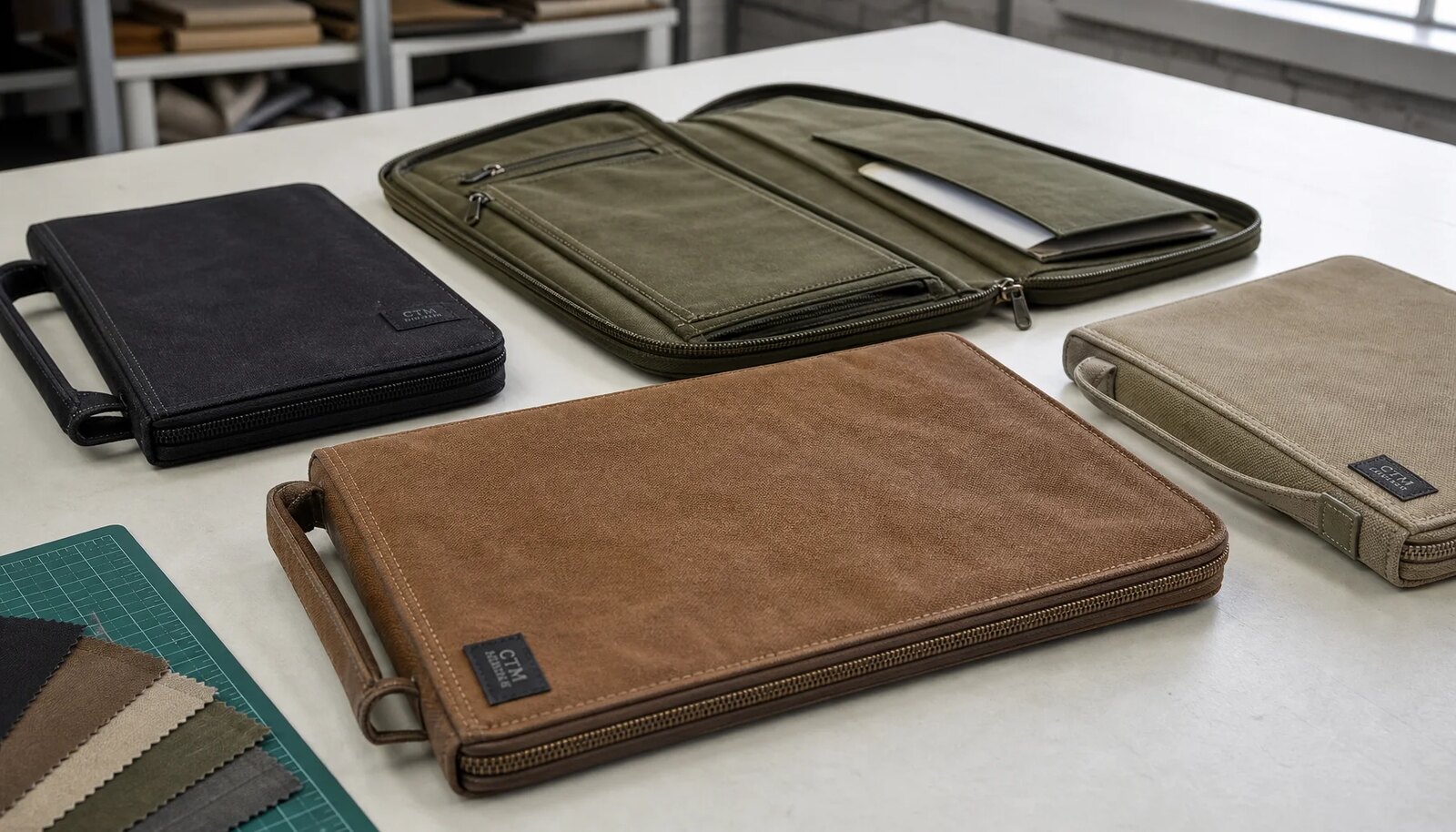
Start With the Event Use Case
A canvas zipper portfolio for event planners is a working carrier, not just a flat branded pouch. It may hold proposal packets, printed timelines, venue maps, badges, exhibitor notes, contracts, pens, fabric swatches, and sometimes a slim tablet. Those contents should drive the wholesale specification before any supplier quotes a price.
The presentation level matters as much as the load. A portfolio used in a premium client meeting needs a cleaner body, smoother zipper travel, stronger corners, and tighter logo placement than a simple staff document pouch. A conference giveaway may need faster production and efficient packing. Neither version is automatically better; the right version is the one that matches visibility, expected life, and distribution method.
This is also where the keyword idea becomes practical: a wholesale canvas zipper portfolios for event planners quality inspection checklist only works when the buyer has defined what the item must survive. If the portfolio is expected to sit on a registration desk, travel in a tote, or be shipped in event kits, those conditions should appear in the RFQ.
- List the exact contents the portfolio must hold, including paper size, insert thickness, badges, pens, or device sleeve.
- State whether the item is client-facing, staff-facing, retail-facing, or part of a conference kit.
- Decide whether the body must hold its shape on a desk or only protect documents inside another bag.
- Separate functional must-haves from cosmetic preferences so suppliers quote the same product.
Write a Spec Sheet Suppliers Can Price
A useful spec sheet removes assumptions. Finished size, usable inside capacity, fabric weight, zipper type, logo method, lining, reinforcement, label position, packing, and shipment terms should all be visible before pricing. A short RFQ may feel faster, but it often creates false comparisons because one quote includes lining while another assumes raw internal seams, or one includes individual packing while another prices loose bulk packing.
Fabric weight should be a decision point, not a decorative phrase. A supplier may suggest 12 oz canvas for a standard portfolio because it can balance cost, hand feel, and structure. Heavier canvas, such as 14 oz or 16 oz, can improve perceived quality and shape retention, but it may increase sewing difficulty, carton weight, and cost. Ask whether the weight is measured before or after dyeing, washing, coating, or finishing.
Construction details deserve the same clarity. Bound seams, interfacing, zipper-end reinforcement, and corner bartacks may seem small on paper, yet they shape how the item feels in hand. If the buyer expects a lined interior, document pocket, pen loop, or tablet sleeve, those features should be specified before price comparison begins.
- Include finished dimensions and usable internal capacity, not only flat cutting size.
- Specify canvas in oz or GSM and ask how finishing affects shrinkage, shade, and hand feel.
- Call out lining, binding, interfacing, pockets, pen loops, and reinforcement rather than assuming they are included.
- Ask each supplier to repeat the full assumed spec in the quotation.
Compare Supplier Routes Clearly
A direct factory is often the stronger route when the buyer needs repeat orders, controlled sewing quality, and fast technical feedback from the sample room. The advantage is clearer ownership of cutting, stitching, trimming, and final packing. The weakness is that some factories quote narrowly when the RFQ is incomplete. They may be good producers but poor interpreters of missing buyer details.
A trading company or sourcing partner can still be the right choice when the buyer is building a larger event kit with several product types. The value is coordination, consolidation, and one commercial contact. The risk is unclear defect ownership. If a zipper fails, a print is off center, or cartons are mixed, procurement needs to know who can approve sorting, rework, replacement, or credit.
Supplier choice should be based on control and accountability, not habit. Ask who owns sampling, who purchases trims, who performs printing, where final packing happens, and who signs off before shipment. A low price becomes less attractive if every correction has to travel through several parties.
- Ask who owns sample development, bulk sewing, print approval, and final inspection.
- Request photos or documents that show experience with similar sewn zipper goods.
- Confirm whether the quoted factory is the same facility that will make bulk production.
- Treat vague rework responsibility as a commercial risk, even when the unit price looks attractive.
Read the Quote Like a Cost Map
A good quote shows more than a unit price. It explains what is included and what remains outside the price. For canvas zipper portfolios, the main cost drivers are fabric weight, zipper grade, lining, reinforcement, print or label method, labor time, packing style, carton quality, and order complexity. If one quote is much lower than the rest, ask what changed.
Buyers should separate factory price from later landed-cost items. Sample fees, print setup, label application, carton marks, inland transport, inspection support, and document handling may not appear in the headline unit price. For clean comparison, ask every supplier to quote under the same Incoterm and the same packing assumption.
Variant planning is another common source of surprise. A 1,000-piece order may not price like one production run if it is split across five canvas colors, three logo versions, and two packing formats. Ask for MOQ and price breaks by color, artwork, label, and packing style, not only by total order quantity.
- Ask for separate lines for sample, setup, unit price, logo cost, packing, carton, labeling, and inspection support.
- Confirm whether the price is EXW, FOB, or another Incoterm before comparing offers.
- Request price breaks by total quantity and by color or artwork split.
- Check whether the quote includes the same zipper, fabric, lining, and packing as the requested sample.
Control Branding Before Sampling
Branding on canvas needs practical approval. Screen print can be efficient for simple logos and larger marks, but textured fabric can affect edge sharpness and ink coverage. Embroidery, woven labels, and stitched patches can look more premium, yet they introduce their own checks: thread color, patch edge, label fold, puckering, and placement accuracy.
The safest artwork instruction uses fixed reference points. Instead of saying the logo should be centered visually, state the distance from the zipper, side seam, bottom edge, or label seam. Include logo size, color target, placement tolerance, and orientation. This helps the sample room set up repeatable production and gives the inspector a measurable standard.
Do not approve branding only from a digital proof. A proof can confirm artwork scale and color intention, but it cannot show how ink sits on canvas, whether embroidery pulls the surface, or whether a patch looks bulky after sewing. The physical sample is the brand standard for bulk production.
- Send vector artwork and specify logo size, color target, placement, and orientation.
- Confirm whether the brand mark will be printed before or after sewing.
- Check whether seams, zipper tape, pockets, or folds affect visible logo placement.
- Approve the physical logo result on the actual fabric, not only the digital proof.
Approve Samples for Bulk Reality
A sample is not a product photo. It is the buyer's first chance to test whether the portfolio works under real event-planner use. Load it with the intended paper pack, zip it repeatedly, hold it by the edges, inspect the corners, and check whether the body twists when filled. Then measure the finished product against the spec sheet.
Before bulk production, create a controlled approval record. This can be a sealed physical sample, a signed sample report, or a documented set of photos and measurements. The record should show fabric, color, zipper, puller, lining, logo method, logo placement, label, packing, and any approved exceptions.
If the factory later changes a trim, label supplier, zipper tape color, fabric batch, print method, or packing style, that change should require buyer approval before bulk goods are cut or sewn. Small material substitutions can create visible differences when the final order is placed into event kits or distributed across multiple venues.
- Measure length, height, zipper opening, pocket position, and logo placement on the sample.
- Cycle the zipper by hand and check for catching, separation, loose puller, or sharp edges.
- Rub printed or labeled areas lightly to check adhesion, color transfer, and edge quality.
- Load the sample with representative contents and check shape, seams, and corner stability.
- Approve only the version that should be copied in bulk, and record all agreed tolerances.
Set Inspection Rules Before Production
The quality inspection checklist should be written before production starts. It needs enough detail for the supplier, third-party inspector, or receiving team to make the same judgment. For this product category, the highest-risk points are zipper function, seam strength, print placement, fabric cleanliness, measurement consistency, and packing accuracy. Those points should be checked on finished goods, not only on loose materials.
Many buyers use an AQL-style final inspection. The exact sampling level and acceptance limits depend on order value, destination risk, and buyer policy, but General Inspection Level II is a common reference point for consumer goods inspections. Critical defects are often treated with the strictest tolerance. Major and minor limits should be agreed before production so shipment release does not become a negotiation.
Inspection samples should be pulled across cartons, colors, artwork versions, and production periods. A sample set taken only from the nearest cartons may miss batch variation. Require defect photos with carton numbers when repeated issues appear. A useful photo record shows the defect, the affected quantity, the SKU or color, and the decision: accept, rework, replace, or hold.
- Critical defects: sharp unsafe hardware, mold, severe odor, wrong customer logo, wrong product, or contamination.
- Major defects: zipper failure, open seam, wrong size outside tolerance, missing reinforcement, off-center logo, or mixed SKU packing.
- Minor defects: short loose threads, slight crease, light packing scuff, or small non-functional shade variation within agreed limits.
- Use pass/fail examples so the factory knows which defects trigger rework or shipment hold.
Make Tolerances Measurable
Tolerances should be specific, realistic, and tied to use. A buyer may set plus or minus 5 mm for main body length and height on many sewn portfolios, but that number is not universal. The right tolerance depends on portfolio size, fabric behavior, construction method, and whether the item must fit a specific insert. Logo placement may need a tighter rule because a visibly off-center mark hurts brand presentation even if the portfolio still functions.
Zipper checks should also be measurable. For sampled units, buyers can request a practical open-close cycle check, such as 20 to 30 full cycles, with no catching, coil separation, loose puller, or sharp slider edge. The number should match the order's quality level and inspection budget, but the expectation should be written down.
Stitching should be checked for both appearance and durability. A target such as 7 to 9 stitches per inch may suit many canvas constructions, though the supplier should confirm what is appropriate for the fabric and seam type. Inspectors should look for skipped stitches, loose thread chains, broken seams, weak bartacks, and uneven binding.
- Set tolerances for finished length, height, zipper opening, pocket position, label location, and logo placement.
- Define whether the item is measured flat, zipped, unzipped, empty, or loaded.
- Use the approved sample as the visual standard for fabric hand feel, shade, print result, and construction detail.
- Require defect photos with carton numbers if inspection finds repeated failures.
Control Packing and Warehouse Intake
Packing is often treated as a late detail, but it can decide whether the shipment is easy to receive or expensive to fix. Portfolios can pick up dust, moisture marks, crease damage, and corner crushing if packing is too loose or cartons are overfilled. Individual protection may be needed for clean canvas surfaces, retail handling, or event-kit assembly. In humid lanes or long transit windows, ask whether desiccant or moisture-resistant handling is appropriate.
Carton strength and weight should match the route. A master carton that is too heavy can crush lower cartons, fail during handling, or create warehouse safety issues. Buyers may set a maximum gross weight, carton dimensions, and carton quantity per SKU. For demanding routes, ask whether the supplier can perform or arrange a basic carton drop check, especially when the shipment will pass through parcel networks or multiple warehouses.
Labeling matters just as much as protection. Event planners, distributors, and fulfillment warehouses may need SKU labels, barcode labels, color separation, carton sequence marks, and destination information. If those are not defined before packing, the buyer may pay warehouse staff to open cartons, sort goods, relabel units, or rebuild kits.
- Confirm individual polybag, paper wrap, belly band, or bulk packing based on destination requirements.
- Set carton quantity, maximum gross weight, carton dimensions, and carton mark format.
- Separate SKUs, colors, artwork versions, and destinations clearly inside master cartons.
- Check barcode readability, carton count, and destination marks before shipment release.
Plan Lead Time Around Outside Inputs
Lead time for canvas zipper portfolios is not only sewing time. Fabric availability, dyeing, washing, zipper purchase, label production, print screen preparation, patch making, sample revisions, carton ordering, inspection booking, and export documents can all affect the final ship date. A quote that says production takes 25 days may still be risky if it excludes sample approval time or delayed artwork confirmation.
Procurement teams should ask suppliers to separate the timeline into clear stages: artwork review, sample making, sample transit, buyer approval, material purchase, cutting, sewing, printing or label application, final packing, inspection, and shipment handover. This makes the schedule easier to manage and reveals which approvals are on the buyer's side.
For event planners, late delivery can be more damaging than a normal retail delay because the product is tied to a fixed date. If the portfolios must arrive before a conference, launch meeting, or sponsor event, build in buffer for sample revision, inspection rework, and freight disruption. A realistic timeline is part of quality control.
- Ask which lead-time steps depend on outside suppliers or subcontractors.
- Confirm the last date for artwork approval, sample approval, and bulk material purchase.
- Reserve time for inspection, possible rework, and reinspection before shipment.
- Match the delivery plan to the event date, not only the factory completion date.
Specification comparison for buyers
| Option | Best fit | What to specify | Procurement risk to check |
|---|---|---|---|
| Direct sewn-goods factory | Repeat portfolio orders, tighter construction control, and buyers who need direct sample-room feedback | Finished size, canvas weight, zipper grade, lining, reinforcement, logo method, packing, inspection standard, and Incoterm | A factory may quote only what is written. Missing RFQ details can lead to a low price that excludes lining, labels, stronger cartons, or inspection support |
| Trading company or sourcing partner | Mixed event kits, consolidated buying, or one commercial contact across several product categories | Factory name or role, sample ownership, production site, rework process, inspection access, and shipment consolidation plan | Responsibility can blur when a zipper, print, or packing defect appears. Confirm who approves rework and who pays for replacement |
| Economy document portfolio | Giveaways, staff kits, registration packs, and short-use event materials | 12 oz canvas baseline, standard #5 nylon coil zipper, simple screen print, minimal inner organization, efficient bulk packing | Too much cost reduction can show up as wavy zipper tape, weak corners, thin body, loose threads, or print that looks cheap in client-facing use |
| Premium planner portfolio | Client meetings, sponsor gifts, conference VIP packs, and retail-style event merchandise | Heavier canvas or structured build, lining or binding, reinforced zipper ends, patch or woven label, cleaner packing, tighter logo tolerance | Higher material and labor cost must be matched by better QC. Inspect structure, alignment, zipper travel, and surface cleanliness closely |
| Screen-printed logo version | Simple logos, larger marks, faster bulk branding, and cost-controlled campaigns | Pantone or color target, artwork size, placement from fixed edges, ink type where relevant, and rub/adhesion expectation | Ink bleed, cracking, poor edge definition, off-center placement, or shade mismatch across production batches |
| Patch, woven label, or embroidery version | Premium look, smaller brand marks, textured canvas, or programs where print durability is a concern | Patch material, stitch color, label size, fold type, placement tolerance, embroidery density, and backing requirements | Puckering, tilted labels, thread color mismatch, bulky patches, or artwork that loses detail at small size |
| Warehouse-ready packing | Distributor orders, event-kit assembly, retail intake, and multi-destination shipments | Unit protection, carton quantity, carton marks, barcode labels, SKU separation, max gross weight, and desiccant if needed | Mixed SKUs, crushed corners, moisture marks, unreadable labels, or extra receiving labor after delivery |
Buyer checklist before sampling
- Define the finished size and usable inside space, including whether the portfolio must fit A4 paper, letter paper, proposal packets, badges, brochures, notebooks, pens, or a slim tablet.
- State the target canvas weight in oz or GSM and ask whether the quoted weight is measured before or after dyeing, washing, coating, or finishing.
- Confirm fabric color, shade tolerance, surface finish, shrinkage risk, and whether the supplier will use greige stock, dyed-to-order fabric, or available market fabric.
- Specify zipper size, zipper type, tape color, slider material, puller style, top stop or end stop construction, and whether the puller needs a custom logo.
- Provide vector artwork, logo size, placement dimensions from fixed edges, approved colors, and acceptable placement tolerance.
- Clarify whether branding should be screen printed, embroidered, woven, debossed on a patch, heat transferred, or applied as a stitched label.
- Confirm lining, binding, interfacing, corner reinforcement, pen loops, document pockets, tablet sleeves, or other internal organization before comparing prices.
- Request a pre-production sample using actual bulk fabric, zipper, logo method, lining, label, and packing whenever schedule allows.
- Set measurable tolerances in the PO, including length, height, zipper opening, pocket position, label position, and logo placement.
- Define critical, major, and minor defects before production, with examples for zipper function, stitching, logo quality, fabric cleanliness, and packing.
Factory quote questions to send
- Which canvas weights can you source for this size, and are the quoted weights measured before or after dyeing, washing, coating, or finishing?
- What finished dimensions do you recommend for the intended contents, and what measurement tolerance will you guarantee in bulk production?
- Which zipper specification are you quoting, including zipper size, coil type, tape color, slider material, puller style, and stop construction?
- What branding methods can you produce on this canvas, and what setup costs, minimums, artwork limits, and approval steps apply to each method?
- What is the MOQ by fabric color, print artwork, label version, and packing style, and how does unit price change if the order is split across variants?
- Can you produce a pre-production sample using actual bulk fabric, zipper, logo method, lining, label, and packing, and what revisions are allowed after review?
- Will you provide a signed or photographed approved sample record before cutting bulk fabric, including measurements, material details, logo placement, and packing?
- What inspection method do you use before shipment, and how do you classify critical, major, and minor defects for zipper portfolios?
- Can final inspection follow an AQL-style plan such as General Inspection Level II, with acceptance limits agreed before production?
- How will production be packed: individual protection, carton quantity, carton marks, barcode labels, desiccant if needed, and maximum carton weight?
Quality-control points to confirm
- Pull inspection samples from multiple cartons, production times, colors, artwork versions, and packing groups rather than from a supplier-selected stack.
- For many wholesale orders, buyers use an AQL-style final inspection such as General Inspection Level II. Set the exact AQL limits in the PO, for example tighter limits for critical defects and defined limits for major and minor defects.
- Classify critical defects as issues that make the product unsafe, unusable, contaminated, or commercially wrong, such as sharp metal burrs, broken zipper, wrong logo, wrong material, mold, or severe odor.
- Classify major defects as issues likely to cause buyer rejection or field failure, such as open seams, zipper separation, missing reinforcement, wrong size outside tolerance, badly off-center print, or mixed SKU packing.
- Classify minor defects as limited finish issues that do not affect function, such as short loose thread ends, slight wrinkle, small non-visible shade variation, or light packing scuff within the approved standard.
- Use agreed measurement tolerances. Common buyer-set ranges for sewn portfolios may be around plus or minus 5 mm for main dimensions, with tighter logo placement tolerances when brand alignment is highly visible.
- Run zipper cycle checks on sampled units. A practical buyer check may require 20 to 30 smooth open-close cycles on selected samples, with no catching, split coil, loose puller, or separation.
- Check stitch density and seam security. A common target may be 7 to 9 stitches per inch for many canvas constructions, but the final requirement should match fabric weight, seam type, and supplier capability.
- Measure finished length, height, gusset if any, zipper opening, pocket placement, label position, and logo location against the approved sample and spec sheet.
- Inspect seam straightness, skipped stitches, bartacks, bound edges, zipper-end reinforcement, corner construction, and raw-edge exposure on both exterior and interior surfaces.