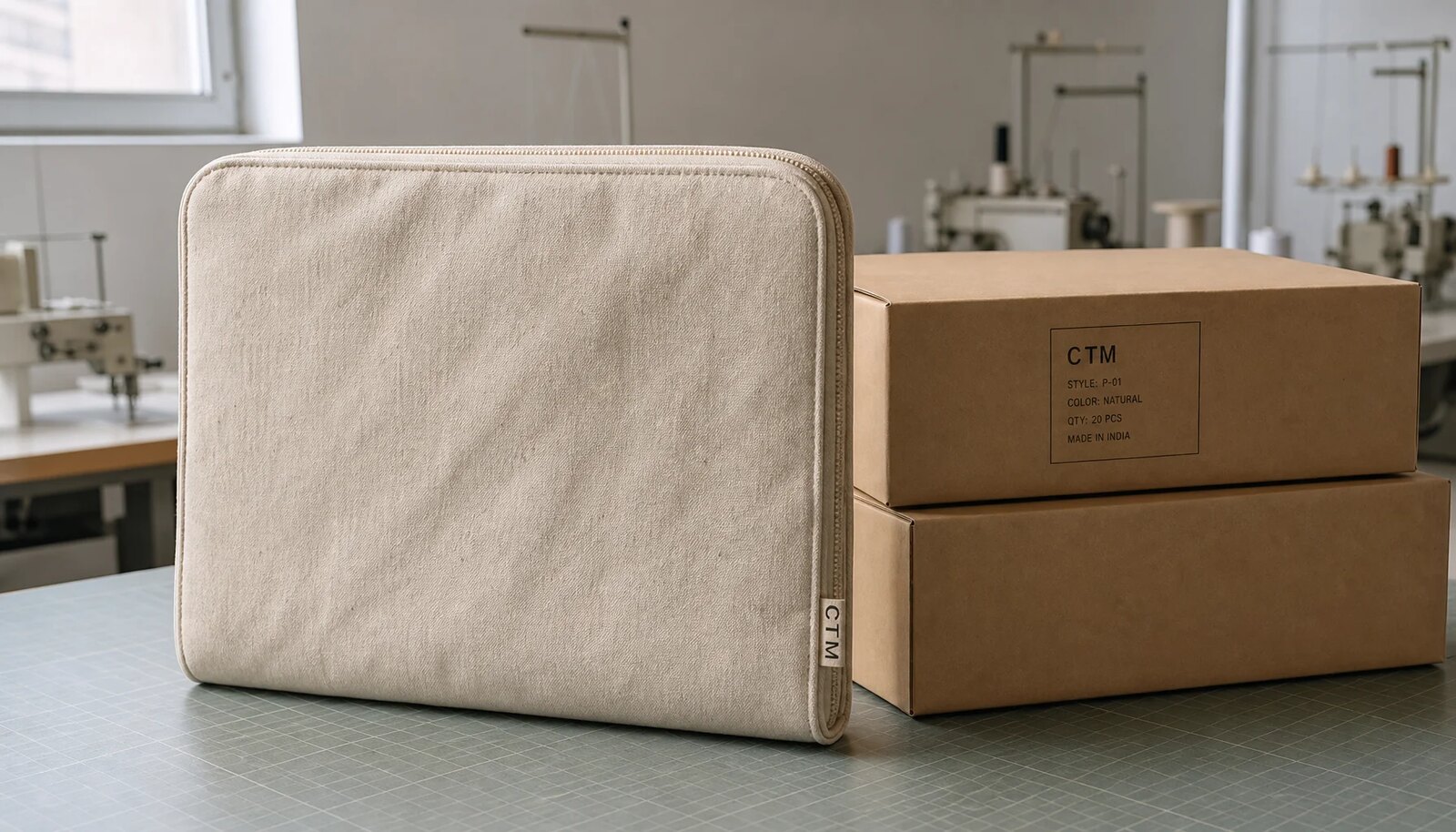
Start With Carton Reality, Not Just Unit Price
Wholesale canvas zipper portfolios for event planners shipping carton planning should begin before the first sample is approved. The portfolio is not only a sewn product; it is an event logistics item. It may need to arrive at a warehouse, be counted by registration tier, travel to a venue, and be unpacked quickly by a team working against a fixed event date. A good unit price is not useful if the cartons are overweight, bulky, mixed without labels, or difficult to reconcile at receiving.
Ask for carton information in the first serious quote: pcs per master carton, carton dimensions, net weight, gross weight, carton count, total CBM, and carton mark format. This lets procurement compare landed cost and handling effort, not just factory price. One supplier may quote bulk-packed units in a standard carton. Another may include individual bags, barcode labels, tissue, destination sorting, and stronger export cartons. Those are different offers and should not be judged on unit price alone.
Set the receiving rule before the factory decides pack count. If your warehouse, venue, or 3PL has a maximum carton weight, use that limit. Some event programs try to stay roughly within a 15-18 kg gross weight range for manual handling, but the controlling number should come from your own receiving operation. Also decide whether cartons must hold one SKU, one logo version, one destination, or a controlled mixed assortment.
CBM math should be visible. Carton CBM equals length x width x height in meters. Total CBM equals carton CBM x carton count. If air freight is possible, also ask the forwarder to review dimensional weight using current carton dimensions. This simple step often catches a packing plan that looks cheap at the factory but expensive in transit.
- Require pcs/carton, carton dimensions, net weight, gross weight, carton count, and total CBM in comparable quotes.
- Set maximum carton gross weight before production packing is finalized.
- State one-SKU, mixed-SKU, destination-sorted, or tier-sorted packing rules.
- Use carton marks that show PO number, SKU, logo version, quantity, carton number, destination, net weight, and gross weight.
- Recheck freight cost when fabric weight, unit packing, or pcs per carton changes.
Turn the Event Use Case Into a Product Spec
A useful spec tells the supplier what must be cut, sewn, decorated, packed, and inspected. Words such as conference pouch, document holder, or premium zipper folder are too broad for consistent production. Start with the contents: A4 papers, US letter sheets, tablets, badge stock, brochures, sponsor flyers, agenda packets, pens, or pre-loaded inserts. The intended contents determine finished size, zipper opening, gusset depth, pocket layout, and carton weight.
Define finished dimensions after sewing and pressing, not only pattern size. If the event team will load a 20 mm thick sponsor pack, include that thickness and approximate weight. Empty samples often look neat. Filled samples reveal whether corners bulge, the zipper strains, the seams twist, or interior pockets block document insertion.
Write a tolerance table. For many sewn canvas portfolios, buyers may begin discussions around +/-10 mm for main body dimensions and tighter tolerances for pocket placement, labels, and logo position. The factory should confirm what is realistic for the design, material, and decoration method. Critical fit areas, such as zipper opening length for a tablet or A4 packet, deserve specific measurement points.
Interior features need the same discipline. Lining, slip pockets, card pockets, document dividers, pen loops, elastic loops, woven labels, hangtags, and care labels all affect labor, stack height, inspection time, and cost. If a feature is optional, ask for it as an alternate line so suppliers do not make different assumptions.
- Specify A4, US letter, tablet, or custom insert size instead of using general document language.
- List finished width, height, gusset depth, zipper opening length, and tolerance.
- Include total insert thickness and approximate insert weight when portfolios will be loaded.
- Define each interior feature with material, size, and placement.
- Use reference photos for intent, but let written dimensions and approved samples control production.
Select Canvas for Structure, Print, and Freight
Canvas weight affects hand feel, print appearance, durability, carton count, and freight cost. A 10 oz cotton canvas can work for lighter event handouts or short-use programs if the loaded sample holds shape. A 12 oz cotton canvas is a practical starting point for many conference portfolios because it offers more structure without becoming a rigid case. Depending on weave and finish, suppliers may quote 12 oz around 380-420 GSM, so ask for both oz and GSM rather than relying on one label.
Heavier canvas can suit executive meetings, membership kits, or repeat-use sales materials, but it is not automatically better. Every fabric change should trigger a packing review: pcs per carton, gross weight, total CBM, carton compression, and freight mode. A beautiful heavy sample may create cartons that exceed a warehouse limit or become uneconomical by air.
Finish matters. Natural canvas carries shade, slub, and texture variation that many buyers accept as part of the material. Bleached or dyed canvas gives more controlled color direction but may need fabric-lot control and longer lead time. Washed canvas can feel softer but may change dimensions. Coated or laminated canvas may improve moisture resistance while affecting sewing, odor, hand feel, and print adhesion.
The purchase order should name the canvas weight, GSM tolerance, fabric code or weave, finish, color reference, acceptable shade variation, and substitution rule. If stock fabric is being used, ask when the lot will be reserved. If the order may span multiple rolls or lots, define how shade variation will be grouped, packed, or approved.
- Use 10 oz canvas only after loaded fit and structure are checked.
- Use 12 oz canvas as a balanced starting point for many corporate event portfolios.
- Request oz, GSM, weave or fabric code, finish, and GSM tolerance.
- Approve natural canvas slub and shade variation in writing.
- Recalculate carton weight and CBM whenever fabric or lining changes.
Specify the Zipper Like a Trim Component
The zipper is a functional part of the portfolio, not a minor accessory. For many canvas zipper portfolios, a #5 nylon coil zipper is a practical default because it is flexible, smooth, and lighter than many metal options. Larger zipper sizes may suit heavier gusseted designs. Metal zippers can look premium, but they may add weight, feel stiff at corners, or mark adjacent units during carton compression.
The quote should state zipper size, zipper type, tape color, slider finish, puller style, end-stop construction, and usable opening length. Standard metal pullers, self-fabric pull tabs, rubber pulls, custom molded pulls, and branded metal pullers should be priced separately when relevant. Custom pulls and dyed zipper tape can have their own MOQ and lead time even when the sewing MOQ is modest.
Test zippers on empty and filled samples. Open and close around the corners, check end stops, and look for snagging, uneven tape, missing teeth, separating coil, loose sliders, sharp pull edges, or lining caught in the path. If portfolios will be loaded by a fulfillment center, the zipper should close without forcing the insert packet into the seam.
A trim card reduces ambiguity. Ask the supplier to present zipper tape, slider, puller, thread, binding, labels, lining, and any elastic or hardware before pre-production approval. Keep the approved trim card or clear reference photos with the signed sample for final inspection.
- Name zipper size, type, tape color, slider finish, pull style, and opening length.
- Quote standard and custom pullers separately because MOQ and timing can differ.
- Test zipper movement with the actual insert load inside.
- Check whether hardware creates pressure marks after packed-carton compression.
- Keep trim card approval linked to the production sample.
Choose Decoration by Artwork and Inspection Needs
Decoration should match the artwork, canvas texture, quantity, and approval timeline. Screen printing is efficient for simple one- or two-color logos and bold sponsor marks. Heat transfer can support smaller details, multicolor artwork, and version splits. Embroidery can feel substantial but adds thickness and may distort lighter canvas. Woven labels or side tabs are useful for subtle branding, but they add another trim item to source and inspect.
Make decoration measurable. State artwork file format, print size, print position, Pantone direction, color count, and whether a strike-off is required. Logo placement tolerance may need to be tighter than body-size tolerance; many buyers discuss ranges such as +/-3 mm to +/-5 mm depending on process and artwork. Natural canvas changes how color appears, so digital mockups should not replace physical approval when brand color matters.
Print durability should match the event use. A three-day conference handout and a repeat-use sales portfolio do not need the same performance standard, but both need clear acceptance rules. Basic checks can include cured ink, no smearing, no ink transfer to adjacent units, no unacceptable cracking after normal handling, clean edges, and registration that matches the approved strike-off.
Multiple sponsor versions need operational control. Ask whether setup fees, screens, strike-offs, MOQ, and carton separation apply per artwork version. If late sponsor additions are likely, plan a base portfolio and a controlled add-on batch instead of letting artwork changes disrupt the main order.
- Use screen print for simple logos and efficient larger runs.
- Use heat transfer for complex artwork, gradients, or smaller version splits when appropriate.
- Set logo size, placement tolerance, Pantone direction, and acceptable edge quality.
- Require a strike-off for important brand color, small type, or multicolor artwork.
- Confirm costs, MOQ, and carton separation per artwork version.
Compare Quotes With Cost Lines Separated
A strong RFQ separates sewn product cost, decoration, unit packing, master carton, export handling, sampling, and inspection support. When everything is collapsed into one price, suppliers fill the gaps differently. One quote may assume bulk pack in a standard export carton. Another may include individual polybags, tissue, barcode labels, stronger cartons, carton marks, and FOB documentation.
Ask suppliers to mark inclusions and exceptions. Product cost should cover fabric, sewing, zipper, trim, thread, labels, and interior features. Decoration cost should state setup, color count, placement, strike-off, and version splits. Packing cost should identify unit packing, carton type, labels, carton marks, and palletization if needed. Export basis should name the incoterm and place, such as EXW factory or FOB named port.
Price breaks should include logistics data. If the target is 2,000 pieces, request 1,000, 2,000, and 3,000 pieces with estimated carton count, total CBM, total gross weight, and MOQ by artwork version. A larger order may lower unit cost but increase storage, pallet space, or leftover inventory. A smaller order may reduce waste but carry more setup cost per unit.
Sampling also deserves a schedule and cost line. Fabric swatches, trim cards, print strike-offs, prototypes, and pre-production samples prove different things. Custom fabric, custom zipper pulls, and woven labels may take longer than sewing the sample itself, so those dependencies should be visible before the event delivery plan is fixed.
- Separate product, decoration, unit packing, carton, export, sample, and inspection costs.
- Compare quotes using the same incoterm and named place.
- Request price breaks with carton count, CBM, and gross weight.
- Ask for MOQ by fabric color, zipper color, artwork version, label, and packing setup.
- List exceptions clearly so missing work is not mistaken for savings.
Control MOQ, Overage, and Partial Cartons
MOQ is rarely one simple number. It may be driven by fabric availability, dye lot, zipper tape color, slider finish, custom puller, woven label production, decoration setup, carton printing, or line efficiency. A supplier may accept a lower MOQ for stock natural canvas with standard zipper tape, then require a higher quantity for dyed fabric, custom labels, or several sponsor logos.
Ask what is driving the minimum. If dyed fabric is the constraint, stock canvas with stronger decoration may be a workable alternative. If a custom puller causes delay, a self-fabric pull tab may reduce risk. If artwork versions create high setup cost, a common base design plus controlled insert cards may simplify production.
Partial cartons are normal when planned. For example, an order packed 40 pieces per carton will not always land on a clean carton count after sponsor splits or destination sorting. The issue is not the partial carton itself; the issue is whether it is labeled, counted, and shown on the packing list. For multi-destination events, plan carton ranges by destination rather than averaging across the total order.
Set overage and shortage rules before cutting starts. Event orders often need exact counts by registration tier, sponsor, or site. If shortage is unacceptable, decide whether a small approved overage may be produced, how it will be billed, and how extra units will be packed. A controlled overage is usually easier to manage than emergency replenishment after receiving.
- Ask whether MOQ is driven by fabric, zipper, label, print, carton, or setup.
- Confirm MOQ per color, artwork version, trim, and destination split.
- Label partial cartons with exact quantity and contents.
- Set overage and shortage tolerance on the purchase order.
- Use design alternatives to reduce MOQ pressure when timing is tight.
Approve Samples With Real Inserts and Packed Photos
Sample approval should prove material, construction, decoration, fit, and pack-out. A fabric swatch confirms color direction, finish, hand feel, and approximate weight. A trim card confirms zipper, puller, thread, labels, binding, and lining. A print strike-off confirms scale, color, opacity, registration, and curing direction. A prototype confirms construction. A pre-production sample confirms the final combination before bulk production.
Do not approve only by appearance. Measure finished width, height, gusset depth, zipper opening, pocket placement, label placement, and logo placement against the tolerance table. Confirm that measurements are taken after sewing and pressing. Keep one signed sample or approved reference set available for production and inspection.
Use real contents. Load the agenda packet, brochure set, badge materials, tablet, or sponsor documents. Close the zipper and inspect corners, pocket access, seam strain, print contact with hardware, and final thickness. If the filled sample changes the planned pack count, update carton data before production packing is approved.
Ask for a packed sample carton photo or loading diagram when quantities justify it. The supplier should show unit orientation, layers, carton fill, carton marks, and sealed carton condition. If zipper heads press into printed panels or corners crush under compression, adjust orientation, interleaving, or pcs per carton before bulk packing.
- Approve fabric, trim, print, construction, fit, and packing as separate checkpoints.
- Measure samples against a written tolerance table.
- Test with actual event contents, not blank paper only.
- Request packed-carton photos showing orientation and pressure points.
- Hold bulk cutting until fabric, zipper, logo, and pack plan are approved.
Write QC and Receiving Rules That Protect the Event
Quality control should turn buyer expectations into inspectable rules. Define critical, major, and minor defects before production. Critical or major defects may include wrong logo, wrong SKU, broken zipper, severe contamination, sharp trim, unusable fit, dimensions outside tolerance, poor print curing, missing pockets, or wrong carton quantity. Minor defects may include small thread ends or slight natural canvas variation when inside the approved standard.
Agree on the inspection plan early. Many soft-goods inspections use General Inspection Level II with critical defects set to 0 and separate AQL levels for major and minor defects, but the exact plan should be confirmed by buyer and supplier. Higher-risk orders may need inline inspection, carton-opening checks across production lots, or 100% checking for logo version and zipper function.
Inspection should sample from multiple cartons. Check canvas shade and weight, dimensions, zipper function, filled fit, decoration, stitching, interior features, unit packing, and carton marks. Zipper checks should focus on corners, end stops, slider security, tape alignment, and lining interference. Decoration checks should cover placement, scale, opacity, registration, curing, cracking, and ink transfer.
Receiving rules matter as much as factory QC. The packing list should match carton marks, carton count, SKU split, and partial-carton labels. Event teams should count cartons at arrival, inspect visible carton damage, photograph discrepancies, and reconcile contents before portfolios are inserted into registration workflows. A clear carton number system makes shortage claims and event sorting much easier.
- Classify wrong logo, broken zipper, unusable fit, and severe stains before production starts.
- Use approved samples, trim cards, and strike-offs as inspection references.
- Verify zipper function on empty and filled units.
- Check carton count, carton marks, SKU split, gross weight, and packing list alignment.
- Define which defects require rework, replacement, sorting, credit, or shipment hold.
Specification comparison for buyers
| Planning decision | Procurement default | Useful figure to request | Buyer risk to control |
|---|---|---|---|
| Canvas weight | 10 oz to 12 oz cotton canvas for most event handout portfolios | Oz, GSM, fabric code, weave, finish, shade standard, and GSM tolerance; 12 oz is often quoted around 380-420 GSM depending on construction | Loose fabric specs create price gaps, shade variation, weak structure, or heavier cartons than planned |
| Finished size tolerance | Written tolerance table tied to actual inserts | Factory-confirmed tolerance for main dimensions, zipper opening, pockets, labels, and logo placement; common sewn-goods targets may start around +/-10 mm for body size and tighter for small features | A4 sheets, US letter, tablets, sponsor packets, or badge stock may not fit cleanly |
| Zipper choice | #5 nylon coil zipper for flexible conference portfolios | #5 coil, tape color, slider finish, puller type, end-stop method, and actual opening length | Wrong zipper weight or hardware can cause snagging, pressure marks, corner damage, or closing failures |
| Logo control | Approve strike-off before bulk decoration | Decoration method, artwork size, Pantone direction, placement tolerance, curing requirement, and version count | Sponsor logos may fail brand review or vary visibly across cartons |
| Carton gross weight | Set a handling limit before pack count is locked | Target gross weight based on buyer warehouse rule; many manual-handling programs prefer staying roughly in the 15-18 kg range when practical | Overweight cartons can trigger repacking, handling charges, injury risk, or receiving refusal |
| Carton cube | Compare total CBM with unit price | Carton L x W x H in meters, carton count, total CBM, and dimensional weight estimate where relevant | A low unit price can lose value through bulky packing or expensive air freight |
| Pack count | Approve pcs per carton after packed-sample review | Pcs/carton, layers, unit orientation, net weight, gross weight, and loading photos | Freight quotes, pallet plans, and receiving labor become unreliable if carton data changes late |
| Unit packing | Match protection, presentation, barcode needs, and waste policy | Bulk pack, paper band, tissue, individual polybag, barcode label, insert card, desiccant, and warning label if required | Plastic-free goals, print abrasion control, scanning, and moisture protection may conflict without a clear instruction |
| SKU separation | One SKU or logo version per carton unless mixed packing is controlled | Carton number range, SKU, color, logo version, destination, quantity, and partial-carton flag | Mixed cartons slow event sorting and weaken shortage claims when carton contents are not traceable |
Buyer checklist before sampling
- Finished width, height, gusset depth, corner shape, zipper opening length, seam allowance appearance, and required fit for A4, US letter, tablet, badge sheets, brochures, agenda packets, or sponsor inserts
- Canvas specification including oz, GSM, weave or fabric code, natural/bleached/dyed/washed/coated finish, shade standard, shrinkage expectation, and GSM tolerance
- Zipper specification including #5 or #8 size, nylon coil or metal, tape color, slider material, puller style, end-stop construction, opening length, and trim approval method
- Interior construction including lining or unlined build, slip pocket dimensions, divider, pen loop, card pocket, elastic loop, woven label, care label, and whether inserts are factory-loaded
- Decoration method, artwork file format, Pantone reference, print area, placement tolerance, color tolerance, curing requirement, abrasion expectation, and strike-off approval rule
- Measurement tolerance table for body dimensions, pocket placement, zipper opening, logo placement, label placement, seam alignment, and acceptable lot-to-lot variation
- Packing method including bulk pack, paper band, tissue, individual polybag, desiccant, hangtag, insert card, warning label, barcode label, and plastic-reduction requirements
- Master carton plan with pcs per carton, maximum gross weight, carton dimensions, board strength, carton marks, partial-carton rules, and suitability for parcel, LTL, air, ocean, or convention freight
- Pallet or receiving requirements including pallet height, cartons per pallet, appointment rules, dock restrictions, liftgate needs, destination labels, and carton number format
- Quote basis including incoterm, named port or warehouse, carton inclusion, origin charges, inspection cost, sample cost, overage/shortage tolerance, and approval-linked payment milestones
Factory quote questions to send
- What exact canvas weight in oz and GSM is included, what GSM tolerance do you control, and is the canvas natural, bleached, dyed, washed, coated, or otherwise finished?
- Is the fabric in stock, reserved after deposit, or produced to order, and how will you control shade variation if more than one fabric lot is used?
- What finished-size tolerance can you commit to after cutting, sewing, pressing, and packing, especially for the zipper opening and insert fit?
- Which zipper size, type, tape color, slider material, puller style, and end-stop construction are quoted, and can you provide a trim card before sample approval?
- Is the decoration screen print, heat transfer, embroidery, woven label, or another method, and how many colors, placements, and artwork versions are included?
- What logo placement tolerance, Pantone reference method, print opacity standard, curing requirement, and registration variance will be used for inspection?
- What is the MOQ by total order, fabric color, zipper tape color, artwork version, woven label, custom puller, and carton configuration?
- What are the expected finished carton dimensions, pcs per master carton, net weight, gross weight, and total CBM for this exact packed order?
- What maximum carton gross weight do you recommend, and can pack count be adjusted to meet our warehouse or venue limit?
- Can you provide a packed pre-production carton photo or loading diagram showing unit orientation, layers, carton fill, and pressure points around zipper heads?
Quality-control points to confirm
- Canvas GSM is checked against the approved specification and agreed tolerance, and production fabric does not feel materially lighter, looser, harsher, or more coated than the approved sample
- Canvas shade, slub level, weave texture, washing effect, coating, and odor stay within the approved standard, with natural canvas variation defined before production
- Finished width, height, gusset depth, zipper opening length, pocket position, label position, and logo position are measured against the written tolerance table
- Real event inserts, sponsor packets, A4 or letter sheets, tablets, or sample materials fit inside without zipper strain, corner bulge, distorted seams, or blocked pockets
- Zipper opens and closes smoothly on empty and filled samples, with no snagging at corners, missing teeth, separating coil, loose slider, sharp pull edge, or lining caught in the path
- Zipper tape is sewn evenly, ends are secured, pullers are attached correctly, and zipper heads do not mark adjacent units after packed-carton compression
- Logo decoration matches the approved strike-off or pre-production sample for scale, placement, opacity, curing, registration, edge clarity, Pantone direction, and artwork version
- Screen print or transfer print passes basic handling checks after curing, with no unacceptable cracking, peeling, smearing, blocking, or ink transfer to adjacent units
- Stitch density and seam alignment are consistent, stress points are reinforced where specified, and there are no skipped stitches, broken seams, needle damage, loose threads, or severe puckering
- Interior features such as pockets, dividers, pen loops, elastic loops, labels, and lining are aligned, secure, and do not block document insertion or zipper movement