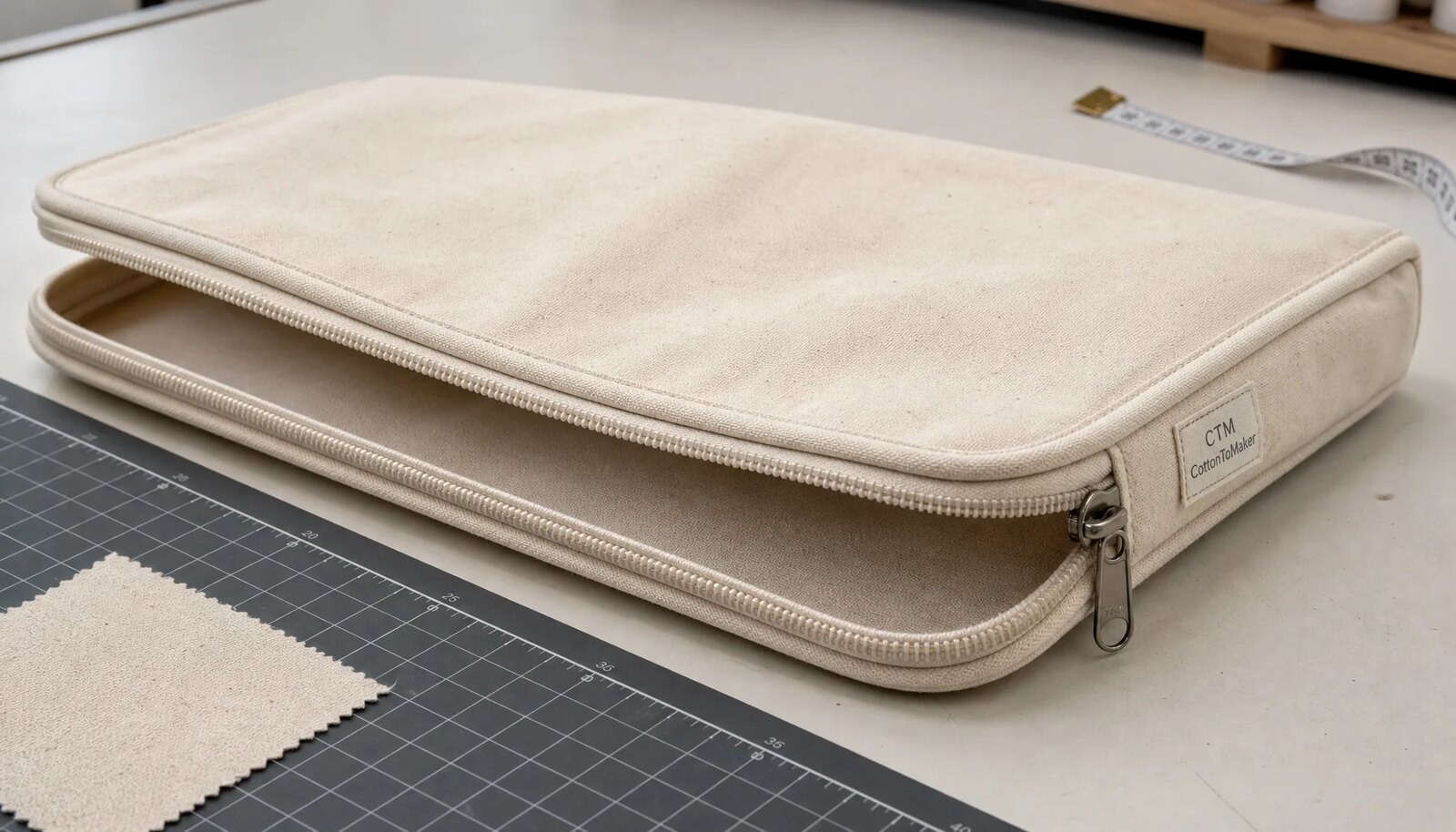
Define the portfolio job first
A canvas zipper portfolio for an apparel brand is usually a working sales tool, not a generic pouch. It may hold line sheets, order forms, seasonal catalogs, fabric swatches, trim cards, hangtag packs, or buyer-meeting documents. Because it sits on the table during wholesale appointments, the material and finish also carry brand meaning.
Start the RFQ with use case and contents. A light trade show folder can use simpler construction and standard components. A swatch carrier needs more internal clearance, stronger corners, smoother zipper movement, and better pocket reinforcement. A retail gift may need cleaner unit packing and tighter logo placement.
This is the practical way to use a wholesale canvas zipper portfolios for eco apparel brands material selection guide: define the job, then price the build. When factories only receive a phrase like natural canvas zipper portfolio, they must guess the canvas weight, zipper grade, lining, pocket layout, and inspection level.
- Buyer folder: flat paper handling, clean front panel, smooth zipper, low wrinkle visibility.
- Swatch carrier: corner strength, pocket depth, loaded zipper function, reinforced openings.
- Trade show handout: lighter weight, standard zipper, simple decoration, efficient packing.
- Retail gift: consistent branding, cleaner interior, protected unit packing, barcode or insert control.
- Sales rep kit: repeat-use durability, reorder consistency, stronger pocket and zipper checks.
Size around real contents
Dimensions should be based on what the portfolio must hold, not only on A4 or US letter language. Catalogs, fabric cards, folded samples, and trims add thickness. Once zipper tape, seams, binding, lining, and pockets are included, the usable inside space can be smaller than the outside dimension suggests.
Ask the supplier to quote finished outside size and usable inside size separately. If the portfolio carries bulky contents, compare a flat body with a shallow gusset. A gusset can solve zipper strain, but it also adds sewing work, carton volume, and cost. If the item only carries paper, flat construction may be cleaner.
Samples should be approved loaded. An empty sample may look balanced, then distort when catalogs or swatches are inserted. Measure the sample flat, load it, close and open the zipper several times, and check whether corners lift, pockets pull, or the zipper curve becomes tight.
- State finished outside length and width in millimeters.
- State usable inside opening and maximum content thickness.
- Send photos or dimensions of the actual contents if possible.
- Quote flat and gusseted options separately when depth is uncertain.
- Set measurement tolerance before bulk production, commonly in millimeters.
Choose canvas by finished GSM
For most zipper portfolios, 12oz to 16oz cotton canvas, roughly 340-450 GSM finished weight, is a practical sourcing range. About 340-380 GSM works for lighter folders, trade show kits, and paper-based programs. About 380-450 GSM gives firmer body for catalogs, swatches, and premium buyer presentations.
Heavier canvas is not automatically better. Very heavy fabric can create bulky corners, stress the zipper seam, increase freight volume, and make the portfolio feel stiff. Too-light canvas may ripple near the zipper, crease under packing pressure, and give weaker support to printed logos.
Always ask whether the quoted weight is raw or finished. Dyeing, bleaching, washing, coating, calendaring, and preshrinking can change weight, handfeel, shrinkage, and surface smoothness. Two suppliers may both quote 14oz canvas while offering different finished fabrics.
- Use 340-380 GSM for lighter document folders and cost-sensitive programs.
- Use 380-450 GSM for firmer portfolios carrying swatches or catalogs.
- Request finished GSM, oz reference, fiber content, weave, and finish process.
- Approve a physical swatch from the intended bulk source.
- Inspect logo zones for heavy slubs, stains, loose yarns, and weave faults.
Separate look from material claims
Natural cotton canvas can support an eco apparel brand's visual direction, but it does not prove organic cotton, recycled content, low-impact dyeing, or chemical compliance. Procurement should separate the look from any claim the brand intends to make on packaging, product pages, sales sheets, or customer communication.
Common routes include conventional natural cotton, bleached cotton, dyed cotton, organic cotton, recycled cotton blend, and cotton-polyester blend. Each route changes MOQ, lead time, price, shade consistency, and document requirements. If no formal claim is needed, say so; it helps the factory quote efficiently without pretending a document is required.
When documentation is required, name it. Depending on the claim and market, buyers may ask for a supplier scope certificate, transaction certificate, RCS or GRS documentation for recycled content, GOTS or OCS documentation for organic content, OEKO-TEX documentation, an RSL statement, or a third-party lab test report. The key is that the document must match the material route and, where applicable, the production lot.
- Do not use natural color as proof of organic or recycled content.
- Ask which certificates or test reports are available before confirming claims.
- Confirm whether documents cover the supplier, the material, or the actual order lot.
- Use lab dips for dyed canvas and shade bands for natural canvas variation.
- Keep approved swatches for reorders and carton-level shade checks.
Specify construction, not just style
Single-layer bound canvas is often the cleanest choice for basic wholesale folders. It is lighter, simpler, and usually easier to pack flat. It still needs controlled binding, trimmed threads, neat zipper ends, and acceptable internal seam finishing so the item does not feel unfinished.
Lined construction gives a smoother interior and can improve the handling of papers, swatches, and trims. A light polyester lining is common in bag production because it is smooth and available; cotton lining may better match a brand story but can add thickness, cost, and wrinkle risk. Either way, inspect for trapped threads, twisting, corner bulk, and pocket distortion.
Pockets must be drawn or described precisely. Specify count, width, depth, opening direction, reinforcement, and intended contents. A business card pocket, a trim-card pocket, and a flat document divider are different sewing problems. If a pocket carries weight, the opening corners need reinforcement and the stitch line should not distort the outside panel.
- Choose single-layer construction for lower-cost folders and simple paper contents.
- Choose lining for smoother interiors and premium buyer kits.
- Specify binding width, seam allowance, thread color, pocket dimensions, and reinforcement.
- Add gusset depth only when loaded contents require it.
- Approve close-up photos of zipper ends, corners, pockets, binding, and inside seams.
Control the zipper spec
The zipper is the most handled component. A size #5 nylon coil zipper is a practical default for many canvas portfolios because it is flexible, smooth, widely available, and suitable for repeated document and swatch use. Smaller zippers can feel weak on firm canvas; larger zippers may be useful for bulky contents but affect cost and appearance.
The RFQ should state tape color, coil color if relevant, slider material, slider finish, puller style, opening direction, zipper path, and end treatment. Natural canvas may work with tonal tape, black tape, antique metal, nickel, or matte hardware. What matters commercially is that the sample and bulk shipment match.
Zipper performance depends on component quality and sewing. Uneven tape tension creates wavy zipper lines. Bulky corners make the slider catch. Weak zipper ends can open under repeated loading. Test the sample with the real contents inside, not only while empty.
- Use size #5 nylon coil zipper as the starting point for most programs.
- Require written approval for zipper, slider, puller, or tape substitutions.
- Check zipper movement around corners while the portfolio is loaded.
- Confirm custom puller tooling, MOQ, plating sample, and lead-time impact.
- Inspect zipper ends and slider finish during sample approval and final inspection.
Match branding to canvas texture
Canvas decoration should be chosen from the artwork and fabric surface together. Texture affects small type, line breaks, opacity, gradients, and color consistency. Before quoting, review logo size, color count, fine details, large solid areas, and distance from seams or zipper curves.
Screen print is efficient for bold one-color or two-color marks, but it needs a suitable mesh, ink, curing process, and surface. Risks include pinholes, broken edges, poor opacity, color drift, and uneven coverage over slubs. The spec should include Pantone direction, print size, reference-edge position, and placement tolerance.
Heat transfer can help with fine detail or tonal artwork, but it must be tested on the exact canvas for adhesion, edge lift, handfeel, cracking, and scorching. Embroidery adds texture but may pucker if stitch density, backing, or thread tension is wrong. Woven labels are often a good apparel-style option for repeat consistency and understated branding.
- Use screen print for bold marks and simple color programs.
- Use heat transfer only after checking adhesion, handfeel, edge lift, and abrasion.
- Use embroidery when tactile branding matters, with backing and stitch density controlled.
- Use woven labels for durable, repeatable apparel-style branding.
- Define logo size, Pantone direction, placement tolerance, and minimum line thickness.
Read MOQ and price together
MOQ is not only a quantity number. It reflects fabric sourcing, component minimums, setup time, cutting efficiency, decoration, packing, and inspection. A natural canvas portfolio with one size, one logo, one fabric color, standard zipper, standard puller, and export packing usually gives the lowest practical MOQ.
Custom dyed canvas, multiple colors, special lining, printed lining, gussets, custom pullers, embroidery, multiple artwork versions, retail packaging, and barcode labeling can raise MOQ or unit cost. Ask whether the MOQ applies to the total order or separately by color, size, artwork, zipper color, label, or custom component.
A low quote may be legitimate, but it should be explained. It may use lighter canvas, simpler sewing, no lining, cheaper hardware, looser tolerances, or basic packing. Buyers should compare quotes by spec line, not by unit price alone.
- Clarify MOQ per order, color, size, artwork, and custom component.
- Ask for base and upgraded quotes rather than one mixed option.
- Separate tooling, sample, logo setup, and packing costs from unit price.
- Keep first orders simple when timing and MOQ matter.
- Ask what spec difference explains an unusually low price.
Approve samples as production references
A production approval sample should use the actual fabric, zipper, puller, lining, thread, label, logo method, pocket layout, and packing method. A shape sample made from substitute material can help early development, but it should not authorize bulk production.
Start sample review with measurements, then function. Measure length, width, zipper opening, pocket depth, label position, and logo placement. Load the intended contents, close and open the zipper, and check for distortion, corner lift, pocket strain, and tight curves.
Decoration approval needs equal discipline. Check print opacity, edge sharpness, Pantone direction, transfer adhesion, embroidery puckering, woven label orientation, and placement. Record revisions in one approval file with photos and dimensions so the factory, buyer, and inspector work from the same reference.
- Approve bulk only from a production-quality sample.
- Load the sample with real contents before judging fit.
- Measure dimensions and logo placement against the written spec.
- Review corners, zipper ends, pockets, lining, binding, labels, and loose threads.
- Keep the signed sample, quote, PO, artwork, and inspection checklist aligned.
Build AQL inspection into the PO
Quality control should be agreed before cutting begins. A useful PO names checkpoints for fabric, cutting, sewing, zipper function, decoration, measurement, labels, packing, and carton condition. It also defines critical, major, and minor defects for canvas zipper portfolios.
Critical defects may include wrong logo, wrong material, broken zipper, unsafe sharp metal, severe contamination, or incorrect size that makes the product unusable. Major defects may include zipper catching, open seams, obvious print misalignment, badly puckered embroidery, severe stains on front panels, loose pocket reinforcement, or damaged unit packing. Minor defects may include short thread tails, tiny non-visible irregularities, or shade movement within an approved band.
For larger orders, use an agreed sampling plan such as ANSI/ASQ Z1.4, with AQL levels confirmed in advance. Many buyers use stricter control for critical defects and separate limits for major and minor defects, but the exact level should follow the buyer's risk tolerance and inspection policy. The defect list must still be product-specific.
Packing is part of quality. Canvas can crease under pressure, and zipper edges can mark panels if units are compressed poorly. Confirm flat packing, tissue or sleeve use, polybag or paper packaging, insert placement, carton strength, carton marks, moisture control, and barcode accuracy where required.
- Set tolerances for size, pocket depth, logo position, and label position.
- Define acceptable natural canvas flecks, slubs, and shade movement.
- Classify critical, major, and minor defects before final inspection.
- Use agreed sampling and AQL levels when order size warrants it.
- Inspect carton count, carton marks, dry goods, compression, and unit protection.
Specification comparison for buyers
| Material or supplier route | Best fit | Main tradeoffs | Documents and QC to request |
|---|---|---|---|
| Conventional natural cotton canvas | Cost-controlled sales folders, trade show handouts, internal kits, and programs with a natural look but no formal material claim | Good availability and visual fit for apparel brands, but shade variation and cotton flecks must be accepted within limits | Fabric swatch, finished GSM declaration, color shade band, RSL statement if required, fabric defect standard for front panels and logo zones |
| Organic cotton canvas | Brands making organic material claims on product pages, packaging, or sales materials | Higher fabric MOQ, longer sourcing time, and more document review; natural color alone is not proof | Supplier scope certificate where applicable, lot-linked transaction certificate if required by the claim route, fiber content statement, approved swatch from intended bulk fabric |
| Recycled cotton blend canvas | Brands prioritizing recycled-content messaging or a more textured handfeel | Blend ratios, strength, slub level, and shade consistency can vary; fine logo detail may be harder to print cleanly | Recycled standard documentation such as RCS or GRS where applicable, blend composition, test report if requested, pre-production swatch and logo strike-off |
| Dyed cotton canvas | Brand-color portfolios, seasonal kits, retail gifts, and programs requiring a specific shade | Needs lab dip approval, shade control, possible higher MOQ, and more attention to crocking and color transfer | Lab dip, approved bulk swatch, colorfastness or rubbing test report if needed, carton-level shade control instructions |
| Single-layer bound construction supplier | Lower-cost wholesale folders that carry paper, line sheets, and light inserts | Lower bulk and simpler sewing, but interior seams and raw edges must be controlled so the item does not feel unfinished | Construction sample, binding width, seam allowance, loose-thread standard, measurement tolerance, photos of zipper ends and inside seams |
| Lined construction supplier | Premium buyer kits, swatch carriers, reusable showroom folders, and portfolios holding mixed contents | Cleaner interior and better paper handling, but higher cost, added thickness, lining wrinkle risk, and more sewing checkpoints | Lining material spec, pocket drawing, reinforcement details, pre-production sample loaded with contents, inspection for twisting, trapped threads, and corner bulk |
Buyer checklist before sampling
- Define the job: buyer meeting folder, swatch carrier, line-sheet case, sales rep kit, retail gift, distributor pack, or trade show handout.
- List the exact contents: A4, US letter, catalogs, trim cards, swatches, hangtag packs, order forms, folded samples, or inserts.
- Specify finished outside dimensions in millimeters and the usable inside space after zipper tape, seams, binding, lining, and pockets are included.
- Choose a target finished canvas weight: about 340-380 GSM for lighter folders or 380-450 GSM for firmer buyer kits and swatch carriers.
- State the fiber route separately from the look: conventional cotton, organic cotton, recycled cotton blend, dyed cotton, RSL requirement, or no formal claim.
- Approve canvas color by physical swatch, lab dip, or shade band, and define acceptable natural flecks or shade movement before bulk cutting.
- Lock construction: single layer or lined, binding width, seam allowance, gusset depth if any, pocket count, pocket depth, opening direction, thread color, and reinforcement points.
- Specify zipper size, tape color, coil color if relevant, slider finish, puller style, zipper path, zipper-end treatment, and whether substitution needs written approval.
- Select branding by artwork reality: screen print for bold marks, heat transfer for detail, embroidery for texture, or woven label for repeatable apparel-style branding.
- Provide logo size, position from reference edges, Pantone direction, minimum line thickness, placement tolerance, and whether artwork may cross seams, folds, or zipper curves.
Factory quote questions to send
- What exact canvas are you quoting, including fiber content, weave, finished GSM, oz reference, color process, shrinkage expectation, and intended bulk fabric source?
- Is the quoted fabric weight measured before or after dyeing, bleaching, washing, coating, calendaring, or preshrinking?
- Can you send a physical swatch from the intended production fabric and keep the same source for the pre-production sample?
- If we need an organic, recycled, RSL, or chemical compliance claim, which document can you provide and will it be linked to the actual production lot?
- What finished dimensions, usable inside dimensions, seam allowance, binding width, pocket depth, and measurement tolerance are included in the quote?
- Which zipper size, tape material, tape color, coil type, slider material, slider finish, puller shape, and end treatment are included?
- May any fabric, zipper, slider, puller, lining, thread, label, or packing material be substituted without written approval?
- Does MOQ apply to the full order or separately by fabric color, size, artwork version, zipper color, label version, or custom component?
- What logo method do you recommend for our artwork, and what are the minimum line thickness, Pantone tolerance, placement tolerance, curing control, and adhesion or abrasion checks?
- What is the timeline for swatch, lab dip if needed, strike-off, sample, revision, pre-production approval, bulk production, packing, and final inspection?
Quality-control points to confirm
- Confirm finished canvas GSM, color, texture, and handfeel against the approved swatch before cutting; record any accepted shade band or lot variation.
- Inspect fabric panels for stains, oil marks, holes, severe slubs, skewed grain, shade mixing, weaving faults, and defects in front-panel or logo areas.
- Measure finished length, width, usable opening, pocket depth, label position, zipper opening, and logo position using agreed millimeter tolerances.
- Check stitch density and consistency along zipper tape, binding, pockets, corners, labels, stress points, and reinforced areas; reject skipped, broken, loose, or open stitches.
- Cycle zippers on inspection samples while loaded with intended contents; note catching, splitting, scraping, tight curves, wavy zipper lines, or weak zipper ends.
- Inspect pullers and sliders for sharp edges, plating scratches, loose attachment, wrong finish, poor movement, or visible mismatch from the approved sample.
- Review screen print, transfer, embroidery, or woven labels for alignment, opacity, Pantone direction, edge sharpness, adhesion, puckering, orientation, and placement.
- Classify defects before inspection: critical examples include wrong logo or broken zipper; major examples include open seams or obvious print shift; minor examples include short thread tails.
- Use an agreed sampling plan such as ANSI/ASQ Z1.4 where appropriate, with AQL levels confirmed by the buyer, supplier, and any third-party inspector.
- Check packing for dry goods, correct count, carton marks, unit protection, barcode or insert accuracy if required, compression marks, zipper-edge protection, and carton strength.