Buying Problem
Wholesale canvas zipper portfolios can look simple in a product photo, but the procurement risk sits in the details. The item combines soft-goods sewing, stationery-style structure, zipper function, and retail presentation. For craft fairs, the buyer is not only purchasing a pouch for holding paper goods. The portfolio may need to protect prints, hold price sheets or order forms, present neatly on a booth table, and survive repeated shopper handling without the zipper or seams failing.
The most common mistake is treating the portfolio like a flat cotton pouch with a zipper. A portfolio has more stress at the corners, a larger front panel for decoration, and a higher expectation for shape retention. If the RFQ only says “canvas zipper portfolio with logo,” different suppliers may quote different fabric weights, structure methods, zipper grades, and packing standards. The lowest price may simply be a thinner, softer, less stable version that looks acceptable in a listing photo but performs poorly at retail.
For craft fair programs, the portfolio often serves several roles at once: display item, storage item, brand carrier, and sometimes a giftable retail SKU. That means the buyer needs to define the use case before asking for price. Is the item meant to hold A4 prints for an artist booth, package stationery for a market stall, carry color swatches for a maker brand, or present a premium branded merchandise bundle? Each use case changes the right fabric weight, need for board support, and acceptable level of print or assembly variation.
Buyers also need to manage the gap between merchandising language and factory language. A merchandiser may think “sturdy portfolio” means reinforced corners and a smooth zipper, while a supplier may interpret it as thicker canvas only. In bulk procurement, vague wording leads to avoidable disputes. The more precise the brief, the better the quote comparison, sample review, and final inspection will be.
If you are sourcing for seasonal craft fairs, the best approach is to separate the buying problem into five decisions: size, structure, fabric, zipper, and branding. Once those are locked, you can compare suppliers on equal terms and build a QC checklist that is actually usable on the factory floor and at the port of shipment.
- Use finished size, not only paper size, because seam allowance and zipper clearance reduce usable space.
- State whether the portfolio is for documents, prints, craft tools, stationery kits, or retail gift sets.
- Separate appearance requirements from functional requirements so factories can quote the correct construction.
- Keep one approved sample as the inspection reference for every bulk shipment.
- Ask the supplier to confirm what is included and what is excluded in the quote before comparing price per unit.
Core Specification
Start the RFQ with a construction specification that a merchandiser can cost line by line. A practical craft fair portfolio often uses 12 oz to 16 oz cotton canvas for the outer shell. In GSM terms, that usually falls around 380 to 540 GSM, but the exact hand feel depends on weave density, finishing, and whether the fabric is natural, bleached, dyed, or washed. A 12 oz canvas is easier to sew and lighter for freight. A 16 oz canvas gives a sturdier retail impression, but corners and zipper areas need more careful sewing and stronger machine control.
For structure, decide whether the product should be soft, semi-rigid, or board-supported. A soft portfolio folds more easily and costs less, but it may not protect art prints or paper inserts. A semi-rigid version with interlining keeps shape better without feeling like a hard case. Board-supported construction is useful for premium stationery kits or higher-value craft fair merchandise, yet it adds weight, carton volume, and risk of bending if packed poorly. Buyers should make this decision early because it affects sewing difficulty, carton sizing, and acceptable defect types.
The size spec should be written in finished dimensions plus tolerance, not just by paper format. For example, an A4-compatible portfolio is not automatically the same as A4 size. You need allowance for seam thickness, zipper tape width, pocket depth, and any gusset or spine structure. If you are buying for craft fairs, also state what the item must hold in practical terms: one stack of prints, a notebook and pen, vouchers and receipts, a sample card set, or a small craft tool kit. That helps the factory design the internal opening and pocket proportions correctly.
The material brief should include color direction and surface expectation. Natural canvas is popular because it feels handmade and works well with simple branding. Bleached canvas gives a cleaner background for logos and retail photography. Dyed canvas gives stronger brand control but increases the need for shade matching and lot control. Washed canvas can create a softer retail aesthetic, but buyers should confirm whether the washing process affects shrinkage, odor, or seam behavior before approving bulk production.
In addition to the outer shell, define the internal build clearly. A portfolio may include no lining, a basic lining, a reinforced panel, or a board insert. Each choice creates a different handling feel and a different QC burden. If the product is meant for resale at craft fairs, the safest route is to ask for a construction breakdown in the quote so the supplier cannot swap material grades later without notice.
- Typical finished sizes: A5, A4, letter size, legal size, or custom craft kit size.
- Outer fabric: natural cotton canvas, dyed canvas, recycled cotton blend, or washed canvas.
- Lining options: no lining, cotton lining, polyester lining, non-woven lining, or laminated inner surface.
- Structure options: unstructured, interlined, PP board insert, paper board insert, or grey board insert.
- Tolerance to define: finished width, height, spine thickness, zipper path, pocket opening, and logo placement.
- Ask the factory to confirm whether the dimensions are measured before or after final pressing and packaging.
Canvas Weight
Fabric weight is a cost driver and a quality signal, but heavier is not automatically better. For craft fair buyers, a 10 oz canvas may work for a simple document sleeve, but it can look weak when the portfolio is displayed upright or handled repeatedly. A 12 oz canvas is often the practical baseline for wholesale programs. A 14 oz to 16 oz canvas gives a sturdier impression and supports larger print areas, especially when the logo is screen printed directly on the front panel. The real question is not only the weight number but the balance between appearance, sewing stability, and freight cost.
A procurement checklist should ask the supplier how the canvas behaves in production. Is the weave open or tight? Does the fabric fray heavily at cut edges? Does it shrink after steam pressing? Does the natural canvas show slubs or specks that are acceptable for this program? These details matter because the same nominal weight can feel very different from one mill to another. If the product is sold at craft fairs, a more natural look may be fine, but the factory still needs a defined acceptance standard for shade variation and surface irregularity.
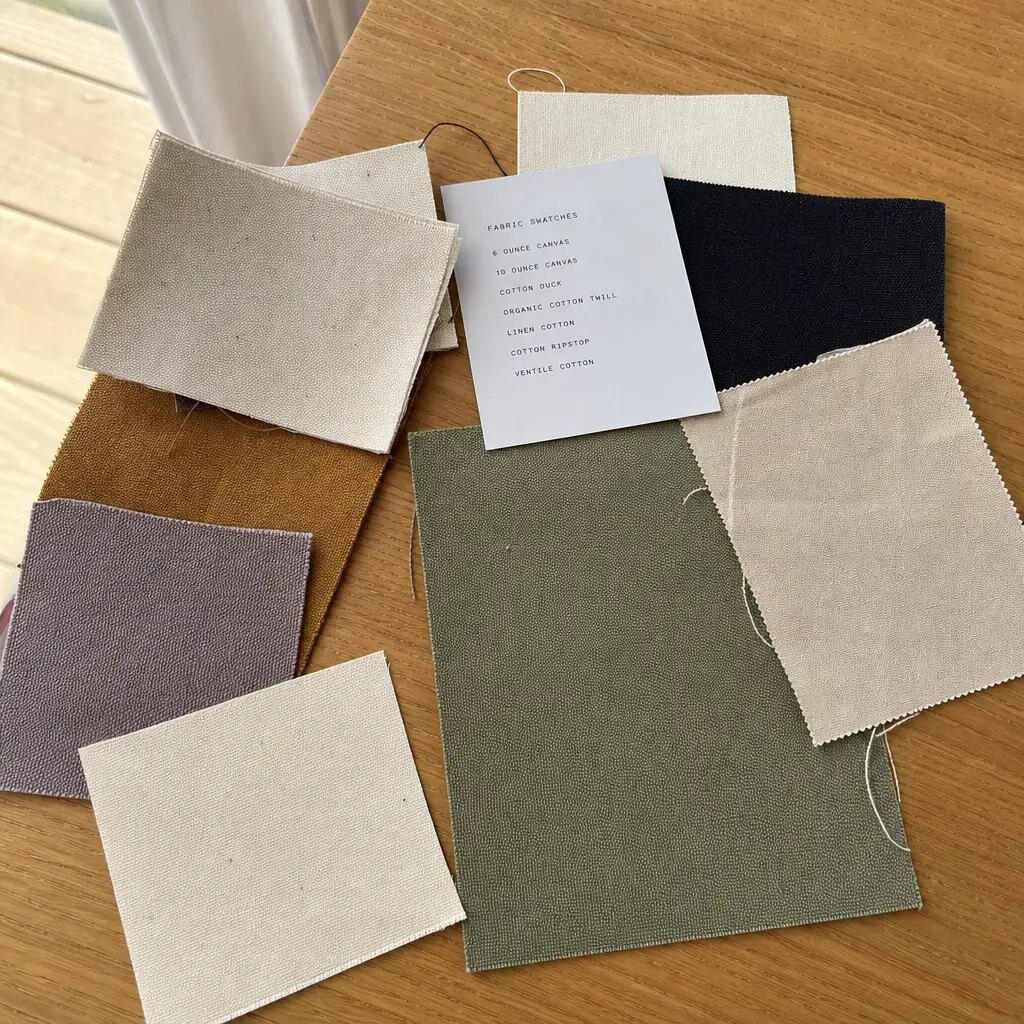
Natural canvas is common for artisan and maker-branded portfolios because it pairs well with simple print methods and low-contrast branding. Bleached or optical-white canvas creates a cleaner base for artwork and can make logos look sharper, but it may show dirt more quickly in market environments. Dyed canvas can strengthen brand identity when matching seasonal collections, yet it introduces more risk in color consistency from lot to lot. If a program includes multiple colors, request a bulk color lab-dip process or pre-production swatch signoff and make sure the approved shade is archived with the golden sample.
Buyers should also think about end-user perception. At craft fairs, shoppers often pick up the item and judge value by hand feel. A very light portfolio may read as promotional merchandise instead of retail goods. A heavier canvas with clean stitching, sharp corners, and balanced zipper hardware often performs better in a direct-to-consumer environment even if the unit cost is slightly higher. That is why canvas weight should be compared together with stitch density, board support, and print method, not in isolation.
- 10 oz canvas: usable for soft promotional folders, less suitable for structured portfolios.
- 12 oz canvas: balanced option for cost, sewing efficiency, and retail handling.
- 14 oz canvas: stronger hand feel for craft fair kits and branded stationery sets.
- 16 oz canvas: premium feel, but needs stronger needles, slower sewing, and better corner control.
- Dyed fabric: better brand color control, but higher MOQ and longer material lead time than stock natural canvas.
- Ask whether shrinkage is prewashed, postwashed, or untreated, especially if the portfolio must maintain exact size.
Zipper And Hardware
The zipper is the main functional failure point. A portfolio can pass a quick visual check and still fail when the zipper catches at a corner or when the slider separates after a few uses. For flexible canvas portfolios, a No. 5 nylon coil zipper is usually the safest option because it bends smoothly and is easier to sew around curves. Metal zippers give a premium look, but they add weight and need cleaner alignment. A poor metal zipper can scratch fabric, damage printed panels, or feel rough during opening. If the portfolio is intended for a craft fair booth, the buyer should not assume the zipper will be handled gently—customers often unzip and rezip a display unit many times.
The RFQ should specify zipper tape color, slider finish, puller type, and zipper length method. Some suppliers cut zipper chain from roll stock and apply stops during sewing; others use finished zippers. Both can work if quality is controlled. The key is to define zipper function as an inspection item. During sampling, open and close the zipper repeatedly with the portfolio filled to its intended thickness, not empty on a flat table. A zipper that works when flat may bind once the portfolio is loaded with paper, swatches, or tools.
Hardware should also be considered from a safety and presentation standpoint. Pullers must feel secure and should not rattle, bend, or detach with normal use. If the zipper pull includes branded metal or molded parts, the supplier should confirm the attachment method and whether the finish is plated, painted, or coated. Any exposed sharp edge, rough plating, or oil residue becomes a customer-facing defect. On natural canvas, even small defects show clearly because the surface is clean and tactile. The more premium the retail positioning, the more important the zipper finish becomes.
For buyers comparing multiple factories, ask whether the supplier has a standard zipper source or must source a custom color. A standard black, natural, or bronze zipper tape usually has lower risk than a special-matched tape color. If matching is necessary, request a tolerance for shade and test the zipper against both the fabric and the logo color. In many cases, the right hardware decision is the one that reduces function risk first and supports branding second.
- Recommended zipper: No. 5 nylon coil zipper for most canvas zipper portfolios.
- Premium option: No. 5 metal zipper with tested slider and smooth teeth alignment.
- Puller choices: standard metal puller, fabric pull tab, leather-look puller, or branded molded puller.
- Inspection threshold: zipper should run smoothly without fabric catching, tooth separation, slider wobble, or loose stops.
- Avoid placing thick inner pocket seams directly under tight zipper curves.
- Ask whether the zipper is chain cut to length or supplied as pre-made finished zippers.
Logo Placement
Canvas portfolios for craft fairs often need branding that looks handmade-friendly but still retail clean. Screen printing is the usual choice for simple one-color or two-color logos. It works well on natural and dyed canvas, provided the print area is flat and the ink is matched to the fabric surface. Heat transfer can handle gradients or small details, but it may look less integrated on textured canvas. Woven labels or cotton side labels are good when the buyer wants a quieter brand mark and repeatable placement across multiple colors. Embroidery is possible, but for many portfolios it adds cost, can stiffen the panel, and may create puckering if the fabric is too light.
Logo position should be treated as a manufacturing decision, not only a design decision. Printing too close to the zipper, fold, binding, or corner creates distortion and higher rejection risk. For large front prints, the factory should print panels before sewing, then control placement during assembly. For small labels, stitch position and label orientation become the main QC points. If the logo must sit near the lower front corner, define the exact distance from the edges and confirm that the sample and bulk units are aligned against the same reference. This is especially important when you need the product to photograph consistently for online or wholesale catalog use.
Buyers should also define decoration performance requirements. Ask the supplier what rub test or tape test is appropriate for the selected print method. Not every portfolio needs a laundry test, but the decoration should survive normal retail handling, booth display, and carton movement without smearing or peeling. For natural canvas, ink penetration and print edge sharpness should be checked carefully because uneven weave can affect appearance. If the design includes fine lines or small text, ask the supplier to confirm the minimum line thickness and minimum font size that will print cleanly on the selected surface.
A useful buyer habit is to approve artwork in the exact color mode and placement file that the factory will use. If the logo must stay clear of stitching or zipper teeth, include a visual placement drawing with measurement marks. That reduces the risk of a sample being approved one way and the bulk line drifting in another direction. For procurement teams, the best decoration spec is the one that can be checked with a ruler and a reference photo, not just by subjective judgment.
- Screen print: best for solid logos, simple artwork, and stronger cost control.
- Heat transfer: useful for multi-color art, but test adhesion and hand feel on canvas.
- Embroidery: possible on canvas, but can pucker panels unless backing and stitch density are controlled.
- Woven label: clean for retail lines, especially when different fabric colors are used.
- Logo tolerance: define distance from bottom edge, side edge, and zipper edge in millimeters.
- Ask for a print strike-off or pre-production decoration sample before bulk approval.
Interior Layout
Interior design affects both usefulness and production stability. A portfolio for craft fairs may carry art prints, order forms, price sheets, stickers, fabric swatches, postcards, tools, or small packaged goods. One large document pocket and one smaller accessory pocket usually provide enough utility without overcomplicating sewing. Every extra slot adds labor, more material types, and more chances for measurement errors. For procurement buyers, this means the interior layout should be justified by real end-use, not by perceived value on paper.
If the portfolio must hold sharp tools, metal rulers, or jewelry display items, plain cotton lining may not be enough. A stronger inner layer or reinforced pocket mouth can prevent early wear. If the item is only for papers and stationery, a lighter lining is acceptable. The important point is to send the factory the intended contents or a size drawing, so pocket openings and zipper clearance are built around real use. A factory can then confirm whether the pockets will sag, block the zipper, or push against seams when filled.
The number of compartments is a common place where quoting and production drift apart. A quote that includes one document sleeve, one zip pocket, one pen loop, and one card slot is not comparable to a quote for a plain lined folder. If the buyer wants more than one pocket, specify pocket dimensions, opening orientation, and reinforcement method. It is also worth confirming whether internal pockets are stitched before the outer shell is closed or assembled in a separate sub-process, because that affects labor time and inspection complexity.
For craft fair applications, function should stay simple and intuitive. Shoppers and sales staff should be able to open the portfolio quickly, view contents clearly, and repack it without wrestling with too many elastic bands or hidden compartments. A practical interior layout usually prioritizes easy access, good visibility, and reliable closure rather than maximum feature count. The result is lower production risk and more consistent quality across a wholesale order.
When the portfolio will be used in retail bundles, ask whether the interior color should contrast with or match the outer canvas. A dark lining can hide marks better, while a light lining can make contents easier to see. The right choice depends on the target user and how the portfolio will be presented in the booth or catalog.
- Document pocket should fit the largest insert without bending the corner.
- Pen loop should hold the intended pen diameter without blocking closure.
- Mesh pocket helps visibility but can snag if the zipper path is too close.
- Elastic bands are useful for tools but add tension that can distort the panel.
- Pocket mouth should have reinforced stitching if buyers will remove items repeatedly at fairs.
- Ask the factory to show pocket clearance with actual sample contents, not just on a flat pattern.
MOQ And Cost
MOQ is usually driven by fabric availability, printing setup, zipper color, and labor efficiency. A factory may accept a lower MOQ when using stock natural canvas, standard black or natural zipper tape, and a one-color screen print. MOQ rises when the buyer requests custom dyed canvas, matching zipper tape, custom pullers, special lining, or multiple colorways. The buyer should compare quotes by included specification, not only by unit price. Otherwise, the cheaper quote may be missing structure, decoration, or packaging elements that matter at retail.
Cost differences often hide inside details that are easy to miss. A quote for 12 oz canvas without lining is not comparable to a quote for 16 oz canvas with board insert and interior pockets. Printing cost may be built into the unit price or charged as a setup fee. Packing may be simple bulk packing or individual retail-ready packing. Freight also changes when portfolios are board-supported and packed flat in larger cartons. For a procurement buyer, the safest method is to request a line-item quote or at least a spec-confirmation sheet that states what is and is not included.
It helps to ask the supplier how price changes with quantity breaks. For example, if the product is being tested at a craft fair first, you may want a small introductory run, then a larger reorder after sell-through proves the design. Some factories can keep the same structure but lower the price by changing packaging, simplifying printing, or using stock hardware. Others will need a new setup because the first run was already optimized for a specific quantity. Knowing where the step-up costs are helps you avoid surprise pricing later.
Also check whether the factory builds a premium into the unit price for low-volume work. This can happen when the supplier allocates more labor to small orders or when they quote a broad range without clarifying fabric stock status. In procurement, the right comparison is total landed cost at the specified quality level. If the portfolio is intended to be sold at craft fairs, a small cost increase may be justified if it reduces defect rates, improves presentation, or lowers customer complaints. The buyer’s job is to identify which spec changes affect customer value and which only add cost without visible benefit.
If you expect multiple seasonal colorways, consider whether the MOQ should be negotiated across styles or colors. A supplier may be more willing to combine quantities if the structure and zipper are unchanged. Ask for this in writing so future reorder planning is easier.
- Main cost drivers: canvas weight, lining, board insert, zipper grade, number of pockets, logo method, packing method, and order quantity.
- MOQ may be per color if fabric is dyed or if zipper tape color changes.
- Screen printing has setup cost, so small orders with many logo colors become inefficient.
- Custom zipper pullers often require mold cost and longer lead time.
- Flat rigid portfolios can increase carton volume even when unit weight is moderate.
- Ask for price breaks at each quantity tier so you can compare true landed cost.
Sample Approval
A useful sample is not just a photo sample. It should use the same fabric weight, zipper type, structure, logo method, and packing direction planned for production. If the factory uses substitute materials for a quick sample, mark it as a construction sample only and do not approve it as the golden sample. For bulk approval, the sample must be close enough that inspectors can compare color, feel, dimensions, zipper function, and print quality against it. If the sample differs materially from production, the bulk order will almost certainly create disputes.
Sample review should include loading the portfolio with the real contents. If it is sold for craft fair vendors, put in the intended paper size, small tools, tags, postcards, or display materials. Close the zipper, hold it by the edge, open it again, and look for panel warping, zipper strain, and pocket sagging. Many problems only appear when the portfolio is used at normal capacity. A sample that feels perfect empty may fail once the panel is loaded and the zipper path bends under tension.
The review process should be documented. Buyers should note the date, sample ID, material details, artwork version, and approval comments. Photograph the front, back, interior, zipper ends, corners, pocket openings, and packing method. This gives the factory a clear target and helps your internal team compare future production lots. When the order is for craft fairs or retail distribution, a signed golden sample is one of the most effective ways to keep the supplier aligned across repeats.
Do not rush sample approval just to save time. If a logo is slightly misplaced, the fabric is the wrong shade, or the zipper feels rough, those issues become expensive in mass production. A small delay at sample stage is usually cheaper than a full carton rejection later. The sample should answer the question, “Can this be mass-produced consistently?” not merely “Does this look acceptable in one piece?”
For higher-risk orders, request one pre-production sample and one pilot production lot if the timeline allows. That is especially useful when the portfolio includes a new board structure, a custom puller, or a special print location. The pilot lot can reveal whether the sewing sequence is stable before you commit to the full order.
- Measure outside size and usable inside size separately.
- Test zipper movement at empty, half-filled, and intended filled condition.
- Rub the printed logo with dry cloth and slightly damp cloth if suitable for the print method.
- Inspect corners for symmetry, bulk, and skipped stitches.
- Keep sample comments in a dated file with photos, not only in message threads.
- Approve the sample only after confirming the final packing style and carton markings.
Inspection Criteria
Final inspection should combine visual checks, measurement checks, and function checks. Visual checks cover stains, oil marks, fabric slubs beyond approved standard, print defects, loose threads, crooked labels, and carton damage. Measurement checks confirm finished size, logo placement, pocket size, and zipper opening. Function checks prove the product can actually be used without zipper failure or structural distortion. For wholesale canvas zipper portfolios for craft fairs, this three-part approach is more reliable than a quick cosmetic walk-through.
Before inspection begins, classify defects so everyone knows what counts as a reject. A critical defect could be a sharp metal edge, mold, severe contamination, or an unusable zipper. Major defects include broken stitches, wrong size, heavy stain, misprinted logo, zipper catching, incorrect fabric, or warped board. Minor defects include small loose threads, slight shade variation within approved range, or mild stitch waviness that does not affect function or retail appearance. Defect definitions should be written into the QC sheet and shared with the factory before mass production ends.
Measurement checks should focus on the dimensions that matter to the user, not every possible dimension. The most important measurements are finished width, finished height, spine or thickness dimension if applicable, zipper length or opening length, and pocket opening dimensions. If the portfolio includes a logo, define the allowable placement tolerance from the bottom edge and side edge. A product can be visually acceptable but still fail if the logo drifts into the seam allowance or the inner pocket becomes too tight for normal use.
Function checks should be repeated enough times to reveal weak points. The zipper should open and close several times without catching at the corners. The slider should not detach, wobble, or snag. If the portfolio uses a board insert or semi-rigid support, inspect whether the board shifts, curls, or creates pressure points after closing. Hold the item at the edges, turn it over, and flex it lightly to see whether the seams remain aligned and the corners keep their shape.
When the order is large enough to justify AQL sampling, use it in combination with targeted critical checks. That means you do not rely on the sampling plan alone. For example, you may sample based on carton counts but still inspect every sampled zipper for smooth operation and every sampled logo for placement accuracy. This is especially important for craft fair programs where retail appeal is highly visible and even a small defect rate can affect sell-through.
- Critical: unsafe hardware, mold, strong odor, wrong product, or zipper completely non-functional.
- Major: wrong fabric weight, wrong color, distorted shape, poor logo adhesion, skipped seam, or damaged carton causing product deformation.
- Minor: trim thread, small removable dust mark, slight stitch waviness, or very small canvas speck accepted in the approved natural fabric standard.
- Measurement: agree tolerance for finished size, pocket opening, logo position, zipper length, and usable interior width.
- Function: every sampled unit should open and close several times without catching or separation.
- Ask the supplier to separate defect records by critical, major, and minor before the shipment is released.
Packing And Lead Time
Packing is part of quality control for canvas zipper portfolios. Soft portfolios can be packed in stacks, but structured portfolios need protection against bending and corner crushing. Individual recycled polybags reduce scuffing, while paper belly bands may fit a plastic-reduction program if the product surface and print can tolerate carton friction. For retail buyers, barcode labels, hangtags, and master carton markings should be confirmed before production, not added in panic at shipment time. A good packing plan protects the product and keeps warehouse receiving simple.
The packing spec should answer four questions: how the portfolio is packed individually, how many are packed per inner carton or export carton, what the carton dimensions are, and how cartons are reinforced if the product is semi-rigid. If the portfolio has a board insert, the carton should not compress the shape. If it has printed surfaces, carton packing should minimize rubbing and ink transfer. If it includes metal hardware, the packing should prevent the hardware from imprinting the canvas during transit.
Lead time depends on material readiness and sample approval discipline. A simple stock-canvas order can move faster than a custom dyed, lined, board-supported portfolio with branded pullers. The production calendar should separate artwork approval, fabric sourcing, sample making, pre-production sample approval, bulk cutting, printing, sewing, final inspection, and packing. Buyers lose time when artwork is approved but fabric color or zipper trim is still undecided. To avoid delays, ask the factory to state what stage starts the lead time clock.
For buyers shipping to trade shows, market organizers, or seasonal craft fairs, buffer time matters more than usual because these orders often have fixed selling dates. A one-week slip on a generic item might be manageable, but a one-week slip on a seasonal craft fair launch can mean missed revenue. That is why lead time should be negotiated together with material availability and approval deadlines. If the supplier says they can ship quickly, ask what assumptions are built into that promise and whether the timeline depends on stock fabrics or stock zippers.
Before confirming the order, request a packing test or packing photo sequence if the portfolio is board-supported. The goal is to prove that the final pack-out does not distort corners, crush zipper ends, or create carton bulge. This is one of the simplest ways to avoid disputes when the goods arrive at your warehouse.
- Request carton dimensions, gross weight, net weight, and pieces per carton before confirming freight.
- Use flat packing when shape must be protected, but calculate carton volume early.
- Add corner protection or divider sheets for board-supported portfolios if scuffing appears in packing test.
- Confirm whether lead time starts after deposit, artwork approval, material arrival, or sample approval.
- Build schedule buffer for dyed canvas, custom zipper tape, branded pullers, and retail labeling.
- Ask for packing photos from the factory before shipment if the product has rigid inserts or printed panels.
Specification comparison for buyers
| Spec decision | Recommended option | Why it works for craft fair buyers | Inspection priority |
|---|---|---|---|
| Outer canvas weight | 12 oz to 16 oz cotton canvas, roughly 380-540 GSM depending on weave and finish | Balances hand feel, print clarity, and durability without pushing freight too high | High: verify actual swatch, not just GSM on the quote |
| Structure method | Canvas outer with board insert or firm non-woven interlining | Helps the portfolio hold shape on retail tables and protects inserts from bending | High: inspect warping, corner crush, and fold-line cracks |
| Zipper type | No. 5 nylon coil zipper for flexible canvas; No. 5 metal zipper for a premium look | Nylon is easier to sew around curves; metal raises perceived value | High: run function tests with the portfolio loaded, not empty |
| Logo decoration | Screen print for simple logos; heat transfer for multi-color art; woven or cotton side label for understated branding | Keeps branding clear without overcomplicating production | Medium: check placement, rub resistance, and edge distortion |
| Interior layout | One document pocket plus one accessory pocket and an elastic pen loop | Useful for craft fair paperwork, swatches, tickets, or small tools without adding too much sewing complexity | Medium: verify pocket dimensions and zipper clearance |
| MOQ logic | Lower MOQ for stock canvas colors and standard zipper colors; higher MOQ for dyed fabric, custom lining, or molded pullers | Improves quote comparability and helps test sell-through before committing to large volume | High: confirm whether MOQ is per color, per logo, or total mixed quantity |
| Packing format | One piece in a recycled polybag or paper belly band, 20-50 pieces per export carton with flat packing | Protects shape and keeps freight cube under control | High: check carton compression, zipper indentation, and print scuffing |
| Inspection level | AQL sampling with function checks on every sampled zipper and measurement checks on critical dimensions | Suitable for wholesale lots where retail appearance and zipper reliability both matter | High: define critical, major, and minor defects before production |
Buyer checklist before sampling
- Define finished size by the largest paper, print, catalog, or tool set the portfolio must carry, then add allowance for seam thickness and zipper clearance.
- State the intended load in the RFQ: papers only, prints, notebooks, swatches, stationery kits, or craft tools.
- Specify outer fabric by ounce or GSM, weave, color, shrinkage tolerance, and whether the canvas is natural, bleached, dyed, washed, or recycled.
- Lock the structure: soft folder, semi-rigid portfolio with interlining, or board-supported portfolio for retail display and document protection.
- Choose zipper type, zipper color, puller style, and slider finish before sampling; treat zipper as a functional component, not just trim.
- Place logo artwork away from fold lines, zipper curves, and heavy seam intersections unless the factory tests the exact placement.
- Approve one pre-production sample with actual fabric, actual zipper, actual logo method, and final packing method.
- Set tolerance for finished size, logo placement, seam allowance, zipper function, corner shape, pocket dimensions, and fabric shade difference.
- Request carton size, carton weight, pieces per carton, and packing photos before production release so freight can be estimated accurately.
- Inspect zipper opening and closing, slider stop security, skipped stitches, loose threads, oil marks, print adhesion, and board warping.
Factory quote questions to send
- What canvas weight and GSM are included in this quote, and is it stock fabric or custom dyed fabric?
- Is the quoted size based on cut size or finished size after sewing and pressing?
- What structure is included: no lining, fabric lining, non-woven interlining, paper board, grey board, or PP board?
- Which zipper specification is included, including zipper size, material, tape color, slider finish, and puller style?
- Which logo method is quoted, how many colors are included, and what is the maximum print area?
- What are the finished size tolerances, zipper length tolerances, logo placement tolerances, and pocket tolerances?
- Is the MOQ per design, per logo, per color, or total mixed quantity?
- How many samples are included, what is the sample lead time, and are sample fees refundable after bulk order?
- What packing is included in the price, including individual bag or band, carton quantity, carton size, and gross weight?
- What production lead time starts after deposit, artwork approval, fabric arrival, or pre-production sample approval?
Quality-control points to confirm
- Finished size should stay within the agreed tolerance, commonly plus or minus 5 mm for smaller portfolios and plus or minus 8 mm for larger document formats.
- Zipper must open and close smoothly across the full curve or edge without catching fabric, loose threads, inner lining, or board edges.
- Slider, zipper stops, and puller must withstand normal hand pulling without separating during repeated function tests.
- Logo print should pass basic rub testing and tape testing appropriate to the print method before bulk approval.
- Corners should be symmetrical, not crushed, twisted, or visibly different between left and right sides.
- Seams should have consistent stitch density, with no skipped stitches, broken stitches, exposed raw edges, or thread nests.
- Interior pockets should match approved dimensions and hold the intended inserts without sagging or blocking the zipper path.
- Canvas color should match approved swatch or golden sample within the agreed shade tolerance, especially for natural and dyed lots.
- Packing should prevent board bending, zipper indentation, print transfer, moisture damage, and carton collapse during export handling.
- Metal components should be free from rust, sharp edges, plating flakes, or oil residue.