Start with the real use case, not a generic portfolio spec
Wholesale canvas zipper portfolios for craft fairs are usually handled more roughly than standard office document holders. They may be stacked on vendor tables, carried in display bins, packed with printed patterns, art sheets, jewelry cards, stationery, or small handmade kits, then opened repeatedly by shoppers. A good material choice must survive that handling while still looking handmade enough for the craft fair environment.
The common sourcing mistake is to quote a “canvas zipper pouch” without defining what goes inside. A portfolio made for flat prints needs different stiffness from one made for embroidery kits or paperwork. If the item must stand in a retail display, the body may need heavier canvas or light interlining. If it will be sold folded inside a kit, heavy canvas may be the wrong choice because it increases freight cost and creates bulky corners.
- For paper patterns or art prints: keep the inside smooth and avoid raw seams that catch paper corners.
- For craft tools or small kits: choose stronger zipper tape, reinforced corners, and darker lining to hide handling marks.
- For booth giveaways or low-price resale: reduce internal pockets first before reducing canvas quality too far.
- For premium maker brands: use heavier canvas, cleaner zipper pullers, and subtle branding rather than oversized print.
Choose canvas weight by structure, sewing risk, and freight cost
Canvas weight is the first material decision that changes both product feel and factory cost. A 10 oz canvas, roughly 300-340 GSM depending on construction, can work for small flat zipper pouches but often feels light for document-size portfolios. A 12 oz to 14 oz canvas, often around 380-450 GSM, is a safer specification for craft fair portfolios because it holds shape, accepts screen print well, and does not become too difficult to sew around zipper corners.
Moving to 16 oz canvas or above may look attractive on a swatch, but it is not automatically better. Heavy fabric increases needle resistance, corner thickness, carton weight, and the chance of zipper waves if the operator stretches one layer more than the other. For a portfolio with lining, inner pocket, and zipper binding, 16 oz canvas can make the finished edge bulky. Buyers should compare finished samples, not loose fabric swatches only.
- Economy option: 10 oz canvas for small portfolios or low-cost event packs where softness is acceptable.
- Balanced option: 12 oz canvas for general craft fair resale and distributor programs.
- Premium option: 14 oz canvas when the product must feel substantial without becoming hard to sew.
- Use 16 oz only when the size, zipper route, and seam construction have been tested on a real sample.
Natural, bleached, dyed, or washed canvas affects more than color
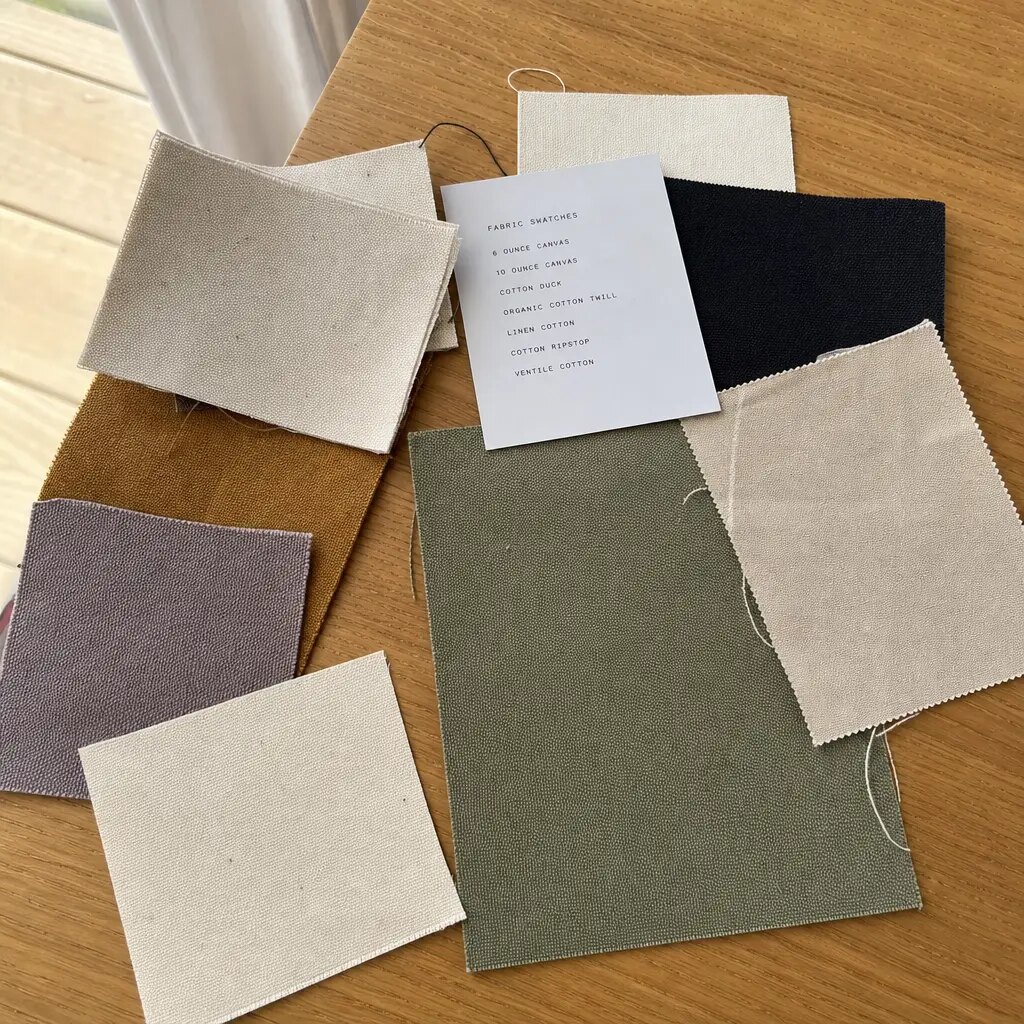
Natural cotton canvas is popular for craft fairs because it matches handmade, eco-leaning, stationery, and maker-brand aesthetics. It also hides small shade variation better than bright dyed fabric. However, natural canvas can include cotton seed specks and uneven yarn tones. These are normal for many natural fabrics, but they must be accepted in advance. If the retail buyer expects a clean cream color, semi-bleached canvas is often the safer choice.
Dyed canvas adds brand color but increases MOQ, shade matching work, and colorfastness risk. For small wholesale runs, stock colors reduce cost and lead time. Washed canvas gives a softer hand feel and reduces shrinkage risk, but washing may make the surface less flat for sharp logo printing. The buyer should decide whether the priority is clean print detail, rustic texture, or controlled color.
- Natural canvas: good for craft aesthetics; allow visible cotton specks within an approved limit.
- Semi-bleached canvas: cleaner background for logos and barcodes, usually still warm in tone.
- Dyed canvas: stronger brand impact, but shade approval and colorfastness testing become important.
- Washed canvas: softer feel and less shrinkage concern, but print edges may look less crisp.
Lining and interlining determine the buyer’s perceived value
A canvas zipper portfolio can be unlined, lined, or lightly structured. Unlined construction is cheaper and can suit rustic craft packaging, but the inside must be finished properly with binding or clean overlock stitching. Raw cotton canvas edges may fray and create lint, which looks poor when customers pull out paper goods. For document portfolios, a 210D or 300D polyester lining is common because it gives a cleaner interior and helps paper slide in smoothly.
Interlining is different from lining. A thin non-woven interlining, cotton backing, or stiffener panel can help a large flat portfolio keep its shape. But too much stiffness causes corner buckling and makes the zipper harder to sew evenly. If the portfolio opens on three sides, stiffness must be tested carefully because the product may not lay flat after sewing. Structure should be added only where it improves use, not everywhere.
- Unlined with bound seams: lowest material cost, acceptable for simple craft packaging if finishing is clean.
- Polyester lining: practical for office, stationery, and gift resale because the inside looks finished.
- Cotton lining: more natural story, higher cost, more shrinkage and wrinkle attention.
- Light interlining: useful for larger formats, but request a sample to test zipper smoothness and corner shape.
Zipper selection should be specified as a functional component
Many quote differences come from the zipper, even when the supplier description simply says “zipper closure.” For most canvas zipper portfolios, a No.5 nylon coil zipper is the practical standard. It is smooth, flexible, lighter than metal, and forgiving around corners. Metal zippers can make the product feel more premium, but they add weight and can feel stiff on a large flat portfolio, especially if the zipper turns around corners.
The slider and puller also matter. A low-grade slider may pass one quick opening test but fail after repeated handling at craft fairs. Zipper tape color should be matched to the canvas or intentionally contrasted. If the buyer wants a branded puller, MOQ and tooling may increase. For many wholesale programs, a clean standard puller plus a woven side label is more cost-effective than custom metal hardware.
- Specify zipper size, such as No.5, rather than using only “good zipper” in the RFQ.
- Define zipper route: top opening only, two-side opening, or three-side opening.
- Approve tape color, slider finish, and puller shape from photos before sampling.
- During sample review, open and close the zipper repeatedly at corners, not only on the straight section.
Logo method depends on canvas texture and order quantity
For wholesale canvas zipper portfolios, screen printing is usually the most economical and durable choice for solid logos, simple line art, or one to three spot colors. The coarse texture of canvas absorbs ink differently from paper or synthetic fabric. Very fine lines, small reversed text, and tight halftones may fill in. Artwork should be adjusted for fabric printing, and the print approval should be made on the actual production canvas.
Heat transfer can reproduce smaller details and more colors, but it changes the hand feel and may look less integrated with natural canvas. Embroidery adds texture but can pucker the fabric unless backing is used, and it is less suitable for thin lines or large filled areas. Woven labels are low-risk for small MOQs and multiple colorways because the same label can be sewn onto different canvas colors.
- Screen print: best for solid logos, cost control, and repeat wholesale orders.
- Heat transfer: useful for full-color art or small text, but test adhesion and hand feel.
- Embroidery: premium look for small logos, but watch puckering on lighter canvas.
- Woven side label: efficient for understated branding and mixed fabric colors.
MOQ logic: fabric, color, zipper, and print setups create the real minimum
MOQ is not only a factory rule. It usually comes from fabric sourcing, cutting efficiency, zipper purchasing, printing setup, and sewing line planning. If the buyer selects stock natural canvas, stock zipper tape, and one screen print design, the MOQ can be more flexible. If the buyer requests custom dyed canvas, matching zipper tape, custom puller, multiple prints, and retail packing, the economic MOQ rises because each item has its own setup loss and purchasing minimum.
For craft fair distributors, mixed designs are common. A practical way to control MOQ is to keep the bag body the same and vary only the printed artwork or hangtag. Another method is to use one woven brand label and let the retail customer add paper inserts. Buyers should calculate MOQ by SKU, not only by total order quantity. A 2,000-piece order divided into eight fabric colors and six logos may behave like many small orders inside the factory.
- Lowest MOQ structure: stock canvas, stock zipper, one size, one print color, standard packing.
- Medium MOQ structure: one body size with several printed designs but same fabric and zipper.
- Higher MOQ structure: custom dyed canvas, custom zipper tape, branded puller, and retail barcode packing.
- Before negotiating MOQ, reduce unnecessary SKU variation that does not add resale value.
Sample approval must use production materials, not a showroom substitute
A neat sample made from available fabric can be useful for shape discussion, but it should not be treated as final approval. Canvas thickness, washing, lining, zipper tape, and print method all change the result. For wholesale portfolios, the pre-production sample should be made with the nominated bulk fabric or a fabric that is confirmed to be identical in weight, finish, and shade. Otherwise, the approved sample may be impossible to repeat in mass production.
Sample review should be more disciplined than simply checking whether it looks good. Put actual documents, craft sheets, or kit materials inside. Test whether the zipper catches at full load. Measure the opening width, not only the outside size. Review print placement after the product is filled because soft canvas can shift visually when loaded. A good sample approval note becomes the production reference for the sewing line and final QC team.
- Measure outside dimensions, usable inside dimensions, and zipper opening width.
- Load the sample with the actual product or paper stack intended for sale.
- Review whether corners remain flat after filling and zipping.
- Compare fabric hand feel, shade, and thickness against the approved swatch.
- Sign off print color, print position, zipper tape color, slider finish, and inner pocket layout together.
Cost drivers to separate in the RFQ before comparing quotes
Two suppliers can quote the same canvas zipper portfolio description and still be pricing different products. One may include 12 oz canvas, lined interior, No.5 zipper, screen print, and individual polybag. Another may quote lighter fabric, unlined construction, cheaper zipper, and bulk packing. The lowest unit price is not useful unless the material and packing assumptions are visible.
A clean RFQ separates the cost drivers so the buyer can make tradeoffs intentionally. Fabric weight, lining, zipper grade, print colors, pocket complexity, packing type, and carton quantity all change price. If retail buyers need hangtags, barcodes, or inner cartons, those details should appear before quotation, not after sample approval. Late packing changes often delay production because carton size, labor time, and sticker placement must be recalculated.
- Fabric: GSM or ounce weight, composition, finish, color source, and shrinkage requirement.
- Construction: lining, interlining, binding, pocket count, zipper route, and seam reinforcement.
- Branding: print size, print colors, label type, artwork position, and setup charges.
- Packing: individual bag, paper band, hangtag, barcode, master carton quantity, and shipping marks.
- Quote data: unit price, sample cost, tooling or screen charge, MOQ by SKU, lead time, carton size, gross weight, and payment terms.
Packing and carton planning protect the flat shape
Canvas portfolios are easy to damage through poor packing because they are flat, wide, and often printed on one surface. If packed too tightly, zipper tracks can leave impressions, corners can bend, and screen prints can rub against neighboring pieces. Individual polybags protect from dust and moisture, but some craft-oriented retailers prefer paper belly bands to reduce plastic. The packing method should match the resale channel and buyer compliance requirements.
Carton quantity should be based on finished size and stiffness, not only on target carton weight. A large A4 or letter-size portfolio may need fewer pieces per carton than a small pouch to avoid compression. Export cartons should use adequate board strength and clear SKU separation. If the buyer sells through distributors, carton labels must make sorting easy at the warehouse or event staging location.
- Flat pack portfolios without folding across the zipper or printed logo.
- Use tissue or protective sheet when heavy ink coverage may rub during transport.
- Keep carton gross weight practical for manual handling, commonly under 18-20 kg where possible.
- Avoid mixing colors or logo designs in one carton unless the carton label clearly states the assortment.
- Request a packing photo or packing sample before mass shipment for retail programs.
Specification comparison for buyers
| Spec decision | Recommended option | When it fits | Buyer risk to check |
|---|---|---|---|
| Outer canvas weight | 12 oz to 14 oz cotton canvas, about 380-450 GSM | Best balance for craft fair portfolios that need structure, printability, and reasonable carton weight | Below 10 oz may feel floppy; above 16 oz increases sewing bulk, freight weight, and zipper stress |
| Canvas finish | Washed natural canvas or semi-bleached canvas with controlled shrinkage | Useful for handmade, craft, stationery, or art supply positioning where texture matters | Unwashed canvas can shrink after steaming or humidity exposure; request shrinkage and color tolerance |
| Lining material | 210D or 300D polyester lining, or unlined with bound seams for a rustic product | Poly lining fits office, stationery, and gift resale; unlined fits lower-cost craft booth packaging | Dark linings can transfer lint visibility; unlined bags need clean seam binding to avoid raw fraying |
| Zipper type | No.5 nylon coil zipper for standard sizes; No.5 metal zipper for heavier premium look | Nylon coil is smoother and lighter for repeated craft fair handling; metal adds perceived value | Cheap sliders fail first; zipper tape color and puller finish must be approved on sample |
| Interlining or structure | Light non-woven interlining or cotton backing panel only where stiffness is needed | Good for A4 documents, prints, craft kits, pattern sheets, or vendor paperwork | Too much stiffness causes corner buckling and higher sewing rejection on zip corners |
| Logo method | Screen print for solid logos; heat transfer for small detail; woven side label for low-risk branding | Screen print suits 100-1,000+ pieces with simple artwork; side label works when buyers want subtle brand use | Heavy ink on coarse canvas can crack; fine lines fill in unless artwork is adjusted for fabric texture |
| Inner pocket construction | One flat document pocket plus one pen loop or small card pocket | Adds buyer value without making the portfolio expensive or slow to sew | Too many internal pockets increase labor minutes, measurement tolerance issues, and inspection failure points |
| Packing method | Flat packed in individual polybag or paper belly band, 20-50 pieces per export carton depending on size | Protects zipper shape and keeps product presentation clean for retail or distributor resale | Over-compressed cartons create zipper waves, bent corners, and wrinkled print surfaces |
Buyer checklist before sampling
- Define the portfolio size by real use: A4 documents, 8.5 x 11 inch papers, craft kits, pattern sheets, prints, tablets, or seller paperwork.
- Select outer fabric by weight and hand feel, not only by the word canvas; request GSM or ounce weight, composition, finish, and shrinkage range.
- Decide whether the product needs structure: unlined soft pouch, lined portfolio, or lightly stiffened document case.
- Specify zipper type, size, tape color, slider finish, puller style, and whether the zipper must open around two or three sides.
- Match logo method to artwork and fabric texture; approve a printed strike-off on the actual canvas, not only on white test fabric.
- Set realistic MOQ by color, fabric weight, zipper color, and print design because each variation may create its own setup cost.
- Include seam allowance, stitching color, binding, pocket layout, and corner shape in the tech pack or marked sample.
- Use measurable acceptance criteria for size tolerance, zipper smoothness, print position, stains, loose threads, and carton condition.
- Plan packing around resale channel: individual polybag, paper band, hangtag, barcode sticker, or bulk pack for event distributors.
- Request carton dimensions, gross weight, volume, HS code suggestion, and packing quantity before comparing supplier quotes.
Factory quote questions to send
- What exact canvas weight, GSM range, composition, and finish are included in this quote?
- Is the fabric stock fabric, greige fabric prepared to order, or custom dyed canvas, and how does that affect MOQ and lead time?
- What zipper brand or zipper grade will be used, and can you provide zipper tape and slider photos before sampling?
- Is the portfolio lined, unlined, or partly reinforced, and what material is used for lining or interlining?
- How many stitches per inch will be used on main seams, zipper seams, and stress points?
- Which print method is quoted, how many colors are included, and is the screen charge or setup charge separated?
- Can you provide a pre-production sample made with bulk fabric, bulk zipper, and final logo method before mass cutting?
- What are the size tolerance, print position tolerance, and zipper function inspection standard used during final QC?
- How many pieces fit per carton, what are the carton dimensions and gross weight, and can packing be adjusted for FBA, retail, or distributor handling?
- What is the estimated production lead time after sample approval and deposit, and what material items could delay the schedule?
Quality-control points to confirm
- Outer canvas weight should match the approved swatch within the agreed tolerance, commonly plus or minus 5 percent when measured by GSM.
- Finished portfolio dimensions should stay within the approved tolerance, usually plus or minus 5 mm for small pouches and plus or minus 10 mm for larger document portfolios.
- Zipper must open and close smoothly for the full track length without skipped teeth, tape waviness, broken stitching, or slider catching at corners.
- Print position should remain within the approved tolerance and show no cracking, ink bleeding, pinholes, heavy edge buildup, or color mismatch beyond the signed sample.
- Seams should be straight, lockstitched securely, and free from open seams, skipped stitches, puckering, loose threads, and needle damage.
- Corners and zipper ends need reinforcement or clean finishing because these areas receive the highest stress during craft fair handling.
- Lining should sit flat without twisting into the zipper path, visible bubbling, or loose pocket stitching.
- Each piece should be free of oil marks, water stains, fabric slubs beyond the approved grade, odor, dust, and metal contamination.
- Cartons should protect flat shape and print surface, with no over-compression, weak carton board, missing shipping marks, or mixed SKU errors.