Start With the Use Case, Not the Product Name
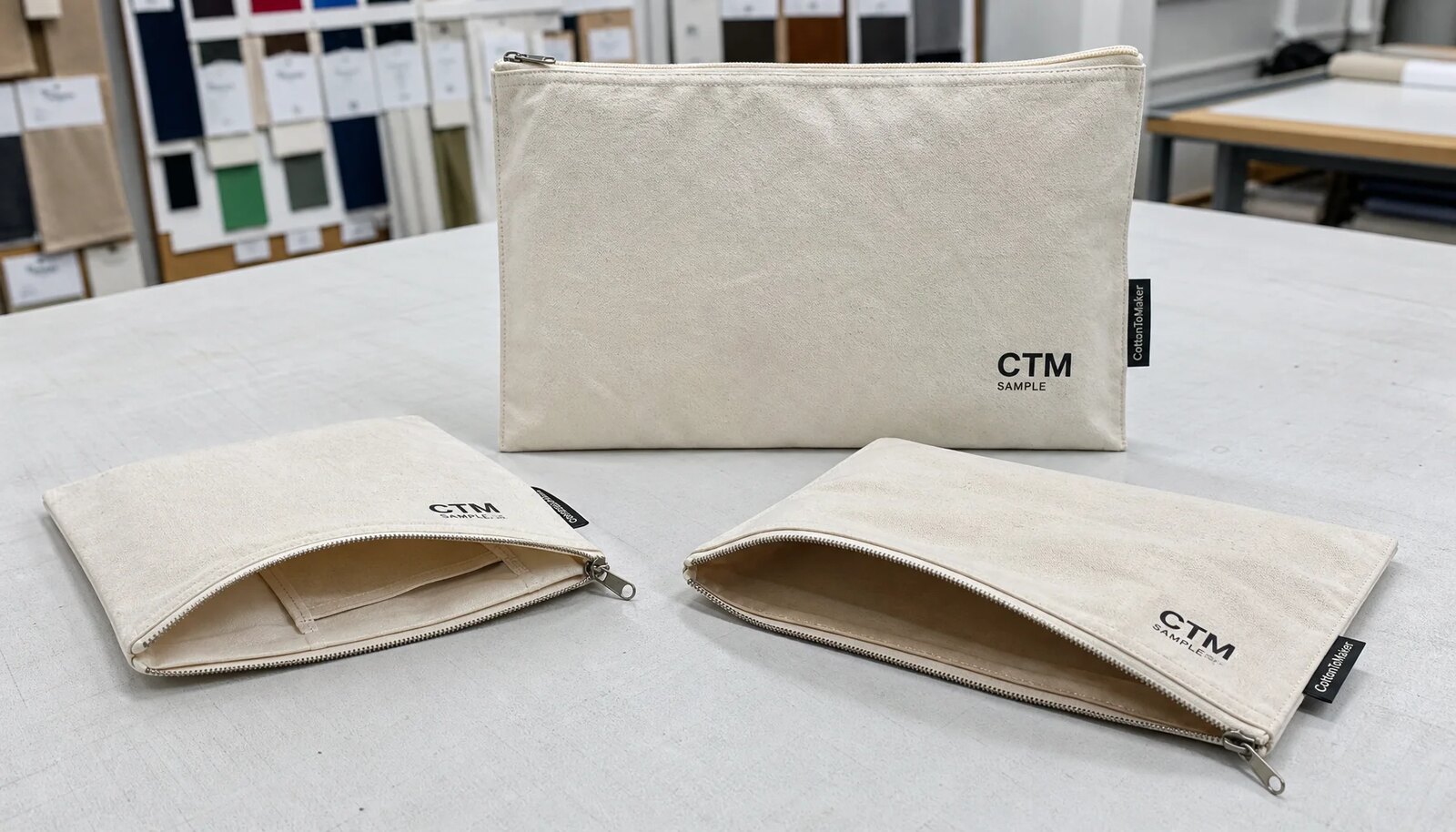
A canvas zipper portfolio looks simple in a catalog: flat body, zipper top, logo on the front. In production, it behaves more like a lightweight business bag than a basic pouch. Craft fair buyers may use the same shape as retail merchandise, an exhibitor welcome folder, a wholesale line-sheet holder, a sponsor giveaway, or a distributor sample kit. Each use changes the right fabric weight, zipper grade, seam finish, logo method, packing style, and inspection standard.
The quoting problem is that two suppliers can describe very different items with nearly identical names. One may price an 8 oz unlined portfolio with a No. 3 zipper and bulk packing. Another may price a 12 oz lined version with a No. 5 zipper, bound pocket edge, screen print, barcode sticker, and individual sleeve. Those are not comparable products.
For a practical RFQ, separate the buying decision into measurable points: fabric weight, measurement stage, finished size, usable interior, zipper opening, trim grade, decoration method, packing, and QC criteria. This keeps the discussion focused on how the portfolio will be handled, sold, filled, and inspected.
- Use 10 oz to 12 oz canvas as the default range for most reusable craft fair portfolios.
- Use 8 oz to 10 oz only for light document sleeves, budget giveaways, or short-use event kits.
- Use 12 oz to 14 oz for premium resale only after checking sewing bulk, zipper function, creasing, and carton weight.
- Treat lining, zipper, logo, and packing as cost drivers, not small finishing details.
Fabric Weight and GSM: Use Both Units
Canvas is often quoted in ounces per square yard, while mills and export factories also use GSM. For RFQs, use both. The rough conversion is 1 oz per square yard equals about 33.9 GSM. That makes 8 oz about 271 GSM, 10 oz about 339 GSM, 12 oz about 407 GSM, and 14 oz about 475 GSM.
The number is only useful if the measurement stage is clear. Greige, dyed, washed, coated, and finished weights may not behave the same. A washed 12 oz cotton canvas may feel softer and show more shade variation than an unwashed one. A coated canvas may feel firmer at a similar GSM. If the quote does not state measurement stage, suppliers may appear aligned while offering different materials.
Composition should also be written plainly. 100% cotton canvas gives the natural hand feel many maker-market brands want, but it can wrinkle, shrink, and show slubs. Cotton-poly blends may improve dimensional stability, but they may not support a natural cotton positioning. Recycled, organic, undyed, or other material claims should be supported with the documents your sales channel requires.
- 8 oz canvas: about 271 GSM; best for light sleeves and lower-cost promotions.
- 10 oz canvas: about 339 GSM; a useful value range for event and exhibitor programs.
- 12 oz canvas: about 407 GSM; stronger retail hand feel for reusable portfolios.
- 14 oz canvas: about 475 GSM; test for corner bulk, zipper strain, freight weight, and carton marks.
- Ask for composition, weave, finish, color method, shrinkage expectation, and approved swatch reference.
Choose the Weight by What Goes Inside
The best fabric weight depends on the load. A one-day exhibitor kit may hold a map, booth rules, badge, and sponsor card. A resale portfolio will be opened repeatedly and judged on hand feel, logo clarity, seam alignment, and interior cleanliness. A maker wholesale portfolio may carry order forms, catalog pages, price cards, swatch cards, sticker sheets, and business cards across multiple shows.
For event-kit distribution, 10 oz canvas with a No. 5 zipper and simple unlined or bound-seam construction often gives the best balance. It feels more substantial than thin promotional cotton without pushing cost and carton weight too high. For resale, 12 oz canvas, cleaner seam standards, accurate logo placement, and protective packing become more important.
Before approving the pattern, load the sample with real contents. Close the zipper, carry it, lay it flat, and remove the contents. If corners bend, the zipper strains, or the front panel distorts around the logo, fabric weight alone is not the fix. You may need a larger pattern, longer opening, revised seam allowance, flatter pocket design, or different corner shape.
- Sponsor giveaway: prioritize working zipper, clean print, and controlled cost over heavy fabric.
- Exhibitor kit: use a simple 10 oz to 12 oz build and avoid unnecessary internal layers.
- Retail resale: favor 12 oz hand feel, clean stitching, lower visible-defect tolerance, and protected packing.
- Wholesale line-sheet use: test actual paper stacks, price cards, and swatch inserts before approving size.
- Premium reusable portfolio: validate 12 oz to 14 oz samples while filled and after carton packing.
Size, Fit, and Tolerance Need Separate Lines
“A4 size” or “letter size” is not enough. Seam allowance, zipper tape, binding, lining, rounded corners, and short zipper openings all reduce usable space. A portfolio can meet the exterior drawing and still fail to hold the buyer’s catalog or rigid insert without bending.
For US letter documents, buyers often start around 13 x 10 in or slightly larger. For A4, a common starting point is around 34 x 26 cm or larger. These are not universal patterns; paper stacks, catalogs, swatch boards, and badges need different clearance. If inserts must remain flat, the usable interior should be larger than the insert, not equal to it.
For many flat sewn canvas portfolios, a finished size tolerance around +/- 5 mm is practical. Tighter control may be possible with stable fabric and a simple pattern, but washed cotton, heavy canvas, lining, binding, and manual sewing add variation. Logo placement should be specified separately, commonly around +/- 3 mm to +/- 5 mm when measuring points are defined.
- Define exterior size, usable interior size, zipper opening length, content thickness, and corner shape.
- State whether measurements are edge to edge, seam to seam, or measured after the product is sewn flat.
- Use about +/- 5 mm finished size tolerance unless sampling proves tighter control is realistic.
- Set logo tolerance separately and define the measuring points from edges or seams.
- Approve fit with buyer-supplied contents before bulk cutting.
Construction Choices That Change the Quote
Construction can move the unit price as much as fabric weight. An unlined portfolio with overlocked seams is faster to cut, sew, inspect, and pack than a lined portfolio with a slip pocket, binding, woven label, branded puller, barcode, and retail sleeve. If the RFQ does not define construction, the lowest quote may simply be a simpler product.
Unlined construction can fit craft fair positioning, especially when the brand wants a natural workshop look. But unlined should not mean raw or messy. Seams need overlocking, binding, turning, or another controlled finish so loose fibers and thread ends do not catch documents. Bound seams give a cleaner interior without the full cost of lining, though they add labor and corner thickness.
Lining gives a more finished retail interior. A 150D to 210D polyester lining is a common light bag-interior range because it is smooth and stable. Cotton lining can support a natural material story, but it may wrinkle, shrink, or shade differently from the shell. Pockets should earn their place: one flat slip pocket or card pocket is useful; bulky gusseted pockets add layers, stitch risk, and zipper stress.
- Unlined: lower cost, but still needs controlled seam finishing and thread trimming.
- Overlocked seams: economical; inspect for loose yarns and paper-catching edges.
- Bound seams: cleaner interior; watch for corner bulk and uneven binding.
- Polyester lining: cleaner retail feel; adds color, sagging, seam, and inspection controls.
- Flat pockets: useful for cards and order forms; gusseted pockets should be contents-tested.
Zipper and Trim Details Are Functional Specs
The zipper is the main working component, not just trim. For document-size canvas zipper portfolios, a No. 5 nylon coil zipper is a practical default. It is stronger than many No. 3 zippers, flexible enough for flat portfolios, and widely available. A No. 3 zipper may work for a very light sleeve, but it can feel weak when paired with heavier canvas or filled document stacks.
Specify zipper tape color, slider type, puller material, puller finish, zipper length, end-stop method, and any branded tab. A metal puller can look more premium, but plating quality matters on natural canvas because poor plating or sharp edges can stain or damage the fabric. Custom tape colors, custom pullers, and branded metal trims should be quoted separately because they may trigger trim MOQ, tooling, or longer lead time.
Inspect the zipper ends closely. This is where canvas, zipper tape, lining, binding, and seam allowance stack together. Heavy layers can create skipped stitches, broken thread, uneven corners, and zipper catching if the machine setup is wrong. Test the sample empty and filled; a product photo cannot prove zipper reliability.
- Specify No. 5 nylon coil zipper unless a tested design reason supports another size.
- Define tape color, slider, puller material, finish, zipper length, and end-stop reinforcement.
- Quote custom pullers and custom zipper colors separately from the base price.
- Test zipper operation with expected contents inside, not only when empty.
- Inspect end stops for skipped stitches, weak backstitching, rough pullers, and uneven bulk.
Logo Method, Strike-Offs, and Version Control
Logo method should be chosen after reviewing fabric weight, weave texture, artwork detail, and order split. Screen printing is usually the practical option for bold one- to three-color artwork on 10 oz to 12 oz canvas. It works well for craft fair names, maker-market logos, sponsor marks, and simple brand graphics. Fine text and thin lines are harder because canvas texture can break detail.
Heat transfer can reproduce finer artwork, but it needs adhesion, edge-lift, bend, rub, and surface-feel checks on final canvas. Some transfers look crisp but feel too plastic for a natural cotton product. Embroidery can look premium, but on flat portfolios it may pucker lighter fabric, expose backing threads inside, and create a raised area that is not ideal for document storage. Woven labels and side tabs are useful when the same base product will be reordered with limited artwork change.
Version control matters in event programs. One order may include several fair names, sponsor logos, dates, cities, or retail SKUs. Each version can require separate screens, transfers, labels, packing labels, barcodes, and carton marks. Provide quantity by version and require separation during printing, sewing, final inspection, and packing.
- Use screen print for bold logos, event names, sponsor marks, and simple 1-3 color artwork.
- Use heat transfer only after adhesion, bend, rub, and edge-lift checks on final fabric.
- Test embroidery for puckering, back-thread exposure, and suitability for a flat document product.
- Set minimum text height and line width after reviewing the production-fabric strike-off.
- Define print size, Pantone references, placement from edges, and placement tolerance before sampling.
- List every artwork version and quantity so setup costs and packing controls are clear.
MOQ, Price Breaks, and Landed-Cost Reality
MOQ is tied to more than factory preference. Fabric purchase quantity, dye lot, cutting efficiency, zipper tape color, lining color, labels, print setup, packing labor, and carton sorting all affect minimums. A 2,000-piece order split across four canvas colors, three zipper colors, six logo versions, and two packing formats is not one efficient run; it is a set of small runs.
A useful quote separates the base portfolio from decoration and packing variables. The base MOQ may apply to one fabric color, one zipper color, and one construction. Logo versions may carry separate setup charges or print minimums. Labels, hangtags, custom pullers, barcode stickers, retail sleeves, and belly bands may each have their own minimum or surcharge.
For landed cost, request carton data early. Example: if a 10 oz unlined portfolio packs 100 pieces per carton and a 12 oz lined version packs 60 pieces per carton, the heavier option may increase freight and handling even before unit price is considered. If individual retail sleeves reduce carton count again, the true cost gap widens. Ask for estimated carton dimensions, gross weight, pieces per carton, and packing method at quote stage, then update them after pre-production approval.
- Request realistic price breaks such as 500, 1,000, 2,500, and 5,000 pieces if they match your program.
- Separate MOQ by canvas color, zipper color, lining color, label design, print version, and packing format.
- Ask for setup charges for screens, transfers, woven labels, custom pullers, hangtags, and barcode versions.
- Confirm whether custom fabric color or zipper tape color triggers dye MOQ, lab dips, surcharges, or longer lead time.
- Compare FOB or EXW pricing with carton dimensions, gross weight, pieces per carton, and packing method.
Sampling Before Bulk Cutting
A showroom sample is only a starting point. It may use available fabric, a generic zipper, simplified logo, convenient lining, or a different seam finish. A pre-production sample should use the final canvas weight, fabric color, zipper grade, lining or seam finish, logo method, label, packing format, and carton direction whenever possible.
The most useful test is low-tech: load the sample with real contents. Use the buyer’s line sheets, catalogs, order forms, sticker sheets, badges, swatch cards, rigid inserts, or tablet insert. Open and close the zipper repeatedly. Check whether contents bend, corners strain, the logo distorts, or the zipper catches at bulky ends. Operate the zipper at least 20 cycles on the sample, including several cycles while filled.
Approval records should be inspection-ready. Photograph the sample with a ruler at key points. Record exterior dimensions, usable interior dimensions, zipper opening length, logo placement, seam finish, zipper end construction, lining, pocket placement, and packing direction. Keep the approved fabric swatch and print strike-off with the sample. If any major spec changes after approval, update cost, lead time, and QC criteria before cutting.
- Approve a pre-production sample before bulk cutting, especially for first orders or new weights.
- Measure exterior size, usable interior size, zipper opening, logo placement, and pocket position.
- Run a filled contents test using actual buyer documents and inserts.
- Operate the zipper at least 20 times and inspect both end stops.
- Rub and lightly bend the print area to check transfer, cracking, peeling, and weak opacity.
- Pack several samples in the proposed direction to check zipper-pull dents and crease marks.
QC Thresholds and Defect Classification
Quality control should not rely on comments like “good stitching” or “premium feel.” Natural canvas may include minor slubs or texture variation, but oil stains, mildew odor, dampness, fabric holes, broken stitches, jammed zippers, and wrong artwork versions need clear classification. Retail resale programs usually need tighter appearance standards than internal event kits, but both require correct size, safe trims, working zippers, clean interiors, and accurate SKU packing.
AQL inspection can be used, but the defect list should match the product. Critical defects include unsafe sharp trim, mold, strong chemical or mildew odor, broken zipper function, or contamination that makes the item unusable. Major defects include wrong fabric, wrong size that prevents document fit, wrong logo version, severe logo misplacement, open seams, heavy stains, missing labels, incorrect carton marks, or mixed SKUs. Minor defects may include small thread ends, slight approved slubs, or minor shade variation within the agreed standard.
Inspection should cover incoming material, in-line sewing, final appearance, function, and packing. Fabric weight and shade should be checked against the approved swatch. Zippers should be opened and closed across the full length. Logos should be reviewed for placement, levelness, color, opacity, and version. Cartons should be checked for quantity, barcode, artwork version, moisture condition, and inner packing direction.
- Critical defects: unsafe trims, mold, strong odor, broken zipper, contamination, or unusable product.
- Major defects: wrong size, wrong fabric, wrong logo, open seam, heavy stain, severe print issue, or incorrect carton mark.
- Minor defects: small thread ends, slight approved slubs, or minor shade variation within the approved standard.
- Measure finished size and usable fit on sampled pieces, not only on the approved sample.
- Check zipper operation, end-stop stitching, seam strength, logo placement, print adhesion, and interior cleanliness.
- Verify carton quantity, barcode, SKU, artwork version, packing direction, and moisture condition before shipment.
Specification comparison for buyers
| Spec decision | Recommended option | When it fits | Buyer risk to check |
|---|---|---|---|
| Main canvas weight | 10 oz to 12 oz cotton canvas, about 339 to 407 GSM when measured as oz per square yard; state whether weight is greige, dyed, washed, coated, or finished | Most craft fair portfolios holding line sheets, order forms, price cards, badges, stickers, catalogs, and flat samples | If measurement stage is missing, suppliers can quote different fabrics under the same nominal weight |
| Budget fabric option | 8 oz to 10 oz canvas, about 271 to 339 GSM | Short-use exhibitor kits, sponsor giveaways, light document sleeves, or high-volume programs where unit cost and freight matter most | Can wrinkle, collapse, show contents, pucker under embroidery, or feel closer to a promo pouch than a reusable portfolio |
| Premium fabric option | 12 oz to 14 oz canvas, about 407 to 475 GSM; sample with final zipper, seam allowance, lining, and packing | Retail resale, premium maker kits, distributor samples, and reusable event merchandise | More seam bulk, slower sewing, heavier cartons, zipper-end stress, and possible carton compression marks |
| Finished and usable size | US letter: often 13 x 10 in or larger; A4: often 34 x 26 cm or larger; set finished size tolerance around +/- 5 mm unless testing supports tighter control | Programs where documents, catalogs, or rigid cards must stay flat | Exterior size alone does not prove fit; seam allowance, binding, lining, rounded corners, and zipper tape reduce capacity |
| Zipper specification | No. 5 nylon coil zipper with defined tape color, slider, puller, zipper length, end-stop method, and reinforcement stitching | Practical default for document-size flat canvas portfolios | No. 3 zippers may jam or feel weak when filled; poor plating can stain natural canvas |
| Interior construction | Unlined with overlocked or bound seams for value programs; 150D to 210D polyester lining for cleaner retail interiors | Unlined fits rustic craft positioning; lined fits resale and repeated handling | Raw edges, fraying, lining sag, loose threads, and trapped trims can catch papers or zipper teeth |
| Logo decoration | Screen print for bold 1-3 color artwork; heat transfer for fine detail after adhesion testing; woven label for repeat stock; embroidery only after pucker testing | Event branding, sponsor marks, resale, and distributor programs with artwork variations | Canvas texture can break fine text; require strike-offs on final fabric and set placement tolerance around +/- 3 mm to +/- 5 mm |
| Packing format | Bulk polybag for event distribution; individual sleeve, barcode, hangtag, or belly band for retail channels | Depends on whether the portfolio is handed out, kitted, resold, or shipped to stores | Retail packing adds labor, volume, SKU control, and carton-marking risk; bulk packing can cause crease or zipper-pull dents if poorly oriented |
Buyer checklist before sampling
- Define the end use: retail resale, exhibitor welcome kit, workshop folder, sponsor giveaway, distributor sample, internal sales tool, or maker wholesale portfolio.
- List actual contents and thickness: A4 sheets, US letter sheets, catalogs, line sheets, rigid inserts, sticker sheets, swatch cards, badges, tablets, or stacked documents.
- Specify finished exterior size, usable interior size, zipper opening length, corner shape, seam allowance, and measuring method.
- Set tolerances in writing; for many sewn canvas portfolios, use about +/- 5 mm for finished size and +/- 3 mm to +/- 5 mm for logo placement.
- State fabric in both oz per square yard and GSM, and identify whether the figure is greige, dyed, washed, coated, laminated, or finished weight.
- Confirm composition and claim requirements: 100% cotton, cotton-poly blend, recycled cotton blend, organic cotton, undyed cotton, or another certified material.
- Choose unlined, overlocked, bound seam, self-fabric lined, or polyester lined construction before comparing prices.
- Require zipper size, tape color, slider type, puller material, puller finish, zipper length, end-stop method, and reinforcement details.
- Provide vector artwork, Pantone references, print size, placement from edges, artwork-version quantities, and minimum readable text requirements.
- Request a strike-off on the final production fabric, not on paper, thin cotton, or a showroom swatch.
Factory quote questions to send
- What canvas weight are you quoting in oz per square yard and GSM, and is it measured before dyeing, after dyeing, after washing, after coating, or after final finishing?
- What is the fabric composition, and can you provide a swatch, composition report, or certification documents if required?
- What finished exterior size, usable interior size, zipper opening length, seam allowance, corner shape, and finished size tolerance are included?
- Will the quoted size fit A4 or US letter documents after seam allowance, zipper tape, binding, lining, and packing are considered?
- Which zipper size, tape color, slider type, puller material, puller finish, end-stop method, and zipper supplier grade are included?
- Is the unit price for unlined, overlocked seam, bound seam, self-fabric lined, or fully lined construction?
- If lining is included, what lining fabric, denier, GSM, color, seam method, and colorfastness controls are quoted?
- Which logo method is included, how many colors are included, what is the maximum printable area, and what are the setup costs by artwork version?
- Can you produce a strike-off on the final canvas weight and color, and what minimum line width and text height do you recommend for this weave?
- What are the estimated pieces per carton, carton dimensions, gross weight, packing method, and carton-marking plan for each SKU or artwork version?
Quality-control points to confirm
- Fabric weight should be checked against the approved swatch or lab reference with a written tolerance; hand feel alone is not enough.
- Finished size should be measured flat after sewing and normal relaxation using agreed measuring points.
- Usable interior dimensions and zipper opening length should be checked separately from exterior dimensions.
- Zipper must open and close smoothly across the full length with no catching, splitting, misaligned coil, missing puller, sharp edge, weak end stop, or loose zipper tape.
- Zipper-end reinforcement should be inspected for skipped stitches, broken thread, bulky corners, and weak backstitching.
- Main seams should have consistent stitch density, straight alignment, secure backstitching, no skipped stitches, no broken thread, and no open seams at stress points.
- Logo placement should remain within the approved tolerance and must be level against the agreed measuring points.
- Printed logos should be inspected for color match, opacity, pinholes, blurred edges, incorrect scale, cracking, peeling, and ink transfer after light rub and bend checks.
- Natural canvas should be checked for oil marks, water stains, mildew odor, dampness, dirty handling marks, severe dark slubs, unacceptable shade bands, and fabric holes.
- Interior seams, lining, and pockets should be free of loose threads, frayed raw edges, sharp trims, trapped fabric, and excess seam bulk that can catch paper or zipper teeth.