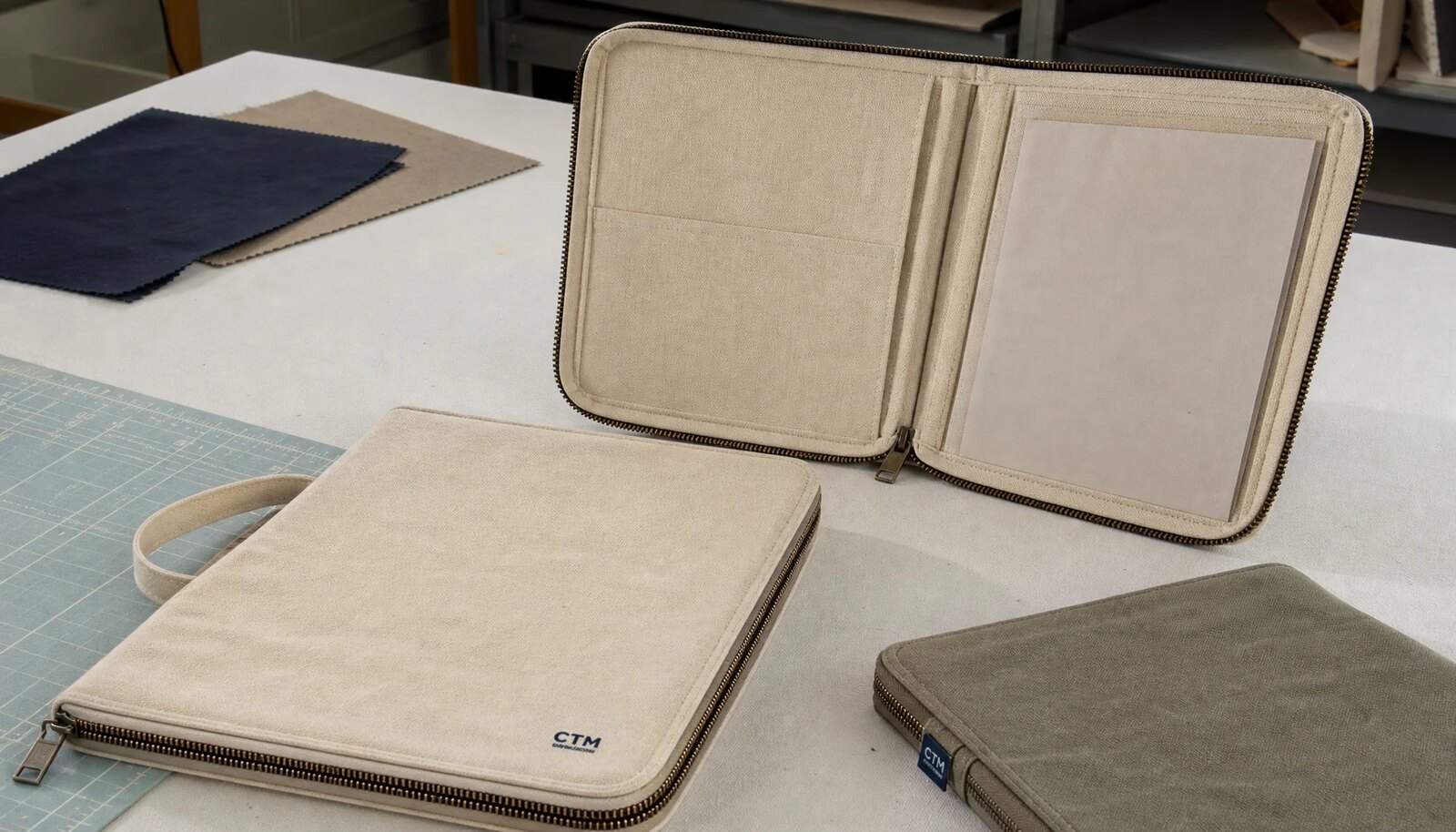
Procurement Context: Specify a Light Business Bag
Canvas zipper portfolios used at craft fairs are not just flat stationery folders. They hold order forms, vendor contracts, receipts, catalogs, sticker sheets, swatches, pens, booth notes, and sometimes small samples. They are opened often, packed in cartons, stacked in storage, and carried between booth, car, and check-in table. That use pattern makes zipper corners, zipper-end seams, pocket seams, printed panels, handles, and carton pressure points the areas most likely to fail.
For a B2B buyer, the useful work is converting appearance language into measurable requirements. Sturdy canvas becomes finished GSM, weave appearance, shrinkage expectation, shade standard, and defect limits. A good zipper becomes zipper type, size, slider, puller, end tabs, stop method, and filled-use function checks. A clean logo becomes artwork size, placement tolerance, color standard, rub test, adhesion check, and sample approval rules.
Start the RFQ by defining the commercial role of the item. A sponsor giveaway may prioritize price and a clean one-color print. A reusable vendor kit needs better zipper ends, reliable document fit, and more practical packing. A retail-ready portfolio may need lining, barcode labels, hangtags, and tighter appearance control.
- Define the use: giveaway, reusable vendor kit, retail product, or premium branded organizer.
- Map stress points: zipper corners, zipper ends, side seams, pocket seams, handle bartacks, printed panels, and carton pressure areas.
- Compare quotes only after matching finished size, materials, logo method, packing, carton data, and inspection rules.
- Approve the sample filled, opened, closed, stacked, and packed before bulk cutting starts.
Canvas Specification: Weight, Weave, and Surface
Canvas weight matters, but ounce weight alone is not a durability standard. A tightly woven 12 oz canvas can feel firmer than a loose 14 oz canvas. Washing can soften the hand feel. Coating or lamination can add body but may change sewing behavior and logo adhesion. Ask for both oz and GSM, and confirm whether the quoted value refers to greige fabric, dyed fabric, washed fabric, coated fabric, or finished bulk fabric.
Supplier-dependent starting examples are useful when treated as guidance, not rules. A 10-12 oz canvas may work for light promotional portfolios. A 12-14 oz canvas is often a practical target for reusable craft fair paperwork folders. A 14-16 oz canvas can support premium positioning when the pattern, zipper, and sewing are also upgraded. In GSM terms, many cotton canvas options in this range may land roughly around 380-540 GSM after finishing, but fabric construction and finish affect the result.
Fabric appearance must be approved before bulk. Natural cotton canvas may show seed specks, slubs, and yarn variation. Dyed canvas needs lab dip approval and shade control. If the front panel carries a printed logo, check hairiness and slub level because both affect edge sharpness and ink coverage.
- Economy target: 10-12 oz canvas for low-load document storage or short event programs.
- Balanced target: 12-14 oz canvas with reinforced zipper ends for reusable vendor paperwork portfolios.
- Premium target: 14-16 oz canvas with lining or light interlining for retail shelves and giftable kits.
- Fabric controls: finished GSM near +/-5%, approved shade range, slub standard, and shrinkage expectation.
- Print surface check: test the final logo on final canvas color and finish, not on substitute fabric.
Zipper Specification: Function Before Finish
The zipper is the first functional signal of quality. If it catches, separates, or needs force, users judge the whole portfolio as weak. Specify zipper type, size, tape color, teeth color, slider material, puller shape, zipper length, end stop method, and corner path. For many document portfolios, a No.5 nylon coil zipper is a practical default because it usually handles repeated opening and curved corners better than rigid alternatives.
Metal zippers can create a premium look, but they are not automatically stronger for this construction. Metal teeth can feel less flexible around corners, and heavier pullers can press into canvas panels during packing. Resin zippers may add bulk. The correct zipper is the one that runs smoothly on the final pattern with expected contents inside.
Small quote omissions can explain large price gaps. One supplier may include fabric zipper-end tabs, stronger sliders, clean stops, and a controlled corner radius. Another may use a basic slider, no end tabs, and a sharper corner that looks acceptable in photos but binds when filled.
- Default option: No.5 nylon coil zipper, approved slider, fabric end tabs, reinforced stops, and controlled tape color.
- Premium option: metal zipper only after testing corner movement, puller comfort, panel dent risk, and packing abrasion.
- RFQ detail: require zipper length, slider material, puller shape, tape color, teeth finish, and end stop construction.
- Pass condition: filled portfolio opens and closes through the full path without binding or tooth separation.
- Major defect trigger: broken puller, separated teeth, deformed slider, unusable zipper, or open seam at the zipper end.
Size and Layout: Measure Usable Clearance
Outside dimensions do not prove the portfolio will hold the buyer's documents. A4 and US letter are close enough to create sourcing mistakes and different enough to cause complaints. A4 is taller and narrower; US letter is wider and shorter. Zipper tape, seam allowance, lining thickness, interlining, and canvas bulk all reduce usable space after sewing.
A practical starting point is 15-25 mm of internal clearance beyond the intended paper size on both length and width after sewing and finishing. Add more if the portfolio must hold catalogs, swatch cards, order pads, sticker sheets, receipt books, business cards, or sample bundles. If contents are thicker than about 10-15 mm, test the item as a loaded organizer instead of a flat sleeve.
Interior features can add buyer value but also add labor and tolerance risk. A simple slip pocket may be enough for many craft fair programs. Multiple dividers, pen loops, mesh pockets, elastic bands, and tool slots increase cost and can distort the outer panel if the pattern is not engineered well.
- A4 program: confirm internal height, internal width, and zipper opening after sewing, lining, and finishing.
- US letter program: check width carefully because an A4-based pattern may be too narrow for US letter contents.
- Swatch program: test the thickest card bundle and confirm closure without forcing the slider.
- Tolerance target: use +/-5 mm for finished length and width unless inserts or fixtures require tighter control.
- Layout control: specify pocket count, pocket size, pen loop position, label placement, and whether pocket stitching may show outside.
Branding Method: Test on Final Canvas
Branding affects construction, cost, inspection, and complaint risk. Screen printing is efficient for simple logos, sponsor marks, event graphics, and distributor branding. It works best with solid color areas and should be placed away from thick seams, zipper edges, and heavy fold zones. State artwork size, placement from edges, color standard, number of colors, ink type, and placement tolerance.
Heat transfer can handle detailed multi-color artwork, but textured canvas makes testing important. Check edge lift, bubbles, gloss inconsistency, cracking, and poor adhesion around yarn texture. Embroidery gives a textile feel, but dense stitching can pucker canvas unless backing, stitch density, and placement are controlled. Woven labels are durable and retail-friendly, but they add MOQ, lead time, and sewing tolerance.
Separate branding costs in the quote. Screen charges, transfer film, embroidery digitizing, woven label MOQ, custom puller tooling, label sewing, hangtag application, and barcode labeling can change the true unit cost. Do not approve bulk from a digital mockup alone.
- Screen print: best for 1-3 solid colors; check registration, dry rub, light wet rub, edge sharpness, and bend-area cracking.
- Heat transfer: best for detailed artwork; check edge lift, bubbles, gloss, cracking, and adhesion on textured yarns.
- Embroidery: best for premium texture; control backing, stitch density, placement, puckering, and distance from stress zones.
- Woven label: best for understated branding; confirm label MOQ, size tolerance, sewing position, and thread color.
- Placement tolerance: commonly set logo position within +/-3 mm to +/-5 mm depending on artwork size and retail needs.
MOQ and Quote Comparison: Normalize the RFQ
MOQ is supplier-dependent and usually comes from materials, trims, setup time, and production scheduling. Stock natural canvas, standard No.5 zipper, one-color screen print, and standard flat packing can support lower starting quantities with some suppliers. Dyed canvas, custom zipper tape, metal pullers, woven labels, custom lining colors, retail hangtags, and multi-color artwork often push practical MOQ higher because upstream suppliers have their own minimums.
Photos can make two quotes look identical when the builds are different. One supplier may include cotton lining, zipper tabs, an inner pocket, individual bags, barcode labels, export cartons, and one sample revision. Another may quote an unlined shell with a basic zipper and bulk packing. Heavy canvas, lining, binding, bartacks, pockets, and stricter inspection all add labor time.
Ask suppliers to separate inclusions, exclusions, and optional upgrades. This helps procurement decide where durability is worth the spend. Zipper-end tabs, better sliders, a slight canvas upgrade, interleaving in cartons, or stronger handle stitching may cost less than post-delivery sorting or zipper complaints.
- Lower MOQ profile: stock natural canvas, standard zipper, simple flat design, one-color print, and standard cartons.
- Higher MOQ profile: dyed canvas, custom zipper tape, metal pullers, woven labels, custom lining, or split color assortments.
- Labor drivers: lining, interlining, binding, pockets, handles, bartacks, hangtags, individual packing, and stricter inspection.
- Quote rule: compare lined to lined, zipper tab to zipper tab, same logo method to same logo method, and same packing to same packing.
- RFQ action: request base price plus optional upgrade prices for zipper, lining, handle, label, packing, and inspection support.
Pre-Production Sample Approval: Verify the Real Build
A pre-production sample should prove the product, not just the appearance. If the sample uses substitute canvas, a temporary zipper, missing lining, wrong thread, or a mock logo method, treat it as a development sample only. Bulk should start after approval of a sample made with final canvas, final zipper, final lining or interlining, final thread, final logo method, final label, final handle if used, and intended packing.
Test the sample the way a craft fair vendor will use it. Load the portfolio with intended contents. Open and close the zipper repeatedly. Watch the corners, zipper tape, slider force, end seams, and document corners. Stack samples or apply moderate pressure to simulate carton packing. If there is a handle, lift the filled sample and inspect bartacks, webbing ends, stitch holes, and fabric tearing.
Record approval with measurements and photos. Measure finished length, finished width, internal clearance, zipper opening, pocket position, logo position, stitch density, and carton condition. Keep one sealed approved sample with the buyer and one with the factory. If anything changes, update the version date.
- Measurement check: outside length and width, internal clearance, zipper opening, pocket position, handle position, and logo distance from edges.
- Function check: load with intended contents and close without forcing, slider bending, tooth separation, or corner crushing.
- Appearance check: shade, slubs, stains, panel flatness, stitch quality, loose threads, zipper tape waviness, odor, and label position.
- Logo check: dry rub, light wet rub, tape adhesion where suitable, bend review, transfer edge review, and normal-light inspection.
- Control sample: seal and label approved samples with date, version, material notes, and buyer sign-off before bulk cutting.
Durability Testing Checklist: Use AQL and Pass-Fail Rules
Durability testing does not need to be complicated, but it must be repeatable. Separate design validation from shipment inspection. Sample approval can use more cycles because it proves the construction. Final inspection should follow the buyer's AQL plan for visual and measurement checks, with added functional tests written into the PO.
For sample approval, test at least 3 finished samples made with final materials. Load each with the intended paper or swatch stack, or a defined equivalent. Run 100 open-close zipper cycles per sample, including full movement around corners. Pass if there is no tooth separation, broken puller, slider deformation, zipper-end seam opening, or function change that requires unusual force. Retail reusable programs may require a higher cycle count before final approval.
For final inspection, sample quantity should not look arbitrary. Use ANSI/ASQ Z1.4 or ISO 2859-1 to define inspection level and acceptable quality limits for the lot size. Many buyers use General Inspection Level II for visual inspection, with agreed AQLs by defect class, then add special functional checks such as zipper cycles, handle load, and print rub on a smaller random subset. Pull units from different cartons and production portions, not only top-layer goods.
- AQL setup: define inspection standard, inspection level, lot size, defect classes, and accept-reject numbers before production.
- Zipper sample test: 3 final-material samples, 100 filled cycles each; pass means smooth glide, no separation, no broken puller, and no end seam opening.
- Zipper final check: random subset from the AQL-selected cartons, often 5-8 units for small to mid lots; run 20 filled cycles each and fail unusable zippers as major defects.
- Document-fit check: measure AQL-selected units or an agreed subset; intended contents must insert and remove without curled corners or forced closure.
- Handle load check: 3 samples or buyer-approved subset, target content weight plus agreed margin for 60 seconds; pass means no torn fabric, loose bartacks, or webbing pullout.
- Print rub check: 3-5 units with dry white cloth and lightly damp cloth; pass means no heavy transfer, peeling, smear, or visible cracking beyond the approved sample.
Packing, Lead Time, and Shipment Control
Canvas zipper portfolios are usually packed flat, but flat packing still needs rules. Too many units in one carton can press zipper teeth or pullers into front panels. Over-compression can curl corners, distort interlining, and make retail-ready goods look used. Individual polybags may reduce dust and moisture exposure, but they add plastic and may conflict with sustainability policies. Paper sleeves, belly bands, glassine bags, or controlled bulk packing can work if abrasion, moisture risk, and barcode readability are tested.
Carton data belongs in the quote. Ask for units per inner pack, units per master carton, carton dimensions, gross weight, carton board strength, carton markings, barcode label placement, and whether interleaving is required. A practical gross weight limit helps warehouse handling and reduces damage from drops or crushing. If the portfolio uses metal pullers, protect or position them so they do not dent adjacent panels.
Lead time is also supplier-dependent. Treat any range as an example until the factory confirms sample development, material purchase, dyeing, lab dips, print setup, woven label production, custom puller tooling, cutting, sewing, packing, final inspection, and export handover. Stock materials can move faster after sample approval. Custom colors, custom trims, retail packaging, and multi-color logos need more buffer.
Turn the checklist into shipment control. In-line checks confirm bulk size, zipper smoothness, fabric shade, logo placement, and stitch density before the whole lot is finished. Final random inspection confirms shipped goods match the approved sample and PO. Defect classification keeps decisions clear: broken zipper, document-fit failure, wrong logo, open seam, mold, severe stain, wrong barcode, and wrong carton count should not be treated like minor loose threads.
- Packing spec: define inner count, master carton count, carton dimensions, gross weight limit, board strength, markings, and barcode placement.
- Shape control: require flat packing without forced compression, severe corner curling, zipper dents, or puller impressions on visible panels.
- Schedule control: separate sample lead time, revision time, material procurement, production, packing, inspection, and export handover.
- Final QC record: require photos, measurement table, zipper test notes, print test notes, carton photos, defect list, and pass-fail conclusion.
- Freight planning: request carton cube and gross weight with the quote so landed cost and warehouse handling can be estimated early.
Specification comparison for buyers
| Build or supplier quote type | Typical starting MOQ logic | Cost and lead-time impact | Best fit | Tradeoffs to verify |
|---|---|---|---|---|
| Stock canvas economy quote | Supplier-dependent MOQ may be more flexible when using natural canvas, standard No.5 nylon coil zipper, no lining, and one-color print; some suppliers may discuss 300-500 pcs | Usually the fastest path after artwork approval because materials and trims are standard; cost stays lower if pockets, handles, and retail packing are removed | Short craft fair campaigns, sponsor giveaways, vendor paperwork folders, and light document storage | Confirm finished GSM, zipper-end reinforcement, document fit, print rub resistance, carton compression, and whether packing is bulk or individual |
| Balanced reusable vendor quote | Often easier around 500-800 pcs when using stock fabric with custom logo and standard trims; exact MOQ depends on supplier workload and trim availability | Moderate cost increase from stronger zipper parts, reinforced ends, inner pocket, better stitch control, and clearer inspection standard | Reusable craft fair organizer kits, distributor onboarding packs, branded business bags, and repeat event programs | Verify zipper tabs, pocket seams, +/-5 mm size tolerance, sample cycle testing, logo placement tolerance, and carton count |
| Retail-ready premium quote | May require 800-1,000+ pcs when adding lining, interlining, woven label, hangtag, barcode label, retail sleeve, or custom color | Higher labor and trim cost; extra time for lab dips, label production, packaging artwork, and sample revisions | Retail stationery assortments, giftable vendor kits, boutique merchandise, and premium branded portfolios | Watch panel waviness, interlining bubbling, crooked labels, print or embroidery puckering, and retailer packing requirements |
| Custom color assortment quote | MOQ is driven by fabric dyeing, zipper tape, lining, trim, and color split minimums; small color splits can raise unit cost | Longer timeline for lab dips, bulk shade approval, material booking, cutting loss, and carton assortment control | Brand campaigns with strict color matching, seasonal assortments, private label programs, and retail display sets | Control shade range, shrinkage, finished GSM, colorfastness checks, carton assortment, and leftover trim risk |
| Heavy-duty handled quote | MOQ depends on handle webbing, reinforcement pattern, bartack setup, and whether webbing color is standard or custom | Cost rises from webbing, reinforcement patches, bartacks or box-X stitching, and extra load testing | Vendor kits carried between booth, car, storage, and check-in tables; higher perceived value business bag programs | Handles invite overloading; set realistic load weight, test seam tearing, inspect bartacks, and avoid approving by appearance only |
| Logo-focused promotional quote | MOQ depends on print method, color count, artwork size, setup charges, and whether the supplier stocks suitable print-ready canvas | Screen print is usually efficient for simple marks; transfers, embroidery, woven labels, and patches add setup time and inspection points | Sponsor programs, event merchandise, distributor branding, and low-to-mid complexity private label orders | Confirm final logo method, placement tolerance, rub or adhesion checks, color standard, and whether setup charges are included |
| Packing-sensitive retail quote | MOQ may be affected by barcode labels, hangtags, belly bands, paper sleeves, insert cards, and carton assortment rules | Packing adds labor, artwork approval, carton planning, and possible material lead time; it can also reduce returns if specified well | Retail shelves, ecommerce prep, warehouse-ready assortments, and multi-SKU programs | Verify carton count, gross weight, board strength, label position, scannability, compression marks, and plastic-free requirements |
Buyer checklist before sampling
- Define the use case: craft fair vendor paperwork, retail resale, sponsor giveaway, onboarding kit, reusable booth organizer, or premium branded business bag.
- State finished outside dimensions, required internal clearance, zipper opening length, and the exact paper size or loaded sample stack to fit.
- Specify canvas weight in oz and GSM, and confirm whether the quoted value is greige, dyed, washed, coated, pre-shrunk, or finished bulk fabric.
- Set fabric controls: finished GSM tolerance near +/-5%, approved shade standard, shrinkage expectation, acceptable slub level, and rejectable stains or weaving faults.
- Specify zipper type, size, tape color, teeth color, slider material, puller shape, zipper length, end tabs, end stops, and corner sewing method.
- Set finished size tolerance, commonly +/-5 mm for length and width unless a retail insert, organizer insert, or display fixture requires tighter approval.
- Confirm seam allowance, stitch-density target such as 7-9 stitches per inch where suitable, thread color, bartack positions, and raw-edge finishing.
- Clarify all quote inclusions: lining, interlining, binding, inner pocket, pen loop, handle, woven label, hangtag, barcode label, individual bag, and carton markings.
- Approve logo method, artwork size, edge distance, color standard, placement tolerance, ink or transfer type, and rub or adhesion checks before bulk.
- Require pre-production samples made with final canvas, zipper, lining, thread, logo method, labels, handle if applicable, and intended packing.
Factory quote questions to send
- What finished GSM and oz weight are you quoting after dyeing, washing, coating, or finishing, and what bulk tolerance do you control?
- Is the canvas natural, bleached, dyed, pigment dyed, enzyme washed, coated, laminated, or pre-shrunk, and can you provide a swatch or lab dip before sampling?
- What shrinkage rate should we expect, and how will cutting dimensions protect the approved internal clearance?
- What yarn count or weave density is available, and is the surface suitable for the requested logo method and artwork size?
- Is the zipper No.5 nylon coil, resin, or metal, and which tape color, teeth color, slider material, puller design, and length are included?
- Do zipper ends include fabric tabs, reinforced stops, or special corner construction, and how do you prevent binding at corners?
- What finished size tolerance, logo placement tolerance, stitch-density tolerance, and shade tolerance do you normally accept for this product?
- Does the quoted price include lining, interlining, binding, inner pocket, pen loop, woven label, handle, hangtag, barcode label, and individual packing?
- What logo method is priced, how many colors are included, what setup charges apply, and what rub, adhesion, or bend tests can you support?
- What MOQ applies separately for stock canvas, dyed canvas, zipper tape, custom puller, woven label, custom lining, packaging, and mixed color assortments?
Quality-control points to confirm
- Finished length and width should normally remain within +/-5 mm unless the buyer approved tighter tolerances for inserts, fixtures, or sets.
- Internal clearance must be checked with the buyer's actual A4, US letter, catalog, or swatch stack thickness, not only with empty measurement.
- Zipper function should be checked filled and unfilled; the slider should move smoothly without tooth separation, wavy tape, broken puller, or corner binding.
- Final inspection sample sizes should follow the buyer's AQL plan, such as ANSI/ASQ Z1.4 or ISO 2859-1, with any extra destructive or cycle tests listed separately in the PO.
- For functional zipper cycle checks, pull random units from different cartons and production portions; any broken zipper, separated teeth, or unusable slider should be treated as a major defect.
- Zipper-end tabs, stops, and corner stitches should be inspected closely because pulling force concentrates there when users overfill the portfolio.
- Main seams, zipper seams, pocket seams, and handle seams should show consistent stitch density, no skipped stitches, no seam slippage, and no unintended raw edges.
- Canvas panels should be checked against the approved standard for oil marks, severe stains, holes, shade panels, unacceptable slubs, dye streaks, and skewing.
- Screen print should be checked for color, registration, edge sharpness, dry rub, light wet rub, tape adhesion where appropriate, and cracking on bend areas.
- Handles, if used, should be bartacked or box-X stitched and tested with the target content weight plus an agreed safety margin.