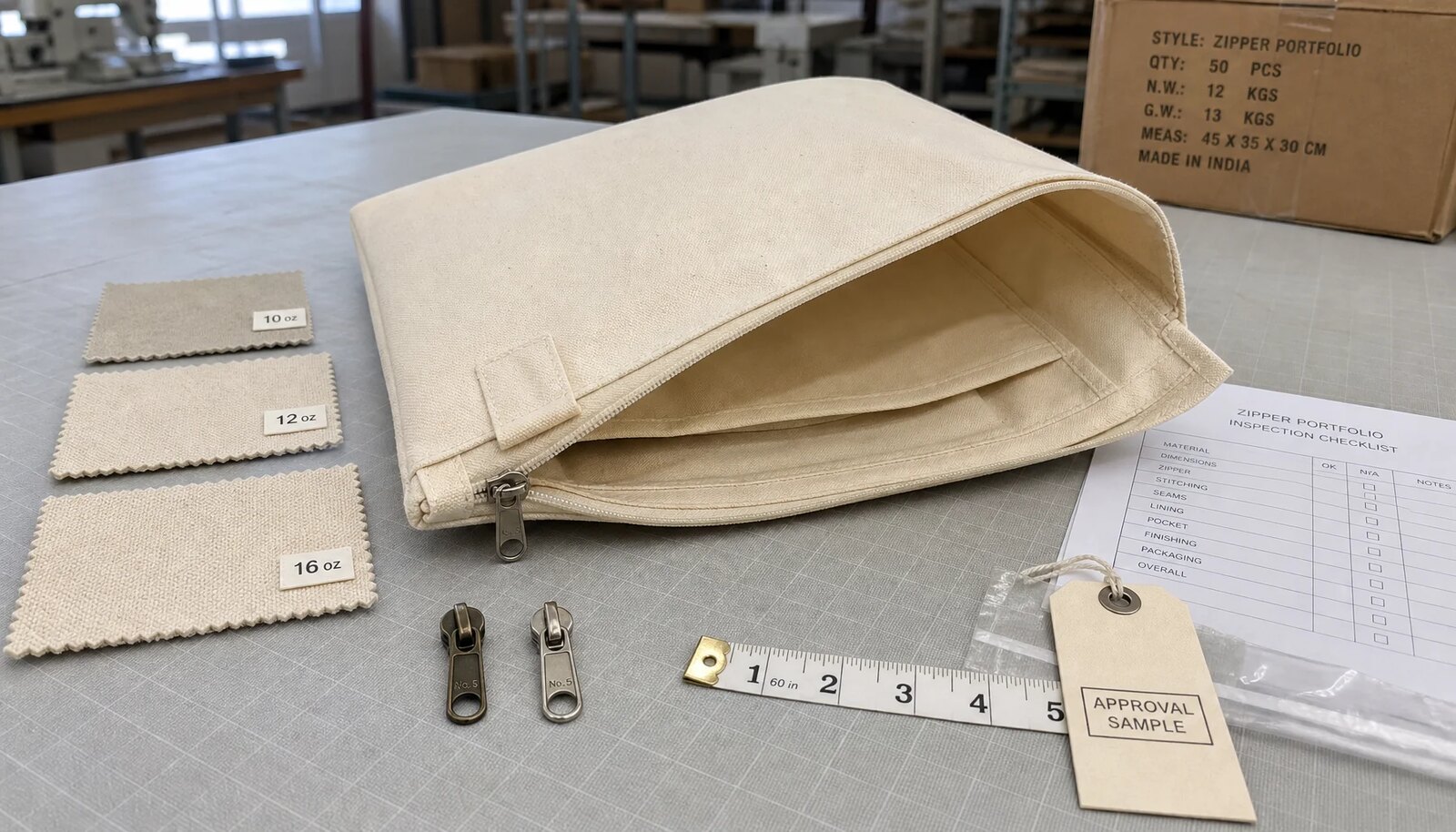
Begin With the Job the Portfolio Must Do
Wholesale canvas zipper portfolios for craft fairs are often described as if they were one simple product. In production, they are not. The same basic shape can be priced as a low-cost document pouch, a branded business bag, a retail stationery accessory, or a distributor sample holder. Each version carries different assumptions about canvas weight, zipper grade, internal finish, logo method, packing, and inspection.
Start the RFQ with the commercial use. A craft fair organizer may need a practical pouch for booth maps, badges, vendor rules, coupons, order forms, and sponsor literature. A maker brand may use the same format for art prints, sticker sheets, embroidery patterns, or DIY kit instructions. A distributor may carry catalogs, line sheets, swatches, and sample cards. Those contents change the required stiffness, opening size, corner clearance, zipper durability, and packing method.
This is where many quote comparisons go wrong. If the inquiry says only “canvas zipper portfolio with logo,” suppliers will fill the gaps with their own default cost model. One may quote lighter 10 oz canvas. Another may choose a smaller zipper or skip reinforcement. A third may assume bulk packing with no retail presentation. A clearer use case helps suppliers quote the same product, not three similar-looking products.
- Open the RFQ with the sales channel and use case.
- State whether the priority is lowest cost, retail finish, repeatable quality, fast delivery, or custom components.
- Tell suppliers whether the portfolio will be handed out, resold, kitted, shipped to stores, or used by sales teams.
- Define the largest and thickest contents before finalizing dimensions.
- Request option pricing if the program may include plain, printed, and retail-packed versions.
Translate Contents Into Real Dimensions
Sizing should begin with the insert stack, not with a flat paper size. A4 paper measures 21 x 29.7 cm, and US letter measures 8.5 x 11 in, but a sewn portfolio cut close to those dimensions will not load properly. Seam allowance, zipper tape, binding, fabric thickness, and corner turning all reduce usable internal space.
For many craft fair and vendor-kit programs, buyers start with a finished outside size around 25 x 35 cm or 10 x 14 in. That can be a sensible baseline for A4 or US letter materials, but it still needs a physical fit test. Twenty vendor forms behave differently from one sheet. A backed art print in a protective sleeve needs more clearance than a loose flyer. Sticker sheets, sample cards, and small catalogs may require easier access rather than simply a larger outside size.
The zipper opening deserves its own line in the RFQ. A portfolio can look correct on a drawing and still be frustrating to use if the zipper stops too early or the opening is tight at the corner. If staff must load hundreds of vendor packets before an event, or if customers will remove contents at a retail counter, opening length becomes a functional requirement.
- Provide maximum insert length, width, and stack thickness.
- Specify finished outside dimensions and usable internal dimensions separately.
- Define zipper opening length and whether the zipper runs along one side, two sides, or around a corner.
- Use a dummy insert stack during sampling when final contents are not ready.
- Set finished-size tolerance, commonly +/-5 mm for flat sewn canvas portfolios unless tighter control is needed.
Specify Canvas Without Guesswork
Canvas weight is one of the largest price drivers, and it changes the hand feel immediately. A 10 oz canvas may photograph like a 12 oz canvas, yet the finished piece will usually feel softer and less structured. For many wholesale canvas zipper portfolios for craft fairs, 12 oz cotton canvas, roughly 380-410 GSM, is a practical starting point. It balances durability, sewability, body, and freight weight.
Heavier is not automatically better. A 14 oz to 16 oz canvas, roughly 450-540 GSM depending on the supplier's construction and conversion, can feel more premium. It can also create bulk at zipper ends, corners, and bound seams. The factory may need stronger needles, slower sewing, adjusted thread tension, wider binding, and heavier cartons. If the portfolio carries documents, stickers, catalogs, or light samples, that extra cost may not improve the buyer's actual use.
The RFQ should name the composition, weave, weight in oz and GSM, tolerance, shrinkage limit, finish, shade standard, and slub acceptance. Natural canvas commonly includes seed flecks and irregular slubs. That look may suit craft and maker markets, but the acceptable range should still be approved. Dyed canvas brings shade control and colorfastness questions. Pre-shrunk fabric can help with size stability, but it may change cost and availability.
- Consider 10 oz, about 300-340 GSM, only when a softer, lower-cost portfolio is acceptable.
- Use 12 oz, about 380-410 GSM, as a balanced starting point for craft fair and branded business bag programs.
- Review 14-16 oz only after checking sewing bulk, zipper installation, carton weight, and landed cost.
- State GSM tolerance, commonly +/-5% unless the order requires tighter material control.
- Approve swatches from the intended bulk source instead of a generic showroom fabric.
Treat the Zipper Like Hardware, Not Trim
The zipper is the working part of the product. If it jams, waves, separates, or fails at the end stop, the portfolio fails even if the canvas and print look good. For craft fair kits, sales folders, and distributor pouches, the zipper may be opened repeatedly during check-in, booth setup, buyer meetings, store receiving, or sample review.
A No. 5 nylon coil zipper is a strong baseline for cotton canvas portfolios. It is flexible, usually easier to sew into flat fabric goods than a metal zipper, and less likely to scratch paper or product inserts. Metal zippers can create a premium look, but they add weight and may be less forgiving around corners. If the buyer wants a metal appearance, a nylon coil zipper with a metal slider and puller can be a practical compromise.
Quote details matter here. Define zipper size, tape material, tape color, slider finish, puller shape, puller size, end stop construction, opening direction, and reinforcement. A black zipper on natural canvas can be attractive, but it should be chosen deliberately. Dark zipper tape should be reviewed for shade consistency and possible staining risk, especially if packed under pressure or exposed to moisture.
- Specify No. 5 nylon coil zipper unless a premium or technical requirement justifies a different option.
- Define tape color, slider finish, puller size, puller shape, and opening direction.
- Ask whether the slider is auto-lock or non-lock if the portfolio may be carried vertically.
- Require smooth opening and closing across the full length, including corners and end stops.
- Inspect zipper-end reinforcement by backstitch, bar tack, binding capture, or another approved method.
Decide Construction Before Price Shopping
Construction choices can change the unit price more than buyers expect. An unlined canvas portfolio with bound seams is usually the cleanest economy format. It works for event kits, vendor packets, distributor handouts, and many branded programs. Simple does not mean sloppy, though. The inside still needs controlled binding, trimmed threads, even seam allowance, and no exposed raw edges beyond the approved construction.
A lined portfolio belongs in the conversation when the item will be sold at retail, used as a business gift, or positioned as a premium organizer. Lining can support internal dividers, card pockets, pen loops, and a more finished presentation. It also adds cutting, sewing, material matching, and inspection points. Lining may hide seam problems, and it can increase thickness at the corners.
Gussets and handles should not be casual add-ons. A gusset gives more room for thicker kits but changes the shape, packing volume, and sewing process. A handle can turn the piece into a light document bag, but it creates stress points that need reinforcement. Procurement should ask suppliers to price these features separately so the buyer can see exactly what each upgrade costs.
- Use unlined construction with bound seams for economy programs and event kits.
- Use lining, dividers, and pockets when retail value or presentation justifies the added labor.
- Specify binding width, seam allowance, stitch density, thread color, and reinforcement locations.
- Quote gussets, handles, divider panels, card pockets, and pen loops as separate add-ons.
- Require inside workmanship photos and physical sample review before mass production approval.
Match the Logo Method to Canvas Texture
Branding should be chosen around the artwork, not only around the lowest print price. Screen printing is usually the best starting point for one to three solid logo colors on cotton canvas. It is efficient for wholesale production and fits the visual language of craft fairs, handmade markets, maker brands, and event merchandise. The limitation is the fabric surface: tiny text, fine reversed lines, and small QR codes can fill in or print unevenly.
Heat transfer can work well for full-color graphics, gradients, and detailed art, but the transfer edge and surface feel must be reviewed on actual canvas. Embroidery can look premium, especially for simple marks, yet dense stitch counts may pucker flat panels if backing and placement are not controlled. Woven labels are useful for small consistent branding, but they introduce separate MOQ, lead time, and placement tolerance. Custom zipper pullers add another component minimum and sometimes tooling.
A useful RFQ states print method, logo size, print location, color references, underbase needs, number of colors, and placement tolerance. Pantone matching on natural cotton canvas is not the same as matching on coated paper. The buyer should approve a physical strike-off, especially for large solid areas, dark fabrics, fine lines, or color-sensitive brand marks. If there are multiple sponsors, store logos, or event versions, list each artwork as a separate SKU or print variant.
- Use screen print for simple solid logos and repeat wholesale orders.
- Use heat transfer only after approving edge feel, flexibility, and rub performance.
- Use embroidery for simple marks, not tiny text or dense artwork on unsupported panels.
- Use woven labels when small consistent branding is more reliable than printing.
- Require strike-offs on actual canvas for fine lines, dark fabric, large solids, or Pantone-sensitive artwork.
Make Cost Drivers Visible in the RFQ
A strong RFQ makes price differences easy to explain. Fabric weight, fabric color, zipper grade, lining, print method, print colors, packing, labels, and inspection standards all affect cost. If those details are bundled into one vague description, the lowest quote may simply be the lightest fabric, the simplest zipper, the fewest stitches, or the thinnest packing.
Build the request around a base product, then ask for add-ons. A practical base might be natural 12 oz cotton canvas, unlined construction, bound seams, No. 5 nylon coil zipper, one-color screen print in one position, and flat bulk packing. Add-on lines can cover dyed canvas, heavier canvas, lining, divider, pocket, gusset, handle, woven label, custom puller, individual bag, paper band, hangtag, barcode sticker, and retail sleeve.
Separate one-time charges from repeat unit costs. Screen setup, custom puller molds, label development, print plate charges, compliance testing, sample courier, and third-party inspection support should not disappear inside the unit price. Repeat orders may not carry the same setup costs. Buyers need to know which charges are reusable, which are per artwork, and which return for every PO.
- Request unit pricing at planned quantities such as 300, 500, 1,000, 2,500, and 5,000 pcs.
- Ask for a base quote plus separate add-on pricing for each optional feature.
- Separate sample fees, setup fees, mold charges, screen charges, labeling, packing, testing, and courier costs.
- Require carton dimensions and gross weight with the quote for landed-cost comparison.
- Ask suppliers to identify any component with a different MOQ from the finished product.
Read MOQ and Lead Time by Component
MOQ usually comes from components, not only from sewing capacity. A factory may accept 300-500 pieces when the order uses stock natural canvas, standard zipper colors, standard sliders, and simple screen printing. The same factory may need 1,000 pieces or more for dyed canvas, custom zipper tape, branded pullers, woven labels, custom retail sleeves, or several colorways. Each supplier in the chain may have its own minimum.
Lead time also needs a staged view. A realistic timeline includes artwork confirmation, fabric sourcing, lab dip if the fabric is dyed, material swatch approval, blank sample, print strike-off, pre-production sample, bulk cutting, printing, sewing, trimming, in-line inspection, final inspection, packing, carton marking, and export handover. “30 days production” may not include sample approval time, strike-off corrections, or buyer review delays.
Craft fair programs often have fixed event dates, which makes timing risk very real. Late goods may miss vendor kit assembly, retail launch, domestic distribution, or sponsor delivery windows. Ask suppliers for calendar dates and critical-path materials. Then add your own time for inbound receiving, inspection, kitting, labeling, and local shipment.
- Ask for MOQ by finished product, fabric color, zipper tape, puller, label, packaging, and artwork version.
- Confirm whether mixed colors or designs can share MOQ or require separate SKU minimums.
- Request lead time by sample, strike-off, production, packing, inspection, and shipment handover.
- Add buyer approval time to the calendar instead of counting only factory production days.
- Reserve buffer for event-driven orders that require kitting or distribution after import.
Approve Physical Samples Before Bulk Cutting
A digital mockup is useful, but it is not an approval sample. It can show approximate logo position and general proportion. It cannot prove hand feel, zipper smoothness, stitch quality, odor, usable capacity, print adhesion, or packing marks. For canvas zipper portfolios, the buyer should approve real materials before the factory cuts bulk fabric.
A practical sample path starts with fabric swatches, followed by a blank fit sample, then a print strike-off on the actual canvas, then a pre-production sample made with confirmed components. If the item will be retail-packed or used in a premium vendor kit, approve a packed sample too. Paper bands, individual bags, hangtags, barcode stickers, folding, and carton count all affect presentation and labor.
The final approved sample should be sealed and referenced in the purchase order. The supplier should keep a matching factory sample. Any later change to fabric lot, zipper tape, slider finish, thread, ink, lining, label, packing method, or carton count should need written buyer approval. This turns final inspection into a factual comparison rather than a subjective argument.
- Approve material swatches from the intended bulk fabric source.
- Review a blank sample for size, stiffness, zipper function, seam construction, and capacity.
- Approve a print strike-off on actual canvas before authorizing bulk printing.
- Open and close the zipper at least 20 times during sample review.
- Insert the real vendor packet, catalog, print stack, or sample kit to confirm usable space.
- Seal the approved sample and use it as the inspection reference.
Write QC Standards Into the Purchase Order
Canvas zipper portfolios should be inspected as both sewn goods and branded merchandise. A promotional-products inspection may focus on the logo but overlook zipper drag, seam weakness, and internal capacity. A sewn-goods inspection may focus on stitching but miss Pantone shift, print curing, barcode errors, or wrong carton marks. The QC plan should cover dimensions, fabric, construction, zipper, print, cleanliness, odor, packing, and labeling.
Define defect classifications before production. Critical defects can include unsafe sharp parts, mold odor, severe contamination, wrong logo, wrong product, broken zipper, or mixed goods that cannot be used. Major defects can include wrong size, poor zipper operation, open seams, missing labels, crooked logo placement, incorrect packing, excessive stains, or wrong fabric weight. Minor defects can include small thread ends, light wrinkles, or natural slub variation within the approved standard.
For AQL inspection, many buyers use general inspection level II for overall workmanship, with special inspection levels for measurements, barcode scans, or function checks depending on order size and risk. The right AQL level depends on the sales channel and buyer tolerance. What matters most is alignment: the buyer, supplier, and any third-party inspector should use the same defect list, measurement method, and sealed approval sample before goods are packed.
- Define critical, major, and minor defects in the PO or inspection protocol.
- Measure outside size, usable inside space, zipper opening, print placement, label placement, and pocket size.
- Test zipper function across the full opening, including end stops and corners.
- Check fabric stains, odor, shade variation, heavy slubs, broken yarns, oil marks, and mixed lots.
- Verify print adhesion, smudging, pinholes, color shift, underbase coverage, curing, and off-center placement.
- Confirm carton count, SKU separation, PO number, carton marks, barcode data, gross weight, and packed presentation.
Specification comparison for buyers
| RFQ item | Recommended specification | Commercial fit | Quote and QC risk to control |
|---|---|---|---|
| Canvas body fabric | 12 oz cotton canvas, approx. 380-410 GSM, with GSM tolerance of +/-5% unless buyer requires tighter control | Balanced choice for craft fair vendor kits, catalog holders, flat merchandise pouches, and branded business portfolios | If GSM is not stated, suppliers may quote 10 oz or mixed stock lots; require swatch approval and bulk fabric lot confirmation |
| Finished size | A4 or US letter plus clearance; common finished outside size is about 25 x 35 cm or 10 x 14 in, subject to insert test | Fits vendor packets, order forms, sample sheets, stickers, catalogs, art prints, and retail stationery inserts | Do not approve by paper size only; confirm outside size, usable internal size, zipper opening length, and corner clearance |
| Size tolerance | Finished length and width commonly +/-5 mm for flat sewn portfolios; print placement commonly +/-3 mm to +/-5 mm depending on artwork and seam reference | Useful for third-party inspection and repeat orders where buyer needs consistent kit assembly or retail presentation | Without tolerances, minor sewing variation can become a dispute; define measurement points before sampling |
| Zipper | No. 5 nylon coil zipper, polyester tape, specified tape color, non-lock or auto-lock slider as required, defined puller shape, end stop, and opening direction | Good standard for repeated opening on cotton canvas while remaining flexible and cost efficient | Cheap sliders can loosen, tape can wave, and zipper ends can fail; require smooth operation and end reinforcement review |
| Construction | Unlined with bound seams for economy; lined with divider or pocket only when retail value supports added labor | Unlined works for event kits and distributor samples; lined versions suit retail, business gifting, or premium assortments | Lining hides seam defects and increases corner bulk; require inside photos, sample review, and inspection access |
| Branding | Screen print for 1-3 solid colors; heat transfer for full-color graphics; woven label or embroidery for premium simple marks | Screen printing is typically most practical for wholesale logo portfolios on natural cotton canvas | Fine lines, small text, and QR codes may fail on textured canvas; require strike-off on actual bulk canvas |
| MOQ | Approx. 300-500 pcs may be possible for stock natural canvas and standard zipper; 1,000+ pcs often applies to dyed canvas, custom zipper tape, custom puller, or woven labels | Lets buyers test seasonal craft fair demand while understanding component-driven minimums | Very low MOQ can mean leftover fabric, mixed lots, simplified packing, or no component reserve for rework |
| Packing | Flat packed, 25-50 pcs per inner bundle and 50-100 pcs per export carton depending on size, weight, and presentation requirement | Protects shape, supports easy receiving counts, and works for vendor kit assembly or retail backroom handling | Over-compression can crease canvas; excessive carton weight can increase damage, handling claims, and warehouse rejection |
| Sample approval | Material swatch, blank fit sample, print strike-off, pre-production sample, packed sample, and sealed approval sample | Essential for branded craft fair, retail, distributor, and event programs where visual and functional quality matter | Photo approval misses hand feel, zipper drag, odor, print adhesion, usable capacity, and packing marks |
Buyer checklist before sampling
- Define the use case: craft fair vendor kit, catalog pouch, retail accessory, distributor sample holder, sales presentation folder, branded event giveaway, or stationery product.
- State the largest item to be carried, including paper size, insert thickness, backing board, plastic sleeve, sticker sheet, sample card, or product literature stack.
- Specify finished outside dimensions, usable internal dimensions, zipper opening length, orientation, seam allowance expectation, and corner clearance requirement.
- State fabric composition, target canvas weight in oz and GSM, allowed GSM tolerance, shrinkage limit, fabric finish, shade standard, and acceptable natural slub level.
- Confirm whether the fabric is natural, bleached, dyed, washed, brushed, coated, laminated, or pre-shrunk, and whether the same fabric lot must be used for the full PO.
- Define zipper size, zipper type, tape material, tape color, slider finish, puller shape, end stop construction, opening direction, and reinforcement at zipper ends.
- Attach vector artwork and define print method, print size, Pantone or TCX references, underbase requirement, color count, print position tolerance, and test method.
- List optional features separately: lining, binding, gusset, divider, inner pocket, card pocket, pen loop, handle, woven label, care label, hangtag, barcode, retail sleeve, and individual bag.
- Request a sample sequence: fabric swatch, blank reference sample, printed strike-off on actual canvas, pre-production sample, packed sample, and sealed approval sample.
- Set QC checkpoints for dimensions, zipper function, seam strength, stitch density, print adhesion, stains, odor, loose threads, needle damage, metal contamination, packing count, and carton marks.
Factory quote questions to send
- What exact canvas composition, weave, quoted weight in oz and GSM, and GSM tolerance are included in the price?
- Is the quoted fabric greige, natural, bleached, dyed, washed, brushed, coated, laminated, or pre-shrunk, and can the same fabric lot be reserved for the full order?
- What shrinkage limit, shade tolerance, slub standard, moisture control, and odor standard do you apply before cutting cotton canvas?
- What zipper size, type, tape material, tape color, slider finish, puller style, and end stop construction are included in the base price?
- Can you provide internal zipper QC data, such as puller attachment strength, slider function checks, or cycle-test references for the zipper grade offered?
- What stitch type, stitch density, thread type, seam allowance, binding width, reinforcement method, and needle size are assumed in the quotation?
- What print method is included, how many colors and positions are covered, and what is the added cost for underbase, second-side print, larger print area, or extra colors?
- Can you make a printed strike-off on the actual bulk canvas before the pre-production sample, and how many working days does it add?
- What MOQ applies separately for the plain product, printed product, dyed canvas, custom zipper tape, custom slider or puller, woven label, retail sleeve, and barcode labeling?
- Can mixed artwork, mixed colors, or mixed sizes share the same MOQ, or does each SKU require a separate cutting, printing, and packing minimum?
Quality-control points to confirm
- Finished length and width should have an agreed tolerance before sampling; for flat canvas portfolios, +/-5 mm is commonly workable, while more structured retail items may require tighter approval by sample.
- Usable internal dimensions should be checked with the buyer's largest intended insert, including real stack thickness, not only with a single sheet of paper.
- Zipper opening length should be measured separately from outside length because zipper stops, seam allowance, and corner turning can reduce access.
- Zipper must run smoothly across the full opening without fabric catching, skipped teeth, slider looseness, broken pullers, sharp edges, wavy tape, or weak end stops.
- Zipper ends should be reinforced by backstitch, bar tack, binding capture, or another approved method, especially for repeated-use vendor kits and sales presentation portfolios.
- Seam allowance should be consistent, stitch density should match the approved sample, and corners should not twist, pucker, or create uneven zipper tension.
- Print adhesion should pass the agreed tape test, dry rub test, or buyer-approved method for the selected ink system and canvas finish.
- Logo placement should be measured from fixed product edges with an agreed tolerance, commonly +/-3 mm to +/-5 mm depending on product size and artwork sensitivity.
- Fabric defects such as oil marks, stains, mold odor, broken yarns, shade panels, heavy slubs outside the approved range, and mixed fabric lots should be classified before production.
- Needle holes, loose threads, skipped stitches, uneven binding, exposed raw edges, zipper puckering, and poor thread trimming should be checked against the sealed approval sample.