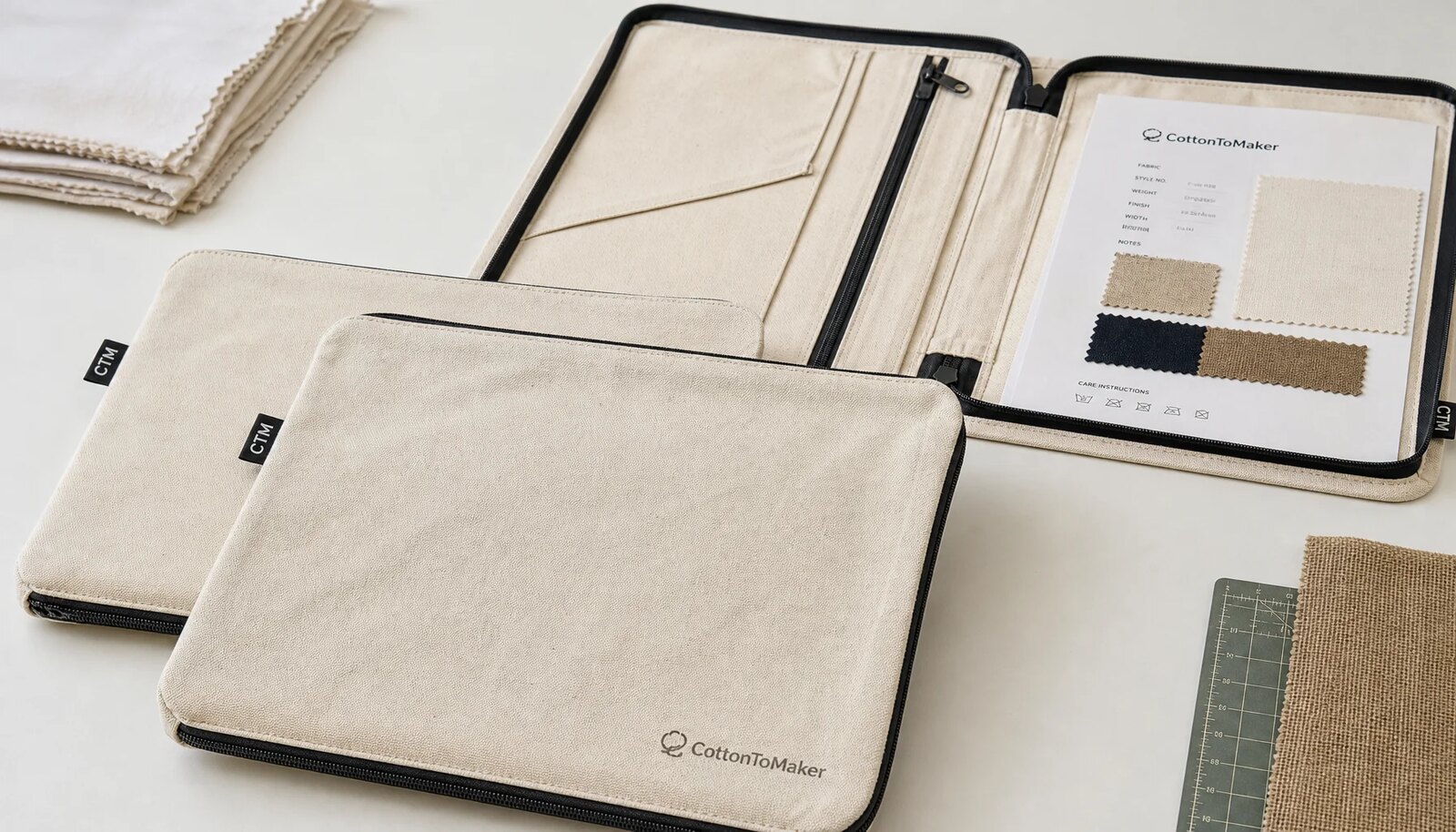
Start With the Job the Portfolio Must Do
Wholesale canvas zipper portfolios for craft fairs look simple in a product photo. In use, they behave more like compact business bags. They may carry wholesale line sheets, order forms, badges, contracts, catalogs, workshop instructions, receipts, postcards, swatch cards, and buyer notes. If the zipper snags during check-in, the documents bend at the corner, or the printed logo rubs onto a catalog, the product has failed the event even if the purchase price was low.
That is why procurement should not quote this item as a vague canvas pouch. A supplier pricing 8 oz unlined natural canvas with a basic zipper is not quoting the same product as a factory pricing 12 oz pre-shrunk canvas, No. 5 nylon coil zipper, cotton lining, screen print, version labels, and flat export packing. Both may call it a canvas zipper portfolio. The RFQ has to remove that ambiguity before price comparison starts.
MOQ negotiation improves when the buyer keeps the base construction stable. One fabric weight, one fabric color, one finished size, one zipper, one lining choice, one thread color, and one packing method create a shared body that can often support different logos or labels. Once the body changes, the order starts acting like multiple small SKUs instead of one efficient production run.
- Decide the role first: giveaway, buyer pack, resale item, sponsor gift, workshop kit, or staff organizer.
- Replace loose terms such as heavy canvas, good zipper, and standard size with measurable specs.
- Compare supplier quotes only after fabric, zipper, lining, print, packing, and tolerances match.
- Use MOQ discussions to reduce variables, not to hide several different products inside one PO.
- Build the timeline backward from the craft fair distribution date, including sampling and inspection.
Size, Document Fit, and Pattern Discipline
Size causes more arguments than almost any other detail. A buyer may ask for an A4 or US letter portfolio and expect the documents to slide in easily. The factory, however, may quote the outside finished size. Those are not the same. Seam allowance, zipper tape, lining, fabric thickness, corner radius, and sewing tension all reduce the usable interior.
State the largest insert first, then state the maximum stack thickness. A few loose order forms need less clearance than a 5 mm stack of catalogs. For flat document portfolios, 10-15 mm clearance around the largest sheet is a practical starting point; thicker or stiffer inserts may need more. Also decide how the user loads the contents. A long-edge zipper is usually easier for paper documents. A short-edge zipper can reduce zipper length but may slow loading. An L-shaped or two-side opening improves access, yet it adds sewing time, zipper length, and more points to inspect.
Pattern control also helps MOQ negotiation. If four craft fairs can share one master size and only change the front logo, the factory can cut one pattern and manage versioning mainly at the printing or labeling stage. If every fair asks for a custom size, the supplier has to manage separate cutting, sewing, inspection, and packing flows. That added handling is exactly what pushes MOQ and price upward.
- Specify outside finished size in millimeters, such as 335 x 245 mm, rather than inch-only notes.
- Specify usable fit, for example: must hold A4 210 x 297 mm sheets plus a 5 mm document stack without bending.
- Define the zipper opening: long edge, short edge, L-shape, or two-side opening.
- Agree on finished-size tolerance before production; +/-5 mm is common for simple flat canvas goods when sewing is controlled.
- Approve the sample with actual inserts, not only a drawing, PDF, or ruler check.
- Keep one master pattern when splitting MOQ by logo, sponsor, city, retailer, or event date.
Canvas Weight, Finish, and Color Reality
Canvas weight changes the whole product: hand feel, structure, print coverage, sewing speed, carton weight, and freight cost. For wholesale canvas zipper portfolios used at craft fairs, 10 oz to 12 oz cotton canvas is often the balanced range, roughly 340-410 GSM depending on weave and finishing. An 8 oz canvas can work for short-term promotional distribution, but it may wrinkle more and feel closer to a light pouch. A 14 oz or 16 oz canvas can look premium, although it adds corner bulk, zipper stiffness, needle wear, and shipping weight.
Ask for both oz and GSM. Fabric labels are not always used consistently across mills or sourcing markets, and two fabrics described as the same ounce weight may not feel identical after finishing. The quote should also state the accepted GSM tolerance. A practical range may be +/-5% to +/-8%, depending on mill standard, but the purchase order should name the agreed tolerance instead of leaving it implied.
Finish and shade need physical approval. Natural canvas usually shows seed flecks, slubs, and shade variation. That may be ideal for a handmade craft fair look, but it should be signed off against a real swatch or sample. Bleached canvas gives a cleaner base for bright logos. Dyed canvas supports brand color programs, but it can raise fabric MOQ, shade-lot risk, and colorfastness requirements. Washed canvas feels softer and more casual, yet shrinkage and distortion must be controlled in the pattern and sample.
- 8 oz canvas: economical for light inserts and short-term promotional use.
- 10 oz canvas: balanced for standard event portfolios and wholesale buyer information packs.
- 12 oz canvas: stronger hand feel for resale, VIP kits, or heavier document stacks.
- 14 oz and above: premium but heavier, bulkier at corners, harder to sew, and more expensive to ship.
- Natural canvas shows flecks and shade variation; bleached canvas gives a cleaner print base; dyed canvas raises color and MOQ considerations.
- Quote fabric in oz, GSM, finish, color reference, shrinkage expectation, and accepted visual variation.
Zipper, Sewing, and Interior Build
The zipper is the working part of the portfolio, so it deserves more than the phrase standard zipper. For most flat canvas portfolios, a No. 5 nylon coil zipper is a sensible choice because it is flexible, smooth, and suitable for fabric goods. Resin or metal zippers may fit a specific brand look, but they add stiffness or weight and can require more care around printed documents. The RFQ should name the zipper type, approximate chain size, tape width, tape color, chain color, slider material, slider finish, puller style, and opening direction.
Many zipper failures start at the ends. Weak stops, missing backtacks, narrow tape, and rushed corner sewing can turn a good-looking sample into a poor bulk order. Require reinforced zipper ends and clean stitching where the zipper meets side seams. Then check how the zipper puller sits in the packed product. If it presses against the logo panel inside a tight carton, it may leave marks.
The interior build sets the cost level and the user experience. Unlined construction is acceptable for many event programs if the seams are bound or neatly overlocked and thread ends are trimmed. A lining gives a cleaner interior and helps documents slide in, but it adds cutting, sewing, material cost, and inspection time. If lining is used, the pattern must preserve usable space and keep loose fabric away from the zipper path.
- Specify nylon coil zipper unless resin or metal is needed for brand positioning.
- Ask for tape width and slider details, not only zipper color.
- Require zipper-end reinforcement with backtack, fabric tab, or approved stop construction.
- Define seam allowance, stitch density, thread color, corner radius, and inside seam finish.
- Choose lining when resale presentation or smoother document insertion justifies the added cost.
- Inspect for snagging, twisted tape, skipped stitches, rough slider edges, weak puller attachment, and loose end stitching.
Logo Method and Version Control
Branding is often the reason this product is ordered in the first place. It is also where MOQ pressure appears. Screen printing is usually the practical choice for solid craft fair logos, sponsor marks, and simple one- or two-color graphics. It works well on canvas when the ink has enough opacity, the art is sized for the fabric texture, and curing is controlled. Very fine lines, tiny text, gradients, and large solid blocks need extra review because canvas can break edges and create uneven coverage.
Heat transfer can help with detailed artwork or shorter runs, but it must be judged on the actual canvas surface. A transfer that looks sharp on a digital proof may feel heavy or plasticky on natural cotton. Woven labels are useful when several events share the same blank body because the factory can attach different labels, hangtags, or insert cards. Embroidery can look premium for small marks, but it may distort lighter canvas and can leave thread backs inside the portfolio.
Version control should be treated as a production requirement, not an admin task. Each artwork version needs a file name, quantity, print size, color target, placement reference, carton label, and delivery destination. Avoid instructions such as logo centered unless the supplier also has measurements. Give placement from two reference edges and set a realistic print-position tolerance. For many flat canvas goods, +/-3 mm to +/-5 mm is more workable than expecting perfect placement across every piece.
- Use screen print for solid logos, event names, retailer marks, and repeat sponsor branding.
- Use heat transfer only after approving edge feel, flexibility, adhesion, and appearance on textured canvas.
- Use woven labels when several brands or fairs can share the same blank portfolio body.
- Keep artwork away from zipper tape, heavy seams, fold lines, and high-pressure stacking areas.
- Specify artwork size, placement from two edges, Pantone or approved color target, number of colors, and position tolerance.
- Create a version table with file name, quantity, print method, carton label, shipping mark, and destination.
MOQ Negotiation by Variable
MOQ is not just a number a salesperson chooses. It reflects fabric purchasing, dye-lot minimums, zipper sourcing, cutting layout, print setup, sewing-line efficiency, packing separation, and the risk of mixing versions. A request for 100 pieces split across five logos may be possible, but operationally it is five small print batches. If those five versions also use different canvas colors or zipper colors, the order becomes harder to produce cleanly at a low unit cost.
The better way to negotiate is to separate total MOQ from minimums by variable. Ask for the minimum per artwork, per fabric color, per zipper color, per lining color, per size, per delivery drop, and per shipping mark. This tells the supplier you understand the production logic, and it makes compromise easier. A factory may accept 1,000 pieces total split into four logos at 250 pieces each if the body is identical. The same factory may require more for four fabric colors because material purchasing and shade control have changed.
Keep price breaks tied to the exact same specification. Ask for 300, 500, 1,000, and 2,000 pieces using the same canvas, zipper, lining, print size, packing method, and Incoterm. If a supplier quietly switches fabric weight, removes lining, or changes packing at a lower tier, the quote is not comparable. Put the accepted split rules into the quotation and PO so printing, packing, warehouse, and inspection teams follow the same plan.
- Easiest split: identical body with different one-color screen prints.
- Moderate split: identical blank body with different woven labels, hangtags, or insert cards.
- Harder split: same body with different zipper colors because purchasing and sorting change.
- Difficult split: different canvas colors because fabric lots and dye minimums apply.
- Most complex split: different sizes, linings, zipper types, print methods, and destinations in small quantities.
- Write the total MOQ and minimum per version directly into the quote and purchase order.
Quote Comparison and Landed Cost
A useful quote describes both the product and the commercial terms. It should include canvas weight and finish, finished and usable dimensions, zipper specification, lining, seam finish, branding method, print size, number of colors, setup charges, sample terms, MOQ split rules, production lead time, packing count, carton dimensions, estimated net and gross weight, payment terms, Incoterm, and quote validity. Without those details, the buyer is comparing assumptions rather than offers.
Do not stop at unit price. A slightly higher FOB price may be the safer buy if the cartons are flatter, the gross weight is realistic, packing is version-controlled, and the factory can support inspection before shipment. A low ex-factory price can become expensive once screen charges, sample revisions, barcode labels, inner bags, carton marks, rework, inspection delays, or emergency air freight are added.
Use the same Incoterm when comparing suppliers. EXW, FOB, CIF, DAP, and DDP allocate cost and risk differently. For flat portfolios, carton volume can matter as much as product weight because freight may be volume-driven. Ask for carton length, width, height, pieces per carton, net weight, gross weight, and whether the goods are flat packed or folded. If the portfolios must arrive ready for event distribution, include version sorting and labeling in the supplier quote rather than pushing the work to a local warehouse later.
- Normalize fabric, zipper, lining, print, packing, and tolerances before comparing unit prices.
- Separate unit price from sample fee, screen charge, artwork setup, label setup, packing upgrade, inspection cost, and freight assumptions.
- Request carton dimensions and gross weight so freight estimates use real volume and weight.
- Use the same Incoterm, currency, payment terms, and quote validity date for all supplier comparisons.
- Confirm whether inner polybag, moisture protection, barcode, version label, and export carton mark are included.
- Treat unclear exclusions as cost risks, not savings.
Sampling and Approval Records
Sampling should match the risk level. A prototype or shape sample can confirm the pattern, zipper opening, and general construction, even if it uses substitute canvas. The pre-production sample is different. It should use bulk-intent fabric, zipper, thread, lining, label, print method, and packing format. Do not approve bulk cutting from a digital mockup or from a sample that differs materially from the planned production.
Test the sample the way the portfolio will be used at the fair. Load the actual catalogs, order forms, badges, postcards, business cards, instruction sheets, swatches, or sample cards. Close the zipper and open it repeatedly. A practical hand check is 20-30 open-close cycles, with attention to zipper ends and tight corners. Watch for inserts catching on seam allowance, lining, thread ends, or zipper tape. Stack several samples to see whether the puller or zipper teeth mark the printed panel.
Approval records keep later discussions grounded. Keep a signed physical sample when possible. If not, maintain a sample report with measurements, photos, material references, print notes, and accepted tolerances. Photograph the front, back, inside, zipper ends, logo close-up, label, and packing method. If natural flecks, small shade variation, or a print-position tolerance are accepted, record that approval in writing before production starts.
- Use prototype samples for shape review and pre-production samples for final material and print approval.
- Measure outside size, internal fit, zipper opening length, seam allowance, and corner radius.
- Test with actual insert stacks and repeated zipper operation.
- Check print rub, opacity, curing, edge sharpness, and hand feel on the real canvas surface.
- Confirm packing behavior by stacking samples flat with the zipper puller in the final position.
- Share the approved sample record with the buyer, supplier, printer, and QC inspector.
Bulk QC Inspection Criteria
Quality control should be written before production begins. General AQL inspection can be useful, but the checklist needs product-specific points: usable document fit, zipper function, print placement, fabric cleanliness, seam strength, version accuracy, and packing flatness. The inspector should know which defects will disrupt event use and which natural canvas characteristics are acceptable.
Dimensional inspection needs more than an outside measurement. Measure the finished product on a flat, relaxed surface, then test the internal space with the buyer's insert stack. A portfolio can meet outside size and still fail if the zipper opening is too short or the lining steals space. For simple flat construction, +/-5 mm is a common commercial target for finished size, but the agreed tolerance should appear in the PO and approved sample report.
Functional checks should cover zipper travel, zipper-end security, stitch density, backtacking, thread trimming, and print durability. Visual checks should catch oil marks, needle cuts, fabric dust, stains, odor, loose fibers, poor ink curing, color mismatch, and mixed artwork versions. For resale items, raise the standard for interior finish, labels, packaging presentation, and rub resistance.
- Define critical defects: wrong logo, unusable internal fit, broken zipper, severe stain, major print error, or mixed-version carton.
- Define major defects: poor stitching, rough zipper travel, visible print offset, loose lining, heavy crease, or incorrect carton label.
- Define minor defects: small thread ends, acceptable natural flecks, tiny slubs, or small handling marks within the approved standard.
- Check fabric GSM, shade, size, zipper function, seams, print, labels, packing, and carton marks against the approved sample.
- Use actual inserts during final inspection instead of relying only on dimensional measurement.
- Require version-count verification when multiple craft fair logos ship together.
Packing, Shipping, and Event-Date Risk
Packing can protect a good product or damage it before it reaches the fair. Flat canvas portfolios should usually ship flat, with no fold across the logo, zipper teeth, zipper puller, or main presentation panel. If folding is necessary for freight savings, approve the fold location on a packing sample. Cotton canvas can hold creases after compression, humidity, and long transit, so presentation risk should be priced into the decision.
A practical export carton often holds 25-50 pieces, depending on portfolio size, canvas weight, lining, and receiving limits. The best carton is not always the fullest carton. Over-compression can bend corners, deform zipper pullers, cause print transfer, and create heavy cartons that are awkward to handle. Request carton dimensions, pieces per carton, net weight, gross weight, stacking method, moisture protection, and inner-pack labeling.
Plan lead time from the event distribution date, not only the public fair date. Include RFQ clarification, artwork freeze, sample production, sample freight, buyer review, revisions, deposit, material purchasing, cutting, printing, sewing, inline QC, final inspection, packing, export handling, freight, customs, inland delivery, and local sorting. If the date is fixed, simplify the product and reduce version count before relying on emergency air freight.
- Pack flat when possible and protect the logo panel from zipper pressure marks.
- Use interleaving or protective sheets when print transfer, ink scuffing, or pressure marking is a risk.
- Label cartons by PO, SKU, artwork version, quantity, destination, and shipping mark.
- Avoid mixed-version cartons unless the assortment plan and inner labels are approved in writing.
- Book inspection before final carton sealing when version accuracy is critical.
- Set the latest safe sample-approval date and latest safe ship date before placing the PO.
Specification comparison for buyers
| Spec decision | Recommended option | When it fits | Buyer risk to check |
|---|---|---|---|
| Canvas body fabric | 10 oz to 12 oz cotton canvas, typically about 340-410 GSM; quote fabric-weight tolerance, commonly +/-5% to +/-8% depending on mill standard | Craft fair buyer packs, order-form kits, wholesale line sheets, workshop documents, flat artist collateral, and light resale portfolios | Quotes that say only 'cotton canvas' can hide major differences in hand feel, shrinkage, print coverage, carton weight, and sewing difficulty |
| Finished and usable size | Define outside finished size plus internal usable document fit; allow 10-15 mm clearance around A4 or US letter inserts and extra clearance for 3-10 mm document stacks | Event welcome kits, catalogs, order books, badges, postcard bundles, flat samples, and sponsor inserts | An outside size may look correct while the internal opening is too small after seam allowance, zipper tape, lining, and corner radius |
| Zipper construction | No. 5 nylon coil zipper for most portfolios; specify tape width, chain color, slider material, puller style, opening direction, and reinforced zipper stops | Repeated opening during booth setup, staff check-in, buyer meetings, and retail display handling | Weak end stops, narrow tape, rough sliders, or missing backtacks can cause failures even when the canvas body looks acceptable |
| Lining and inside finish | Unlined with bound or clean overlocked seams for cost control; polyester or cotton lining for premium interior and smoother document insertion | Unlined for event distribution; lined for giftable portfolios, resale, VIP buyer kits, or portfolios carrying high-value printed materials | Loose lining can reduce usable size, bunch at corners, catch in the zipper, or raise labor cost without improving the buyer's intended use |
| Branding method | Screen print for solid logos; heat transfer for detailed art after hand-feel approval; woven label for MOQ-friendly versioning; embroidery only for small marks | Craft fair logos, sponsor marks, store names, artist collectives, class kits, and recurring event series | Large print areas on textured canvas may show pinholes, uneven opacity, cracking, migration, or heavy hand if ink and curing are not controlled |
| MOQ negotiation unit | Negotiate one shared base body first: same canvas GSM, fabric color, size, zipper, lining, thread, and packing; then split by artwork or label | Multiple craft fairs, cities, sponsors, retailers, departments, or artist groups needing different front branding | Factories may accept artwork splits but reject fabric-color, zipper-color, size, or lining splits because they change material purchasing, cutting, sewing, and sorting |
| Approval sample | Approve a pre-production sample using bulk-intent fabric, zipper, thread, lining, print method, label, and packing format | Confirms document fit, zipper function, print color, fabric hand, seam finish, carton flatness, and version labeling before bulk cutting | A shape sample made with substitute canvas is useful only for construction review, not for final color, GSM, shrinkage, print, or zipper approval |
| Packing method | Flat pack 25-50 pcs per export carton depending on size and weight; specify moisture protection, version labels, carton marks, and target gross weight | Keeps portfolios presentable for event distribution and reduces pre-event steaming, sorting, and repacking | Over-compressed cartons can create corner bends, zipper pressure marks, print transfer, mixed versions, and excessive receiving labor |
| Quote basis | Require fabric GSM/oz, tolerances, dimensions, zipper spec, lining, print size, setup costs, MOQ split rules, sample terms, lead time, carton data, Incoterm, payment terms, and quote validity | Allows procurement teams to compare factories on the same technical and commercial basis | A low unit price without technical exclusions often rises after sample, screen charge, packing, carton, labeling, inspection, or freight details are added |
Buyer checklist before sampling
- Define the product role: craft fair giveaway, vendor welcome portfolio, wholesale buyer pack, resale item, workshop kit, sponsor gift, or staff document organizer.
- List every insert the portfolio must hold, including sheet size, catalog thickness, badge, receipt book, business card, postcard bundle, flat sample, or order form stack.
- State outside finished dimensions and internal usable dimensions in millimeters, plus maximum insert stack thickness such as 3 mm, 5 mm, or 10 mm.
- Specify canvas weight in oz and GSM, fabric finish, color standard, shrinkage expectation, and whether natural seed flecks or slubs are acceptable.
- Choose unlined, half-lined, fully lined, bound-seam, or overlocked-seam construction and confirm the effect on internal usable space.
- Lock zipper type, approximate chain size, tape width, tape color, slider material, slider finish, puller style, opening direction, and zipper-end reinforcement.
- Provide logo file name, artwork size, print location from two reference edges, Pantone or approved color target, number of colors, and print-position tolerance.
- State acceptable production tolerances for finished size, internal fit, print position, seam allowance, stitch density, fabric weight, and carton quantity.
- Ask whether total MOQ can be combined across logo versions while keeping the same fabric, size, zipper, lining, thread, packing, and ship mark rules.
- Request price breaks at 300, 500, 1,000, and 2,000 pcs using the same specification, and separate any setup charges from unit price.
Factory quote questions to send
- What exact canvas weight is quoted in oz and GSM, what fabric-weight tolerance applies, and is the fabric natural, bleached, dyed, washed, laminated, or pre-shrunk?
- Is the quoted dimension the outside finished size, cutting size, or internal usable size, and what finished-size tolerance will be applied in bulk?
- What internal usable size can you guarantee after seam allowance, zipper tape, lining, and corner sewing, and can you test it with our actual insert stack?
- Which zipper is included: nylon coil, resin, or metal; what approximate chain size, tape width, tape color, slider material, puller style, and end-stop reinforcement are quoted?
- What stitch density, thread type, seam allowance, edge finish, zipper-end backtack, and corner reinforcement are included in the quoted construction?
- Which print method is quoted, what maximum print area is included, how many colors are included, what screen or setup charges are separate, and what curing method is used?
- What tolerances will be accepted for fabric GSM, finished size, internal fit, print position, print color, stitch density, carton quantity, and carton gross weight?
- Can total MOQ be combined across printed logos if fabric, size, zipper color, lining, thread, packing, and carton marks remain identical?
- What is the minimum quantity per artwork, per fabric color, per zipper color, per lining color, per size, per delivery drop, and per shipping mark?
- Will the pre-production sample use the same fabric batch or bulk-intent fabric, zipper, thread, lining, label, print method, and packing format planned for production?
Quality-control points to confirm
- Finished outside size should be measured on a flat, relaxed product; a common target for simple flat portfolios is +/-5 mm unless the buyer specifies tighter control.
- Internal document fit must be tested with the buyer's actual paper, catalog, badge, card, swatch, or insert stack, including the maximum stack thickness stated in the PO.
- Canvas GSM should be checked against the approved specification and reference sample; define whether the accepted tolerance is +/-5%, +/-8%, or the mill's stated range.
- Canvas shade, natural seed flecks, slubs, creases, washing effect, and dye variation should be judged against an approved reference, not against a digital image.
- Zipper function should be checked across the full opening for smooth travel, no skipped coil, no twisted tape, no sharp slider edges, and no loose or weak zipper-end stitching.
- Zipper pull strength and end security should be tested by repeated opening and closing on samples and by AQL inspection in bulk, especially at the start and stop points.
- Seam allowance, stitch density, backtacking, thread tension, corner shape, and edge finish should be consistent around the zipper, bottom corners, and label attachment points.
- Print quality should be inspected for color, opacity, edge sharpness, pinholes, registration, curing, hand feel, and position against the approved artwork and signed sample.
- Print rub should be checked with a clean white cloth; use stricter wet-rub or crocking checks if the item is dyed canvas, resale merchandise, or likely to contact light papers.
- Defects such as oil stains, needle cuts, loose fibers, thread ends, odor, fabric dust, dirt, zipper scratches, print transfer, and handling marks should be removed before packing.